
Daniel 10:6

Hebrew (Westminster Leningrad Codex) Daniel 10:6 appears in the Hebrew Old Testament. The text above is from the Westminster Leningrad Codex. Each word links to its Strong’s number, a concise gloss, and parsing drawn from the Open Scriptures Hebrew Bible morphology. Click any word for its full Brown-Driver-Briggs (BDB) entry.
Download image
Cite this verse

Daniel 10:6 (World English Bible). Public Domain. Lemma interlinear Bible study tool, https://lemma.gebible.app/v/daniel/10/6.

Show BibTeX & RIS
BibTeX
RIS
English Translation
his body also was like the beryl, and his face as the appearance of lightning, and his eyes as flaming torches, and his arms and his feet like burnished brass, and the voice of his words like the voice of a multitude.
World English Bible · Public Domain
Download a study sheet

One document with this verse’s original text, its word-by-word gloss line, the meaning frame, cross-references with their text, attributed commentary, and full source and license credits — printable, and it pastes into notes with its structure intact.

This verse Autodidact and up

Study sheet (.html) Plain text (.txt)

A passage Seminary Student

Up to 50 verses in one chapter. A passage sheet keeps up to 6 commentary sources and 12 cross-references per verse, in the order this page ranks them, and says so on the sheet whenever that leaves anything out. Ask for a single verse and you get the Autodidact verse sheet above.

Everything on this page stays free to read, with no account — the sheet is a download of what is already on screen, not access to it.

Want to remove ads? Support Godless Engineer
Compare translations 3

The same verse in 3 English versions, stacked beneath the original-language interlinear above. Click any original word for its lexicon entry.

Each is an independent rendering of the whole verse — the interlinear is not word-aligned to these translations.

Highlighted words mark where these versions differ — a whole-verse word diff, not a word-by-word alignment.

  • World English Bible Public Domain
    his body also was like the beryl, and his face as the appearance of lightning, and his eyes as flaming torches, and his arms and his feet like burnished brass, and the voice of his words like the voice of a multitude.
  • King James Version Public Domain
    His body also was like the beryl, and his face as the appearance of lightning, and his eyes as lamps of fire, and his arms and his feet like in colour to polished brass, and the voice of his words like the voice of a multitude.
  • unfoldingWord Literal Text CC BY-SA 4.0
    His body was like topaz, his face was like the appearance of lightning, his eyes were like flaming torches, his arms and his feet were like the gleam of polished bronze, and the sound of his words was like the sound of a multitude.

unfoldingWord Literal Text — © unfoldingWord, licensed CC BY-SA 4.0. Word-aligned USFM3 via Door43 (git.door43.org/unfoldingWord/en_ult).

Versions to compare (up to 4)

3 of 4 selected

Show all 18 translations

Every available English version of this verse, each an independent rendering of the whole verse.

  • World English Bible Public Domain
    his body also was like the beryl, and his face as the appearance of lightning, and his eyes as flaming torches, and his arms and his feet like burnished brass, and the voice of his words like the voice of a multitude.
  • Berean Standard Bible Public Domain
    His body was like beryl, his face like the brilliance of lightning, his eyes like flaming torches, his arms and legs like the gleam of polished bronze, and his voice like the sound of a multitude.
  • Majority Standard Bible Public Domain
    His body was like beryl, his face like the brilliance of lightning, his eyes like flaming torches, his arms and legs like the gleam of polished bronze, and his voice like the sound of a multitude.
  • King James Version Public Domain
    His body also was like the beryl, and his face as the appearance of lightning, and his eyes as lamps of fire, and his arms and his feet like in colour to polished brass, and the voice of his words like the voice of a multitude.
  • American Standard Version (1901) Public Domain
    his body also was like the beryl, and his face as the appearance of lightning, and his eyes as flaming torches, and his arms and his feet like unto burnished brass, and the voice of his words like the voice of a multitude.
  • Revised Version (1885) Public Domain
    his body also was like the beryl, and his face as the appearance of lightning, and his eyes as lamps of fire, and his arms and his feet like in colour to burnished brass, and the voice of his words like the voice of a multitude.
  • Geneva Bible (1599) Public Domain
    His body also was like the Chrysolite, and his face (to looke vpon) like the lightning, and his eyes as lamps of fire, and his armes and his feete were like in colour to polished brasse, and the voyce of his wordes was like the voyce of a multitude.
  • Douay-Rheims (1899) Public Domain
    And his body was like the chrysolite, and his face as the appearance of lightning, and his eyes as a burning lamp: and his arms, and all downward even to the feet, like in appearance to glittering brass: and the voice of his word like the voice of a multitude.
  • Young's Literal Translation Public Domain
    and his body as a beryl, and his face as the appearance of lightning, and his eyes as lamps of fire, and his arms and his feet as the aspect of bright brass, and the voice of his words as the voice of a multitude.
  • Literal Standard Version CC BY-SA 4.0
    and his body as a beryl, and his face as the appearance of lightning, and his eyes as lamps of fire, and his arms and his feet as the aspect of bright bronze, and the voice of his words as the voice of a multitude.
  • Unlocked Literal Bible CC BY-SA 4.0
    His body was like topaz, and his face was like lightning. His eyes were like flaming torches, and his arms and his feet were like polished bronze. The sound of his words was like the sound of a great crowd.
  • unfoldingWord Literal Text CC BY-SA 4.0
    His body was like topaz, his face was like the appearance of lightning, his eyes were like flaming torches, his arms and his feet were like the gleam of polished bronze, and the sound of his words was like the sound of a multitude.
  • Darby Bible Public Domain
    and his body was like a chrysolite, and his face as the appearance of lightning, and his eyes as torches of fire, and his arms and his feet as the look of burnished brass, and the voice of his words like the voice of a multitude.
  • World Messianic Bible Public Domain
    His body also was like beryl, and his face as the appearance of lightning, and his eyes as flaming torches. His arms and his feet were like burnished bronze. The voice of his words was like the voice of a multitude.
  • Webster's Bible Public Domain
    His body also was like the beryl, and his face as the appearance of lightning, and his eyes as lamps of fire, and his arms and his feet like in color to polished brass, and the voice of his words like the voice of a multitude.
  • Free Bible Version CC BY-SA 4.0
    His body shone like a jewel; his face was as bright as lightning; his eyes were like blazing torches; his arms and legs gleamed like polished bronze; and his voice sounded like the roar of a crowd.
  • Bible in Basic English Public Domain
    And his body was like the beryl, and his face had the look of a thunder-flame, and his eyes were like burning lights, and his arms and feet like the colour of polished brass, and the sound of his voice was like the sound of an army.
  • JPS Tanakh (1917) Public Domain
    his body also was like the beryl, and his face as the appearance of lightning, and his eyes as torches of fire, and his arms and his feet like in colour to burnished brass, and the voice of his words like the voice of a multitude.

Literal Standard Version (2020), Covenant Press — licensed CC BY-SA 4.0. Text via the HelloAO Bible API (eBible.org). Unlocked Literal Bible (unfoldingWord) — licensed CC BY-SA 4.0. Text via the HelloAO Bible API (eBible.org). unfoldingWord Literal Text — © unfoldingWord, licensed CC BY-SA 4.0. Word-aligned USFM3 via Door43 (git.door43.org/unfoldingWord/en_ult). Free Bible Version, Dr. Jonathan Gallagher — licensed CC BY-SA 4.0. Text via the HelloAO Bible API (eBible.org).

Word by word

More ways to search: Search by grammar → Find every occurrence → Compare this word →

Practice this passage: Drill this verse → Learn its vocabulary →

קָלָ֑ל
qâlâl
H7044
“burnished”
Adjective, Adjective, Masculine, Singular, Absolute
Part of Speech
Adjective
Type
Adjective
Gender
Masculine
Number
Singular
State
Absolute
Full BDB Definition

Origin: from H7043

TWOT: 2028c

burnished, polished
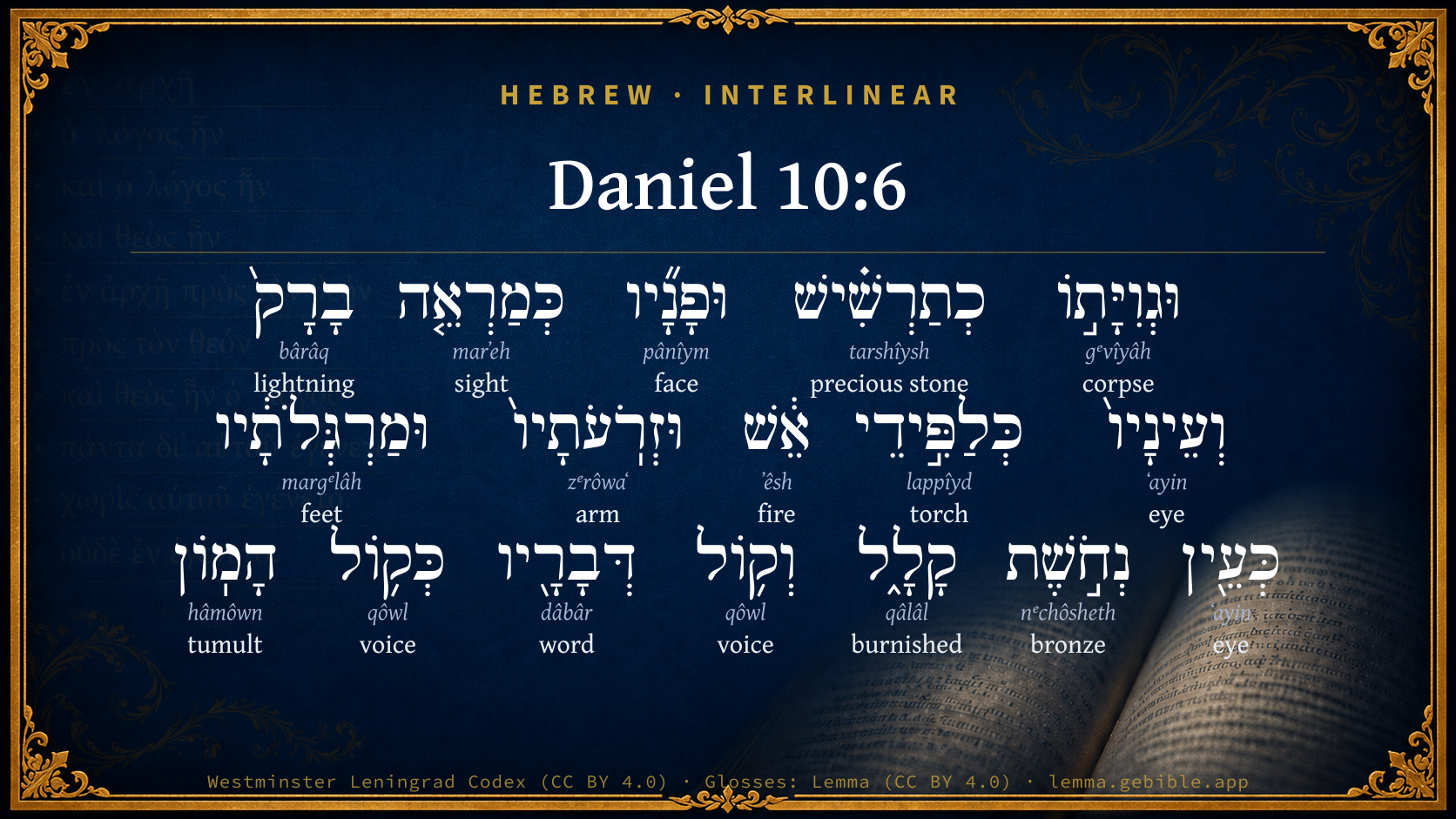
  1. וּגְוִיָּת֣וֹ gᵉvîyâh H1472 “and · corpse · his” Conjunction + Noun, Common, Feminine, Singular, Construct + Suffix, Personal, 3rd Person, Masculine, Singular
  2. כְתַרְשִׁ֗ישׁ tarshîysh H8658 “like/as · precious stone” Preposition + Noun, Common, Masculine, Singular, Absolute
  3. וּפָנָ֞יו pânîym H6440 “and · face(s) · his” Conjunction + Noun, Common, Both, Plural, Construct + Suffix, Personal, 3rd Person, Masculine, Singular
  4. כְּמַרְאֵ֤ה marʼeh H4758 “like/as · sight of” Preposition + Noun, Common, Masculine, Singular, Construct
  5. בָרָק֙ bârâq H1300 “lightning” Noun, Common, Masculine, Singular, Absolute
  6. וְעֵינָיו֙ ʻayin H5869 “and · eyes · his” Conjunction + Noun, Common, Both, Dual, Construct + Suffix, Personal, 3rd Person, Masculine, Singular
  7. כְּלַפִּ֣ידֵי lappîyd H3940 “like/as · torches of” Preposition + Noun, Common, Masculine, Plural, Construct
  8. אֵ֔שׁ ʼêsh H784 “fire” Noun, Common, Both, Singular, Absolute
  9. וּזְרֹֽעֹתָיו֙ zᵉrôwaʻ H2220 “and · arms · his” Conjunction + Noun, Common, Both, Plural, Construct + Suffix, Personal, 3rd Person, Masculine, Singular
  10. וּמַרְגְּלֹתָ֔יו margᵉlâh H4772 “and · feet · his” Conjunction + Noun, Common, Feminine, Plural, Construct + Suffix, Personal, 3rd Person, Masculine, Singular
  11. כְּעֵ֖ין ʻayin H5869 “like/as · eye of” Preposition + Noun, Common, Both, Singular, Construct
  12. נְחֹ֣שֶׁת nᵉchôsheth H5178 “bronze” Noun, Common, Feminine, Singular, Absolute
  13. וְק֥וֹל qôwl H6963 “and · voice of” Conjunction + Noun, Common, Masculine, Singular, Construct
  14. דְּבָרָ֖יו dâbâr H1697 “words · his” Noun, Common, Masculine, Plural, Construct + Suffix, Personal, 3rd Person, Masculine, Singular
  15. כְּק֥וֹל qôwl H6963 “like/as · voice of” Preposition + Noun, Common, Masculine, Singular, Construct
  16. הָמֽוֹן hâmôwn H1995 “tumult” Noun, Common, Masculine, Singular, Absolute

About this verse

These counts appear in no published source. They are computed here, from the morphology-tagged text and Lemma’s own curated glosses. What Lemma adds →

17
words
15
distinct lemmas
Prophets
section

Notable vocabulary

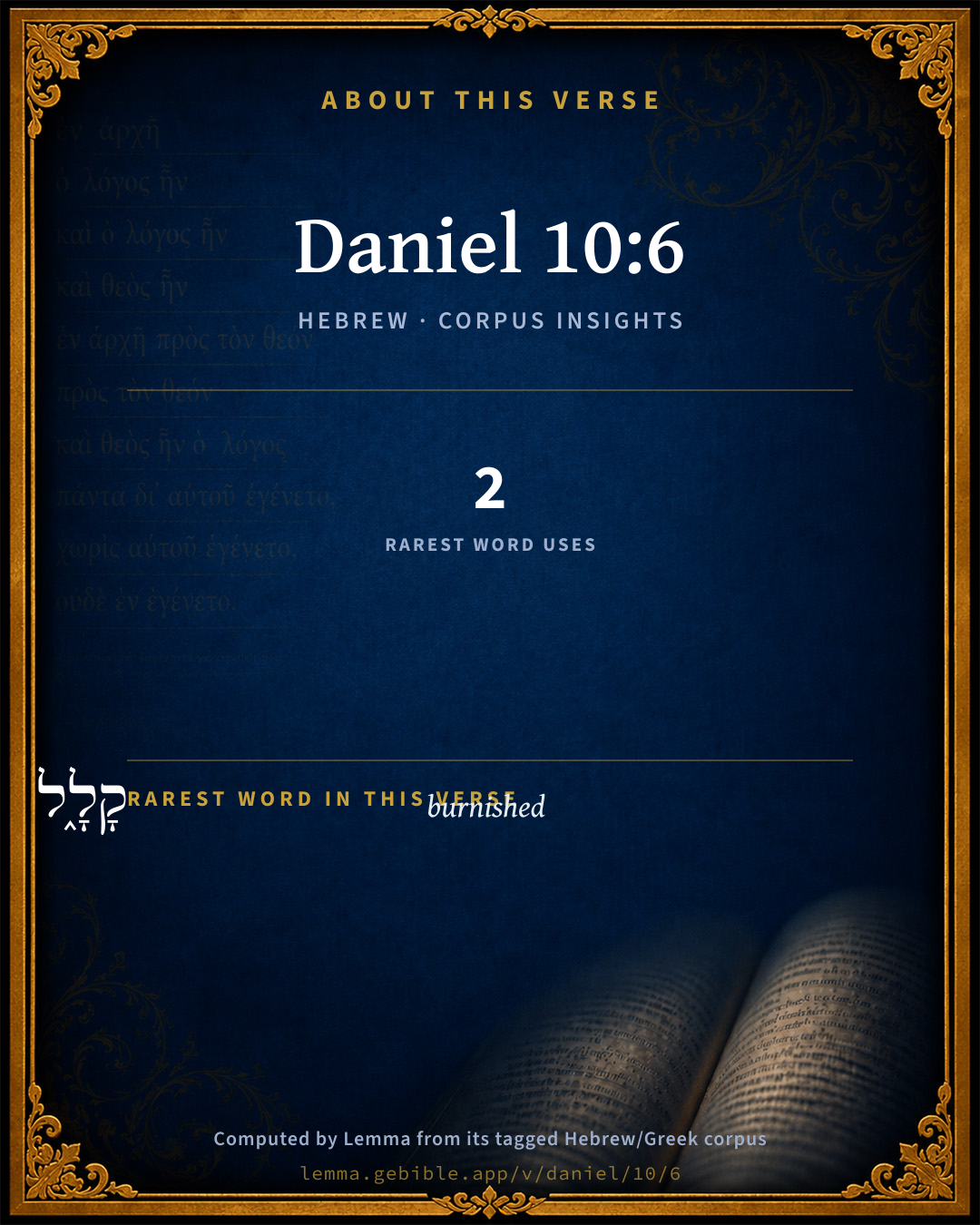
The rarest word here is קָלָ֑ל burnished H7044 — appearing just 2 times in the whole Hebrew Bible.

Shared distinctive vocabulary

קָלָ֑ל burnished H7044 occurs in 2 verses of the Hebrew Bible. Also found in:

Grammatical profile

  • 16 nouns
  • 1 adjective

Repetition

Words recur within this verse — often emphatic in Hebrew:

  • וְעֵינָיו֙ eye H5869 ×2
  • וְק֥וֹל voice H6963 ×2

Hebrew & Septuagint length

In English translation the verse runs 42 words from the Hebrew and 46 from the Septuagint (LXX English) — closely comparable.

A rough comparison of the two English renderings, which tokenize alike — not a word-level alignment.

Word counts can differ between the Hebrew and the Greek without any difference in meaning — e.g. the Hebrew direct-object marker אֵת has no separate Greek word, and Greek often adds the article ὁ.

Cross-references

13

Topical passages linked to Daniel 10:6 in the Treasury of Scripture Knowledge — connected by theme and wording, ordered by reader-vote popularity; previews shown in the World English Bible.

  • Revelation 19:12 His eyes are a flame of fire, and on his head are many crowns. He has names written and a name written which no one knows but he himself.
  • Matthew 17:2 He was transfigured before them. His face shone like the sun, and his garments became as white as the light.
  • Revelation 1:13–17 And among the lampstands was one like a son of man, clothed with a robe reaching down to his feet, and with a golden sash around his chest.
  • Revelation 10:3–4 He cried with a loud voice, as a lion roars. When he cried, the seven thunders uttered their voices.
  • Ezekiel 1:14 The living creatures ran and returned as the appearance of a flash of lightning.
  • Ezekiel 1:16 The appearance of the wheels and their work was like a beryl: and they four had one likeness; and their appearance and their work was as it were a wheel within a wheel.
  • Ezekiel 1:24 When they went, I heard the noise of their wings like the noise of great waters, like the voice of the Almighty, a noise of tumult like the noise of a host: when they stood, they let down their wings.
  • Ezekiel 10:9 I looked, and behold, four wheels beside the cherubim, one wheel beside one cherub, and another wheel beside another cherub; and the appearance of the wheels was like a beryl stone.
  • Revelation 10:1 I saw a mighty angel coming down out of the sky, clothed with a cloud. A rainbow was on his head. His face was like the sun, and his feet like pillars of fire.
  • Revelation 21:20 the fifth, sardonyx; the sixth, sardius; the seventh, chrysolite; the eighth, beryl; the ninth, topaz; the tenth, chrysoprasus; the eleventh, jacinth; and the twelfth, amethyst.
  • Exodus 28:20 and the fourth row a chrysolite, an onyx, and a jasper: they shall be enclosed in gold in their settings.
  • Ezekiel 1:7 Their feet were straight feet; and the sole of their feet was like the sole of a calf's foot; and they sparkled like burnished brass.
  • Luke 9:29 As he was praying, the appearance of his face was altered, and his clothing became white and dazzling.

Cross-references courtesy of OpenBible.info (CC BY 4.0).

Hebrew and Greek witnesses Masoretic Hebrew ↔ Greek Septuagint

The same verse in the two great witnesses to the Old Testament, shown verse-for-verse.

These are two independent witnesses, not word-aligned to each other, and the Septuagint is shown in lemma (dictionary) form.

Hebrew Daniel 10:6 Masoretic · Westminster Leningrad Codex

וּגְוִיָּת֣וֹ כְתַרְשִׁ֗ישׁ וּפָנָ֞יו כְּמַרְאֵ֤ה בָרָק֙ וְעֵינָיו֙ כְּלַפִּ֣ידֵי אֵ֔שׁ וּזְרֹֽעֹתָיו֙ וּמַרְגְּלֹתָ֔יו כְּעֵ֖ין נְחֹ֣שֶׁת קָלָ֑ל וְק֥וֹל דְּבָרָ֖יו כְּק֥וֹל הָמֽוֹן

his body also was like the beryl, and his face as the appearance of lightning, and his eyes as flaming torches, and his arms and his feet like burnished brass, and the voice of his words like the voice of a multitude.

World English Bible · Public Domain

Greek LXX Daniel 10:6 Septuagint · lemma form

καί ὁ σῶμα αὐτός ὡσεί θαρσις καί ὁ πρόσωπον αὐτός ὡσεί ὅρασις ἀστραπή καί ὁ ὀφθαλμός αὐτός ὡσεί λαμπάς πῦρ καί ὁ βραχίων αὐτός καί ὁ πούς ὡσεί χαλκός ἐκἀστράπτω καί φωνή λαλιά αὐτός ὡσεί φωνή θόρυβος

and his body was as Tharsis, and his face was a the appearance of lightning, and his eyes as lamps of fire, and his arms and his legs as the appearance of shining brass, and the voice of his words as the voice of a multitude.

LXX2012 (modern English Septuagint) · Public Domain

On this verse, The Cambridge Bible for Schools and Colleges discusses the Septuagint’s reading. Read the note in Commentary ↓

Hebrew: Westminster Leningrad Codex (CC BY 4.0). Greek: Septuagint (public domain); English from LXX2012 (modern English Septuagint) (Public Domain). How the Septuagint differs from the Hebrew →

Commentary

Notes on Daniel 10:6 from classic Christian and Jewish commentators (each source and its license shown beneath its notes). The classic Christian expositions comment on the surrounding passage and are grouped to its opening verse, so a note may address several verses; the Jewish commentaries on the Tanakh (Rashi and others) are per-verse, so they appear only where the commentator wrote on this verse.

Lemma curates 59 commentaries, every one of them public domain or Creative Commons licensed, each selected and text-cleaned for this edition rather than reprinted as found. About our sources →

Trapp's Complete Commentary

John Trapp

Dan 10:6 His body also [was] like the beryl, and his face as the appearance of lightning, and his eyes as lamps of fire, and his arms and his feet like in colour to polished brass, and the voice of his words like the voice of a multitude.

Ver. 6. His body also was like the beryl.] Of an azure colour, like the heavens. The "second Adam is the Lord from heaven." {1Co 15:47} Some render it the chrysolite, which is of the colour of the sea; to note, say they, his power to purge the Church by his Word, Spirit, and judgments, as by the water of the sea.

And his face as the appearance of lightning.] Which both shineth and terrifieth, and soon appeareth from the one end of the heaven to the other; {Mat 24:27} Christ suddenly discovereth all things though never so remote. {Psa 90:8 Eze 1:13}

And his eyes as lamps of fire.] To note his omniscience, his wrath also and readiness to revenge. {Jer 32:19}

And his arms and his feet like in colour to polished brass.] Scintillantes purissime. To note his omnipotence in the execution of his wrath while he trampleth on his enemies, as he that hath brazen arms and feet cart easily break in pieces a potter’s vessel.

And the voice of his words like the voice of a multitude.] Strepitus - i.e., Maris. Or, As the noise of many waters, {Rev 1:15} noting the efficacy of Christ’s doctrine. See Act 2:4.

John Trapp, A Commentary or Exposition upon All the Books of the Old and New Testament (1647–1656) — public domain. Text from a community e-Sword module.

Keil & Delitzsch

C. F. Keil & F. Delitzsch

His body shone like תּרשׁישׁ, i.e., the chrysolite of the Old and the topaz of the New Testament (see under Eze 1:16); his countenance had the appearance of lightning, his eyes as lamps of fire, his arms and the place of his feet like the sight of polished brass (קלל, see under Eze 1:7).מרגּלות, place of the feet, does not stand for feet, but denotes that part of the human frame where the feet are; and the word indicates that not the feet alone, but the under parts of the body shone like burnished brass. The voice of his words, i.e., the sound of his speaking, was like המון קול, for which in Eze 1:24 המלּה קול (the voice of noise), and by מחנה קול (Eze 1:24) the noise of a host is denoted.

This heavenly form has thus, it is true, the shining white talar common to the angel, Eze 9:9, but all the other features, as here described - the shining of his body, the brightness of his countenance, his eyes like a lamp of fire, arms and feet like glistering brass, the sound of his speaking-all these point to the revelation of the יהוה כּבוד, the glorious appearance of the Lord, Ezekiel 1, and teach us that the אישׁ seen by Daniel was no common angel-prince, but a manifestation of Jehovah, i.e., the Logos. This is placed beyond a doubt by a comparison with Rev 1:13-15, where the form of the Son of man whom John saw walking in the midst of the seven golden candlesticks is described like the glorious appearance seen by Ezekiel and Daniel.

The place where this heavenly being was, is not here specially stated. In Dan 12:6 he appears hovering over the waters of the river, the Tigris. This agrees also with the verse before us, according to which Daniel, while standing on the banks of the river, on lifting up his eyes beheld the vision. Hence it further follows, that the אישׁ seen here by Daniel is the same heavenly being whose voice he heard, Dan 8:16, from the waters of the Ulai, without seeing his form.

When now he whose voice Daniel heard from thence presents himself before him here on the Tigris in a majesty which human nature is not able to endure, and announces to him the future, and finally, Dan 12:6., with a solemn oath attests the completion of the divine counsel, he thereby shows himself, as C. B. Michaelis ad Daniel p. 372, Schmieder in Gerlach's Bibelw., and Oehler (Art. Messias in Herz.'s Realenc. ix. p. 417) have acknowledged, to be the Angel of Jehovah κατ ̓ἐξοχὴν, as the "Angel of His presence." The combination of this angel with that in the form of a son of man appearing in the clouds (Dan 7:13) is natural; and this combination is placed beyond a doubt by the comparison with Rev 1:13, where John sees the glorified Christ, who is described by a name definitely referring to Dan 7:13, as ὅμοιον υἱῷ ἀνθρώπου.

On the other hand, the opinion maintained to some extent among the Rabbis, which even Hengstenberg has in modern times advocated (Beitr. i. p. 165ff.; Christol. iii. 2, p. 50ff.), namely, that the angel of the Lord who here appears to Daniel in divine majesty is identical with the angel-prince Michael, has no support in Scripture, and stands in contradiction to Dan 10:13, Dan 10:21, where he who speaks is certainly distinguished from Michael, for here there is ascribed to Michael a position with reference to the people of God which is not appropriate to the Angel of the Lord or the Logos. It is true, indeed, that Hengstenberg holds, with many old interpreters, that he who speaks with Daniel, Dan 10:11, and reveals to him the future, is different from him who appears to him, Dan 10:5, Dan 10:6, and is identical with the angel Gabriel. But the reasons advanced in support of this are not sufficient. The latter supposition is grounded partly on the similarity of the address to Daniel, חמות אישׁ, Dan 10:11, Dan 10:19, cf. with Dan 9:23, partly on the similarity of the circumstances, Dan 8:17-18, cf. with Dan 10:10 and Dan 12:5. But the address to Daniel חמות אישׁ proves nothing, because it does not express to Daniel the relation of the angel to him, but of the Lord who sent the angel; and Gabriel in Dan 9:23 does not address the prophet thus, but only says that he is המדות, i.e., a man greatly beloved of God. The similarity of circumstances with Dan 8:17-18 proves nothing further than that he who appeared was a heavenly being. More noticeable is the similarity of Dan 8:13 with Dan 12:5, so far as in both cases two angels appear along with him who hovers over the waters, and the voice from above the waters in Dan 8:16 directs the angel Gabriel to explain the vision to the prophet. But from the circumstance that in Daniel 8 and also in Daniel 9 Gabriel gives to the prophet disclosures regarding the future, it by no means follows, even on the supposition that he who is represented in the chapter before us as speaking is different from him who appears in Dan 10:5, Dan 10:6, that the angel who speaks is Gabriel. If he were Gabriel, he would have been named here, according to the analogy of Dan 10:9, Dan 10:21.

To this is to be added, that the assumed difference between him who speaks, Dan 10:11, and him who appears, Dan 10:5, Dan 10:6, is not made out, nor yet is it on the whole demonstrable. It is true that in favour of this difference, he who speaks is on the banks of the river where Daniel stands, while he who appears, vv. 5, 6, and also at the end of the vision, Dan 12:1-13, is in the midst of the Tigris, and in Dan 10:5 of this chapter (Dan 12:1-13) two other persons are standing on the two banks of the river, one of whom asks him who is clothed with linen, as if in the name of Daniel, when the things announced shall happen. Now if we assume that he who is clothed in linen is no other than he who speaks to Daniel, v. 11, then one of these two persons becomes a κωφὸν πρόσωπον, and it cannot be at all seen for what purpose he appears. If, on the contrary, the difference of the two is assumed, then each has his own function. The Angel of the Lord is present in silent majesty, and only by a brief sentence confirms the words of his messenger (Dan 12:7). The one of those standing on the banks is he who, as the messenger and interpreter of the Angel of the Lord, had communicated all disclosures regarding the future to Daniel as he stood by the banks. The third, the angel standing on the farther bank, directs the question regarding the duration of the time to the Angel of the Lord. Thus Hengstenberg is in harmony with C. B. Michaelis and others.

But however important these reasons for the difference appears, yet we cannot regard them as conclusive. From the circumstance that, Dan 10:10, a hand touched Daniel as he was sinking down in weakness and set him on his knees, it does not with certainty follow that this was the hand of the angel (Gabriel) who stood by Daniel, who spoke to him, Dan 10:11. The words of the text, "a hand touched me," leave the person whose hand it was altogether undefined; and also in Dan 10:16, Dan 10:18, where Daniel is again touched, so that he was able to open his mouth and was made capable of hearing the words that were addressed to him, the person from whom the touch proceeded is altogether indefinite. The designations, אדם בּני כּדּמוּת, like the similitude of the sons of men, Dan 10:16, and אדם כּמראה, like the appearance of a man, Dan 10:18, do not point to a definite angel who appears speaking in the sequel. But the circumstance that in Dan 12:1-13, besides the form that hovered over the water, other two angels appear on the banks, does not warrant us to assume that these two angels were already present or visible in Dan 10:5. The words, "Then I looked and saw other two, the one," etc., Dan 12:5, much rather indicate that the scene was changed, that Daniel now for the first time saw the two angels on the banks. In Daniel 10 he only sees him who is clothed with linen, and was so terrified by this "great sight" that he fell powerless to the ground on hearing his voice, and was only able to stand up after a hand had touched him and a comforting word had been spoken to him. Nothing is here, as in Dan 8:15, said of the coming of the angel. If thus, after mention being made of the hand which by touching him set him on his knees, it is further said, "and he spake to me ... " (Dan 10:11), the context only leads to this conclusion, that he who spake to him was the man whose appearance and words had so overwhelmed him. To suppose another person, or an angel different from the one who was clothed with linen, as speaking, could only be justified if the contents of that which was spoken demanded such a supposition.

He who spake said, among other things, that he was sent to Daniel (Dan 10:11); that the prince of the kingdom of Persia had withstood him one and twenty days; and that Michael, one of the chief angel-princes, had come to his help (Dan 10:13, Dan 10:21). These statements do not indicate that he was an inferior angel, but they are suitable to the Angel of the Lord; for he also says (Zac 2:13, 15; Zac 4:9) that he is sent by Jehovah; cf. also Isa 48:16 and Isa 61:1. The coming to his help by the angel-prince Michael, also, does not denote that he who speaks was an angel subordinated to the archangel Michael. In Zac 1:15 עזר denotes help which men render to God; and in Ch1 12:21. it is related that Israelites of different tribes came to David to help him against his enemies, i.e., under his leadership to fight for him. Similarly we may suppose that the angel Michael gave help to the Angel of the Lord against the prince of the kingdom of Persia.

There thus remains only the objection, that if we take the angel clothed with linen and him who speaks as the same, then in Dan 12:5 one of the angels who stood on the two banks of the Tigris becomes a κωφὸν πρόσωπον; but if we are not able to declare the object for which two angels appear there, yet the one of those two angels cannot certainly be the same as he who announced, Daniel 10 and 11, the future to the prophet, because these angels are expressly designated as two others (אהרים שׁנים), and the אהרים excludes the identifying of these with angels that previously appeared to Daniel. This argument is not set aside by the reply that the angels standing on the two banks of the river are spoken of as אהרים with reference to the Angel of the Lord, Dan 10:6, for the reference of the אהרים to that which follows is inconsistent with the context; see under Dan 12:5.

Thus every argument utterly fails that has been adduced in favour of the supposition that he who speaks, Dan 10:11, is different from him who is clothed in linen; and we are warranted to abide by the words of the narrative, which in Daniel 10 names no other angel than the man clothed with linen, who must on that account be the same as he who speaks and announces the future to the prophet. The hand which again set him up by touching him, is, it is true, to be thought of as proceeding from an angel; but it is not more definitely described, because this angel is not further noticed. But after the man clothed with linen has announced the future to the prophet, the scene changes (Dan 12:5). Daniel sees the same angels over the waters of the Tigris, and standing on the two banks of the river. Where he who was clothed in linen stands, is left indefinite in the narrative. If from the first it is he who hovers over the water of the river, he could yet talk with the prophet standing on its banks. But it is also possible that at first he was visible close beside the banks.

Keil & Delitzsch — Biblical Commentary on the Old Testament (1861–1891) — public domain (CC PDM 1.0). Text via the HelloAO Bible API. (Old Testament only.)

Jamieson, Fausset & Brown

Robert Jamieson, A. R. Fausset & David Brown

beryl--literally, "Tarshish," in Spain. The beryl, identical with the chrysolite or topaz, was imported into the East from Tarshish, and therefore is called "the Tarshish stone."

Jamieson, Fausset & Brown — Commentary Critical and Explanatory on the Whole Bible (1871) — public domain (CC PDM 1.0). Text via the HelloAO Bible API.

Adam Clarke's Commentary

Verse 6. His body also was like the beryl] The description of this person is very similar to that of our Lord in Re 1:13-15.

Adam Clarke's Commentary on the Bible (1810–1826) — public domain. Text from a community e-Sword/MySword module.

Ellicott's Commentary for English Readers

(6) Beryl.—Heb., Tarshish, a variety of the topaz.

His feet.—More correctly, the place where his feet were, or the lower extremities of his limbs. We are not told in what position the man was when Daniel first saw him. Later on (Dan_12:6) he is described as being upon or above the waters. In this position he symbolises God as supreme over the nations who are represented by the Tigris.

A Bible Commentary for English Readers, edited by Charles John Ellicott (1878–1897) — public domain. Text from a community e-Sword module.

The Cambridge Bible for Schools and Colleges

gen. ed. J. J. S. Perowne

6. The dazzling appearance of his person.

His body] The word used in Eze_1:11; Eze_1:23.

the beryl] the chrysolith (as LXX. in Ex. and Eze_28:13)—said (see Smith, D. B., s. v. beryl) to be the topaz of the moderns—a flashing stone, described by Pliny as ‘a transparent stone with a refulgence like that of gold.’ Comp. Exo_28:20, and especially Eze_1:16; Eze_10:9, where the wheels of the chariot in Ez.’s vision are compared to the same stone. The Heb. is tarshish: it may be so called, as Pliny says of the chrysolith, on account of its having been brought from Spain (Tarshish, Tartessus).

as the appearance of lightning, … as torches of fire] cf. Eze_1:13 (R.V. marg.), ‘In the midst of the living creatures was an appearance like burning coals of fire, like the appearance of torches … and out of the fire went forth lightning.’

like the gleaming of burnished brass] from Eze_1:7 (of the feet of the cherubic figures which supported the throne) ‘and they sparkled like the gleaming of burnished brass.’ Gleaming is lit. eye, fig. of something sparkling: so Eze_1:4; Eze_1:16; Eze_1:22; Eze_1:27; Eze_8:2; Eze_10:9; Pro_23:31 (A.V. in all ‘colour’).

the voice of his words] or, the sound of his words: the words do not seem to become articulate until Dan_10:11.

like the voice of a multitude] Isa_13:4 (the Heb. for ‘voice,’ ‘sound,’ ‘noise’ is the same). But the expression is perhaps suggested by Eze_1:24 (R.V.) ‘a noise of tumult’ (where the Heb. for tumult partly resembles that for multitude here). An impressive, but inarticulate, sound seems to be what the comparison is intended to suggest. With the last three clauses of this verse, comp. the description of the risen Christ in Rev_1:14 b, 15.

The Cambridge Bible for Schools and Colleges (gen. ed. J. J. S. Perowne; Cambridge University Press, 1878–1918) — public domain. Text from a community e-Sword module.

John Gill's Exposition

His body also was like the beryl,.... That is, that part of it which was not covered with the linen garment, and was seen, was like such a precious stone, said to be of an azure and sky colour, signifying he was the Lord from heaven; though, according to its name, it should be of a sea colour, greenish; and so, according to some, the beryl is. Cocceius thinks the sardonyx is meant, which is of a flesh colour, and so more fit to express the comeliness of a human body; the beryl, being of a different colour, seems not so apt to set forth the agreeable colour of a man. Braunius (p) is of opinion that the chrysolite is meant, a stone of a golden colour; and takes the sense to be, that such was the lustre of the golden girdle about his loins, that the rest of the parts of the body about it appeared as if all of gold:

and his face the appearance of lightning; exceeding bright, very dazzling to the eye, and striking terror to the mind; expressive of something very awful and majestic; and agrees well with Christ the sun of righteousness, whose face or countenance at his transfiguration on the mount, and when John saw him in a visionary way, was as the sun shineth in his strength, in the summer solstice, or at noonday, Mat 17:2, from whom is all the light of knowledge and truth, of joy, peace, and comfort, of grace and glory; and which darts as swiftly and as powerfully from him as the rays of the sun, or as lightning from one end of the heaven to the other; and irradiates and illuminates as brightly and clearly:

and his eyes as lamps of fire; denoting his omniscience of all persons and things; and how piercing and penetrating his eyes are into the affairs of men and states, by whom they are clearly seen, and to whom they are exactly known; and how fierce and terrible his wrath is towards his enemies, and whose looks must inject dread and terror into them; see Rev 19:12,

and his arms and his feet like in colour to polished brass; denoting his great strength for action, his stability and firmness, and the glory of his power, in trampling upon his enemies, and subduing them; especially as displayed in the redemption of his people, when his own arm wrought salvation for them; when he came travelling in the greatness of his strength, and trod the winepress of his father's wrath alone; when he set his feet on the necks of his and his people's enemies, and got an entire victory over sin, Satan, and the world, under whose feet they are, and ever will be subject:

and the voice of his words; not of the law, which was a voice of words, which they that heard entreated they might hear no more, and were very sonorous and dreadful; but rather of the Gospel, of the words and doctrines of grace and truth, which proceeded out of the mouth of Christ, and were such as were wondered at; which is a voice of love, grace, and mercy, sweet, charming, and alluring, powerful and efficacious; and the words of it are the words of peace, pardon, righteousness, life, and salvation; yea, this voice of Christ may take in his voice and words of commands, his ordinances and institutions, which he requires an obedience unto; and even his threatenings of wrath and ruin to wicked men, as well as his gracious and precious promises to his people: and this voice of his is said to be

like the voice of a multitude; of a great many men together; whose voice is heard a long way off, and is very strong and powerful: or,

as the voice of noise (q); which may be understood either of the noise of a multitude of men, or of the sea, or of many waters; see Rev 1:15 and may intend the power and efficacy of his words, whether in his doctrines, or in his judgments, in a way of grace and comfort, or of wrath and vengeance.

(p) De Vestitu Sacerdot. Hebr. l. 2. c. 17. sect 10, 11, 12. p. 721, 722. (q) "ut vox tumultus", Montanus, "vel strepitus", Piscator, Michaelis.

John Gill's Exposition of the Whole Bible (1746–1763) — public domain (CC PDM 1.0). Text via the HelloAO Bible API.

Albert Barnes' Notes on the Bible

His body also was like the beryl - There is a very striking resemblance between the description here given and that of the Saviour as he appeared to John in Patmos, Rev 1:13-16. See the notes at that passage. It contains, however, no description of the appearance of the body. “Beryl” is “a mineral of great hardness, occurring in green and bluish-green six-sided prisms. It is identical with the emerald, except that the latter has a purer and richer color. “ - Dana, in Webster’s Dictionary. The Hebrew word used here is תרשׁישׁ tarshı̂ysh “Tarshish, Tartessus,” and properly refers to a country supposed to be on the south of Spain, a place where this mineral was probably found. This was situated between the mouths of the river Baetis, or Guadalquivir, and was a flourishing mart of the Phoenicians, Gen 10:4; Psa 72:10; Isa 23:1, Isa 23:6, Isa 23:10, ... - Gesenius. The name was given to this gem because it was brought from that place. The true meaning of the word, as applied to a gem, is supposed to be the chrysolite, that is, the topaz of the moderns. “Tarshish, the chrysolite,” says Rosenmuller (“Mineralogy and Botany of the Bible,” pp. 38, 39), “is a crystal-line precious stone of the quartz kind, of a glassy fracture. The prevailing color is yellowish-green, and pistachio-green of every variety and degree of shade, but always with a yellow and gold luster. It is completely diaphanous, and has a strong double refraction. Most commonly the chrysolite is found solid and in grains, or in angular pieces. The Hebrew word “Tarshish” denotes the south of Spain, the Tartessus of the Greeks and Romans, a place to which the Phoenicians traded even in the earliest ages. Probably the Phoenicians first brought the chrysolite from Spain to Syria, and it was on that account called Tarshish stone.”

And his face as the appearance of lightning - Bright, shining. In Rev 1:16 it is, “And his countenance was as the sun shineth in his strength.” See the notes at that passage.

And his eyes as lamps of fire - Keen, penetrating. So in Rev 1:14 : “His eyes were as a flame of fire.”

And his arms and his feet like in color to polished brass - So in Rev 1:15 : “And his feet like unto fine brass, as if they burned in a furnace.” See the notes at that passage. The meaning is, that they were bright - like burnished metal. The Hebrew here is, “like the eye of brass;” then, as the word eye comes to denote the “face or countenance,” the meaning is, “like the face or appearance of brass.” Complete Exo 10:5, Exo 10:15; Num 22:5, Num 22:11. It is easy to conceive of the appearance which one would make whose arms and feet resembled burnished brass.

And the voice of his words like the voice a multitude - A multitude of people - loud and strong. So in Rev 1:15 : “And his voice as the sound of many waters.”

Albert Barnes' Notes on the Bible (1834–1885) — public domain. Text from a community e-Sword/MySword module.

Haydock's Catholic Bible Commentary

Chrysolite. Hebrew: "Tharsis." This precious stone was perhaps greenish.

George Leo Haydock (1774–1849), Haydock's Catholic Family Bible and Commentary, 1859 edition — public domain. Excludes Psalms (Douay-Rheims chapter numbering differs from Protestant) and Deuterocanonical books (Catholic canon only).

Matthew Poole's English Annotations

Like the beryl, which is of a sea colour; others translate it the chrysolite, others the jacinth, the word in the text כתרשיש like the tarsis, this is a colour like the sea: the beryl, which is azure, and like the heavens, show Christ to be immortal and glorious, the Lord from heaven, heavenly, 1Co 15:47. See Eze 1:16; 10:9; 28:13. His face as the lightning quickens to succour his saints and terrify his enemies, Mat 24:27; 28:3; Rev 4:5. His eyes like lamps of fire, signify omniscience, splendour, and terror in Christ. His arms and his feet like in colour to polished brass, note his incredible power and swiftness to defend or to destroy invincibly. The voice of his words like the voice of a multitude: by this the Lord would distinguish the Lord Christ from creatures, and when he comes with a noise and a sound, to show the grandeur and terror of his presence. And thus his presence is wont to be ushered in before the revelation of great things, Eze 1:24; 43:2; Act 2:2; Rev 1:10,15; 14:2; 19:1; by the example of Moses, Isaiah, Jeremiah, and the apostles; noting also the mighty power of Christ to fear.

Matthew Poole's English Annotations on the Holy Bible (1683–1685) — public domain. Text from a community e-Sword/MySword module.

Scofield Reference Notes

C. I. Scofield

His body The theophanies. Dan 10:10; Dan 10:18; Eze 40:3; Gen 12:7; Rev 1:9. (See Scofield "Dan 10:10").

beryl Chrysolite. Cf. Eze 1:16.

The Scofield Reference Bible (1917 edition), notes by C. I. Scofield — public domain. Text from a community e-Sword module.

Rashi

Rabbi Shlomo Yitzchaki (Rashi)

And his body was like tarshish Our Sages of blessed memory explained in Tractate Hullin (9lb): “His body was two thousand parasangs large, like the measurement of the sea named Tarshish, and that is the sea of Africa (the Mediterranean).”

brandished Heb. קָלָל, smelted, refined, and shiny.

like the voice of a multitude like the voice of a gathering of a large multitude, whose voice is heard from afar.

Rashi on the Tanakh — English translations: “The Judaica Press complete Tanach with Rashi, translated by A. J. Rosenberg” (CC BY 4.0); “Pentateuch with Rashi's commentary by M. Rosenbaum and A.M. Silbermann, 1929-1934” (public domain); “The Metsudah Tanach series, Lakewood, N.J” (CC BY 4.0); and “The Book of Joshua, Metsudah Publications, 1997” (CC BY 4.0). Text via Sefaria.

Lesson kit

Teaching starters — assembled from the data on this page, not authored interpretation. Every prompt links to the verse data it draws on. Edit before teaching.

Daniel, in the Prophets, opens this verse with 17 words (15 distinct Hebrew lemmas). Its most distinctive word is qâlâl (“burnished”). A historical commentator’s framing appears above. Read the whole chapter for the surrounding context.

Discussion questions

  1. The word qâlâl carries the sense “burnished.” How does it shape the verse?
  2. Ezekiel 1:7 shares the word «burnished» with this verse. How do the two illuminate each other?
  3. “eye” occurs 2× in this one verse. What is the effect of the repetition?
  4. These translations render this verse differently. What is at stake in choosing one wording over another?
  5. Reading how Trapp's Complete Commentary and Keil & Delitzsch read this verse, where do the two commentators agree and where do they part?

Things to notice

Reading settings

Reading text

Shown beneath each verse's original-language words.

Old Testament
Old Testament edition

Read the OT as the Masoretic Hebrew (MT) or the Greek Septuagint (LXX).

English shown for the Greek Septuagint (in the Hebrew ↔ Greek comparison).

Comparing translations? Open the Compare panel on any verse page to stack up to four side by side.