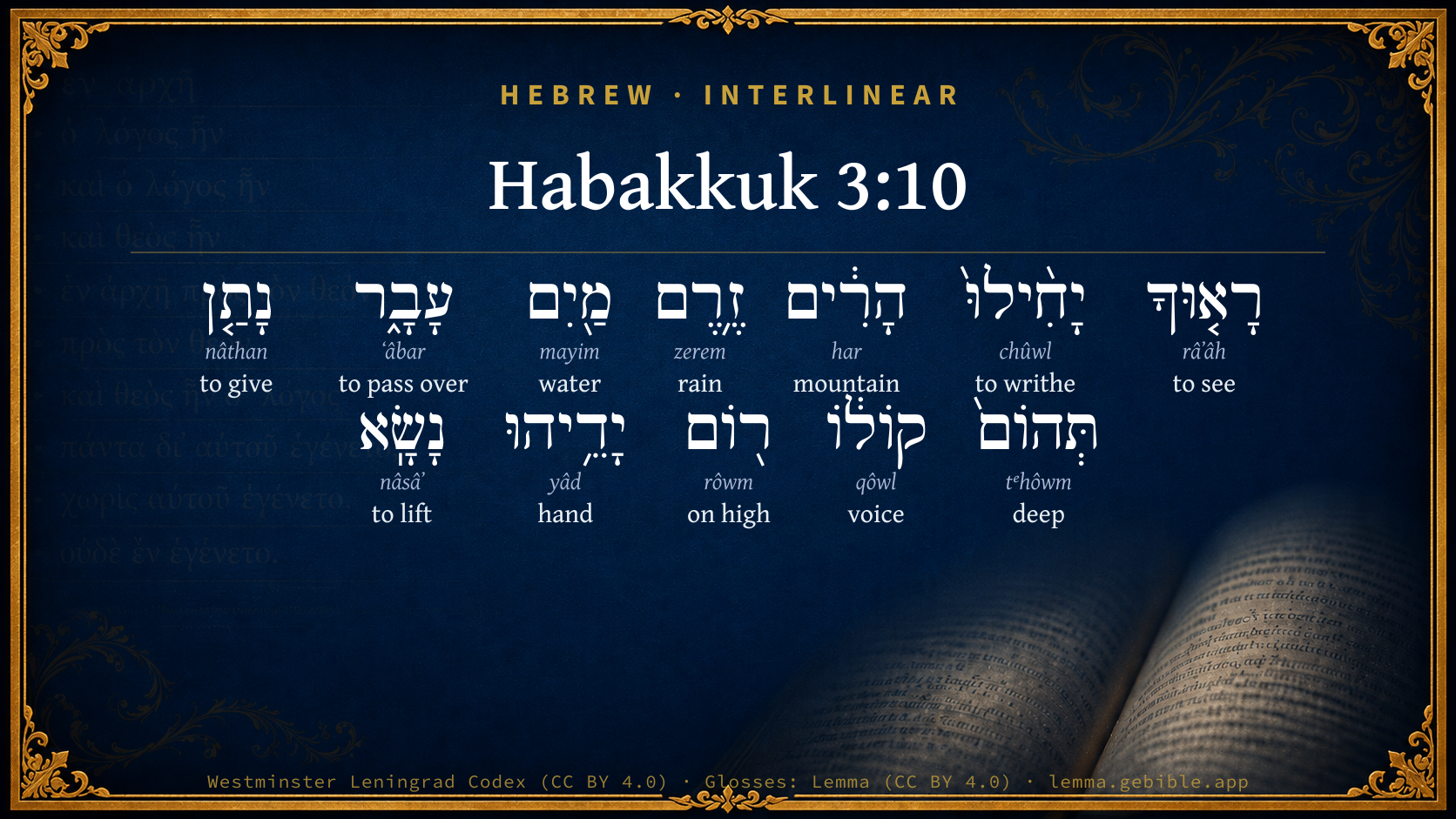
Habakkuk 3:10

Hebrew (Westminster Leningrad Codex) Habakkuk 3:10 appears in the Hebrew Old Testament. The text above is from the Westminster Leningrad Codex. Each word links to its Strong’s number, a concise gloss, and parsing drawn from the Open Scriptures Hebrew Bible morphology. Click any word for its full Brown-Driver-Briggs (BDB) entry.
Download image
Cite this verse

Habakkuk 3:10 (World English Bible). Public Domain. Lemma interlinear Bible study tool, https://lemma.gebible.app/v/habakkuk/3/10.

Show BibTeX & RIS
BibTeX
RIS
English Translation
The mountains saw you, and were afraid. The tempest of waters passed by. The deep roared and lifted up its hands on high.
World English Bible · Public Domain
Highlights
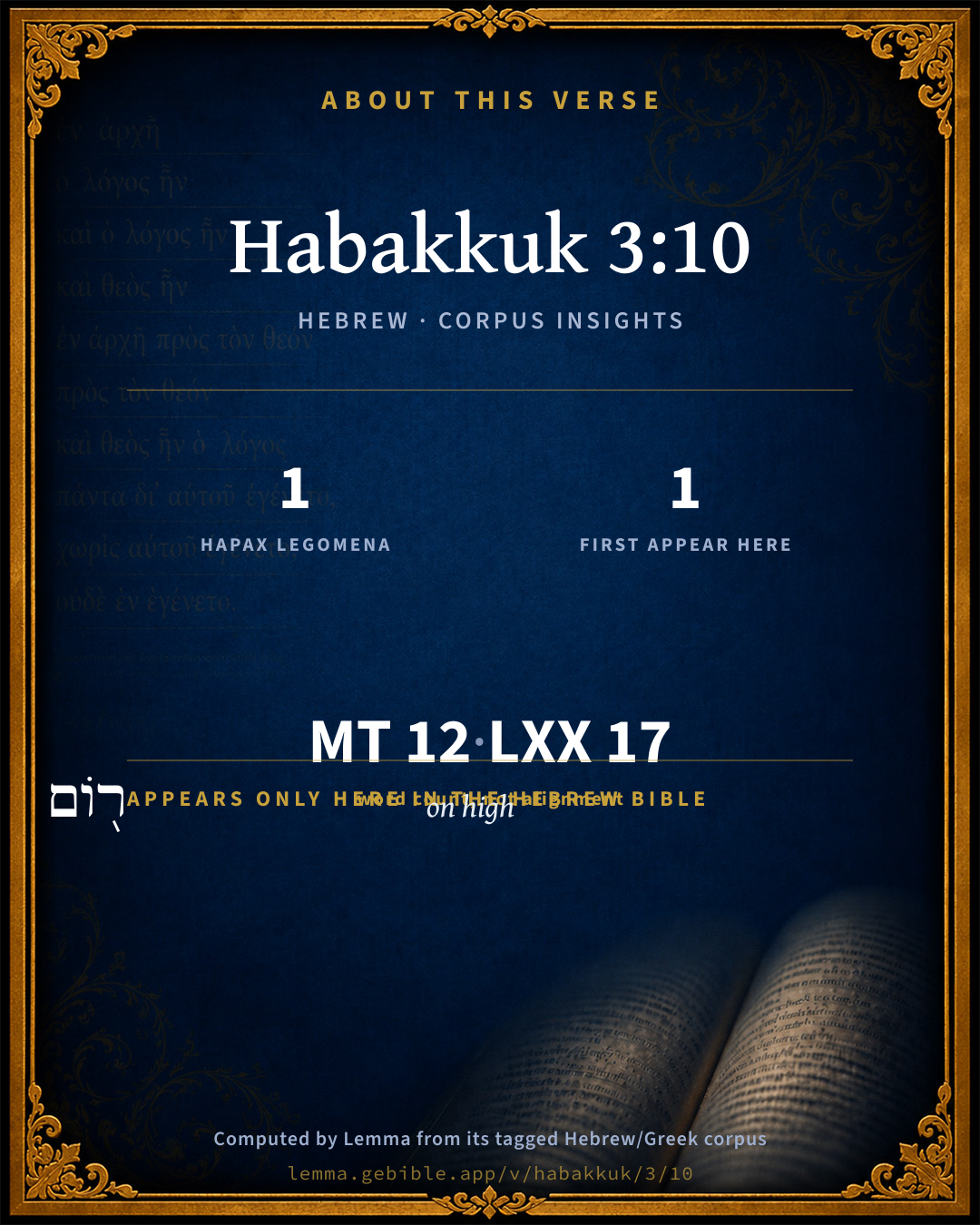
  • 1 hapax legomenon — only here in the Hebrew Bible
  • 1 first appearance in the Hebrew Bible
Full analysis ↓
Download a study sheet

One document with this verse’s original text, its word-by-word gloss line, the meaning frame, cross-references with their text, attributed commentary, and full source and license credits — printable, and it pastes into notes with its structure intact.

This verse Autodidact and up

Study sheet (.html) Plain text (.txt)

A passage Seminary Student

Up to 50 verses in one chapter. A passage sheet keeps up to 6 commentary sources and 12 cross-references per verse, in the order this page ranks them, and says so on the sheet whenever that leaves anything out. Ask for a single verse and you get the Autodidact verse sheet above.

Everything on this page stays free to read, with no account — the sheet is a download of what is already on screen, not access to it.

Want to remove ads? Support Godless Engineer
Compare translations 3

The same verse in 3 English versions, stacked beneath the original-language interlinear above. Click any original word for its lexicon entry.

Each is an independent rendering of the whole verse — the interlinear is not word-aligned to these translations.

Highlighted words mark where these versions differ — a whole-verse word diff, not a word-by-word alignment.

  • World English Bible Public Domain
    The mountains saw you, and were afraid. The tempest of waters passed by. The deep roared and lifted up its hands on high.
  • King James Version Public Domain
    The mountains saw thee, and they trembled: the overflowing of the water passed by: the deep uttered his voice, and lifted up his hands on high.
  • unfoldingWord Literal Text CC BY-SA 4.0
    The mountains saw you; they writhed. A torrent of waters swept past. The deep gave its voice; it lifted its hands on high.

unfoldingWord Literal Text — © unfoldingWord, licensed CC BY-SA 4.0. Word-aligned USFM3 via Door43 (git.door43.org/unfoldingWord/en_ult).

Versions to compare (up to 4)

3 of 4 selected

Show all 18 translations

Every available English version of this verse, each an independent rendering of the whole verse.

  • World English Bible Public Domain
    The mountains saw you, and were afraid. The tempest of waters passed by. The deep roared and lifted up its hands on high.
  • Berean Standard Bible Public Domain
    The mountains saw You and quaked; torrents of water swept by. The deep roared with its voice and lifted its hands on high.
  • Majority Standard Bible Public Domain
    The mountains saw You and quaked; torrents of water swept by. The deep roared with its voice and lifted its hands on high.
  • King James Version Public Domain
    The mountains saw thee, and they trembled: the overflowing of the water passed by: the deep uttered his voice, and lifted up his hands on high.
  • American Standard Version (1901) Public Domain
    The mountains saw thee, and were afraid; The tempest of waters passed by; The deep uttered its voice, And lifted up its hands on high.
  • Revised Version (1885) Public Domain
    The mountains saw thee, and were afraid; the tempest of waters passed by: the deep uttered his voice, and lifted up his hands on high.
  • Geneva Bible (1599) Public Domain
    The mountaines sawe thee, and they trembled: the streame of the water passed by: the deepe made a noyse, and lift vp his hand on hie.
  • Douay-Rheims (1899) Public Domain
    The mountains saw thee, and were grieved: the great body of waters passed away. The deep put forth its voice: the deep lifted up its hands.
  • Young's Literal Translation Public Domain
    Seen thee -- pained are mountains, An inundation of waters hath passed over, Given forth hath the deep its voice, High its hands it hath lifted up.
  • Literal Standard Version CC BY-SA 4.0
    Seen You—pained are mountains, || An inundation of waters has passed over, || The deep has given forth its voice, || It has lifted up its hands high.
  • Unlocked Literal Bible CC BY-SA 4.0
    The mountains saw you and twisted in pain. Downpours of water passed over them; the deep sea raised a shout. It lifted up its waves.
  • unfoldingWord Literal Text CC BY-SA 4.0
    The mountains saw you; they writhed. A torrent of waters swept past. The deep gave its voice; it lifted its hands on high.
  • Darby Bible Public Domain
    The mountains saw thee, they were in travail: Torrents of waters passed by; The deep uttered its voice, Lifted up its hands on high.
  • World Messianic Bible Public Domain
    The mountains saw you, and were afraid. The storm of waters passed by. The deep roared and lifted up its hands on high.
  • Webster's Bible Public Domain
    The mountains saw thee, and they trembled: the overflowing of the water passed by: the deep uttered his voice, and lifted up his hands on high.
  • Free Bible Version CC BY-SA 4.0
    Mountains saw you and shook. Water poured down and swept by. The deep called out, lifting high its waves.
  • Bible in Basic English Public Domain
    The mountains saw you and were moved with fear; the clouds were streaming with water: the voice of the deep was sounding; the sun did not come up, and the moon kept still in her place.
  • JPS Tanakh (1917) Public Domain
    The mountains have seen Thee, and they tremble; the tempest of waters floweth over; the deep uttereth its voice, and lifteth up its hands on high.

Literal Standard Version (2020), Covenant Press — licensed CC BY-SA 4.0. Text via the HelloAO Bible API (eBible.org). Unlocked Literal Bible (unfoldingWord) — licensed CC BY-SA 4.0. Text via the HelloAO Bible API (eBible.org). unfoldingWord Literal Text — © unfoldingWord, licensed CC BY-SA 4.0. Word-aligned USFM3 via Door43 (git.door43.org/unfoldingWord/en_ult). Free Bible Version, Dr. Jonathan Gallagher — licensed CC BY-SA 4.0. Text via the HelloAO Bible API (eBible.org).

Word by word

More ways to search: Search by grammar → Find every occurrence → Compare this word →

Practice this passage: Drill this verse → Learn its vocabulary →

ר֖וֹם
rôwm
H7315
“on high of”
Noun, Common, Masculine, Singular, Construct
Part of Speech
Noun
Type
Common
Gender
Masculine
Number
Singular
State
Construct
Full BDB Definition

Origin: from H7311

TWOT: 2133b

on high, upwards
  1. רָא֤וּךָ râʼâh H7200 “to see · you” Verb, Qal, Perfect, 3rd Person, Common, Plural + Suffix, Personal, 2nd Person, Masculine, Singular
  2. יָחִ֨ילוּ֙ chûwl H2342 “to writhe” Verb, Qal, Imperfect, 3rd Person, Masculine, Plural
  3. הָרִ֔ים har H2022 “mountains” Noun, Common, Masculine, Plural, Absolute
  4. זֶ֥רֶם zerem H2230 “rain of” Noun, Common, Masculine, Singular, Construct
  5. מַ֖יִם mayim H4325 “water(s)” Noun, Common, Masculine, Plural, Absolute
  6. עָבָ֑ר ʻâbar H5674 “to pass over” Verb, Qal, Perfect, 3rd Person, Masculine, Singular
  7. נָתַ֤ן nâthan H5414 “to give” Verb, Qal, Perfect, 3rd Person, Masculine, Singular
  8. תְּהוֹם֙ tᵉhôwm H8415 “deep” Noun, Common, Both, Singular, Absolute
  9. קוֹל֔וֹ qôwl H6963 “voice · his” Noun, Common, Masculine, Singular, Construct + Suffix, Personal, 3rd Person, Masculine, Singular
  10. יָדֵ֥יהוּ yâd H3027 “hands · his” Noun, Common, Both, Dual, Construct + Suffix, Personal, 3rd Person, Masculine, Singular
  11. נָשָֽׂא nâsâʼ H5375 “to lift” Verb, Qal, Perfect, 3rd Person, Masculine, Singular

About this verse

These counts appear in no published source. They are computed here, from the morphology-tagged text and Lemma’s own curated glosses. What Lemma adds →

12
words
12
distinct lemmas
Prophets
section

Notable vocabulary

1 hapax legomenon — a word that appears only here in the entire Hebrew Bible:

  • ר֖וֹם on high H7315

First appearance in Scripture

This word makes its first canonical appearance in the Hebrew Bible here:

  • ר֖וֹם on high H7315

Shared distinctive vocabulary

זֶ֥רֶם rain H2230 occurs in 7 verses of the Hebrew Bible. Also found in:

Grammatical profile

  • 5 verbs
  • 7 nouns

Verb forms

  • רָא֤וּךָ Qal · Perfect
  • יָחִ֨ילוּ֙ Qal · Imperfect
  • עָבָ֑ר Qal · Perfect
  • נָתַ֤ן Qal · Perfect
  • נָשָֽׂא Qal · Perfect

Hebrew & Septuagint length

In English translation the verse runs 23 words from the Hebrew and 27 from the Septuagint (LXX English) — closely comparable.

A rough comparison of the two English renderings, which tokenize alike — not a word-level alignment.

Word counts can differ between the Hebrew and the Greek without any difference in meaning — e.g. the Hebrew direct-object marker אֵת has no separate Greek word, and Greek often adds the article ὁ.

In the original languages it is 12 Hebrew tokens and 17 Greek tokens — but the two are counted differently (Hebrew bundles its prefixes and suffixes into one token; the Greek is in lemma form), so that isn’t a like-for-like length.

Cross-references

33

Topical passages linked to Habakkuk 3:10 in the Treasury of Scripture Knowledge — connected by theme and wording, ordered by reader-vote popularity; previews shown in the World English Bible.

  • Joshua 4:23–24 For Yahweh your God dried up the waters of the Jordan from before you, until you were passed over, as Yahweh your God did to the Red Sea, which he dried up from before us, until we were passed over;
  • Psalms 93:3 The floods have lifted up, Yahweh, The floods have lifted up their voice. The floods lift up their waves.
  • Psalms 98:7–8 Let the sea roar with its fullness; The world, and those who dwell therein.
  • Isaiah 43:20 The animals of the field shall honor me, the jackals and the ostriches; because I give waters in the wilderness, and rivers in the desert, to give drink to my people, my chosen,
  • Jeremiah 4:24 I saw the mountains, and, behold, they trembled, and all the hills moved back and forth.
  • Joshua 4:18 It happened, when the priests who bore the ark of the covenant of Yahweh were come up out of the midst of the Jordan, and the soles of the priests' feet were lifted up to the dry ground, that the waters of the Jordan returned to their place, and went over all its banks, as before.
  • Hebrews 11:29 By faith, they passed through the Red sea as on dry land. When the Egyptians tried to do so, they were swallowed up.
  • Exodus 19:16–18 It happened on the third day, when it was morning, that there were thunders and lightnings, and a thick cloud on the mountain, and the sound of an exceedingly loud trumpet; and all the people who were in the camp trembled.
  • Psalms 74:13–15 You divided the sea by your strength. You broke the heads of the sea monsters in the waters.
  • Psalms 136:13–15 To him who divided the Red Sea apart; For his loving kindness endures forever;
  • Isaiah 63:11–13 Then he remembered the days of old, Moses [and] his people, [saying], Where is he who brought them up out of the sea with the shepherds of his flock? where is he who put his holy Spirit in the midst of them?
  • Isaiah 64:1–2 Oh that you would tear the heavens, that you would come down, that the mountains might quake at your presence,
  • Matthew 27:51 Behold, the veil of the temple was torn in two from the top to the bottom. The earth quaked and the rocks were split.
  • Exodus 14:22–28 The children of Israel went into the midst of the sea on the dry ground, and the waters were a wall to them on their right hand, and on their left.
  • Joshua 3:15–16 and when those who bore the ark were come to the Jordan, and the feet of the priests who bore the ark were dipped in the brink of the water (for the Jordan overflows all its banks all the time of harvest),
  • Judges 5:4–5 Yahweh, when you went forth out of Seir, When you marched out of the field of Edom, The earth trembled, the sky also dropped, Yes, the clouds dropped water.
  • Nehemiah 9:11 You divided the sea before them, so that they went through the midst of the sea on the dry land; and their pursuers you did cast into the depths, as a stone into the mighty waters.
  • Psalms 18:15 Then the channels of waters appeared, The foundations of the world were laid bare at your rebuke, Yahweh, At the blast of the breath of your nostrils.
  • Psalms 65:13 The pastures are covered with flocks. The valleys also are clothed with grain. They shout for joy! They also sing.
  • Psalms 66:6 He turned the sea into dry land. They went through the river on foot. There, we rejoiced in him.
  • Psalms 68:7–8 God, when you went forth before your people, When you marched through the wilderness... Selah.
  • Psalms 77:16–19 The waters saw you, God. The waters saw you, and they writhed. The depths also convulsed.
  • Psalms 96:11–13 Let the heavens be glad, and let the earth rejoice. Let the sea roar, and it's fullness!
  • Psalms 97:4–5 His lightning lights up the world. The earth sees, and trembles.
  • Psalms 114:3–8 The sea saw it, and fled. The Jordan was driven back.
  • Isaiah 11:15–16 Yahweh will utterly destroy the tongue of the Egyptian sea; and with his scorching wind will he wave his hand over the River, and will strike it into seven streams, and cause men to march over in sandals.
  • Isaiah 55:12 For you shall go out with joy, and be led forth with peace: the mountains and the hills shall break forth before you into singing; and all the trees of the fields shall clap their hands.
  • Micah 1:4 The mountains melt under him, And the valleys split apart, Like wax before the fire, Like waters that are poured down a steep place.
  • Nahum 1:5 The mountains quake before him, and the hills melt away. The earth trembles at his presence, yes, the world, and all who dwell in it.
  • Habakkuk 3:6 He stood, and shook the earth. He looked, and made the nations tremble. The ancient mountains were crumbled. The age-old hills collapsed. His ways are eternal.
  • Revelation 6:14 The sky was removed like a scroll when it is rolled up. Every mountain and island were moved out of their places.
  • Revelation 16:12 The sixth poured out his bowl on the great river, the Euphrates. Its water was dried up, that the way might be made ready for the kings that come from the sunrise.
  • Revelation 20:11 I saw a great white throne, and him who sat on it, from whose face the earth and the heaven fled away. There was found no place for them.

Cross-references courtesy of OpenBible.info (CC BY 4.0).

Hebrew and Greek witnesses Masoretic Hebrew ↔ Greek Septuagint

The same verse in the two great witnesses to the Old Testament, shown verse-for-verse.

These are two independent witnesses, not word-aligned to each other, and the Septuagint is shown in lemma (dictionary) form.

Hebrew Habakkuk 3:10 Masoretic · Westminster Leningrad Codex

רָא֤וּךָ יָחִ֨ילוּ֙ הָרִ֔ים זֶ֥רֶם מַ֖יִם עָבָ֑ר נָתַ֤ן תְּהוֹם֙ קוֹל֔וֹ ר֖וֹם יָדֵ֥יהוּ נָשָֽׂא

The mountains saw you, and were afraid. The tempest of waters passed by. The deep roared and lifted up its hands on high.

World English Bible · Public Domain

Greek LXX Habakkuk 3:10 Septuagint · lemma form

ὁράω σύ καί ὠδίνω λαός σκορπίζω ὕδωρ πορεία αὐτός δίδωμι ὁ ἄβυσσος φωνή αὐτός ὕψος φαντασία αὐτός

The nations shall see you and be in pain, as you do divide the moving waters: the deep uttered her voice, and raised her form on high.

LXX2012 (modern English Septuagint) · Public Domain

On this verse, Haydock's Catholic Bible Commentary discusses the Septuagint’s reading. Read the note in Commentary ↓

Hebrew: Westminster Leningrad Codex (CC BY 4.0). Greek: Septuagint (public domain); English from LXX2012 (modern English Septuagint) (Public Domain). How the Septuagint differs from the Hebrew →

Targum (Aramaic paraphrase)

1

The Targum is the ancient Jewish Aramaic paraphrase of the Hebrew Scriptures — an interpretive translation, not the Hebrew text itself. Onkelos (literal) and Pseudo-Jonathan (expansive) render the Torah, and Jonathan the Prophets. Coverage is partial: where no permissively-licensed English translation exists for a verse, only the Aramaic is shown. This is verse-level text, not a word-by-word alignment to the Hebrew.

  1. Targum Jonathan Prophets (Joshua–Malachi)
    בְּאִתְגְלָיוּתָךְ עַל טוּרָא דְסִינַי חֲזוֹ יְקָרָךְ זָעוּ טוּרַיָא עֲנָנֵי מִטְרָא עֲדוֹ אָרִים תְּהוֹמָא קָלֵיהּ חֵילֵי מְרוֹמָא תְּמָהוּ קָמוּ:

    (no public-domain English translation for this verse)

    Targum Jonathan — Aramaic: “Mikraot Gedolot” (public domain). English: “Sefaria Community Translation” (CC0 1.0 (public-domain dedication)); “London "Chaldee Paraphrase," 1871” (public domain). Text via Sefaria.

Commentary

Notes on Habakkuk 3:10 from classic Christian and Jewish commentators (each source and its license shown beneath its notes). The classic Christian expositions comment on the surrounding passage and are grouped to its opening verse, so a note may address several verses; the Jewish commentaries on the Tanakh (Rashi and others) are per-verse, so they appear only where the commentator wrote on this verse.

Lemma curates 59 commentaries, every one of them public domain or Creative Commons licensed, each selected and text-cleaned for this edition rather than reprinted as found. About our sources →

Trapp's Complete Commentary

John Trapp

Hab 3:10 The mountains saw thee, [and] they trembled: the overflowing of the water passed by: the deep uttered his voice, [and] lifted up his hands on high.

Ver. 10. The mountains saw thee, and they trembled] sc. At the promulgation of the law, Exo 19:17 Psa 114:4; Psa 114:6, when God came with ten thousand of his saints, Deu 33:2; and so terrible was the earthquake, that it wrought an earthquake, even in Moses himself, Heb 12:21. It is the office of the law to do so; and happy is he who, terrified and thunder struck by the threats thereof, runs to Christ for refuge, as to One who is able to save to the utmost them that come unto God by him, Heb 9:25. Some take mountains metaphorically, for the mighties of the earth, and read it thus, The mountains saw thee, and they grieved, see Num 22:3 Jos 2:9-11.

The overflowing of the water passed by] The inundation of Jordan passed into the Dead Sea, the lower part of it, I mean, like as the upper stood, and rose up upon a heap, Jos 3:13, being bounded and barred up by the almighty power of God.

The deep uttered his voice, and lifted up his hands on high] i.e. Summo consensu suffragatus est. It voiced, and voted for God’s judgments; helping forward the execution thereof.

John Trapp, A Commentary or Exposition upon All the Books of the Old and New Testament (1647–1656) — public domain. Text from a community e-Sword module.

Keil & Delitzsch

C. F. Keil & F. Delitzsch

"The mountains see Thee, they writhe: a shower of waters passes along: the abyss lifts up its voice, it lifts up its hands on high. Hab 3:11. Sun, moon, enter into their habitation at the light of Thine arrows which shoot by, at the shining of the lightning of Thy spear." The effect of the coming of God upon the mountains was already referred to in Hab 3:6. There they crumbled into ruins, here they writhe with terror. This difference is to be explained from the fact that there (Hab 3:6) the general effect of the omnipotence of God upon nature was intended, whereas here (Hab 3:10, Hab 3:11) the special effect is described, which is produced upon nature by the judgment about to be executed by God upon the nations. The perfects in the description represent this effect as following immediately upon the coming of God. But in the first clause of Hab 3:10 the perfect ראוּך is followed by the imperfect יחילוּ, because the writhing is a lasting condition. The force of the description is heightened by the omission of the copula before the clauses and the particular objects. The two verbs of the first clause stand in the relation of cause and effect to one another: when the mountains have seen Thee, they writhe with terror. The further description is not founded upon the idea of a terrible storm; for there is no reference to thunder, nor even to lightnings, but only to the arrows (Hab 3:11), which may be explained from the idea of God, as a warlike hero, making bare His bow. The colours and different features of the description are borrowed from the judgment of the flood. Hab 3:10 (a and b) points to this divine judgment of the olden time, both the coming of the showers of water (geshem as in Gen 7:12 and Gen 8:2, and strengthened by mayim, analogous to hammabbūl hâyâh mayim in Gen 7:6; ‛âbhar as in Nah 3:19; Psa 48:5), and also the nâthan tehōm qōlō, the raging outburst of the abyss. Tehōm is the mass of water in the abyss, not merely that of the ocean, but that of the subterranean waters also (Gen 49:25; Deu 33:13), the "great deep" (tehōm rabbâh), whose fountains were broken up at the flood (Gen 7:11); and not the ocean of heaven, as Hitzig erroneously infers from Gen 7:11; Gen 8:2, and Pro 8:27. To this mass of water, which is called tehōm from its roaring depth, the prophet attributes a voice, which it utters, to express the loud, mighty roaring of the waters as they rush forth from the bursting earth. As at the time of the flood, which was a type of the last judgment (Isa 24:18), the windows of heaven and the fountains of the deep were opened, so that the upper and lower waters, which are divided by the firmament, rushed together again, and the earth returned, as it were, to its condition before the second day of creation; so here also the rivers of the earth and rain-showers of heaven come together, so that the abyss roars up with a loud noise (Delitzsch). This roaring outburst of the mass of waters from the heart of the earth is then represented as a lifting up of the hands to heaven, with reference to the fact that the waves are thrown up. Rōm = rūm (Pro 25:3; Pro 21:4) is an accusative of direction, like mârōm in Kg2 19:22. ידיהוּ, for ידיו, a full-sounding and more extended form, possibly to express by the rhythm the greatness of the prodigy, how magna vi brachii tollunt (Delitzsch). The lifting up of the hands is not a gesture denoting either an oath or rebellion; but it is an involuntary utterance of terror, of restlessness, of anguish, as it were, with a prayer for help (Delitzsch).

Keil & Delitzsch — Biblical Commentary on the Old Testament (1861–1891) — public domain (CC PDM 1.0). Text via the HelloAO Bible API. (Old Testament only.)

Tyndale Open Study Notes

Tyndale Open Resources

3:10 waters: See study note on 3:8; see also Exod 15:1-18.

Tyndale Open Study Notes — © Tyndale Open Resources, licensed CC BY-SA 4.0. Text via the HelloAO Bible API.

Geneva Bible (1599)

Geneva Bible translators

He alludeth to the red sea and Jordan, which gave passage to God’s people, and showed signs of their obedience as it were by the lifting up their hands.

Geneva Bible (1599) marginal notes — public domain. Text via Bolls.life.

Jamieson, Fausset & Brown

Robert Jamieson, A. R. Fausset & David Brown

The mountains--repetition with increased emphasis of some of the tremendous phenomena mentioned in Hab 3:6.

overflowing of the water passed by--namely, of the Red Sea; and again, of the Jordan. God marked His favor to His people in all the elements, causing every obstacle, whether mountains or waters, which impeded their progress, to "pass away" [CALVIN]. MAURER, not so well, translates, "torrents (rains) of water rush down."

lifted . . . hands on high--namely, its billows lifted on high by the tempest. Personification. As men signify by voice or gesture of hand that they will do what they are commanded, so these parts of nature testified their obedience to God's will (Exo 14:22; Jos 3:16; Psa 77:17-18; Psa 114:4).

Jamieson, Fausset & Brown — Commentary Critical and Explanatory on the Whole Bible (1871) — public domain (CC PDM 1.0). Text via the HelloAO Bible API.

Adam Clarke's Commentary

Verse 10. The mountains saw thee] This is the continued answer to the questions in Hab 3:8. These are figures highly poetic, to show with what ease God accomplished the most arduous tasks in behalf of his people. As soon as the mountains saw him, they trembled, they were in pangs. When he appeared, the sea fled to right and left, to give him a passage. "It uttered its voice." The separation of the waters occasioned a terrible noise. "And it lifted up its hands on high." Its waters, being separated, stood in heaps on the right hand and left. These heaps or waves are poetically represented here as the hands of the sea.

Adam Clarke's Commentary on the Bible (1810–1826) — public domain. Text from a community e-Sword/MySword module.

John Calvin's Commentaries

Habakkuk proceeds with the history of the people’s redemption. We have said what his object was, even this that the people, though in an extreme state of calamity, might yet entertain hope of God’s favor; for he became not a Redeemer to the race of Abraham for one time, but that he might continue the same favor to them to the end.

He says that mountains had seen and grieved. Some explain this allegorically of kings, and say, that they grieved when envy preyed on them: but this view is too strained. The Prophet, I have no doubt, means simply, that the mountains obeyed God, so as to open a way for his people. At the same time, the verb חול, chul, signifies not only to grieve, but also to bring forth, and then to fall and to abide in the same place. We might then with no less propriety read thus—see thee did the mountains, and were still, or fell down; that is, they were subservient to thy command, and did not intercept the way of thy people. I think the real meaning of the Prophet to be, that God had formerly imprinted on all the elements evident marks of his paternal favor, so that the posterity of Abraham might ever confide in him as their deliverer in all their distresses: and even the context requires this meaning; for he subjoins -

The stream or the inundation of waters, etc.: and this second part cannot be explained allegorically. We then see, that the import of the words is—That God removed all obstacles, so that neither mountains, nor waters, nor sea, nor rivers, intercepted the passage of the people. He says now, that the inundation of waters had passed away. This applies both to Jordan and to the Red Sea; for God separated the Red Sea, so that the waters stood apart, contrary to the laws of nature, and the same thing happened to Jordan; for the flowing of the water was stayed, and a way was opened, so that the people passed over dryshod into the land of Canaan. Thus took place what is said by the Prophet, the stream of waters passed away. We indeed know that such is the abundance of waters in the sea and in the rivers, that they cannot be dried up: when therefore waters disappear, it is what is beyond the course of nature. The Prophet, therefore, records this miracle, that the faithful might know, that though the whole world were resisting, their salvation would still be certain; for the Lord can surmount whatever impediments there may be.

He then ascribes life to waters; for he says, that the abyss gave its voice, and also, that the deep lifted up its hands; or that the abyss with uplifted hands was ready to obey God. It is a striking personification; for though the abyss is void of intelligence, and it cannot speak, yet the Prophet says, that the abyss with its voice and uplifted hands testified its obedience, when God would have his people to pass through to the promised land. When anxious to testify our obedience, we do this both with our voice and in our gesture. When any one is willing to do what is commanded, he says, “Here I am,” or “I promise to do this.” As, then, servants respond to others, so the Prophet says, that a voice was uttered by the abyss. The abyss indeed uttered no voice; but the event itself surpassed all voices. Now when a whole people meet together, they raise their hands; for their consent cannot be understood except by the outstretching of the hands, and hence came the word hand-extending, χειροτονια. This similitude the Prophet now takes, and says, that the abyss raised up its hands; that is, shows its consent by this gesture. As when men declare by this sign that they will do what they are bidden; so also the abyss lifted up its hands. If we read, The deep raised up its hands, the sense will be the same. Let us proceed -

John Calvin's Commentaries (1540-1563) — public domain. Text from the Calvin Translation Society English edition (1840s-50s) via the Christian Classics Ethereal Library (ccel.org). Calvin's coverage is partial (roughly two-thirds of the Bible); uncommented books and verses are honest gaps, never fabricated. The 19th-century editor's footnotes and remarks are omitted so the notes are faithfully Calvin's own voice.

Ellicott's Commentary for English Readers

(10) The mountains saw thee.—The earthquake at Sinai and the dividing of the Red Sea, the waters of which were lifted up “as a wall on the right hand and on the left” of Israel, lie at the basis of this description. This imagery, however, of sweeping floods and quaking mountains is usual in poetical accounts of Divine interposition.

(10-18) All the verbs in these verses are misrendered as regards tense. (See note on 3-15.)

A Bible Commentary for English Readers, edited by Charles John Ellicott (1878–1897) — public domain. Text from a community e-Sword module.

The Cambridge Bible for Schools and Colleges

gen. ed. J. J. S. Perowne

10. The mountains saw thee, and] the mountains see thee, they tremble. The other verbs in the verse should also be in the present.

The overflowing of the water] the rainflood of waters passeth (driveth) along. Ch. Hab_1:11; the reference is to a rainstorm.

The deep uttered] uttereth. The “deep” (tehôm, Assyr. tiamat) is properly the primal ocean, subterranean source of the visible sea, but here the latter itself. The reference is probably to the Red Sea; Psa_106:9, “he led them through the depths”; so Isa_63:13. The roaring of the troubled and smitten sea is described.

lift up his hands] lifteth up. The reference appears to be to the mounting heavenwards of the waves. It is doubtful, however, if uttering its voice and lifting up its hands are meant to express an appeal on the part of the sea for mercy (Ew.). Comp. Psa_77:16.

The Cambridge Bible for Schools and Colleges (gen. ed. J. J. S. Perowne; Cambridge University Press, 1878–1918) — public domain. Text from a community e-Sword module.

John Gill's Exposition

The mountains saw thee, and they trembled,.... At the power and presence of God, as Sinai of old; See Gill on Hab 3:6 by which are signified mighty people and nations, kings and great men, struck with terror at the amazing providence of God in the world, on the behalf of his own people, and against their enemies; see Rev 6:14,

the overflowing of the water passed by; which is usually referred to the overflowing of the river Jordan at the time of the passage of the Israelites through it, when the waters above stood and rose up as a heap, and those below failed, and were cut off, and passed away into the salt sea, Jos 3:15 but perhaps it may refer to the times of David, when he conquered all his enemies round about, who were like an overflowing flood; but now passed away, particularly the Philistines, who had always been very troublesome to Israel, but now were overcome by David at Baalperazim; where the Lord, on the contrary, broke forth upon his enemies as the breach of waters, from whence the place had its name, Sa2 5:20 and as this respects time that was then to come, when this prayer was made, it may regard the flood of persecution, which ceased in Constantine's time, when Paganism was abolished, and Christianity established; concerning which it might be said, "the winter is past, the rain is over and gone", Sol 2:11 and the word (n) here used signifies a large shower of rain, causing an inundation, a storm, a tempest; and so fitly expresses the violence of persecution, now at an end:

the deep uttered his voice, and lifted up hands on high; language very poetical, exceeding striking, very beautiful and elegant. It is generally understood of the deep waters of the Red sea, or of Jordan, or both, when divided for the Israelites to pass through; at which time, when they rose up, they made a great noise, and stood on a heap; and so the phrases are expressive of the roaring and raging of them as they rose up, which was as if they had spoken; and of the position in which they were, standing up on high, as if they had hands, and these lifted up: but rather they figuratively refer to the mighty nations conquered by David, who asked favour and mercy of him, and signified their subjection to him; and, having respect to times to come, may denote the subjection of the multitude of people and nations in the Roman empire to Christ, when heathenism was abolished in it; and the joy and rejoicing of Christians upon it, and the ceasing of persecution in it, even high and low, rich and poor, all ranks and degrees of men; height and depth, men in high or low circumstances, signified by the depth uttering his voice, and the height lifting up its hands, in token of praise and thankfulness; for so the latter clause may be rendered, "the height lifted up his hands" (o); and answers to the deep in the preceding clause; agreeable to this sense is Jarchi's note,

""the deep uttered his voice": the inhabitants of the earth praised him; "the height lifted up his hands"; the host of heaven confessed unto him;''

every creature in heaven, on the earth, and under the earth, and in the sea, ascribed blessing, honour, glory, and power, to the Lord on this occasion, Rev 5:13. The Targum is,

"the powers on high stood wondering;''

amazed at what was done, and lifted up their hands with astonishment.

(n) "nimbus", Tigurine version; "impetus", Munster; "imber aquosus", Cocceius, Van Till; "inundatio aquarum", Burkius. (o) "altitudo manum suam sublevavit", Munster; "tudo manus suas tulit", Burkius.

John Gill's Exposition of the Whole Bible (1746–1763) — public domain (CC PDM 1.0). Text via the HelloAO Bible API.

Albert Barnes' Notes on the Bible

The mountains saw Thee and they trembled - literally, “they tremble.” While man is insensate, inanimate nature feels and attests the presence of its Maker. “It saw it trembles.” To see, feel, tremble were one. The prophet does not follow a bare order of events, or bind himself to miracles which actually took place. The mountains tremble with earthquakes, or seem to be shaken by the thunders which they re-echo. And so they are signs, how what is firmest and closes up the way to man, trembles at the Presence of God. Whatever is lifted up shall be bowed down before Him. (See Zec 4:7.). But the word “trembled” is that which is especially used of travail pangs and so it may spiritually denote that “they who conceive the fear of God shall bring forth unto salvation.” “The overflowing,” i. e., the impetuous, sweeping, flow, of the water (or, of waters), such as in themselves would bear all before them, pass by harmless. The more they swell, the more they expend themselves, and pass away. “The whole force of persecution, wherewith they vexed Thy people, at sight of Thee passed away,” like a torrent which rages and disappears, and, by raging, the sooner wastes itself.

The deep uttered his voice, and lifted up his hands - רום = מרום mârôm which stands as the accusative of direction with “lifted up the eyes” Isa 37:23; Isa 40:26.

On high - The noise of the waves, when God brought the strong East wind over it and Psa 106:9. rebuked it, was as a cry to God; the waves, as they swelled, were like hands lifted up to Him, and stricken one against the other. There is no distinct ground against a slightly different rendering it: “the deep uttered his voice, the height lifted up his hands” i. e., to One yet higher, whom height and depth owned as their Lord and worshipped.

Albert Barnes' Notes on the Bible (1834–1885) — public domain. Text from a community e-Sword/MySword module.

Haydock's Catholic Bible Commentary

Grieved. They seemed full of surprise, as in labour, (Hebrew) and the abyss spoke in its manner, (Calmet) obeying thy voice, and letting the Israelites pass. (Haydock) (Psalm lxxiii. 15., and cxiii. 3., and Numbers xxi. 13. (Calmet) --- "Earth, sea, and rocks quake at the sight of God." (Æschyl.) (Haydock) --- Septuagint are obscure, (Calmet) "Peoples shall behold thee, and grieve, (or be in labour: Greek: odinesousi has both meanings; St. Jerome) dividing the waters of the passage, the abyss," &c. Other cop.[copies?] read, "Thou, Lord, wilt divide," which S. Jerome explains of heresies, which soon disappear. (Haydock)

George Leo Haydock (1774–1849), Haydock's Catholic Family Bible and Commentary, 1859 edition — public domain. Excludes Psalms (Douay-Rheims chapter numbering differs from Protestant) and Deuterocanonical books (Catholic canon only).

Matthew Poole's English Annotations

The mountains; literally taken, it is an elegant hyperbole, expressing to us the glorious effects of God’s power and presence; and thus Sinai and the contiguous hills, the whole mount, Exo 19:18, are intended: or if you take it figuratively, these are kings and states, whose hieroglyphics in Scripture are mountains.

Saw; were sensible of, showed they were sensible of his approach and presence.

Trembled; were grieved; so it will well suit to mountains metaphorically taken, it was grief to the kings and states to see God own, conduct, and prosper Israel, Num 22:3; Josh. 2:9-11; or

trembled, i.e. were shaken as with an earthquake, Exo 19:18; Psa 68:8; 114:4,6; so it suits the letter of the text.

The overflowing; the inundation, which at that season was wont to be very great, the mighty floods on Jordan.

Passed by; passed away, i.e. at the word of God the waters below flowed and ran away from those above, which stood on a heap, to make a path for Israel.

The deep; either the deep channel in which Jordan flowed, the very bottom of the river, appeared; or the deep, i.e. the Red Sea.

Uttered his voice; with dreadful roaring, like a mighty voice, parted its waters; divided, but with great and terrible noise, in this unusual commotion.

Lifted up his hands; testified its obedience to the command of God, as by lifting up the hand one doth at distance signify his ready compliance with the command, or direction: or

hands, i.e. sides; so when the upper waters stood on a heap, both in Jordan and the Red Sea, they appeared as with sides or flankers unto the Israelites.

On high; like a mountain, visible and conspicuous to all.

Matthew Poole's English Annotations on the Holy Bible (1683–1685) — public domain. Text from a community e-Sword/MySword module.

The Pulpit Commentary

The mountains saw thee, and they trembled; literally, were in pain, Septuagint, wjdinhsousi. The words point to the phenomena of an earthquake, as Sinai shook at the presence of the Lord. (Psa_114:6) So Virgil, "AEn.," 6:256

Sub pedibus mugire solum, et juga coepta moveri Silvarum Adventante des.

For "mountains," the LXX reads, "peoples" The overflowing of the water passed by; the talent of water passed along. Cataracts of rain fell, as in the Deluge. "The windows on high are open, and the foundations of the earth do shake". (Isa_24:18) Those who confine the reference topast events see here an intimation of the passage of the Jordan. (Jos_3:15, Jos_3:16) The deep uttered his voice. The mass of waters in the ocean and under the earth rears mightily as it bursts forth. (Gen_49:25; Deu_33:13) His hands. Its waves. (Psa_98:8) Septuagint, uyov fantasiav aujthv, "the height of its form."

The Pulpit Commentary (1880–1919), ed. H.D.M. Spence-Jones & Joseph S. Exell — public domain. Text from a community e-Sword module.

John Wesley's Explanatory Notes

Overflowing - The inundation which at that season was wont to be very great in and round Jordan, passed away at the word of God; the waters below flowed, and ran from those above, which stood on a heap to make a path for Israel. The deep - Either the deep channel in which Jordan flowed, or the Red Sea with dreadful roaring parted its waters. Lift up his hands - Its waves which stood on an heap.

John Wesley, Explanatory Notes Upon the Whole Bible (1754–1765) — public domain. Text via the GEBible commentary corpus.

Rashi

Rabbi Shlomo Yitzchaki (Rashi)

Mountains saw You and quaked The mountains of the streams of Arnon that cleft to one another.

A stream of water passed When they crossed the Jordan, the water was “completely cut off,” and the flow of the stream of water passed downstream; the water “which came down from above stood and rose up.”

The deep gave forth its voice The inhabitants of the land praised Him.

The heaven raised up its thanks The host of the heaven thanked Him.

Rashi on the Tanakh — English translations: “The Judaica Press complete Tanach with Rashi, translated by A. J. Rosenberg” (CC BY 4.0); “Pentateuch with Rashi's commentary by M. Rosenbaum and A.M. Silbermann, 1929-1934” (public domain); “The Metsudah Tanach series, Lakewood, N.J” (CC BY 4.0); and “The Book of Joshua, Metsudah Publications, 1997” (CC BY 4.0). Text via Sefaria.

Lesson kit

Teaching starters — assembled from the data on this page, not authored interpretation. Every prompt links to the verse data it draws on. Edit before teaching.

Habakkuk, in the Prophets, opens this verse with 12 words (12 distinct Hebrew lemmas). Its most distinctive word is rôwm (“on high”). A historical commentator’s framing appears above. Read the whole chapter for the surrounding context.

Discussion questions

  1. The word rôwm carries the sense “on high.” How does it shape the verse?
  2. This verse holds 1 word here found nowhere else in the Hebrew Bible. What might the rare word draw attention to?
  3. The word “on high” first appears here in Scripture. What is being introduced at this debut?
  4. Job 24:8 shares the word «rain» with this verse. How do the two illuminate each other?
  5. The translations on this page render this verse differently — a whole-verse word diff, not a word-by-word alignment. What might account for the different wordings?
  6. The verb «רָא֤וּךָ» is Qal Perfect. How does its form color the action?
  7. Reading how Trapp's Complete Commentary and Keil & Delitzsch read this verse, where do the two commentators agree and where do they part?

Things to notice

Reading settings

Reading text

Shown beneath each verse's original-language words.

Old Testament
Old Testament edition

Read the OT as the Masoretic Hebrew (MT) or the Greek Septuagint (LXX).

English shown for the Greek Septuagint (in the Hebrew ↔ Greek comparison).

Comparing translations? Open the Compare panel on any verse page to stack up to four side by side.