Deuteronomy 4:30

Hebrew (Westminster Leningrad Codex) Deuteronomy 4:30 appears in the Hebrew Old Testament. The text above is from the Westminster Leningrad Codex. Each word links to its Strong’s number, a concise gloss, and parsing drawn from the Open Scriptures Hebrew Bible morphology. Click any word for its full Brown-Driver-Briggs (BDB) entry.
Download image
Cite this verse

Deuteronomy 4:30 (World English Bible). Public Domain. Lemma interlinear Bible study tool, https://lemma.gebible.app/v/deuteronomy/4/30.

Show BibTeX & RIS
BibTeX
RIS
English Translation
When you are in oppression, and all these things are come on you, in the latter days you shall return to Yahweh your God, and listen to his voice:
World English Bible · Public Domain
Download a study sheet

One document with this verse’s original text, its word-by-word gloss line, the meaning frame, cross-references with their text, attributed commentary, and full source and license credits — printable, and it pastes into notes with its structure intact.

This verse Autodidact and up

Study sheet (.html) Plain text (.txt)

A passage Seminary Student

Up to 50 verses in one chapter. A passage sheet keeps up to 6 commentary sources and 12 cross-references per verse, in the order this page ranks them, and says so on the sheet whenever that leaves anything out. Ask for a single verse and you get the Autodidact verse sheet above.

Everything on this page stays free to read, with no account — the sheet is a download of what is already on screen, not access to it.

Want to remove ads? Support Godless Engineer
Compare translations 3

The same verse in 3 English versions, stacked beneath the original-language interlinear above. Click any original word for its lexicon entry.

Each is an independent rendering of the whole verse — the interlinear is not word-aligned to these translations.

Highlighted words mark where these versions differ — a whole-verse word diff, not a word-by-word alignment.

  • World English Bible Public Domain
    When you are in oppression, and all these things are come on you, in the latter days you shall return to Yahweh your God, and listen to his voice:
  • King James Version Public Domain
    When thou art in tribulation, and all these things are come upon thee, even in the latter days, if thou turn to the LORD thy God, and shalt be obedient unto his voice;
  • unfoldingWord Literal Text CC BY-SA 4.0
    When trouble for you, and you find all these things in the later days, then you will return to Yahweh your God and listen to his voice.

unfoldingWord Literal Text — © unfoldingWord, licensed CC BY-SA 4.0. Word-aligned USFM3 via Door43 (git.door43.org/unfoldingWord/en_ult).

Versions to compare (up to 4)

3 of 4 selected

Show all 18 translations

Every available English version of this verse, each an independent rendering of the whole verse.

  • World English Bible Public Domain
    When you are in oppression, and all these things are come on you, in the latter days you shall return to Yahweh your God, and listen to his voice:
  • Berean Standard Bible Public Domain
    When you are in distress and all these things have happened to you, then in later days you will return to the LORD your God and listen to His voice.
  • Majority Standard Bible Public Domain
    When you are in distress and all these things have happened to you, then in later days you will return to the LORD your God and listen to His voice.
  • King James Version Public Domain
    When thou art in tribulation, and all these things are come upon thee, even in the latter days, if thou turn to the LORD thy God, and shalt be obedient unto his voice;
  • American Standard Version (1901) Public Domain
    When thou art in tribulation, and all these things are come upon thee, in the latter days thou shalt return to Jehovah thy God, and hearken unto his voice:
  • Revised Version (1885) Public Domain
    When thou art in tribulation, and all these things are come upon thee, in the latter days thou shalt return to the LORD thy God, and hearken unto his voice:
  • Geneva Bible (1599) Public Domain
    When thou art in tribulation, and all these things are come vpon thee, at the length if thou returne to the Lord thy God, and bee obedient vnto his voyce,
  • Douay-Rheims (1899) Public Domain
    After all the things aforesaid shall and thee, in the latter time thou shalt return to the Lord thy God, and shalt hear his voice.
  • Young's Literal Translation Public Domain
    in distress `being' to thee, and all these things have found thee, in the latter end of the days, and thou hast turned back unto Jehovah thy God, and hast hearkened to His voice;
  • Literal Standard Version CC BY-SA 4.0
    In the distress of yours, when all these things have found you in the latter end of the days, and you have turned back to your God YHWH and have listened to His voice—
  • Unlocked Literal Bible CC BY-SA 4.0
    When you are in distress, and when all these things will have come on you, in those later days you will return to Yahweh your God and listen to his voice.
  • unfoldingWord Literal Text CC BY-SA 4.0
    When trouble for you, and you find all these things in the later days, then you will return to Yahweh your God and listen to his voice.
  • Darby Bible Public Domain
    In thy tribulation, and when all these things shall come upon thee, at the end of days, thou shalt return to Jehovah thy God, and shalt hearken to his voice,
  • World Messianic Bible Public Domain
    When you are in oppression, and all these things have come on you, in the latter days you shall return to the LORD your God and listen to his voice.
  • Webster's Bible Public Domain
    When thou art in tribulation, and all these things have come upon thee, even in the latter days, if thou shalt turn to the LORD thy God, and shalt be obedient to his voice;
  • Free Bible Version CC BY-SA 4.0
    When you are in trouble, after you've experienced all these things, then eventually you will return to the Lord your God and do what he says.
  • Bible in Basic English Public Domain
    When you are in trouble and all these things have come on you, if, in the future, you are turned again to the Lord your God, and give ear to his voice:
  • JPS Tanakh (1917) Public Domain
    In thy distress, when all these things are come upon thee, in the end of days, thou wilt return to the LORD thy God, and hearken unto His voice;

Literal Standard Version (2020), Covenant Press — licensed CC BY-SA 4.0. Text via the HelloAO Bible API (eBible.org). Unlocked Literal Bible (unfoldingWord) — licensed CC BY-SA 4.0. Text via the HelloAO Bible API (eBible.org). unfoldingWord Literal Text — © unfoldingWord, licensed CC BY-SA 4.0. Word-aligned USFM3 via Door43 (git.door43.org/unfoldingWord/en_ult). Free Bible Version, Dr. Jonathan Gallagher — licensed CC BY-SA 4.0. Text via the HelloAO Bible API (eBible.org).

Word by word

More ways to search: Search by grammar → Find every occurrence → Compare this word →

Practice this passage: Drill this verse → Learn its vocabulary →

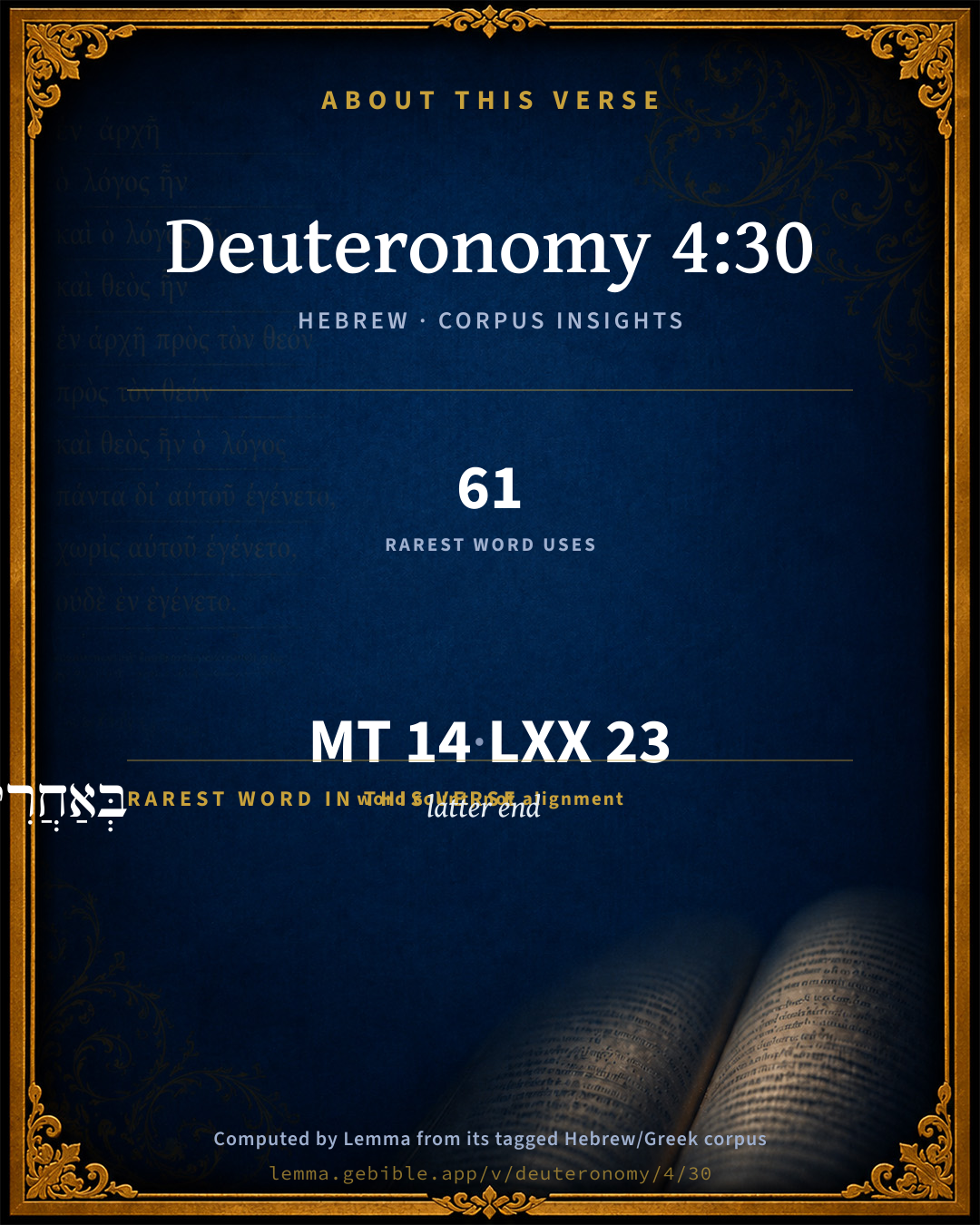
בְּאַחֲרִית֙
ʼachărîyth
H319
“in/at · latter end of”
Preposition + Noun, Common, Feminine, Singular, Construct
Part of Speech
Preposition + Noun
Type
Common
Gender
Feminine
Number
Singular
State
Construct
Full BDB Definition

Origin: from H310

TWOT: 68f

after part, end - end, issue, event - latter time (prophetic for future time) - posterity - last, hindermost
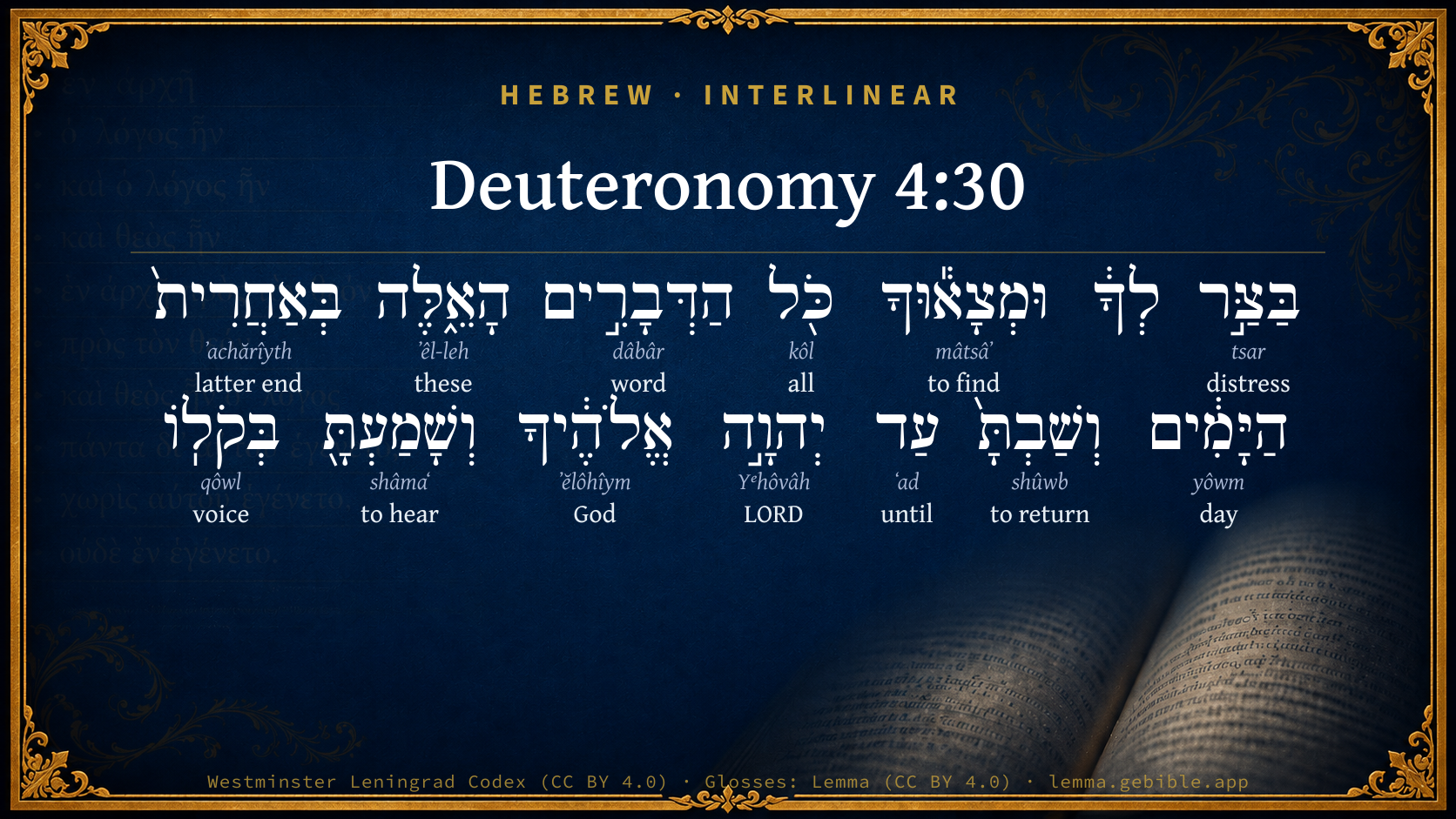
  1. בַּצַּ֣ר tsar H6862 “in/at the · distress” Preposition, Determined + Adjective, Adjective, Masculine, Singular, Absolute
  2. וּמְצָא֕וּךָ mâtsâʼ H4672 “and · to find · you” Conjunction + Verb, Qal, Sequential Perfect, 3rd Person, Common, Plural + Suffix, Personal, 2nd Person, Masculine, Singular
  3. כֹּ֖ל kôl H3605 “all of” Noun, Common, Masculine, Singular, Construct
  4. הַדְּבָרִ֣ים dâbâr H1697 “the · words” Particle, Definite Article + Noun, Common, Masculine, Plural, Absolute
  5. הָאֵ֑לֶּה ʼêl-leh H428 “the · these” Particle, Definite Article + Pronoun, Demonstrative, Common, Plural
  6. הַיָּמִ֔ים yôwm H3117 “the · days” Particle, Definite Article + Noun, Common, Masculine, Plural, Absolute
  7. וְשַׁבְתָּ֙ shûwb H7725 “and · to return” Conjunction + Verb, Qal, Sequential Perfect, 2nd Person, Masculine, Singular
  8. עַד ʻad H5704 “until” Preposition
  9. יְהוָ֣ה Yᵉhôvâh H3068 “LORD” Noun, Proper
  10. אֱלֹהֶ֔יךָ ʼĕlôhîym H430 “God(s) · your” Noun, Common, Masculine, Plural, Construct + Suffix, Personal, 2nd Person, Masculine, Singular
  11. וְשָׁמַעְתָּ֖ shâmaʻ H8085 “and · to hear” Conjunction + Verb, Qal, Sequential Perfect, 2nd Person, Masculine, Singular
  12. בְּקֹלֽוֹ qôwl H6963 “in/at · voice · his” Preposition + Noun, Common, Masculine, Singular, Construct + Suffix, Personal, 3rd Person, Masculine, Singular

About this verse

These counts appear in no published source. They are computed here, from the morphology-tagged text and Lemma’s own curated glosses. What Lemma adds →

14
words
13
distinct lemmas
Pentateuch
section

Grammatical profile

  • 3 verbs
  • 7 nouns
  • 1 adjective
  • 1 pronoun
  • 2 prepositions

Verb forms

  • וּמְצָא֕וּךָ Qal · Sequential Perfect
  • וְשַׁבְתָּ֙ Qal · Sequential Perfect
  • וְשָׁמַעְתָּ֖ Qal · Sequential Perfect

Hebrew & Septuagint length

In English translation the verse runs 29 words from the Hebrew and 27 from the Septuagint (LXX English) — closely comparable.

A rough comparison of the two English renderings, which tokenize alike — not a word-level alignment.

Word counts can differ between the Hebrew and the Greek without any difference in meaning — e.g. the Hebrew direct-object marker אֵת has no separate Greek word, and Greek often adds the article ὁ.

In the original languages it is 14 Hebrew tokens and 23 Greek tokens — but the two are counted differently (Hebrew bundles its prefixes and suffixes into one token; the Greek is in lemma form), so that isn’t a like-for-like length.

Cross-references

22

Topical passages linked to Deuteronomy 4:30 in the Treasury of Scripture Knowledge — connected by theme and wording, ordered by reader-vote popularity; previews shown in the World English Bible.

  • Joel 2:12–13 "Yet even now," says Yahweh, "turn to me with all your heart, And with fasting, and with weeping, and with mourning."
  • Jeremiah 23:20 The anger of Yahweh shall not return, until he has executed, and until he have performed the intents of his heart: in the latter days you shall understand it perfectly.
  • Hosea 3:5 Afterward the children of Israel shall return, and seek Yahweh their God, and David their king, and shall come with trembling to Yahweh and to his blessings in the last days.
  • Deuteronomy 31:29 For I know that after my death you will utterly corrupt yourselves, and turn aside from the way which I have commanded you; and evil will happen to you in the latter days; because you will do that which is evil in the sight of Yahweh, to provoke him to anger through the work of your hands.
  • Genesis 49:1 Jacob called to his sons, and said: "Gather yourselves together, that I may tell you that which will happen to you in the days to come.
  • Isaiah 1:19 If you are willing and obedient, You shall eat the good of the land;
  • Jeremiah 7:23 but this thing I commanded them, saying, Listen to my voice, and I will be your God, and you shall be my people; and walk you in all the way that I command you, that it may be well with you.
  • Numbers 24:20 He looked at Amalek, and took up his parable, and said, Amalek was the first of the nations; But his latter end shall come to destruction.
  • Exodus 18:8 Moses told his father-in-law all that Yahweh had done to Pharaoh and to the Egyptians for Israel's sake, all the hardships that had come on them on the way, and how Yahweh delivered them.
  • Deuteronomy 30:10 if you shall obey the voice of Yahweh your God, to keep his commandments and his statutes which are written in this book of the law; if you turn to Yahweh your God with all your heart, and with all your soul.
  • Deuteronomy 31:17 Then my anger shall be kindled against them in that day, and I will forsake them, and I will hide my face from them, and they shall be devoured, and many evils and troubles shall come on them; so that they will say in that day, Haven't these evils come on us because our God is not among us?
  • 1 Kings 8:46–53 If they sin against you (for there is no man who doesn't sin), and you are angry with them, and deliver them to the enemy, so that they carry them away captive to the land of the enemy, far off or near;
  • 2 Chronicles 6:36–39 If they sin against you (for there is no man who doesn't sin), and you are angry with them, and deliver them to the enemy, so that they carry them away captive to a land far off or near;
  • Daniel 9:11–19 Yes, all Israel have transgressed your law, even turning aside, that they should not obey your voice: therefore has the curse been poured out on us, and the oath that is written in the law of Moses the servant of God; for we have sinned against him.
  • Daniel 10:14 Now I have come to make you understand what shall happen to your people in the latter days; for the vision is yet for [many] days:
  • Hosea 14:2–3 Take words with you, and return to Yahweh. Tell him, "Forgive all our sins, And accept that which is good: So we offer like bulls our lips.
  • Zechariah 6:15 Those who are far off shall come and build in the temple of Yahweh; and you shall know that Yahweh of hosts has sent me to you. This will happen, if you will diligently obey the voice of Yahweh your God."'"
  • Acts 3:19 "Repent therefore, and turn again, that your sins may be blotted out, so that there may come times of refreshing from the presence of the Lord,
  • Acts 26:20 but declared first to them of Damascus, at Jerusalem, and throughout all the country of Judea, and also to the Gentiles, that they should repent and turn to God, doing works worthy of repentance.
  • Hebrews 1:2 has at the end of these days spoken to us by his Son, whom he appointed heir of all things, through whom also he made the worlds.
  • Lamentations 3:40 Let us search and try our ways, and turn again to Yahweh.
  • Hebrews 5:9 Having been made perfect, he became to all of those who obey him the author of eternal salvation,

Cross-references courtesy of OpenBible.info (CC BY 4.0).

Hebrew and Greek witnesses Masoretic Hebrew ↔ Greek Septuagint

The same verse in the two great witnesses to the Old Testament, shown verse-for-verse.

These are two independent witnesses, not word-aligned to each other, and the Septuagint is shown in lemma (dictionary) form.

Hebrew Deuteronomy 4:30 Masoretic · Westminster Leningrad Codex

בַּצַּ֣ר לְךָ֔ וּמְצָא֕וּךָ כֹּ֖ל הַדְּבָרִ֣ים הָאֵ֑לֶּה בְּאַחֲרִית֙ הַיָּמִ֔ים וְשַׁבְתָּ֙ עַד יְהוָ֣ה אֱלֹהֶ֔יךָ וְשָׁמַעְתָּ֖ בְּקֹלֽוֹ

When you are in oppression, and all these things are come on you, in the latter days you shall return to Yahweh your God, and listen to his voice:

World English Bible · Public Domain

Greek LXX Deuteronomy 4:30 Septuagint · lemma form

καί εὑρίσκω σύ πᾶς ὁ λόγος οὗτος ἐπί ἔσχατος ὁ ἡμέρα καί ἐπιστρέφω πρός κύριος ὁ θεός σύ καί εἰςἀκούω ὁ φωνή αὐτός

And all these things shall come upon you in the last days, and you shall turn to the Lord your God, and shall listen to his voice.

LXX2012 (modern English Septuagint) · Public Domain

Hebrew: Westminster Leningrad Codex (CC BY 4.0). Greek: Septuagint (public domain); English from LXX2012 (modern English Septuagint) (Public Domain). How the Septuagint differs from the Hebrew →

Targum (Aramaic paraphrase)

2

The Targum is the ancient Jewish Aramaic paraphrase of the Hebrew Scriptures — an interpretive translation, not the Hebrew text itself. Onkelos (literal) and Pseudo-Jonathan (expansive) render the Torah, and Jonathan the Prophets. Coverage is partial: where no permissively-licensed English translation exists for a verse, only the Aramaic is shown. This is verse-level text, not a word-by-word alignment to the Hebrew.

  1. Targum Onkelos Torah (Genesis–Deuteronomy)
    כַּד יֵיעוֹק לָךְ וְיַשְׁכְּחֻנָךְ כֹּל פִּתְגָמַיָא הָאִלֵין בְּסוֹף יוֹמַיָא וּתְתוּב לְדַחַלְתָּא דַיְיָ אֱלָהָךְ וּתְקַבֵּל לְמֵימְרֵהּ

    (no public-domain English translation for this verse)

    Targum Onkelos — Aramaic: “Onkelos Genesis” (public domain); “Onkelos Exodus” (public domain); “Onkelos Leviticus” (public domain); “Onkelos Numbers” (public domain); “Onkelos Deuteronomy” (public domain). English: “Sefaria Community Translation” (CC0 1.0 (public-domain dedication)); “J.W. Etheridge. The Targums of Onkelos and Jonathan Ben Uzziel on the Pentateuch. London: Longmans, Green, 1862” (public domain). Text via Sefaria.

  2. Targum Pseudo-Jonathan Torah (Genesis–Deuteronomy)
    כַּד תֵּיעוֹק לְכוֹן וִיאַרְעוּן לְכוֹן כָּל פִּתְגָמַיָא הָאִילֵין בְּסוֹף יוֹמַיָא וּתְתוּבוּן עַד דַּחַלְתָּא דַיְיָ אֱלָהָכוֹן וּתְקַבְּלוּן לְמֵימְרֵיהּ

    When you suffer oppression, and all these things come upon you in the end of the days, and you be converted to the fear of the Lord your God, and obey His Word;

    Targum Pseudo-Jonathan — Aramaic: “Targum Jonathan on Genesis” (public domain); “Targum Jonathan on Exodus” (public domain); “Targum Jonathan on Leviticus” (public domain); “Targum Jonathan on Numbers” (public domain); “Targum Jonathan on Deuteronomy” (public domain). English: “The Targum of Jonathan ben Uzziel, trans. J. W. Etheridge, London, 1862” (public domain). Text via Sefaria.

Commentary

Notes on Deuteronomy 4:30 from classic Christian and Jewish commentators (each source and its license shown beneath its notes). The classic Christian expositions comment on the surrounding passage and are grouped to its opening verse, so a note may address several verses; the Jewish commentaries on the Tanakh (Rashi and others) are per-verse, so they appear only where the commentator wrote on this verse.

Lemma curates 59 commentaries, every one of them public domain or Creative Commons licensed, each selected and text-cleaned for this edition rather than reprinted as found. About our sources →

Trapp's Complete Commentary

John Trapp

Deu 4:30 When thou art in tribulation, and all these things are come upon thee, [even] in the latter days, if thou turn to the LORD thy God, and shalt be obedient unto his voice;

Ver. 30. Even in the latter days.] This is by some understood of the Messiah’s days, which are the latter times of the world; {Hos 3:5 1Co 10:11} and they believe that here is pointed at the great and last conversion of the Jews.

John Trapp, A Commentary or Exposition upon All the Books of the Old and New Testament (1647–1656) — public domain. Text from a community e-Sword module.

Joseph Benson's Commentary

Deu 4:30-31. In the latter days — Either in general in succeeding ages and generations, or particularly in the days of the Messiah, commonly called in Scripture, the latter, or last days. Here the apostacy and misery of the Jewish nation in the latter days is clearly foretold, as it is more at large in chap 28. But the passage also gives encouragement to hope for their conversion and redemption; and that even in those times when their case should seem most desperate; when they should have forsaken God and rejected the Messiah, toward the end of the world.

Joseph Benson's Commentary on the Old and New Testaments (1811–1818) — public domain. Text from a community e-Sword module.

Tyndale Open Study Notes

Tyndale Open Resources

4:30 distant future (literally last [or latter] days): Israel would eventually return from the Exile and worldwide dispersion (see 30:1-10; Lev 26:40-45; Jer 31:27-34; Ezek 36:22-31).

Tyndale Open Study Notes — © Tyndale Open Resources, licensed CC BY-SA 4.0. Text via the HelloAO Bible API.

Geneva Bible (1599)

Geneva Bible translators

Hebrew, in the latter days.

Geneva Bible (1599) marginal notes — public domain. Text via Bolls.life.

Jamieson, Fausset & Brown

Robert Jamieson, A. R. Fausset & David Brown

in the latter days, if thou turn to the Lord thy God--either towards the destined close of their captivities, when they evinced a returning spirit of repentance and faith, or in the age of Messiah, which is commonly called "the latter days," and when the scattered tribes of Israel shall be converted to the Gospel of Christ. The occurrence of this auspicious event will be the most illustrious proof of the truth of the promise made in Deu 4:31.

Jamieson, Fausset & Brown — Commentary Critical and Explanatory on the Whole Bible (1871) — public domain (CC PDM 1.0). Text via the HelloAO Bible API.

Adam Clarke's Commentary

Verse 30. When thou art in tribulation in the latter days] Are not these the times spoken of? And is there not still hope for Israel? Could we see them become zealous for their own law and religious observances - could we see them humble themselves before the God of Jacob - could we see them conduct their public worship with any tolerable decency and decorum - could we see them zealous to avoid every moral evil, inquiring the road to Zion, with their faces thitherward; then might we hope that the redemption of Israel was at hand: but alas! there is not the most distant evidence of any thing of the kind, except in a very few solitary instances. They are, perhaps, in the present day, more lost to every sacred principle of their own institutions than they have ever been since their return from the Babylonish captivity. By whom shall Jacob arise? for in this sense he is small - deeply fallen, and greatly degraded.

Adam Clarke's Commentary on the Bible (1810–1826) — public domain. Text from a community e-Sword/MySword module.

The Cambridge Bible for Schools and Colleges

gen. ed. J. J. S. Perowne

30. all these things] Implied in 26 f.

in the latter days] The end or issue of the days; frequently in the prophets of what is beyond the period with which they are engaged.

and hearken unto his voice] Found also in JE, this phrase much oftener occurs in D; no less than 17 times.

The Cambridge Bible for Schools and Colleges (gen. ed. J. J. S. Perowne; Cambridge University Press, 1878–1918) — public domain. Text from a community e-Sword module.

John Gill's Exposition

When thou art in tribulation,.... In a strange land, in the power of a foreign enemy, and used ill:

and all these things are come upon thee; captivity, thraldom, hard labour, and want of the necessaries of life:

even in the latter days: in their present captivity for the rejection of the Messiah:

if thou turn to the Lord thy God; as the Jews will when they are converted and brought to a sense of their sin, and of their need of Christ, and seek to him as their Saviour, as they will do in the latter day, Hos 3:5.

and shall be obedient unto his voice; not of the law only, but of the Gospel also, proclaiming peace, pardon, righteousness, and salvation by him whom they have pierced.

John Gill's Exposition of the Whole Bible (1746–1763) — public domain (CC PDM 1.0). Text via the HelloAO Bible API.

Haydock's Catholic Bible Commentary

Voice, after the captivity of Babylon, or rather at the end of the world. The nation at large has not embraced the worship of idols since the former period. But it will not be perfectly converted until the fulness of the Gentiles....come in.---And so all Israel....be saved, Romans xi. 25. (Calmet) --- St. Paul terms their present state a blindness in part, because, though few have embraced the revelation of God, made to all by his only Son, the far greater part have obstinately shut their eyes, so that, even while they read the clearest prophecies, they seem to have a veil on then. But, after they shall have been the sport of their passions and errors till the latter time, when the man of sin shall be fully revealed, they will see how wretchedly they have been deluded, and, the grace of God touching their hearts, they will remember the covenant, and embrace Christ, the end of all the law. Happy those who do not defer their conversion till that awful period! (Haydock)

George Leo Haydock (1774–1849), Haydock's Catholic Family Bible and Commentary, 1859 edition — public domain. Excludes Psalms (Douay-Rheims chapter numbering differs from Protestant) and Deuterocanonical books (Catholic canon only).

Matthew Poole's English Annotations

In the latter days; either in general, in succeeding ages and generations; or particularly, in the days of the Messias, which are commonly called in Scripture

the latter, or last days, as Isa 2:2; Hos 3:5; Mic 4:1; Dan 2:44; Heb 1:2 9:26. And so this may respect the conversion and redemption of the Jewish nation even in those times when their case seems most desperate, when they have forsaken their God and rejected their Messias for many ages, to wit, towards the end of the world.

Matthew Poole's English Annotations on the Holy Bible (1683–1685) — public domain. Text from a community e-Sword/MySword module.

The Pulpit Commentary

In the latter days; in the afterward of days ( (Deu_11:12) a phase used sometimes to designate the times of the Messiah (Isa_2:2; Hos_3:5; comp. Act_2:17; 1Pe_1:20; Heb_1:1; 1Jn_2:18) but here, as generally, it simply indicates futurity, the time to come (cf. Gen_49:1; Num_24:14; Deu_31:29, etc.) This, however, may include the far distant future, and so points to the time when Israel shall finally return to the Lord and be saved, through the acknowledgment of him whom they despised and rejected when he came as the Messiah promised to the fathers. As St. Paul grounds the assurance of the final redemption of Israel, as a whole, on their calling of God, (Rom_11:26-29) so Moses here sees in God"s covenant the ground of the ever-watchful care and grace of God to Israel, and the security of their final restoration as a nation.

The Pulpit Commentary (1880–1919), ed. H.D.M. Spence-Jones & Joseph S. Exell — public domain. Text from a community e-Sword module.

John Wesley's Explanatory Notes

In the latter days - In succeeding ages.

John Wesley, Explanatory Notes Upon the Whole Bible (1754–1765) — public domain. Text via the GEBible commentary corpus.

unfoldingWord translationNotes

Door43 World Missions Community

will have come on

"have happened to"

in those later days

"afterwards" or "then"

listen to his voice

Here "listen" is an idiom that means to hear and obey. Also, "his voice" refers to Yahweh and emphasizes what he says. AT: "obey what he says" (See: Idiom and Synecdoche)

translationWords

Yahweh

God

voice

mercy

covenant

ancestor

oath

unfoldingWord translationNotes — © Distant Shores Media and the Door43 World Missions Community, licensed CC BY-SA 4.0. Source: git.door43.org/Door43/en_tn.

Ramban (Nachmanides)

Rabbi Moshe ben Nachman (Ramban / Nachmanides)

AND THOU WILT RETURN TO THE ETERNAL THY G-D, AND HEARKEN UNTO HIS VOICE. This, too, is an allusion to the redemption from [the exile in] Babylon, that they will repent to G-d and confess [their sins] before Him and hearken to the voice of the prophets that He will appoint for them. Therefore, he promised them that He would not destroy them, nor forget the covenant of their fathers, as He said, And I will remember My covenant with Jacob etc. And at the end of this book he will allude to the future redemption as I have explained, and I will yet mention it with the help of G-d.

Ramban (Nachmanides) on the Tanakh — English translation: “Commentary on the Torah by Ramban (Nachmanides). Translated and annotated by Charles B. Chavel. New York, Shilo Pub. House, 1971-1976” (CC BY 4.0). Text via Sefaria.

Lesson kit

Teaching starters — assembled from the data on this page, not authored interpretation. Every prompt links to the verse data it draws on. Edit before teaching.

Deuteronomy, in the Pentateuch, opens this verse with 14 words (13 distinct Hebrew lemmas). Its most distinctive word is ʼachărîyth (“latter end”). A historical commentator’s framing appears above. Read the whole chapter for the surrounding context.

Discussion questions

  1. The word ʼachărîyth carries the sense “latter end.” How does it shape the verse?
  2. Joel 2:12–13 shares this passage’s theme. How do the two illuminate each other?
  3. These translations render this verse differently. What is at stake in choosing one wording over another?
  4. The verb «וּמְצָא֕וּךָ» is Qal Sequential Perfect. How does its form color the action?
  5. Reading how Trapp's Complete Commentary and Joseph Benson's Commentary read this verse, where do the two commentators agree and where do they part?

Things to notice

Reading settings

Reading text

Shown beneath each verse's original-language words.

Old Testament
Old Testament edition

Read the OT as the Masoretic Hebrew (MT) or the Greek Septuagint (LXX).

English shown for the Greek Septuagint (in the Hebrew ↔ Greek comparison).

Comparing translations? Open the Compare panel on any verse page to stack up to four side by side.