
Exodus 9:33

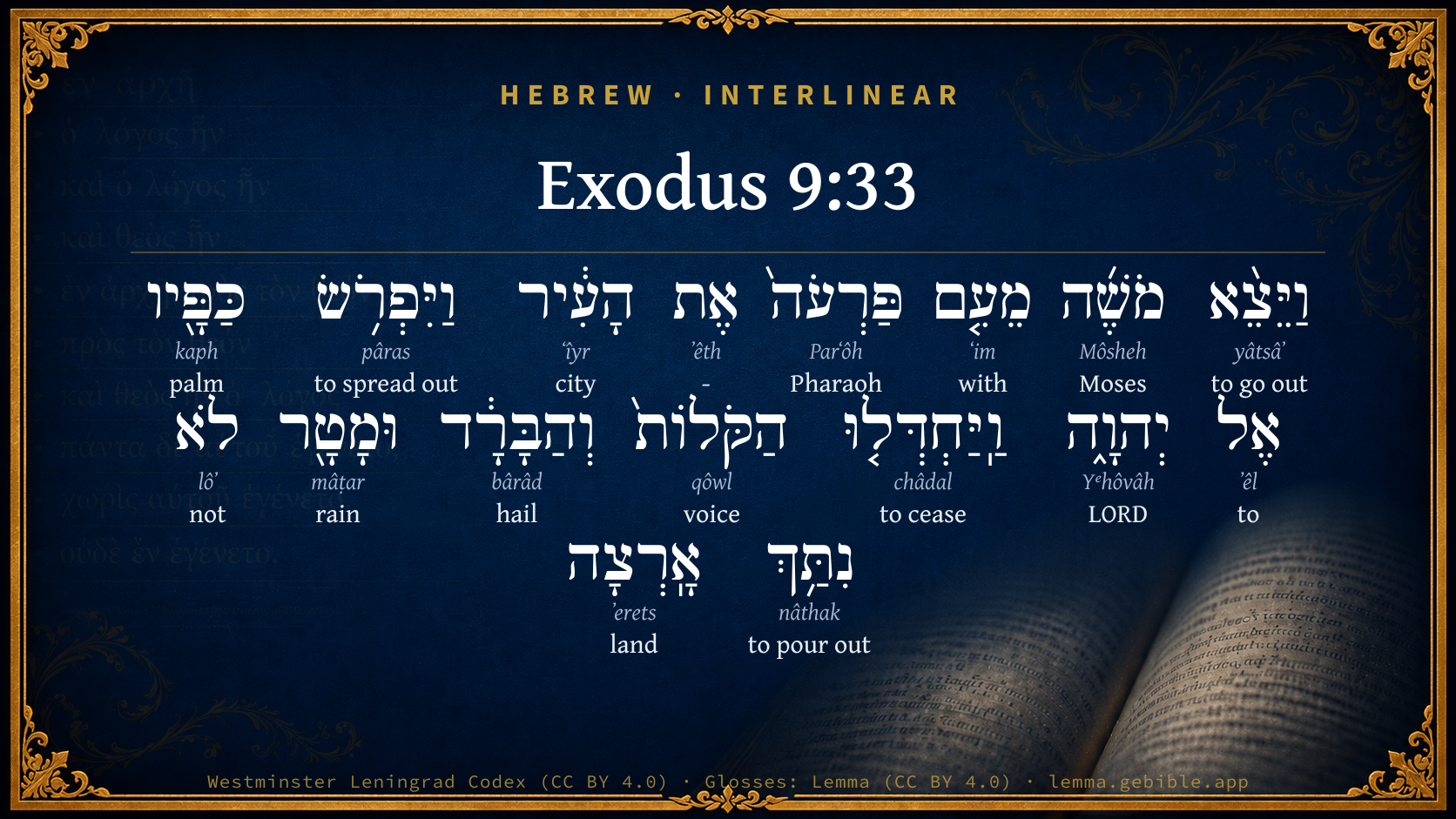
Hebrew (Westminster Leningrad Codex) Exodus 9:33 appears in the Hebrew Old Testament. The text above is from the Westminster Leningrad Codex. Each word links to its Strong’s number, a concise gloss, and parsing drawn from the Open Scriptures Hebrew Bible morphology. Click any word for its full Brown-Driver-Briggs (BDB) entry.
Download image
Cite this verse

Exodus 9:33 (World English Bible). Public Domain. Lemma interlinear Bible study tool, https://lemma.gebible.app/v/exodus/9/33.

Show BibTeX & RIS
BibTeX
RIS
English Translation
Moses went out of the city from Pharaoh, and spread abroad his hands to Yahweh; and the thunders and hail ceased, and the rain was not poured on the earth.
World English Bible · Public Domain
Highlights
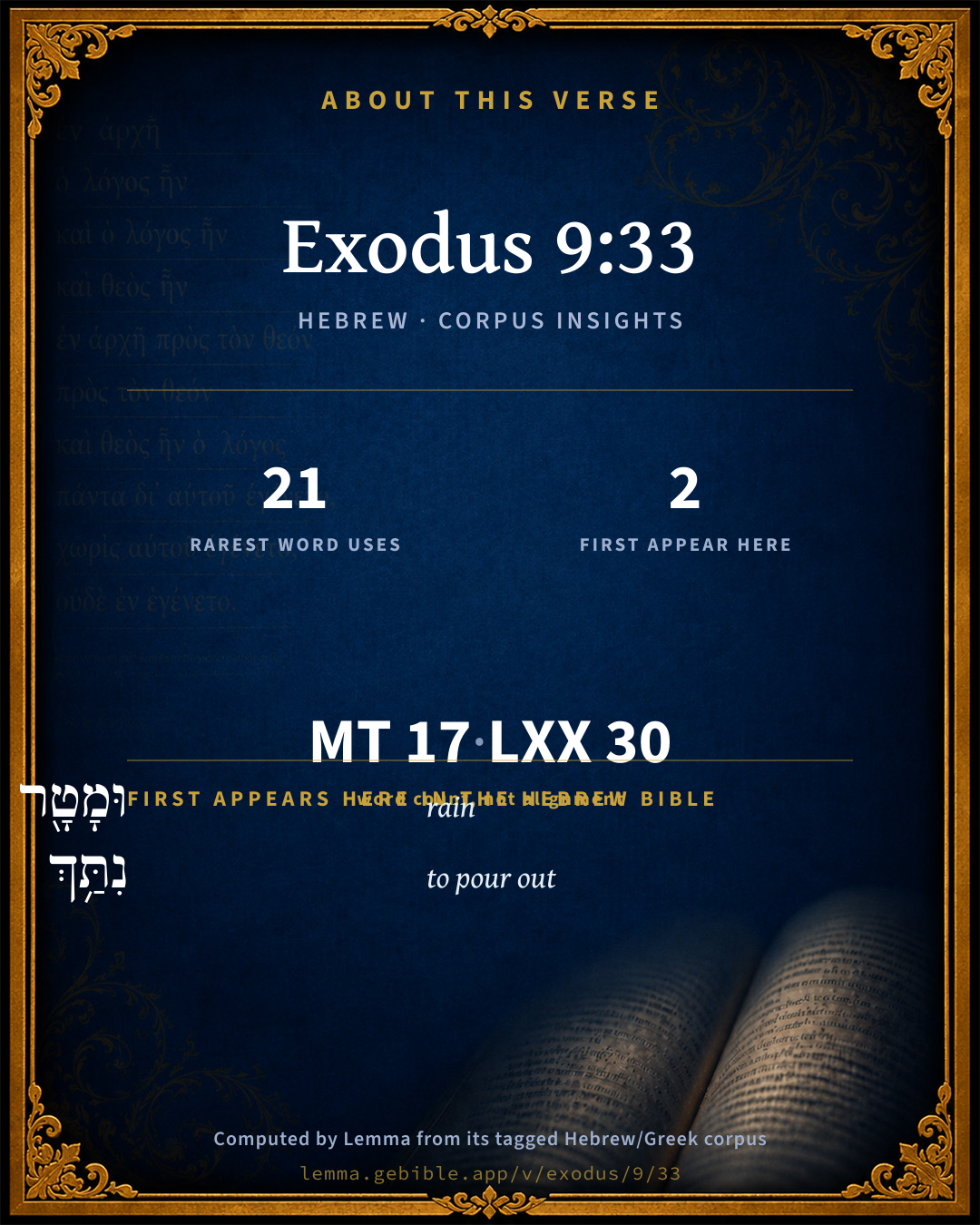
  • 2 first appearances in the Hebrew Bible
Full analysis ↓
Download a study sheet

One document with this verse’s original text, its word-by-word gloss line, the meaning frame, cross-references with their text, attributed commentary, and full source and license credits — printable, and it pastes into notes with its structure intact.

This verse Autodidact and up

Study sheet (.html) Plain text (.txt)

A passage Seminary Student

Up to 50 verses in one chapter. A passage sheet keeps up to 6 commentary sources and 12 cross-references per verse, in the order this page ranks them, and says so on the sheet whenever that leaves anything out. Ask for a single verse and you get the Autodidact verse sheet above.

Everything on this page stays free to read, with no account — the sheet is a download of what is already on screen, not access to it.

Want to remove ads? Support Godless Engineer
Compare translations 3

The same verse in 3 English versions, stacked beneath the original-language interlinear above. Click any original word for its lexicon entry.

Each is an independent rendering of the whole verse — the interlinear is not word-aligned to these translations.

Highlighted words mark where these versions differ — a whole-verse word diff, not a word-by-word alignment.

  • World English Bible Public Domain
    Moses went out of the city from Pharaoh, and spread abroad his hands to Yahweh; and the thunders and hail ceased, and the rain was not poured on the earth.
  • King James Version Public Domain
    And Moses went out of the city from Pharaoh, and spread abroad his hands unto the LORD: and the thunders and hail ceased, and the rain was not poured upon the earth.
  • unfoldingWord Literal Text CC BY-SA 4.0
    And Moses left the city from being with Pharaoh, and he spread his palms to Yahweh, and the thunder and hail ceased, and the rain was not poured on the earth.

unfoldingWord Literal Text — © unfoldingWord, licensed CC BY-SA 4.0. Word-aligned USFM3 via Door43 (git.door43.org/unfoldingWord/en_ult).

Versions to compare (up to 4)

3 of 4 selected

Show all 18 translations

Every available English version of this verse, each an independent rendering of the whole verse.

  • World English Bible Public Domain
    Moses went out of the city from Pharaoh, and spread abroad his hands to Yahweh; and the thunders and hail ceased, and the rain was not poured on the earth.
  • Berean Standard Bible Public Domain
    Then Moses departed from Pharaoh, went out of the city, and spread out his hands to the LORD. The thunder and hail ceased, and the rain no longer poured down on the land.
  • Majority Standard Bible Public Domain
    Then Moses departed from Pharaoh, went out of the city, and spread out his hands to the LORD. The thunder and hail ceased, and the rain no longer poured down on the land.
  • King James Version Public Domain
    And Moses went out of the city from Pharaoh, and spread abroad his hands unto the LORD: and the thunders and hail ceased, and the rain was not poured upon the earth.
  • American Standard Version (1901) Public Domain
    And Moses went out of the city from Pharaoh, and spread abroad his hands unto Jehovah: and the thunders and hail ceased, and the rain was not poured upon the earth.
  • Revised Version (1885) Public Domain
    And Moses went out of the city from Pharaoh, and spread abroad his hands unto the LORD: and the thunders and hail ceased, and the rain was not poured upon the earth.
  • Geneva Bible (1599) Public Domain
    Then Moses went out of the citie from Pharaoh, and spred his hands to the Lord, and the thunder and the haile ceased, neither rained it vpon the earth.
  • Douay-Rheims (1899) Public Domain
    And when Moses was gone from Pharao out of the city, he stretched forth his hands to the Lord: and the thunders and the hail ceased, neither did there drop any more rain upon the earth.
  • Young's Literal Translation Public Domain
    And Moses goeth out from Pharaoh, `from' the city, and spreadeth his hands unto Jehovah, and the voices and the hail cease, and rain hath not been poured out to the earth;
  • Literal Standard Version CC BY-SA 4.0
    And Moses goes out from Pharaoh, [from] the city, and spreads his hands to YHWH, and the voices and the hail cease, and rain has not been poured out to the earth;
  • Unlocked Literal Bible CC BY-SA 4.0
    When Moses had left Pharaoh and the city, he spread out his hands to Yahweh; the thunder and hail stopped, and the rain came down no more.
  • unfoldingWord Literal Text CC BY-SA 4.0
    And Moses left the city from being with Pharaoh, and he spread his palms to Yahweh, and the thunder and hail ceased, and the rain was not poured on the earth.
  • Darby Bible Public Domain
    And Moses went out of the city from Pharaoh, and spread out his hands to Jehovah; and the thunders and hail ceased, and the rain was not [any more] poured on the earth.
  • World Messianic Bible Public Domain
    Moses went out of the city from Pharaoh, and spread out his hands to the LORD; and the thunders and hail ceased, and the rain was not poured on the earth.
  • Webster's Bible Public Domain
    And Moses went out of the city from Pharaoh, and spread abroad his hands to the LORD: and the thunders and hail ceased, and the rain was not poured upon the earth.
  • Free Bible Version CC BY-SA 4.0
    Moses left Pharaoh and went out of the city, and prayed to the Lord. The thunder and hail stopped, and the rainstorm finished.
  • Bible in Basic English Public Domain
    So Moses went out of the town, and stretching out his hands made prayer to God: and the thunders and the ice-storm came to an end; and the fall of rain was stopped.
  • JPS Tanakh (1917) Public Domain
    And Moses went out of the city from Pharaoh, and spread forth his hands unto the LORD; and the thunders and hail ceased, and the rain was not poured upon the earth.

Literal Standard Version (2020), Covenant Press — licensed CC BY-SA 4.0. Text via the HelloAO Bible API (eBible.org). Unlocked Literal Bible (unfoldingWord) — licensed CC BY-SA 4.0. Text via the HelloAO Bible API (eBible.org). unfoldingWord Literal Text — © unfoldingWord, licensed CC BY-SA 4.0. Word-aligned USFM3 via Door43 (git.door43.org/unfoldingWord/en_ult). Free Bible Version, Dr. Jonathan Gallagher — licensed CC BY-SA 4.0. Text via the HelloAO Bible API (eBible.org).

Word by word

More ways to search: Search by grammar → Find every occurrence → Compare this word →

Practice this passage: Drill this verse → Learn its vocabulary →

נִתַּ֥ךְ
nâthak
H5413
“to pour out”
Verb, Niphal, Perfect, 3rd Person, Masculine, Singular
Part of Speech
Verb
Stem
Niphal
Form
Perfect
Person
3rd Person
Gender
Masculine
Number
Singular
Full BDB Definition

Origin: a primitive root

TWOT: 1442

to pour out or forth, drop (or rain), be poured, be poured out, be melted, be molten - (Qal) to pour forth - (Niphal) to be poured, be poured out - (Hiphil) to pour out, melt - (Hophal) to be melted
  1. וַיֵּצֵ֨א yâtsâʼ H3318 “and · to go out” Conjunction + Verb, Qal, Sequential Imperfect, 3rd Person, Masculine, Singular
  2. מֹשֶׁ֜ה Môsheh H4872 “Moses” Noun, Proper
  3. מֵעִ֤ם ʻim H5973 “from · with” Preposition + Preposition
  4. פַּרְעֹה֙ Parʻôh H6547 “Pharaoh” Noun, Proper
  5. אֶת ʼêth H853 “-” Particle, Direct Object
  6. הָעִ֔יר ʻîyr H5892 “the · city” Particle, Definite Article + Noun, Common, Feminine, Singular, Absolute
  7. וַיִּפְרֹ֥שׂ pâras H6566 “and · to spread out” Conjunction + Verb, Qal, Sequential Imperfect, 3rd Person, Masculine, Singular
  8. כַּפָּ֖יו kaph H3709 “palms · his” Noun, Common, Feminine, Dual, Construct + Suffix, Personal, 3rd Person, Masculine, Singular
  9. אֶל ʼêl H413 “to” Preposition
  10. יְהוָ֑ה Yᵉhôvâh H3068 “LORD” Noun, Proper
  11. וַֽיַּחְדְּל֤וּ châdal H2308 “and · to cease” Conjunction + Verb, Qal, Sequential Imperfect, 3rd Person, Masculine, Plural
  12. הַקֹּלוֹת֙ qôwl H6963 “the · voices” Particle, Definite Article + Noun, Common, Masculine, Plural, Absolute
  13. וְהַבָּרָ֔ד bârâd H1259 “and · the · hail” Conjunction + Particle, Definite Article + Noun, Common, Masculine, Singular, Absolute
  14. וּמָטָ֖ר mâṭar H4306 “and · rain” Conjunction + Noun, Common, Masculine, Singular, Absolute
  15. לֹא lôʼ H3808 “not” Particle, Negative
  16. אָֽרְצָה ʼerets H776 “land · toward” Noun, Common, Both, Singular, Absolute + Suffix, Demonstrative

About this verse

These counts appear in no published source. They are computed here, from the morphology-tagged text and Lemma’s own curated glosses. What Lemma adds →

17
words
17
distinct lemmas
Pentateuch
section

Notable vocabulary

The rarest word here is נִתַּ֥ךְ to pour out H5413 — appearing just 21 times in the whole Hebrew Bible.

First appearance in Scripture

These words make their first canonical appearance in the Hebrew Bible here:

  • וּמָטָ֖ר rain H4306
  • נִתַּ֥ךְ to pour out H5413

Shared distinctive vocabulary

נִתַּ֥ךְ to pour out H5413 occurs in 19 verses of the Hebrew Bible. Also found in:

Grammatical profile

  • 4 verbs
  • 9 nouns
  • 2 prepositions
  • 2 particles

Verb forms

  • וַיֵּצֵ֨א Qal · Sequential Imperfect
  • וַיִּפְרֹ֥שׂ Qal · Sequential Imperfect
  • וַֽיַּחְדְּל֤וּ Qal · Sequential Imperfect
  • נִתַּ֥ךְ Niphal · Perfect

Hebrew & Septuagint length

In English translation the verse runs 30 words from the Hebrew and 34 from the Septuagint (LXX English) — closely comparable.

A rough comparison of the two English renderings, which tokenize alike — not a word-level alignment.

Word counts can differ between the Hebrew and the Greek without any difference in meaning — e.g. the Hebrew direct-object marker אֵת has no separate Greek word, and Greek often adds the article ὁ.

In the original languages it is 17 Hebrew tokens and 30 Greek tokens — but the two are counted differently (Hebrew bundles its prefixes and suffixes into one token; the Greek is in lemma form), so that isn’t a like-for-like length.

Cross-references

4

Topical passages linked to Exodus 9:33 in the Treasury of Scripture Knowledge — connected by theme and wording, ordered by reader-vote popularity; previews shown in the World English Bible.

  • Exodus 9:29 Moses said to him, "As soon as I have gone out of the city, I will spread abroad my hands to Yahweh. The thunders shall cease, neither shall there be any more hail; that you may know that the earth is Yahweh's.
  • Exodus 8:12 Moses and Aaron went out from Pharaoh, and Moses cried to Yahweh concerning the frogs which he had brought on Pharaoh.
  • Exodus 10:18–19 He went out from Pharaoh, and prayed to Yahweh.
  • James 5:17–18 Elijah was a man with a nature like ours, and he prayed earnestly that it might not rain, and it didn't rain on the earth for three years and six months.

Cross-references courtesy of OpenBible.info (CC BY 4.0).

Hebrew and Greek witnesses Masoretic Hebrew ↔ Greek Septuagint

The same verse in the two great witnesses to the Old Testament, shown verse-for-verse.

These are two independent witnesses, not word-aligned to each other, and the Septuagint is shown in lemma (dictionary) form.

Hebrew Exodus 9:33 Masoretic · Westminster Leningrad Codex

וַיֵּצֵ֨א מֹשֶׁ֜ה מֵעִ֤ם פַּרְעֹה֙ אֶת הָעִ֔יר וַיִּפְרֹ֥שׂ כַּפָּ֖יו אֶל יְהוָ֑ה וַֽיַּחְדְּל֤וּ הַקֹּלוֹת֙ וְהַבָּרָ֔ד וּמָטָ֖ר לֹא נִתַּ֥ךְ אָֽרְצָה

Moses went out of the city from Pharaoh, and spread abroad his hands to Yahweh; and the thunders and hail ceased, and the rain was not poured on the earth.

World English Bible · Public Domain

Greek LXX Exodus 9:33 Septuagint · lemma form

ἐκἔρχομαι δέ μωυσῆς ἀπό φαραώ ἐκτός ὁ πόλις καί ἐκπετάννυμι ὁ χείρ πρός κύριος καί ὁ φωνή παύω καί ὁ χάλαζα καί ὁ ὑετός οὐ στάζω ἔτι ἐπί ὁ γῆ

And Moses went forth from Pharao out of the city, and stretched out his hands to the Lord, and the thunders ceased and the hail, and the rain did not drop on the earth.

LXX2012 (modern English Septuagint) · Public Domain

Hebrew: Westminster Leningrad Codex (CC BY 4.0). Greek: Septuagint (public domain); English from LXX2012 (modern English Septuagint) (Public Domain). How the Septuagint differs from the Hebrew →

Targum (Aramaic paraphrase)

2

The Targum is the ancient Jewish Aramaic paraphrase of the Hebrew Scriptures — an interpretive translation, not the Hebrew text itself. Onkelos (literal) and Pseudo-Jonathan (expansive) render the Torah, and Jonathan the Prophets. Coverage is partial: where no permissively-licensed English translation exists for a verse, only the Aramaic is shown. This is verse-level text, not a word-by-word alignment to the Hebrew.

  1. Targum Onkelos Torah (Genesis–Deuteronomy)
    וּנְפַק משֶׁה מִלְוַת פַּרְעֹה יָת קַרְתָּא וּפְרַשׂ יְדוֹהִי בִּצְלוֹ קֳדָם יְיָ וַיִתְמַנְעוּן קָלַיָא וּבַרְדָא וּמִטְרָא דַהֲוָה נָחִית לָא מְטָא עַל אַרְעָא:

    (no public-domain English translation for this verse)

    Targum Onkelos — Aramaic: “Onkelos Genesis” (public domain); “Onkelos Exodus” (public domain); “Onkelos Leviticus” (public domain); “Onkelos Numbers” (public domain); “Onkelos Deuteronomy” (public domain). English: “Sefaria Community Translation” (CC0 1.0 (public-domain dedication)); “J.W. Etheridge. The Targums of Onkelos and Jonathan Ben Uzziel on the Pentateuch. London: Longmans, Green, 1862” (public domain). Text via Sefaria.

  2. Targum Pseudo-Jonathan Torah (Genesis–Deuteronomy)
    וּנְפַק משֶׁה וְאַהֲרן מִלְוַת פַּרְעה סְמִיךְ לְקַרְתָּא וּפְרַס יְדוֹי בִּצְלוֹי קֳדָם יְיָ וְאִתְמְנָעוּ קָלִין דִלְוָוט וּבַרְדָא וּמִטְרָא דַהֲוָה נָחִית לָא מָטָא עַל אַרְעָא

    And Mosheh and Aharon went out from Pharoh to the suburb, and he stretched out his hands in prayer before the Lord, and the thunders of the curse were withheld, and the hail and rain that were descending came not on the earth.

    Targum Pseudo-Jonathan — Aramaic: “Targum Jonathan on Genesis” (public domain); “Targum Jonathan on Exodus” (public domain); “Targum Jonathan on Leviticus” (public domain); “Targum Jonathan on Numbers” (public domain); “Targum Jonathan on Deuteronomy” (public domain). English: “The Targum of Jonathan ben Uzziel, trans. J. W. Etheridge, London, 1862” (public domain). Text via Sefaria.

Commentary

Notes on Exodus 9:33 from classic Christian and Jewish commentators (each source and its license shown beneath its notes). The classic Christian expositions comment on the surrounding passage and are grouped to its opening verse, so a note may address several verses; the Jewish commentaries on the Tanakh (Rashi and others) are per-verse, so they appear only where the commentator wrote on this verse.

Lemma curates 59 commentaries, every one of them public domain or Creative Commons licensed, each selected and text-cleaned for this edition rather than reprinted as found. About our sources →

Trapp's Complete Commentary

John Trapp

Exo 9:33 And Moses went out of the city from Pharaoh, and spread abroad his hands unto the LORD: and the thunders and hail ceased, and the rain was not poured upon the earth.

Ver. 33. Went out of the city.] For privacy sake.

Spread abroad his hands.] {See Trapp on "Exo 9:29"}

John Trapp, A Commentary or Exposition upon All the Books of the Old and New Testament (1647–1656) — public domain. Text from a community e-Sword module.

Joseph Benson's Commentary

Exo 9:33-34. Moses went out of the city — Not only for privacy in his communication with God, but to show that he durst venture abroad into the field, notwithstanding the hail and lightning, knowing that every hail- stone had its direction from God. And spread abroad his hands unto the Lord — An outward expression of earnest desire, and humble expectation. He prevailed with God; but he could not prevail with Pharaoh: he sinned yet more, and hardened his heart — The prayer of Moses opened and shut heaven, like Elijah’s. And such is the power of God’s two witnesses, Rev 11:6. Yet neither Moses nor Elijah, nor those two witnesses, could subdue the hard hearts of men. Pharaoh was frighted into compliance by the judgment, but, when it was over, his convictions vanished.

Joseph Benson's Commentary on the Old and New Testaments (1811–1818) — public domain. Text from a community e-Sword module.

Adam Clarke's Commentary

Verse 33. Spread abroad his hands] Probably with the rod of God in them. See what has been said on the spreading out of the hands in prayer, Ex 9:29. See Clarke on Ex 9:29.

Adam Clarke's Commentary on the Bible (1810–1826) — public domain. Text from a community e-Sword/MySword module.

Ellicott's Commentary for English Readers

(33) Moses went out of the city . . . and spread abroad his hands.—Moses did not fear the storm. Though it still raged, he quitted the shelter of the city, and went out into the midst of it, and spread out his hands to God, when lo! at once the rain, and hail, and thunder ceased at his bidding, and soon “there was a great calm.” As Millington observes—“Moses knew that he was safe, though all around might be destroyed; the very hairs of his head were all numbered, not one of them could perish. Standing there under the tempestuous canopy of heaven, bareheaded, in the attitude of prayer, he spread abroad his hands unto the Lord, and the thunder and hail ceased, and the rain was not poured upon the earth” (Plagues of Egypt, p. 135).

A Bible Commentary for English Readers, edited by Charles John Ellicott (1878–1897) — public domain. Text from a community e-Sword module.

John Gill's Exposition

And when Pharaoh saw that the rain, and the hail, and the thunders were ceased,.... And there was a clear sky and a fine serene heaven, the black clouds were dispersed and gone, and he heard no more the clattering of the hailstones, and the terrible claps of thunder, and saw no more the flashes of lightning, but all was calm and composed:

he sinned yet more, and hardened his heart, he and his servants; instead of giving glory to God, who had heard the prayers of Moses and Aaron for them, and had delivered them from their frights and fears, and the terror and horror they were in, and of letting the people of Israel go, see Rev 16:21.

John Gill's Exposition of the Whole Bible (1746–1763) — public domain (CC PDM 1.0). Text via the HelloAO Bible API.

Matthew Poole's English Annotations

Moses went out of the city, that, being solitary, he might pour forth his heart in fervent prayers.

Matthew Poole's English Annotations on the Holy Bible (1683–1685) — public domain. Text from a community e-Sword/MySword module.

Whedon's Commentary on the Bible

Daniel D. Whedon

33. Went out of the city — This shows that Pharaoh then resided in a city, probably Zoan. See on Exo_1:8.

Daniel D. Whedon (gen. ed.), Commentary on the Old and New Testaments (1874–1909) — public domain. Text from a community e-Sword module.

The Pulpit Commentary

The rain was not poured upon the earth. Rain had not been previously mentioned, as it was no part of the plague, that is, it caused no damage. But Moses, recording the cessation as an eye-witness, recollects that rain was mingled with the hail, and that, at his prayer, the thunder, the hail, and the rain all ceased. The touch is one which no later writer would have introduced.

The Pulpit Commentary (1880–1919), ed. H.D.M. Spence-Jones & Joseph S. Exell — public domain. Text from a community e-Sword module.

John Wesley's Explanatory Notes

Moses went out of the city - Not only for privacy in his communion with God, but to shew that he durst venture abroad into the field, notwithstanding the hail and lightning, knowing that every hail-stone had its direction from God. Peace with God makes men thunder-proof, for it is the voice of their father. And spread abroad his hands unto the Lord - An outward expression of earnest desire, and humble expectation. He prevailed with God; but he could not prevail with Pharaoh; he sinned yet more, and hardened his heart - The prayer of Moses opened and shut heaven, like Elijah's. And such is the power of God's two witnesses, Rev. xi, 6. Yet neither Moses nor Elijah, nor those two witnesses, could subdue the hard hearts of men. Pharaoh was frighted into compliance by the judgment, but, when it was over, his convictions vanished.

John Wesley, Explanatory Notes Upon the Whole Bible (1754–1765) — public domain. Text via the GEBible commentary corpus.

Keil & Delitzsch

C. F. Keil & F. Delitzsch

But even this plague did not lead Pharaoh to alter his mind. As soon as it had ceased on the intercession of Moses, he and his servants continued sinning and hardening their hearts.

Keil & Delitzsch — Biblical Commentary on the Old Testament (1861–1891) — public domain (CC PDM 1.0). Text via the HelloAO Bible API. (Old Testament only.)

Rashi

Rabbi Shlomo Yitzchaki (Rashi)

לא נתך means [RAIN] DID NOT REACH the earth (i. e. no fresh rain came down) — that rain, too, which was alredy in the air at the moment when Moses was praying remained there and did not reach the ground. In a similar sense is “ותתך עלינו the curse and the oath” — a passage in the book of Ezra (really, Daniel 9:11) — which signifies, “the curse and the oath have reached us”. But Menachem ben Seruk classified it in the same section as, (Ezekiel 22:22) “כהתוך כסף” which has the meaning of melting (pouring forth) metal. I agree with his opinion, because in the Targum we render ויצק, (Onkelos Exodus 38:5) “And he cast (metal)”, by ואתיך, and (Onkelos Exodus 38:27) לצקת, “to cast (metal)” by לאתכא, each of these Aramaic words being of the same root as our word נתך. Therefore לא נתך ארצה would mean: rain was not poured out to the ground.

Rashi on the Tanakh — English translations: “The Judaica Press complete Tanach with Rashi, translated by A. J. Rosenberg” (CC BY 4.0); “Pentateuch with Rashi's commentary by M. Rosenbaum and A.M. Silbermann, 1929-1934” (public domain); “The Metsudah Tanach series, Lakewood, N.J” (CC BY 4.0); and “The Book of Joshua, Metsudah Publications, 1997” (CC BY 4.0). Text via Sefaria.

Lesson kit

Teaching starters — assembled from the data on this page, not authored interpretation. Every prompt links to the verse data it draws on. Edit before teaching.

Exodus, in the Pentateuch, opens this verse with 17 words (17 distinct Hebrew lemmas). Its most distinctive word is nâthak (“to pour out”). A historical commentator’s framing appears above. Read the whole chapter for the surrounding context.

Discussion questions

  1. The word nâthak carries the sense “to pour out.” How does it shape the verse?
  2. 2 words make their first appearance in Scripture here. What does this debut establish?
  3. How does 2 Samuel 21:10, which shares the word «to pour out», read alongside this verse?
  4. The translations on this page render this verse differently — a whole-verse word diff, not a word-by-word alignment. What might account for the different wordings?
  5. «וַיֵּצֵ֨א» is a Qal Sequential Imperfect verb. How does that grammatical form shape the action described?
  6. Compare how Trapp's Complete Commentary and Joseph Benson's Commentary read this verse. Where do they agree or differ?

Things to notice

Reading settings

Reading text

Shown beneath each verse's original-language words.

Old Testament
Old Testament edition

Read the OT as the Masoretic Hebrew (MT) or the Greek Septuagint (LXX).

English shown for the Greek Septuagint (in the Hebrew ↔ Greek comparison).

Comparing translations? Open the Compare panel on any verse page to stack up to four side by side.