
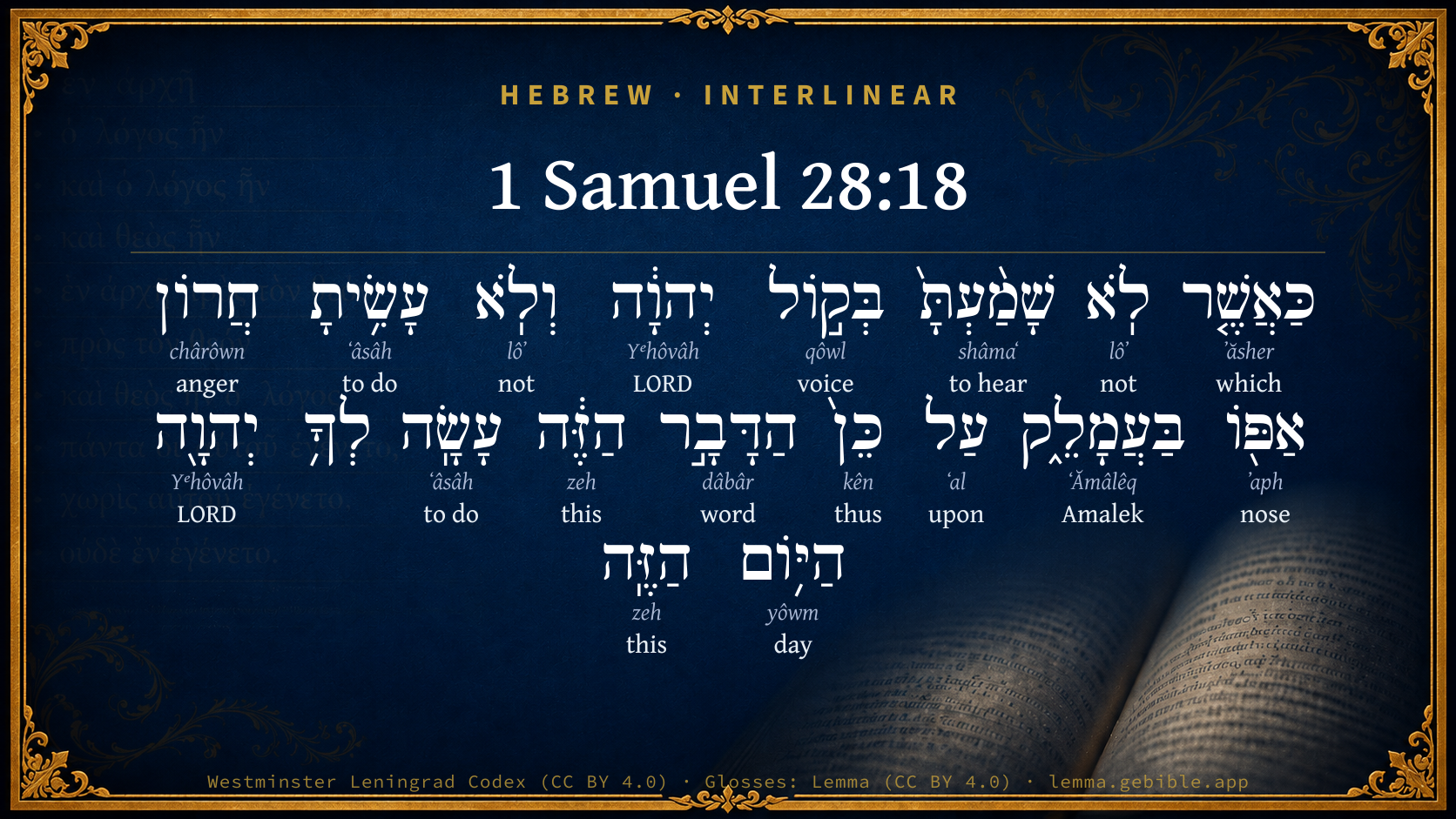
1 Samuel 28:18

Hebrew (Westminster Leningrad Codex) 1 Samuel 28:18 appears in the Hebrew Old Testament. The text above is from the Westminster Leningrad Codex. Each word links to its Strong’s number, a concise gloss, and parsing drawn from the Open Scriptures Hebrew Bible morphology. Click any word for its full Brown-Driver-Briggs (BDB) entry.
Download image
Cite this verse

1 Samuel 28:18 (World English Bible). Public Domain. Lemma interlinear Bible study tool, https://lemma.gebible.app/v/1-samuel/28/18.

Show BibTeX & RIS
BibTeX
RIS
English Translation
Because you didn't obey the voice of Yahweh, and didn't execute his fierce wrath on Amalek, therefore has Yahweh done this thing to you this day.
World English Bible · Public Domain
Download a study sheet

One document with this verse’s original text, its word-by-word gloss line, the meaning frame, cross-references with their text, attributed commentary, and full source and license credits — printable, and it pastes into notes with its structure intact.

This verse Autodidact and up

Study sheet (.html) Plain text (.txt)

A passage Seminary Student

Up to 50 verses in one chapter. A passage sheet keeps up to 6 commentary sources and 12 cross-references per verse, in the order this page ranks them, and says so on the sheet whenever that leaves anything out. Ask for a single verse and you get the Autodidact verse sheet above.

Everything on this page stays free to read, with no account — the sheet is a download of what is already on screen, not access to it.

Want to remove ads? Support Godless Engineer
Compare translations 3

The same verse in 3 English versions, stacked beneath the original-language interlinear above. Click any original word for its lexicon entry.

Each is an independent rendering of the whole verse — the interlinear is not word-aligned to these translations.

Highlighted words mark where these versions differ — a whole-verse word diff, not a word-by-word alignment.

  • World English Bible Public Domain
    Because you didn't obey the voice of Yahweh, and didn't execute his fierce wrath on Amalek, therefore has Yahweh done this thing to you this day.
  • King James Version Public Domain
    Because thou obeyedst not the voice of the LORD, nor executedst his fierce wrath upon Amalek, therefore hath the LORD done this thing unto thee this day.
  • unfoldingWord Literal Text CC BY-SA 4.0
    Because you did not listen to the voice of Yahweh and you did not do the burning of his nose against Amalek, therefore Yahweh has done this thing to you this day.

unfoldingWord Literal Text — © unfoldingWord, licensed CC BY-SA 4.0. Word-aligned USFM3 via Door43 (git.door43.org/unfoldingWord/en_ult).

Versions to compare (up to 4)

3 of 4 selected

Show all 18 translations

Every available English version of this verse, each an independent rendering of the whole verse.

  • World English Bible Public Domain
    Because you didn't obey the voice of Yahweh, and didn't execute his fierce wrath on Amalek, therefore has Yahweh done this thing to you this day.
  • Berean Standard Bible Public Domain
    Because you did not obey the LORD or carry out His burning anger against Amalek, the LORD has done this to you today.
  • Majority Standard Bible Public Domain
    Because you did not obey the LORD or carry out His burning anger against Amalek, the LORD has done this to you today.
  • King James Version Public Domain
    Because thou obeyedst not the voice of the LORD, nor executedst his fierce wrath upon Amalek, therefore hath the LORD done this thing unto thee this day.
  • American Standard Version (1901) Public Domain
    Because thou obeyedst not the voice of Jehovah, and didst not execute his fierce wrath upon Amalek, therefore hath Jehovah done this thing unto thee this day.
  • Revised Version (1885) Public Domain
    Because thou obeyedst not the voice of the LORD and didst not execute his fierce wrath upon Amalek, therefore hath the LORD done this thing unto thee this day.
  • Geneva Bible (1599) Public Domain
    Because thou obeyedst not the voyce of the Lord, nor executedst his fierce wrath vpon the Amalekites, therefore hath the Lord done this vnto thee this day.
  • Douay-Rheims (1899) Public Domain
    Because thou didst not obey the voice of the Lord, neither didst thou execute the wrath of his indignation upon Amalec. Therefore hath the Lord done to thee what thou sufferest this day.
  • Young's Literal Translation Public Domain
    Because thou hast not hearkened to the voice of Jehovah, nor didst the fierceness of His anger on Amalek -- therefore this thing hath Jehovah done to thee this day;
  • Literal Standard Version CC BY-SA 4.0
    Because you have not listened to the voice of YHWH, nor did the fierceness of His anger on Amalek—therefore YHWH has done this thing to you this day;
  • Unlocked Literal Bible CC BY-SA 4.0
    Because you did not obey the voice of Yahweh and did not carry out his fierce wrath on Amalek, he has therefore done this today to you.
  • unfoldingWord Literal Text CC BY-SA 4.0
    Because you did not listen to the voice of Yahweh and you did not do the burning of his nose against Amalek, therefore Yahweh has done this thing to you this day.
  • Darby Bible Public Domain
    Because thou didst not hearken to the voice of Jehovah, and didst not execute his fierce anger upon Amalek, therefore has Jehovah done this thing to thee this day.
  • World Messianic Bible Public Domain
    Because you didn’t obey the LORD’s voice, and didn’t execute his fierce wrath on Amalek, therefore the LORD has done this thing to you today.
  • Webster's Bible Public Domain
    Because thou didst not obey the voice of the LORD, nor execute his fierce wrath upon Amalek, therefore hath the LORD done this thing to thee this day.
  • Free Bible Version CC BY-SA 4.0
    The Lord has done this to you today because you did not do what the Lord commanded and you did not execute his furious anger on the Amalekites.
  • Bible in Basic English Public Domain
    Because you did not do what the Lord said, and did not give effect to his burning wrath against Amalek. So the Lord has done this thing to you today.
  • JPS Tanakh (1917) Public Domain
    Because thou didst not hearken to the voice of the LORD, and didst not execute His fierce wrath upon Amalek, therefore hath the LORD done this thing unto thee this day.

Literal Standard Version (2020), Covenant Press — licensed CC BY-SA 4.0. Text via the HelloAO Bible API (eBible.org). Unlocked Literal Bible (unfoldingWord) — licensed CC BY-SA 4.0. Text via the HelloAO Bible API (eBible.org). unfoldingWord Literal Text — © unfoldingWord, licensed CC BY-SA 4.0. Word-aligned USFM3 via Door43 (git.door43.org/unfoldingWord/en_ult). Free Bible Version, Dr. Jonathan Gallagher — licensed CC BY-SA 4.0. Text via the HelloAO Bible API (eBible.org).

Word by word

More ways to search: Search by grammar → Find every occurrence → Compare this word →

Practice this passage: Drill this verse → Learn its vocabulary →

בַּעֲמָלֵ֑ק
ʻĂmâlêq
H6002
“in/at · Amalek”
Preposition + Noun, Proper
Part of Speech
Preposition + Noun
Type
Proper
Full BDB Definition

Origin: probably of foreign origin

TWOT: None

Amalek = "dweller in a valley" - son of Eliphaz by his concubine Timnah, grandson of Esau, and progenitor of a tribe of people in southern Canaan - descendants of Amalek
  1. כַּאֲשֶׁ֤ר ʼăsher H834 “like/as · which” Preposition + Particle, Relative
  2. לֹֽא lôʼ H3808 “not” Particle, Negative
  3. שָׁמַ֨עְתָּ֙ shâmaʻ H8085 “to hear” Verb, Qal, Perfect, 2nd Person, Masculine, Singular
  4. בְּק֣וֹל qôwl H6963 “in/at · voice of” Preposition + Noun, Common, Masculine, Singular, Construct
  5. יְהוָ֔ה Yᵉhôvâh H3068 “LORD” Noun, Proper
  6. וְלֹֽא lôʼ H3808 “and · not” Conjunction + Particle, Negative
  7. עָשִׂ֥יתָ ʻâsâh H6213 “to do” Verb, Qal, Perfect, 2nd Person, Masculine, Singular
  8. חֲרוֹן chârôwn H2740 “anger of” Noun, Common, Masculine, Singular, Construct
  9. אַפּ֖וֹ ʼaph H639 “nose · his” Noun, Common, Masculine, Singular, Construct + Suffix, Personal, 3rd Person, Masculine, Singular
  10. עַל ʻal H5921 “upon” Preposition
  11. כֵּן֙ kên H3651 “thus” Particle, Demonstrative
  12. הַדָּבָ֣ר dâbâr H1697 “the · word” Particle, Definite Article + Noun, Common, Masculine, Singular, Absolute
  13. הַזֶּ֔ה zeh H2088 “the · this” Particle, Definite Article + Pronoun, Demonstrative, Masculine, Singular
  14. עָשָֽׂה ʻâsâh H6213 “to do” Verb, Qal, Perfect, 3rd Person, Masculine, Singular
  15. יְהוָ֖ה Yᵉhôvâh H3068 “LORD” Noun, Proper
  16. הַיּ֥וֹם yôwm H3117 “the · day” Particle, Definite Article + Noun, Common, Masculine, Singular, Absolute
  17. הַזֶּֽה zeh H2088 “the · this” Particle, Definite Article + Pronoun, Demonstrative, Masculine, Singular

About this verse

These counts appear in no published source. They are computed here, from the morphology-tagged text and Lemma’s own curated glosses. What Lemma adds →

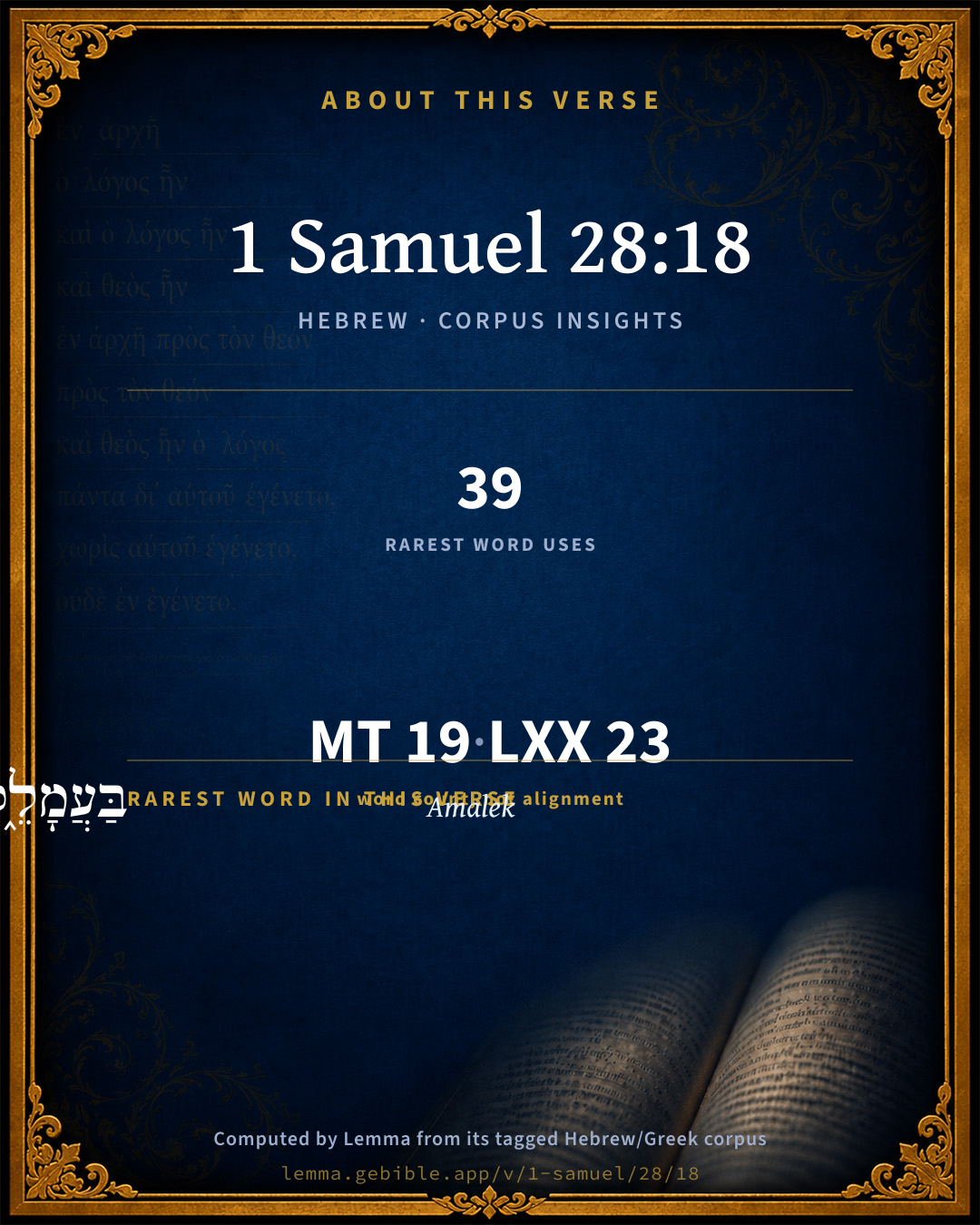
19
words
14
distinct lemmas
Historical
section

Shared distinctive vocabulary

בַּעֲמָלֵ֑ק Amalek H6002 occurs in 37 verses of the Hebrew Bible. Also found in:

Grammatical profile

  • 3 verbs
  • 8 nouns
  • 2 pronouns
  • 2 prepositions
  • 4 particles

Verb forms

  • שָׁמַ֨עְתָּ֙ Qal · Perfect
  • עָשִׂ֥יתָ Qal · Perfect
  • עָשָֽׂה Qal · Perfect

Repetition

Words recur within this verse — often emphatic in Hebrew:

  • יְהוָ֔ה LORD H3068 ×2
  • עָשִׂ֥יתָ to do H6213 ×2
  • לֹֽא not H3808 ×2
  • הַזֶּ֔ה this H2088 ×2

Hebrew & Septuagint length

In English translation the verse runs 26 words from the Hebrew and 31 from the Septuagint (LXX English) — closely comparable.

A rough comparison of the two English renderings, which tokenize alike — not a word-level alignment.

Word counts can differ between the Hebrew and the Greek without any difference in meaning — e.g. the Hebrew direct-object marker אֵת has no separate Greek word, and Greek often adds the article ὁ.

In the original languages it is 19 Hebrew tokens and 23 Greek tokens — but the two are counted differently (Hebrew bundles its prefixes and suffixes into one token; the Greek is in lemma form), so that isn’t a like-for-like length.

Cross-references

8

Topical passages linked to 1 Samuel 28:18 in the Treasury of Scripture Knowledge — connected by theme and wording, ordered by reader-vote popularity; previews shown in the World English Bible.

  • 1 Samuel 15:9 But Saul and the people spared Agag, and the best of the sheep, and of the oxen, and of the fatlings, and the lambs, and all that was good, and wouldn't utterly destroy them: but everything that was vile and refuse, that they destroyed utterly.
  • 1 Kings 20:42 He said to him, Thus says Yahweh, Because you have let go out of your hand the man whom I had devoted to destruction, therefore your life shall go for his life, and your people for his people.
  • Jeremiah 48:10 Cursed be he who does the work of Yahweh negligently; and cursed be he who keeps back his sword from blood.
  • 1 Samuel 13:9 Saul said, Bring here the burnt offering to me, and the peace-offerings. He offered the burnt offering.
  • 1 Samuel 15:20 Saul said to Samuel, Yes, I have obeyed the voice of Yahweh, and have gone the way which Yahweh sent me, and have brought Agag the king of Amalek, and have utterly destroyed the Amalekites.
  • 1 Samuel 15:23–26 For rebellion is as the sin of witchcraft, and stubbornness is as idolatry and teraphim. Because you have rejected the word of Yahweh, he has also rejected you from being king.
  • 1 Chronicles 10:13 So Saul died for his trespass which he committed against Yahweh, because of the word of Yahweh, which he didn't keep; and also because he asked counsel of one who had a familiar spirit, to inquire [thereby],
  • Psalms 50:21–22 You have done these things, and I kept silent. You thought that the "I AM" was just like you. I will rebuke you, and accuse you in front of your eyes.

Cross-references courtesy of OpenBible.info (CC BY 4.0).

Hebrew and Greek witnesses Masoretic Hebrew ↔ Greek Septuagint

The same verse in the two great witnesses to the Old Testament, shown verse-for-verse.

These are two independent witnesses, not word-aligned to each other, and the Septuagint is shown in lemma (dictionary) form.

Hebrew 1 Samuel 28:18 Masoretic · Westminster Leningrad Codex

כַּאֲשֶׁ֤ר לֹֽא שָׁמַ֨עְתָּ֙ בְּק֣וֹל יְהוָ֔ה וְלֹֽא עָשִׂ֥יתָ חֲרוֹן אַפּ֖וֹ בַּעֲמָלֵ֑ק עַל כֵּן֙ הַדָּבָ֣ר הַזֶּ֔ה עָשָֽׂה לְךָ֥ יְהוָ֖ה הַיּ֥וֹם הַזֶּֽה

Because you didn't obey the voice of Yahweh, and didn't execute his fierce wrath on Amalek, therefore has Yahweh done this thing to you this day.

World English Bible · Public Domain

Greek LXX 1 Samuel 28:18 Septuagint · lemma form

διότι οὐ ἀκούω φωνή κύριος καί οὐ ποιέω θυμός ὀργή αὐτός ἐν αμαληκ διά οὗτος ὁ ῥῆμα ποιέω κύριος σύ ὁ ἡμέρα οὗτος

because you did not listen to the voice of the Lord, and did not execute his fierce anger upon Amalec, therefore the Lord has done this thing to you this day.

LXX2012 (modern English Septuagint) · Public Domain

Hebrew: Westminster Leningrad Codex (CC BY 4.0). Greek: Septuagint (public domain); English from LXX2012 (modern English Septuagint) (Public Domain). How the Septuagint differs from the Hebrew →

Targum (Aramaic paraphrase)

1

The Targum is the ancient Jewish Aramaic paraphrase of the Hebrew Scriptures — an interpretive translation, not the Hebrew text itself. Onkelos (literal) and Pseudo-Jonathan (expansive) render the Torah, and Jonathan the Prophets. Coverage is partial: where no permissively-licensed English translation exists for a verse, only the Aramaic is shown. This is verse-level text, not a word-by-word alignment to the Hebrew.

  1. Targum Jonathan Prophets (Joshua–Malachi)
    כְּמָא דְלָא קַבֵּילְתָּא בְּמֵימְרָא דַייָ וְלָא עֲבַדְתָּא תְקֵיף רוּגְזֵיהּ בַּעֲמָלֵק עַל כֵּן פִּתְגָמָא הָדֵין עֲבַד לָךְ יְיָ יוֹמָא הָדֵין:

    (no public-domain English translation for this verse)

    Targum Jonathan — Aramaic: “Mikraot Gedolot” (public domain). English: “Sefaria Community Translation” (CC0 1.0 (public-domain dedication)); “London "Chaldee Paraphrase," 1871” (public domain). Text via Sefaria.

Commentary

Notes on 1 Samuel 28:18 from classic Christian and Jewish commentators (each source and its license shown beneath its notes). The classic Christian expositions comment on the surrounding passage and are grouped to its opening verse, so a note may address several verses; the Jewish commentaries on the Tanakh (Rashi and others) are per-verse, so they appear only where the commentator wrote on this verse.

Lemma curates 59 commentaries, every one of them public domain or Creative Commons licensed, each selected and text-cleaned for this edition rather than reprinted as found. About our sources →

Trapp's Complete Commentary

John Trapp

1Sa 28:18 Because thou obeyedst not the voice of the LORD, nor executedst his fierce wrath upon Amalek, therefore hath the LORD done this thing unto thee this day.

Ver. 18. Because thou obeyedst not the voice of the Lord.] This disobedience the devil had once tempted him unto, and now he layeth it in his dish to drive him to despair. This is yet his method to this day: be not ignorant of his wiles.

John Trapp, A Commentary or Exposition upon All the Books of the Old and New Testament (1647–1656) — public domain. Text from a community e-Sword module.

Tyndale Open Study Notes

Tyndale Open Resources

28:18 you refused: Samuel’s message to Saul had not changed (cp. 15:19).

Tyndale Open Study Notes — © Tyndale Open Resources, licensed CC BY-SA 4.0. Text via the HelloAO Bible API.

Adam Clarke's Commentary

Verse 18. Nor executedst his fierce wrath upon Amalek] See 1Sa 15:1-9 and the notes there.

Adam Clarke's Commentary on the Bible (1810–1826) — public domain. Text from a community e-Sword/MySword module.

The Cambridge Bible for Schools and Colleges

gen. ed. J. J. S. Perowne

18. Because thou obeyedst not, &c.] Cp. 1Sa_15:20; 1Sa_15:26.

executedst … hath the Lord done] The connexion between the sin and the sentence is emphasized by the use of the same verb in the original in both clauses.

The Cambridge Bible for Schools and Colleges (gen. ed. J. J. S. Perowne; Cambridge University Press, 1878–1918) — public domain. Text from a community e-Sword module.

John Gill's Exposition

Because thou obeyedst not the voice of the Lord,.... At Gilgal, as Abarbinel thinks; which is the first thing for which the kingdom was threatened to be taken from him, Sa1 13:13,

nor executedst his fierce wrath upon Amalek: in sparing Agag, and the best of the cattle, Sa1 15:9,

therefore hath the Lord done this thing unto thee this day; forsaken him, rent his kingdom from him, and would deliver him into the hands of the Philistines, as follows: had he been the true Samuel, he would have told him of some other sins of his, provoking to the Lord; as his slaughter of the priests at Nob, his cruel persecution of David, and especially of his asking counsel of one that had a familiar spirit at this time, of which not a word is said, and yet was the very transgression for which Saul died, Ch1 10:13.

John Gill's Exposition of the Whole Bible (1746–1763) — public domain (CC PDM 1.0). Text via the HelloAO Bible API.

Matthew Poole's English Annotations

Nor executedst his fierce wrath upon Amalek; he mentions this as an eminent instance of his disobedience.

Matthew Poole's English Annotations on the Holy Bible (1683–1685) — public domain. Text from a community e-Sword/MySword module.

unfoldingWord translationNotes

Door43 World Missions Community

Yahweh will give Israel along with you into the hand of the Philistines

Samuel speaks as if the people of Israel were a small object that Yahweh would give to the Philistines, whom he speaks of as if they were one person. AT: "Yahweh will allow the Philistines to do whatever they want to do to you and the people of Israel" (See: Metaphor)

will be with me

This is a polite way to say that Saul will die. AT: "will be dead" (See: Euphemism)

Yahweh will also give the army of Israel into the hand of the Philistines

Samuel speaks as if the army of Israel were a small object that Yahweh would give to the Philistines, whom he speaks of as if they were one person. AT: "Yahweh will allow the Philistines to do whatever they want to do to the army of Israel" (See: Metaphor)

translationWords

obey

voice

Yahweh

wrath

Amalek

hand

Israel

Philistines

son

unfoldingWord translationNotes — © Distant Shores Media and the Door43 World Missions Community, licensed CC BY-SA 4.0. Source: git.door43.org/Door43/en_tn.

Lesson kit

Teaching starters — assembled from the data on this page, not authored interpretation. Every prompt links to the verse data it draws on. Edit before teaching.

1 Samuel, in the Historical, opens this verse with 19 words (14 distinct Hebrew lemmas). Its most distinctive word is ʻĂmâlêq (“Amalek”). A historical commentator’s framing appears above. Read the whole chapter for the surrounding context.

Discussion questions

  1. The word ʻĂmâlêq carries the sense “Amalek.” How does it shape the verse?
  2. How does Genesis 36:12, which shares the word «Amalek», read alongside this verse?
  3. What does the repetition of “LORD” (2× in this one verse) do in this verse?
  4. The translations on this page render this verse differently — a whole-verse word diff, not a word-by-word alignment. What might account for the different wordings?
  5. «שָׁמַ֨עְתָּ֙» is a Qal Perfect verb. How does that grammatical form shape the action described?
  6. Compare how Trapp's Complete Commentary and Tyndale Open Study Notes read this verse. Where do they agree or differ?

Things to notice

Reading settings

Reading text

Shown beneath each verse's original-language words.

Old Testament
Old Testament edition

Read the OT as the Masoretic Hebrew (MT) or the Greek Septuagint (LXX).

English shown for the Greek Septuagint (in the Hebrew ↔ Greek comparison).

Comparing translations? Open the Compare panel on any verse page to stack up to four side by side.