
Exodus 24:3

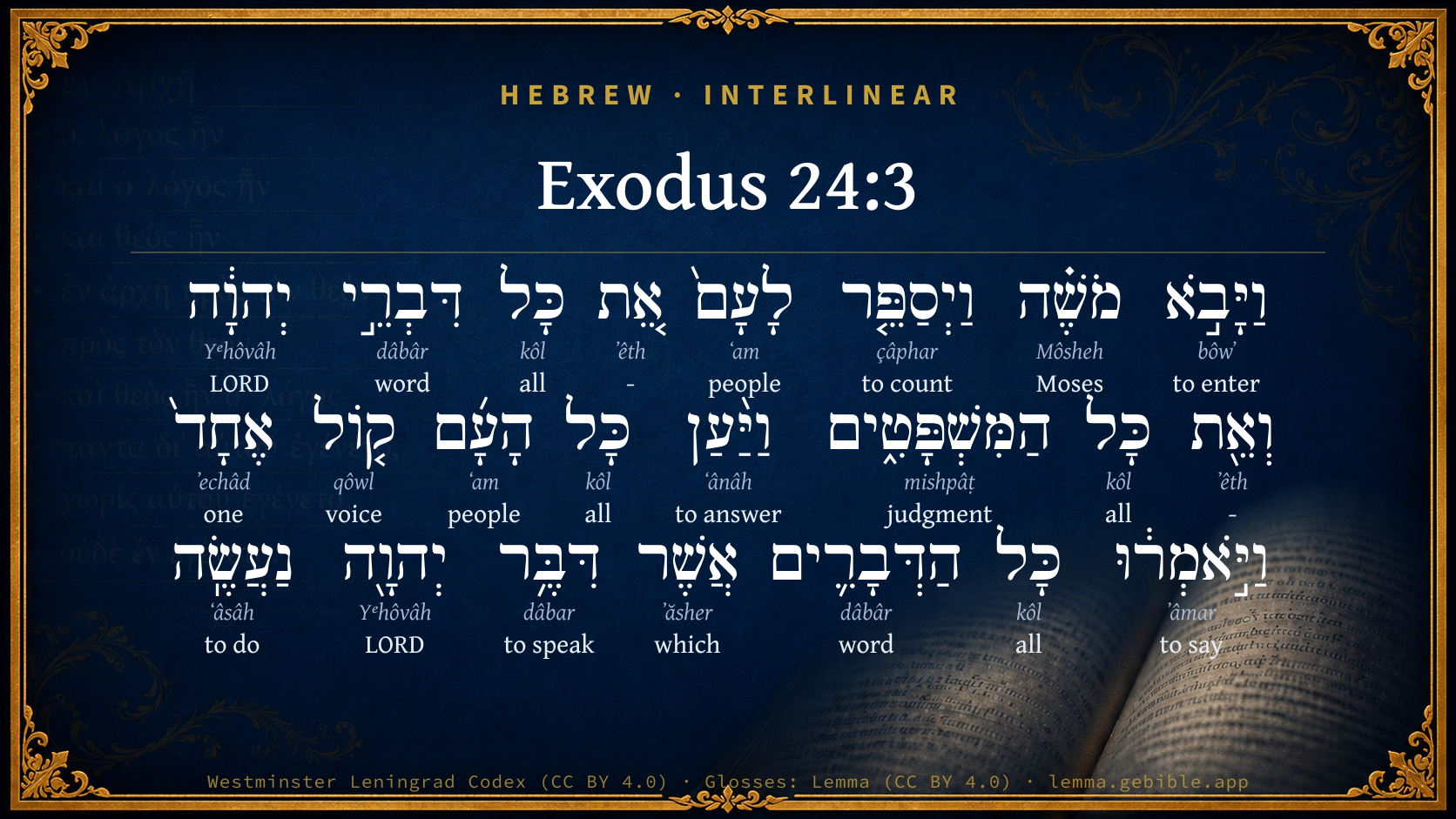
Hebrew (Westminster Leningrad Codex) Exodus 24:3 appears in the Hebrew Old Testament. The text above is from the Westminster Leningrad Codex. Each word links to its Strong’s number, a concise gloss, and parsing drawn from the Open Scriptures Hebrew Bible morphology. Click any word for its full Brown-Driver-Briggs (BDB) entry.
Download image
Cite this verse

Exodus 24:3 (World English Bible). Public Domain. Lemma interlinear Bible study tool, https://lemma.gebible.app/v/exodus/24/3.

Show BibTeX & RIS
BibTeX
RIS
English Translation
Moses came and told the people all the words of Yahweh, and all the ordinances; and all the people answered with one voice, and said, "All the words which Yahweh has spoken will we do."
World English Bible · Public Domain
Download a study sheet

One document with this verse’s original text, its word-by-word gloss line, the meaning frame, cross-references with their text, attributed commentary, and full source and license credits — printable, and it pastes into notes with its structure intact.

This verse Autodidact and up

Study sheet (.html) Plain text (.txt)

A passage Seminary Student

Up to 50 verses in one chapter. A passage sheet keeps up to 6 commentary sources and 12 cross-references per verse, in the order this page ranks them, and says so on the sheet whenever that leaves anything out. Ask for a single verse and you get the Autodidact verse sheet above.

Everything on this page stays free to read, with no account — the sheet is a download of what is already on screen, not access to it.

Want to remove ads? Support Godless Engineer
Compare translations 3

The same verse in 3 English versions, stacked beneath the original-language interlinear above. Click any original word for its lexicon entry.

Each is an independent rendering of the whole verse — the interlinear is not word-aligned to these translations.

Highlighted words mark where these versions differ — a whole-verse word diff, not a word-by-word alignment.

  • World English Bible Public Domain
    Moses came and told the people all the words of Yahweh, and all the ordinances; and all the people answered with one voice, and said, "All the words which Yahweh has spoken will we do."
  • King James Version Public Domain
    And Moses came and told the people all the words of the LORD, and all the judgments: and all the people answered with one voice, and said, All the words which the LORD hath said will we do.
  • unfoldingWord Literal Text CC BY-SA 4.0
    And Moses went and recounted to the people all of the words of Yahweh and all of the ordinances. And all of the people answered with one voice and said, “We will do all the things that Yahweh has spoken.”

unfoldingWord Literal Text — © unfoldingWord, licensed CC BY-SA 4.0. Word-aligned USFM3 via Door43 (git.door43.org/unfoldingWord/en_ult).

Versions to compare (up to 4)

3 of 4 selected

Show all 18 translations

Every available English version of this verse, each an independent rendering of the whole verse.

  • World English Bible Public Domain
    Moses came and told the people all the words of Yahweh, and all the ordinances; and all the people answered with one voice, and said, "All the words which Yahweh has spoken will we do."
  • Berean Standard Bible Public Domain
    When Moses came and told the people all the words and ordinances of the LORD, they all responded with one voice: “All the words that the LORD has spoken, we will do.”
  • Majority Standard Bible Public Domain
    When Moses came and told the people all the words and ordinances of the LORD, they all responded with one voice: “All the words that the LORD has spoken, we will do.”
  • King James Version Public Domain
    And Moses came and told the people all the words of the LORD, and all the judgments: and all the people answered with one voice, and said, All the words which the LORD hath said will we do.
  • American Standard Version (1901) Public Domain
    And Moses came and told the people all the words of Jehovah, and all the ordinances: and all the people answered with one voice, and said, All the words which Jehovah hath spoken will we do.
  • Revised Version (1885) Public Domain
    And Moses came and told the people all the words of the LORD, and all the judgments: and all the people answered with one voice, and said, All the words which the LORD hath spoken will we do.
  • Geneva Bible (1599) Public Domain
    Afterwarde Moses came and told the people all the wordes of the Lord, and all the lawes: and all the people answered with one voyce, and said, All the things which the Lord hath said, will we doe.
  • Douay-Rheims (1899) Public Domain
    So Moses came and told the people all the words of the Lord, and all the judgments: and all the people answered with one voice: We will do all the words of the Lord, which he hath spoken.
  • Young's Literal Translation Public Domain
    And Moses cometh in, and recounteth to the people all the words of Jehovah, and all the judgments, and all the people answer -- one voice, and say, `All the words which Jehovah hath spoken we do.'
  • Literal Standard Version CC BY-SA 4.0
    And Moses comes in, and recounts to the people all the words of YHWH, and all the judgments, and all the people answer [with] one voice, and say, “All the words which YHWH has spoken we do.”
  • Unlocked Literal Bible CC BY-SA 4.0
    Moses went and told the people all of Yahweh's words and decrees. All the people answered with one voice and said, “We will do all the words that Yahweh has said.”
  • unfoldingWord Literal Text CC BY-SA 4.0
    And Moses went and recounted to the people all of the words of Yahweh and all of the ordinances. And all of the people answered with one voice and said, “We will do all the things that Yahweh has spoken.”
  • Darby Bible Public Domain
    And Moses came and told the people all the words of Jehovah, and all the judgments; and all the people answered with one voice, and said, All the words that Jehovah has said will we do!
  • World Messianic Bible Public Domain
    Moses came and told the people all the LORD’s words, and all the ordinances; and all the people answered with one voice, and said, “All the words which the LORD has spoken will we do.”
  • Webster's Bible Public Domain
    And Moses came and told the people all the words of the LORD, and all the judgments: and all the people answered with one voice, and said, All the words which the LORD hath said will we perform.
  • Free Bible Version CC BY-SA 4.0
    Moses went and told the people all the Lord's instructions and regulations. They all responded together: “We will do everything the Lord says!”
  • Bible in Basic English Public Domain
    Then Moses came and put before the people all the words of the Lord and his laws: and all the people, answering with one voice, said, Whatever the Lord has said we will do.
  • JPS Tanakh (1917) Public Domain
    And Moses came and told the people all the words of the LORD, and all the ordinances; and all the people answered with one voice, and said: 'All the words which the Lord hath spoken will we do.'

Literal Standard Version (2020), Covenant Press — licensed CC BY-SA 4.0. Text via the HelloAO Bible API (eBible.org). Unlocked Literal Bible (unfoldingWord) — licensed CC BY-SA 4.0. Text via the HelloAO Bible API (eBible.org). unfoldingWord Literal Text — © unfoldingWord, licensed CC BY-SA 4.0. Word-aligned USFM3 via Door43 (git.door43.org/unfoldingWord/en_ult). Free Bible Version, Dr. Jonathan Gallagher — licensed CC BY-SA 4.0. Text via the HelloAO Bible API (eBible.org).

Word by word

More ways to search: Search by grammar → Find every occurrence → Compare this word →

Practice this passage: Drill this verse → Learn its vocabulary →

וַיְסַפֵּ֤ר
çâphar
H5608
“and · to count”
Conjunction + Verb, Piel, Sequential Imperfect, 3rd Person, Masculine, Singular
Part of Speech
Conjunction + Verb
Stem
Piel
Form
Sequential Imperfect
Person
3rd Person
Gender
Masculine
Number
Singular
Full BDB Definition

Origin: a primitive root

TWOT: 1540 , 1540c

to count, recount, relate (verb) - (Qal) - to count (things) - to number, take account of, reckon - (Niphal) to be counted, be numbered - (Piel) to recount, rehearse, declare - to recount (something), rehearse - to talk - to count exactly or accurately - (Pual) to be recounted, be rehearsed, be related - enumerator, muster-officer, secretary, scribe (noun masculine) - enumerator, muster-officer, secretary - learned man, scribe
  1. וַיָּבֹ֣א bôwʼ H935 “and · to enter” Conjunction + Verb, Qal, Sequential Imperfect, 3rd Person, Masculine, Singular
  2. מֹשֶׁ֗ה Môsheh H4872 “Moses” Noun, Proper
  3. לָעָם֙ ʻam H5971 “to/for the · people” Preposition, Determined + Noun, Common, Masculine, Singular, Absolute
  4. אֵ֚ת ʼêth H853 “-” Particle, Direct Object
  5. כָּל kôl H3605 “all of” Noun, Common, Masculine, Singular, Construct
  6. דִּבְרֵ֣י dâbâr H1697 “words of” Noun, Common, Masculine, Plural, Construct
  7. יְהוָ֔ה Yᵉhôvâh H3068 “LORD” Noun, Proper
  8. וְאֵ֖ת ʼêth H853 “and · -” Conjunction + Particle, Direct Object
  9. כָּל kôl H3605 “all of” Noun, Common, Masculine, Singular, Construct
  10. הַמִּשְׁפָּטִ֑ים mishpâṭ H4941 “the · judgments” Particle, Definite Article + Noun, Common, Masculine, Plural, Absolute
  11. וַיַּ֨עַן ʻânâh H6030 “and · to answer” Conjunction + Verb, Qal, Sequential Imperfect, 3rd Person, Masculine, Singular
  12. כָּל kôl H3605 “all of” Noun, Common, Masculine, Singular, Construct
  13. הָעָ֜ם ʻam H5971 “the · people” Particle, Definite Article + Noun, Common, Masculine, Singular, Absolute
  14. ק֤וֹל qôwl H6963 “voice” Noun, Common, Masculine, Singular, Absolute
  15. אֶחָד֙ ʼechâd H259 “one” Adjective, Cardinal number, Masculine, Singular, Absolute
  16. וַיֹּ֣אמְר֔וּ ʼâmar H559 “and · to say” Conjunction + Verb, Qal, Sequential Imperfect, 3rd Person, Masculine, Plural
  17. כָּל kôl H3605 “all of” Noun, Common, Masculine, Singular, Construct
  18. הַדְּבָרִ֛ים dâbâr H1697 “the · words” Particle, Definite Article + Noun, Common, Masculine, Plural, Absolute
  19. אֲשֶׁר ʼăsher H834 “which” Particle, Relative
  20. דִּבֶּ֥ר dâbar H1696 “to speak” Verb, Piel, Perfect, 3rd Person, Masculine, Singular
  21. יְהוָ֖ה Yᵉhôvâh H3068 “LORD” Noun, Proper
  22. נַעֲשֶֽׂה ʻâsâh H6213 “to do” Verb, Qal, Imperfect, 1st Person, Common, Plural

About this verse

These counts appear in no published source. They are computed here, from the morphology-tagged text and Lemma’s own curated glosses. What Lemma adds →

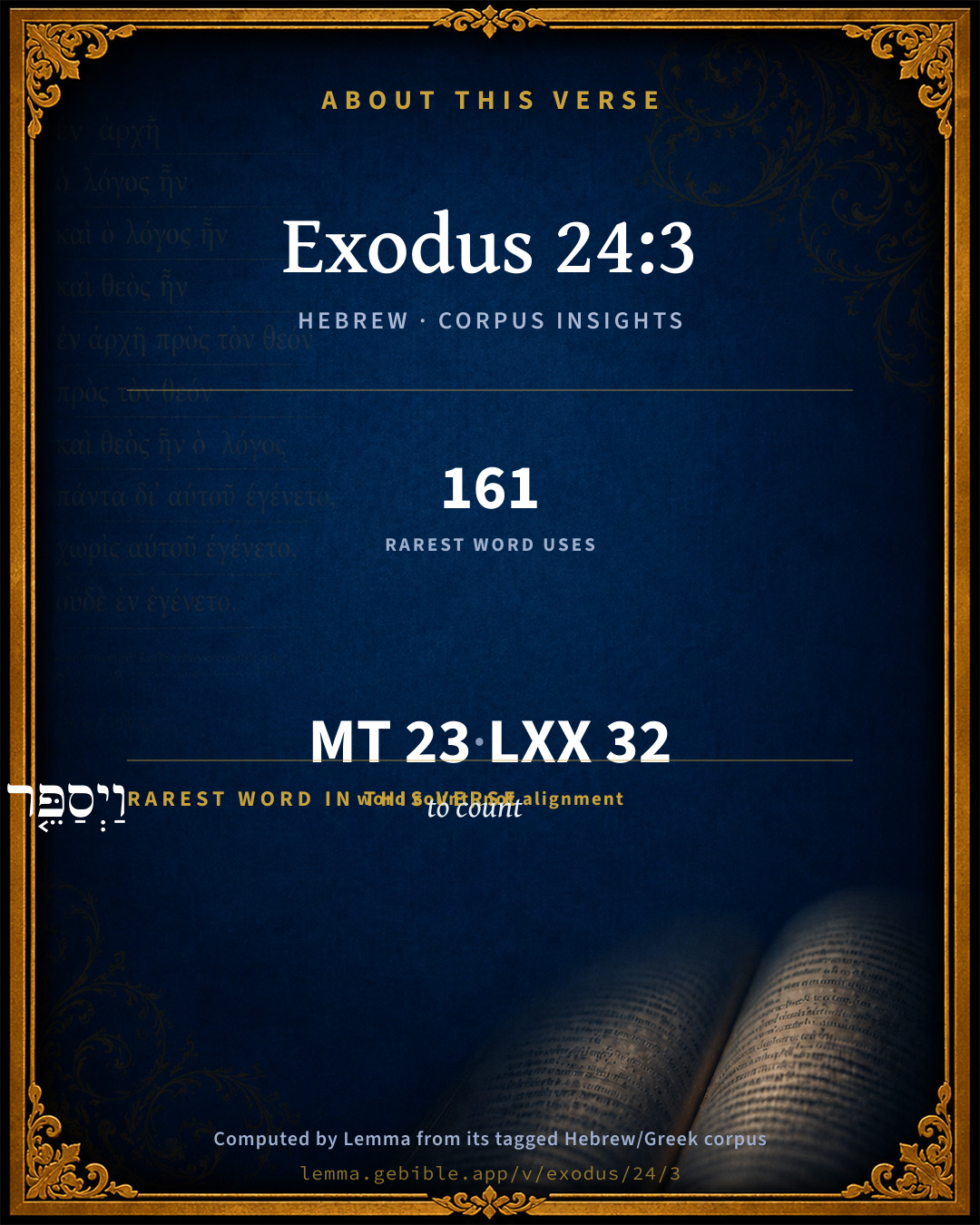
23
words
16
distinct lemmas
Pentateuch
section

Grammatical profile

  • 6 verbs
  • 13 nouns
  • 1 adjective
  • 3 particles

Verb forms

  • וַיָּבֹ֣א Qal · Sequential Imperfect
  • וַיְסַפֵּ֤ר Piel · Sequential Imperfect
  • וַיַּ֨עַן Qal · Sequential Imperfect
  • וַיֹּ֣אמְר֔וּ Qal · Sequential Imperfect
  • דִּבֶּ֥ר Piel · Perfect
  • נַעֲשֶֽׂה Qal · Imperfect

Repetition

Words recur within this verse — often emphatic in Hebrew:

  • כָּל all H3605 ×4
  • לָעָם֙ people H5971 ×2
  • דִּבְרֵ֣י word H1697 ×2
  • יְהוָ֔ה LORD H3068 ×2

Hebrew & Septuagint length

In English translation the verse runs 35 words from the Hebrew and 40 from the Septuagint (LXX English) — closely comparable.

A rough comparison of the two English renderings, which tokenize alike — not a word-level alignment.

Word counts can differ between the Hebrew and the Greek without any difference in meaning — e.g. the Hebrew direct-object marker אֵת has no separate Greek word, and Greek often adds the article ὁ.

In the original languages it is 23 Hebrew tokens and 32 Greek tokens — but the two are counted differently (Hebrew bundles its prefixes and suffixes into one token; the Greek is in lemma form), so that isn’t a like-for-like length.

Cross-references

13

Topical passages linked to Exodus 24:3 in the Treasury of Scripture Knowledge — connected by theme and wording, ordered by reader-vote popularity; previews shown in the World English Bible.

  • Exodus 19:8 All the people answered together, and said, "All that Yahweh has spoken we will do." Moses reported the words of the people to Yahweh.
  • Exodus 24:7 He took the book of the covenant and read it in the hearing of the people, and they said, "All that Yahweh has spoken will we do, and be obedient."
  • Joshua 24:22 Joshua said to the people, You are witnesses against yourselves that you have chosen you Yahweh, to serve him. They said, We are witnesses.
  • Deuteronomy 5:1 Moses called to all Israel, and said to them, Hear, Israel, the statutes and the ordinances which I speak in your ears this day, that you may learn them, and observe to do them.
  • Deuteronomy 6:1 Now this is the commandment, the statutes, and the ordinances, which Yahweh your God commanded to teach you, that you might do them in the land where you go over to possess it;
  • Deuteronomy 4:1 Now, Israel, listen to the statutes and to the ordinances, which I teach you, to do them; that you may live, and go in and possess the land which Yahweh, the God of your fathers, gives you.
  • Deuteronomy 4:5 Behold, I have taught you statutes and ordinances, even as Yahweh my God commanded me, that you should do so in the midst of the land where you go in to possess it.
  • Deuteronomy 4:45 these are the testimonies, and the statutes, and the ordinances, which Moses spoke to the children of Israel, when they came forth out of Egypt,
  • Deuteronomy 5:27–28 Go you near, and hear all that Yahweh our God shall say: and speak you to us all that Yahweh our God shall speak to you; and we will hear it, and do it.
  • Exodus 21:1–23 "Now these are the ordinances which you shall set before them.
  • Deuteronomy 5:31 But as for you, stand you here by me, and I will speak to you all the commandment, and the statutes, and the ordinances, which you shall teach them, that they may do them in the land which I give them to possess it.
  • Deuteronomy 11:1 Therefore you shall love Yahweh your God, and keep his charge, and his statutes, and his ordinances, and his commandments, always.
  • Galatians 3:19–20 What then is the law? It was added because of transgressions, until the seed should come to whom the promise has been made. It was ordained through angels by the hand of a mediator.

Cross-references courtesy of OpenBible.info (CC BY 4.0).

Hebrew and Greek witnesses Masoretic Hebrew ↔ Greek Septuagint

The same verse in the two great witnesses to the Old Testament, shown verse-for-verse.

These are two independent witnesses, not word-aligned to each other, and the Septuagint is shown in lemma (dictionary) form.

Hebrew Exodus 24:3 Masoretic · Westminster Leningrad Codex

וַיָּבֹ֣א מֹשֶׁ֗ה וַיְסַפֵּ֤ר לָעָם֙ אֵ֚ת כָּל דִּבְרֵ֣י יְהוָ֔ה וְאֵ֖ת כָּל הַמִּשְׁפָּטִ֑ים וַיַּ֨עַן כָּל הָעָ֜ם ק֤וֹל אֶחָד֙ וַיֹּ֣אמְר֔וּ כָּל הַדְּבָרִ֛ים אֲשֶׁר דִּבֶּ֥ר יְהוָ֖ה נַעֲשֶֽׂה

Moses came and told the people all the words of Yahweh, and all the ordinances; and all the people answered with one voice, and said, "All the words which Yahweh has spoken will we do."

World English Bible · Public Domain

Greek LXX Exodus 24:3 Septuagint · lemma form

εἰςἔρχομαι δέ μωυσῆς καί διαἡγέομαι ὁ λαός πᾶς ὁ ῥῆμα ὁ θεός καί ὁ δικαίωμα ἀποκρίνω δέ πᾶς ὁ λαός φωνή εἷς λέγω πᾶς ὁ λόγος ὅς λαλέω κύριος ποιέω καί ἀκούω

And Moses went in and related to the people all the words of God and the ordinances; and all the people answered with one voice, saying, All the words which the Lord has spoken, we will do and be obedient.

LXX2012 (modern English Septuagint) · Public Domain

Hebrew: Westminster Leningrad Codex (CC BY 4.0). Greek: Septuagint (public domain); English from LXX2012 (modern English Septuagint) (Public Domain). How the Septuagint differs from the Hebrew →

Targum (Aramaic paraphrase)

2

The Targum is the ancient Jewish Aramaic paraphrase of the Hebrew Scriptures — an interpretive translation, not the Hebrew text itself. Onkelos (literal) and Pseudo-Jonathan (expansive) render the Torah, and Jonathan the Prophets. Coverage is partial: where no permissively-licensed English translation exists for a verse, only the Aramaic is shown. This is verse-level text, not a word-by-word alignment to the Hebrew.

  1. Targum Onkelos Torah (Genesis–Deuteronomy)
    וַאֲתָא משֶׁה וְאִשְׁתָּעִי לְעַמָא יָת כָּל פִּתְגָמַיָא דַיְיָ וְיָת כָּל דִינַיָא וַאֲתֵיב כָּל עַמָא קָלָא חַד וַאֲמָרוּ כָּל פִּתְגָמַיָא דִי מַלִיל יְיָ נַעְבֵּד:

    (no public-domain English translation for this verse)

    Targum Onkelos — Aramaic: “Onkelos Genesis” (public domain); “Onkelos Exodus” (public domain); “Onkelos Leviticus” (public domain); “Onkelos Numbers” (public domain); “Onkelos Deuteronomy” (public domain). English: “Sefaria Community Translation” (CC0 1.0 (public-domain dedication)); “J.W. Etheridge. The Targums of Onkelos and Jonathan Ben Uzziel on the Pentateuch. London: Longmans, Green, 1862” (public domain). Text via Sefaria.

  2. Targum Pseudo-Jonathan Torah (Genesis–Deuteronomy)
    וְאָתָא משֶׁה וְאִשְׁתָּעֵי לְעַמָּא יַת כָּל פִּתְגָּמַיָא דַיְיָ וְיַת כָּל דִּינַיָיא וְאָתֵיב כָּל עַמָּא קָלָא חָד וַאֲמָרוּ כָּל דְּמַלֵּיל יְיָ נַעֲבֵיד

    And Mosheh came and set before the people all the words of the Lord, and all the judgments. And all the people answered with one voice, and said, All that the Lord hath spoken we will do.

    Targum Pseudo-Jonathan — Aramaic: “Targum Jonathan on Genesis” (public domain); “Targum Jonathan on Exodus” (public domain); “Targum Jonathan on Leviticus” (public domain); “Targum Jonathan on Numbers” (public domain); “Targum Jonathan on Deuteronomy” (public domain). English: “The Targum of Jonathan ben Uzziel, trans. J. W. Etheridge, London, 1862” (public domain). Text via Sefaria.

Commentary

Notes on Exodus 24:3 from classic Christian and Jewish commentators (each source and its license shown beneath its notes). The classic Christian expositions comment on the surrounding passage and are grouped to its opening verse, so a note may address several verses; the Jewish commentaries on the Tanakh (Rashi and others) are per-verse, so they appear only where the commentator wrote on this verse.

Lemma curates 59 commentaries, every one of them public domain or Creative Commons licensed, each selected and text-cleaned for this edition rather than reprinted as found. About our sources →

Trapp's Complete Commentary

John Trapp

Exo 24:3 And Moses came and told the people all the words of the LORD, and all the judgments: and all the people answered with one voice, and said, All the words which the LORD hath said will we do.

Ver. 3. And told the people,] So he became a Mediator {Gal 3:19} - non redemptionis sed relationis.

Will we do.] God’s people are "willing." {Psa 110:3} But "weak through the flesh." {Rom 8:3} {See Trapp on "Heb 13:18"}

John Trapp, A Commentary or Exposition upon All the Books of the Old and New Testament (1647–1656) — public domain. Text from a community e-Sword module.

Joseph Benson's Commentary

Exo 24:3. Moses told the people all the words of the Lord — He laid before them all the precepts, in the foregoing chapters, and put it to them, whether they were willing to submit to these laws or not? And all the people answered, All the words which the Lord hath said will we do — They had before consented in general to be under God’s government; here they consent in particular to these laws now given.

Joseph Benson's Commentary on the Old and New Testaments (1811–1818) — public domain. Text from a community e-Sword module.

Keil & Delitzsch

C. F. Keil & F. Delitzsch

The ceremony described in Exo 24:3-11 is called "the covenant which Jehovah made with Israel" (Exo 24:8). It was opened by Moses, who recited to the people "all the words of Jehovah" (i.e., not the decalogue, for the people had heard this directly from the mouth of God Himself, but the words in Exo 20:22-26), and "all the rights" (ch. 21-23); whereupon the people answered unanimously (אחד קול), "All the words which Jehovah hath spoken will we do." This constituted the preparation for the conclusion of the covenant. It was necessary that the people should not only know what the Lord imposed upon them in the covenant about to be made with them, and what He promised them, but that they should also declare their willingness to perform what was imposed upon them. The covenant itself was commenced by Moses writing all the words of Jehovah in "the book of the covenant" (Exo 24:4 and Exo 24:7), for the purpose of preserving them in an official record. The next day, early in the morning, he built an altar at the foot of the mountain, and erected twelve boundary-stones or pillars for the twelve tribes, most likely round about the altar and at some distance from it, so as to prepare the soil upon which Jehovah was about to enter into union with the twelve tribes. As the altar indicated the presence of Jehovah, being the place where the Lord would come to His people to bless them (Exo 20:24), so the twelve pillars, or boundary-stones, did not serve as mere memorials of the conclusion of the covenant, but were to indicate the place of the twelve tribes, and represent their presence also.

Keil & Delitzsch — Biblical Commentary on the Old Testament (1861–1891) — public domain (CC PDM 1.0). Text via the HelloAO Bible API. (Old Testament only.)

Tyndale Open Study Notes

Tyndale Open Resources

24:3 went down: At this critical moment, would the people accept this relationship with God in which they would swear absolute loyalty to him and agree to live in ways that are in keeping with his character? Fortunately, they answered unanimously, with one voice, that they would abide by the covenant.

Tyndale Open Study Notes — © Tyndale Open Resources, licensed CC BY-SA 4.0. Text via the HelloAO Bible API.

Geneva Bible (1599)

Geneva Bible translators

When he had received these laws in mount Sinai.

Hebrew, judgments.

Geneva Bible (1599) marginal notes — public domain. Text via Bolls.life.

Adam Clarke's Commentary

Verse 3. Moses - told the people all the words of the Lord] That is, the ten commandments, and the various laws and ordinances mentioned from the beginning of the 20th to the end of the 23d chapter.

Adam Clarke's Commentary on the Bible (1810–1826) — public domain. Text from a community e-Sword/MySword module.

Ellicott's Commentary for English Readers

(3) Moses . . . told the people all the words of the Lord.—Moses gave them an outline of the legislation which he subsequently committed to writing (Exo_24:4) and formed into “the Book of the Covenant” (Exo_24:7). Its general purport and main heads were communicated, but probably not all its details. Otherwise it would scarcely have been necessary to read the contents of the book to them. The people willingly gave in their adhesion, feeling the laws to be “holy, just, and good,” and not yet knowing how difficult they would find it to render a perfect obedience.

A Bible Commentary for English Readers, edited by Charles John Ellicott (1878–1897) — public domain. Text from a community e-Sword module.

The Cambridge Bible for Schools and Colleges

gen. ed. J. J. S. Perowne

3. the words … and the judgements] i.e. (see on Exo_21:1) both the positive commands, and the ‘judgements,’ or decisions prescribing what is to be done in particular cases, contained in Exo_20:22 to Exo_23:33. The Decalogue, which the people had heard themselves, cannot be included in the terms used. The fact, however, that only the ‘words’ are referred to in clauseb suggests that ‘and the judgements’ in cl.a may be an addition of the redactor who placed the ‘judgements’ of Exo_21:2 to Exo_22:17 in their present position (cf. on v. 12).

3–8 (E). The sequel to Exo_23:33. Moses communicates to the people the words which Jehovah has spoken; and upon their expressing their assent to them, solemnly concludes a covenant, on the basis of them, between Jehovah and the nation.

The Cambridge Bible for Schools and Colleges (gen. ed. J. J. S. Perowne; Cambridge University Press, 1878–1918) — public domain. Text from a community e-Sword module.

John Gill's Exposition

And Moses came and told the people all the words of the Lord, and all the judgments,.... Which according to Jarchi were the seven commands given to the sons of Noah, the laws concerning the sabbath, and honouring parents, the red heifer, and the judgments at Marah; but all these they were acquainted with before, excepting that of the red heifer, and the law, for that was not yet delivered to Moses, nor were these the ten commands, for they had heard them from the Lord themselves; but they doubtless were the judgments, or judicial laws, which he was ordered to set before the people, contained in the two preceding chapters, which were chiefly of the judicial kind, and related to the civil polity of the people of Israel:

and all the people answered with one voice; one speaking for, and in the name of the rest, or they all lift up their voice together, and being unanimous in their sentiments, expressed them in the same words:

and said, all the words which the Lord hath said will we do; that is, they would be careful to observe all the laws, statutes, judgments, and commands which the Lord had enjoined them; and less than this they could not say, for they had promised Moses, that if he would draw nigh to God, and hear what he should say, and deliver it to them, they would hearken to it, and obey it, as if they had heard God himself speak it; only they entreated the Lord would speak no more to them, as he did the ten commands, it being so terrible to them.

John Gill's Exposition of the Whole Bible (1746–1763) — public domain (CC PDM 1.0). Text via the HelloAO Bible API.

Matthew Poole's English Annotations

Moses came down from the mount to the people, after he had received the laws from God.

All the words which the Lord hath said will we do: this they so readily and rashly promise, because they were not sensible of their own weakness, and because they did not understand the comprehensiveness, and spirituality, and strictness of God’s law, but thought it consisted only in the external performances and abstinences expressed.

Matthew Poole's English Annotations on the Holy Bible (1683–1685) — public domain. Text from a community e-Sword/MySword module.

Whedon's Commentary on the Bible

Daniel D. Whedon

3, 4. Moses came and told — After receiving the laws as so many words of the Lord, he put them in writing, and thus codified the judgments (comp. Exo_21:1) which were to govern the people. Whether he wrote all the words of the Lord before he descended from the mountain, or after he appeared again among the people, is not said. We most naturally suppose that they would have been written in the mountain, but the order of this narrative seems to imply that he first reported them orally to the people, who answered with one voice, and pledged obedience.

Thereupon he wrote all the words, occupying, perhaps, a part of the night in this labour, and rose up early in the morning of the following day to ratify and seal the covenant by appropriate offerings and a reading of the laws from the book in which he had written them.

Builded an altar under the hill — In accord with the directions of Exo_20:24-26.

Twelve pillars — Significant of the tribal divisions of the nation, and their common interest in the covenant. Comp. Jos_4:1-9.

Daniel D. Whedon (gen. ed.), Commentary on the Old and New Testaments (1874–1909) — public domain. Text from a community e-Sword module.

The Pulpit Commentary

And Moses came. Moses descended from the mount, and reported to the people all the words of the Lord all the legislation contained in the last three chapters and a half, (Exo_20:19, to Exo_23:33) not perhaps in extenso, but as to its main provisions. And all the people answered with one voice, promising obedience. In times of excitement, a common impulse constantly animates an entire multitude, and an exaltation of feeling leads them to make pledges, which they are very unwilling to stand by afterwards. Hence Moses requires something more than a verbal assent.

HOMILETICS.

Vers. 3-8. Man"s readiness to enter into covenant with God, and promise unlimited obedience.

In any covenant which God proposes to man, the advantages offered to him are so great, and the requirements made of him so manifestly "holy, just, and good," that it is almost impossible that he should calmly consider the terms and reject them. It is his natural instinct to exclaim that the Lord hath said I will do, and be obedient." There are many reasons for this feeling, of which the following are some:

I THE CREATURE IS MORALLY BOUND TO OBEY ITS CREATOR. That which an intelligent agent has made belongs to him absolutely, and cannot resist his will without rebellion. Now, "it is God that has made us, and not we ourselves." We are his, whether we choose to obey him or no his to punish or reward to kill or make alive to exalt to happiness or condemn to misery. We cannot resist his will without being self-condemned. The reasons which make disobedience to a father morally wrong tell with increased force if applied to God, who is far more truly than our father,

1. The author of our existence;

2. The preserver of our life; and

3. The bestower upon us of favours and benefits which we cannot possibly repay.

II MAN"S BEST INTERESTS ARE PROMOTED BY A PERFECT OBEDIENCE. Every law ever imposed by God on man has been imposed for man"s sake, and tends to his advantage. If a man were truly wise, he would lay down for himself as rules of conduct exactly those laws which are laid down for his guidance in Holy Scripture. The man whose obedience approaches nearest to perfection is the happiest. For every act of disobedience there is a natural penalty.

III THE HIGHEST ASPIRATION OF MAN"S NATURE IS TO DO GOD"S WILL. Angels have no other desire but this. Man has a thousand desires, but, together with them, has an inward conviction that it is better for him to resist than to gratify the greater number. His passions draw him one way, his reason another, his affections, perhaps, a third. He has no unmixed satisfaction but in following the lead of the highest principle within him; and this principle is the love of God, which prompts him to make it the sole object of his life to please God by so acting as God would have him. Man, therefore, readily promises obedience as of old at Sinai, so now at baptism and confirmation, or, again, after a sudden conversion; and, under the excitation of stirred feelings and an awakened conscience, imagines that he will keep to his brave resolve; but when the excitement is past, and the feelings have calmed down, and the tame, dull course of ordinary life is entered upon, then it is found not so easy to observe the promises made, and "do all that the Lord has said, and be obedient." The flagrant contrast between the conduct of the Israelites and their words is known to all. The contrast is, perhaps, less, but it is still great, between the pledges given by Christians and their acts. Performance ever lags far behind promise. "The spirit, indeed, is willing, but the flesh is weak." Temptations assail Satan spreads his wiles the lower nature turns traitor, and men fall away. Happy, if, while there is still time, they "return and repent, and do the first works," anti casting themselves upon Christ obtain pardon for their disobedience from the ever-merciful God.

Vers. 3-8. The terms of the covenant accepted.

I OBSERVE HOW CLEARLY THESE TERMS HAD BEEN STATED. Moses came and told the people all the words of the Lord and all the judgments. All the way to Sinai the people had the opportunity of seeing the power of Jehovah; at Sinai something of his glory had been manifested; and now in these words and judgments the character and will of Jehovah were made known. It is observable that at their first approach to Sinai the people had expressed their willingness to be obedient to God. (Exo_19:8) But he does not seek to bind them. down by a formal contract until he has made clear the laws under which he would have them to live. it is well for us to bear in mind that God distinctly and emphatically states all things of practical and present importance. We indeed may have a very imperfect understanding of his statements; but the statements in themselves are perfectly plain, only requiring that our minds should be brought into a right state of humility, and concentrated upon the study of God"s holy commandments with the requisite degree of attention.

II OBSERVE ALSO THE WAY IN WHICH THESE TERMS HAD BEEN ACCEPTED. The people answered with one voice. There was a remarkable unanimity. Are we to take it that there was a complete, universal, cordial shout of acceptance? There is no reason to suppose otherwise, no reason to suppose but that a profound impression had been made on every mind. Not the slightest word appears to indicate discord. But of course, although there was no discord in the expression, there was great diversity in the state of mind which underlay the shout of acceptance. The emotion finding vent in this unanimous acceptance could be traced back in a few instances to a thoroughly awakened conscience, desiring to live a thoroughly righteous life, and be in true and complete conformity to the will of God; for there were men of David"s spirit long before David"s time. But in how many was there nothing more than the inconsiderate shout of those who, after all God had said, had yet not the slightest knowledge of his will! And yet with all these profound differences the superficial enthusiastic agreement evidently served a purpose. For not only was there a word, but also a highly significant and impressive deed. Notice that all the preparations in the way of altar, pillars, offerings, etc., made so carefully by Moses, are not said to have been made by God"s commandment. The most we can say is, that they were not out of harmony with his will. They were a visible representation, a kind of writing out of the great contract into which the people thus entered. There stood the altar signifying the presence of God, and there the pillars signifying the twelve tribes, and there was the blood with its principle of life joining together, in a glorious unity, Jehovah and his people. The great and lamentable differences underneath are neither forgotten nor underrated; but for the time they are not regarded. The unity of feeling thus seemed was made to serve a great symbolic purpose. These people, by word and deed, by the erection of these pillars, and by the acceptance of the sprinkled blood, took part in a great historic act, and declared that they were the people of God in a way the consequences of which they could not afterwards escape.

III Observe this very remarkable thing THAT GOD SHOULD HAVE ACCEPTED THEIR ACCEPTANCE. He knew how much and how little it meant, and yet he did not point out the rashness of the utterance, he did not interfere with the symbolic actions by which Moses more deliberately set forth the adhesion of the people. We are bound, therefore, to conclude that in whatever ignorance and sudden enthusiasm the people might subscribe to this covenant, yet that subscription was right. The laws that God gave from Sinai are the laws for men to live by. The constitution of God"s kingdom was by this great symbolic act solemnly introduced into Israel, and made the constitution of Israel also. Every nation, if it is to be anything more than a mere crowd, must have a constitution. Some constitutions grow, and like all things that grow, they occasionally branch out in unexpected directions. Other constitutions, men meet together to determine and formulate, like that of the American republic. But here is a constitution which comes down out of heaven from God; and in a great historic act, the nation into which it comes accepts it. Hence those born under that constitution were bound to accept it also. There was no nation on the face of the earth that had such securities, privileges, and prospects as Israel had under these laws from Sinai. The government was neither a despotism nor a democracy. The people were neither under an arbitrary will which might capriciously change, nor did they depend upon their own fluctuating opinions. God, if we might use such an expression, was bound by these laws, even as the people were themselves. Y.

HOMILIES BY J. ORR

Vers. 3-9. The ratification of the covenant.

These verses contain the account of the formal ratification of the covenant between Israel and Jehovah an event, the most momentous in the history of the nation, big, for weal or woe, with unimaginable issues, and a shadow of the better covenant which God now makes with Christians. Observe

I THE RATIONALITY OF THE COVENANT. God desires from his people "reasonable service". (Rom_12:1) He would not have them enter it in haste. Vows made under the influence of sudden impressions are not to be trusted. Once committed to his service, God will deal with us with strictness. (Exo_23:21) But he does not wish us to commit ourselves till we have carefully considered the nature of the step we are taking, and the magnitude of the issues involved. (cf. Luk_14:26-34) See this illustrated in the history of the covenant with Israel. The covenant was entered into

1. With great deliberation. It was not forced on Israel. The negotiations connected with it were intentionally drawn out and prolonged, just that the people might have the opportunity of pondering well the character of the proposed engagement. Alike in the events of the exodus, and in the miracles of the desert, they had had abundant experience of the character of the Being with whom they were allying themselves. Arrived at Sinai, preliminary proposals were made to them, and an opportunity given them at the outset of saying Yea or Nay. (Exo_19:3-9) Their acceptance of these proposals was followed by the giving of the law, which drew from them a new promise to do whatever God should speak to them. (Exo_20:19; Deu_5:27) An interval ensued, during which Moses was in the mountain. (Exo_20:21) On descending, he recites to them "All the words of the Lord, and all the judgments" (ver. 3); and once again they promise full obedience. Even then the matter is allowed to stand over till the morrow, when Moses appears with the written book in his hand, and they are asked, finally, if they adhere to what they have said (ver. 7). Greater precautions against rash committal could scarcely have been taken.

1. After careful instruction. Pains were taken fully to inform the people of the terms of the covenant, before asking them to enter into it. The law was uttered by God"s own voice. The "judgments" were recited to them by Moses. They were read a second time from the "book." Their assent to the covenant was thus sought to be made an intelligent one. If we engage ourselves to God, he would have us do it with "understanding.

2. Amidst impressive solemnities. These the reading of the words from the book, the sprinkling of the blood, etc. were of a nature adapted to arouse the minds of the people to a just sense of the momentousness of the transaction. From the whole we learn that if dedication is the result of an act, it should be of a calm, sober, thoughtful act; it cannot be done too solemnly or too intelligently. Our religious life should have a rational basis.

II THE BOND OF THE COVENANT. The nucleus of the transaction is the people"s promise the words which the Lord hath said will we do" (ver. 3) that the Lord hath said will we do, and be obedient" (ver. 7). There is a tone of rashness of self-confidence in this promise, as given by Israel, which forewarns of subsequent defection. The people evidently had but little knowledge of their own hearts. They had little perception of the spiritual requirements of this law. They had not learned to distrust themselves. Their surrender to the Divine will was not thorough or heartwhole. (See on Exo_19:8) It remains true, however, that surrender of the will to God, in the spirit of obedience, is an indispensable condition of being received into covenant with him. "The idea of the servant of God is complete only when he who is bound to God also binds himself to God"s will, following God perfectly." (Oehler.) This is as true of the Gospel as of the law. The obedient will is implicit in faith. The end contemplated in salvation is obedience. We are made free from sin that we may become servants of righteousness. (Rom_6:18) The recognition of this the acceptance of the obligation is involved in conversion, in saving faith, in the new birth, in the coming to Christ, or however else we may express the change from death to life. If we no longer speak of the promise of obedience as the "bond" of the covenant, it is only because that which the Gospel primarily demands of us, viz. faith, goes deeper than such a promise, while implicitly containing it. The object of spiritual trust is, ultimately, God himself, and in the Gospel, Christ, as the sent of God to be the Saviour of the world; but such trust invariably involves the yielding up of the will to God, and is on its practical side, an energy of holiness. The true believer is, of necessity, a doer of the will of the Father. "Faith, without works, is dead". (Jam_2:17-26) (See further, on Exo_19:5) It is, however, well that this implicit element in faith should also be allowed to become explicit in distinct acts of consecration or of self-dedication to God. This brings us very near to what we have in this covenant with Israel. See below.

III THE CEREMONIAL OF RATIFICATION.

(1) Moses "builded an altar under the hill, and twelve pillars, according to the twelve tribes of Israel" (ver. 4).

(2) Young men of his appointment sacrificed burnt-offerings and peace-offerings unto the Lord. (ver. 5).

(3) The blood of the sacrificed animals was divided: half was put in basins, and half sprinkled on the altar (ver. 6).

(4) The words of the book of the Covenant were next solemnly read in the audience of the people; and the latter renewed their assent to them (ver. 7).

(5) The blood was then cast upon the people out of the basins, and the Covenant was declared to be concluded (ver. 8). Two points here claim our attention.

1. The ratifying of the Covenant with sacrifice; and

2. The action with the blood.

Both were significant.

1. The sacrifices. The burnt-offering was primarily a symbol of self-surrender (cf. Psa_51:16-19) The idea embodied here, therefore, was, that in the institution of the Covenant, what was required was the unconditional surrender of the offerer, with all that belonged to him, to God. The peace-offering symbolises reconciliation and fellowship. But the offering of the sacrifices had also a propitiatory reference. This is plain from the sprinkling of the blood on the altar. It is sprinkled there as atoning for the people"s sins. It was through the blood of propitiation that peace was made, that reconciliation was brought about. This teaches several things. It shows

(1) That Israel was viewed by God as sinful.

(2) That it was not on legal grounds, but as an act of grace, that they were being admitted into covenant.

(3) That the covenant embodied grace as well as law.

(4) That God. would deal graciously with Israel, if they sincerely endeavoured to keep his law, notwithstanding many defects and failures.

(5) That their attitude under the law, in seeking to fulfil its righteousness, ought to be an evangelical, not a legal one, i.e. , they ought to draw their motives, their encouragement, and their hope, not from the thought of their self-sufficiency to keep the law, or from the idea that they were actually keeping it in such a way as legally to entitle them to the blessing, but from the conviction of God"s mercy to them, which, as it was the foundation of their national existence, so was it the real ground of their standing all along.

2. The sprinkling of the blood on the people. It is, as Keil remarks, the one blood which is sprinkled on the altar and on the people; and it is not sprinkled on the people, till it has been presented and accepted on the altar. Applied to the people, the blood had the effect of formally cleansing them from sin, and of consecrating them to God"s service. God thereafter claimed them as his special property. Redeemed life is his. Made free from sin, we become servants of God. J.O. (Rom_6:22)

The Pulpit Commentary (1880–1919), ed. H.D.M. Spence-Jones & Joseph S. Exell — public domain. Text from a community e-Sword module.

John Wesley's Explanatory Notes

Moses told the people all the words of the Lord - He laid before them all the precepts, in the foregoing chapters, and put it to them, whether they were willing to submit to these laws or no? And all the people answered, All the words which the Lord hath said we will do - They had before consented in general to be under God's government; here they consent in particular to these laws now given.

John Wesley, Explanatory Notes Upon the Whole Bible (1754–1765) — public domain. Text via the GEBible commentary corpus.

unfoldingWord translationNotes

Door43 World Missions Community

with one voice

This is an idiom that means the people were in complete agreement. AT: "together" or "in agreement" (See: Idiom)

foot of the mountain

"base of the mountain" or "bottom of the mountain"

translationWords

word of God

decree

unfoldingWord translationNotes — © Distant Shores Media and the Door43 World Missions Community, licensed CC BY-SA 4.0. Source: git.door43.org/Door43/en_tn.

Rashi

Rabbi Shlomo Yitzchaki (Rashi)

ויבא משה ויספר לעם AND MOSES CAME AND RELATED TO THE PEOPLE — on that same day (the 4th of Sivan).

את כל דברי ה׳ ALL THE WORDS OF THE LORD — the commands concerning their keeping apart from women and the setting of bounds at Mount Sinai.

ואת כל המשפטים AND ALL THE JUDGMENTS which had been ordained before the Sinaitic legislation: the seven commands given to the “Sons of Noah” (the non-Israelite world), the law of the Sabbath, of filial respect, of the “red heifer” and regarding the administration of justice, all of which had been given to them already in Marah (cf. Sanhedrin 56b).

Rashi on the Tanakh — English translations: “The Judaica Press complete Tanach with Rashi, translated by A. J. Rosenberg” (CC BY 4.0); “Pentateuch with Rashi's commentary by M. Rosenbaum and A.M. Silbermann, 1929-1934” (public domain); “The Metsudah Tanach series, Lakewood, N.J” (CC BY 4.0); and “The Book of Joshua, Metsudah Publications, 1997” (CC BY 4.0). Text via Sefaria.

Ramban (Nachmanides)

Rabbi Moshe ben Nachman (Ramban / Nachmanides)

AND MOSES CAME AND TOLD THE PEOPLE ALL THE WORDS OF THE ETERNAL. At the time that this whole commandment mentioned here was given, Moses was at the place where he drew near unto the thick darkness where G-d was, and now he came to that “far off” place where the people had been at the time of the Revelation, and told them all that he had been commanded [i.e., beginning with Ye yourselves have seen — above 20:19 — up to the end of all the commandments and ordinances, 23:33], and they listened to his voice. Scripture does not say here: “and he came down from the mountain,” for they were all then at the lower part of the mountain, 19:17. and not at the top where the Glory of G-d was; [the difference] was only that Moses was near the place of the thick darkness, whilst the people stood from afar at the time of the giving of the commandments, as I have explained., 19:19, and 20:15. When Moses left his place and began coming towards the people, all the heads of their tribes and their elders came up to the place where the priests that come near to the Eternal, 19:22. stood, and said to him, Now therefore why should we die? for this great fire will consume us; Go thou near, and hear etc., Verse 24. for they thought that the Revered G-d Himself would tell them all the commandments of the Torah just as He had told them the Ten Commandments. Then Moses came together with the heads of the tribes and the elders to the place where the people were standing and told all of them all the words of G-d, and they said, “We will do all that He has commanded us in the Ten Commandments, and we will hearken to your voice in everything that you have commanded, or will command in His Name, exalted be He.” When Moses went back afterwards to the edge of the mountain with the elders, as G-d had commanded him, then G-d said to him again, Come up to Me into the mountain, and be there. It was at that time that He informed him, I have heard the voice of the words of the people, which they have spoken unto thee; they have well said all that they have spoken, and He commanded him: Go say to them: Return ye to your tents. But as for thee, stand thou here by Me, and I will speak unto thee all the commandment, and the statutes, and the ordinances, which thou shalt teach them., Verses 27-28. It is with reference to this that He said here, And I will give thee the Tablets of stone, and the law and the commandment, meaning, that to you alone I will give the law and the commandments which you will teach them, and they will keep them as they have undertaken to do.

Ramban (Nachmanides) on the Tanakh — English translation: “Commentary on the Torah by Ramban (Nachmanides). Translated and annotated by Charles B. Chavel. New York, Shilo Pub. House, 1971-1976” (CC BY 4.0). Text via Sefaria.

Lesson kit

Teaching starters — assembled from the data on this page, not authored interpretation. Every prompt links to the verse data it draws on. Edit before teaching.

Exodus, in the Pentateuch, opens this verse with 23 words (16 distinct Hebrew lemmas). Its most distinctive word is çâphar (“to count”). A historical commentator’s framing appears above. Read the whole chapter for the surrounding context.

Discussion questions

  1. How does “to count” (çâphar) shape what this verse is saying?
  2. How does Exodus 19:8, which shares this passage’s theme, read alongside this verse?
  3. What does the repetition of “all” (4× in this one verse) do in this verse?
  4. The translations on this page render this verse differently — a whole-verse word diff, not a word-by-word alignment. What might account for the different wordings?
  5. «וַיָּבֹ֣א» is a Qal Sequential Imperfect verb. How does that grammatical form shape the action described?
  6. Compare how Trapp's Complete Commentary and Joseph Benson's Commentary read this verse. Where do they agree or differ?

Things to notice

Reading settings

Reading text

Shown beneath each verse's original-language words.

Old Testament
Old Testament edition

Read the OT as the Masoretic Hebrew (MT) or the Greek Septuagint (LXX).

English shown for the Greek Septuagint (in the Hebrew ↔ Greek comparison).

Comparing translations? Open the Compare panel on any verse page to stack up to four side by side.