
2 Samuel 19:35

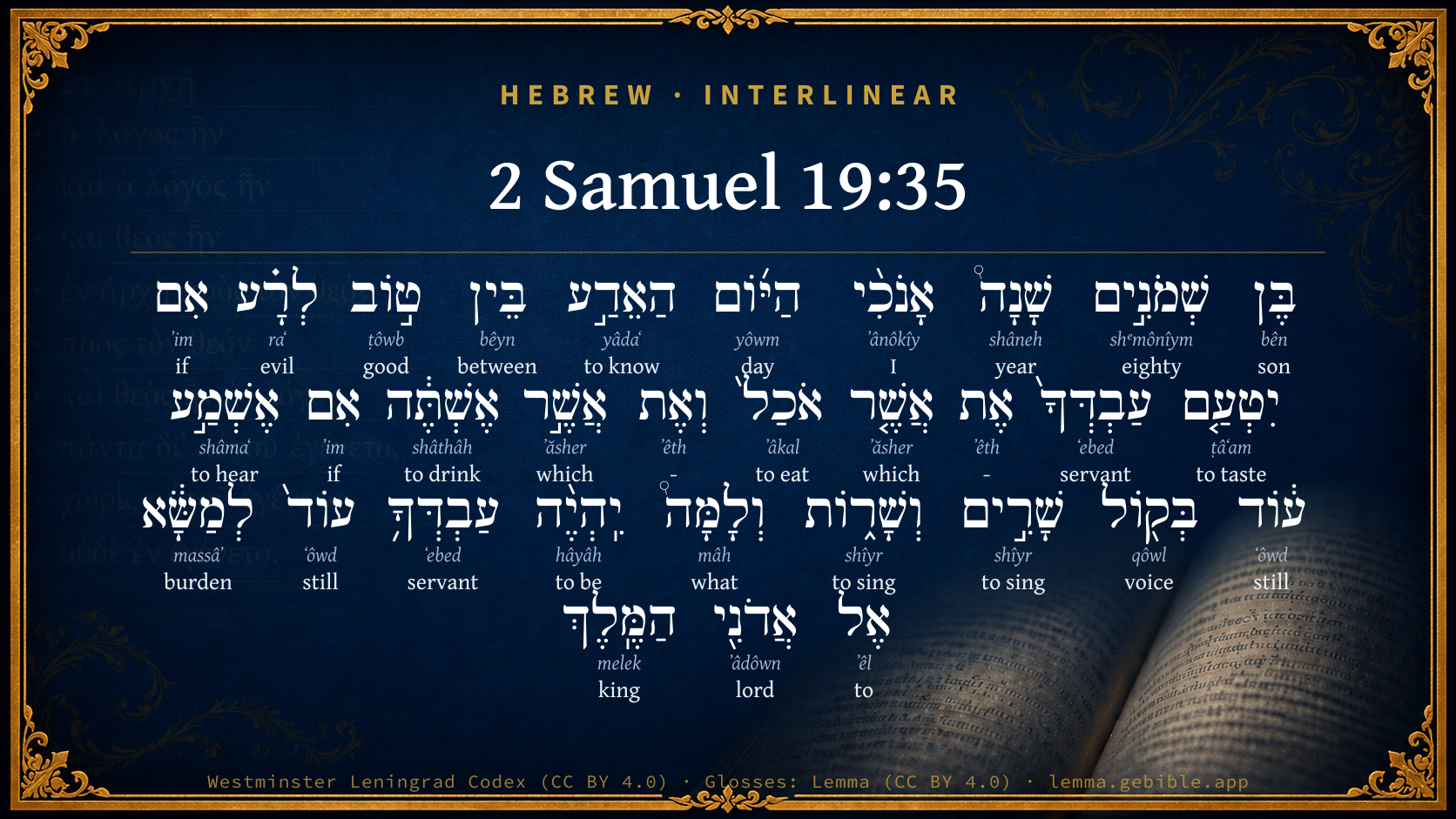
Hebrew (Westminster Leningrad Codex) 2 Samuel 19:35 appears in the Hebrew Old Testament. The text above is from the Westminster Leningrad Codex. Each word links to its Strong’s number, a concise gloss, and parsing drawn from the Open Scriptures Hebrew Bible morphology. Click any word for its full Brown-Driver-Briggs (BDB) entry.
Download image
Cite this verse

2 Samuel 19:35 (World English Bible). Public Domain. Lemma interlinear Bible study tool, https://lemma.gebible.app/v/2-samuel/19/35.

Show BibTeX & RIS
BibTeX
RIS
English Translation
I am this day eighty years old: can I discern between good and bad? can your servant taste what I eat or what I drink? can I hear any more the voice of singing men and singing women? why then should your servant be yet a burden to my lord the king?
World English Bible · Public Domain
Download a study sheet

One document with this verse’s original text, its word-by-word gloss line, the meaning frame, cross-references with their text, attributed commentary, and full source and license credits — printable, and it pastes into notes with its structure intact.

This verse Autodidact and up

Study sheet (.html) Plain text (.txt)

A passage Seminary Student

Up to 50 verses in one chapter. A passage sheet keeps up to 6 commentary sources and 12 cross-references per verse, in the order this page ranks them, and says so on the sheet whenever that leaves anything out. Ask for a single verse and you get the Autodidact verse sheet above.

Everything on this page stays free to read, with no account — the sheet is a download of what is already on screen, not access to it.

Want to remove ads? Support Godless Engineer
Compare translations 3

The same verse in 3 English versions, stacked beneath the original-language interlinear above. Click any original word for its lexicon entry.

Each is an independent rendering of the whole verse — the interlinear is not word-aligned to these translations.

Highlighted words mark where these versions differ — a whole-verse word diff, not a word-by-word alignment.

  • World English Bible Public Domain
    I am this day eighty years old: can I discern between good and bad? can your servant taste what I eat or what I drink? can I hear any more the voice of singing men and singing women? why then should your servant be yet a burden to my lord the king?
  • King James Version Public Domain
    I am this day fourscore years old: and can I discern between good and evil? can thy servant taste what I eat or what I drink? can I hear any more the voice of singing men and singing women? wherefore then should thy servant be yet a burden unto my lord the king?
  • unfoldingWord Literal Text CC BY-SA 4.0
    I a son of 80 years today. Do I know between good to bad? Or does your servant taste what I eat or what I drink? Or do I still hear the voice of the singers or the singers? So why should your servant become a further burden to my lord the king?

unfoldingWord Literal Text — © unfoldingWord, licensed CC BY-SA 4.0. Word-aligned USFM3 via Door43 (git.door43.org/unfoldingWord/en_ult).

Versions to compare (up to 4)

3 of 4 selected

Show all 18 translations

Every available English version of this verse, each an independent rendering of the whole verse.

  • World English Bible Public Domain
    I am this day eighty years old: can I discern between good and bad? can your servant taste what I eat or what I drink? can I hear any more the voice of singing men and singing women? why then should your servant be yet a burden to my lord the king?
  • Berean Standard Bible Public Domain
    I am now eighty years old. Can I discern what is good and what is not? Can your servant taste what he eats or drinks? Can I still hear the voice of singing men and women? Why should your servant be an added burden to my lord the king?
  • Majority Standard Bible Public Domain
    I am now eighty years old. Can I discern what is good and what is not? Can your servant taste what he eats or drinks? Can I still hear the voice of singing men and women? Why should your servant be an added burden to my lord the king?
  • King James Version Public Domain
    I am this day fourscore years old: and can I discern between good and evil? can thy servant taste what I eat or what I drink? can I hear any more the voice of singing men and singing women? wherefore then should thy servant be yet a burden unto my lord the king?
  • American Standard Version (1901) Public Domain
    I am this day fourscore years old: can I discern between good and bad? can thy servant taste what I eat or what I drink? can I hear any more the voice of singing men and singing women? wherefore then should thy servant be yet a burden unto my lord the king?
  • Revised Version (1885) Public Domain
    I am this day fourscore years old: can I discern between good and bad? can thy servant taste what I eat or what I drink? can I hear any more the voice of singing men and singing women? wherefore then should thy servant be yet a burden unto my lord the king?
  • Geneva Bible (1599) Public Domain
    I am this day fourescore yeere olde: and can I discerne betweene good or euill? Hath thy seruant any taste in that I eat or in that I drinke? Can I heare any more the voyce of singing men and women? wherefore then should thy seruant be anymore a burthen vnto my lord the king?
  • Douay-Rheims (1899) Public Domain
    I am this day fourscore years old, are my senses quick to discern sweet and bitter? or can meat or drink delight thy servant? or can I hear any more the voice of singing men and singing women? why should thy servant be a burden to my lord, the king?
  • Young's Literal Translation Public Domain
    A son of eighty years I `am' to-day; do I know between good and evil? doth thy servant taste that which I am eating, and that which I drink? do I hearken any more to the voice of singers and songstresses? and why is thy servant any more for a burden unto my lord the king?
  • Literal Standard Version CC BY-SA 4.0
    I [am] a son of eighty years today; do I know between good and evil? Does your servant taste that which I am eating, and that which I drink? Do I listen anymore to the voice of male and female singers? And why is your servant for a burden to my lord the king anymore?
  • Unlocked Literal Bible CC BY-SA 4.0
    I am eighty years old. Can I distinguish between good and bad? Can your servant taste what I eat or what I drink? Can I hear any more the voice of singing men and singing women? Why then should your servant be a burden to my master the king?
  • unfoldingWord Literal Text CC BY-SA 4.0
    I a son of 80 years today. Do I know between good to bad? Or does your servant taste what I eat or what I drink? Or do I still hear the voice of the singers or the singers? So why should your servant become a further burden to my lord the king?
  • Darby Bible Public Domain
    I am this day eighty years old: can I discern between good and bad? can thy servant taste what I eat and what I drink? can I hear any more the voice of singing men and singing women? and why should thy servant be yet a burden to my lord the king?
  • World Messianic Bible Public Domain
    I am eighty years old, today. Can I discern between good and bad? Can your servant taste what I eat or what I drink? Can I hear the voice of singing men and singing women any more? Why then should your servant be a burden to my lord the king?
  • Webster's Bible Public Domain
    I am this day eighty years old: and can I discern between good and evil? can thy servant taste what I eat or what I drink? can I hear any more the voice of singing-men and singing-women? why then should thy servant be yet a burden to my lord the king?
  • Free Bible Version CC BY-SA 4.0
    “I'm already eighty. I don't enjoy anything anymore. I can't taste what I eat or drink. I can't hear when people sing. There's no point for me, your servant, to be another burden to Your Majesty!
  • Bible in Basic English Public Domain
    I am now eighty years old: good and bad are the same to me; have meat and drink any taste for me now? am I able to take pleasure in the voices of men or women in song? why then am I to be a trouble to my lord the king?
  • JPS Tanakh (1917) Public Domain
    (19-36) I am this day fourscore years old; can I discern between good and bad? can thy servant taste what I eat or what I drink? can I hear any more the voice of singing men and singing women? wherefore then should thy servant be yet a burden unto my lord the king?

Literal Standard Version (2020), Covenant Press — licensed CC BY-SA 4.0. Text via the HelloAO Bible API (eBible.org). Unlocked Literal Bible (unfoldingWord) — licensed CC BY-SA 4.0. Text via the HelloAO Bible API (eBible.org). unfoldingWord Literal Text — © unfoldingWord, licensed CC BY-SA 4.0. Word-aligned USFM3 via Door43 (git.door43.org/unfoldingWord/en_ult). Free Bible Version, Dr. Jonathan Gallagher — licensed CC BY-SA 4.0. Text via the HelloAO Bible API (eBible.org).

Word by word

More ways to search: Search by grammar → Find every occurrence → Compare this word →

Practice this passage: Drill this verse → Learn its vocabulary →

יִטְעַ֤ם
ṭâʻam
H2938
“to taste”
Verb, Qal, Imperfect, 3rd Person, Masculine, Singular
Part of Speech
Verb
Stem
Qal
Form
Imperfect
Person
3rd Person
Gender
Masculine
Number
Singular
Full BDB Definition

Origin: a primitive root

TWOT: 815

to taste, perceive, eat - (Qal) to taste
  1. בֶּן bên H1121 “son of” Noun, Common, Masculine, Singular, Construct
  2. שְׁמֹנִ֣ים shᵉmônîym H8084 “eighty” Adjective, Cardinal number, Both, Plural, Absolute
  3. שָׁנָה֩ shâneh H8141 “year” Noun, Common, Feminine, Singular, Absolute
  4. אָנֹכִ֨י ʼânôkîy H595 “I” Pronoun, Personal, 1st Person, Common, Singular
  5. הַיּ֜וֹם yôwm H3117 “the · day” Particle, Definite Article + Noun, Common, Masculine, Singular, Absolute
  6. הַאֵדַ֣ע yâdaʻ H3045 “to know” Particle, Interrogative + Verb, Qal, Imperfect, 1st Person, Common, Singular
  7. בֵּין bêyn H996 “between” Preposition
  8. ט֣וֹב ṭôwb H2896 “good” Adjective, Adjective, Masculine, Singular, Absolute
  9. לְרָ֗ע raʻ H7451 “to/for · evil” Preposition + Adjective, Adjective, Masculine, Singular, Absolute
  10. אִם ʼim H518 “if” Conjunction
  11. עַבְדְּךָ֙ ʻebed H5650 “servant · your” Noun, Common, Masculine, Singular, Construct + Suffix, Personal, 2nd Person, Masculine, Singular
  12. אֶת ʼêth H853 “-” Particle, Direct Object
  13. אֲשֶׁ֤ר ʼăsher H834 “which” Particle, Relative
  14. אֹכַל֙ ʼâkal H398 “to eat” Verb, Qal, Imperfect, 1st Person, Common, Singular
  15. וְאֶת ʼêth H853 “and · -” Conjunction + Particle, Direct Object
  16. אֲשֶׁ֣ר ʼăsher H834 “which” Particle, Relative
  17. אֶשְׁתֶּ֔ה shâthâh H8354 “to drink” Verb, Qal, Imperfect, 1st Person, Common, Singular
  18. אִם ʼim H518 “if” Conjunction
  19. אֶשְׁמַ֣ע shâmaʻ H8085 “to hear” Verb, Qal, Imperfect, 1st Person, Common, Singular
  20. ע֔וֹד ʻôwd H5750 “still” Adverb
  21. בְּק֖וֹל qôwl H6963 “in/at · voice of” Preposition + Noun, Common, Masculine, Singular, Construct
  22. שָׁרִ֣ים shîyr H7891 “singing” Verb, Qal, Participle Active, Masculine, Plural, Absolute
  23. וְשָׁר֑וֹת shîyr H7891 “and · singing” Conjunction + Verb, Qal, Participle Active, Feminine, Plural, Absolute
  24. וְלָמָּה֩ mâh H4100 “and · to/for · what” Conjunction + Preposition + Particle, Interrogative
  25. יִֽהְיֶ֨ה hâyâh H1961 “to be” Verb, Qal, Imperfect, 3rd Person, Masculine, Singular
  26. עַבְדְּךָ֥ ʻebed H5650 “servant · your” Noun, Common, Masculine, Singular, Construct + Suffix, Personal, 2nd Person, Masculine, Singular
  27. עוֹד֙ ʻôwd H5750 “still” Adverb
  28. לְמַשָּׂ֔א massâʼ H4853 “to/for · burden” Preposition + Noun, Common, Masculine, Singular, Absolute
  29. אֶל ʼêl H413 “to” Preposition
  30. אֲדֹנִ֖י ʼâdôwn H113 “lord · my” Noun, Common, Masculine, Singular, Construct + Suffix, Personal, 1st Person, Common, Singular
  31. הַמֶּֽלֶךְ melek H4428 “the · king” Particle, Definite Article + Noun, Common, Masculine, Singular, Absolute

About this verse

These counts appear in no published source. They are computed here, from the morphology-tagged text and Lemma’s own curated glosses. What Lemma adds →

32
words
26
distinct lemmas
Historical
section

Notable vocabulary

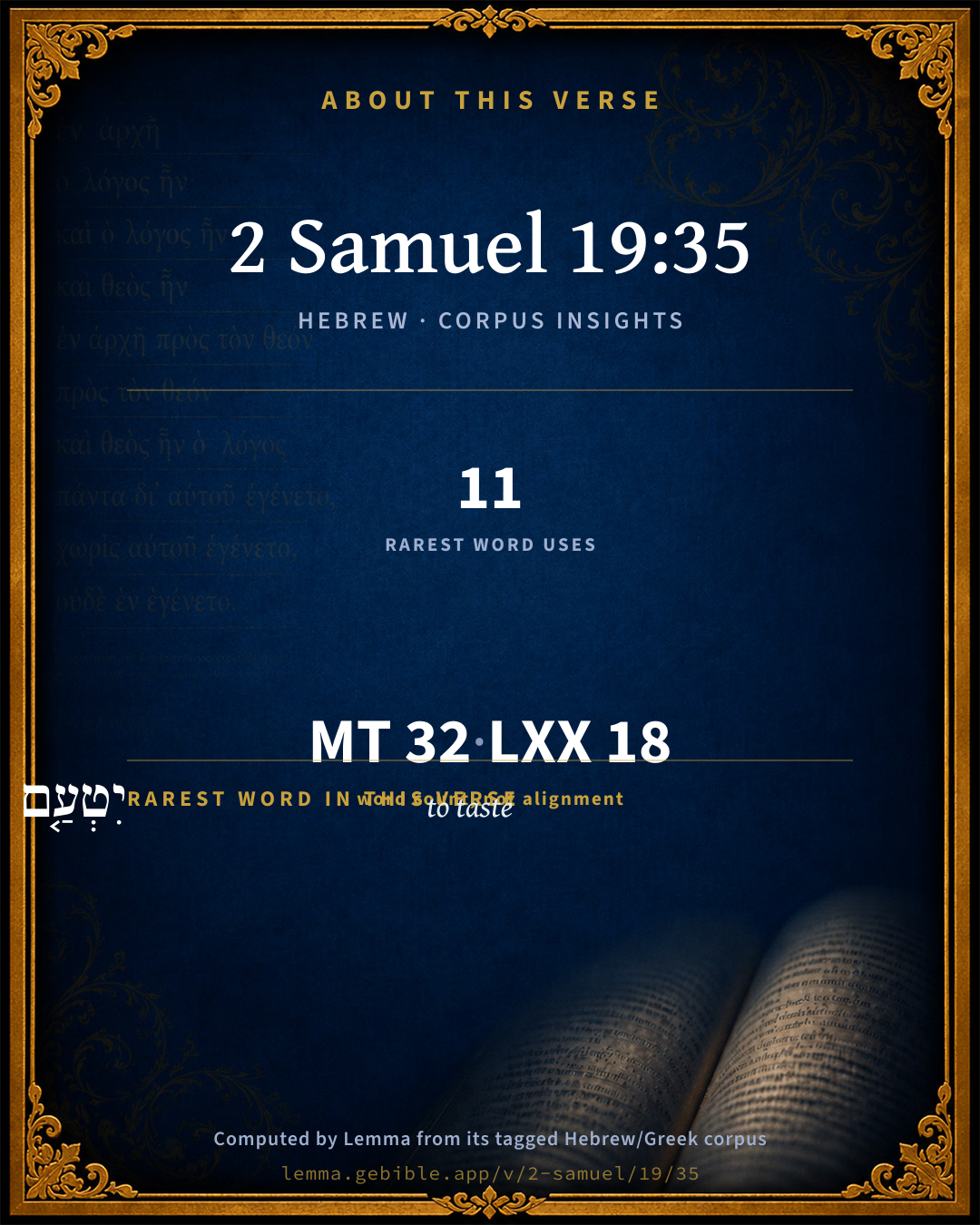
The rarest word here is יִטְעַ֤ם to taste H2938 — appearing just 11 times in the whole Hebrew Bible.

Shared distinctive vocabulary

יִטְעַ֤ם to taste H2938 occurs in 10 verses of the Hebrew Bible. Also found in:

Grammatical profile

  • 8 verbs
  • 9 nouns
  • 3 adjectives
  • 1 pronoun
  • 2 prepositions
  • 2 conjunctions
  • 2 adverbs
  • 5 particles

Verb forms

  • הַאֵדַ֣ע Qal · Imperfect
  • יִטְעַ֤ם Qal · Imperfect
  • אֹכַל֙ Qal · Imperfect
  • אֶשְׁתֶּ֔ה Qal · Imperfect
  • אֶשְׁמַ֣ע Qal · Imperfect
  • שָׁרִ֣ים Qal · Participle Active
  • וְשָׁר֑וֹת Qal · Participle Active
  • יִֽהְיֶ֨ה Qal · Imperfect

Repetition

Words recur within this verse — often emphatic in Hebrew:

  • עַבְדְּךָ֙ servant H5650 ×2
  • ע֔וֹד still H5750 ×2
  • שָׁרִ֣ים to sing H7891 ×2
  • אִם if H518 ×2
  • אֲשֶׁ֤ר which H834 ×2

Hebrew & Septuagint length

In English translation the verse runs 52 words from the Hebrew and 54 from the Septuagint (LXX English) — closely comparable.

A rough comparison of the two English renderings, which tokenize alike — not a word-level alignment.

Word counts can differ between the Hebrew and the Greek without any difference in meaning — e.g. the Hebrew direct-object marker אֵת has no separate Greek word, and Greek often adds the article ὁ.

In the original languages it is 32 Hebrew tokens and 18 Greek tokens — but the two are counted differently (Hebrew bundles its prefixes and suffixes into one token; the Greek is in lemma form), so that isn’t a like-for-like length.

Cross-references

14

Topical passages linked to 2 Samuel 19:35 in the Treasury of Scripture Knowledge — connected by theme and wording, ordered by reader-vote popularity; previews shown in the World English Bible.

  • 2 Samuel 15:33 David said to him, If you pass on with me, then you will be a burden to me:
  • Ezra 2:65 besides their men-servants and their maid-servants, of whom there were seven thousand three hundred thirty-seven: and they had two hundred singing men and singing women.
  • Psalms 90:10 The days of our years are seventy, Or even by reason of strength eighty years; Yet their pride is but labor and sorrow, For it passes quickly, and we fly away.
  • Exodus 2:8 Pharaoh's daughter said to her, "Go." The maiden went and called the child's mother.
  • Exodus 12:4 and if the household be too little for a lamb, then he and his neighbor next to his house shall take one according to the number of the souls; according to what everyone can eat you shall make your count for the lamb.
  • 2 Samuel 13:25 The king said to Absalom, No, my son, let us not all go, lest we be burdensome to you. He pressed him: however he would not go, but blessed him.
  • Nehemiah 7:67 besides their men-servants and their maid-servants, of whom there were seven thousand three hundred thirty-seven: and they had two hundred forty-five singing men and singing women.
  • Job 6:30 Is there injustice on my tongue? Can't my taste discern mischievous things?
  • Job 12:11 Doesn't the ear try words, Even as the palate tastes its food?
  • Ecclesiastes 2:8 I also gathered silver and gold for myself, and the treasure of kings and of the provinces. I got myself men-singers and women-singers, and the delights of the sons of men--musical instruments, and that of all sorts.
  • Ecclesiastes 12:1–5 Remember also your Creator in the days of your youth, Before the evil days come, and the years draw near, When you will say, "I have no pleasure in them;"
  • Isaiah 5:11–12 Woe to those who rise up early in the morning, that they may follow strong drink; Who stay late into the night, until wine inflames them!
  • Hebrews 5:14 But solid food is for those who are full grown, who by reason of use have their senses exercised to discern good and evil.
  • 1 Peter 2:3 if indeed you have tasted that the Lord is gracious:

Cross-references courtesy of OpenBible.info (CC BY 4.0).

Hebrew and Greek witnesses Masoretic Hebrew ↔ Greek Septuagint

The same verse in the two great witnesses to the Old Testament, shown verse-for-verse.

These are two independent witnesses, not word-aligned to each other, and the Septuagint is shown in lemma (dictionary) form.

Hebrew 2 Samuel 19:35 Masoretic · Westminster Leningrad Codex

בֶּן שְׁמֹנִ֣ים שָׁנָה֩ אָנֹכִ֨י הַיּ֜וֹם הַאֵדַ֣ע בֵּין ט֣וֹב לְרָ֗ע אִם יִטְעַ֤ם עַבְדְּךָ֙ אֶת אֲשֶׁ֤ר אֹכַל֙ וְאֶת אֲשֶׁ֣ר אֶשְׁתֶּ֔ה אִם אֶשְׁמַ֣ע ע֔וֹד בְּק֖וֹל שָׁרִ֣ים וְשָׁר֑וֹת וְלָמָּה֩ יִֽהְיֶ֨ה עַבְדְּךָ֥ עוֹד֙ לְמַשָּׂ֔א אֶל אֲדֹנִ֖י הַמֶּֽלֶךְ

I am this day eighty years old: can I discern between good and bad? can your servant taste what I eat or what I drink? can I hear any more the voice of singing men and singing women? why then should your servant be yet a burden to my lord the king?

World English Bible · Public Domain

Greek LXX 2 Samuel 19:35 Septuagint · lemma form

καί εἶπον βερζελλι πρός ὁ βασιλεύς πόσος ἡμέρα ἔτος ζωή ἐγώ ὅτι ἀναβαίνω μετά ὁ βασιλεύς εἰς ἰερουσαλήμ

I am this day eighty years old: can I then distinguish between good and evil? Can your servant taste any longer what I eat or drink? can I any longer hear the voice of singing men or singing women? and therefore shall your servant any longer be a burden to my lord the king?

LXX2012 (modern English Septuagint) · Public Domain

Hebrew: Westminster Leningrad Codex (CC BY 4.0). Greek: Septuagint (public domain); English from LXX2012 (modern English Septuagint) (Public Domain). How the Septuagint differs from the Hebrew →

Targum (Aramaic paraphrase)

1

The Targum is the ancient Jewish Aramaic paraphrase of the Hebrew Scriptures — an interpretive translation, not the Hebrew text itself. Onkelos (literal) and Pseudo-Jonathan (expansive) render the Torah, and Jonathan the Prophets. Coverage is partial: where no permissively-licensed English translation exists for a verse, only the Aramaic is shown. This is verse-level text, not a word-by-word alignment to the Hebrew.

  1. Targum Jonathan Prophets (Joshua–Malachi)
    וַאֲמַר בַּרְזִלַי לְמַלְכָּא כַּמָה יוֹמֵי שְׁנֵי חַיַי אָרֵי אָסַק עִם מַלְכָּא לִירוּשְׁלֵם:

    (no public-domain English translation for this verse)

    Targum Jonathan — Aramaic: “Mikraot Gedolot” (public domain). English: “Sefaria Community Translation” (CC0 1.0 (public-domain dedication)); “London "Chaldee Paraphrase," 1871” (public domain). Text via Sefaria.

Commentary

Notes on 2 Samuel 19:35 from classic Christian and Jewish commentators (each source and its license shown beneath its notes). The classic Christian expositions comment on the surrounding passage and are grouped to its opening verse, so a note may address several verses; the Jewish commentaries on the Tanakh (Rashi and others) are per-verse, so they appear only where the commentator wrote on this verse.

Lemma curates 59 commentaries, every one of them public domain or Creative Commons licensed, each selected and text-cleaned for this edition rather than reprinted as found. About our sources →

Trapp's Complete Commentary

John Trapp

2Sa 19:35 I [am] this day fourscore years old: [and] can I discern between good and evil? can thy servant taste what I eat or what I drink? can I hear any more the voice of singing men and singing women? wherefore then should thy servant be yet a burden unto my lord the king?

Ver. 35. Can I discern between good and evil?] Am I fit for courtly pleasures? It is past time of day with me for such matters. See Ecc 12:2-4. {See Trapp on "Ecc 12:2"} {See Trapp on "Ecc 12:3"} {See Trapp on "Ecc 12:4"}

Can I hear any more the voice?] David was a musical man, and had variety of signing and music at his meals. So had Muleasses, king of Tunis, who, that he might with more pleasure hear them, used to cover his eyes all the while.

John Trapp, A Commentary or Exposition upon All the Books of the Old and New Testament (1647–1656) — public domain. Text from a community e-Sword module.

Geneva Bible (1599)

Geneva Bible translators

He thought it not meet to receive benefits of him to whom he was not able to do service again.

Geneva Bible (1599) marginal notes — public domain. Text via Bolls.life.

Jamieson, Fausset & Brown

Robert Jamieson, A. R. Fausset & David Brown

the voice of singing men and singing women--Bands of professional musicians form a prominent appendage to the courts of Oriental princes.

Jamieson, Fausset & Brown — Commentary Critical and Explanatory on the Whole Bible (1871) — public domain (CC PDM 1.0). Text via the HelloAO Bible API.

Adam Clarke's Commentary

Verse 35. Can thy servant taste what I eat] Here is at once an affecting description of the infirmities of old age; and a correct account of the mode of living at an Eastern court in ancient times.

Barzillai was fourscore years old; his ear was become dull of hearing, and his relish for his food was gone: he therefore appears to have been not only an old man, but an infirm old man. Besides delicate meats and drinks, we find that vocal music constituted a principal part of court entertainments: male and female singers made a necessary appendage to these banquets, as they do in most Eastern courts to the present day. As David was a most sublime poet, and emphatically styled the sweet singer of Israel, he no doubt had his court well supplied with vocal as well as instrumental performers; and, probably, with poets and poetesses; for it is not likely that he was the only poet of his time, though he undoubtedly was the most excellent.

Adam Clarke's Commentary on the Bible (1810–1826) — public domain. Text from a community e-Sword/MySword module.

The Cambridge Bible for Schools and Colleges

gen. ed. J. J. S. Perowne

35. fourscore years] Cp. Psa_90:10.

singing men and singing women] Musicians were a part of royal state (Ecc_2:8); banquets were commonly enlivened by music. See Isa_5:11-12; Isa_24:8-9; Amo_6:4-6.

The Cambridge Bible for Schools and Colleges (gen. ed. J. J. S. Perowne; Cambridge University Press, 1878–1918) — public domain. Text from a community e-Sword module.

John Gill's Exposition

I am this day fourscore years old,.... Not that that day was precisely his birthday, but that he was about such an age, very little under or over; very probably he was full that age:

and can I discern between good and evil? signifying, either that his intellectual powers were impaired, and could not distinguish what was right and wrong, and so could be of no service to David in his privy council, or any court of judicature, he was fit for no post or office under him; or that his natural senses were not quick to distinguish between good and bad, particularly between good and bad food, which he could neither discern by smell nor taste, as follows:

can thy servant taste what I eat or what I drink? have any gust or relish of, or take any delight or pleasure in eating and drinking; so that the most delicious food, and richest wines, and all the dainties of a king's table, would signify nothing to him:

can I hear any more the voice of singing men and singing women? either being so deaf that he could not hear them at all, or however not with any delight; the evil days being come upon him, in which he could take no pleasure in the diversions of a court:

wherefore then should thy servant be yet a burden unto my lord the king? he could neither take any pleasure himself, nor be of any service to the king, but on the contrary a burden to him; not only on account of his sustenance, and being obliged to have servants to attend him, which might be the least part of his burden, but his company would be disagreeable and troublesome, through the infirmities of old age upon him.

John Gill's Exposition of the Whole Bible (1746–1763) — public domain (CC PDM 1.0). Text via the HelloAO Bible API.

Haydock's Catholic Bible Commentary

Burden, as I am unfit for any service. (Menochius)

George Leo Haydock (1774–1849), Haydock's Catholic Family Bible and Commentary, 1859 edition — public domain. Excludes Psalms (Douay-Rheims chapter numbering differs from Protestant) and Deuterocanonical books (Catholic canon only).

Matthew Poole's English Annotations

My senses are grown dull, and uncapable of relishing the delights of the court. I am past taking pleasure in delicious tastes, or sweet music, and other such delights of the court. I am through age both useless and burdensome to others, and therefore most improper for a court life.

Matthew Poole's English Annotations on the Holy Bible (1683–1685) — public domain. Text from a community e-Sword/MySword module.

Whedon's Commentary on the Bible

Daniel D. Whedon

35. Can I discern between good and evil — Is it to be supposed that at my time of life I still retain unimpaired the powers of judgment and discrimination which belong to the age of healthfulness and vigour? Good and evil are to be understood here of the pleasures and entertainments of court life, as the following specifications show.

Can thy servant taste what I eat — Thy servant is a periphrastic expression for I, as is 2Sa_19:26, and frequently elsewhere. It is a form of expression used out of respect to royalty, and is equivalent to Can I taste what I eat, etc. His senses of taste and hearing had become so impaired that delicate meats and drinks, and vocal or instrumental music, with all which he would be constantly entertained at the royal court, would not be appreciated by him.

Daniel D. Whedon (gen. ed.), Commentary on the Old and New Testaments (1874–1909) — public domain. Text from a community e-Sword module.

The Pulpit Commentary

The privations of old age.

Barzillai graphically depicts these as experienced by himself. All old men have not exactly the same experience; but all who live to a great age must expect a similar diminution of their powers.

I THE PRIVATIONS OF THE AGED.

1. Enfeebled or annihilated powers. Blunted or extinct senses; dulness or loss of sight, hearing, taste, smelling; feebleness of body and mind. Consequent inability for active employments. Loss of the pleasures which the exercise of vigorous faculties confers.

2. Increasing dependence on others. Possibly, unlike Barzillai, for the means of subsistence; certainly for much besides. Hence the old man is apt to become, and feel himself to be, "a burden," putting the kindness and patience of others to a severe test. The discomfort arising from such dependance is often very great.

3. The sense of loneliness. Sometimes the aged survive all who have loved and cared for them, and, if not, they commonly feel themselves cut off from the interests and pleasures of the new generation.

II HOW THESE PRIVATIONS SHOULD BE BORNE.

1. With cheerful submission and patience. Remembering that the order of nature which brings such ills to the aged, and the circumstances which occasion their own particular troubles, are the appointment of the infinitely wise and good Creator and Father. Recalling also their many years of vigorous faculty and lively enjoyment, and cherishing a gratitude which will suppress discontent.

2. With thankfulness for what remains. The love and care which provide for, or minister to, their needs and alleviate their troubles. Above all, the unchanging love of God and the Redeemer, and the spiritual blessings hence enjoyed.

3. With watchfulness against the temptations incident to old age. Such as those to fretfulness, irritability, impatience, envy of the young, and needless interference with their enjoyments. The revival with new power of old sinful propensities, ill tempers, and bad habits.

4. With joyful hope. Of speedy deliverance from all burdens and troubles, and the recommencement of life with renewed and perfected energies. Nothing can keep the aged Christian long out of heaven.

III HOW OTHERS SHOULD REGARD THEM.

1. With respectful tenderness, sympathy, and readiness to alleviate them.

2. With diminished desire for the great prolongation of their own lives.

3. With steadfast aim and endeavour so to live that, if old age come, it maynot be oppressed with the needless burdens and anxieties which a godless life leads to. Let the young keep in mind the admonition, "Remember now thy Creator in the days of thy youth, while the evil days come not, nor the years draw nigh, when thou shalt say, I have no pleasure in them". G.W. (Ecc_12:1)

The Pulpit Commentary (1880–1919), ed. H.D.M. Spence-Jones & Joseph S. Exell — public domain. Text from a community e-Sword module.

John Wesley's Explanatory Notes

I am, &c. - My senses are grown dull, and incapable of relishing the pleasures of a court. I am past taking pleasures in delicious tastes, or sweet musick, and other such delights. I am through age both useless and burdensome to others, and therefore most improper for a court life.

John Wesley, Explanatory Notes Upon the Whole Bible (1754–1765) — public domain. Text via the GEBible commentary corpus.

Rashi

Rabbi Shlomo Yitzchaki (Rashi)

How many more years of life [do I have]. That I have to live.

That I should go up. There are only a few left, [therefore] what pleasure will I have from your providing for me.

Rashi on the Tanakh — English translations: “The Judaica Press complete Tanach with Rashi, translated by A. J. Rosenberg” (CC BY 4.0); “Pentateuch with Rashi's commentary by M. Rosenbaum and A.M. Silbermann, 1929-1934” (public domain); “The Metsudah Tanach series, Lakewood, N.J” (CC BY 4.0); and “The Book of Joshua, Metsudah Publications, 1997” (CC BY 4.0). Text via Sefaria.

Lesson kit

Teaching starters — assembled from the data on this page, not authored interpretation. Every prompt links to the verse data it draws on. Edit before teaching.

2 Samuel, in the Historical, opens this verse with 32 words (26 distinct Hebrew lemmas). Its most distinctive word is ṭâʻam (“to taste”). A historical commentator’s framing appears above. Read the whole chapter for the surrounding context.

Discussion questions

  1. The word ṭâʻam carries the sense “to taste.” How does it shape the verse?
  2. How does 1 Samuel 14:24, which shares the word «to taste», read alongside this verse?
  3. What does the repetition of “servant” (2× in this one verse) do in this verse?
  4. The translations on this page render this verse differently — a whole-verse word diff, not a word-by-word alignment. What might account for the different wordings?
  5. «הַאֵדַ֣ע» is a Qal Imperfect verb. How does that grammatical form shape the action described?
  6. Compare how Trapp's Complete Commentary and Geneva Bible (1599) read this verse. Where do they agree or differ?

Things to notice

Reading settings

Reading text

Shown beneath each verse's original-language words.

Old Testament
Old Testament edition

Read the OT as the Masoretic Hebrew (MT) or the Greek Septuagint (LXX).

English shown for the Greek Septuagint (in the Hebrew ↔ Greek comparison).

Comparing translations? Open the Compare panel on any verse page to stack up to four side by side.