
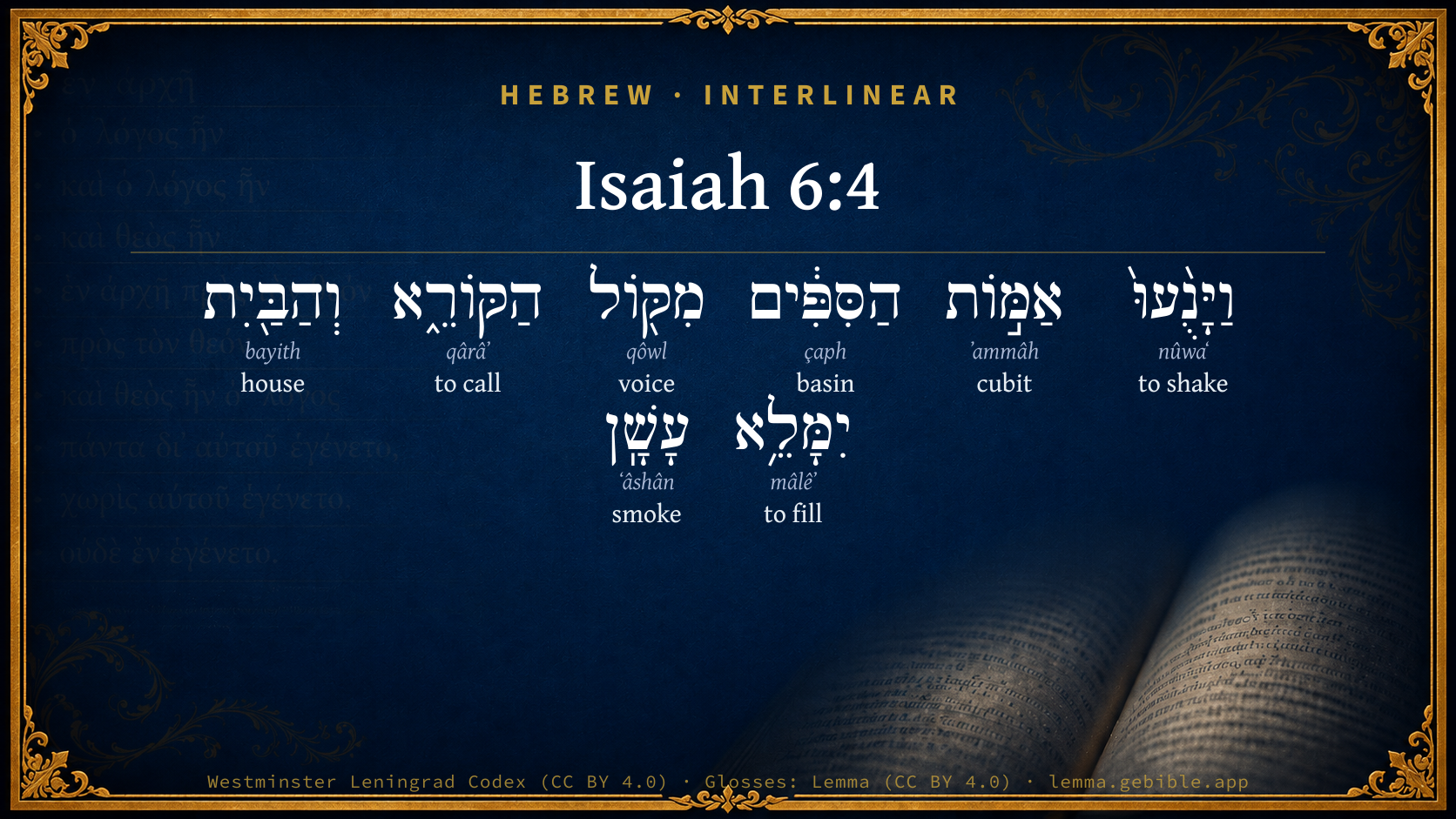
Isaiah 6:4

Hebrew (Westminster Leningrad Codex) Isaiah 6:4 appears in the Hebrew Old Testament. The text above is from the Westminster Leningrad Codex. Each word links to its Strong’s number, a concise gloss, and parsing drawn from the Open Scriptures Hebrew Bible morphology. Click any word for its full Brown-Driver-Briggs (BDB) entry.
Download image
Cite this verse

Isaiah 6:4 (World English Bible). Public Domain. Lemma interlinear Bible study tool, https://lemma.gebible.app/v/isaiah/6/4.

Show BibTeX & RIS
BibTeX
RIS
English Translation
The foundations of the thresholds shook at the voice of him who called, and the house was filled with smoke.
World English Bible · Public Domain
Download a study sheet

One document with this verse’s original text, its word-by-word gloss line, the meaning frame, cross-references with their text, attributed commentary, and full source and license credits — printable, and it pastes into notes with its structure intact.

This verse Autodidact and up

Study sheet (.html) Plain text (.txt)

A passage Seminary Student

Up to 50 verses in one chapter. A passage sheet keeps up to 6 commentary sources and 12 cross-references per verse, in the order this page ranks them, and says so on the sheet whenever that leaves anything out. Ask for a single verse and you get the Autodidact verse sheet above.

Everything on this page stays free to read, with no account — the sheet is a download of what is already on screen, not access to it.

Want to remove ads? Support Godless Engineer
Compare translations 3

The same verse in 3 English versions, stacked beneath the original-language interlinear above. Click any original word for its lexicon entry.

Each is an independent rendering of the whole verse — the interlinear is not word-aligned to these translations.

Highlighted words mark where these versions differ — a whole-verse word diff, not a word-by-word alignment.

  • World English Bible Public Domain
    The foundations of the thresholds shook at the voice of him who called, and the house was filled with smoke.
  • King James Version Public Domain
    And the posts of the door moved at the voice of him that cried, and the house was filled with smoke.
  • unfoldingWord Literal Text CC BY-SA 4.0
    And the foundations of the thresholds shook from the voice of the one calling, and the house was filled smoke.

unfoldingWord Literal Text — © unfoldingWord, licensed CC BY-SA 4.0. Word-aligned USFM3 via Door43 (git.door43.org/unfoldingWord/en_ult).

Versions to compare (up to 4)

3 of 4 selected

Show all 18 translations

Every available English version of this verse, each an independent rendering of the whole verse.

  • World English Bible Public Domain
    The foundations of the thresholds shook at the voice of him who called, and the house was filled with smoke.
  • Berean Standard Bible Public Domain
    At the sound of their voices the doorposts and thresholds shook, and the temple was filled with smoke.
  • Majority Standard Bible Public Domain
    At the sound of their voices the doorposts and thresholds shook, and the temple was filled with smoke.
  • King James Version Public Domain
    And the posts of the door moved at the voice of him that cried, and the house was filled with smoke.
  • American Standard Version (1901) Public Domain
    And the foundations of the thresholds shook at the voice of him that cried, and the house was filled with smoke.
  • Revised Version (1885) Public Domain
    And the foundations of the thresholds were moved at the voice of him that cried, and the house was filled with smoke.
  • Geneva Bible (1599) Public Domain
    And the lintles of the doore cheekes moued at the voyce of him that cryed, and the house was filled with smoke.
  • Douay-Rheims (1899) Public Domain
    And the lintels of the doors were moved at the voice of him that cried, and the house was filled with smoke.
  • Young's Literal Translation Public Domain
    And the posts of the thresholds are moved by the voice of him who is calling, and the house is full of smoke.
  • Literal Standard Version CC BY-SA 4.0
    And the posts of the thresholds are moved by the voice of him who is calling, and the house is full of smoke.
  • Unlocked Literal Bible CC BY-SA 4.0
    The foundations of the thresholds shook at the voices of those who were crying out, and the house was filled with smoke.
  • unfoldingWord Literal Text CC BY-SA 4.0
    And the foundations of the thresholds shook from the voice of the one calling, and the house was filled smoke.
  • Darby Bible Public Domain
    And the foundations of the thresholds shook at the voice of him that cried, and the house was filled with smoke.
  • World Messianic Bible Public Domain
    The foundations of the thresholds shook at the voice of him who called, and the house was filled with smoke.
  • Webster's Bible Public Domain
    And the posts of the door moved at the voice of him that cried, and the house was filled with smoke.
  • Free Bible Version CC BY-SA 4.0
    The sound of their shouts made the doorposts and doorsteps shake, and the Temple was filled with smoke.
  • Bible in Basic English Public Domain
    And the bases of the door-pillars were shaking at the sound of his cry, and the house was full of smoke.
  • JPS Tanakh (1917) Public Domain
    And the posts of the door were moved at the voice of them that called, and the house was filled with smoke.

Literal Standard Version (2020), Covenant Press — licensed CC BY-SA 4.0. Text via the HelloAO Bible API (eBible.org). Unlocked Literal Bible (unfoldingWord) — licensed CC BY-SA 4.0. Text via the HelloAO Bible API (eBible.org). unfoldingWord Literal Text — © unfoldingWord, licensed CC BY-SA 4.0. Word-aligned USFM3 via Door43 (git.door43.org/unfoldingWord/en_ult). Free Bible Version, Dr. Jonathan Gallagher — licensed CC BY-SA 4.0. Text via the HelloAO Bible API (eBible.org).

Word by word

More ways to search: Search by grammar → Find every occurrence → Compare this word →

Practice this passage: Drill this verse → Learn its vocabulary →

About this verse

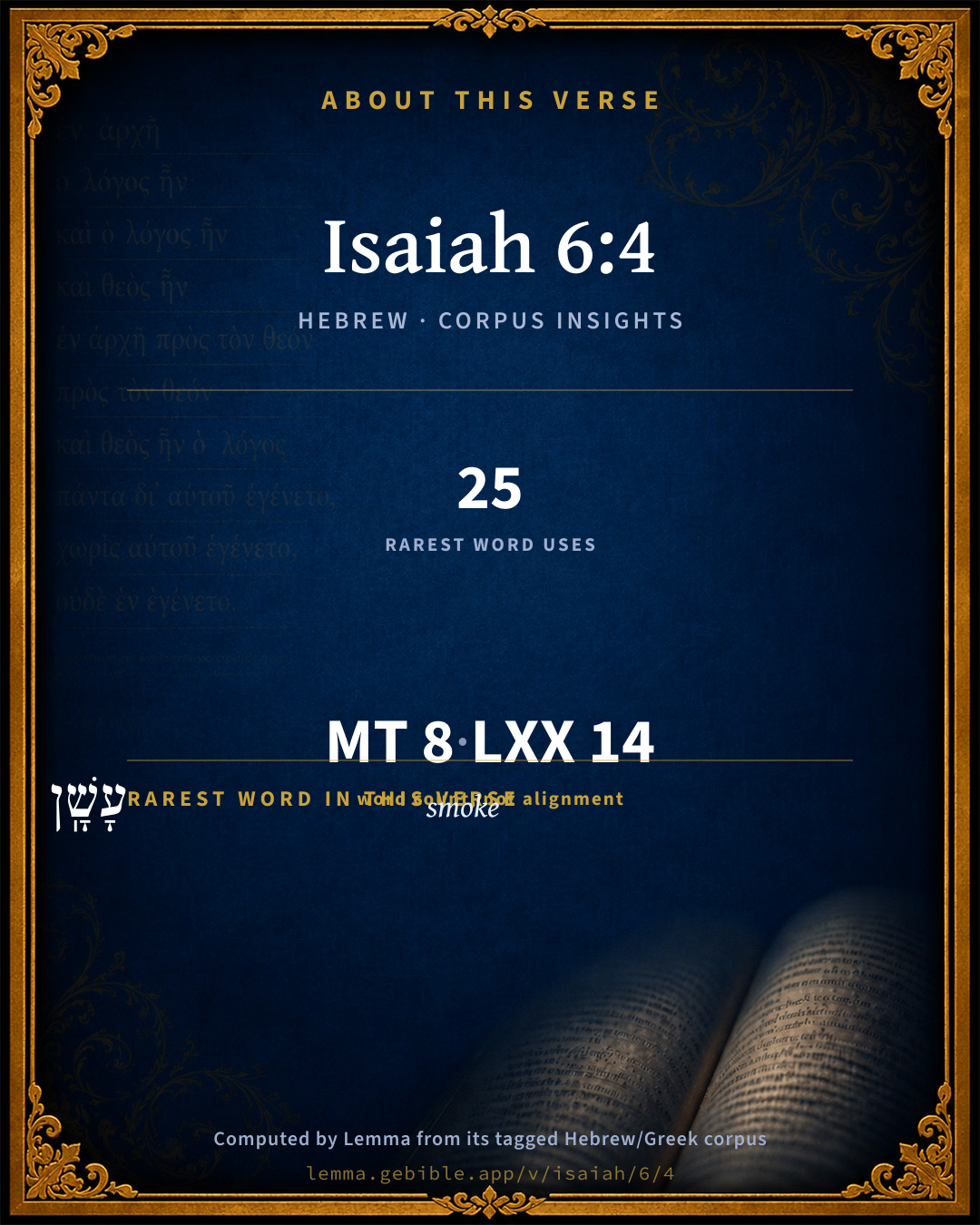
These counts appear in no published source. They are computed here, from the morphology-tagged text and Lemma’s own curated glosses. What Lemma adds →

8
words
8
distinct lemmas
Prophets
section

Notable vocabulary

The rarest word here is עָשָֽׁן smoke H6227 — appearing just 25 times in the whole Hebrew Bible.

Shared distinctive vocabulary

עָשָֽׁן smoke H6227 occurs in 24 verses of the Hebrew Bible. Also found in:

Grammatical profile

  • 3 verbs
  • 5 nouns

Verb forms

  • וַיָּנֻ֨עוּ֙ Qal · Sequential Imperfect
  • הַקּוֹרֵ֑א Qal · Participle Active
  • יִמָּלֵ֥א Niphal · Imperfect

Hebrew & Septuagint length

In English translation the verse runs 20 words from the Hebrew and 16 from the Septuagint (LXX English) — closely comparable.

A rough comparison of the two English renderings, which tokenize alike — not a word-level alignment.

Word counts can differ between the Hebrew and the Greek without any difference in meaning — e.g. the Hebrew direct-object marker אֵת has no separate Greek word, and Greek often adds the article ὁ.

In the original languages it is 8 Hebrew tokens and 14 Greek tokens — but the two are counted differently (Hebrew bundles its prefixes and suffixes into one token; the Greek is in lemma form), so that isn’t a like-for-like length.

Cross-references

9

Topical passages linked to Isaiah 6:4 in the Treasury of Scripture Knowledge — connected by theme and wording, ordered by reader-vote popularity; previews shown in the World English Bible.

  • Revelation 15:8 The temple was filled with smoke from the glory of God, and from his power. No one was able to enter into the temple, until the seven plagues of the seven angels would be finished.
  • Exodus 40:34 Then the cloud covered the tent of meeting, and the glory of Yahweh filled the tent.
  • 1 Kings 8:10–12 It came to pass, when the priests were come out of the holy place, that the cloud filled the house of Yahweh,
  • 2 Chronicles 5:13–6:1 it happened, when the trumpeters and singers were as one, to make one sound to be heard in praising and thanking Yahweh; and when they lifted up their voice with the trumpets and cymbals and instruments of music, and praised Yahweh, [saying], For he is good; for his loving kindness endures forever; that then the house was filled with a cloud, even the house of Yahweh,
  • Ezekiel 10:5 The sound of the wings of the cherubim was heard even to the outer court, as the voice of God Almighty when he speaks.
  • Revelation 11:19 God's temple that is in heaven was opened, and the ark of the Lord's covenant was seen in his temple. Lightnings, sounds, thunders, an earthquake, and great hail followed.
  • Psalms 18:8 Smoke went out of his nostrils. Consuming fire came out of his mouth. Coals were kindled by it.
  • Amos 9:1 I saw the Lord standing beside the altar, and he said, "Strike the tops of the pillars, that the thresholds may shake; and break them in pieces on the head of all of them; and I will kill the last of them with the sword: there shall not one of them flee away, and there shall not one of them escape.
  • Ezekiel 1:24 When they went, I heard the noise of their wings like the noise of great waters, like the voice of the Almighty, a noise of tumult like the noise of a host: when they stood, they let down their wings.

Cross-references courtesy of OpenBible.info (CC BY 4.0).

Hebrew and Greek witnesses Masoretic Hebrew ↔ Greek Septuagint

The same verse in the two great witnesses to the Old Testament, shown verse-for-verse.

These are two independent witnesses, not word-aligned to each other, and the Septuagint is shown in lemma (dictionary) form.

Hebrew Isaiah 6:4 Masoretic · Westminster Leningrad Codex

וַיָּנֻ֨עוּ֙ אַמּ֣וֹת הַסִּפִּ֔ים מִקּ֖וֹל הַקּוֹרֵ֑א וְהַבַּ֖יִת יִמָּלֵ֥א עָשָֽׁן

The foundations of the thresholds shook at the voice of him who called, and the house was filled with smoke.

World English Bible · Public Domain

Greek LXX Isaiah 6:4 Septuagint · lemma form

καί ἐπιαἴρω ὁ ὑπέρθυρον ἀπό ὁ φωνή ὅς ἐκκράζω καί ὁ οἶκος πίμπλημι καπνός

And the lintel shook at the voice they uttered, and the house was filled with smoke.

LXX2012 (modern English Septuagint) · Public Domain

On this verse, Keil & Delitzsch discusses the Septuagint’s reading. Read the note in Commentary ↓

Hebrew: Westminster Leningrad Codex (CC BY 4.0). Greek: Septuagint (public domain); English from LXX2012 (modern English Septuagint) (Public Domain). How the Septuagint differs from the Hebrew →

Targum (Aramaic paraphrase)

1

The Targum is the ancient Jewish Aramaic paraphrase of the Hebrew Scriptures — an interpretive translation, not the Hebrew text itself. Onkelos (literal) and Pseudo-Jonathan (expansive) render the Torah, and Jonathan the Prophets. Coverage is partial: where no permissively-licensed English translation exists for a verse, only the Aramaic is shown. This is verse-level text, not a word-by-word alignment to the Hebrew.

  1. Targum Jonathan Prophets (Joshua–Malachi)
    וְזָעוּ אֵילְוַת סִפֵּי הֵיכְלָא מִקָל מִלוּלָא וּבֵית מַקְדְשָׁא אִתְמְלֵי אֲמִטְתָא:

    And the posts of the threshold of the temple moved at the voice of him that cried, and the house of the sanctuary was filled with cloudy darkness.

    Targum Jonathan — Aramaic: “Mikraot Gedolot” (public domain). English: “Sefaria Community Translation” (CC0 1.0 (public-domain dedication)); “London "Chaldee Paraphrase," 1871” (public domain). Text via Sefaria.

Commentary

Notes on Isaiah 6:4 from classic Christian and Jewish commentators (each source and its license shown beneath its notes). The classic Christian expositions comment on the surrounding passage and are grouped to its opening verse, so a note may address several verses; the Jewish commentaries on the Tanakh (Rashi and others) are per-verse, so they appear only where the commentator wrote on this verse.

Lemma curates 59 commentaries, every one of them public domain or Creative Commons licensed, each selected and text-cleaned for this edition rather than reprinted as found. About our sources →

Trapp's Complete Commentary

John Trapp

Isa 6:4 And the posts of the door moved at the voice of him that cried, and the house was filled with smoke.

Ver. 4. And the posts of the door were moved.] Presently upon the angels’ hymn this occured, with such a force it was uttered, as it was at the time of our Saviour’s resurrection, when the angel rolled back the stone and sat upon it there was a great earthquake. {Mat 28:2} By the moving of the "posts" or thresholds was signified the destruction of the temple, when the smoke with which the house was filled, when it was burned down by the Chaldees, as also the just excaecation of the Jews. Their temple, that had been filled with the train of glory, is now filled with smoke going out of God’s nostrils when he was angry. {Psa 18:8 Deu 29:20}

John Trapp, A Commentary or Exposition upon All the Books of the Old and New Testament (1647–1656) — public domain. Text from a community e-Sword module.

The Biblical Illustrator

Joseph S. Exell

Isa_6:4

And the posts of the door moved

The shaken temple

It is stated that, at a musical festival which was held in Westminster Abbey on one occasion, the strains were so powerful in a certain part of the performance, that the whole building was shaken.

So it was on this occasion. The sacred edifice trembled at the presence of God, and at the voice of those who were engaged in His praise.

The Biblical Illustrator, edited by Joseph S. Exell (c. 1880s–1900s) — public domain. Text from a community e-Sword module.

Joseph Benson's Commentary

Isa 6:4. And the posts of the door moved — Together with the door itself. Such violent motions were commonly tokens of God’s anger. And here, it seems, this concussion of the temple was intended to signify God’s displeasure against his people for their sins, and to be a token of its destruction, by the Babylonians first, and afterward by the Romans; and the house was filled with smoke — Which elsewhere is a token of God’s presence and acceptance, but here, of his anger; and may be considered likewise as an emblem of the darkness and blindness of that generation of Jews, accustomed to worship in that temple, as also of that future generation of the same people, who should worship there in the days of the Messiah, before its second destruction by the Romans.

Joseph Benson's Commentary on the Old and New Testaments (1811–1818) — public domain. Text from a community e-Sword module.

Keil & Delitzsch

C. F. Keil & F. Delitzsch

When Isaiah heard this, he stood entranced at the farthest possible distance from Him that sat upon the throne, namely, under the door of the heavenly palace or temple. What he still further felt and saw, he proceeds to relate in Isa 6:4 : "And the foundations of the thresholds shook with the voice of them that cried; and the house became full of smoke." By ‛ammoth hassippim, the lxx, Vulgate, Syriac, and others understand the posts of the lintels, the supporting beams of the superliminaria, which closed the doorway at the top. But as saph is only used in other places to signify the threshold and porch (limen and vestibulum), ‛ammoth hassippim must be understood here in the (perfectly appropriate) sense of "the foundations of the thresholds" (ammâh, which bears the same relation to עם, mother, as matrix to mater, is used to denote the receptive basis into which the door-steps with their plugs were inserted, like the talmudic ammetâh derēchayyâh, the frame or box of the hand-mill (Berachoth 18b), and ammath megērah, the wood-work which runs along the back of the saw and keeps it firmly extended (Kelim 21, 3); compare the "Schraubenmutter," literally screw-mother, or female screw, which receives and holds the cylindrical screw). Every time that the choir of seraphim (הקּורא: compare such collective singulars as hâ'oreb, the ambush, in Jos 8:19; hechâlutz, of men of war, in Jos 6:7, etc.) began their song, the support of the threshold of the porch in which Isaiah was standing trembled. The building was seized with reverential awe throughout its whole extent, and in its deepest foundations: for in the blessed state beyond, nothing stands immoveable or unsusceptible in relation to the spirits there; but all things form, as it were, the accidentia of their free personality, yielding to their impressions, and voluntarily following them in all their emotions. The house was also "filled with smoke." Many compare this with the similar occurrence in connection with the dedication of Solomon's temple (Kg1 8:10); but Drechsler is correct in stating that the two cases are not parallel, for there God simply attested His own presence by the cloud of smoke behind which He concealed Himself, whereas here there was no need of any such self-attestation. Moreover, in this instance God does not dwell in the cloud and thick darkness, whilst the smoke is represented as the effect of the songs of praise in which the seraphim have joined, and not of the presence of God. The smoke arose from the altar of incense mentioned in Isa 6:6. But when Drechsler says that it was the prayers of saints (as in Rev 5:8; Rev 8:3-4), which ascended to the Lord in the smoke, this is a thought which is quite out of place here. The smoke was the immediate consequence of the seraphs' song of praise.

This begins to throw a light upon the name seraphim, which may help us to decipher it. The name cannot possibly be connected with sârâph, a snake (Sanscr. sarpa, Lat. serpens); and to trace the word to a verb sâraph in the sense of the Arabic 'sarafa ('sarufa), to tower high, to be exalted, or highly honoured (as Gesenius, Hengstenberg, Hofmann, and others have done), yields a sense which does not very strongly commend itself. On the other hand, to follow Knobel, who reads shârâthim (worshippers of God), and thus presents the Lexicon with a new word, and to pronounce the word serpahim a copyist's error, would be a rash concession to the heaven-storming omnipotence which is supposed to reside in the ink of a German scholar. It is hardly admissible, however, to interpret the name as signifying directly spirits of light or fire, since the true meaning of sâraph is not urere (to burn), but Comburere (to set on fire or burn up). Umbreit endeavours to do justice to this transitive meaning by adopting the explanation "fiery beings," by which all earthly corruption is opposed and destroyed. The vision itself, however, appears to point to a much more distinctive and special meaning in the name, which only occurs in this passage of Isaiah. We shall have more to say upon this point presently.

Keil & Delitzsch — Biblical Commentary on the Old Testament (1861–1891) — public domain (CC PDM 1.0). Text via the HelloAO Bible API. (Old Testament only.)

Geneva Bible (1599)

Geneva Bible translators

Which things were to confirm the Prophet, that it was not the voice of man: and by the smoke was signified the blindness that should come upon the Jews.

Geneva Bible (1599) marginal notes — public domain. Text via Bolls.life.

Jamieson, Fausset & Brown

Robert Jamieson, A. R. Fausset & David Brown

posts of . . . door--rather, foundations of the thresholds.

house--temple.

smoke--the Shekinah cloud (Kg1 8:10; Eze 10:4).

Jamieson, Fausset & Brown — Commentary Critical and Explanatory on the Whole Bible (1871) — public domain (CC PDM 1.0). Text via the HelloAO Bible API.

Ellicott's Commentary for English Readers

(4) The posts of the door.—Better, the foundations of the threshold. The words seem to point to the prophet’s position as in front of the Holy of holies.

The house was filled with smoke.—The vision had its prototype in “the smoke as of a furnace” on Sinai (Exo_19:18), in the glory-cloud of 1Ki_8:10, and possibly in its lurid fire-lit darkness represented the wrath of Jehovah, as the clear brightness of the throne did His love. So in Rev_15:8, the “smoke from the glory of God” precedes the outpouring of the seven vials of wrath’. The parallelism of the clouds of incense-smoke as the symbol of adoring prayer (Rev_5:8; Rev_8:4) suggests an alternative interpretation as possible; but in that case mention would probably have been made of the censers from which it rose. The incense-clouds of the Temple may in either case have been the starting-point of the mystic vision.

A Bible Commentary for English Readers, edited by Charles John Ellicott (1878–1897) — public domain. Text from a community e-Sword module.

The Cambridge Bible for Schools and Colleges

gen. ed. J. J. S. Perowne

4. the posts of the door moved] the foundations of the thresholds shook (R.V.).

was filled (began to fill) with smoke] The smoke symbolises the “dark side of Jehovah’s self-manifestation” (Rev_15:8), the reaction of His holy nature against sin. It answers to the rising consciousness of alienation and impurity in the prophet’s mind, expressed in the next verse.

The Cambridge Bible for Schools and Colleges (gen. ed. J. J. S. Perowne; Cambridge University Press, 1878–1918) — public domain. Text from a community e-Sword module.

John Gill's Exposition

And the posts of the door moved at the voice of him that cried,.... That is, the posts of the door of the temple, as the Targum adds, where this vision was seen, as represented to the prophet. Some think this respects the earthquake in Uzziah's time, mentioned in Zac 14:5 and which they suppose was at the time he attempted to offer incense, and was smitten with leprosy; but, as Kimchi observes, this moving of the door posts was only in the vision of prophecy, and not in reality; this shaking therefore may denote either the shaking and removing of the temple service and worship, at the death of Christ, and through the preaching of the Gospel; or rather the shaking of the consciences of men by the word, which made them cry out, what shall we do to be saved?

And the house was filled with smoke; this was a token either of the burning of the temple, or of the anger of God against the Jews, Psa 18:8 or of their superstition and will worship, the cause of it, Rev 9:1 or of the judicial blindness and darkness they were given up unto, Isa 6:9 or rather of the presence of God in his church, and with his ministers, Exo 40:3 the allusion may be to the cloud of incense that covered the mercy seat, on the day of atonement, Lev 16:13 the passage is cited on this account in the Talmud (n).

(n) T. Bab. Yoma, fol. 53. 1.

John Gill's Exposition of the Whole Bible (1746–1763) — public domain (CC PDM 1.0). Text via the HelloAO Bible API.

Albert Barnes' Notes on the Bible

And the posts of the door - Margin, ‘Thresholds.’ There is some difficulty in the Hebrew here, but the meaning of the expression is sufficiently apparent. It means that there was a tremour, or concussion, as if by awe, or by the sound attending the cry. It is evidently a poetic expression.

The house - The temple.

Was filled with smoke - There is here, doubtless, a reference to “the cloud” that is so often mentioned in the Old Testament as the visible symbol of the Divinity; see the note at Isa 4:5. A similar appearance is recorded when Solomon dedicated the temple; 1Ki 8:10; 2Ch 5:13; Eze 10:4.

Albert Barnes' Notes on the Bible (1834–1885) — public domain. Text from a community e-Sword/MySword module.

Haydock's Catholic Bible Commentary

Of him. Septuagint, "them," (Haydock) the Seraphim signifying that the veil was removed by the death of Christ, (Theodoret) or that the people should be led into captivity, as a Jew explained it to St. Jerome.

George Leo Haydock (1774–1849), Haydock's Catholic Family Bible and Commentary, 1859 edition — public domain. Excludes Psalms (Douay-Rheims chapter numbering differs from Protestant) and Deuterocanonical books (Catholic canon only).

Matthew Poole's English Annotations

The posts of the door, together with the door itself, as if the door was to be removed, and the temple thereby to be exposed to the view and rapine of profane persons. Such violent motions were commonly tokens of God’s anger.

Him that cried, to wit, the angel, which cried; Isa 4:3.

Filled with smoke; which elsewhere is a token of God’s presence and acceptance, as Exo 40:34; 1Ki 8:10, but here of his anger, as Psa 18:8, and elsewhere.

Matthew Poole's English Annotations on the Holy Bible (1683–1685) — public domain. Text from a community e-Sword/MySword module.

Whedon's Commentary on the Bible

Daniel D. Whedon

4. Posts… moved… voice of him — As each cried “holy” singly, the prophet, standing in front of the vestibule, (not far from the great altar,) beheld a tremor of the “posts;” a trembling not caused by the physical force of the cry, but as a pulsation at the intensity of the divine holiness.

Filled with smoke — The incense from the burning altar of Isa_6:6, the symbol of worship of the present Jehovah, accompanying the ascription. See notes on Rev_8:2-5.

Daniel D. Whedon (gen. ed.), Commentary on the Old and New Testaments (1874–1909) — public domain. Text from a community e-Sword module.

The Pulpit Commentary

The posts of the door moved; rather, the bases of the thresholds shook (compare Revised Version). The shout of the seraphs shook the very foundations on which the thresholds of the gates of heaven rested a testimony to the energy with which it was uttered. At the voice of him that cried; i.e. "at the voice of each and all." The house was filled with smoke. "Smoke" is sometimes the mere sign of the presence of God, Isa_4:5; but more often it indicates his presence in anger or judgment. (see Exo_19:18 Exo_20:18 Rev_15:8) Here there had been no smoke at first, and we must suppose it, therefore, a sign of the anger which finds vent in ver. 9-12.

The Pulpit Commentary (1880–1919), ed. H.D.M. Spence-Jones & Joseph S. Exell — public domain. Text from a community e-Sword module.

John Wesley's Explanatory Notes

The posts - Together with the door itself. Such violent motions were commonly tokens of God's anger. Smoak - Which elsewhere is a token of God's presence and acceptance, but here of his anger.

John Wesley, Explanatory Notes Upon the Whole Bible (1754–1765) — public domain. Text via the GEBible commentary corpus.

J. A. Alexander on Isaiah

Joseph Addison Alexander

“Then stirred, or shook, the bases of the thresholds at the voice that cried, or at the voice of the one crying, and the house is filled with smoke.” The effect of this doxology, and of the whole supernatural appearance, is described. The door may be particularly spoken of, because the Prophet was looking through it from the court without into the interior. The participle crying may agree with voice directly or with seraph understood. By smoke some understand a cloud or vapor showing the presence of Jehovah. Most interpreters, however, understand it in its proper sense of smoke, as the natural attendant of the fire which blazed about the throne of God, or of that which burned upon the altar, as in #Lev 16:13 the mercy-seat is said to be covered with a "cloud of incense." In either case it was intended to produce a solemn awe in the beholder.

Joseph Addison Alexander, The Prophecies of Isaiah (1846–1847; New York: Scribner, 1870–1878) — public domain. Text from a community e-Sword module.

unfoldingWord translationNotes

Door43 World Missions Community

General Information:

Isaiah continues to describe his vision.

The foundations of the thresholds shook at the voices of those who were crying out

"When the seraphim called out, their voices shook the doorways and their foundations"

the house was filled with smoke

This can be stated in active form. AT: "smoke filled the temple" or "smoke filled the palace" (See: Active or Passive)

Woe is me! For I am doomed

This can be stated in active form. AT: "I am in great trouble! Terrible things will happen to me" (See: Active or Passive)

of unclean lips

Here "lips" represent what a person speaks. And, people saying things that are unacceptable to God is spoken of as if their lips were physically unclean. (See: Metonymy and Metaphor)

Yahweh, Yahweh of hosts

Yahweh, the ruler of the angel armies"

my eyes have seen

Here "eyes" represents the whole person. AT: "I have seen" (See: Synecdoche)

translationWords

threshold

voice

house

woe

doom

clean

people group

king

Yahweh of hosts

unfoldingWord translationNotes — © Distant Shores Media and the Door43 World Missions Community, licensed CC BY-SA 4.0. Source: git.door43.org/Door43/en_tn.

Rashi

Rabbi Shlomo Yitzchaki (Rashi)

And the doorposts quaked [Jonathan renders:] אֵילְוַת סִפֵּי, they are the doorposts of the entrance, which are measured with the measurements of cubits in the height and in the width, and they are the doorposts of the Temple.

from the voice of him who called [i.e.,] from the voice of the angels calling. This took place on the day of the earthquake, about which it is stated (Zechariah 14:5): “And you shall flee as you fled on the day of the earthquake in the days of Uzziah.” On the day that Uzziah stood, ready to burn incense in the Temple, the heavens quaked, [attempting] to burn him, as if to say that his punishment should be by burning, as it is said (Num. 16:35): “And it consumed the two hundred and fifty men.” For this reason, Scripture calls them seraphim, for they attempted to burn him. The earth quaked, attempting to swallow him up, thinking that his punishment should be that he be swallowed up like Korah, who contested the priesthood. Thereupon, a heavenly voice emanated and said (ibid. 17: 5), “And there shall not be” another man contesting the priesthood “like Korah” to be swallowed up, “and like his assembly” to be burnt, but, “as the Lord spoke by the hand of Moses,” in the thornbush (Exodus 4:6), “Now bring your hand into your bosom,” and he took it out, stricken with zaraath like snow, here too, the zaraath shone on his forehead.”

and the House became filled with smoke Was filled with smoke [i.e., even though the future tense is used, the past is meant].

Rashi on the Tanakh — English translations: “The Judaica Press complete Tanach with Rashi, translated by A. J. Rosenberg” (CC BY 4.0); “Pentateuch with Rashi's commentary by M. Rosenbaum and A.M. Silbermann, 1929-1934” (public domain); “The Metsudah Tanach series, Lakewood, N.J” (CC BY 4.0); and “The Book of Joshua, Metsudah Publications, 1997” (CC BY 4.0). Text via Sefaria.

Ibn Ezra

Rabbi Abraham ibn Ezra

And the posts of the threshold moved. It was as if the threshold would move away from its place.

אמות Posts. About the meaning of the word there is no question; in this sense, it is, according to some, hapax legomenon.

ההמון הקורא מקול ═ מקול הקורא At the voice of the multitude that cried.

The verse begins with the past וינועו, and continues with the future ימלא, because the Hebrew language has no special form for the imperfect tense; past and future are therefore used for it promiscuously.

Ibn Ezra on the Tanakh — English translations: “Sefaria Community Translation” (CC0 1.0 (public-domain dedication)); “Yalkut, Sifsei Chachomim Chumash, Metsudah Publications, 2009” (CC BY 4.0); and “Commentary of Ibn Ezra on Isaiah - trans. by M. Friedlander, 1873” (public domain). Text via Sefaria.

Lesson kit

Teaching starters — assembled from the data on this page, not authored interpretation. Every prompt links to the verse data it draws on. Edit before teaching.

Isaiah, in the Prophets, opens this verse with 8 words (8 distinct Hebrew lemmas). Its most distinctive word is ʻâshân (“smoke”). A historical commentator’s framing appears above. Read the whole chapter for the surrounding context.

Discussion questions

  1. What does “smoke” (ʻâshân) contribute to the verse as a whole?
  2. How does Genesis 15:17, which shares the word «smoke», read alongside this verse?
  3. The translations on this page render this verse differently — a whole-verse word diff, not a word-by-word alignment. What might account for the different wordings?
  4. «וַיָּנֻ֨עוּ֙» is a Qal Sequential Imperfect verb. How does that grammatical form shape the action described?
  5. Compare how Trapp's Complete Commentary and The Biblical Illustrator read this verse. Where do they agree or differ?

Things to notice

Reading settings

Reading text

Shown beneath each verse's original-language words.

Old Testament
Old Testament edition

Read the OT as the Masoretic Hebrew (MT) or the Greek Septuagint (LXX).

English shown for the Greek Septuagint (in the Hebrew ↔ Greek comparison).

Comparing translations? Open the Compare panel on any verse page to stack up to four side by side.