
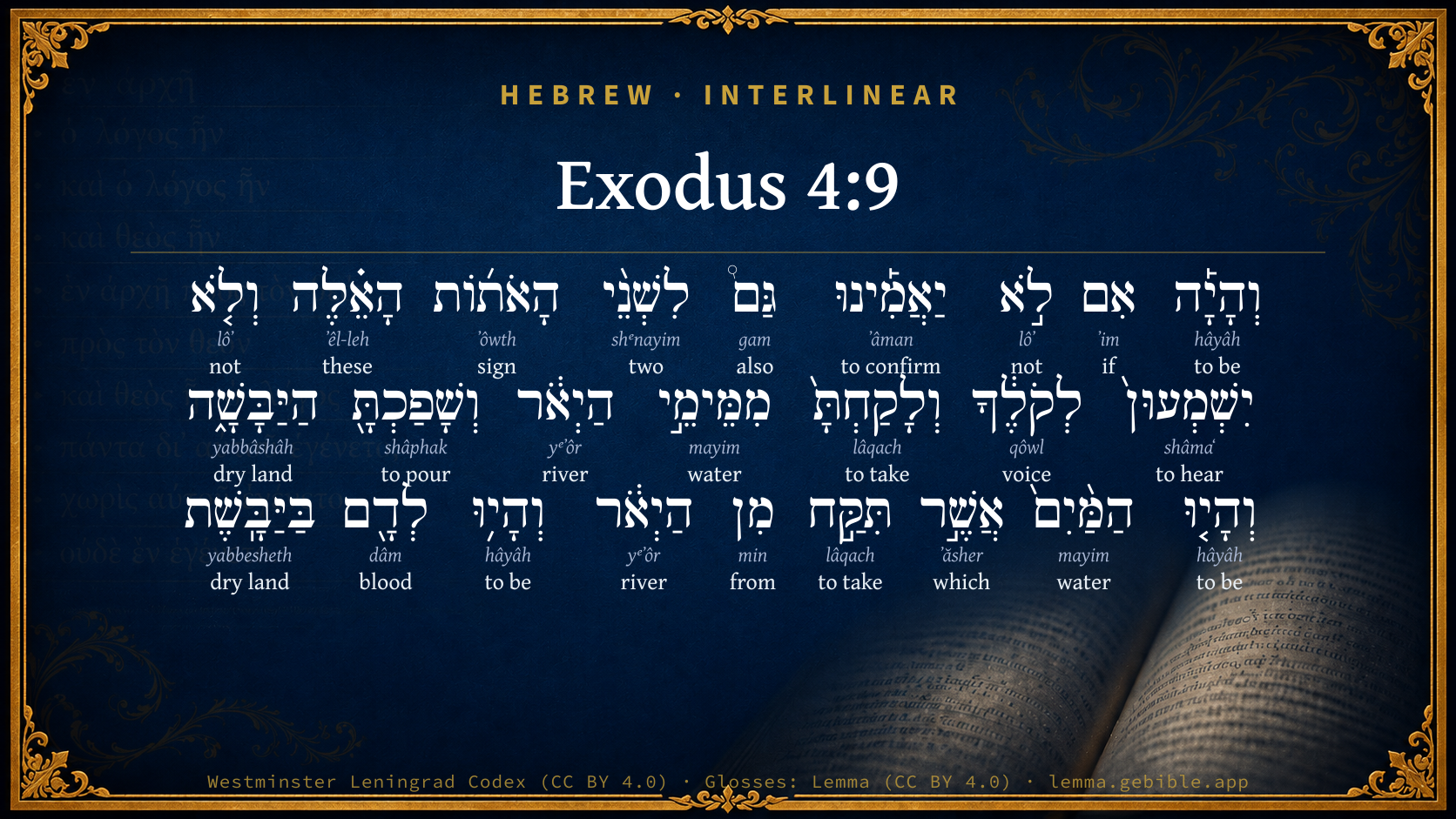
Exodus 4:9

Hebrew (Westminster Leningrad Codex) Exodus 4:9 appears in the Hebrew Old Testament. The text above is from the Westminster Leningrad Codex. Each word links to its Strong’s number, a concise gloss, and parsing drawn from the Open Scriptures Hebrew Bible morphology. Click any word for its full Brown-Driver-Briggs (BDB) entry.
Download image
Cite this verse

Exodus 4:9 (World English Bible). Public Domain. Lemma interlinear Bible study tool, https://lemma.gebible.app/v/exodus/4/9.

Show BibTeX & RIS
BibTeX
RIS
English Translation
It will happen, if they will not believe even these two signs, neither listen to your voice, that you shall take of the water of the river, and pour it on the dry land. The water which you take out of the river will become blood on the dry land."
World English Bible · Public Domain
Highlights
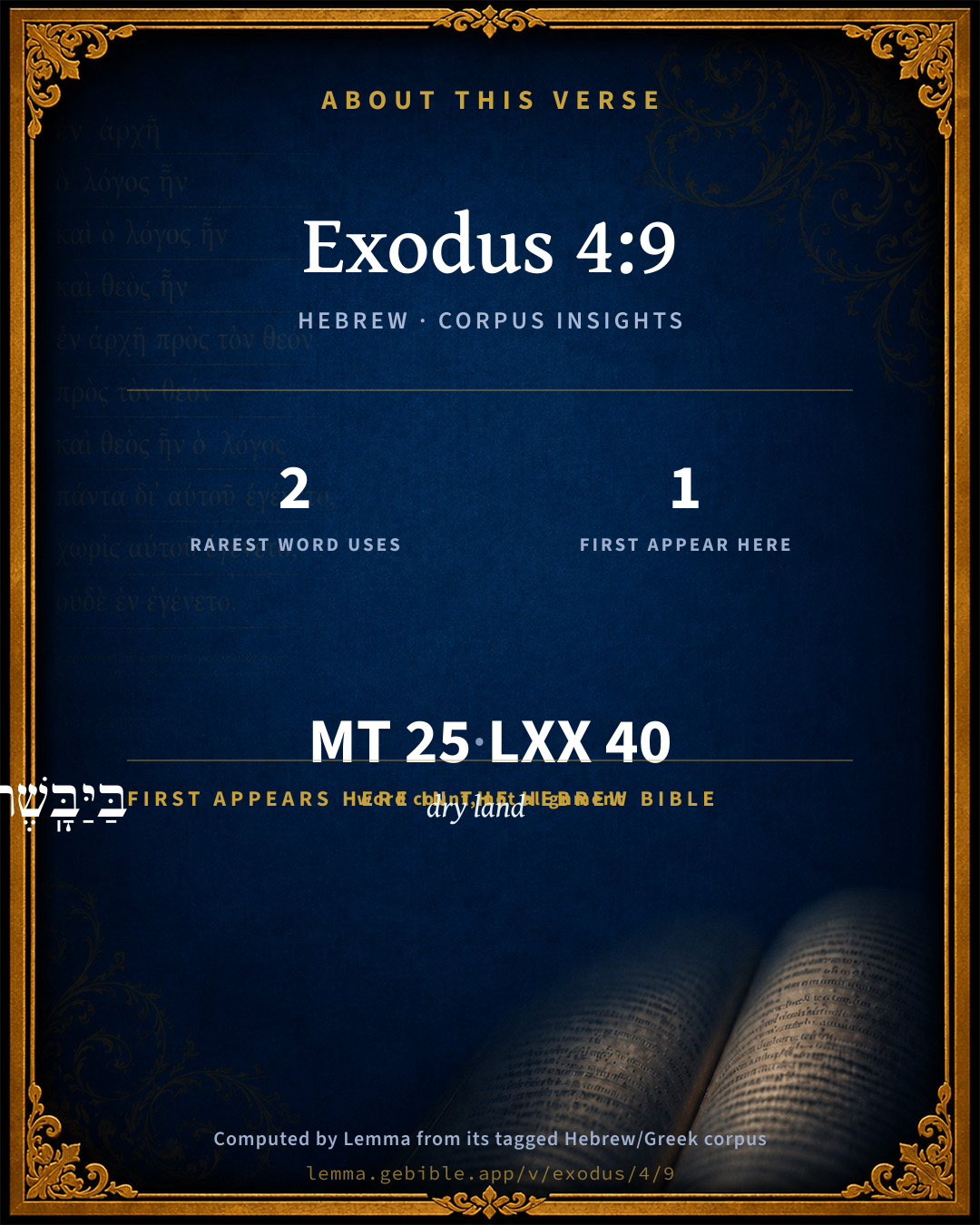
  • 1 first appearance in the Hebrew Bible
Full analysis ↓
Download a study sheet

One document with this verse’s original text, its word-by-word gloss line, the meaning frame, cross-references with their text, attributed commentary, and full source and license credits — printable, and it pastes into notes with its structure intact.

This verse Autodidact and up

Study sheet (.html) Plain text (.txt)

A passage Seminary Student

Up to 50 verses in one chapter. A passage sheet keeps up to 6 commentary sources and 12 cross-references per verse, in the order this page ranks them, and says so on the sheet whenever that leaves anything out. Ask for a single verse and you get the Autodidact verse sheet above.

Everything on this page stays free to read, with no account — the sheet is a download of what is already on screen, not access to it.

Want to remove ads? Support Godless Engineer
Compare translations 3

The same verse in 3 English versions, stacked beneath the original-language interlinear above. Click any original word for its lexicon entry.

Each is an independent rendering of the whole verse — the interlinear is not word-aligned to these translations.

Highlighted words mark where these versions differ — a whole-verse word diff, not a word-by-word alignment.

  • World English Bible Public Domain
    It will happen, if they will not believe even these two signs, neither listen to your voice, that you shall take of the water of the river, and pour it on the dry land. The water which you take out of the river will become blood on the dry land."
  • King James Version Public Domain
    And it shall come to pass, if they will not believe also these two signs, neither hearken unto thy voice, that thou shalt take of the water of the river, and pour it upon the dry land: and the water which thou takest out of the river shall become blood upon the dry land.
  • unfoldingWord Literal Text CC BY-SA 4.0
    And it will be, if they do not believe even these two signs, and they do not listen to your voice, then you shall take from the water of the river and you shall pour it on the dry land. And it will happen, the water which you take from the river, that it will become blood on the dry land.”

unfoldingWord Literal Text — © unfoldingWord, licensed CC BY-SA 4.0. Word-aligned USFM3 via Door43 (git.door43.org/unfoldingWord/en_ult).

Versions to compare (up to 4)

3 of 4 selected

Show all 18 translations

Every available English version of this verse, each an independent rendering of the whole verse.

  • World English Bible Public Domain
    It will happen, if they will not believe even these two signs, neither listen to your voice, that you shall take of the water of the river, and pour it on the dry land. The water which you take out of the river will become blood on the dry land."
  • Berean Standard Bible Public Domain
    But if they do not believe even these two signs or listen to your voice, take some water from the Nile and pour it on the dry ground. Then the water you take from the Nile will become blood on the ground.”
  • Majority Standard Bible Public Domain
    But if they do not believe even these two signs or listen to your voice, take some water from the Nile and pour it on the dry ground. Then the water you take from the Nile will become blood on the ground.”
  • King James Version Public Domain
    And it shall come to pass, if they will not believe also these two signs, neither hearken unto thy voice, that thou shalt take of the water of the river, and pour it upon the dry land: and the water which thou takest out of the river shall become blood upon the dry land.
  • American Standard Version (1901) Public Domain
    And it shall come to pass, if they will not believe even these two signs, neither hearken unto thy voice, that thou shalt take of the water of the river, and pour it upon the dry land: and the water which thou takest out of the river shall become blood upon the dry land.
  • Revised Version (1885) Public Domain
    And it shall come to pass, if they will not believe even these two signs, neither hearken unto thy voice, that thou shalt take of the water of the river, and pour it upon the dry land: and the water which thou takest out of the river shall become blood upon the dry land.
  • Geneva Bible (1599) Public Domain
    But if they will not yet beleeue these two signes, neither obey vnto thy voyce, then shalt thou take of the water of the riuer, and powre it vpon the drie lande: so the water which thou shalt take out of the riuer, shalbe turned to blood vpon the drie land.
  • Douay-Rheims (1899) Public Domain
    But if they will not even believe these two signs, nor hear thy voice: take of the river water, and pour it out upon the dry land, and whatsoever thou drawest out of the river shall be turned into blood.
  • Young's Literal Translation Public Domain
    `And it hath come to pass, if they do not give credence even to these two signs, nor hearken to thy voice, that thou hast taken of the waters of the River, and hast poured on the dry land, and the waters which thou takest from the River have been, yea, they have become -- blood on the dry land.'
  • Literal Standard Version CC BY-SA 4.0
    And it has come to pass, if they do not give credence even to these two signs, nor listen to your voice, that you have taken of the waters of the River, and have poured [it] on the dry land, and the waters which you take from the River have been, indeed, they have become blood on the dry land.”
  • Unlocked Literal Bible CC BY-SA 4.0
    If they do not believe even these two signs of my power, or listen to you, then take some water from the river and pour it on the dry land. The water that you take will become blood on the dry land.”
  • unfoldingWord Literal Text CC BY-SA 4.0
    And it will be, if they do not believe even these two signs, and they do not listen to your voice, then you shall take from the water of the river and you shall pour it on the dry land. And it will happen, the water which you take from the river, that it will become blood on the dry land.”
  • Darby Bible Public Domain
    And it shall come to pass, if they will not believe also those two signs, neither hearken unto thy voice, that thou shalt take of the water of the river, and pour [it] on the dry [land]; and the water that thou takest out of the river shall become blood upon the dry [land].
  • World Messianic Bible Public Domain
    It will happen, if they will not believe even these two signs or listen to your voice, that you shall take of the water of the river, and pour it on the dry land. The water which you take out of the river will become blood on the dry land.”
  • Webster's Bible Public Domain
    And it shall come to pass, if they will not believe also these two signs, neither hearken to thy voice, that thou shalt take of the water of the river, and pour it upon the dry land: and the water which thou takest out of the river shall become blood upon the dry land.
  • Free Bible Version CC BY-SA 4.0
    “But if they still don't believe you or listen to you because of these two signs, then you are to take some water from the Nile and pour it out on the ground. The Nile water will turn into blood on the ground.”
  • Bible in Basic English Public Domain
    And if they have no faith even in these two signs and will not give ear to your voice, then you are to take the water of the Nile and put it on the dry land: and the water you take out of the river will become blood on the dry land.
  • JPS Tanakh (1917) Public Domain
    And it shall come to pass, if they will not believe even these two signs, neither hearken unto thy voice, that thou shalt take of the water of the river, and pour it upon the dry land; and the water which thou takest out of the river shall become blood upon the dry land.'

Literal Standard Version (2020), Covenant Press — licensed CC BY-SA 4.0. Text via the HelloAO Bible API (eBible.org). Unlocked Literal Bible (unfoldingWord) — licensed CC BY-SA 4.0. Text via the HelloAO Bible API (eBible.org). unfoldingWord Literal Text — © unfoldingWord, licensed CC BY-SA 4.0. Word-aligned USFM3 via Door43 (git.door43.org/unfoldingWord/en_ult). Free Bible Version, Dr. Jonathan Gallagher — licensed CC BY-SA 4.0. Text via the HelloAO Bible API (eBible.org).

Word by word

More ways to search: Search by grammar → Find every occurrence → Compare this word →

Practice this passage: Drill this verse → Learn its vocabulary →

בַּיַּבָּֽשֶׁת
yabbesheth
H3006
“in/at the · dry land”
Preposition, Determined + Noun, Common, Feminine, Singular, Absolute
Part of Speech
Preposition + Noun
Type
Common
Gender
Feminine
Number
Singular
State
Absolute
Full BDB Definition

Origin: a variation of H3004

TWOT: 837c

dry land
  1. וְהָיָ֡ה hâyâh H1961 “and · to be” Conjunction + Verb, Qal, Sequential Perfect, 3rd Person, Masculine, Singular
  2. אִם ʼim H518 “if” Conjunction
  3. לֹ֣א lôʼ H3808 “not” Particle, Negative
  4. יַאֲמִ֡ינוּ ʼâman H539 “to confirm” Verb, Hiphil, Imperfect, 3rd Person, Masculine, Plural
  5. גַּם֩ gam H1571 “also” Particle, Accusative
  6. לִשְׁנֵ֨י shᵉnayim H8147 “to/for · two” Preposition + Adjective, Cardinal number, Masculine, Dual, Construct
  7. הָאֹת֜וֹת ʼôwth H226 “the · signs” Particle, Definite Article + Noun, Common, Both, Plural, Absolute
  8. הָאֵ֗לֶּה ʼêl-leh H428 “the · these” Particle, Definite Article + Pronoun, Demonstrative, Common, Plural
  9. וְלֹ֤א lôʼ H3808 “and · not” Conjunction + Particle, Negative
  10. יִשְׁמְעוּן֙ shâmaʻ H8085 “to hear” Verb, Qal, Imperfect, 3rd Person, Masculine, Plural + Suffix, n
  11. לְקֹלֶ֔ךָ qôwl H6963 “to/for · voice · your” Preposition + Noun, Common, Masculine, Singular, Construct + Suffix, Personal, 2nd Person, Masculine, Singular
  12. וְלָקַחְתָּ֙ lâqach H3947 “and · to take” Conjunction + Verb, Qal, Sequential Perfect, 2nd Person, Masculine, Singular
  13. מִמֵּימֵ֣י mayim H4325 “from · water(s) of” Preposition + Noun, Common, Masculine, Plural, Construct
  14. הַיְאֹ֔ר yᵉʼôr H2975 “the · river” Particle, Definite Article + Noun, Proper
  15. וְשָׁפַכְתָּ֖ shâphak H8210 “and · to pour” Conjunction + Verb, Qal, Sequential Perfect, 2nd Person, Masculine, Singular
  16. הַיַּבָּשָׁ֑ה yabbâshâh H3004 “the · dry land” Particle, Definite Article + Noun, Common, Feminine, Singular, Absolute
  17. וְהָי֤וּ hâyâh H1961 “and · to be” Conjunction + Verb, Qal, Sequential Perfect, 3rd Person, Common, Plural
  18. הַמַּ֨יִם֙ mayim H4325 “the · water(s)” Particle, Definite Article + Noun, Common, Masculine, Plural, Absolute
  19. אֲשֶׁ֣ר ʼăsher H834 “which” Particle, Relative
  20. תִּקַּ֣ח lâqach H3947 “to take” Verb, Qal, Imperfect, 2nd Person, Masculine, Singular
  21. מִן min H4480 “from” Preposition
  22. הַיְאֹ֔ר yᵉʼôr H2975 “the · river” Particle, Definite Article + Noun, Proper
  23. וְהָי֥וּ hâyâh H1961 “and · to be” Conjunction + Verb, Qal, Sequential Perfect, 3rd Person, Common, Plural
  24. לְדָ֖ם dâm H1818 “to/for · blood” Preposition + Noun, Common, Masculine, Singular, Absolute

About this verse

These counts appear in no published source. They are computed here, from the morphology-tagged text and Lemma’s own curated glosses. What Lemma adds →

25
words
19
distinct lemmas
Pentateuch
section

Notable vocabulary

The rarest word here is בַּיַּבָּֽשֶׁת dry land H3006 — appearing just 2 times in the whole Hebrew Bible.

First appearance in Scripture

This word makes its first canonical appearance in the Hebrew Bible here:

  • בַּיַּבָּֽשֶׁת dry land H3006

Shared distinctive vocabulary

בַּיַּבָּֽשֶׁת dry land H3006 occurs in 2 verses of the Hebrew Bible. Also found in:

Grammatical profile

  • 8 verbs
  • 9 nouns
  • 1 adjective
  • 1 pronoun
  • 1 preposition
  • 1 conjunction
  • 4 particles

Verb forms

  • וְהָיָ֡ה Qal · Sequential Perfect
  • יַאֲמִ֡ינוּ Hiphil · Imperfect
  • יִשְׁמְעוּן֙ Qal · Imperfect
  • וְלָקַחְתָּ֙ Qal · Sequential Perfect
  • וְשָׁפַכְתָּ֖ Qal · Sequential Perfect
  • וְהָי֤וּ Qal · Sequential Perfect
  • תִּקַּ֣ח Qal · Imperfect
  • וְהָי֥וּ Qal · Sequential Perfect

Repetition

Words recur within this verse — often emphatic in Hebrew:

  • וְהָיָ֡ה to be H1961 ×3
  • וְלָקַחְתָּ֙ to take H3947 ×2
  • מִמֵּימֵ֣י water H4325 ×2
  • הַיְאֹ֔ר river H2975 ×2
  • לֹ֣א not H3808 ×2

Hebrew & Septuagint length

In English translation the verse runs 50 words from the Hebrew and 57 from the Septuagint (LXX English) — closely comparable.

A rough comparison of the two English renderings, which tokenize alike — not a word-level alignment.

Word counts can differ between the Hebrew and the Greek without any difference in meaning — e.g. the Hebrew direct-object marker אֵת has no separate Greek word, and Greek often adds the article ὁ.

In the original languages it is 25 Hebrew tokens and 40 Greek tokens — but the two are counted differently (Hebrew bundles its prefixes and suffixes into one token; the Greek is in lemma form), so that isn’t a like-for-like length.

Cross-references

3

Topical passages linked to Exodus 4:9 in the Treasury of Scripture Knowledge — connected by theme and wording, ordered by reader-vote popularity; previews shown in the World English Bible.

  • Exodus 1:22 Pharaoh charged all his people, saying, "You shall cast every son who is born into the river, and every daughter you shall save alive."
  • Exodus 7:19–25 Yahweh said to Moses, "Tell Aaron, 'Take your rod, and stretch out your hand over the waters of Egypt, over their rivers, over their streams, and over their pools, and over all their ponds of water, that they may become blood; and there shall be blood throughout all the land of Egypt, both in vessels of wood and in vessels of stone.'"
  • Matthew 7:2 For with whatever judgment you judge, you will be judged; and with whatever measure you measure, it will be measured to you.

Cross-references courtesy of OpenBible.info (CC BY 4.0).

Hebrew and Greek witnesses Masoretic Hebrew ↔ Greek Septuagint

The same verse in the two great witnesses to the Old Testament, shown verse-for-verse.

These are two independent witnesses, not word-aligned to each other, and the Septuagint is shown in lemma (dictionary) form.

Hebrew Exodus 4:9 Masoretic · Westminster Leningrad Codex

וְהָיָ֡ה אִם לֹ֣א יַאֲמִ֡ינוּ גַּם֩ לִשְׁנֵ֨י הָאֹת֜וֹת הָאֵ֗לֶּה וְלֹ֤א יִשְׁמְעוּן֙ לְקֹלֶ֔ךָ וְלָקַחְתָּ֙ מִמֵּימֵ֣י הַיְאֹ֔ר וְשָׁפַכְתָּ֖ הַיַּבָּשָׁ֑ה וְהָי֤וּ הַמַּ֨יִם֙ אֲשֶׁ֣ר תִּקַּ֣ח מִן הַיְאֹ֔ר וְהָי֥וּ לְדָ֖ם בַּיַּבָּֽשֶׁת

It will happen, if they will not believe even these two signs, neither listen to your voice, that you shall take of the water of the river, and pour it on the dry land. The water which you take out of the river will become blood on the dry land."

World English Bible · Public Domain

Greek LXX Exodus 4:9 Septuagint · lemma form

καί εἰμί ἐάν μή πιστεύω σύ ὁ δύο σημεῖον οὗτος μηδέ εἰςἀκούω ὁ φωνή σύ λαμβάνω ἀπό ὁ ὕδωρ ὁ ποταμός καί ἐκχέω ἐπί ὁ ξηρός καί εἰμί ὁ ὕδωρ ὅς ἐάν λαμβάνω ἀπό ὁ ποταμός αἷμα ἐπί ὁ ξηρός

And it shall come to pass if they will not believe you for these two signs, and will not listen to your voice, that you shall take of the water of the river and pour it upon the dry land, and the water which you shall take from the river shall be blood upon the dry land.

LXX2012 (modern English Septuagint) · Public Domain

Hebrew: Westminster Leningrad Codex (CC BY 4.0). Greek: Septuagint (public domain); English from LXX2012 (modern English Septuagint) (Public Domain). How the Septuagint differs from the Hebrew →

Targum (Aramaic paraphrase)

2

The Targum is the ancient Jewish Aramaic paraphrase of the Hebrew Scriptures — an interpretive translation, not the Hebrew text itself. Onkelos (literal) and Pseudo-Jonathan (expansive) render the Torah, and Jonathan the Prophets. Coverage is partial: where no permissively-licensed English translation exists for a verse, only the Aramaic is shown. This is verse-level text, not a word-by-word alignment to the Hebrew.

  1. Targum Onkelos Torah (Genesis–Deuteronomy)
    וִיהֵי אִם לָא יְהֵמְנוּן אַף לִתְרֵין אָתַיָא הָאִלֵּין וְלָא יְקַבְּלוּן מִנָךְ וְתִסַב מִמַיָא דִבְנַהֲרָא וְתֵשׁוֹד לְּיַבֶּשְׁתָּא וִיהוֹן מַיָא דִי תִסַב מִן נַהֲרָא וִיהוֹן לִדְמָא בְּיַבֶּשְׁתָּא:

    (no public-domain English translation for this verse)

    Targum Onkelos — Aramaic: “Onkelos Genesis” (public domain); “Onkelos Exodus” (public domain); “Onkelos Leviticus” (public domain); “Onkelos Numbers” (public domain); “Onkelos Deuteronomy” (public domain). English: “Sefaria Community Translation” (CC0 1.0 (public-domain dedication)); “J.W. Etheridge. The Targums of Onkelos and Jonathan Ben Uzziel on the Pentateuch. London: Longmans, Green, 1862” (public domain). Text via Sefaria.

  2. Targum Pseudo-Jonathan Torah (Genesis–Deuteronomy)
    וִיהֵי אִין לָא יְהֵימְנוּן אוּף לִתְרֵין אָתַיָא הָאִילֵן וְלָא יְקַבְּלוּן מִינָךְ וְתִסַב מִן מוֹי דִבְנַהֲרָא וְתֵשׁוֹד לְיַבֶּשְׁתָּא וִיהוֹן מוֹי דְתִיסַב מִן נַהֲרָא וִיהוֹן לִדְמָא בְּיַבֶּשְׁתָּא

    And if they believe not these two signs, nor receive from thee, thou shalt take of the water of the river and pour it on the ground, and the water that thou shalt take from the river shall become blood upon the ground.

    Targum Pseudo-Jonathan — Aramaic: “Targum Jonathan on Genesis” (public domain); “Targum Jonathan on Exodus” (public domain); “Targum Jonathan on Leviticus” (public domain); “Targum Jonathan on Numbers” (public domain); “Targum Jonathan on Deuteronomy” (public domain). English: “The Targum of Jonathan ben Uzziel, trans. J. W. Etheridge, London, 1862” (public domain). Text via Sefaria.

Commentary

Notes on Exodus 4:9 from classic Christian and Jewish commentators (each source and its license shown beneath its notes). The classic Christian expositions comment on the surrounding passage and are grouped to its opening verse, so a note may address several verses; the Jewish commentaries on the Tanakh (Rashi and others) are per-verse, so they appear only where the commentator wrote on this verse.

Lemma curates 59 commentaries, every one of them public domain or Creative Commons licensed, each selected and text-cleaned for this edition rather than reprinted as found. About our sources →

Trapp's Complete Commentary

John Trapp

Exo 4:9 And it shall come to pass, if they will not believe also these two signs, neither hearken unto thy voice, that thou shalt take of the water of the river, and pour [it] upon the dry [land]: and the water which thou takest out of the river shall become blood upon the dry [land].

Ver. 9. Shall become blood.] In the year 874, in Brixia in Italy, it rained blood for three days and three nights. In 1505, there appeared in Germany, upon the garments of men and women various prints and tokens of the nails, of the sponge, of the spear, of the Lord’s coat, and of bloody crosses. Maximilian, the Emperor, had, and showed the same to Francis Mirandula, who thereupon wrote his "Staurestichon," and therein thus -

“Non ignota cane, Caesar monstravit, et ipsi

Vidimus; innumeros prompsit Germania testes.” {a}

In the third year of Queen Mary, William Pikes being at liberty after imprisonment, and going into his garden, took with him a Bible: where sitting and reading, there suddenly fell down upon his book four drops of fresh blood, and he knew not from whence it came. Whereat he being sore astonished, and wiping out one of the drops with his finger, called his wife and said, In the virtue of God, wife, what meaneth this? Will the Lord have four sacrifices? I see well enough the Lord will have blood; his will be done, and give me grace to abide the trial, &c.

{a} Baleus Centur., 8. Func., Chronol. Act. and Mon., fol. 769, 1853.

John Trapp, A Commentary or Exposition upon All the Books of the Old and New Testament (1647–1656) — public domain. Text from a community e-Sword module.

Tyndale Open Study Notes

Tyndale Open Resources

4:9 As with the previous two signs, the fact that the water from the Nile will turn to blood also demonstrated God’s power over life and death.

Tyndale Open Study Notes — © Tyndale Open Resources, licensed CC BY-SA 4.0. Text via the HelloAO Bible API.

Geneva Bible (1599)

Geneva Bible translators

Because these three signs should be sufficient witnesses to prove that Moses should deliver God’s people.

Geneva Bible (1599) marginal notes — public domain. Text via Bolls.life.

Jamieson, Fausset & Brown

Robert Jamieson, A. R. Fausset & David Brown

take of the water of the river--Nile. Those miracles, two of which were wrought then, and the third to be performed on his arrival in Goshen, were at first designed to encourage him as satisfactory proofs of his divine mission, and to be repeated for the special confirmation of his embassy before the Israelites.

Jamieson, Fausset & Brown — Commentary Critical and Explanatory on the Whole Bible (1871) — public domain (CC PDM 1.0). Text via the HelloAO Bible API.

Ellicott's Commentary for English Readers

(9) Shall become blood.—The verb is repeated in the Hebrew, which intensifies the assertion. The English equivalent of the phrase used would be, “shall assuredly become.” The signs were, no doubt, selected primarily for facility of exhibition; but they may also have been intended to be significant. The change of a rod into a serpent showed that a feeble implement might become a power to chastise and to destroy. That of a healthy into a leprous hand, and the reverse, indicated that Moses’s mission was both to punish and to save; while the change of water into blood suggested—albeit vaguely—the conversion of that peace and prosperity, which Egypt was enjoying, into calamity, suffering, and bloodshed.

A Bible Commentary for English Readers, edited by Charles John Ellicott (1878–1897) — public domain. Text from a community e-Sword module.

The Cambridge Bible for Schools and Colleges

gen. ed. J. J. S. Perowne

9. The third sign, to be resorted to only if necessary. Water taker from the Nile, and poured upon the earth, to be turned into blood.

the river (twice)] the Nile (Heb. ye’ôr): see on Exo_1:22.

The Cambridge Bible for Schools and Colleges (gen. ed. J. J. S. Perowne; Cambridge University Press, 1878–1918) — public domain. Text from a community e-Sword module.

John Gill's Exposition

And it shall come to pass, if they will not believe also these two signs,.... Performed before their eyes; for these were done over again when Moses came into Egypt to the Israelites, and yet some of them might still remain unbelievers to his commission, and so to the voice of these signs, which loudly called for their faith:

neither hearken unto thy voice; affirming he came from God, and was sent to be the deliverer of them:

that thou shalt take of the water of the river; of the river Nile, when he should come into Egypt; wherefore Josephus (q) is mistaken when he intimates that this was done at the same time with the other signs; and was water he took near at hand and poured on the ground: but Philo (r) truly refers this to Egypt, where it was done, as it ought to be:

and pour it upon the dry land, and the water which thou takest out of the river shall become blood upon the dry land; by which it would appear how easily the Lord could destroy the land of Egypt, and make it a barren land, whose fertility was owing to the overflow of the river Nile as a means; and this would be a specimen also of what he would do hereafter, in turning the waters of the river into blood, thereby avenging the blood of innocent babes drowned there by the Egyptians.

(q) Antiqu. l. 2. c. 12. sect. 3. (r) De Vita Mosis, l. 1. p. 614.

John Gill's Exposition of the Whole Bible (1746–1763) — public domain (CC PDM 1.0). Text via the HelloAO Bible API.

Haydock's Catholic Bible Commentary

Blood. This third sign had the same tendency as the former. It showed the cruel persecution inflicted upon the Hebrews, particularly in drowning their male infants; a cruelty which God would shortly revenge, by turning the waters of Egypt into blood, and by slaying the first-born and the army of the Egyptians. (Tirinus)

George Leo Haydock (1774–1849), Haydock's Catholic Family Bible and Commentary, 1859 edition — public domain. Excludes Psalms (Douay-Rheims chapter numbering differs from Protestant) and Deuterocanonical books (Catholic canon only).

Matthew Poole's English Annotations

The river Nile, well known to Moses, and called so by way of eminency, as Euphrates also is. Shall become, Heb. shall be, even shall be, i.e. it shall assuredly be so.

Matthew Poole's English Annotations on the Holy Bible (1683–1685) — public domain. Text from a community e-Sword/MySword module.

Whedon's Commentary on the Bible

Daniel D. Whedon

9. The third sign symbolizes Jehovah’s power over Egypt and her gods. But for the Nile there would be no Egypt; and when Moses smote the water of the river he turned the very breast milk of Egypt to blood. And, besides, the Nile was a national god, for its fertilizing power was deemed to proceed from Osiris himself. Thus Jehovah smites Egypt’s life-giving god, who is stretched through the land a loathsome corpse.

Daniel D. Whedon (gen. ed.), Commentary on the Old and New Testaments (1874–1909) — public domain. Text from a community e-Sword module.

The Pulpit Commentary

If they will not believe also. Even" would be a better translation than "also." The river is of course "the Nile." See the comment on Exo_2:3. Of the three signs given, the first would probably convince all those who were religious, well-disposed, and fair-minded; the second, acting upon their fears, would move all but the desperately wicked, who despised Jehovah and put their trust in the gods of the Egyptians. (Jos_24:14; Eze_20:7, 8 23:3, 8, etc.) The third sign was for these last, who would regard the Nile as a great divinity, and would see in the conversion of Nile water into blood a significant indication that the God who had commissioned Moses was greater than any Egyptian one.

The intent of the third sign.

Blood poured on the ground could symbolise nothing but war and destruction. That water should be turned into it implied that peace should be changed into war, prosperity into ruin, quiet and tranquillity into a horrible carnage. The special reference would be to the destruction of Pharaoh"s host in the Red Sea; but the other ruinous plagues, as especially the fifth, the seventh, and the tenth, would be glanced at also. That the water became blood on touching the ground of Egypt would indicate that it was the land and people of Egypt who were to be the sufferers. A very dreadful vengeance was thus foreshadowed by the third sign, which should have warned the Pharaoh of the terrible results that would follow his resistance to God"s will as proclaimed by Moses. To the Israelites, on the contrary, the sign was one assuring them of final triumph; that the blood of their enemies would be poured out like water in the coming struggle, and their resistance to God"s will be signally punished.

The Pulpit Commentary (1880–1919), ed. H.D.M. Spence-Jones & Joseph S. Exell — public domain. Text from a community e-Sword module.

Rashi

Rabbi Shlomo Yitzchaki (Rashi)

והיו המים וגו׳ — Here we have the word והיו twice. It appears to me that if it was stated היאר לדם ביבשת מן והיו המים אשר תקח, I might understand it to mean that it would be turned into blood in his hand and that also when it reached the ground it would retain that state (more lit., it would be as it was). But now (as the text stands) it tells us that it would not become blood until it would come on the dry ground.

Rashi on the Tanakh — English translations: “The Judaica Press complete Tanach with Rashi, translated by A. J. Rosenberg” (CC BY 4.0); “Pentateuch with Rashi's commentary by M. Rosenbaum and A.M. Silbermann, 1929-1934” (public domain); “The Metsudah Tanach series, Lakewood, N.J” (CC BY 4.0); and “The Book of Joshua, Metsudah Publications, 1997” (CC BY 4.0). Text via Sefaria.

Ramban (Nachmanides)

Rabbi Moshe ben Nachman (Ramban / Nachmanides)

V’HAYU’ (AND IT SHALL BE) THAT THE WATER WHICH THOU TAKEST OUT OF THE RIVER ‘V’HAYU’ (SHALL BECOME) BLOOD UPON THE DRY LAND. “The word v’hayu is mentioned here twice. It appears to me that if He had said, ‘V’hayu (And it shall be) that the water which thou takest out of the river be blood upon the dry land,’ I might understand it to mean that it would be turned into blood in his hand, and that also when it reached the ground it would remain in the same state. But now, [as the verse actually reads], the final v’hayu teaches us that it would not become blood until it reaches the dry land.” Thus the language of Rashi.But the purport of this verse is not as the Rabbi [Rashi] has it, and there is no need for his Midrash, for the masters of language have found in many places that it is the normal style of Scripture to repeat words for the purpose of emphasis and significance, or because of some lengthy phrase intervening between them. Such a case is the verse: And if a Levite come from any of thy gates out of all Israel, where he sojourneth, and come with all the desire of his soul. Here Scripture repeats [the verb] “come” because of the lengthy expression between [the parts of the verse]. Similarly: And the king of Egypt spoke to the Hebrew midwives, of whom the name of the one was Shiphrah, and the name of the other Puah; and he said: When ye act as midwives, etc.; And G-d spoke unto Israel in the visions of the night, and He said: Jacob, Jacob. There are many instances of such verses.

Ramban (Nachmanides) on the Tanakh — English translation: “Commentary on the Torah by Ramban (Nachmanides). Translated and annotated by Charles B. Chavel. New York, Shilo Pub. House, 1971-1976” (CC BY 4.0). Text via Sefaria.

Lesson kit

Teaching starters — assembled from the data on this page, not authored interpretation. Every prompt links to the verse data it draws on. Edit before teaching.

Exodus, in the Pentateuch, opens this verse with 25 words (19 distinct Hebrew lemmas). Its most distinctive word is yabbesheth (“dry land”). A historical commentator’s framing appears above. Read the whole chapter for the surrounding context.

Discussion questions

  1. What does “dry land” (yabbesheth) contribute to the verse as a whole?
  2. This is the first place “dry land” appears in Scripture (first appears here). What does its debut here establish?
  3. How does Psalms 95:5, which shares the word «dry land», read alongside this verse?
  4. What does the repetition of “to be” (3× in this one verse) do in this verse?
  5. These translations render this verse differently; the difference is in the English rendering, not the original. What questions does that raise?
  6. «וְהָיָ֡ה» is a Qal Sequential Perfect verb. How does that grammatical form shape the action described?
  7. Compare how Trapp's Complete Commentary and Tyndale Open Study Notes read this verse. Where do they agree or differ?

Things to notice

Reading settings

Reading text

Shown beneath each verse's original-language words.

Old Testament
Old Testament edition

Read the OT as the Masoretic Hebrew (MT) or the Greek Septuagint (LXX).

English shown for the Greek Septuagint (in the Hebrew ↔ Greek comparison).

Comparing translations? Open the Compare panel on any verse page to stack up to four side by side.