
1 Samuel 28:23

Hebrew (Westminster Leningrad Codex) 1 Samuel 28:23 appears in the Hebrew Old Testament. The text above is from the Westminster Leningrad Codex. Each word links to its Strong’s number, a concise gloss, and parsing drawn from the Open Scriptures Hebrew Bible morphology. Click any word for its full Brown-Driver-Briggs (BDB) entry.
Download image
Cite this verse

1 Samuel 28:23 (World English Bible). Public Domain. Lemma interlinear Bible study tool, https://lemma.gebible.app/v/1-samuel/28/23.

Show BibTeX & RIS
BibTeX
RIS
English Translation
But he refused, and said, I will not eat. But his servants, together with the woman, constrained him; and he listened to their voice. So he arose from the earth, and sat on the bed.
World English Bible · Public Domain
Download a study sheet

One document with this verse’s original text, its word-by-word gloss line, the meaning frame, cross-references with their text, attributed commentary, and full source and license credits — printable, and it pastes into notes with its structure intact.

This verse Autodidact and up

Study sheet (.html) Plain text (.txt)

A passage Seminary Student

Up to 50 verses in one chapter. A passage sheet keeps up to 6 commentary sources and 12 cross-references per verse, in the order this page ranks them, and says so on the sheet whenever that leaves anything out. Ask for a single verse and you get the Autodidact verse sheet above.

Everything on this page stays free to read, with no account — the sheet is a download of what is already on screen, not access to it.

Want to remove ads? Support Godless Engineer
Compare translations 3

The same verse in 3 English versions, stacked beneath the original-language interlinear above. Click any original word for its lexicon entry.

Each is an independent rendering of the whole verse — the interlinear is not word-aligned to these translations.

Highlighted words mark where these versions differ — a whole-verse word diff, not a word-by-word alignment.

  • World English Bible Public Domain
    But he refused, and said, I will not eat. But his servants, together with the woman, constrained him; and he listened to their voice. So he arose from the earth, and sat on the bed.
  • King James Version Public Domain
    But he refused, and said, I will not eat. But his servants, together with the woman, compelled him; and he hearkened unto their voice. So he arose from the earth, and sat upon the bed.
  • unfoldingWord Literal Text CC BY-SA 4.0
    But he refused and said, “I will not eat.” But his servants urged him, and also the woman, and he listened to their voice. And he arose from the ground and sat on the bed.

unfoldingWord Literal Text — © unfoldingWord, licensed CC BY-SA 4.0. Word-aligned USFM3 via Door43 (git.door43.org/unfoldingWord/en_ult).

Versions to compare (up to 4)

3 of 4 selected

Show all 18 translations

Every available English version of this verse, each an independent rendering of the whole verse.

  • World English Bible Public Domain
    But he refused, and said, I will not eat. But his servants, together with the woman, constrained him; and he listened to their voice. So he arose from the earth, and sat on the bed.
  • Berean Standard Bible Public Domain
    Saul refused, saying, “I will not eat.” But his servants joined the woman in urging him, and he heeded their voice. He got up from the ground and sat on the bed.
  • Majority Standard Bible Public Domain
    Saul refused, saying, “I will not eat.” But his servants joined the woman in urging him, and he heeded their voice. He got up from the ground and sat on the bed.
  • King James Version Public Domain
    But he refused, and said, I will not eat. But his servants, together with the woman, compelled him; and he hearkened unto their voice. So he arose from the earth, and sat upon the bed.
  • American Standard Version (1901) Public Domain
    But he refused, and said, I will not eat. But his servants, together with the woman, constrained him; and he hearkened unto their voice. So he arose from the earth, and sat upon the bed.
  • Revised Version (1885) Public Domain
    But he refused, and said, I will not eat. But his servants, together with the woman, constrained him; and he hearkened unto their voice. So he arose from the earth, and sat upon the bed.
  • Geneva Bible (1599) Public Domain
    But he refused, and said, I will not eate: but his seruants and the woman together compelled him, and he obeyed their voyce: so he arose from the earth, and sate on the bed.
  • Douay-Rheims (1899) Public Domain
    But he refused, and said: I will not eat. But his servants and the woman forced him, and at length hearkening to their voice, he arose from the ground and sat upon the bed.
  • Young's Literal Translation Public Domain
    And he refuseth, and saith, `I do not eat;' and his servants urge on him, and also the woman, and he hearkeneth to their voice, and riseth from the earth, and sitteth on the bed.
  • Literal Standard Version CC BY-SA 4.0
    And he refuses and says, “I do not eat”; and his servants urge him on, and also the woman, and he listens to their voice, and rises from the earth, and sits on the bed.
  • Unlocked Literal Bible CC BY-SA 4.0
    But Saul refused and said, “I will not eat.” But his servants, together with the woman, compelled him, and he listened to their voice. So he rose from the ground and sat on the bed.
  • unfoldingWord Literal Text CC BY-SA 4.0
    But he refused and said, “I will not eat.” But his servants urged him, and also the woman, and he listened to their voice. And he arose from the ground and sat on the bed.
  • Darby Bible Public Domain
    But he refused and said, I will not eat. Then his servants, and the woman also, compelled him, and he hearkened to their voice; and he arose from the earth and sat on the bed.
  • World Messianic Bible Public Domain
    But he refused, and said, “I will not eat.” But his servants, together with the woman, constrained him; and he listened to their voice. So he arose from the earth and sat on the bed.
  • Webster's Bible Public Domain
    But he refused, and said, I will not eat. But his servants, together with the woman, compelled him; and he hearkened to their voice. So he arose from the earth, and sat upon the bed.
  • Free Bible Version CC BY-SA 4.0
    But he refused, saying, “I can't eat anything.” But his men and the woman encouraged him to eat, and he did what they said. He got up from the ground and sat on the bed.
  • Bible in Basic English Public Domain
    But he would not, saying, I have no desire for food. But his servants, together with the woman, made him take food, and he gave way to them. So he got up from the earth, and took his seat on the bed.
  • JPS Tanakh (1917) Public Domain
    But he refused, and said: 'I will not eat.' But his servants, together with the woman, urged him; and he hearkened unto their voice. So he arose from the earth, and sat upon the bed.

Literal Standard Version (2020), Covenant Press — licensed CC BY-SA 4.0. Text via the HelloAO Bible API (eBible.org). Unlocked Literal Bible (unfoldingWord) — licensed CC BY-SA 4.0. Text via the HelloAO Bible API (eBible.org). unfoldingWord Literal Text — © unfoldingWord, licensed CC BY-SA 4.0. Word-aligned USFM3 via Door43 (git.door43.org/unfoldingWord/en_ult). Free Bible Version, Dr. Jonathan Gallagher — licensed CC BY-SA 4.0. Text via the HelloAO Bible API (eBible.org).

Word by word

More ways to search: Search by grammar → Find every occurrence → Compare this word →

Practice this passage: Drill this verse → Learn its vocabulary →

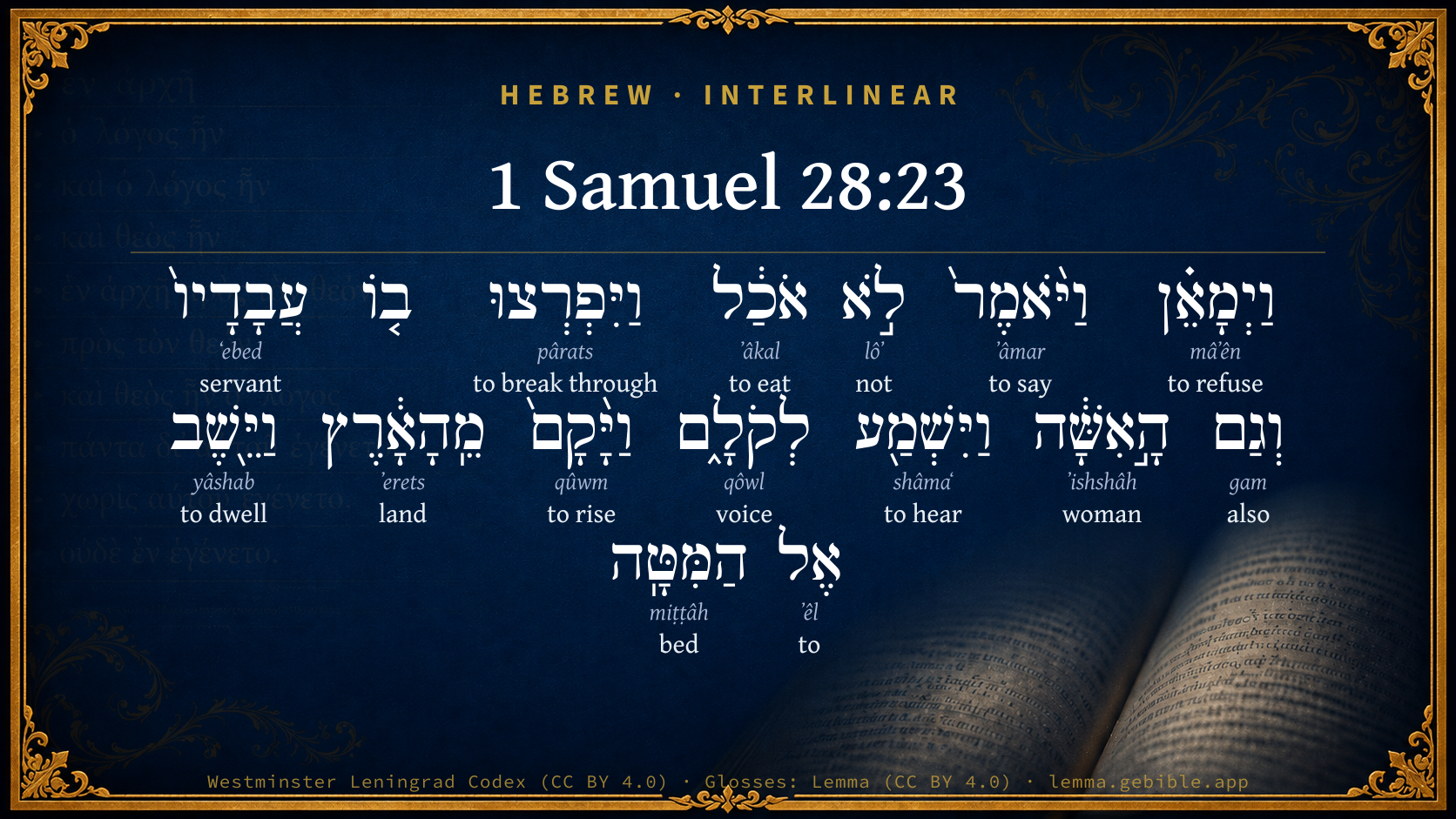
הַמִּטָּֽה
miṭṭâh
H4296
“the · bed”
Particle, Definite Article + Noun, Common, Feminine, Singular, Absolute
Part of Speech
Particle + Noun
Type
Common
Gender
Feminine
Number
Singular
State
Absolute
Full BDB Definition

Origin: from H5186

TWOT: 1352c

couch, bed, bier
  1. וַיְמָאֵ֗ן mâʼên H3985 “and · to refuse” Conjunction + Verb, Piel, Sequential Imperfect, 3rd Person, Masculine, Singular
  2. וַיֹּ֨אמֶר֙ ʼâmar H559 “and · to say” Conjunction + Verb, Qal, Sequential Imperfect, 3rd Person, Masculine, Singular
  3. לֹ֣א lôʼ H3808 “not” Particle, Negative
  4. אֹכַ֔ל ʼâkal H398 “to eat” Verb, Qal, Imperfect, 1st Person, Common, Singular
  5. וַיִּפְרְצוּ pârats H6555 “and · to break through” Conjunction + Verb, Qal, Sequential Imperfect, 3rd Person, Masculine, Plural
  6. עֲבָדָיו֙ ʻebed H5650 “servants · his” Noun, Common, Masculine, Plural, Construct + Suffix, Personal, 3rd Person, Masculine, Singular
  7. וְגַם gam H1571 “and · also” Conjunction + Particle, Accusative
  8. הָ֣אִשָּׁ֔ה ʼishshâh H802 “the · woman” Particle, Definite Article + Noun, Common, Feminine, Singular, Absolute
  9. וַיִּשְׁמַ֖ע shâmaʻ H8085 “and · to hear” Conjunction + Verb, Qal, Sequential Imperfect, 3rd Person, Masculine, Singular
  10. לְקֹלָ֑ם qôwl H6963 “to/for · voice · their” Preposition + Noun, Common, Masculine, Singular, Construct + Suffix, Personal, 3rd Person, Masculine, Plural
  11. וַיָּ֨קָם֙ qûwm H6965 “and · to rise” Conjunction + Verb, Qal, Sequential Imperfect, 3rd Person, Masculine, Singular
  12. מֵֽהָאָ֔רֶץ ʼerets H776 “from · the · land” Preposition + Particle, Definite Article + Noun, Common, Both, Singular, Absolute
  13. וַיֵּ֖שֶׁב yâshab H3427 “and · to dwell” Conjunction + Verb, Qal, Sequential Imperfect, 3rd Person, Masculine, Singular
  14. אֶל ʼêl H413 “to” Preposition

About this verse

These counts appear in no published source. They are computed here, from the morphology-tagged text and Lemma’s own curated glosses. What Lemma adds →

16
words
15
distinct lemmas
Historical
section

Shared distinctive vocabulary

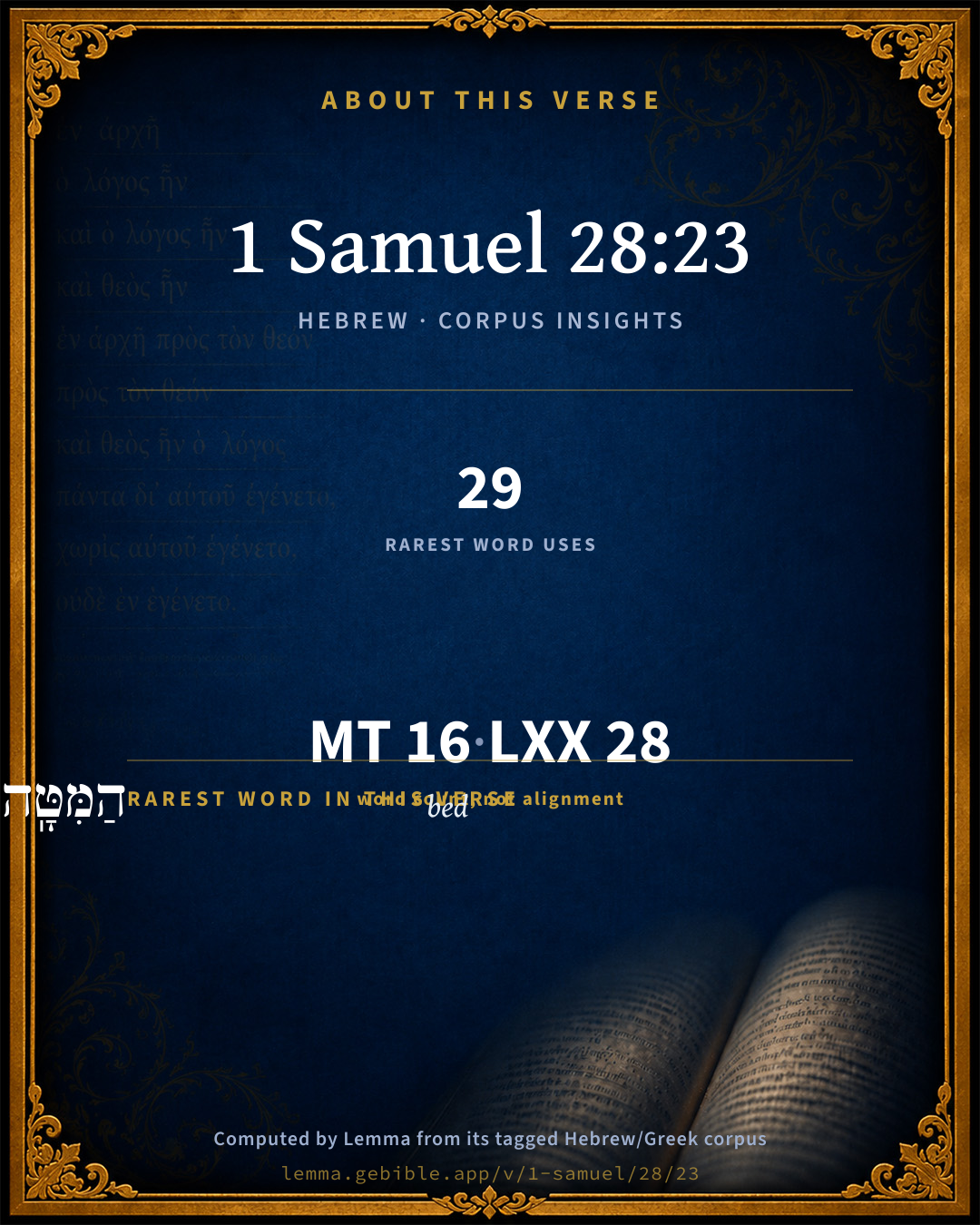
הַמִּטָּֽה bed H4296 occurs in 29 verses of the Hebrew Bible. Also found in:

Grammatical profile

  • 7 verbs
  • 5 nouns
  • 2 prepositions
  • 2 particles

Verb forms

  • וַיְמָאֵ֗ן Piel · Sequential Imperfect
  • וַיֹּ֨אמֶר֙ Qal · Sequential Imperfect
  • אֹכַ֔ל Qal · Imperfect
  • וַיִּפְרְצוּ Qal · Sequential Imperfect
  • וַיִּשְׁמַ֖ע Qal · Sequential Imperfect
  • וַיָּ֨קָם֙ Qal · Sequential Imperfect
  • וַיֵּ֖שֶׁב Qal · Sequential Imperfect

Hebrew & Septuagint length

In English translation the verse runs 35 words from the Hebrew and 30 from the Septuagint (LXX English) — closely comparable.

A rough comparison of the two English renderings, which tokenize alike — not a word-level alignment.

Word counts can differ between the Hebrew and the Greek without any difference in meaning — e.g. the Hebrew direct-object marker אֵת has no separate Greek word, and Greek often adds the article ὁ.

In the original languages it is 16 Hebrew tokens and 28 Greek tokens — but the two are counted differently (Hebrew bundles its prefixes and suffixes into one token; the Greek is in lemma form), so that isn’t a like-for-like length.

Cross-references

8

Topical passages linked to 1 Samuel 28:23 in the Treasury of Scripture Knowledge — connected by theme and wording, ordered by reader-vote popularity; previews shown in the World English Bible.

  • 1 Kings 21:4 Ahab came into his house sullen and angry because of the word which Naboth the Jezreelite had spoken to him; for he had said, I will not give you the inheritance of my fathers. He laid him down on his bed, and turned away his face, and would eat no bread.
  • 2 Kings 4:8 It fell on a day, that Elisha passed to Shunem, where was a great woman; and she constrained him to eat bread. So it was, that as often as he passed by, he turned in there to eat bread.
  • 2 Kings 5:13 His servants came near, and spoke to him, and said, My father, if the prophet had bid you do some great thing, wouldn't you have done it? how much rather then, when he says to you, Wash, and be clean?
  • Proverbs 25:20 As one who takes away a garment in cold weather, Or vinegar on soda, So is one who sings songs to a heavy heart.
  • Luke 14:23 "The lord said to the servant, 'Go out into the highways and hedges, and compel them to come in, that my house may be filled.
  • Luke 24:29 They urged him, saying, "Stay with us, for it is almost evening, and the day is almost over." He went in to stay with them.
  • Acts 16:15 When she and her household were baptized, she begged us, saying, "If you have judged me to be faithful to the Lord, come into my house, and stay." So she persuaded us.
  • 2 Corinthians 5:14 For the love of Christ constrains us; because we judge thus, that one died for all, therefore all died.

Cross-references courtesy of OpenBible.info (CC BY 4.0).

Hebrew and Greek witnesses Masoretic Hebrew ↔ Greek Septuagint

The same verse in the two great witnesses to the Old Testament, shown verse-for-verse.

These are two independent witnesses, not word-aligned to each other, and the Septuagint is shown in lemma (dictionary) form.

Hebrew 1 Samuel 28:23 Masoretic · Westminster Leningrad Codex

וַיְמָאֵ֗ן וַיֹּ֨אמֶר֙ לֹ֣א אֹכַ֔ל וַיִּפְרְצוּ ב֤וֹ עֲבָדָיו֙ וְגַם הָ֣אִשָּׁ֔ה וַיִּשְׁמַ֖ע לְקֹלָ֑ם וַיָּ֨קָם֙ מֵֽהָאָ֔רֶץ וַיֵּ֖שֶׁב אֶל הַמִּטָּֽה

But he refused, and said, I will not eat. But his servants, together with the woman, constrained him; and he listened to their voice. So he arose from the earth, and sat on the bed.

World English Bible · Public Domain

Greek LXX 1 Samuel 28:23 Septuagint · lemma form

καί οὐ βούλομαι ἐσθίω καί παραβιάζομαι αὐτός ὁ παῖς αὐτός καί ὁ γυνή καί ἀκούω ὁ φωνή αὐτός καί ἀναἵστημι ἀπό ὁ γῆ καί καταἵζω ἐπί ὁ δίφρος

But he would not eat; so his servants and the woman constrained him, and he listened to their voice, and rose up from the earth, and sat upon a bench.

LXX2012 (modern English Septuagint) · Public Domain

Hebrew: Westminster Leningrad Codex (CC BY 4.0). Greek: Septuagint (public domain); English from LXX2012 (modern English Septuagint) (Public Domain). How the Septuagint differs from the Hebrew →

Targum (Aramaic paraphrase)

1

The Targum is the ancient Jewish Aramaic paraphrase of the Hebrew Scriptures — an interpretive translation, not the Hebrew text itself. Onkelos (literal) and Pseudo-Jonathan (expansive) render the Torah, and Jonathan the Prophets. Coverage is partial: where no permissively-licensed English translation exists for a verse, only the Aramaic is shown. This is verse-level text, not a word-by-word alignment to the Hebrew.

  1. Targum Jonathan Prophets (Joshua–Malachi)
    וְסָרִיב וַאֲמַר לָא אֵכוּל וְאַתְקִיפוּ בֵיהּ עַבְדוֹהִי וְאַף אִתְּתָא וְקַבֵּיל לְמֵימְרֵיהוֹן וְקָם מֵאַרְעָא וְיָתֵיב עַל עַרְסָא:

    (no public-domain English translation for this verse)

    Targum Jonathan — Aramaic: “Mikraot Gedolot” (public domain). English: “Sefaria Community Translation” (CC0 1.0 (public-domain dedication)); “London "Chaldee Paraphrase," 1871” (public domain). Text via Sefaria.

Commentary

Notes on 1 Samuel 28:23 from classic Christian and Jewish commentators (each source and its license shown beneath its notes). The classic Christian expositions comment on the surrounding passage and are grouped to its opening verse, so a note may address several verses; the Jewish commentaries on the Tanakh (Rashi and others) are per-verse, so they appear only where the commentator wrote on this verse.

Lemma curates 59 commentaries, every one of them public domain or Creative Commons licensed, each selected and text-cleaned for this edition rather than reprinted as found. About our sources →

Trapp's Complete Commentary

John Trapp

1Sa 28:23 But he refused, and said, I will not eat. But his servants, together with the woman, compelled him; and he hearkened unto their voice. So he arose from the earth, and sat upon the bed.

Ver. 23. I will not eat.] If the message of death made Hezekiah weep, {Isa 38:3} and the approach of it was mar mar, bitter bitterness, {Isa 38:17} what wonder if Saul were so dismayed that he had no mind to his meat?

John Trapp, A Commentary or Exposition upon All the Books of the Old and New Testament (1647–1656) — public domain. Text from a community e-Sword module.

Adam Clarke's Commentary

Verse 23. I will not eat.] It is no wonder that not only his strength, but also his appetite, had departed from him.

And sat upon the bed] Beds or couches were the common places on which the ancients sat to take their repasts.

Adam Clarke's Commentary on the Bible (1810–1826) — public domain. Text from a community e-Sword/MySword module.

Ellicott's Commentary for English Readers

(23) And sat upon the bed—That is, upon the divan, or cushioned seat, which usually runs round the walls of rooms in Eastern dwellings. There is nothing in the narration to support the common idea, represented so often in painting, that the scene above related took place in a cave. The witch probably lived in a dwelling of her own at En-dor. There is nothing either in the narrative to indicate that she was living in a place of concealment.

A Bible Commentary for English Readers, edited by Charles John Ellicott (1878–1897) — public domain. Text from a community e-Sword module.

The Cambridge Bible for Schools and Colleges

gen. ed. J. J. S. Perowne

23. upon the bed] Probably the divan, or platform running along the wall, which in the East serves for a seat by day and a bed at night. Cp. Est_1:6; Eze_23:41. Portable couches were also in use (ch. 1Sa_19:15).

The Cambridge Bible for Schools and Colleges (gen. ed. J. J. S. Perowne; Cambridge University Press, 1878–1918) — public domain. Text from a community e-Sword module.

John Gill's Exposition

But he refused, and said, I will not eat,.... Choosing rather to die with famine than by the sword of the Philistines; though perhaps his meaning is, he could not eat, his stomach loathed it, being overwhelmed with grief and trouble:

but his servants, together with the woman, compelled him; not by force, but by arguments; they reasoned with him, and prevailed upon him to try to eat:

and he hearkened unto their voice; and agreed to eat, if he could:

so he arose from the earth; on which he lay at his full length:

and sat upon the bed; or couch, it being now the custom to recline on couches at caring; though some deny that this custom obtained so early.

John Gill's Exposition of the Whole Bible (1746–1763) — public domain (CC PDM 1.0). Text via the HelloAO Bible API.

Albert Barnes' Notes on the Bible

The bed - Rather, “the bench” or divan, such as in the East still runs along the wall, furnished with cushions, for those who sit at meals Est 1:6; Eze 23:41.

Albert Barnes' Notes on the Bible (1834–1885) — public domain. Text from a community e-Sword/MySword module.

Matthew Poole's English Annotations

Compelled him, i.e. did over-persuade him, by importunate entreaties, as the next words show.

Matthew Poole's English Annotations on the Holy Bible (1683–1685) — public domain. Text from a community e-Sword/MySword module.

Whedon's Commentary on the Bible

Daniel D. Whedon

23. I will not eat — Extreme mental anguish takes away all appetite.

Compelled him — Constrained him by urgent importunity.

Sat upon the bed — The couch or divan beside the table, on which guests are wont to recline at meals.

Daniel D. Whedon (gen. ed.), Commentary on the Old and New Testaments (1874–1909) — public domain. Text from a community e-Sword module.

Lesson kit

Teaching starters — assembled from the data on this page, not authored interpretation. Every prompt links to the verse data it draws on. Edit before teaching.

1 Samuel, in the Historical, opens this verse with 16 words (15 distinct Hebrew lemmas). Its most distinctive word is miṭṭâh (“bed”). A historical commentator’s framing appears above. Read the whole chapter for the surrounding context.

Discussion questions

  1. What does “bed” (miṭṭâh) contribute to the verse as a whole?
  2. How does Genesis 47:31, which shares the word «bed», read alongside this verse?
  3. These translations render this verse differently. What is at stake in choosing one wording over another?
  4. «וַיְמָאֵ֗ן» is a Piel Sequential Imperfect verb. How does that grammatical form shape the action described?
  5. Compare how Trapp's Complete Commentary and Adam Clarke's Commentary read this verse. Where do they agree or differ?

Things to notice

Reading settings

Reading text

Shown beneath each verse's original-language words.

Old Testament
Old Testament edition

Read the OT as the Masoretic Hebrew (MT) or the Greek Septuagint (LXX).

English shown for the Greek Septuagint (in the Hebrew ↔ Greek comparison).

Comparing translations? Open the Compare panel on any verse page to stack up to four side by side.