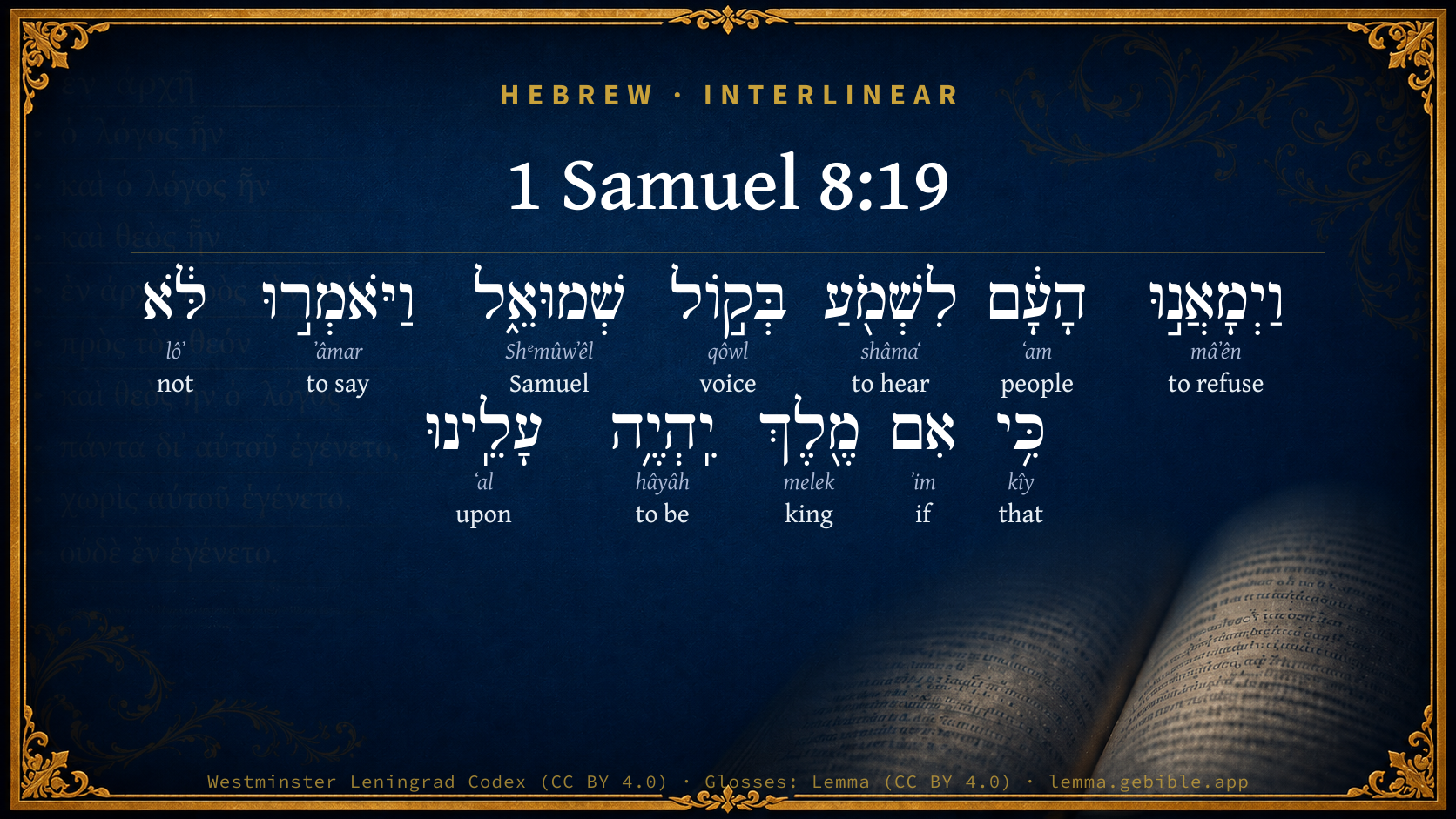
1 Samuel 8:19

Hebrew (Westminster Leningrad Codex) 1 Samuel 8:19 appears in the Hebrew Old Testament. The text above is from the Westminster Leningrad Codex. Each word links to its Strong’s number, a concise gloss, and parsing drawn from the Open Scriptures Hebrew Bible morphology. Click any word for its full Brown-Driver-Briggs (BDB) entry.
Download image
Cite this verse

1 Samuel 8:19 (World English Bible). Public Domain. Lemma interlinear Bible study tool, https://lemma.gebible.app/v/1-samuel/8/19.

Show BibTeX & RIS
BibTeX
RIS
English Translation
But the people refused to listen to the voice of Samuel; and they said, No: but we will have a king over us,
World English Bible · Public Domain
Download a study sheet

One document with this verse’s original text, its word-by-word gloss line, the meaning frame, cross-references with their text, attributed commentary, and full source and license credits — printable, and it pastes into notes with its structure intact.

This verse Autodidact and up

Study sheet (.html) Plain text (.txt)

A passage Seminary Student

Up to 50 verses in one chapter. A passage sheet keeps up to 6 commentary sources and 12 cross-references per verse, in the order this page ranks them, and says so on the sheet whenever that leaves anything out. Ask for a single verse and you get the Autodidact verse sheet above.

Everything on this page stays free to read, with no account — the sheet is a download of what is already on screen, not access to it.

Want to remove ads? Support Godless Engineer
Compare translations 3

The same verse in 3 English versions, stacked beneath the original-language interlinear above. Click any original word for its lexicon entry.

Each is an independent rendering of the whole verse — the interlinear is not word-aligned to these translations.

Highlighted words mark where these versions differ — a whole-verse word diff, not a word-by-word alignment.

  • World English Bible Public Domain
    But the people refused to listen to the voice of Samuel; and they said, No: but we will have a king over us,
  • King James Version Public Domain
    Nevertheless the people refused to obey the voice of Samuel; and they said, Nay; but we will have a king over us;
  • unfoldingWord Literal Text CC BY-SA 4.0
    But the people refused to listen to the voice of Samuel. And they said, “No! But surely a king will be over us.

unfoldingWord Literal Text — © unfoldingWord, licensed CC BY-SA 4.0. Word-aligned USFM3 via Door43 (git.door43.org/unfoldingWord/en_ult).

Versions to compare (up to 4)

3 of 4 selected

Show all 18 translations

Every available English version of this verse, each an independent rendering of the whole verse.

  • World English Bible Public Domain
    But the people refused to listen to the voice of Samuel; and they said, No: but we will have a king over us,
  • Berean Standard Bible Public Domain
    Nevertheless, the people refused to listen to Samuel. “No!” they said. “We must have a king over us.
  • Majority Standard Bible Public Domain
    Nevertheless, the people refused to listen to Samuel. “No!” they said. “We must have a king over us.
  • King James Version Public Domain
    Nevertheless the people refused to obey the voice of Samuel; and they said, Nay; but we will have a king over us;
  • American Standard Version (1901) Public Domain
    But the people refused to hearken unto the voice of Samuel; and they said, Nay: but we will have a king over us,
  • Revised Version (1885) Public Domain
    But the people refused to hearken unto the voice of Samuel; and they said, Nay; but we will have a king over us;
  • Geneva Bible (1599) Public Domain
    But the people would not heare the voyce of Samuel, but did say, Nay, but there shall be a King ouer vs.
  • Douay-Rheims (1899) Public Domain
    But the people would not hear the voice of Samuel, and they said: Nay: but there shall be a king over us.
  • Young's Literal Translation Public Domain
    And the people refuse to hearken to the voice of Samuel, and say, `Nay, but a king is over us,
  • Literal Standard Version CC BY-SA 4.0
    And the people refuse to listen to the voice of Samuel, and say, “No, but a king is over us,
  • Unlocked Literal Bible CC BY-SA 4.0
    But the people refused to listen to Samuel; they said, “No! There must be a king over us
  • unfoldingWord Literal Text CC BY-SA 4.0
    But the people refused to listen to the voice of Samuel. And they said, “No! But surely a king will be over us.
  • Darby Bible Public Domain
    And the people refused to hearken to the voice of Samuel; and they said, No, but there shall be a king over us,
  • World Messianic Bible Public Domain
    But the people refused to listen to the voice of Samuel; and they said, “No, but we will have a king over us,
  • Webster's Bible Public Domain
    Nevertheless, the people refused to obey the voice of Samuel; and they said, No; but we will have a king over us;
  • Free Bible Version CC BY-SA 4.0
    But the people refused to listen to what Samuel said. “No!” they insisted. “We want our own king!
  • Bible in Basic English Public Domain
    But the people gave no attention to the voice of Samuel; and they said, No, but we will have a king over us,
  • JPS Tanakh (1917) Public Domain
    But the people refused to hearken unto the voice of Samuel; and they said: 'Nay; but there shall be a king over us;

Literal Standard Version (2020), Covenant Press — licensed CC BY-SA 4.0. Text via the HelloAO Bible API (eBible.org). Unlocked Literal Bible (unfoldingWord) — licensed CC BY-SA 4.0. Text via the HelloAO Bible API (eBible.org). unfoldingWord Literal Text — © unfoldingWord, licensed CC BY-SA 4.0. Word-aligned USFM3 via Door43 (git.door43.org/unfoldingWord/en_ult). Free Bible Version, Dr. Jonathan Gallagher — licensed CC BY-SA 4.0. Text via the HelloAO Bible API (eBible.org).

Word by word

More ways to search: Search by grammar → Find every occurrence → Compare this word →

Practice this passage: Drill this verse → Learn its vocabulary →

וַיְמָאֲנ֣וּ
mâʼên
H3985
“and · to refuse”
Conjunction + Verb, Piel, Sequential Imperfect, 3rd Person, Masculine, Plural
Part of Speech
Conjunction + Verb
Stem
Piel
Form
Sequential Imperfect
Person
3rd Person
Gender
Masculine
Number
Plural
Full BDB Definition

Origin: a primitive root

TWOT: 1138

(Piel) to refuse
  1. הָעָ֔ם ʻam H5971 “the · people” Particle, Definite Article + Noun, Common, Masculine, Singular, Absolute
  2. לִשְׁמֹ֖עַ shâmaʻ H8085 “to hear” Preposition + Verb, Qal, Infinitive Construct
  3. בְּק֣וֹל qôwl H6963 “in/at · voice of” Preposition + Noun, Common, Masculine, Singular, Construct
  4. שְׁמוּאֵ֑ל Shᵉmûwʼêl H8050 “Samuel” Noun, Proper
  5. וַיֹּאמְר֣וּ ʼâmar H559 “and · to say” Conjunction + Verb, Qal, Sequential Imperfect, 3rd Person, Masculine, Plural
  6. לֹּ֔א lôʼ H3808 “not” Particle, Negative
  7. כִּ֥י kîy H3588 “that” Conjunction
  8. אִם ʼim H518 “if” Conjunction
  9. מֶ֖לֶךְ melek H4428 “king” Noun, Common, Masculine, Singular, Absolute
  10. יִֽהְיֶ֥ה hâyâh H1961 “to be” Verb, Qal, Imperfect, 3rd Person, Masculine, Singular
  11. עָלֵֽינוּ ʻal H5921 “upon · us” Preposition + Suffix, Personal, 1st Person, Common, Plural

About this verse

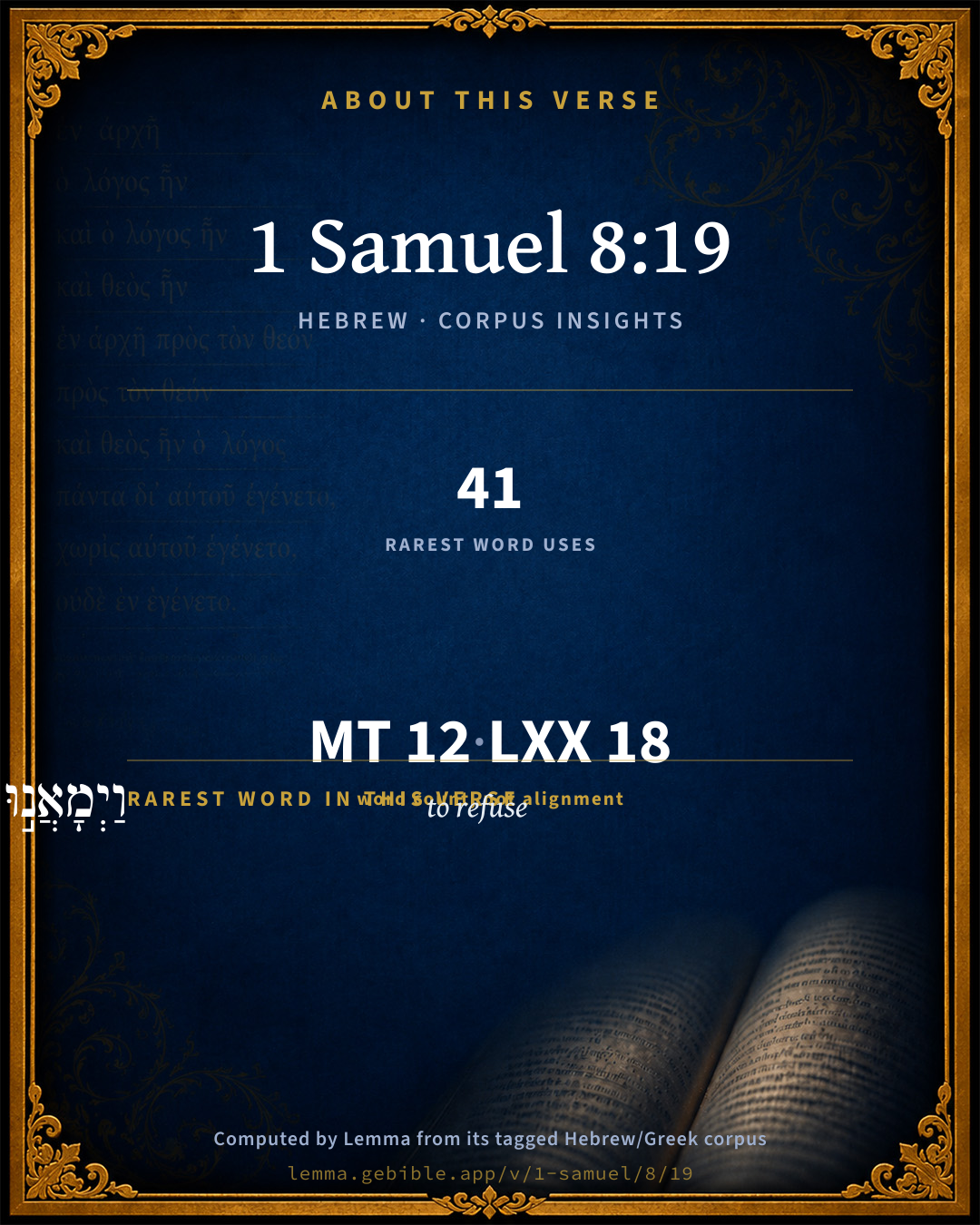
These counts appear in no published source. They are computed here, from the morphology-tagged text and Lemma’s own curated glosses. What Lemma adds →

12
words
12
distinct lemmas
Historical
section

Shared distinctive vocabulary

וַיְמָאֲנ֣וּ to refuse H3985 occurs in 39 verses of the Hebrew Bible. Also found in:

Grammatical profile

  • 4 verbs
  • 4 nouns
  • 1 preposition
  • 2 conjunctions
  • 1 particle

Verb forms

  • וַיְמָאֲנ֣וּ Piel · Sequential Imperfect
  • לִשְׁמֹ֖עַ Qal · Infinitive Construct
  • וַיֹּאמְר֣וּ Qal · Sequential Imperfect
  • יִֽהְיֶ֥ה Qal · Imperfect

Hebrew & Septuagint length

In English translation the verse runs 23 words from the Hebrew and 22 from the Septuagint (LXX English) — closely comparable.

A rough comparison of the two English renderings, which tokenize alike — not a word-level alignment.

Word counts can differ between the Hebrew and the Greek without any difference in meaning — e.g. the Hebrew direct-object marker אֵת has no separate Greek word, and Greek often adds the article ὁ.

In the original languages it is 12 Hebrew tokens and 18 Greek tokens — but the two are counted differently (Hebrew bundles its prefixes and suffixes into one token; the Greek is in lemma form), so that isn’t a like-for-like length.

Cross-references

5

Topical passages linked to 1 Samuel 8:19 in the Treasury of Scripture Knowledge — connected by theme and wording, ordered by reader-vote popularity; previews shown in the World English Bible.

  • Jeremiah 44:16 As for the word that you have spoken to us in the name of Yahweh, we will not listen to you.
  • Psalms 81:11 But my people didn't listen to my voice. Israel desired none of me.
  • Isaiah 66:4 I also will choose their delusions, and will bring their fears on them; because when I called, none did answer; when I spoke, they did not hear: but they did that which was evil in my eyes, and chose that in which I didn't delight.
  • Jeremiah 7:13 Now, because you have done all these works, says Yahweh, and I spoke to you, rising up early and speaking, but you didn't hear; and I called you, but you didn't answer:
  • Ezekiel 33:31 They come to you as the people comes, and they sit before you as my people, and they hear your words, but don't do them; for with their mouth they show much love, but their heart goes after their gain.

Cross-references courtesy of OpenBible.info (CC BY 4.0).

Hebrew and Greek witnesses Masoretic Hebrew ↔ Greek Septuagint

The same verse in the two great witnesses to the Old Testament, shown verse-for-verse.

These are two independent witnesses, not word-aligned to each other, and the Septuagint is shown in lemma (dictionary) form.

Hebrew 1 Samuel 8:19 Masoretic · Westminster Leningrad Codex

וַיְמָאֲנ֣וּ הָעָ֔ם לִשְׁמֹ֖עַ בְּק֣וֹל שְׁמוּאֵ֑ל וַיֹּאמְר֣וּ לֹּ֔א כִּ֥י אִם מֶ֖לֶךְ יִֽהְיֶ֥ה עָלֵֽינוּ

But the people refused to listen to the voice of Samuel; and they said, No: but we will have a king over us,

World English Bible · Public Domain

Greek LXX 1 Samuel 8:19 Septuagint · lemma form

καί οὐ ἀβουλέω ὁ λαός ἀκούω ὁ σαμουηλ καί εἶπον αὐτός οὐ ἀλλά ἤ βασιλεύς εἰμί ἐπί ἐγώ

But the people would not listen to Samuel; and they said to him, Nay, but there shall be a king over us.

LXX2012 (modern English Septuagint) · Public Domain

Hebrew: Westminster Leningrad Codex (CC BY 4.0). Greek: Septuagint (public domain); English from LXX2012 (modern English Septuagint) (Public Domain). How the Septuagint differs from the Hebrew →

Targum (Aramaic paraphrase)

1

The Targum is the ancient Jewish Aramaic paraphrase of the Hebrew Scriptures — an interpretive translation, not the Hebrew text itself. Onkelos (literal) and Pseudo-Jonathan (expansive) render the Torah, and Jonathan the Prophets. Coverage is partial: where no permissively-licensed English translation exists for a verse, only the Aramaic is shown. This is verse-level text, not a word-by-word alignment to the Hebrew.

  1. Targum Jonathan Prophets (Joshua–Malachi)
    וְסָרִיבוּ עַמָא לְקַבָּלָא לְמֵימַר שְׁמוּאֵל וַאֲמַרוּ לָא אֱלָהֵן מַלְכָּא יְהֵי עֲלָנָא:

    (no public-domain English translation for this verse)

    Targum Jonathan — Aramaic: “Mikraot Gedolot” (public domain). English: “Sefaria Community Translation” (CC0 1.0 (public-domain dedication)); “London "Chaldee Paraphrase," 1871” (public domain). Text via Sefaria.

Commentary

Notes on 1 Samuel 8:19 from classic Christian and Jewish commentators (each source and its license shown beneath its notes). The classic Christian expositions comment on the surrounding passage and are grouped to its opening verse, so a note may address several verses; the Jewish commentaries on the Tanakh (Rashi and others) are per-verse, so they appear only where the commentator wrote on this verse.

Lemma curates 59 commentaries, every one of them public domain or Creative Commons licensed, each selected and text-cleaned for this edition rather than reprinted as found. About our sources →

Trapp's Complete Commentary

John Trapp

1Sa 8:19 Nevertheless the people refused to obey the voice of Samuel; and they said, Nay; but we will have a king over us;

Ver. 19. Nay; but we will have a king.] Why then you shall, saith God, for a mischief to you. {Hos 13:11} You shall have your will, and then I will have mine another while. See the like, Eze 24:13.

John Trapp, A Commentary or Exposition upon All the Books of the Old and New Testament (1647–1656) — public domain. Text from a community e-Sword module.

The Biblical Illustrator

Joseph S. Exell

1Sa_8:19-20

And they said, Nay, but we will have a king over us.

A king desired

If we were asked what is the prevailing feeling which the study of this history is calculated to produce, we should answer in one word--disappointment.

I. The request of the Israelites brings before us a melancholy view of the progress of degeneracy in a community. It requires no effort to perceive in this desire of the Israelites the renewed manifestation of the discontented and rebellious disposition which prevailed in the camp at the Red Sea, and on subsequent occasions in the wilderness; but now it was marked by a greater fixedness of criminal resolve and of God-dishonouring purpose. It was the sin of the fathers living over again, but with greater intensity, in the persons of the children. This view of the case is, in a high degree, admonitory. None of us, perhaps, think enough of the connection between ourselves and the future. Each age exerts a very considerable influence on that which succeeds it, and the men of any particular age are responsible to God in a very large and affecting measure for the characteristics of the period which may come after them The degeneracy of communities is after all the degeneracy of individuals; and he who makes the effort to prevent in the conduct of a single individual the continuance of sin--who attempts in the case of a single individual to raise the tone of morals, does so far provide a better State of things for the age that shall come after him. If looking at the clamorous assembly which the narrative brings before us as now surrounding Samuel and asking a change in the form of government, we inquire whence learnt they those low thoughts of God which led them so much to dishonour Him as to wish to put Him aside in order to make room for an earthly ruler? the only proper and correct reply would be, From those who went before them. We live for a future age, and virtually we have the character of that age in our hands, whether as it concerns the nation, the church, or the family

II. The scene brought before us by this demand of Israel for a king, teaches us the perilousness of allowing our thoughts to run in an improper direction and our wishes to centre upon a wrong object. And this for a reason which is very distinctly conveyed to us in the tenour of the narrative--the absorbing effect of one wrong thought, and its consequent power to throw into oblivion all those counteracting thoughts and objects which from any other source might be suggested. Trace the progress of this one wrong desire, in Israel, of having a king. Was there nothing to be said on the other side? Rather we might ask, Is it not exceedingly easy to conceive of the counteracting effect which at the first stage might have been presented to such a wish by a recollection of their actual privileges at the moment? There is a matchless sublimity--the sublimity of condescension and graciousness--about the very idea of a theocracy. But if its sublimity did not appeal to their moral sense, its peculiar advantageousness might have appealed to their self-regard. The God-honouring wish grew stronger and stronger. At least, however, it might have been expected that they would be moved by a vivid delineation of the unwelcome consequences which God declared would attend on the new arrangement. Yet, after all, this is but a picture of real life, applicable to every age. It contains a faithful warning. It says--Beware of the first wrong desire, give it no encouragement. Beware of the first misdirection of thought. Be sure you are right at first in your plans and purposes, because afterwards, by reason of the very force with which wrong thoughts indulged exclude all suggestions to the contrary, it may be too late to alter. To the young it especially says--In the purposes you cherish, the plans you propose, the changes you contemplate, the objects on which you allow your affections to rest, beware of a mistake at the first.

III. It is of importance that we should carefully study the essential evil of the motive which here operated in the minds of the Hebrew nation. That motive was--that they might be like other people. And if in a thoughtful mood we take a survey of the causes which have wrought to produce moral desolation in communities from that day until the present, there will appear none whose operation has proved more widely mischievous, more intensely active to harm than this--a desire to be like others. Many a time has that young man left the house of God full of conviction, and ready to resolve that, whatever others did, he would serve the Lord. But he turned to take another look at the world, and the thought came along with the look, float much of his worldly interest depended upon the friendship of those around him, and that if he expected them to be his friends, his opinions and his habits must not be opposed to theirs. He gave in to the principle of being like them; and, having resembled them in time, his lot now throughout eternity resembles theirs too. Alas! the wreck of souls which this principle involves! and, we must, add, the wreck of earthly comfort, too. (J. A. Miller.)

The Biblical Illustrator, edited by Joseph S. Exell (c. 1880s–1900s) — public domain. Text from a community e-Sword module.

Joseph Benson's Commentary

1Sa 8:19-20. Nevertheless the people refused to obey — This description of kingly government, as then exercised in the East, did not deter them from persisting in their desires. But they still peremptorily demanded a king, although Samuel told them that this demand was, in effect, throwing off the government of God. That we also may be like all other nations —

Strange blindness and stupidity, that they could not see it was their singular felicity that they were not like other nations! Num 23:9; Deu 33:28; as in other glorious privileges, so especially in this, that they had God for their king and governor, who never failed in time of need to raise up men of wonderful worth to be their deliverers. But they wanted a king to go out before them, and to fight their battles — Could they desire a battle better fought for them than the last was, by Samuel’s prayers and God’s thunders? Were they fond to try the chance of war at the same uncertainty that others did? And what was the issue? Their first king was slain in battle; and so was Josiah, one of the last and best.

Joseph Benson's Commentary on the Old and New Testaments (1811–1818) — public domain. Text from a community e-Sword module.

Jamieson, Fausset & Brown

Robert Jamieson, A. R. Fausset & David Brown

Nevertheless the people refused to obey the voice of Samuel--They sneered at Samuel's description as a bugbear to frighten them. Determined, at all hazards, to gain their object, they insisted on being made like all the other nations, though it was their glory and happiness to be unlike other nations in having the Lord for their King and Lawgiver (Num 23:9; Deu 33:28). Their demand was conceded, for the government of a king had been provided for in the law; and they were dismissed to wait the appointment, which God had reserved to Himself (Deu 17:14-20).

Next: 1 Samuel Chapter 9

Jamieson, Fausset & Brown — Commentary Critical and Explanatory on the Whole Bible (1871) — public domain (CC PDM 1.0). Text via the HelloAO Bible API.

Adam Clarke's Commentary

Verse 19. The people refused to obey] They would have the king, his manner and all, notwithstanding the solemn warning which they here receive.

Adam Clarke's Commentary on the Bible (1810–1826) — public domain. Text from a community e-Sword/MySword module.

Ellicott's Commentary for English Readers

(19) The people refused.—The warning words of the prophet-judge were evidently carefully considered and debated in a formal assembly, but the majority at least abided by the terms of their request.

A Bible Commentary for English Readers, edited by Charles John Ellicott (1878–1897) — public domain. Text from a community e-Sword module.

The Cambridge Bible for Schools and Colleges

gen. ed. J. J. S. Perowne

19–22. Reply of the people

19. Nevertheless] Simply And.

The Cambridge Bible for Schools and Colleges (gen. ed. J. J. S. Perowne; Cambridge University Press, 1878–1918) — public domain. Text from a community e-Sword module.

John Gill's Exposition

Nevertheless, the people refused to obey the voice of Samuel,.... The advice he gave not to think of a king, but be content with the government under which they were; but to this they would not hearken, notwithstanding all the inconveniences that would attend such a change:

and they said, nay, but we will have a king over us; they would not believe what Samuel said concerning a king, even though they were the words of the Lord he delivered to them; and though they knew Samuel was a prophet, and spoke by a spirit of prophecy, and none of his words had ever fallen to the ground: but such was their stubbornness and obstinacy, and so set upon having a king, that one they would have, let them suffer what hardships, or be at what expenses they might; at all events, and against all remonstrances, they were determined to have one.

John Gill's Exposition of the Whole Bible (1746–1763) — public domain (CC PDM 1.0). Text via the HelloAO Bible API.

Haydock's Catholic Bible Commentary

Over us. The populace is generally inconstant, and fond of changes. (Menochius)

George Leo Haydock (1774–1849), Haydock's Catholic Family Bible and Commentary, 1859 edition — public domain. Excludes Psalms (Douay-Rheims chapter numbering differs from Protestant) and Deuterocanonical books (Catholic canon only).

Matthew Poole's English Annotations

They said, Nay, i.e. these things shall never be, these are but vain suppositions to affright us from our purpose. Thus they are not ashamed to give Samuel the lie, of whose modesty, integrity, and prophetical spirit they had so great assurance, as if he had reigned those pretences merely to keep the power in his own and his sons’ hands.

We will have a king over us; we will have a king, whatsoever it cost us, although all thy predictions should be verified.

Matthew Poole's English Annotations on the Holy Bible (1683–1685) — public domain. Text from a community e-Sword/MySword module.

Whedon's Commentary on the Bible

Daniel D. Whedon

19. The people refused to obey — They had counted the cost, and were willing to submit to regal exactions for the sake of having a government like the nations around them. “On this Samuel sorrowfully dismissed them to their homes, that he might have time to take the necessary measures for effecting this great change.” — Kitto.

Daniel D. Whedon (gen. ed.), Commentary on the Old and New Testaments (1874–1909) — public domain. Text from a community e-Sword module.

The Pulpit Commentary

Vers. 19, 20. The people refused to obey literally, to hearken tothe voice of Samuel. The words of Samuel were no doubt formally considered by the elders, and we may be sure that there would not be wanting men to urge attention and obedience to his warning; but when the decision had to be made, whether by vote or acclamation, the majority persisted in their choice, and for a reason which completely justified Samuel"s displeasure; for they sayThat we also may be like all the nations. Their wish was not to develop and perfect their own institutions, but to revolt from them, and escape from the rigour of the Mosaic law. It is remarkable that their nearest neighbours and most inveterate enemies, the Philistines, had no king, but an oligarchy of five princes. Probably it had been argued, in the assembly of the elders, that if the whole power of Israel were gathered into one hand it would be more than a match for the Philistines, whose energy must often have been diminished by discords among its rulers. That our king may judgei.e. govern (1Sa_7:17) us, and fight our battles. Here the people had reason on their side. Both the internal administration of justice and the defence of the country would be better managed under a permanent and regular authority than under the judges, whose rule was extemporised to meet difficulties, and had no inherent stability.

The Pulpit Commentary (1880–1919), ed. H.D.M. Spence-Jones & Joseph S. Exell — public domain. Text from a community e-Sword module.

Keil & Delitzsch

C. F. Keil & F. Delitzsch

With such a description of the "right of the king" as this, Samuel had pointed out to the elders the dangers connected with a monarchy in so alarming a manner, that they ought to have been brought to reflection, and to have desisted from their demand. "But the people refused to hearken to the voice of Samuel." They repeated their demand, "We will have a king over us, that we also may be like all the nations, and that our king may judge us, and go out before us, and conduct our battles."

Keil & Delitzsch — Biblical Commentary on the Old Testament (1861–1891) — public domain (CC PDM 1.0). Text via the HelloAO Bible API. (Old Testament only.)

unfoldingWord translationNotes

Door43 World Missions Community

translationWords

Samuel

king

nation

judge

unfoldingWord translationNotes — © Distant Shores Media and the Door43 World Missions Community, licensed CC BY-SA 4.0. Source: git.door43.org/Door43/en_tn.

Lesson kit

Teaching starters — assembled from the data on this page, not authored interpretation. Every prompt links to the verse data it draws on. Edit before teaching.

1 Samuel, in the Historical, opens this verse with 12 words (12 distinct Hebrew lemmas). Its most distinctive word is mâʼên (“to refuse”). A historical commentator’s framing appears above. Read the whole chapter for the surrounding context.

Discussion questions

  1. How does “to refuse” (mâʼên) shape what this verse is saying?
  2. Genesis 37:35 shares the word «to refuse» with this verse. How do the two illuminate each other?
  3. The translations on this page render this verse differently — a whole-verse word diff, not a word-by-word alignment. What might account for the different wordings?
  4. The verb «וַיְמָאֲנ֣וּ» is Piel Sequential Imperfect. How does its form color the action?
  5. Reading how Trapp's Complete Commentary and The Biblical Illustrator read this verse, where do the two commentators agree and where do they part?

Things to notice

Reading settings

Reading text

Shown beneath each verse's original-language words.

Old Testament
Old Testament edition

Read the OT as the Masoretic Hebrew (MT) or the Greek Septuagint (LXX).

English shown for the Greek Septuagint (in the Hebrew ↔ Greek comparison).

Comparing translations? Open the Compare panel on any verse page to stack up to four side by side.