
2 Samuel 15:23

Hebrew (Westminster Leningrad Codex) 2 Samuel 15:23 appears in the Hebrew Old Testament. The text above is from the Westminster Leningrad Codex. Each word links to its Strong’s number, a concise gloss, and parsing drawn from the Open Scriptures Hebrew Bible morphology. Click any word for its full Brown-Driver-Briggs (BDB) entry.
Download image
Cite this verse

2 Samuel 15:23 (World English Bible). Public Domain. Lemma interlinear Bible study tool, https://lemma.gebible.app/v/2-samuel/15/23.

Show BibTeX & RIS
BibTeX
RIS
English Translation
All the country wept with a loud voice, and all the people passed over: the king also himself passed over the brook Kidron, and all the people passed over, toward the way of the wilderness.
World English Bible · Public Domain
Highlights
  • 1 first appearance in the Hebrew Bible
Full analysis ↓
Download a study sheet

One document with this verse’s original text, its word-by-word gloss line, the meaning frame, cross-references with their text, attributed commentary, and full source and license credits — printable, and it pastes into notes with its structure intact.

This verse Autodidact and up

Study sheet (.html) Plain text (.txt)

A passage Seminary Student

Up to 50 verses in one chapter. A passage sheet keeps up to 6 commentary sources and 12 cross-references per verse, in the order this page ranks them, and says so on the sheet whenever that leaves anything out. Ask for a single verse and you get the Autodidact verse sheet above.

Everything on this page stays free to read, with no account — the sheet is a download of what is already on screen, not access to it.

Want to remove ads? Support Godless Engineer
Compare translations 3

The same verse in 3 English versions, stacked beneath the original-language interlinear above. Click any original word for its lexicon entry.

Each is an independent rendering of the whole verse — the interlinear is not word-aligned to these translations.

Highlighted words mark where these versions differ — a whole-verse word diff, not a word-by-word alignment.

  • World English Bible Public Domain
    All the country wept with a loud voice, and all the people passed over: the king also himself passed over the brook Kidron, and all the people passed over, toward the way of the wilderness.
  • King James Version Public Domain
    And all the country wept with a loud voice, and all the people passed over: the king also himself passed over the brook Kidron, and all the people passed over, toward the way of the wilderness.
  • unfoldingWord Literal Text CC BY-SA 4.0
    And all of the land was weeping a great voice, and all of the people were crossing, and the king was crossing, over the Valley of Kidron, and all of the people were crossing to the face of the way of the wilderness.

unfoldingWord Literal Text — © unfoldingWord, licensed CC BY-SA 4.0. Word-aligned USFM3 via Door43 (git.door43.org/unfoldingWord/en_ult).

Versions to compare (up to 4)

3 of 4 selected

Show all 18 translations

Every available English version of this verse, each an independent rendering of the whole verse.

  • World English Bible Public Domain
    All the country wept with a loud voice, and all the people passed over: the king also himself passed over the brook Kidron, and all the people passed over, toward the way of the wilderness.
  • Berean Standard Bible Public Domain
    Everyone in the countryside was weeping loudly as all the people passed by. And as the king crossed the Kidron Valley, all the people also passed toward the way of the wilderness.
  • Majority Standard Bible Public Domain
    Everyone in the countryside was weeping loudly as all the people passed by. And as the king crossed the Kidron Valley, all the people also passed toward the way of the wilderness.
  • King James Version Public Domain
    And all the country wept with a loud voice, and all the people passed over: the king also himself passed over the brook Kidron, and all the people passed over, toward the way of the wilderness.
  • American Standard Version (1901) Public Domain
    And all the country wept with a loud voice, and all the people passed over: the king also himself passed over the brook Kidron, and all the people passed over, toward the way of the wilderness.
  • Revised Version (1885) Public Domain
    And all the country wept with a loud voice, and all the people passed over: the king also himself passed over the brook Kidron, and all the people passed over, toward the way of the wilderness.
  • Geneva Bible (1599) Public Domain
    And all the countrey wept with a loude voyce, and all the people went forward, but the King passed ouer the brooke Kidron: and all the people went ouer toward the way of ye wildernes.
  • Douay-Rheims (1899) Public Domain
    And they all wept with a loud voice, and all the people passed over: the king also himself went over the brook Cedron, and all the people marched towards the way that looketh to the desert.
  • Young's Literal Translation Public Domain
    And all the land are weeping -- a great voice, and all the people are passing over; and the king is passing over through the brook Kidron, and all the people are passing over on the front of the way of the wilderness;
  • Literal Standard Version CC BY-SA 4.0
    And all the land is weeping [with] a great voice, and all the people are passing over; and the king is passing over through the Brook of Kidron, and all the people are passing over on the front of the way of the wilderness;
  • Unlocked Literal Bible CC BY-SA 4.0
    All the country wept with a loud voice as all the people passed by over the Kidron Valley, and as the king also himself crossed over. All the people traveled on the road toward the wilderness.
  • unfoldingWord Literal Text CC BY-SA 4.0
    And all of the land was weeping a great voice, and all of the people were crossing, and the king was crossing, over the Valley of Kidron, and all of the people were crossing to the face of the way of the wilderness.
  • Darby Bible Public Domain
    And all the country wept with a loud voice, and all the people passed over; the king also himself passed over the torrent Kidron, and all the people passed over, towards the way of the wilderness.
  • World Messianic Bible Public Domain
    All the country wept with a loud voice, and all the people passed over. The king also himself passed over the brook Kidron, and all the people passed over toward the way of the wilderness.
  • Webster's Bible Public Domain
    And all the country wept with a loud voice, and all the people passed over: the king also himself passed over the brook Kidron, and all the people passed over, towards the way of the wilderness.
  • Free Bible Version CC BY-SA 4.0
    All the people in the countryside were crying aloud as everyone with David passed by. They crossed the Kidron Valley with the king on the way toward the wilderness.
  • Bible in Basic English Public Domain
    And there was great weeping in all the country when all the people went through; and the king himself was waiting in the Kidron valley and all the people went by him in the direction of the olive-tree on the edge of the waste land.
  • JPS Tanakh (1917) Public Domain
    And all the country wept with a loud voice, as all the people passed over; and as the king passed over the brook Kidron, all the people passed over, toward the way of the wilderness.

Literal Standard Version (2020), Covenant Press — licensed CC BY-SA 4.0. Text via the HelloAO Bible API (eBible.org). Unlocked Literal Bible (unfoldingWord) — licensed CC BY-SA 4.0. Text via the HelloAO Bible API (eBible.org). unfoldingWord Literal Text — © unfoldingWord, licensed CC BY-SA 4.0. Word-aligned USFM3 via Door43 (git.door43.org/unfoldingWord/en_ult). Free Bible Version, Dr. Jonathan Gallagher — licensed CC BY-SA 4.0. Text via the HelloAO Bible API (eBible.org).

Word by word

More ways to search: Search by grammar → Find every occurrence → Compare this word →

Practice this passage: Drill this verse → Learn its vocabulary →

קִדְר֔וֹן
Qidrôwn
H6939
“Kidron”
Noun, Proper
Part of Speech
Noun
Type
Proper
Full BDB Definition

Origin: from H6937

TWOT: None

Kidron = "dark" - a stream east of Jerusalem
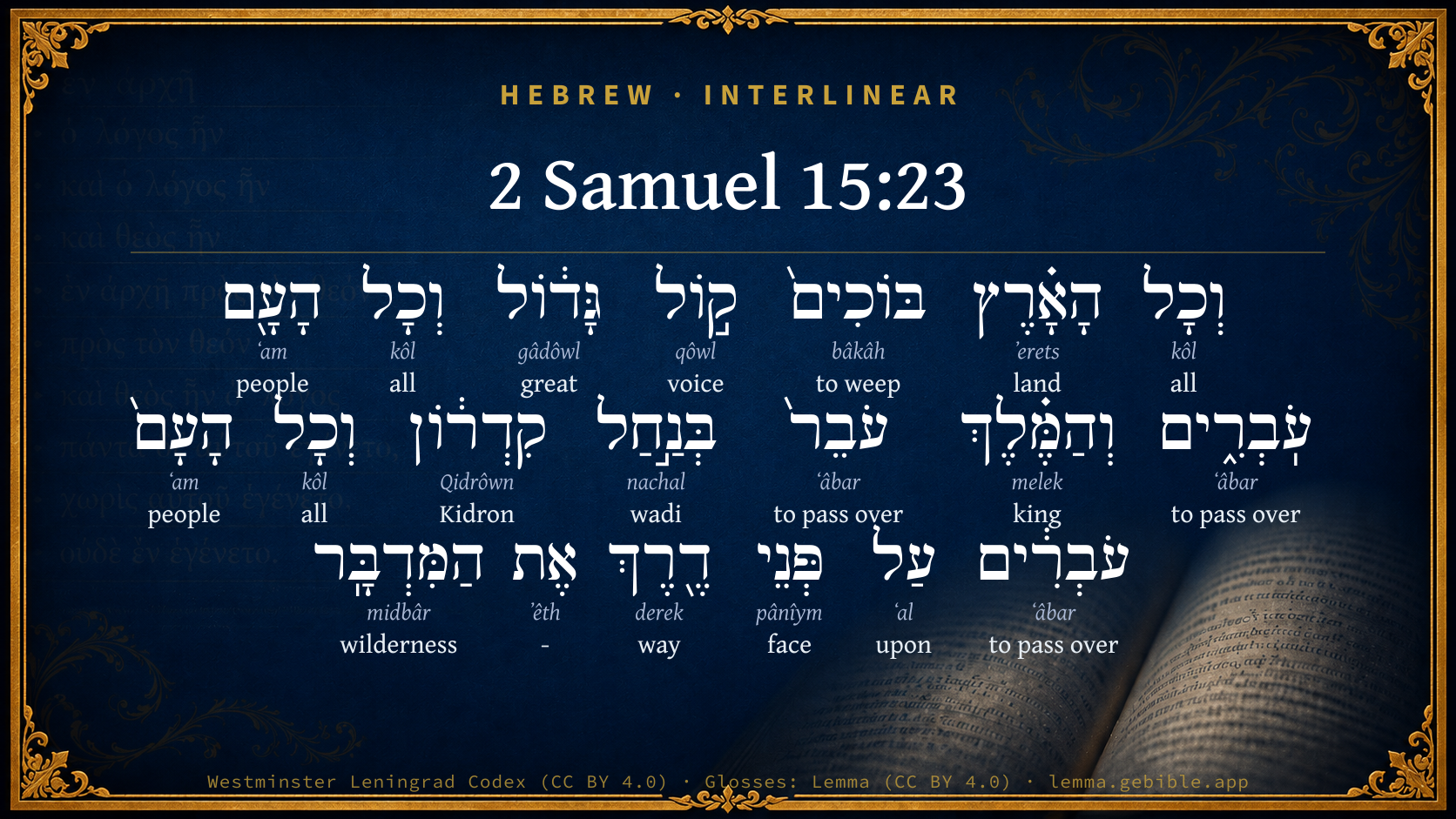
  1. וְכָל kôl H3605 “and · all of” Conjunction + Noun, Common, Masculine, Singular, Construct
  2. הָאָ֗רֶץ ʼerets H776 “the · land” Particle, Definite Article + Noun, Common, Both, Singular, Absolute
  3. בּוֹכִים֙ bâkâh H1058 “weeping” Verb, Qal, Participle Active, Masculine, Plural, Absolute
  4. ק֣וֹל qôwl H6963 “voice” Noun, Common, Masculine, Singular, Absolute
  5. גָּד֔וֹל gâdôwl H1419 “great” Adjective, Adjective, Masculine, Singular, Absolute
  6. וְכָל kôl H3605 “and · all of” Conjunction + Noun, Common, Masculine, Singular, Construct
  7. הָעָ֖ם ʻam H5971 “the · people” Particle, Definite Article + Noun, Common, Masculine, Singular, Absolute
  8. עֹֽבְרִ֑ים ʻâbar H5674 “passing over” Verb, Qal, Participle Active, Masculine, Plural, Absolute
  9. וְהַמֶּ֗לֶךְ melek H4428 “and · the · king” Conjunction + Particle, Definite Article + Noun, Common, Masculine, Singular, Absolute
  10. עֹבֵר֙ ʻâbar H5674 “passing over” Verb, Qal, Participle Active, Masculine, Singular, Absolute
  11. בְּנַ֣חַל nachal H5158 “in/at · wadi of” Preposition + Noun, Common, Masculine, Singular, Construct
  12. וְכָל kôl H3605 “and · all of” Conjunction + Noun, Common, Masculine, Singular, Construct
  13. הָעָם֙ ʻam H5971 “the · people” Particle, Definite Article + Noun, Common, Masculine, Singular, Absolute
  14. עֹבְרִ֔ים ʻâbar H5674 “passing over” Verb, Qal, Participle Active, Masculine, Plural, Absolute
  15. עַל ʻal H5921 “upon” Preposition
  16. פְּנֵי pânîym H6440 “face(s) of” Noun, Common, Both, Plural, Construct
  17. דֶ֖רֶךְ derek H1870 “way” Noun, Common, Both, Singular, Absolute
  18. אֶת ʼêth H853 “-” Particle, Direct Object
  19. הַמִּדְבָּֽר midbâr H4057 “the · wilderness” Particle, Definite Article + Noun, Common, Masculine, Singular, Absolute

About this verse

These counts appear in no published source. They are computed here, from the morphology-tagged text and Lemma’s own curated glosses. What Lemma adds →

20
words
15
distinct lemmas
Historical
section

Notable vocabulary

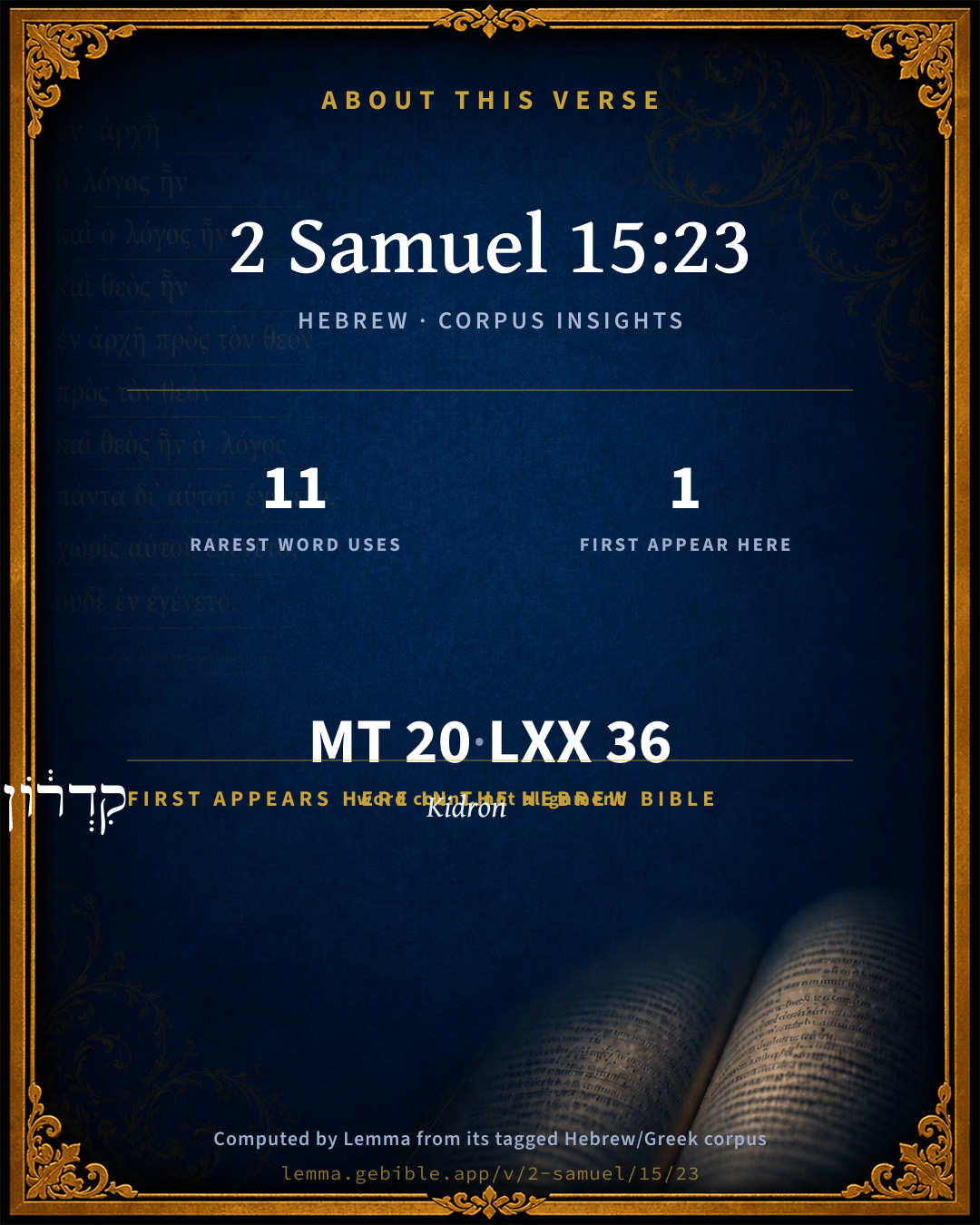
The rarest word here is קִדְר֔וֹן Kidron H6939 — appearing just 11 times in the whole Hebrew Bible.

First appearance in Scripture

This word makes its first canonical appearance in the Hebrew Bible here:

  • קִדְר֔וֹן Kidron H6939

Shared distinctive vocabulary

קִדְר֔וֹן Kidron H6939 occurs in 10 verses of the Hebrew Bible. Also found in:

Grammatical profile

  • 4 verbs
  • 13 nouns
  • 1 adjective
  • 1 preposition
  • 1 particle

Verb forms

  • בּוֹכִים֙ Qal · Participle Active
  • עֹֽבְרִ֑ים Qal · Participle Active
  • עֹבֵר֙ Qal · Participle Active
  • עֹבְרִ֔ים Qal · Participle Active

Repetition

Words recur within this verse — often emphatic in Hebrew:

  • וְכָל all H3605 ×3
  • עֹֽבְרִ֑ים to pass over H5674 ×3
  • הָעָ֖ם people H5971 ×2

Hebrew & Septuagint length

In English translation the verse runs 35 words from the Hebrew and 42 from the Septuagint (LXX English) — closely comparable.

A rough comparison of the two English renderings, which tokenize alike — not a word-level alignment.

Word counts can differ between the Hebrew and the Greek without any difference in meaning — e.g. the Hebrew direct-object marker אֵת has no separate Greek word, and Greek often adds the article ὁ.

In the original languages it is 20 Hebrew tokens and 36 Greek tokens — but the two are counted differently (Hebrew bundles its prefixes and suffixes into one token; the Greek is in lemma form), so that isn’t a like-for-like length.

Cross-references

9

Topical passages linked to 2 Samuel 15:23 in the Treasury of Scripture Knowledge — connected by theme and wording, ordered by reader-vote popularity; previews shown in the World English Bible.

  • 2 Samuel 16:2 The king said to Ziba, What do you mean by these? Ziba said, The donkeys are for the king's household to ride on; and the bread and summer fruit for the young men to eat; and the wine, that such as are faint in the wilderness may drink.
  • 1 Kings 2:37 For on the day you go out, and pass over the brook Kidron, know you for certain that you shall surely die: your blood shall be on your own head.
  • John 18:1 When Jesus had spoken these words, he went out with his disciples over the brook Kidron, where was a garden, into which he and his disciples entered.
  • 1 Kings 15:13 Also Maacah his mother he removed from being queen, because she had made an abominable image for an Asherah; and Asa cut down her image, and burnt it at the brook Kidron.
  • 2 Chronicles 29:16 The priests went in to the inner part of the house of Yahweh, to cleanse it, and brought out all the uncleanness that they found in the temple of Yahweh into the court of the house of Yahweh. The Levites took it, to carry it out abroad to the brook Kidron.
  • Matthew 3:1 In those days, John the Baptizer came, preaching in the wilderness of Judea, saying,
  • Matthew 3:3 For this is he who was spoken of by Isaiah the prophet, saying, "The voice of one crying in the wilderness, Make ready the way of the Lord, Make his paths straight."
  • Luke 1:80 The child was growing, and becoming strong in spirit, and was in the desert until the day of his public appearance to Israel.
  • Romans 12:15 Rejoice with those who rejoice. Weep with those who weep.

Cross-references courtesy of OpenBible.info (CC BY 4.0).

Hebrew and Greek witnesses Masoretic Hebrew ↔ Greek Septuagint

The same verse in the two great witnesses to the Old Testament, shown verse-for-verse.

These are two independent witnesses, not word-aligned to each other, and the Septuagint is shown in lemma (dictionary) form.

Hebrew 2 Samuel 15:23 Masoretic · Westminster Leningrad Codex

וְכָל הָאָ֗רֶץ בּוֹכִים֙ ק֣וֹל גָּד֔וֹל וְכָל הָעָ֖ם עֹֽבְרִ֑ים וְהַמֶּ֗לֶךְ עֹבֵר֙ בְּנַ֣חַל קִדְר֔וֹן וְכָל הָעָם֙ עֹבְרִ֔ים עַל פְּנֵי דֶ֖רֶךְ אֶת הַמִּדְבָּֽר

All the country wept with a loud voice, and all the people passed over: the king also himself passed over the brook Kidron, and all the people passed over, toward the way of the wilderness.

World English Bible · Public Domain

Greek LXX 2 Samuel 15:23 Septuagint · lemma form

καί πᾶς ὁ γῆ κλαίω φωνή μέγας καί πᾶς ὁ λαός παραπορεύομαι ἐν ὁ χειμάροος κεδρων καί ὁ βασιλεύς διαβαίνω ὁ χειμάροος κεδρων καί πᾶς ὁ λαός καί ὁ βασιλεύς παραπορεύομαι ἐπί πρόσωπον ὁδός ὁ ἐρῆμος

And all the country wept with a loud voice. And all the people passed by over the brook of Kedron; and the king crossed the brook Kedron: and all the people and the king passed on toward the way of the wilderness.

LXX2012 (modern English Septuagint) · Public Domain

On this verse, The Pulpit Commentary discusses the Septuagint’s reading. Read the note in Commentary ↓

Hebrew: Westminster Leningrad Codex (CC BY 4.0). Greek: Septuagint (public domain); English from LXX2012 (modern English Septuagint) (Public Domain). How the Septuagint differs from the Hebrew →

Targum (Aramaic paraphrase)

1

The Targum is the ancient Jewish Aramaic paraphrase of the Hebrew Scriptures — an interpretive translation, not the Hebrew text itself. Onkelos (literal) and Pseudo-Jonathan (expansive) render the Torah, and Jonathan the Prophets. Coverage is partial: where no permissively-licensed English translation exists for a verse, only the Aramaic is shown. This is verse-level text, not a word-by-word alignment to the Hebrew.

  1. Targum Jonathan Prophets (Joshua–Malachi)
    וְכָל דַיָירֵי אַרְעָא בָּכַן קַל רַב וְכָל עַמָא עָבְרִין וּמַלְכָּא עֲבַר בְּנַחֲלָא דְקִדְרוּן וְכָל עַמָא עָבְרִין עַל אַפֵּי אוֹרַח מַדְבְּרָא:

    (no public-domain English translation for this verse)

    Targum Jonathan — Aramaic: “Mikraot Gedolot” (public domain). English: “Sefaria Community Translation” (CC0 1.0 (public-domain dedication)); “London "Chaldee Paraphrase," 1871” (public domain). Text via Sefaria.

Commentary

Notes on 2 Samuel 15:23 from classic Christian and Jewish commentators (each source and its license shown beneath its notes). The classic Christian expositions comment on the surrounding passage and are grouped to its opening verse, so a note may address several verses; the Jewish commentaries on the Tanakh (Rashi and others) are per-verse, so they appear only where the commentator wrote on this verse.

Lemma curates 59 commentaries, every one of them public domain or Creative Commons licensed, each selected and text-cleaned for this edition rather than reprinted as found. About our sources →

Trapp's Complete Commentary

John Trapp

2Sa 15:23 And all the country wept with a loud voice, and all the people passed over: the king also himself passed over the brook Kidron, and all the people passed over, toward the way of the wilderness.

Ver. 23. And all the country wept with a loud voice.] All David’s friends did, when Absalom and his complices were jolly and jocund: but their good times lasted not long.

The king also himself passed over the brook Kidron.] Which had its name from darkness, and was the town ditch. Herein he became a type of Christ, who passed over the same brook, when he was in danger of the Jews. {Joh 18:1}

Toward the way of the wilderness.] The wilderness of Jericho.

John Trapp, A Commentary or Exposition upon All the Books of the Old and New Testament (1647–1656) — public domain. Text from a community e-Sword module.

The Biblical Illustrator

Joseph S. Exell

2Sa_15:23

And all the country wept with a loud voice.

The way of the Cross

Notice the weeping people. (Luk_23:27-31.) Davids experience at this time contains many foreshadowings of the passion of our Lord, but also some contrasts, as the conduct of the priesthood. (Verse 24 compared with Joh_18:13; Joh_18:24.)

I. The ark sent back. In this incident Davids character rises to its height of moral grandeur. The ark was the symbol of Gods presence. (1Sa_4:1-11.) The Israelites in Elis time had degenerated into trust of the symbol, instead of that which it symbolized. (Jer_7:1-4; Mat_3:9.) David understood the spiritual truth underlying, but not inseparable from, the outward sign.

II. His motives in sending back the ark seem to have been:

1. An expression of his unworthiness, as one who had deeply sinned, and was suffering the consequences of sin, to enjoy the consolation of religion.

2. Trust in Jehovah Himself apart from ordinances and symbols. If I shall find favour, then I shall be restored to the sanctuary and its blessings; and if not, then what good will the ark do me? Without Gods favour it will only be a useless responsibility. This teaches us a deep spiritual lesson, needed in all ages, that mere outward forms of religion can never profit a heart not at peace with God. And in these expressions. David manifested strong faith. (Num_14:8; Dan_3:17-18; 1Jn_5:4.)

3. He feared to injure others by the withdrawal of the symbol of Gods presence, but would rather leave a witness in rebellious Jerusalem. (Psa_69:6; Psa_69:36.)

4. Besides this, he doubtless feared to imperil the ark itself, remembering the awful lesson of Uzzahs death.

III. A prayer immediately answered. (2Sa_15:31; 2Sa_16:23; 1Co_3:18-19; 1Co_1:18-25.) Ahithophels treachery specially alluded to. (Psa_41:9; Psa_55:12-15.) (R. E. Faulkner.)

The Biblical Illustrator, edited by Joseph S. Exell (c. 1880s–1900s) — public domain. Text from a community e-Sword module.

Joseph Benson's Commentary

2Sa 15:23. All the country wept — All about Jerusalem, and the generality of the people by whom they passed, being extremely afflicted to see their king, under whom they had lived in great peace and prosperity, reduced to such extremities. It must be considered, that Absalom’s friends and partisans were gone to him to Hebron, and the rest of the people thereabouts were either well-wishers to David, or at least moved with compassion at the sad and sudden change of so great and good a king, which was sufficient to affect a heart of stone. All the people passed over — All that continued faithful to David in those parts. The king also passed over the brook Kidron — Or Cedron, which was near Jerusalem. The very same brook which Christ passed over, when he entered upon his sufferings, Joh 18:1. Toward the way of the wilderness — Which lay between Jerusalem and Jericho.

Joseph Benson's Commentary on the Old and New Testaments (1811–1818) — public domain. Text from a community e-Sword module.

Tyndale Open Study Notes

Tyndale Open Resources

15:23 The Kidron Valley, east of Jerusalem, separated the City of David from the Mount of Olives.

Tyndale Open Study Notes — © Tyndale Open Resources, licensed CC BY-SA 4.0. Text via the HelloAO Bible API.

Geneva Bible (1599)

Geneva Bible translators

To wit, the six hundred men.

Geneva Bible (1599) marginal notes — public domain. Text via Bolls.life.

Jamieson, Fausset & Brown

Robert Jamieson, A. R. Fausset & David Brown

the brook Kidron--a winter torrent that flows through the valley between the city and the eastern side of the Mount of Olives.

Jamieson, Fausset & Brown — Commentary Critical and Explanatory on the Whole Bible (1871) — public domain (CC PDM 1.0). Text via the HelloAO Bible API.

Adam Clarke's Commentary

Verse 23. The brook Kidron] This was an inconsiderable brook, and only furnished with water in winter, and in the rains. See Joh 18:1.

Adam Clarke's Commentary on the Bible (1810–1826) — public domain. Text from a community e-Sword/MySword module.

Ellicott's Commentary for English Readers

(23) The brook Kidron.—A valley with a watercourse, filled in winter, lying immediately east of Jerusalem, between the city and the Mount of Olives.

A Bible Commentary for English Readers, edited by Charles John Ellicott (1878–1897) — public domain. Text from a community e-Sword module.

The Cambridge Bible for Schools and Colleges

gen. ed. J. J. S. Perowne

23. all the country] Lit. all the land: the inhabitants who stood by to watch the procession, as distinguished from all the people, the army and retinue of followers accompanying David.

the brook Kidron] The ravine of Kidron is the deep ravine on the east of Jerusalem, now commonly known as the Valley of Jehoshaphat, which separates the city from the Mount of Olives. No stream now flows in it except during the heavy rains of winter, nor is there any evidence that there was anciently more water in it than at present. The name, if it is a Hebrew word, means black, referring either to the blackness of the torrent flowing through it (Job_6:16), or more probably to the gloominess of the ravine. The Sept., following the common tendency to substitute a significant name of similar sound, calls it the ravine of the cedars (χειμάρρους τῶν κέδρων—Cedrôn, cp. Joh_18:1). In the O. T. it is chiefly mentioned as an unhallowed spot used for a common cemetery, into which idolatrous abominations were thrown by reforming kings (1Ki_15:13; 2Ch_29:16; 2Ch_30:14; 2Ki_23:4; 2Ki_23:6; 2Ki_23:12; Jer_31:40). The single mention of it in the N. T. is perhaps designed to recall the present occasion and to suggest the parallel between David fleeing from Jerusalem, and Christ leaving the city which had rejected Him, as the treachery of Judas was the counterpart and “fulfilment” of that of Ahithophel (Joh_18:1; Joh_13:18).

toward the way of the wilderness] The road to Jericho led through the northern part of the desert of Judah. Cp. 2Sa_15:28 and ch. 2Sa_16:2.

The Cambridge Bible for Schools and Colleges (gen. ed. J. J. S. Perowne; Cambridge University Press, 1878–1918) — public domain. Text from a community e-Sword module.

John Gill's Exposition

And all the country wept with a loud voice,.... The people that came out of the country villages round about, upon the report of the king's leaving Jerusalem, because of his son's conspiracy against him; these wept when they saw him in the circumstances in which he was, obliged to fly from a rebellious son:

and all the people passed over; the people that were with David passed over Kidron, and so the Cherethites, and Pelethites:

the king also himself passed over the brook Kidron; this explains what place it was they passed over, which is not before mentioned, but is particularly named in the account of the king's passing over it; over which same brook the Messiah, his antitype, passed a little before his sufferings and death; of which brook; see Gill on Joh 18:1. It is often by Josephus (m) called a valley, sometimes a brook, it having little water, except in winter; Mr. Maundrell (n) says, it ran along the bottom of the valley of Jehoshaphat, a brook in the wintertime; but without the least drop of water in it all the time, says he, we were in Jerusalem; and so Reland (o), that in summertime it ceases to be a river, and has the name of a valley; and Le Bruyn says (p), it is at present dried up; it runs along the valley of Jehoshaphat, and is not above three paces broad; it has no other but rain water, which flows from the adjacent hills:

and all the people passed over to the way of the wilderness; which lay between Jerusalem and Jericho.

(m) Antiqu. l. 8. c. 1. sect. 5. & l. 9. c. 7. sect. 3. De Bello Jud. l. 5. c. 2. sect. 3. c. 4. sect. 2. c. 6. sect. 1. (n) Journey from Aleppo, &c. p. 102. (o) Palestin. Illustrat. tom. 1. p. 294, 351. (p) Voyage to the Levant, ch. 48. p. 188.

John Gill's Exposition of the Whole Bible (1746–1763) — public domain (CC PDM 1.0). Text via the HelloAO Bible API.

Haydock's Catholic Bible Commentary

Cedron. Hebrew nachal Kidron, may signify, "the shady torrent," or "vale," as it is styled by Josephus. It does not take its name from cedars. It is dry in summer, and when filled with water, in only three steps across. (Doubdan xxvii.) --- Desert, of Bethel, (Calmet) or of Jericho, where St. John the Baptist and our Saviour dwelt for some time. David passed over Kedron, only after he had dismissed the priests. (Menochius)

George Leo Haydock (1774–1849), Haydock's Catholic Family Bible and Commentary, 1859 edition — public domain. Excludes Psalms (Douay-Rheims chapter numbering differs from Protestant) and Deuterocanonical books (Catholic canon only).

Matthew Poole's English Annotations

All the country, i.e. the generality of the people by whom they passed; for it must be considered that Absalom’s friends and partisans were gone to him to Hebron, and the rest of the people thereabouts were either well-willers to David, or at least moved with compassion at the sad and sudden change of so great and good a king, which was able to affect a heart of stone.

The brook Kidron was near Jerusalem. See Mat 26:36; Joh 18:1.

Toward the way of the wilderness; which was between Jerusalem and Jericho.

Matthew Poole's English Annotations on the Holy Bible (1683–1685) — public domain. Text from a community e-Sword/MySword module.

Whedon's Commentary on the Bible

Daniel D. Whedon

23. The brook Kidron — This mountain ravine commences a little more than a mile northwest of Jerusalem, runs more than a mile in an easterly direction, and then turns southward and passes directly below the walls of the city on the east. To the south of the city it joins with the valley of Hinnom, and runs off in a southeasterly direction, through a deep, wild gorge, to the Dead Sea. It contains the bed of a streamlet, but no water runs in it except after heavy rains have fallen on the surrounding hills.

Toward the way of the wilderness — The way that led through the wild desert of Judah, which lay between Jerusalem and the Jordan, and extended south along the Dead Sea.

Daniel D. Whedon (gen. ed.), Commentary on the Old and New Testaments (1874–1909) — public domain. Text from a community e-Sword module.

The Pulpit Commentary

All the country wept. This general lamentation proves that David was not really unpopular in Jerusalem, though it was there that Absalom had dazzled the people by his magnificence, and sought to win favour by his gracious ways. By the country the inhabitants are meant, who watched the king"s departure; while the people are David"s followers his retinue and attendants. The brook Kidron. This is a winter torrent, dry during most of the year, but serving at the rainy seasons to carry off the rainfall from the Valley of Jehoshaphat. It lay on the east of Jerusalem, and beyond it was Mount Olivet. The direction of David"s flight was toward the wild country on the east of the Jordan, in which Ishbosheth had found a refuge after the defeat of Gilboa. To reach it he must pass by Jericho, and thence through the Arabah (Jer_39:4) to the ford of the Jordan, after crossing which he would be in comparative safety. Ahithophel would have followed that very night, and have attacked before David had placed the river between himself and his pursuers.

Vers. 23-29. (ACROSS THE KIDRON.)

The ark restored to its place.

back the ark of God to the city" (ver. 25). Having crossed the Kidron ravine amidst the loud wailing of the people, and halted for a moment in the ascent of Olivet, David was met by Zadok (of the elder branch of the Aaronic family), with the Levites, carrying the ark (ch. 6.), and by Abiathar (a descendant of Eli, of the younger branch). The former had come.to him at Hebron (about thirty years before), "a young man mighty of valour"; (1Ch_12:28) the latter was a still older friend of David, (1Sa_22:23) occupying the highest official position (Zadok being his vicar only, or sagan, (1Ki_2:27, 1Ki_2:35; 1Ch_16:39) but not taking the most prominent part in active service, and perhaps entertaining "jealousy of his rival" (Blunt). They doubtless intended to render valuable service to the king by bringing the ark. Why, then, did he send it back? Not from want of proper regard for it (ver. 25, latter part). He did not, indeed, put a superstitious confidence in it, like Hophni and Phinehas. He esteemed and reverenced it as an appointed symbol of the Divine presence and "favour," and a valuable means of Divine worship and service, (1Sa_4:11) just as highly as when he conducted it in triumph to its resting place. (2Sa_6:16) But "he would not use the ark as a charm; he had too much reverence for it to risk it in his personal peril" (Stanley). He locked upon it as belonging to God and to his people, not to himself; considered, not only that it would be of no advantage to him in present circumstances, but also that he was not justified in removing it from the city and depriving the people of its presence; that rather it was the will of God that he should himself be deprived of it, at least for a season; and thus he honoured God in adversity as he had formerly done in prosperity. "David is always great in affliction. His conduct throughout, his goodness, resignation, and patience, are clearly evinced in all these trying scenes" (Kitto). Consider him as an example of:

1. Spiritual insight. He perceived the true nature and worth of the ark; that the symbol was distinct from the reality of the Divine favour, did not necessarily ensure its possession, was not an essential condition of it; that its value depended upon the relation of men to God. (1Sa_6:1-9) Affliction often teaches us how to regard the outward privileges and ordinances of religion. "He was contented at this time to forbear the presence of the ark, having his confidence in God, and not relying altogether upon the external sacrament" (Willet).

2. Deep humility. Having acted unworthily of the ark of the "testimony," and disobeyed the commandments of God, he deemed himself unworthy of the honour of its presence. His deprivation of it was a just chastisement for his misuse and abuse of it. "I am not worthy," etc. (Gen_32:10; Luk_5:8; Mat_8:8)

1. Holy affection toward the "habitation" of God; (Psa_26:8) toward God himself; and toward his people. Hence, although banished from the ark of God, he desired that the God of the ark should still be honoured by others, and do them good. "Observe his disinteresed self-sacrifice for the good of the people. He would not punish his subjects for his son"s sins" (Wordsworth). "It argues a good principle to be more concerned for the Church"s prosperity than for our own, to prefer Jerusalem before our chief joy, the success of the gospel and the flourishing of the Church above our own wealth, credit, ease, safety, even when they are most at hazard

2. (Matthew Henry). "Let thy Name be magnified forever". (2Sa_7:26)

3. Lofty faith in the presence of God in all places, his superintendence of all events, his acquaintance with all hearts, his righteousness and goodness, favour, guidance, mercy, and truth (ver. 20). It is "an instance of David"s clear faith in the omnipresence of God and of his spiritual elevation from the outward symbols of the sanctuary to the Divine essence that was symbolized by them." "Salvation belongeth unto the Lord," etc.. (Psa_3:8 Psa_4:3 Psa_5:7)

1. Unquenchable hope. "If I find favour," etc. (ver. 26). So far from despairing of God"s favour, he cherished the expectation of being delivered "out of all his troubles," brought back to Jerusalem, seeing the ark again, and worshipping in his tabernacle with joy. "My hope is in thee". (Psa_39:7 Psa_42:5 Psa_71:14)

2. Entire resignation, "And if he thus say, I have no delight in thee; behold, here am I, let him do to me as seemeth good unto him" (ver. 26; 1Sa_3:18; 2Sa_12:15-23) "He besought God, as Alexander Severus told his soldiers a generous and a wise man should; praying for the. best things and bearing whatever should befall" (Delany). "This marks strongly his subdued and right spirit, partly induced, we doubt not, by the humility of his own conscious transgressions. He fell; but it was the fall of the upright, and he rose again; submitting himself meekly in the mean time to the will of God" (Chalmers).

3. Practical wisdom. "Art thou a seer? return to the city," etc. (vers. 2729); "Behold! return," etc. (LXX). "The peculiar exercises of religion ought to precede, but not to exclude, the use of every prudent means of securing success in lawful undertakings" (Scott). When, in time of adversity, we decline the aid of our friends in one form, because it seems to us injudicious and improper, we should gladly avail ourselves of it in another; knowing that by such instrumentality the help for which we look to God is most commonly vouchsafed. "Among the few faithful amidst the faithless, the first place belongs to the priests, whom loyalty and interest alike bound to the throne. So they were ready if they had been permitted to have carried even the ark to share the exile of the king. They will have their loyalty crowned by seeing the ark, the tent of a once nomad worship, signifying by its flame a spiritual life, set up in Jerusalem; the younger amongst them may see a temple rise, the scene of as noble a worship as the world has yet known" (R. Williams). D.

The Pulpit Commentary (1880–1919), ed. H.D.M. Spence-Jones & Joseph S. Exell — public domain. Text from a community e-Sword module.

John Wesley's Explanatory Notes

Kidron - Or, Cedron, which was near Jerusalem. The very same brook that Christ passed over when he entered upon his sufferings, John xviii, 1. Wilderness - Which was between Jerusalem and Jericho.

John Wesley, Explanatory Notes Upon the Whole Bible (1754–1765) — public domain. Text via the GEBible commentary corpus.

Rashi

Rabbi Shlomo Yitzchaki (Rashi)

And all the people were passing. From the king and onwards according to his location they are called passers by.

Rashi on the Tanakh — English translations: “The Judaica Press complete Tanach with Rashi, translated by A. J. Rosenberg” (CC BY 4.0); “Pentateuch with Rashi's commentary by M. Rosenbaum and A.M. Silbermann, 1929-1934” (public domain); “The Metsudah Tanach series, Lakewood, N.J” (CC BY 4.0); and “The Book of Joshua, Metsudah Publications, 1997” (CC BY 4.0). Text via Sefaria.

Lesson kit

Teaching starters — assembled from the data on this page, not authored interpretation. Every prompt links to the verse data it draws on. Edit before teaching.

2 Samuel, in the Historical, opens this verse with 20 words (15 distinct Hebrew lemmas). Its most distinctive word is Qidrôwn (“Kidron”). A historical commentator’s framing appears above. Read the whole chapter for the surrounding context.

Discussion questions

  1. How does “Kidron” (Qidrôwn) shape what this verse is saying?
  2. The word “Kidron” first appears here in Scripture. What is being introduced at this debut?
  3. 1 Kings 2:37 shares the word «Kidron» with this verse. How do the two illuminate each other?
  4. “all” occurs 3× in this one verse. What is the effect of the repetition?
  5. The translations on this page render this verse differently — a whole-verse word diff, not a word-by-word alignment. What might account for the different wordings?
  6. The verb «בּוֹכִים֙» is Qal Participle Active. How does its form color the action?
  7. Reading how Trapp's Complete Commentary and The Biblical Illustrator read this verse, where do the two commentators agree and where do they part?

Things to notice

Reading settings

Reading text

Shown beneath each verse's original-language words.

Old Testament
Old Testament edition

Read the OT as the Masoretic Hebrew (MT) or the Greek Septuagint (LXX).

English shown for the Greek Septuagint (in the Hebrew ↔ Greek comparison).

Comparing translations? Open the Compare panel on any verse page to stack up to four side by side.