

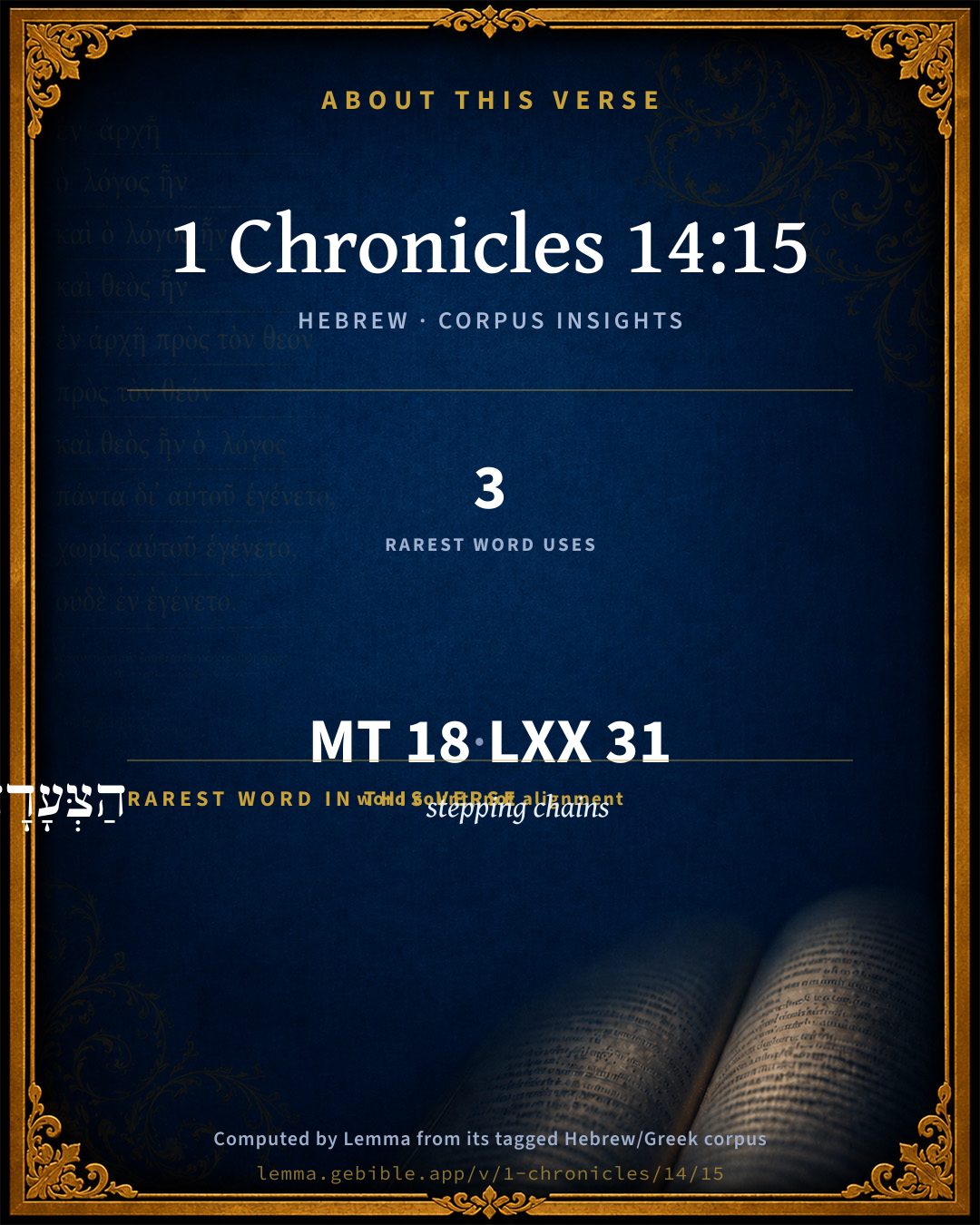
1 Chronicles 14:15

Hebrew (Westminster Leningrad Codex) 1 Chronicles 14:15 appears in the Hebrew Old Testament. The text above is from the Westminster Leningrad Codex. Each word links to its Strong’s number, a concise gloss, and parsing drawn from the Open Scriptures Hebrew Bible morphology. Click any word for its full Brown-Driver-Briggs (BDB) entry.
Download image
Cite this verse

1 Chronicles 14:15 (World English Bible). Public Domain. Lemma interlinear Bible study tool, https://lemma.gebible.app/v/1-chronicles/14/15.

Show BibTeX & RIS
BibTeX
RIS
English Translation
It shall be, when you hear the sound of marching in the tops of the mulberry trees, that then you shall go out to battle; for God is gone out before you to strike the host of the Philistines.
World English Bible · Public Domain
Download a study sheet

One document with this verse’s original text, its word-by-word gloss line, the meaning frame, cross-references with their text, attributed commentary, and full source and license credits — printable, and it pastes into notes with its structure intact.

This verse Autodidact and up

Study sheet (.html) Plain text (.txt)

A passage Seminary Student

Up to 50 verses in one chapter. A passage sheet keeps up to 6 commentary sources and 12 cross-references per verse, in the order this page ranks them, and says so on the sheet whenever that leaves anything out. Ask for a single verse and you get the Autodidact verse sheet above.

Everything on this page stays free to read, with no account — the sheet is a download of what is already on screen, not access to it.

Want to remove ads? Support Godless Engineer
Compare translations 3

The same verse in 3 English versions, stacked beneath the original-language interlinear above. Click any original word for its lexicon entry.

Each is an independent rendering of the whole verse — the interlinear is not word-aligned to these translations.

Highlighted words mark where these versions differ — a whole-verse word diff, not a word-by-word alignment.

  • World English Bible Public Domain
    It shall be, when you hear the sound of marching in the tops of the mulberry trees, that then you shall go out to battle; for God is gone out before you to strike the host of the Philistines.
  • King James Version Public Domain
    And it shall be, when thou shalt hear a sound of going in the tops of the mulberry trees, that then thou shalt go out to battle: for God is gone forth before thee to smite the host of the Philistines.
  • unfoldingWord Literal Text CC BY-SA 4.0
    And it will be, when you hear the sound of marching in the tops of the balsam trees, then you shall go out in battle, for God has gone out to your face to strike the camp of the Philistines.”

unfoldingWord Literal Text — © unfoldingWord, licensed CC BY-SA 4.0. Word-aligned USFM3 via Door43 (git.door43.org/unfoldingWord/en_ult).

Versions to compare (up to 4)

3 of 4 selected

Show all 18 translations

Every available English version of this verse, each an independent rendering of the whole verse.

  • World English Bible Public Domain
    It shall be, when you hear the sound of marching in the tops of the mulberry trees, that then you shall go out to battle; for God is gone out before you to strike the host of the Philistines.
  • Berean Standard Bible Public Domain
    As soon as you hear the sound of marching in the tops of the balsam trees, move out to battle, because this will mean that God has marched out before you to strike the camp of the Philistines.”
  • Majority Standard Bible Public Domain
    As soon as you hear the sound of marching in the tops of the balsam trees, move out to battle, because this will mean that God has gone out before you to strike the camp of the Philistines.”
  • King James Version Public Domain
    And it shall be, when thou shalt hear a sound of going in the tops of the mulberry trees, that then thou shalt go out to battle: for God is gone forth before thee to smite the host of the Philistines.
  • American Standard Version (1901) Public Domain
    And it shall be, when thou hearest the sound of marching in the tops of the mulberry-trees, that then thou shalt go out to battle; for God is gone out before thee to smite the host of the Philistines.
  • Revised Version (1885) Public Domain
    And it shall be, when thou hearest the sound of marching in the tops of the mulberry trees, that then thou shalt go out to battle: for God is gone out before thee to smite the host of the Philistines;
  • Geneva Bible (1599) Public Domain
    And when thou hearest the noyse of one going in the toppes of the mulberie trees, then goe out to battel: for God is gone foorth before thee, to smite the hoste of the Philistims.
  • Douay-Rheims (1899) Public Domain
    And when thou shalt hear the sound of one going in the tops of the pear trees, then shalt thou go out to battle. For God is gone out before thee to strike the army of the Philistines.
  • Young's Literal Translation Public Domain
    and it cometh to pass, when thou hearest the sound of the stepping at the heads of the mulberries, then thou goest out into battle, for God hath gone out before thee to smite the camp of the Philistines.'
  • Literal Standard Version CC BY-SA 4.0
    and it comes to pass, when you hear the sound of the stepping at the heads of the mulberries, then you go out into battle, for God has gone out before you to strike the camp of the Philistines.”
  • Unlocked Literal Bible CC BY-SA 4.0
    When you hear the sound of marching in the wind blowing through the balsam treetops, then attack with force. Do this because God will have gone out before you to attack the army of the Philistines.”
  • unfoldingWord Literal Text CC BY-SA 4.0
    And it will be, when you hear the sound of marching in the tops of the balsam trees, then you shall go out in battle, for God has gone out to your face to strike the camp of the Philistines.”
  • Darby Bible Public Domain
    And it shall be, when thou hearest the sound of marching in the tops of the mulberry-trees, that then thou shalt go out to battle; for God will have gone forth before thee to smite the army of the Philistines.
  • World Messianic Bible Public Domain
    When you hear the sound of marching in the tops of the mulberry trees, then go out to battle; for God has gone out before you to strike the army of the Philistines.”
  • Webster's Bible Public Domain
    And it shall be, when thou shalt hear a sound of going in the tops of the mulberry trees, then thou shalt go out to battle: for God hath gone forth before thee to smite the host of the Philistines.
  • Free Bible Version CC BY-SA 4.0
    As soon as you hear the sound of marching in the tops of the balsam trees, go and attack for the Lord has gone before you to strike down the Philistine army.”
  • Bible in Basic English Public Domain
    And at the sound of footsteps in the tops of the trees, go out to the fight, for God has gone out before you to overcome the army of the Philistines.
  • JPS Tanakh (1917) Public Domain
    And it shall be, when thou hearest the sound of marching in the tops of the mulberry-trees, that then thou shalt go out to battle; for God is gone out before thee to smite the host of the Philistines.'

Literal Standard Version (2020), Covenant Press — licensed CC BY-SA 4.0. Text via the HelloAO Bible API (eBible.org). Unlocked Literal Bible (unfoldingWord) — licensed CC BY-SA 4.0. Text via the HelloAO Bible API (eBible.org). unfoldingWord Literal Text — © unfoldingWord, licensed CC BY-SA 4.0. Word-aligned USFM3 via Door43 (git.door43.org/unfoldingWord/en_ult). Free Bible Version, Dr. Jonathan Gallagher — licensed CC BY-SA 4.0. Text via the HelloAO Bible API (eBible.org).

Word by word

More ways to search: Search by grammar → Find every occurrence → Compare this word →

Practice this passage: Drill this verse → Learn its vocabulary →

הַצְּעָדָה֙
tsᵉʻâdâh
H6807
“the · stepping chains”
Particle, Definite Article + Noun, Common, Feminine, Singular, Absolute
Part of Speech
Particle + Noun
Type
Common
Gender
Feminine
Number
Singular
State
Absolute
Full BDB Definition

Origin: from H6806

TWOT: 1943b , 1943c

marching - armlet, anklet, stepping chains
  1. וִ֠יהִי hâyâh H1961 “and · to be” Conjunction + Verb, Qal, Jussive, 3rd Person, Masculine, Singular
  2. כְּֽשָׁמְעֲךָ֞ shâmaʻ H8085 “like/as · to hear · you” Preposition + Verb, Qal, Infinitive Construct + Suffix, Personal, 2nd Person, Masculine, Singular
  3. אֶת ʼêth H853 “-” Particle, Direct Object
  4. ק֤וֹל qôwl H6963 “voice of” Noun, Common, Masculine, Singular, Construct
  5. בְּרָאשֵׁ֣י rôʼsh H7218 “in/at · heads of” Preposition + Noun, Common, Masculine, Plural, Construct
  6. הַבְּכָאִ֔ים bâkâʼ H1057 “the · balsam trees” Particle, Definite Article + Noun, Common, Masculine, Plural, Absolute
  7. אָ֖ז ʼâz H227 “then” Adverb
  8. תֵּצֵ֣א yâtsâʼ H3318 “to go out” Verb, Qal, Imperfect, 2nd Person, Masculine, Singular
  9. בַמִּלְחָמָ֑ה milchâmâh H4421 “in/at the · battle” Preposition, Determined + Noun, Common, Feminine, Singular, Absolute
  10. כִּֽי kîy H3588 “that” Conjunction
  11. יָצָ֤א yâtsâʼ H3318 “to go out” Verb, Qal, Perfect, 3rd Person, Masculine, Singular
  12. הָֽאֱלֹהִים֙ ʼĕlôhîym H430 “the · God(s)” Particle, Definite Article + Noun, Common, Masculine, Plural, Absolute
  13. לְפָנֶ֔יךָ pânîym H6440 “to/for · face(s) · your” Preposition + Noun, Common, Both, Plural, Construct + Suffix, Personal, 2nd Person, Masculine, Singular
  14. לְהַכּ֖וֹת nâkâh H5221 “to strike” Preposition + Verb, Hiphil, Infinitive Construct
  15. אֶת ʼêth H853 “-” Particle, Direct Object
  16. מַחֲנֵ֥ה machăneh H4264 “camp of” Noun, Common, Both, Singular, Construct
  17. פְלִשְׁתִּֽים Pᵉlishtîy H6430 “Philistines” Noun, Gentilic, Masculine, Plural, Absolute

About this verse

These counts appear in no published source. They are computed here, from the morphology-tagged text and Lemma’s own curated glosses. What Lemma adds →

18
words
16
distinct lemmas
Historical
section

Notable vocabulary

The rarest word here is הַצְּעָדָה֙ stepping chains H6807 — appearing just 3 times in the whole Hebrew Bible.

Shared distinctive vocabulary

הַצְּעָדָה֙ stepping chains H6807 occurs in 3 verses of the Hebrew Bible. Also found in:

Grammatical profile

  • 5 verbs
  • 9 nouns
  • 1 conjunction
  • 1 adverb
  • 2 particles

Verb forms

  • וִ֠יהִי Qal · Jussive
  • כְּֽשָׁמְעֲךָ֞ Qal · Infinitive Construct
  • תֵּצֵ֣א Qal · Imperfect
  • יָצָ֤א Qal · Perfect
  • לְהַכּ֖וֹת Hiphil · Infinitive Construct

Repetition

A word recurs within this verse — often emphatic in Hebrew:

  • תֵּצֵ֣א to go out H3318 ×2

Hebrew & Septuagint length

In English translation the verse runs 39 words from the Hebrew and 41 from the Septuagint (LXX English) — closely comparable.

A rough comparison of the two English renderings, which tokenize alike — not a word-level alignment.

Word counts can differ between the Hebrew and the Greek without any difference in meaning — e.g. the Hebrew direct-object marker אֵת has no separate Greek word, and Greek often adds the article ὁ.

In the original languages it is 18 Hebrew tokens and 31 Greek tokens — but the two are counted differently (Hebrew bundles its prefixes and suffixes into one token; the Greek is in lemma form), so that isn’t a like-for-like length.

Cross-references

12

Topical passages linked to 1 Chronicles 14:15 in the Treasury of Scripture Knowledge — connected by theme and wording, ordered by reader-vote popularity; previews shown in the World English Bible.

  • Isaiah 13:4 The noise of a multitude in the mountains, as of a great people! the noise of a tumult of the kingdoms of the nations gathered together! Yahweh of Hosts is mustering the host for the battle.
  • Acts 2:2 Suddenly there came from the sky a sound like the rushing of a mighty wind, and it filled all the house where they were sitting.
  • 2 Kings 19:7 Behold, I will put a spirit in him, and he shall hear news, and shall return to his own land; and I will cause him to fall by the sword in his own land.
  • Isaiah 45:1–2 Thus says Yahweh to his anointed, to Cyrus, whose right hand I have held, to subdue nations before him, and I will loose the loins of kings; to open the doors before him, and the gates shall not be shut:
  • Micah 2:12–13 I will surely assemble, Jacob, all of you; I will surely gather the remnant of Israel; I will put them together as the sheep of Bozrah, As a flock in the midst of their pasture; They will swarm with people.
  • Philippians 2:12–13 So then, my beloved, even as you have always obeyed, not only in my presence, but now much more in my absence, work out your own salvation with fear and trembling.
  • Leviticus 26:36 "'As for those of you who are left, I will send a faintness into their hearts in the lands of their enemies: and the sound of a driven leaf will put them to flight; and they shall flee, as one flees from the sword; and they will fall when no one pursues.
  • Judges 4:14 Deborah said to Barak, Up; for this is the day in which Yahweh has delivered Sisera into your hand; hasn't Yahweh gone out before you? So Barak went down from Mount Tabor, and ten thousand men after him.
  • Judges 7:9 It happened the same night, that Yahweh said to him, Arise, get you down into the camp; for I have delivered it into your hand.
  • Judges 7:15 It was so, when Gideon heard the telling of the dream, and the interpretation of it, that he worshiped; and he returned into the camp of Israel, and said, Arise; for Yahweh has delivered into your hand the host of Midian.
  • 1 Samuel 14:9–22 If they say thus to us, Wait until we come to you; then we will stand still in our place, and will not go up to them.
  • 2 Kings 7:6 For the Lord had made the host of the Syrians to hear a noise of chariots, and a noise of horses, even the noise of a great host: and they said one to another, Behold, the king of Israel has hired against us the kings of the Hittites, and the kings of the Egyptians, to come on us.

Cross-references courtesy of OpenBible.info (CC BY 4.0).

Hebrew and Greek witnesses Masoretic Hebrew ↔ Greek Septuagint

The same verse in the two great witnesses to the Old Testament, shown verse-for-verse.

These are two independent witnesses, not word-aligned to each other, and the Septuagint is shown in lemma (dictionary) form.

Hebrew 1 Chronicles 14:15 Masoretic · Westminster Leningrad Codex

וִ֠יהִי כְּֽשָׁמְעֲךָ֞ אֶת ק֤וֹל הַצְּעָדָה֙ בְּרָאשֵׁ֣י הַבְּכָאִ֔ים אָ֖ז תֵּצֵ֣א בַמִּלְחָמָ֑ה כִּֽי יָצָ֤א הָֽאֱלֹהִים֙ לְפָנֶ֔יךָ לְהַכּ֖וֹת אֶת מַחֲנֵ֥ה פְלִשְׁתִּֽים

It shall be, when you hear the sound of marching in the tops of the mulberry trees, that then you shall go out to battle; for God is gone out before you to strike the host of the Philistines.

World English Bible · Public Domain

Greek LXX 1 Chronicles 14:15 Septuagint · lemma form

καί εἰμί ἐν ὁ ἀκούω σύ ὁ φωνή ὁ συσσεισμός ὁ ἄκρος ὁ ἄπιος τότε ἐκἔρχομαι εἰς ὁ πόλεμος ὅτι ἐκἔρχομαι ὁ θεός ἔμπροσθεν σύ ὁ πατάσσω ὁ παρεμβολή ὁ ἀλλόφυλος

And it shall be, when you shall hear the sound of their tumult in the tops of the pear trees, then you shall go into the battle: for God has gone out before you to strike the army of the Philistines.

LXX2012 (modern English Septuagint) · Public Domain

On this verse, The Cambridge Bible for Schools and Colleges discusses the Septuagint’s reading. Read the note in Commentary ↓

Hebrew: Westminster Leningrad Codex (CC BY 4.0). Greek: Septuagint (public domain); English from LXX2012 (modern English Septuagint) (Public Domain). How the Septuagint differs from the Hebrew →

Commentary

Notes on 1 Chronicles 14:15 from classic Christian and Jewish commentators (each source and its license shown beneath its notes). The classic Christian expositions comment on the surrounding passage and are grouped to its opening verse, so a note may address several verses; the Jewish commentaries on the Tanakh (Rashi and others) are per-verse, so they appear only where the commentator wrote on this verse.

Lemma curates 59 commentaries, every one of them public domain or Creative Commons licensed, each selected and text-cleaned for this edition rather than reprinted as found. About our sources →

Trapp's Complete Commentary

John Trapp

1Ch 14:15 And it shall be, when thou shalt hear a sound of going in the tops of the mulberry trees, [that] then thou shalt go out to battle: for God is gone forth before thee to smite the host of the Philistines.

Ver. 15. For God.] That is, The angel of God, saith the Chaldee.

John Trapp, A Commentary or Exposition upon All the Books of the Old and New Testament (1647–1656) — public domain. Text from a community e-Sword module.

Jamieson, Fausset & Brown

Robert Jamieson, A. R. Fausset & David Brown

for God is gone forth before thee--"a sound of going in the tops of the mulberry trees," that is, the rustling of the leaves by a strong breeze suddenly rising, was the sign by which David was divinely apprised of the precise moment for the attack. The impetuosity of his onset was like the gush of a pent-up torrent, which sweeps away all in its course; and in allusion to this incident the place got its name.

Jamieson, Fausset & Brown — Commentary Critical and Explanatory on the Whole Bible (1871) — public domain (CC PDM 1.0). Text via the HelloAO Bible API.

Adam Clarke's Commentary

Verse 15. A sound of going] "When thou shalt hear the sound of the angels coming to thy assistance, then go out to battle; for an angel is sent from the presence of God, that he may render thy way prosperous." - T.

Adam Clarke's Commentary on the Bible (1810–1826) — public domain. Text from a community e-Sword/MySword module.

Ellicott's Commentary for English Readers

(15) A sound of going.—Rather, the sound of marching. The sign may have been a natural one. David was to listen for the wind rustling in the tops of the bacas—a sound like that of walking on dead leaves—and then to make his attack. (But comp 2Ki_7:6.) But we are reminded, in connection with this fragment of David’s history, that all ancient people attached a prophetic import to the motion and rustling of leaves. Omens from trees are mentioned in the table of contents of the great Assyrian work on terrestrial omens, compiled by order of Sargon of Agadê or Accad (about 2200 B.C.). Comp. also the speaking oaks of Dodona, the laurel of Delos (Virg. Æn. iii. 91), and that of Delphi (Hymn to Apollo, 393). The “oak of the diviners” (Jdg_9:37), and perhaps Deborah’s palm-tree, and even the burning bush, must be referred to the same order of ideas. The Arabs believe the thorny bushes of the gharqad capable of uttering prophetic words; and with them the samûra, or Egyptian thorn, is sacred. These analogies, however, do not militate against the reality or the miraculous character of the Biblical occurrence. The Divine communications with man always assume the form best adapted for striking the mind amidst reigning ideas. Biblical visions, e.g., always have the colour of the seer’s environment: those of Joseph are Egyptian; those of Ezekiel in the Exile, Assyrian. (See, further, Lenormant, La Divination en Chaldée).

Then thou shalt go out to battle.—A paraphrase of the term used in Samuel.

For God is gone forth.—“Then” (Samuel), viz., “when thou hast heard the signal.”

A Bible Commentary for English Readers, edited by Charles John Ellicott (1878–1897) — public domain. Text from a community e-Sword module.

The Cambridge Bible for Schools and Colleges

gen. ed. J. J. S. Perowne

15. a sound of going] R.V. the sound of marching. Targ. the sound of angels coming to thy help. LXX. the sound of shaking.

thou shalt go out to battle] Samuel has a more vivid phrase, thou shalt bestir thyself.

smote the host of the Philistines from Gibeon even to Gazer] This victory was decisive; the main army of the Philistines was routed.

Gazer] R.V. Gezer. Cp. 1Ch_6:67, note.

The Cambridge Bible for Schools and Colleges (gen. ed. J. J. S. Perowne; Cambridge University Press, 1878–1918) — public domain. Text from a community e-Sword module.

Haydock's Catholic Bible Commentary

Tops, or on the height. God sent an invisible army to David’s assistance.

George Leo Haydock (1774–1849), Haydock's Catholic Family Bible and Commentary, 1859 edition — public domain. Excludes Psalms (Douay-Rheims chapter numbering differs from Protestant) and Deuterocanonical books (Catholic canon only).

The Pulpit Commentary

A sound of going. This is net a mere generic or longer form of expression to signify a sound itself. There is significance in the word "going." The sense of the Hebrew word would be thrown out more emphatically by such a rendering as, the sound of steps (literally, stepping). When the motion of the agitated leaves simulated the sound of steps, the stepping of men, then David and his army were to step forth to battle. Though the root of the "stepping" spoken of as heard in the trees is not identical with that of the "going" repeated twice in the remainder of the verseThen thou shalt go out for God is gone forth yet it does alliterate to some extent with it, and rather creates the impression that it was intended to do so. However, the parallel place does not sustain this impression, inasmuch as a different word, "Thou shalt bestir thyself," is there employed, in place of the first occurrence of our supposed alliteration, in the clause, "Thou shalt go out." There is something stirring to the imagination, and probably it was felt so by David and his men, in the signal unseen yet not unheard, and in a sense not of earth, but midway between earth and heaven. The very various voices of the various trees, according to the character of their foliage, may well set poetry going, and startle or fascinate imagination, as the case may be. The music of one tree or grove is as different from that of another as can be listen to the difference between the melancholy plaint so unceasing of some plantation of firs, and the multitudinous, silvery, rippling of but one white poplar of good size. Presumably the sound in the present ease more resembled that of the steady tramp of them that march.

A sound of going.

In his frequent contests with the Philistines. David was assured of the constant support and guidance of the God of hosts. The king sought the honour of his God, and God prospered the exploits of his servant. On the occasion referred to in this passage, Divine wisdom is said to have directed the strategy of the army of Israel, to have indicated the moment of assault, and to have assured the warriors of certain victory. The signal was, strange to say, "a sound of going in the tops of the mulberry trees." This incident has usually been regarded as indicative of the tokens of the Divine presence accorded to such as are engaged in the spiritual service of their God. We are reminded of

I THE POWERLESSNESS AND INSUFFICIENCY OF MEN FOR THE SPIRITUAL CONFLICT. Christians have a warfare to wage against foes many and mighty, and for this warfare their native resources are inadequate, scanty, and feeble. If we know ourselves we must needs look above, to the Strong for strength, to the Wise for wisdom.

II THE GRACIOUS TOKENS OF A DIVINE PRESENCE AND COOPERATION. The "sound of going" told David that God was near was on his side. God"s people are never left without indications of the Divine presence, and these assure them that they are not alone, that the "Lord of hosts is with them." Sometimes by events in his providence, sometimes by lessons from his Word, sometimes by the suggestions of his Spirit, he gives his people to understand, in the hour of their need and helplessness, that he is on their side.

III THE DIVINE SIGNAL FOR HIS PEOPLE"S ACTION. As we have not only to know but also to do God"s will, we need not only revelation of truth but summons to practical service. God gives his soldiers the watchword, the signal to advance. Then is the moment to "go forward," to repel and to defeat the foe. "If God be for us, who can be against us?" It is well that we should not run before the word is given; yet it will not do to tarry when he directs us to advance.

IV THE OMEN AND PRESAGE OF TRUE VICTORY. When the sound of going was beard in the tree-tops, it was as the movement of angels" wings; the mighty rushing was as the tramp of the host of God, the earnest of victory to David"s arms. If the Lord our God goes forth with us to the spiritual war, we shall surely overcome. Ours shall be the victory of faith, even that which overcometh the world. T.

Signs and sounds of the Divine presence.

The circumstances connected with the second enterprise of the Philistines are more fully detailed; and it seems the design of the chronicler to remind us that, in answer to prayer and dependence, God may not only give a general approval, but also minute and careful directions, and such as may involve waiting on him and watching for the right situation and the right moment. In some manifest and impressive way the Divine presence would be declared, and the Divine will made known. Often God finds it necessary to teach his people that he must be waited for as well as waited on. A sound as of marching or stepping would presently be heard; it would be a rustling of the leaves of the bach trees, as if a wind were passing through them; and this would be the sign that the heavenly host had come to assure the victory; and immediately upon hearing this sign, David was to act with vigour; he was to "bestir himself," or be sharp. "The sound of a going in the tops of the trees" had a double significance. It was the sound of the viewless march of "the Lord going out before him to smite the host of the Philistines." It was the sound of God going forth to smite their gods, even as he smote the gods of Egypt. (comp Psa_29:4)

I THE DIVINE PRESENCE RESPONDS TO MAN"S DEPENDENCE AND PRAYER. To his dependence, which is the appropriate state of mind and feeling. To his prayer, which is the appropriate mode of expressing the right feeling. That which shuts a man"s door against God is selfconfidence. If a man feels that he can "go the warfare at his own charges," he does not need God, and God can but leave him alone to learn the lesson of his own self-impotence. The assurance on which the dependent man may rest is this: "To that man will I look, and with him will I dwell, who is humble, and. contrite of heart, and trembleth at my word." If we but win and maintain this right attitude, then we may have perfect confidence that God is with us, although the confidence may be more a matter of faith than of feeling. God was really with David, though the sensible sign of his presence did not come until, when the wind was still, there was that suggestive "sound of a going in the tops of the mulberry trees.

II THE DIVINE PRESENCE MAY BE RECOGNIZED ONLY IN RESULTS. It sometimes seems right to God to make us go quite through our working-time only holding the faith of his presence and hell), and not in any way aided by sensible signs. But such faith is a practical inspiration and strength. It is "the substance of things hoped for, the evidence of things not seen." Sometimes the issues and results plainly show that God was with us; and the final issues of life will have this for the conviction they seal: "It was a good way wherein the Lord our God led us.

III THE DIVINE PRESENCE MAY BE RECOGNIZED IN CONSCIOUS STRENGTH FOR DUTY. This truth is effectively illustrated in St. Paul, (2Co_12:7-9) He was taught to see God with him just in this, that "strength was made perfect in his weakness." In view of the practical character of our life, it is a more important thing to have strength for doing than, without strength, mere comfort of feeling. And yet men yearn most for sensible signs, and undervalue the inward strengthenings.

IV THE DIVINE PRESENCE MAY BE INDICATED BY GRACIOUS SIGNS. As in the case of our Lord at his baptism and at his transfiguration. Also in his great agony in Gethsemane, there appeared an "angel from heaven, strengthening him." On several occasions of St. Paul"s life he was favoured with special visions. With the pious servant of God we may say, "The best of all is that God is with us;" but we may also ask for the comforting sense of that presence through the aid of gracious signs. And God will grant these, both for our own sakes and for the sake of others who may be blessed through us. While watchful against extravagance and superstition, we ought not to deny the truth of visions and signs and Divine communications granted nowadays to God"s people. There might well be a fuller expectancy of direct dealings with dependent and prayerful men, manifest Divine leading by inward impulse, and providential direction, and signs plain enough to sensitive souls. R.T.

The Pulpit Commentary (1880–1919), ed. H.D.M. Spence-Jones & Joseph S. Exell — public domain. Text from a community e-Sword module.

unfoldingWord translationNotes

Door43 World Missions Community

Connecting Statement:

God continues his answer to David's question.

When you hear the sound of marching in the wind blowing through the balsam treetops

This speaks of the sound of the leaves rustling as wind blows through them as if it were the sound of marching. AT: "When the wind blowing through the tops of the balsam trees sounds like men marching" (See: Metaphor)

Gezer

This is the name of a town. (See: How to Translate Names)

David's fame went out into all lands

People in every land hearing of David's reputation is spoken of as if David's fame traveled to those lands. AT: "People far away heard about David's fame" (See: Personification)

translationWords

command

Gibeon

Yahweh

nation

fear

unfoldingWord translationNotes — © Distant Shores Media and the Door43 World Missions Community, licensed CC BY-SA 4.0. Source: git.door43.org/Door43/en_tn.

Lesson kit

Teaching starters — assembled from the data on this page, not authored interpretation. Every prompt links to the verse data it draws on. Edit before teaching.

1 Chronicles, in the Historical, opens this verse with 18 words (16 distinct Hebrew lemmas). Its most distinctive word is tsᵉʻâdâh (“stepping chains”). A historical commentator’s framing appears above. Read the whole chapter for the surrounding context.

Discussion questions

  1. What does “stepping chains” (tsᵉʻâdâh) contribute to the verse as a whole?
  2. 2 Samuel 5:24 shares the word «stepping chains» with this verse. How do the two illuminate each other?
  3. “to go out” occurs 2× in this one verse. What is the effect of the repetition?
  4. These translations render this verse differently; the difference is in the English rendering, not the original. What questions does that raise?
  5. The verb «וִ֠יהִי» is Qal Jussive. How does its form color the action?
  6. Reading how Trapp's Complete Commentary and Jamieson, Fausset & Brown read this verse, where do the two commentators agree and where do they part?

Things to notice

Reading settings

Reading text

Shown beneath each verse's original-language words.

Old Testament
Old Testament edition

Read the OT as the Masoretic Hebrew (MT) or the Greek Septuagint (LXX).

English shown for the Greek Septuagint (in the Hebrew ↔ Greek comparison).

Comparing translations? Open the Compare panel on any verse page to stack up to four side by side.