
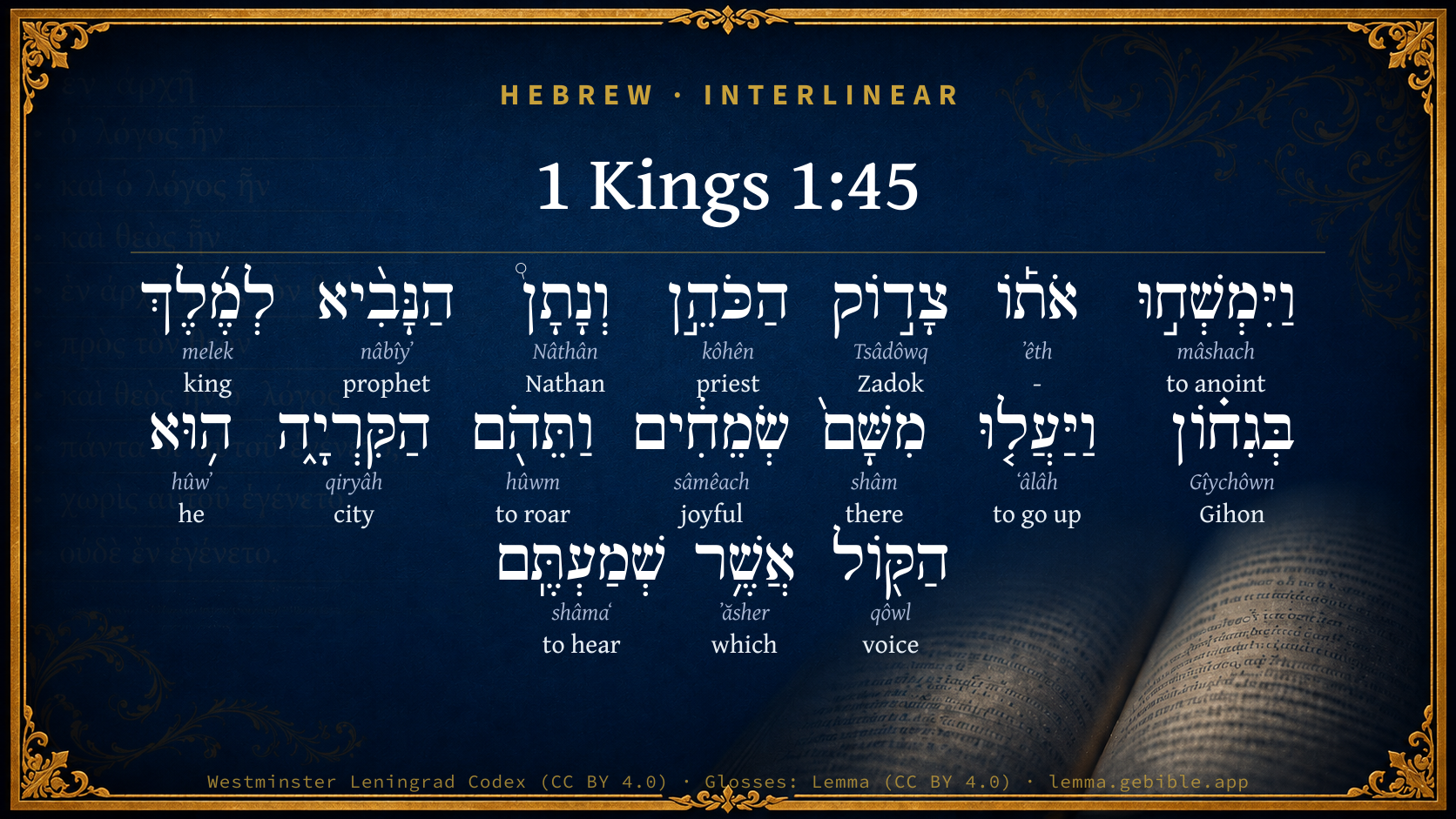
1 Kings 1:45

Hebrew (Westminster Leningrad Codex) 1 Kings 1:45 appears in the Hebrew Old Testament. The text above is from the Westminster Leningrad Codex. Each word links to its Strong’s number, a concise gloss, and parsing drawn from the Open Scriptures Hebrew Bible morphology. Click any word for its full Brown-Driver-Briggs (BDB) entry.
Download image
Cite this verse

1 Kings 1:45 (World English Bible). Public Domain. Lemma interlinear Bible study tool, https://lemma.gebible.app/v/1-kings/1/45.

Show BibTeX & RIS
BibTeX
RIS
English Translation
and Zadok the priest and Nathan the prophet have anointed him king in Gihon; and they are come up from there rejoicing, so that the city rang again. This is the noise that you have heard.
World English Bible · Public Domain
Download a study sheet

One document with this verse’s original text, its word-by-word gloss line, the meaning frame, cross-references with their text, attributed commentary, and full source and license credits — printable, and it pastes into notes with its structure intact.

This verse Autodidact and up

Study sheet (.html) Plain text (.txt)

A passage Seminary Student

Up to 50 verses in one chapter. A passage sheet keeps up to 6 commentary sources and 12 cross-references per verse, in the order this page ranks them, and says so on the sheet whenever that leaves anything out. Ask for a single verse and you get the Autodidact verse sheet above.

Everything on this page stays free to read, with no account — the sheet is a download of what is already on screen, not access to it.

Want to remove ads? Support Godless Engineer
Compare translations 3

The same verse in 3 English versions, stacked beneath the original-language interlinear above. Click any original word for its lexicon entry.

Each is an independent rendering of the whole verse — the interlinear is not word-aligned to these translations.

Highlighted words mark where these versions differ — a whole-verse word diff, not a word-by-word alignment.

  • World English Bible Public Domain
    and Zadok the priest and Nathan the prophet have anointed him king in Gihon; and they are come up from there rejoicing, so that the city rang again. This is the noise that you have heard.
  • King James Version Public Domain
    And Zadok the priest and Nathan the prophet have anointed him king in Gihon: and they are come up from thence rejoicing, so that the city rang again. This is the noise that ye have heard.
  • unfoldingWord Literal Text CC BY-SA 4.0
    And Zadok the priest and Nathan the prophet anointed him as king at Gihon, and they have come up from there rejoicing, and the city is agitated. This the sound that you have heard.

unfoldingWord Literal Text — © unfoldingWord, licensed CC BY-SA 4.0. Word-aligned USFM3 via Door43 (git.door43.org/unfoldingWord/en_ult).

Versions to compare (up to 4)

3 of 4 selected

Show all 18 translations

Every available English version of this verse, each an independent rendering of the whole verse.

  • World English Bible Public Domain
    and Zadok the priest and Nathan the prophet have anointed him king in Gihon; and they are come up from there rejoicing, so that the city rang again. This is the noise that you have heard.
  • Berean Standard Bible Public Domain
    Zadok the priest and Nathan the prophet have anointed him king at Gihon, and they have gone up from there with rejoicing that rings out in the city. That is the noise you hear.
  • Majority Standard Bible Public Domain
    Zadok the priest and Nathan the prophet have anointed him king at Gihon, and they have gone up from there with rejoicing that rings out in the city. That is the noise you hear.
  • King James Version Public Domain
    And Zadok the priest and Nathan the prophet have anointed him king in Gihon: and they are come up from thence rejoicing, so that the city rang again. This is the noise that ye have heard.
  • American Standard Version (1901) Public Domain
    and Zadok the priest and Nathan the prophet have anointed him king in Gihon; and they are come up from thence rejoicing, so that the city rang again. This is the noise that ye have heard.
  • Revised Version (1885) Public Domain
    and Zadok the priest and Nathan the prophet have anointed him king in Gihon: and they are come up from thence rejoicing, so that the city rang again. This is the noise that ye have heard.
  • Geneva Bible (1599) Public Domain
    And Zadok the Priest, and Nathan ye Prophet haue anointed him King in Gihon: and they are gone vp from thence with ioy, and the citie is moued: this is the noise that ye haue heard.
  • Douay-Rheims (1899) Public Domain
    And Sadoc the priest, and Nathan the prophet have anointed him king in Gihon: and they are gone up from thence rejoicing, so that the city rang again: this is the noise that you have heard.
  • Young's Literal Translation Public Domain
    and they anoint him -- Zadok the priest and Nathan the prophet -- for king in Gihon, and are come up thence rejoicing, and the city is moved; it `is' the noise that ye have heard.
  • Literal Standard Version CC BY-SA 4.0
    and they anoint him—Zadok the priest and Nathan the prophet—for king in Gihon, and have come up there rejoicing, and the city is moved; it [is] the noise that you have heard.
  • Unlocked Literal Bible CC BY-SA 4.0
    Zadok the priest and Nathan the prophet have anointed him king at Gihon, and have come up from there rejoicing, so that the city is in an uproar. This is the noise that you have heard.
  • unfoldingWord Literal Text CC BY-SA 4.0
    And Zadok the priest and Nathan the prophet anointed him as king at Gihon, and they have come up from there rejoicing, and the city is agitated. This the sound that you have heard.
  • Darby Bible Public Domain
    and Zadok the priest and Nathan the prophet have anointed him king at Gihon; and they are come up from thence rejoicing, so that the city is in an uproar. This is the noise which ye have heard.
  • World Messianic Bible Public Domain
    Zadok the priest and Nathan the prophet have anointed him king in Gihon. They have come up from there rejoicing, so that the city rang again. This is the noise that you have heard.
  • Webster's Bible Public Domain
    And Zadok the priest and Nathan the prophet have anointed him king in Gihon: and they have come from thence rejoicing, so that the city resounded. This is the noise that ye have heard.
  • Free Bible Version CC BY-SA 4.0
    Zadok the priest and Nathan the prophet anointed him king at the Gihon Spring. Now they have returned, celebrating with shouts that echo round the city. That's the noise you're hearing.
  • Bible in Basic English Public Domain
    And Zadok the priest and Nathan the prophet put the holy oil on him and made him king in Gihon; and they came back from there with joy, and the town was all worked up. This is the noise which has come to your ears.
  • JPS Tanakh (1917) Public Domain
    And Zadok the priest and Nathan the prophet have anointed him king in Gihon; and they are come up from thence rejoicing, so that the city is in an uproar. This is the noise that ye have heard.

Literal Standard Version (2020), Covenant Press — licensed CC BY-SA 4.0. Text via the HelloAO Bible API (eBible.org). Unlocked Literal Bible (unfoldingWord) — licensed CC BY-SA 4.0. Text via the HelloAO Bible API (eBible.org). unfoldingWord Literal Text — © unfoldingWord, licensed CC BY-SA 4.0. Word-aligned USFM3 via Door43 (git.door43.org/unfoldingWord/en_ult). Free Bible Version, Dr. Jonathan Gallagher — licensed CC BY-SA 4.0. Text via the HelloAO Bible API (eBible.org).

Word by word

More ways to search: Search by grammar → Find every occurrence → Compare this word →

Practice this passage: Drill this verse → Learn its vocabulary →

וַתֵּהֹ֖ם
hûwm
H1949
“and · to roar”
Conjunction + Verb, Niphal, Sequential Imperfect, 3rd Person, Feminine, Singular
Part of Speech
Conjunction + Verb
Stem
Niphal
Form
Sequential Imperfect
Person
3rd Person
Gender
Feminine
Number
Singular
Full BDB Definition

Origin: a primitive root [compare H2000 ]

TWOT: 486

to distract, ring again, make a (great) noise, murmur, roar, discomfit, be moved - (Qal) to discomfit - (Niphal) to be in a stir - (Hiphil) - to murmur - to show disquietude
  1. וַיִּמְשְׁח֣וּ mâshach H4886 “and · to anoint” Conjunction + Verb, Qal, Sequential Imperfect, 3rd Person, Masculine, Plural
  2. אֹת֡וֹ ʼêth H853 “- · him” Particle, Direct Object + Suffix, Personal, 3rd Person, Masculine, Singular
  3. צָד֣וֹק Tsâdôwq H6659 “Zadok” Noun, Proper
  4. הַכֹּהֵ֣ן kôhên H3548 “the · priest” Particle, Definite Article + Noun, Common, Masculine, Singular, Absolute
  5. וְנָתָן֩ Nâthân H5416 “and · Nathan” Conjunction + Noun, Proper
  6. הַנָּבִ֨יא nâbîyʼ H5030 “the · prophet” Particle, Definite Article + Noun, Common, Masculine, Singular, Absolute
  7. לְמֶ֜לֶךְ melek H4428 “to/for · king” Preposition + Noun, Common, Masculine, Singular, Absolute
  8. בְּגִח֗וֹן Gîychôwn H1521 “in/at · Gihon” Preposition + Noun, Proper
  9. וַיַּעֲל֤וּ ʻâlâh H5927 “and · to go up” Conjunction + Verb, Qal, Sequential Imperfect, 3rd Person, Masculine, Plural
  10. מִשָּׁם֙ shâm H8033 “from · there” Preposition + Adverb
  11. שְׂמֵחִ֔ים sâmêach H8056 “joyful” Adjective, Adjective, Masculine, Plural, Absolute
  12. הַקִּרְיָ֑ה qiryâh H7151 “the · city” Particle, Definite Article + Noun, Common, Feminine, Singular, Absolute
  13. ה֥וּא hûwʼ H1931 “he” Pronoun, Personal, 3rd Person, Masculine, Singular
  14. הַקּ֖וֹל qôwl H6963 “the · voice” Particle, Definite Article + Noun, Common, Masculine, Singular, Absolute
  15. אֲשֶׁ֥ר ʼăsher H834 “which” Particle, Relative
  16. שְׁמַעְתֶּֽם shâmaʻ H8085 “to hear” Verb, Qal, Perfect, 2nd Person, Masculine, Plural

About this verse

These counts appear in no published source. They are computed here, from the morphology-tagged text and Lemma’s own curated glosses. What Lemma adds →

17
words
17
distinct lemmas
Historical
section

Notable vocabulary

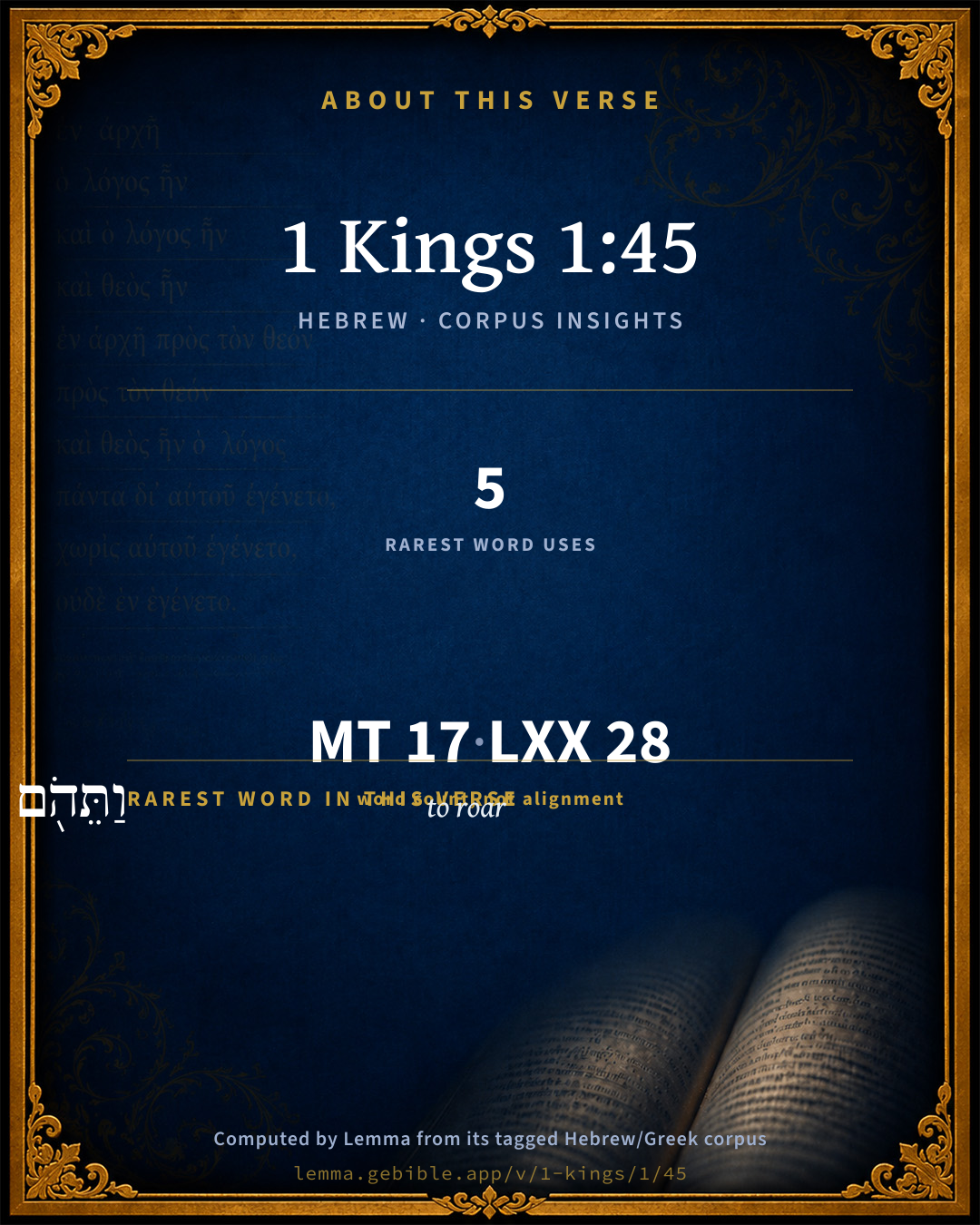
The rarest word here is וַתֵּהֹ֖ם to roar H1949 — appearing just 5 times in the whole Hebrew Bible.

Shared distinctive vocabulary

וַתֵּהֹ֖ם to roar H1949 occurs in 5 verses of the Hebrew Bible. Also found in:

Grammatical profile

  • 4 verbs
  • 8 nouns
  • 1 adjective
  • 1 pronoun
  • 1 adverb
  • 2 particles

Verb forms

  • וַיִּמְשְׁח֣וּ Qal · Sequential Imperfect
  • וַיַּעֲל֤וּ Qal · Sequential Imperfect
  • וַתֵּהֹ֖ם Niphal · Sequential Imperfect
  • שְׁמַעְתֶּֽם Qal · Perfect

Hebrew & Septuagint length

In English translation the verse runs 36 words from the Hebrew and 31 from the Septuagint (LXX English) — closely comparable.

A rough comparison of the two English renderings, which tokenize alike — not a word-level alignment.

Word counts can differ between the Hebrew and the Greek without any difference in meaning — e.g. the Hebrew direct-object marker אֵת has no separate Greek word, and Greek often adds the article ὁ.

In the original languages it is 17 Hebrew tokens and 28 Greek tokens — but the two are counted differently (Hebrew bundles its prefixes and suffixes into one token; the Greek is in lemma form), so that isn’t a like-for-like length.

Cross-references

6

Topical passages linked to 1 Kings 1:45 in the Treasury of Scripture Knowledge — connected by theme and wording, ordered by reader-vote popularity; previews shown in the World English Bible.

  • 1 Kings 1:40 All the people came up after him, and the people piped with pipes, and rejoiced with great joy, so that the earth shook with the sound of them.
  • 1 Samuel 4:5 When the ark of the covenant of Yahweh came into the camp, all Israel shouted with a great shout, so that the earth rang again.
  • 1 Samuel 28:14 He said to her, What form is he of? She said, An old man comes up; and he is covered with a robe. Saul perceived that it was Samuel, and he bowed with his face to the ground, and did obeisance.
  • 1 Kings 14:6 It was so, when Ahijah heard the sound of her feet, as she came in at the door, that he said, Come in, you wife of Jeroboam; why feign you yourself to be another? for I am sent to you with heavy news.
  • Ezra 3:13 so that the people could not discern the noise of the shout of joy from the noise of the weeping of the people; for the people shouted with a loud shout, and the noise was heard afar off.
  • Daniel 5:26–28 This is the interpretation of the thing: MENE; God has numbered your kingdom, and brought it to an end;

Cross-references courtesy of OpenBible.info (CC BY 4.0).

Hebrew and Greek witnesses Masoretic Hebrew ↔ Greek Septuagint

The same verse in the two great witnesses to the Old Testament, shown verse-for-verse.

These are two independent witnesses, not word-aligned to each other, and the Septuagint is shown in lemma (dictionary) form.

Hebrew 1 Kings 1:45 Masoretic · Westminster Leningrad Codex

וַיִּמְשְׁח֣וּ אֹת֡וֹ צָד֣וֹק הַכֹּהֵ֣ן וְנָתָן֩ הַנָּבִ֨יא לְמֶ֜לֶךְ בְּגִח֗וֹן וַיַּעֲל֤וּ מִשָּׁם֙ שְׂמֵחִ֔ים וַתֵּהֹ֖ם הַקִּרְיָ֑ה ה֥וּא הַקּ֖וֹל אֲשֶׁ֥ר שְׁמַעְתֶּֽם

and Zadok the priest and Nathan the prophet have anointed him king in Gihon; and they are come up from there rejoicing, so that the city rang again. This is the noise that you have heard.

World English Bible · Public Domain

Greek LXX 1 Kings 1:45 Septuagint · lemma form

καί χρίω αὐτός σαδωκ ὁ ἱερεύς καί ναθαν ὁ προφήτης εἰς βασιλεύς ἐν ὁ γιων καί ἀναβαίνω ἐκεῖθεν εὐφραίνω καί ἤχέω ὁ πόλις οὗτος ὁ φωνή ὅς ἀκούω

and Sadoc the priest and Nathan the prophet have anointed him in Gion, and have gone up thence rejoicing, and the city resounded: this is the sound which you⌃ have heard.

LXX2012 (modern English Septuagint) · Public Domain

Hebrew: Westminster Leningrad Codex (CC BY 4.0). Greek: Septuagint (public domain); English from LXX2012 (modern English Septuagint) (Public Domain). How the Septuagint differs from the Hebrew →

Targum (Aramaic paraphrase)

1

The Targum is the ancient Jewish Aramaic paraphrase of the Hebrew Scriptures — an interpretive translation, not the Hebrew text itself. Onkelos (literal) and Pseudo-Jonathan (expansive) render the Torah, and Jonathan the Prophets. Coverage is partial: where no permissively-licensed English translation exists for a verse, only the Aramaic is shown. This is verse-level text, not a word-by-word alignment to the Hebrew.

  1. Targum Jonathan Prophets (Joshua–Malachi)
    וּמְשָׁחוּ יָתֵיהּ צָדוֹק כַּהֲנָא וְנָתָן נְבִיָא לְמֶהֱוֵי מַלְכָּא בְּשִׁילוֹחָא וּסְלִיקוּ מִתַּמָן כַּד חָדָן וְאִשְׁתַּגִישַׁת קַרְתָּא הוּא קָלָא דִשְׁמַעְתּוּן:

    (no public-domain English translation for this verse)

    Targum Jonathan — Aramaic: “Mikraot Gedolot” (public domain). English: “Sefaria Community Translation” (CC0 1.0 (public-domain dedication)); “London "Chaldee Paraphrase," 1871” (public domain). Text via Sefaria.

Commentary

Notes on 1 Kings 1:45 from classic Christian and Jewish commentators (each source and its license shown beneath its notes). The classic Christian expositions comment on the surrounding passage and are grouped to its opening verse, so a note may address several verses; the Jewish commentaries on the Tanakh (Rashi and others) are per-verse, so they appear only where the commentator wrote on this verse.

Lemma curates 59 commentaries, every one of them public domain or Creative Commons licensed, each selected and text-cleaned for this edition rather than reprinted as found. About our sources →

Trapp's Complete Commentary

John Trapp

1Ki 1:45 And Zadok the priest and Nathan the prophet have anointed him king in Gihon: and they are come up from thence rejoicing, so that the city rang again. This [is] the noise that ye have heard.

Ver. 45. This is the noise that ye have heard.] A doleful knell to those who had feasted and boasted themselves in a jocund security and promise of success. "A dreadful sound is in their ears: in prosperity the destroyer cometh upon them. Trouble and anguish maketh them afraid, whilst they prevail against them as a king ready to the battle." {Job 15:21; Job 15:24}

John Trapp, A Commentary or Exposition upon All the Books of the Old and New Testament (1647–1656) — public domain. Text from a community e-Sword module.

John Gill's Exposition

And Zadok the priest, and Nathan the prophet, have anointed him king in Gihon,.... Or at Gihon; that is, Siloah, according to the Targum; here the act of anointing is ascribed to them both, as in Kg1 1:34; Zadok very probably applied the oil to him, and Nathan might be some way or other assisting in it; however he was here present, not only as approving of it, but declaring it as a prophet, that it was according to the will of God, as well as of the king:

and they are come up from thence rejoicing; with a multitude of people along with them:

so that the city rang again; with the blowing of trumpets, the sound of pipings, and the shouts of the people:

this is the noise which ye have heard; which had so alarmed them.

John Gill's Exposition of the Whole Bible (1746–1763) — public domain (CC PDM 1.0). Text via the HelloAO Bible API.

The Pulpit Commentary

And Zadok the priest and Nathan the prophet have anointed him king in Gihon: and they are come up from thence rejoicing, so that the city hyrqi same word as in ver. 41. Elsewhere almost exclusively found in poetry rang again rather, "is in commotion." Same expression in ver. 41 and. Rth_1:19, where it is translated, "the city was moved" This is the noise Hebrews voice that ye have heard.

The Pulpit Commentary (1880–1919), ed. H.D.M. Spence-Jones & Joseph S. Exell — public domain. Text from a community e-Sword module.

Lesson kit

Teaching starters — assembled from the data on this page, not authored interpretation. Every prompt links to the verse data it draws on. Edit before teaching.

1 Kings, in the Historical, opens this verse with 17 words (17 distinct Hebrew lemmas). Its most distinctive word is hûwm (“to roar”). A historical commentator’s framing appears above. Read the whole chapter for the surrounding context.

Discussion questions

  1. What does “to roar” (hûwm) contribute to the verse as a whole?
  2. How does Ruth 1:19, which shares the word «to roar», read alongside this verse?
  3. These translations render this verse differently; the difference is in the English rendering, not the original. What questions does that raise?
  4. «וַיִּמְשְׁח֣וּ» is a Qal Sequential Imperfect verb. How does that grammatical form shape the action described?
  5. Compare how Trapp's Complete Commentary and John Gill's Exposition read this verse. Where do they agree or differ?

Things to notice

Reading settings

Reading text

Shown beneath each verse's original-language words.

Old Testament
Old Testament edition

Read the OT as the Masoretic Hebrew (MT) or the Greek Septuagint (LXX).

English shown for the Greek Septuagint (in the Hebrew ↔ Greek comparison).

Comparing translations? Open the Compare panel on any verse page to stack up to four side by side.