
Deuteronomy 30:2

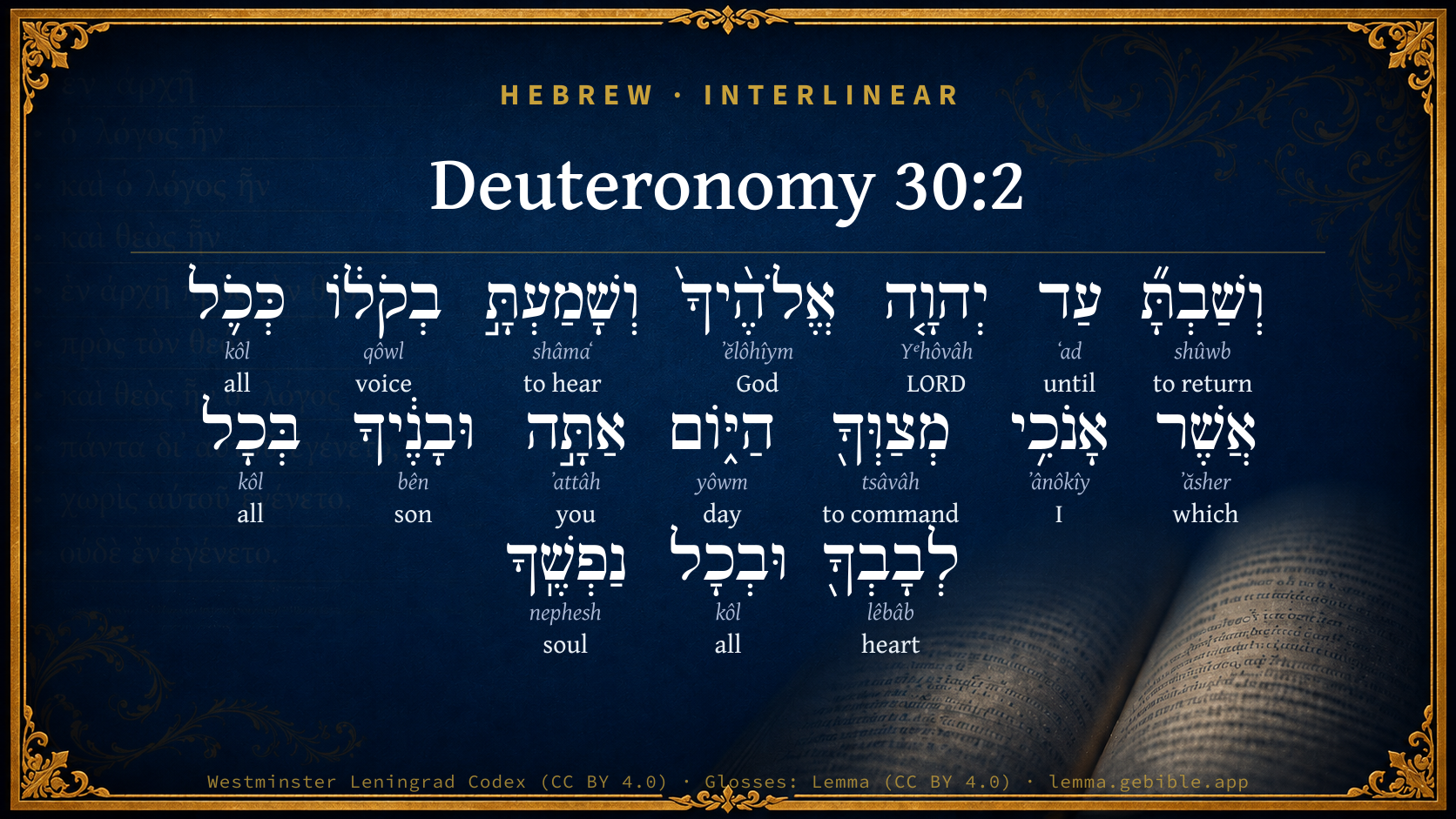
Hebrew (Westminster Leningrad Codex) Deuteronomy 30:2 appears in the Hebrew Old Testament. The text above is from the Westminster Leningrad Codex. Each word links to its Strong’s number, a concise gloss, and parsing drawn from the Open Scriptures Hebrew Bible morphology. Click any word for its full Brown-Driver-Briggs (BDB) entry.
Download image
Cite this verse

Deuteronomy 30:2 (World English Bible). Public Domain. Lemma interlinear Bible study tool, https://lemma.gebible.app/v/deuteronomy/30/2.

Show BibTeX & RIS
BibTeX
RIS
English Translation
and shall return to Yahweh your God, and shall obey his voice according to all that I command you this day, you and your children, with all your heart, and with all your soul;
World English Bible · Public Domain
Download a study sheet

One document with this verse’s original text, its word-by-word gloss line, the meaning frame, cross-references with their text, attributed commentary, and full source and license credits — printable, and it pastes into notes with its structure intact.

This verse Autodidact and up

Study sheet (.html) Plain text (.txt)

A passage Seminary Student

Up to 50 verses in one chapter. A passage sheet keeps up to 6 commentary sources and 12 cross-references per verse, in the order this page ranks them, and says so on the sheet whenever that leaves anything out. Ask for a single verse and you get the Autodidact verse sheet above.

Everything on this page stays free to read, with no account — the sheet is a download of what is already on screen, not access to it.

Want to remove ads? Support Godless Engineer
Compare translations 3

The same verse in 3 English versions, stacked beneath the original-language interlinear above. Click any original word for its lexicon entry.

Each is an independent rendering of the whole verse — the interlinear is not word-aligned to these translations.

Highlighted words mark where these versions differ — a whole-verse word diff, not a word-by-word alignment.

  • World English Bible Public Domain
    and shall return to Yahweh your God, and shall obey his voice according to all that I command you this day, you and your children, with all your heart, and with all your soul;
  • King James Version Public Domain
    And shalt return unto the LORD thy God, and shalt obey his voice according to all that I command thee this day, thou and thy children, with all thine heart, and with all thy soul;
  • unfoldingWord Literal Text CC BY-SA 4.0
    and you return to Yahweh your God and listen to his voice, according to all that I am commanding you today, you and your sons, with all your heart and with all your soul,

unfoldingWord Literal Text — © unfoldingWord, licensed CC BY-SA 4.0. Word-aligned USFM3 via Door43 (git.door43.org/unfoldingWord/en_ult).

Versions to compare (up to 4)

3 of 4 selected

Show all 18 translations

Every available English version of this verse, each an independent rendering of the whole verse.

  • World English Bible Public Domain
    and shall return to Yahweh your God, and shall obey his voice according to all that I command you this day, you and your children, with all your heart, and with all your soul;
  • Berean Standard Bible Public Domain
    and when you and your children return to the LORD your God and obey His voice with all your heart and all your soul according to everything I am giving you today,
  • Majority Standard Bible Public Domain
    and when you and your children return to the LORD your God and obey His voice with all your heart and all your soul according to everything I am giving you today,
  • King James Version Public Domain
    And shalt return unto the LORD thy God, and shalt obey his voice according to all that I command thee this day, thou and thy children, with all thine heart, and with all thy soul;
  • American Standard Version (1901) Public Domain
    and shalt return unto Jehovah thy God, and shalt obey his voice according to all that I command thee this day, thou and thy children, with all thy heart, and with all thy soul;
  • Revised Version (1885) Public Domain
    and shalt return unto the LORD thy God, and shalt obey his voice according to all that I command thee this day, thou and thy children, with all thine heart, and with all thy soul;
  • Geneva Bible (1599) Public Domain
    And shalt returne vnto the Lord thy God, and obey his voyce in all that I commaund thee this day: thou, and thy children with all thine heart and with all thy soule,
  • Douay-Rheims (1899) Public Domain
    And shalt return to him, and obey his commandments, as I command thee this day, thou and thy children, with all thy heart, and with all thy soul:
  • Young's Literal Translation Public Domain
    and hast turned back unto Jehovah thy God, and hearkened to His voice, according to all that I am commanding thee to-day, thou and thy sons, with all thy heart, and with all thy soul --
  • Literal Standard Version CC BY-SA 4.0
    and have turned back to your God YHWH and listened to His voice, according to all that I am commanding you today, you and your sons, with all your heart and with all your soul—
  • Unlocked Literal Bible CC BY-SA 4.0
    and when you return to Yahweh your God and obey his voice, following all that I am commanding you today— you and your children—with all your heart and with all your soul,
  • unfoldingWord Literal Text CC BY-SA 4.0
    and you return to Yahweh your God and listen to his voice, according to all that I am commanding you today, you and your sons, with all your heart and with all your soul,
  • Darby Bible Public Domain
    and shalt return to Jehovah thy God, and shalt hearken to his voice according to all that I command thee this day, thou and thy sons, with all thy heart and with all thy soul;
  • World Messianic Bible Public Domain
    and return to the LORD your God and obey his voice according to all that I command you today, you and your children, with all your heart and with all your soul,
  • Webster's Bible Public Domain
    And shalt return to the LORD thy God, and shalt obey his voice according to all that I command thee this day, thou and thy children, with all thy heart, and with all thy soul;
  • Free Bible Version CC BY-SA 4.0
    When that happens, and when you and your children come back to the Lord your God, and when you do what he says with all your mind and all your being in accordance with everything I'm telling you today, then the Lord your God will be merciful to you.
  • Bible in Basic English Public Domain
    And your hearts are turned again to the Lord your God, and you give ear to his word which I give you today, you and your children, with all your heart and with all your soul:
  • JPS Tanakh (1917) Public Domain
    and shalt return unto the LORD thy God, and hearken to His voice according to all that I command thee this day, thou and thy children, with all thy heart, and with all thy soul;

Literal Standard Version (2020), Covenant Press — licensed CC BY-SA 4.0. Text via the HelloAO Bible API (eBible.org). Unlocked Literal Bible (unfoldingWord) — licensed CC BY-SA 4.0. Text via the HelloAO Bible API (eBible.org). unfoldingWord Literal Text — © unfoldingWord, licensed CC BY-SA 4.0. Word-aligned USFM3 via Door43 (git.door43.org/unfoldingWord/en_ult). Free Bible Version, Dr. Jonathan Gallagher — licensed CC BY-SA 4.0. Text via the HelloAO Bible API (eBible.org).

Word by word

More ways to search: Search by grammar → Find every occurrence → Compare this word →

Practice this passage: Drill this verse → Learn its vocabulary →

לְבָבְךָ֖
lêbâb
H3824
“heart · your”
Noun, Common, Masculine, Singular, Construct + Suffix, Personal, 2nd Person, Masculine, Singular
Part of Speech
Noun
Type
Common
Gender
Masculine
Number
Singular
State
Construct
Full BDB Definition

Origin: from H3823

TWOT: 1071a

inner man, mind, will, heart, soul, understanding - inner part, midst - midst (of things) - heart (of man) - soul, heart (of man) - mind, knowledge, thinking, reflection, memory - inclination, resolution, determination (of will) - conscience - heart (of moral character) - as seat of appetites - as seat of emotions and passions - as seat of courage
  1. וְשַׁבְתָּ֞ shûwb H7725 “and · to return” Conjunction + Verb, Qal, Sequential Perfect, 2nd Person, Masculine, Singular
  2. עַד ʻad H5704 “until” Preposition
  3. יְהוָ֤ה Yᵉhôvâh H3068 “LORD” Noun, Proper
  4. אֱלֹהֶ֨יךָ֙ ʼĕlôhîym H430 “God(s) · your” Noun, Common, Masculine, Plural, Construct + Suffix, Personal, 2nd Person, Masculine, Singular
  5. וְשָׁמַעְתָּ֣ shâmaʻ H8085 “and · to hear” Conjunction + Verb, Qal, Sequential Perfect, 2nd Person, Masculine, Singular
  6. בְקֹל֔וֹ qôwl H6963 “in/at · voice · his” Preposition + Noun, Common, Masculine, Singular, Construct + Suffix, Personal, 3rd Person, Masculine, Singular
  7. כְּכֹ֛ל kôl H3605 “like/as · all” Preposition + Noun, Common, Masculine, Singular, Absolute
  8. אֲשֶׁר ʼăsher H834 “which” Particle, Relative
  9. אָנֹכִ֥י ʼânôkîy H595 “I” Pronoun, Personal, 1st Person, Common, Singular
  10. מְצַוְּךָ֖ tsâvâh H6680 “commanding · you” Verb, Piel, Participle Active, Masculine, Singular, Construct + Suffix, Personal, 2nd Person, Masculine, Singular
  11. הַיּ֑וֹם yôwm H3117 “the · day” Particle, Definite Article + Noun, Common, Masculine, Singular, Absolute
  12. אַתָּ֣ה ʼattâh H859 “you” Pronoun, Personal, 2nd Person, Masculine, Singular
  13. וּבָנֶ֔יךָ bên H1121 “and · sons · your” Conjunction + Noun, Common, Masculine, Plural, Construct + Suffix, Personal, 2nd Person, Masculine, Singular
  14. בְּכָל kôl H3605 “in/at · all of” Preposition + Noun, Common, Masculine, Singular, Construct
  15. וּבְכָל kôl H3605 “and · in/at · all of” Conjunction + Preposition + Noun, Common, Masculine, Singular, Construct
  16. נַפְשֶֽׁךָ nephesh H5315 “soul · your” Noun, Common, Both, Singular, Construct + Suffix, Personal, 2nd Person, Masculine, Singular

About this verse

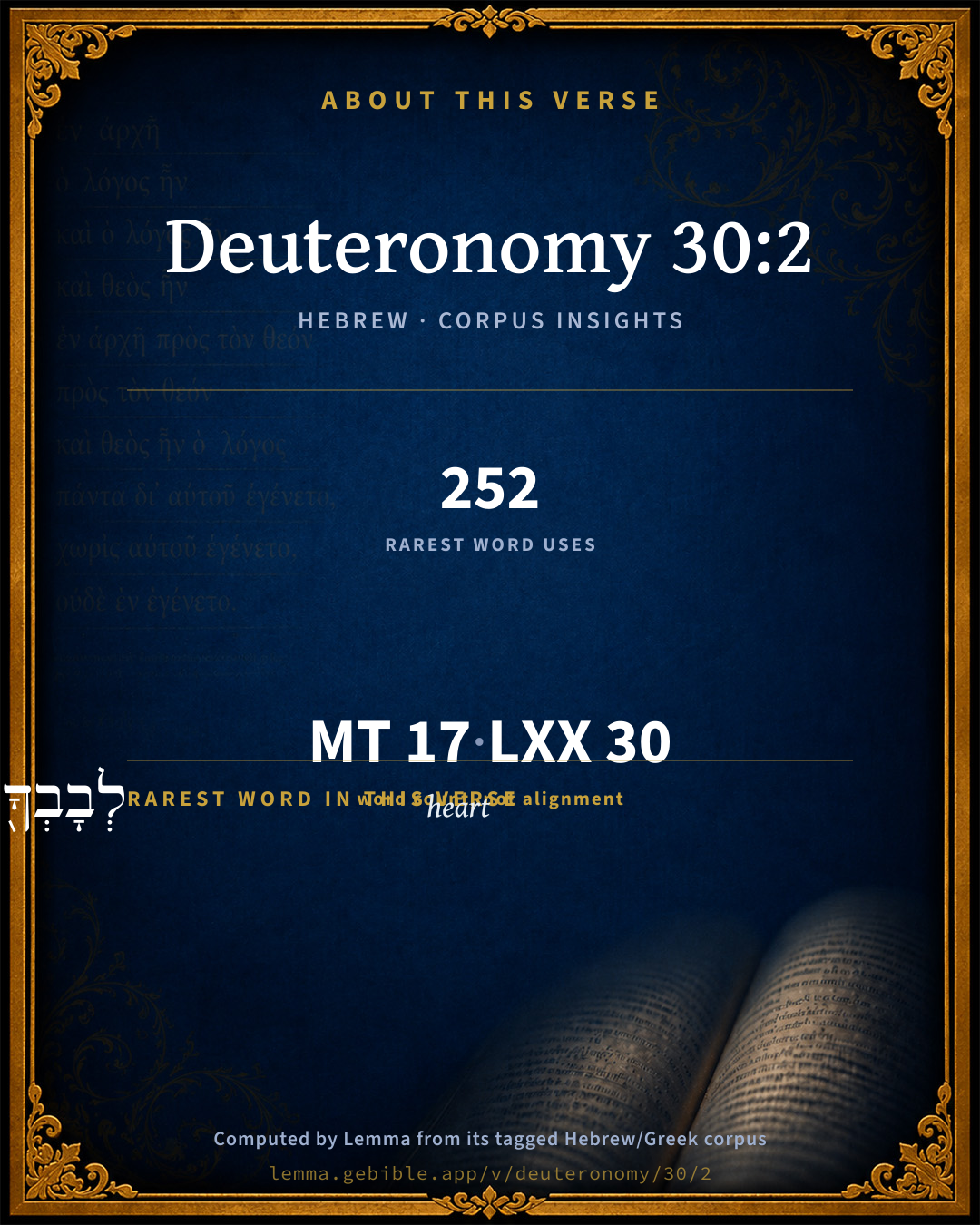
These counts appear in no published source. They are computed here, from the morphology-tagged text and Lemma’s own curated glosses. What Lemma adds →

17
words
15
distinct lemmas
Pentateuch
section

Grammatical profile

  • 3 verbs
  • 10 nouns
  • 2 pronouns
  • 1 preposition
  • 1 particle

Verb forms

  • וְשַׁבְתָּ֞ Qal · Sequential Perfect
  • וְשָׁמַעְתָּ֣ Qal · Sequential Perfect
  • מְצַוְּךָ֖ Piel · Participle Active

Repetition

A word recurs within this verse — often emphatic in Hebrew:

  • כְּכֹ֛ל all H3605 ×3

Hebrew & Septuagint length

In English translation the verse runs 34 words from the Hebrew and 33 from the Septuagint (LXX English) — closely comparable.

A rough comparison of the two English renderings, which tokenize alike — not a word-level alignment.

Word counts can differ between the Hebrew and the Greek without any difference in meaning — e.g. the Hebrew direct-object marker אֵת has no separate Greek word, and Greek often adds the article ὁ.

In the original languages it is 17 Hebrew tokens and 30 Greek tokens — but the two are counted differently (Hebrew bundles its prefixes and suffixes into one token; the Greek is in lemma form), so that isn’t a like-for-like length.

Cross-references

22

Topical passages linked to Deuteronomy 30:2 in the Treasury of Scripture Knowledge — connected by theme and wording, ordered by reader-vote popularity; previews shown in the World English Bible.

  • Joel 2:12–13 "Yet even now," says Yahweh, "turn to me with all your heart, And with fasting, and with weeping, and with mourning."
  • Deuteronomy 4:28–31 There you shall serve gods, the work of men's hands, wood and stone, which neither see, nor hear, nor eat, nor smell.
  • Nehemiah 1:9 but if you return to me, and keep my commandments and do them, though your outcasts were in the uttermost part of the heavens, yet will I gather them from there, and will bring them to the place that I have chosen, to cause my name to dwell there.
  • Lamentations 3:40 Let us search and try our ways, and turn again to Yahweh.
  • 2 Corinthians 3:16 But whenever one turns to the Lord, the veil is taken away.
  • Ephesians 6:24 Grace be with all those who love our Lord Jesus Christ with incorruptible love. Amen.
  • 1 John 1:9 If we confess our sins, he is faithful and righteous to forgive us the sins, and to cleanse us from all unrighteousness.
  • Deuteronomy 6:5 and you shall love Yahweh your God with all your heart, and with all your soul, and with all your might.
  • Deuteronomy 13:3 you shall not listen to the words of that prophet, or to that dreamer of dreams: for Yahweh your God proves you, to know whether you love Yahweh your God with all your heart and with all your soul.
  • 1 Chronicles 29:9 Then the people rejoiced, because they offered willingly, because with a perfect heart they offered willingly to Yahweh: and David the king also rejoiced with great joy.
  • 1 Chronicles 29:17 I know also, my God, that you try the heart, and have pleasure in uprightness. As for me, in the uprightness of my heart I have willingly offered all these things: and now have I seen with joy your people, that are present here, offer willingly to you.
  • Psalms 41:12 As for me, you uphold me in my integrity, And set me in your presence forever.
  • Psalms 119:80 Let my heart be blameless toward your decrees, That I may not be disappointed.
  • Isaiah 55:6–7 Seek you Yahweh while he may be found; call you on him while he is near:
  • Jeremiah 3:10 Yet for all this her treacherous sister Judah has not returned to me with her whole heart, but only in pretense, says Yahweh.
  • Jeremiah 4:14 Jerusalem, wash your heart from wickedness, that you may be saved. How long shall your evil thoughts lodge within you?
  • Jeremiah 29:13 You shall seek me, and find me, when you shall search for me with all your heart.
  • Lamentations 3:32 For though he cause grief, yet will he have compassion according to the multitude of his loving kindnesses.
  • Hosea 3:5 Afterward the children of Israel shall return, and seek Yahweh their God, and David their king, and shall come with trembling to Yahweh and to his blessings in the last days.
  • Hosea 6:1–2 "Come, and let us return to Yahweh; For he has torn us to pieces, And he will heal us; He has injured us, And he will bind up our wounds.
  • Hosea 14:1–3 Israel, return to Yahweh your God; For you have fallen because of your sin.
  • Zechariah 12:10 I will pour on the house of David, and on the inhabitants of Jerusalem, the spirit of grace and of supplication; and they will look to me whom they have pierced; and they shall mourn for him, as one mourns for his only son, and will grieve bitterly for him, as one grieves for his firstborn.

Cross-references courtesy of OpenBible.info (CC BY 4.0).

Hebrew and Greek witnesses Masoretic Hebrew ↔ Greek Septuagint

The same verse in the two great witnesses to the Old Testament, shown verse-for-verse.

These are two independent witnesses, not word-aligned to each other, and the Septuagint is shown in lemma (dictionary) form.

Hebrew Deuteronomy 30:2 Masoretic · Westminster Leningrad Codex

וְשַׁבְתָּ֞ עַד יְהוָ֤ה אֱלֹהֶ֨יךָ֙ וְשָׁמַעְתָּ֣ בְקֹל֔וֹ כְּכֹ֛ל אֲשֶׁר אָנֹכִ֥י מְצַוְּךָ֖ הַיּ֑וֹם אַתָּ֣ה וּבָנֶ֔יךָ בְּכָל לְבָבְךָ֖ וּבְכָל נַפְשֶֽׁךָ

and shall return to Yahweh your God, and shall obey his voice according to all that I command you this day, you and your children, with all your heart, and with all your soul;

World English Bible · Public Domain

Greek LXX Deuteronomy 30:2 Septuagint · lemma form

καί ἐπιστρέφω ἐπί κύριος ὁ θεός σύ καί ὑποἀκούω ὁ φωνή αὐτός κατά πᾶς ὅσος ἐγώ ἐντέλλομαι σύ σήμερον ἐκ ὅλος ὁ καρδία σύ καί ἐκ ὅλος ὁ ψυχή σύ

and shall return to the Lord your God, and shall listen to his voice, according to all things which I charge you this day, with all your heart, and with all your soul;

LXX2012 (modern English Septuagint) · Public Domain

Hebrew: Westminster Leningrad Codex (CC BY 4.0). Greek: Septuagint (public domain); English from LXX2012 (modern English Septuagint) (Public Domain). How the Septuagint differs from the Hebrew →

Targum (Aramaic paraphrase)

2

The Targum is the ancient Jewish Aramaic paraphrase of the Hebrew Scriptures — an interpretive translation, not the Hebrew text itself. Onkelos (literal) and Pseudo-Jonathan (expansive) render the Torah, and Jonathan the Prophets. Coverage is partial: where no permissively-licensed English translation exists for a verse, only the Aramaic is shown. This is verse-level text, not a word-by-word alignment to the Hebrew.

  1. Targum Onkelos Torah (Genesis–Deuteronomy)
    וּתְתוּב לְדַחַלְתָּא דַיְיָ אֱלָהָךְ וּתְקַבֵּל לְמֵימְרֵהּ כְּכֹל דִי אֲנָא מְפַקְדָךְ יוֹמָא דֵין אַתְּ וּבְנָיךְ בְּכָל לִבָּךְ וּבְכָל נַפְשָׁךְ

    (no public-domain English translation for this verse)

    Targum Onkelos — Aramaic: “Onkelos Genesis” (public domain); “Onkelos Exodus” (public domain); “Onkelos Leviticus” (public domain); “Onkelos Numbers” (public domain); “Onkelos Deuteronomy” (public domain). English: “Sefaria Community Translation” (CC0 1.0 (public-domain dedication)); “J.W. Etheridge. The Targums of Onkelos and Jonathan Ben Uzziel on the Pentateuch. London: Longmans, Green, 1862” (public domain). Text via Sefaria.

  2. Targum Pseudo-Jonathan Torah (Genesis–Deuteronomy)
    טוּבֵיכוֹן דְצַדִיקַיָא מָרֵי תְּתוּבָא דְכַד תְּחוֹבוּן וּתְתוּבוּן מַטְיָא תְּיוּבְתְּכוֹן עַד כּוּרְסֵי יְקָרָא דַיְיָ אֱלָהָכוֹן אִין תְּקַבְּלוּן לְמֵימְרֵיהּ כְּכָל מַה דַאֲנָא מְפַקֵיד לְכוֹן יוֹמָנָא אַתּוּן וּבְנֵיכוֹן בְּכָל לִבְּכוֹן וּבְכָל נַפְשְׁכוֹן

    The upright of you will be favoured with a blessed repentance; and though you have sinned, yet shall your repentance come up unto the glorious throne of the Lord your God, if you will hearken to His Word according to all that I have commanded you this day, you, and your children, with all your heart and with all your soul.

    Targum Pseudo-Jonathan — Aramaic: “Targum Jonathan on Genesis” (public domain); “Targum Jonathan on Exodus” (public domain); “Targum Jonathan on Leviticus” (public domain); “Targum Jonathan on Numbers” (public domain); “Targum Jonathan on Deuteronomy” (public domain). English: “The Targum of Jonathan ben Uzziel, trans. J. W. Etheridge, London, 1862” (public domain). Text via Sefaria.

Commentary

Notes on Deuteronomy 30:2 from classic Christian and Jewish commentators (each source and its license shown beneath its notes). The classic Christian expositions comment on the surrounding passage and are grouped to its opening verse, so a note may address several verses; the Jewish commentaries on the Tanakh (Rashi and others) are per-verse, so they appear only where the commentator wrote on this verse.

Lemma curates 59 commentaries, every one of them public domain or Creative Commons licensed, each selected and text-cleaned for this edition rather than reprinted as found. About our sources →

Trapp's Complete Commentary

John Trapp

Deu 30:2 And shalt return unto the LORD thy God, and shalt obey his voice according to all that I command thee this day, thou and thy children, with all thine heart, and with all thy soul;

Ver. 2. And shalt return to the Lord.] By sin we run away from God; by repentance we return to him.

John Trapp, A Commentary or Exposition upon All the Books of the Old and New Testament (1647–1656) — public domain. Text from a community e-Sword module.

The Biblical Illustrator

Joseph S. Exell

Deu_30:2

And shalt return unto the Lord thy God.

The proper signs of repentance

Moses is here dealing with the signs of repentance, which begin in the humiliation of the heart, and end in the reformation of the life. In the New Testament there two words translated by our English word repentance: one of them conveys specially the notion of changing ones mind as to things--seeing things in a different light, and then shaping ones conduct accordingly. But it is necessary for us to distinguish even between sorrow for sin and repentance. Sorrow has two results; it may end in spiritual life or in spiritual death; and, in themselves, one of these is as natural as the other. Sorrow may produce two kinds of reformation--a transient or a permanent one. Sorrow is in itself, therefore, a thing neither good nor bad; its value depends on the spirit of the person on whom it falls. Fire will inflame straw, soften iron, or harden clay; its effects are determined by the object with which it comes in contact. Warmth develops the energies of life, or helps the progress of decay. It is a great power in the hothouse, a great power also in the coffin; it expands the leaf, matures the fruit, adds precocious vigour to vegetable life; and warmth, too, develops with tenfold rapidity the weltering process of dissolution. So too with sorrow. There are spirits in which it develops the seminal principle of life; there are others in which it prematurely hastens the consummation of irreparable decay. Repentance is a state of mind and heart, but it may be merely a cherished sentiment, in which, as a mere sentiment, the man hopes to find his satisfaction. Such repentance is, and it always must be, ineffective. It is self-centred; it is disguised pride. By its fruits you must know it. The repentance that does nothing is nothing. This is our constant difficulty--men are perpetually trying to sever sentiment from con-duet. They want to keep the two spheres separate, and hope to be right towards God in heart, and to do what they like in their life. This self-delusion Gods Word persistently resists. Religion cannot keep only in the heart sphere. It must come out and show itself in the life. It will be white and frail as a plant growing in a dungeon if it be kept wholly within. Every element of the religious life must act, must speak. Shut it up and it will fade away. And now let us see if we can trace the stages of the Divine dealing still, with individuals, in Moses foreshadowings of Gods dealings with His people Israel.

1. Gods will, as He has been pleased to reveal it, controls heart and conduct; and enables each man to judge and appraise himself. When Job came into the full sense of God, what could he do but exclaim, I abhor myself, and repent in dust and ashes.

2. Mans self-will, resisting the Divine will, brings man into sin. Pollok pictures, in his poem, the misery of lost souls as this, that they see the words wherever they turn, Ye knew your duty, and ye did it not. That is sin.

3. Sinful man comes under Divine discipline, which may take the ordinary forms of the natural consequences of transgression, or which may be special afflictive Divine dispensations. The prodigal son only came into the sufferings and humiliations that always follow a life of vice.

4. The aim sought to be reached by Divine discipline is the conviction of sin, self-humiliation on account of sin, and the earnest desire to recover from sin. The sufferings following sin may bring remorse, but that is no holy feeling. God would work the godly sorrow of repentance. Remorse keeps a man away from God, hugging to himself his bitterness. Repentance leads a man to God, dissolves him in the tears of confession, and yet kindles a new hope in the soul. And now--

5. We come to the point of our text. When a penitent comes back to God, He looks for the signs of the penitence. He finds them partly in that very return to seek His forgiveness; but He looks for it also in the steadfast endeavour of the penitent henceforth to obey. (The Weekly Pulpit.)

Repentance necessary

We have heard much of the Gospel containing comfort for the mere sinner, and if by the mere sinner be meant one that has nothing to plead but the mercy of God, through the atonement, like the publican in the parable, it is for such, and only such, that the Gospel contains consolation. But if by the mere sinner be meant the impenitent, though distressed sinner, it has no comfort for such in their present state. Repentance is necessary to forgiveness, in the same sense as faith is necessary to justification; for it is not possible for a sinner either to embrace the Saviour, or prize the consolations of the Gospel, while insensible to the evil of sin. There is no grace in the Gospel, but upon the supposition that God is in the right, and that sin is exceedingly sinful, and, consequently, none to be perceived or prized. (Andrew Fuller.)

Thoroughness in repentance

In the War Cry there was a picture of a man kneeling at a table and praying, Lord, make a good job of me. The words are rough enough, but the meaning is, in many respects, admirable. The poor man feels that he is a failure, and that he needs new making. His feeling is that none but the Lord can accomplish the necessary renewal. His fear is lest he should not have the full work wrought upon him, and that his conversion should not be thorough and complete. He has no need to fear that the Lord would not operate effectively, for the great Worker never leaves His work half done. Still, the very fear of being but partly sanctified shows his earnestness and his desire to be truly and fully converted from the error of his ways. Lifeless, questionable religion is poor stuff. Oh, that the Lord would make a good job of us. (C. H. Spurgeon.)

Repentance

Repentance is neither base nor bitter, it is good rising up out of evil. It is the turning of the soul from the way of midnight to the point of the coming sun. Darkness drops from the face, and silver light dawns upon it. True regret for wrong never weakens, but always strengthens the heart. As some plants of the bitterest root have the whitest and sweetest blossoms, so the bitterest wrong has the sweetest repentance, which, indeed, is only the soul blossoming back to its better nature.

Whole-heartedness in religion

A dealer in pictures who makes it his business to find as many new painters as possible, both in this country and abroad, was asked recently in regard to his methods of selecting pictures to buy. He was very frank in his talk, and one thing which he said is shrewd enough to be worth quoting. Of course, he said, with my experience I am able to judge whether there is promise in a painters work, but I never buy with any idea of putting the painter on my list until I have seen the man and talked with him myself. I always watch him closely, and I never buy his pictures unless his eye lights up when I talk to him about his work and about his profession. The artist whose heart was really in his work could not discuss it without kindling, and the man who did not paint from the heart was not the one whose pictures the dealer wanted. And so God desires whole-hearted obedience to His commands.

The Biblical Illustrator, edited by Joseph S. Exell (c. 1880s–1900s) — public domain. Text from a community e-Sword module.

Joseph Benson's Commentary

Deu 30:2. And shalt return unto the Lord — Here is a further description of true repentance. It is a returning unto the Lord, in humiliation, shame, and sorrow, and yet with confidence in him, as our God, with a fixed purpose of obeying him universally and heartily in future. This the Jews did, as a nation, in some measure, after they were carried captive to Babylon, since which time we read nothing of their idolatry. But they degenerated into other sins, which made them reject the Messiah when he was sent to them, for which they are punished to this day, and will be till they repent and be converted, Rom 11:23-26; Luk 21:24.

Joseph Benson's Commentary on the Old and New Testaments (1811–1818) — public domain. Text from a community e-Sword module.

Tyndale Open Study Notes

Tyndale Open Resources

30:2-3 with all your heart and all your soul: The expectation of these verses was clearly articulated in the Shema, Israel’s great statement of covenant faith and commitment (cp. 6:4). Obedience to the covenant was a prerequisite necessary for Israel to receive God’s forgiveness and return to its land.

Tyndale Open Study Notes — © Tyndale Open Resources, licensed CC BY-SA 4.0. Text via the HelloAO Bible API.

Geneva Bible (1599)

Geneva Bible translators

In true repentance is none hypocrisy.

Geneva Bible (1599) marginal notes — public domain. Text via Bolls.life.

The Cambridge Bible for Schools and Colleges

gen. ed. J. J. S. Perowne

2. Expansion of Deu_4:30 b.

The Cambridge Bible for Schools and Colleges (gen. ed. J. J. S. Perowne; Cambridge University Press, 1878–1918) — public domain. Text from a community e-Sword module.

John Gill's Exposition

And shalt return unto the Lord thy God,.... By repentance, acknowledging their manifold sins and transgressions, particularly their disbelief and rejection of the Messiah, now seeking him and salvation by him; see Hos 3:5,

and shalt obey his voice; in the Gospel, yielding the obedience of faith to that; embracing the Gospel, and submitting to the ordinances of it:

according to all that I command thee this day, thou, and thy children; which was to love the Lord, and walk in his ways, directed to in the Gospel, and which were to be regarded from a principle of love to God and the blessed Redeemer; see Deu 30:6,

with all thine heart and with all thy soul; that is, both their return unto the Lord, and their obedience to his voice or word, should be hearty and sincere; which being the case, the following things would be done for them.

John Gill's Exposition of the Whole Bible (1746–1763) — public domain (CC PDM 1.0). Text via the HelloAO Bible API.

The Pulpit Commentary

And shalt return unto the Lord thy God; retrain from the worship of false gods to worship and serve Jehovah the one true God, the God of their fathers, and the God whom as a nation they had before wet-shipped. (cf. Neh_1:8, Neh_1:9)

The Pulpit Commentary (1880–1919), ed. H.D.M. Spence-Jones & Joseph S. Exell — public domain. Text from a community e-Sword module.

Ramban (Nachmanides)

Rabbi Moshe ben Nachman (Ramban / Nachmanides)

AND THOU SHALT RETURN UNTO THE ETERNAL THY G-D, AND HEARKEN TO HIS VOICE ACCORDING TO ALL THAT I COMMAND THEE THIS DAY, THOU AND THY CHILDREN. The meaning thereof is that you will return with all thy heart, and with all thy soul and you will take it upon yourself and upon your children throughout their generations to do according to all that I command thee this day, just as they did at the second redemption [i.e., the redemption from Babylon], as it is written, and they entered into a curse, and into an oath, to walk in G-d’s law, which was given by Moses the servant of G-d, and to observe and do all the commandments of the Eternal our G-d, and His ordinances and His statutes. Or it may be that the expression that I command thee this day, thou and thy children is like “command you — to you and to your children,” is gramatically difficult, because the verse begins with the accusative thee, and follows with the nominative thou. Ramban offers two explanations: First, that the verse contains two separate thoughts: that you will return to G-d, and that you will accept upon yourself and your children all that He commands us. Second, that the nominative thou is equivalent to the accusative thee [“to you”], and the verse is thus expressing a single thought: “that I command thee this day — to you and to your children.” Ramban proceeds to cite Scriptural examples of similar usage — a nominative in place of an accusative. similar to the expression ‘v’atah tzuveitha’ (and you) is to be understood as lecha (“and to you”). [meaning lecha tzuveithi — “to you I ordered that the command be given”]. So also, and they dealt ill ‘othanu’ is “us,” but Ramban interprets it in the context of the verse as if it means “to us.” means lanu (“to us”). (you) means lecha (to you). And in my opinion there is in this matter a great secret; for it alludes to that which the Rabbis said, “The son of David [i.e., the Messiah] will not come until all souls in the guf are exhausted.” I have already spoken of this matter.

Ramban (Nachmanides) on the Tanakh — English translation: “Commentary on the Torah by Ramban (Nachmanides). Translated and annotated by Charles B. Chavel. New York, Shilo Pub. House, 1971-1976” (CC BY 4.0). Text via Sefaria.

Sforno

Rabbi Ovadia Sforno

And you will return. Your repentance will be in order to solely perform the will of your Creator. This is the type of repentance that reaches the Heavenly Throne.

And obey Him exactly. Not out of habit, as you did before now.

You and your sons. Even the children of the next generation will recognize this, as the verse states, “All of you know Me, from the young to the old” (Yirmiyahu 31:33).

Wholeheartedly. So that you will have no doubt.

With your whole being. Your desires of your soul will not prevent you, when you recognize the importance of the matter.

Sforno on the Tanakh — English translation: “Yalkut, Sifsei Chachomim Chumash, Metsudah Publications, 2009” (CC BY 4.0). Text via Sefaria.

Lesson kit

Teaching starters — assembled from the data on this page, not authored interpretation. Every prompt links to the verse data it draws on. Edit before teaching.

Deuteronomy, in the Pentateuch, opens this verse with 17 words (15 distinct Hebrew lemmas). Its most distinctive word is lêbâb (“heart”). A historical commentator’s framing appears above. Read the whole chapter for the surrounding context.

Discussion questions

  1. How does “heart” (lêbâb) shape what this verse is saying?
  2. Joel 2:12–13 shares this passage’s theme. How do the two illuminate each other?
  3. “all” occurs 3× in this one verse. What is the effect of the repetition?
  4. These translations render this verse differently. What is at stake in choosing one wording over another?
  5. The verb «וְשַׁבְתָּ֞» is Qal Sequential Perfect. How does its form color the action?
  6. Reading how Trapp's Complete Commentary and The Biblical Illustrator read this verse, where do the two commentators agree and where do they part?

Things to notice

Reading settings

Reading text

Shown beneath each verse's original-language words.

Old Testament
Old Testament edition

Read the OT as the Masoretic Hebrew (MT) or the Greek Septuagint (LXX).

English shown for the Greek Septuagint (in the Hebrew ↔ Greek comparison).

Comparing translations? Open the Compare panel on any verse page to stack up to four side by side.