1 Samuel 12:18

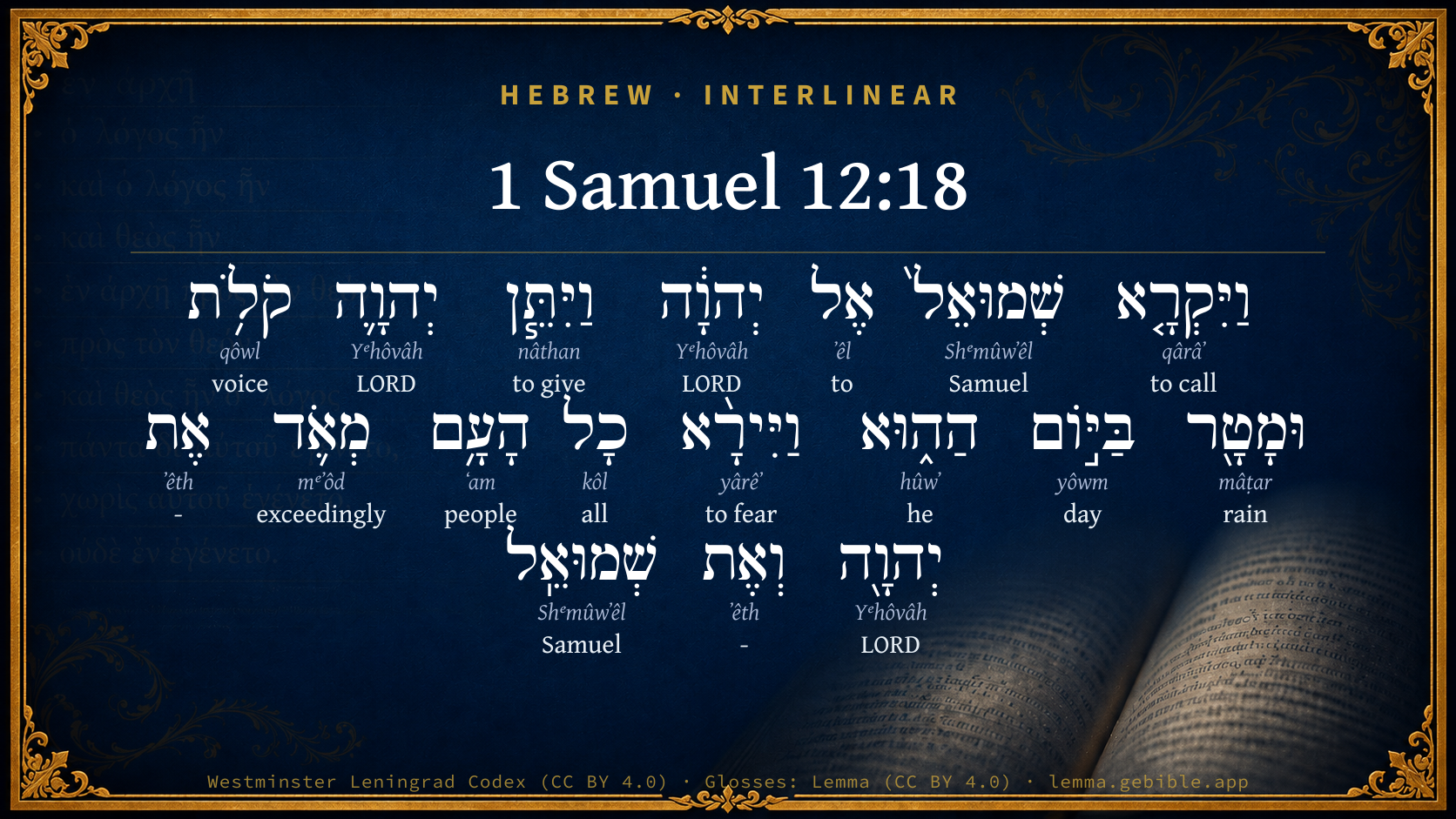
Hebrew (Westminster Leningrad Codex) 1 Samuel 12:18 appears in the Hebrew Old Testament. The text above is from the Westminster Leningrad Codex. Each word links to its Strong’s number, a concise gloss, and parsing drawn from the Open Scriptures Hebrew Bible morphology. Click any word for its full Brown-Driver-Briggs (BDB) entry.
Download image
Cite this verse

1 Samuel 12:18 (World English Bible). Public Domain. Lemma interlinear Bible study tool, https://lemma.gebible.app/v/1-samuel/12/18.

Show BibTeX & RIS
BibTeX
RIS
English Translation
So Samuel called to Yahweh; and Yahweh sent thunder and rain that day: and all the people greatly feared Yahweh and Samuel.
World English Bible · Public Domain
Download a study sheet

One document with this verse’s original text, its word-by-word gloss line, the meaning frame, cross-references with their text, attributed commentary, and full source and license credits — printable, and it pastes into notes with its structure intact.

This verse Autodidact and up

Study sheet (.html) Plain text (.txt)

A passage Seminary Student

Up to 50 verses in one chapter. A passage sheet keeps up to 6 commentary sources and 12 cross-references per verse, in the order this page ranks them, and says so on the sheet whenever that leaves anything out. Ask for a single verse and you get the Autodidact verse sheet above.

Everything on this page stays free to read, with no account — the sheet is a download of what is already on screen, not access to it.

Want to remove ads? Support Godless Engineer
Compare translations 3

The same verse in 3 English versions, stacked beneath the original-language interlinear above. Click any original word for its lexicon entry.

Each is an independent rendering of the whole verse — the interlinear is not word-aligned to these translations.

Highlighted words mark where these versions differ — a whole-verse word diff, not a word-by-word alignment.

  • World English Bible Public Domain
    So Samuel called to Yahweh; and Yahweh sent thunder and rain that day: and all the people greatly feared Yahweh and Samuel.
  • King James Version Public Domain
    So Samuel called unto the LORD; and the LORD sent thunder and rain that day: and all the people greatly feared the LORD and Samuel.
  • unfoldingWord Literal Text CC BY-SA 4.0
    Then Samuel called upon Yahweh, and Yahweh gave thunder and rain on that day. And all of the people greatly feared Yahweh and Samuel.

unfoldingWord Literal Text — © unfoldingWord, licensed CC BY-SA 4.0. Word-aligned USFM3 via Door43 (git.door43.org/unfoldingWord/en_ult).

Versions to compare (up to 4)

3 of 4 selected

Show all 18 translations

Every available English version of this verse, each an independent rendering of the whole verse.

  • World English Bible Public Domain
    So Samuel called to Yahweh; and Yahweh sent thunder and rain that day: and all the people greatly feared Yahweh and Samuel.
  • Berean Standard Bible Public Domain
    So Samuel called to the LORD, and on that day the LORD sent thunder and rain. As a result, all the people greatly feared the LORD and Samuel.
  • Majority Standard Bible Public Domain
    So Samuel called to the LORD, and on that day the LORD sent thunder and rain. As a result, all the people greatly feared the LORD and Samuel.
  • King James Version Public Domain
    So Samuel called unto the LORD; and the LORD sent thunder and rain that day: and all the people greatly feared the LORD and Samuel.
  • American Standard Version (1901) Public Domain
    So Samuel called unto Jehovah; and Jehovah sent thunder and rain that day: and all the people greatly feared Jehovah and Samuel.
  • Revised Version (1885) Public Domain
    So Samuel called unto the LORD; and the LORD sent thunder and rain that day: and all the people greatly feared the LORD and Samuel.
  • Geneva Bible (1599) Public Domain
    Then Samuel called vnto the Lord, and the Lord sent thunder and raine the same day: and all the people feared the Lord and Samuel exceedingly.
  • Douay-Rheims (1899) Public Domain
    And Samuel cried unto the Lord, and the Lord sent thunder and rain that day.
  • Young's Literal Translation Public Domain
    And Samuel calleth unto Jehovah, and Jehovah giveth voices and rain, on that day, and all the people greatly fear Jehovah and Samuel;
  • Literal Standard Version CC BY-SA 4.0
    And Samuel calls to YHWH, and YHWH gives voices and rain on that day, and all the people greatly fear YHWH and Samuel;
  • Unlocked Literal Bible CC BY-SA 4.0
    So Samuel called to Yahweh; and that same day Yahweh sent thunder and rain. Then all the people greatly feared Yahweh and Samuel.
  • unfoldingWord Literal Text CC BY-SA 4.0
    Then Samuel called upon Yahweh, and Yahweh gave thunder and rain on that day. And all of the people greatly feared Yahweh and Samuel.
  • Darby Bible Public Domain
    And Samuel called to Jehovah; and Jehovah sent thunder and rain that day. And all the people greatly feared Jehovah and Samuel.
  • World Messianic Bible Public Domain
    So Samuel called to the LORD, and the LORD sent thunder and rain that day. Then all the people greatly feared the LORD and Samuel.
  • Webster's Bible Public Domain
    So Samuel called to the LORD; and the LORD sent thunder and rain that day: and all the people greatly feared the LORD and Samuel.
  • Free Bible Version CC BY-SA 4.0
    Then Samuel prayed to the Lord, and that very day the Lord sent thunder and rain. Everyone was in absolute awe of the Lord and of Samuel.
  • Bible in Basic English Public Domain
    So Samuel made prayer to the Lord; and the Lord sent thunder and rain that day: and all the people were in fear of the Lord and of Samuel.
  • JPS Tanakh (1917) Public Domain
    So Samuel called unto the LORD; and the LORD sent thunder and rain that day; and all the people greatly feared the LORD and Samuel.

Literal Standard Version (2020), Covenant Press — licensed CC BY-SA 4.0. Text via the HelloAO Bible API (eBible.org). Unlocked Literal Bible (unfoldingWord) — licensed CC BY-SA 4.0. Text via the HelloAO Bible API (eBible.org). unfoldingWord Literal Text — © unfoldingWord, licensed CC BY-SA 4.0. Word-aligned USFM3 via Door43 (git.door43.org/unfoldingWord/en_ult). Free Bible Version, Dr. Jonathan Gallagher — licensed CC BY-SA 4.0. Text via the HelloAO Bible API (eBible.org).

Word by word

More ways to search: Search by grammar → Find every occurrence → Compare this word →

Practice this passage: Drill this verse → Learn its vocabulary →

וּמָטָ֖ר
mâṭar
H4306
“and · rain”
Conjunction + Noun, Common, Masculine, Singular, Absolute
Part of Speech
Conjunction + Noun
Type
Common
Gender
Masculine
Number
Singular
State
Absolute
Full BDB Definition

Origin: from H4305

TWOT: 1187a

rain
  1. וַיִּקְרָ֤א qârâʼ H7121 “and · to call” Conjunction + Verb, Qal, Sequential Imperfect, 3rd Person, Masculine, Singular
  2. שְׁמוּאֵל֙ Shᵉmûwʼêl H8050 “Samuel” Noun, Proper
  3. אֶל ʼêl H413 “to” Preposition
  4. יְהוָ֔ה Yᵉhôvâh H3068 “LORD” Noun, Proper
  5. וַיִּתֵּ֧ן nâthan H5414 “and · to give” Conjunction + Verb, Qal, Sequential Imperfect, 3rd Person, Masculine, Singular
  6. יְהוָ֛ה Yᵉhôvâh H3068 “LORD” Noun, Proper
  7. קֹלֹ֥ת qôwl H6963 “voices” Noun, Common, Masculine, Plural, Absolute
  8. בַּיּ֣וֹם yôwm H3117 “in/at the · day” Preposition, Determined + Noun, Common, Masculine, Singular, Absolute
  9. הַה֑וּא hûwʼ H1931 “the · he” Particle, Definite Article + Pronoun, Personal, 3rd Person, Masculine, Singular
  10. וַיִּירָ֨א yârêʼ H3372 “and · to fear” Conjunction + Verb, Qal, Sequential Imperfect, 3rd Person, Masculine, Singular
  11. כָל kôl H3605 “all of” Noun, Common, Masculine, Singular, Construct
  12. הָעָ֥ם ʻam H5971 “the · people” Particle, Definite Article + Noun, Common, Masculine, Singular, Absolute
  13. מְאֹ֛ד mᵉʼôd H3966 “exceedingly” Adverb
  14. אֶת ʼêth H853 “-” Particle, Direct Object
  15. יְהוָ֖ה Yᵉhôvâh H3068 “LORD” Noun, Proper
  16. וְאֶת ʼêth H853 “and · -” Conjunction + Particle, Direct Object
  17. שְׁמוּאֵֽל Shᵉmûwʼêl H8050 “Samuel” Noun, Proper

About this verse

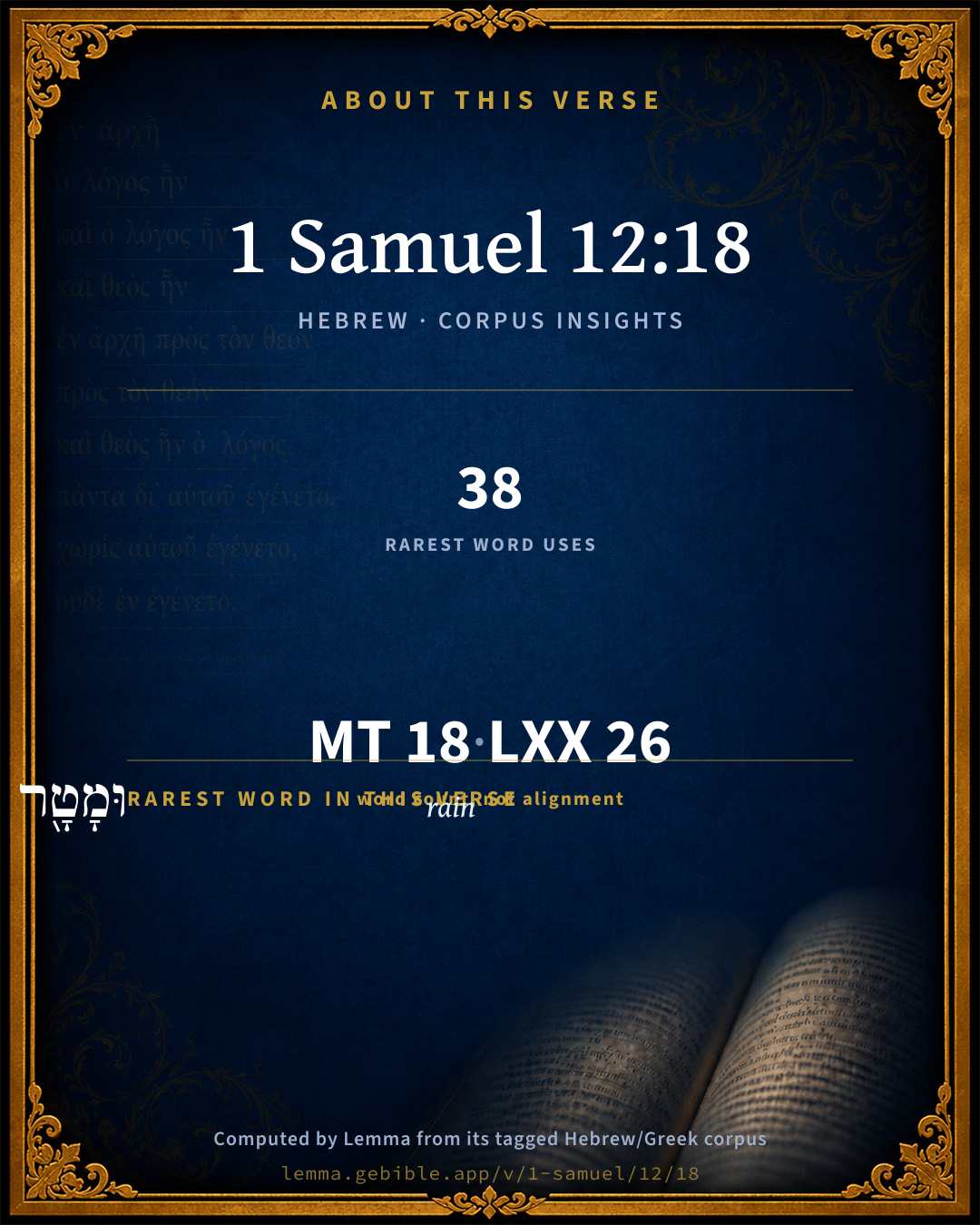
These counts appear in no published source. They are computed here, from the morphology-tagged text and Lemma’s own curated glosses. What Lemma adds →

18
words
14
distinct lemmas
Historical
section

Shared distinctive vocabulary

וּמָטָ֖ר rain H4306 occurs in 36 verses of the Hebrew Bible. Also found in:

Grammatical profile

  • 3 verbs
  • 10 nouns
  • 1 pronoun
  • 1 preposition
  • 1 adverb
  • 2 particles

Verb forms

  • וַיִּקְרָ֤א Qal · Sequential Imperfect
  • וַיִּתֵּ֧ן Qal · Sequential Imperfect
  • וַיִּירָ֨א Qal · Sequential Imperfect

Repetition

Words recur within this verse — often emphatic in Hebrew:

  • יְהוָ֔ה LORD H3068 ×3
  • שְׁמוּאֵל֙ Samuel H8050 ×2

Hebrew & Septuagint length

In English translation the verse runs 22 words from the Hebrew and 26 from the Septuagint (LXX English) — closely comparable.

A rough comparison of the two English renderings, which tokenize alike — not a word-level alignment.

Word counts can differ between the Hebrew and the Greek without any difference in meaning — e.g. the Hebrew direct-object marker אֵת has no separate Greek word, and Greek often adds the article ὁ.

In the original languages it is 18 Hebrew tokens and 26 Greek tokens — but the two are counted differently (Hebrew bundles its prefixes and suffixes into one token; the Greek is in lemma form), so that isn’t a like-for-like length.

Cross-references

5

Topical passages linked to 1 Samuel 12:18 in the Treasury of Scripture Knowledge — connected by theme and wording, ordered by reader-vote popularity; previews shown in the World English Bible.

  • Exodus 14:31 Israel saw the great work which Yahweh did to the Egyptians, and the people feared Yahweh; and they believed in Yahweh, and in his servant Moses.
  • Exodus 9:23–25 Moses stretched forth his rod toward the heavens, and Yahweh sent thunder, hail, and lightning flashed down to the earth. Yahweh rained hail on the land of Egypt.
  • Ezra 10:9 Then all the men of Judah and Benjamin gathered themselves together to Jerusalem within the three days; it was the ninth month, on the twentieth [day] of the month: and all the people sat in the broad place before the house of God, trembling because of this matter, and for the great rain.
  • Psalms 106:12–13 Then they believed his words. They sang his praise.
  • Revelation 11:5–6 If anyone desires to harm them, fire proceeds out of their mouth and devours their enemies. If anyone desires to harm them, he must be killed in this way.

Cross-references courtesy of OpenBible.info (CC BY 4.0).

Hebrew and Greek witnesses Masoretic Hebrew ↔ Greek Septuagint

The same verse in the two great witnesses to the Old Testament, shown verse-for-verse.

These are two independent witnesses, not word-aligned to each other, and the Septuagint is shown in lemma (dictionary) form.

Hebrew 1 Samuel 12:18 Masoretic · Westminster Leningrad Codex

וַיִּקְרָ֤א שְׁמוּאֵל֙ אֶל יְהוָ֔ה וַיִּתֵּ֧ן יְהוָ֛ה קֹלֹ֥ת וּמָטָ֖ר בַּיּ֣וֹם הַה֑וּא וַיִּירָ֨א כָל הָעָ֥ם מְאֹ֛ד אֶת יְהוָ֖ה וְאֶת שְׁמוּאֵֽל

So Samuel called to Yahweh; and Yahweh sent thunder and rain that day: and all the people greatly feared Yahweh and Samuel.

World English Bible · Public Domain

Greek LXX 1 Samuel 12:18 Septuagint · lemma form

καί ἐπικαλέω σαμουηλ ὁ κύριος καί δίδωμι κύριος φωνή καί ὑετός ἐν ὁ ἡμέρα ἐκεῖνος καί φοβέω πᾶς ὁ λαός ὁ κύριος σφόδρα καί ὁ σαμουηλ

And Samuel called upon the Lord, and the Lord sent thunders and rain in that day; and all the people feared greatly the Lord and Samuel.

LXX2012 (modern English Septuagint) · Public Domain

Hebrew: Westminster Leningrad Codex (CC BY 4.0). Greek: Septuagint (public domain); English from LXX2012 (modern English Septuagint) (Public Domain). How the Septuagint differs from the Hebrew →

Targum (Aramaic paraphrase)

1

The Targum is the ancient Jewish Aramaic paraphrase of the Hebrew Scriptures — an interpretive translation, not the Hebrew text itself. Onkelos (literal) and Pseudo-Jonathan (expansive) render the Torah, and Jonathan the Prophets. Coverage is partial: where no permissively-licensed English translation exists for a verse, only the Aramaic is shown. This is verse-level text, not a word-by-word alignment to the Hebrew.

  1. Targum Jonathan Prophets (Joshua–Malachi)
    וּקְרָא שְׁמוּאֵל קֳדָם יְיָ וִיהַב יְיָ קָלִין וּמִטְרָא בְּיוֹמָא הַהוּא וּדְחַל כָּל עַמָא לַחֲדָא מִן קֳדָם יְיָ וּמִפִּתְגָמֵי שְׁמוּאֵל:

    (no public-domain English translation for this verse)

    Targum Jonathan — Aramaic: “Mikraot Gedolot” (public domain). English: “Sefaria Community Translation” (CC0 1.0 (public-domain dedication)); “London "Chaldee Paraphrase," 1871” (public domain). Text via Sefaria.

Commentary

Notes on 1 Samuel 12:18 from classic Christian and Jewish commentators (each source and its license shown beneath its notes). The classic Christian expositions comment on the surrounding passage and are grouped to its opening verse, so a note may address several verses; the Jewish commentaries on the Tanakh (Rashi and others) are per-verse, so they appear only where the commentator wrote on this verse.

Lemma curates 59 commentaries, every one of them public domain or Creative Commons licensed, each selected and text-cleaned for this edition rather than reprinted as found. About our sources →

Trapp's Complete Commentary

John Trapp

1Sa 12:18 So Samuel called unto the LORD; and the LORD sent thunder and rain that day: and all the people greatly feared the LORD and Samuel.

Ver. 18. And the Lord sent thunder and rain that day.] Out of the midst of water he fetched fire, astonishing the people with the fearful noise of that eruption; that he might refute their folly, and bring them to repentance: since now they saw evidently that God was greatly displeased with them for rejecting his government, and that it was not Samuel’s saying only.

John Trapp, A Commentary or Exposition upon All the Books of the Old and New Testament (1647–1656) — public domain. Text from a community e-Sword module.

Joseph Benson's Commentary

1Sa 12:18. The Lord sent thunder and rain — Such was the power and favour with God that this man of God possessed! By this thunder and rain, God showed them their folly in desiring a king to save them, rather than God or Samuel, expecting more from an arm of flesh than from the arm of God, or from the power of prayer. Could their king thunder with a voice like God? Could their prince command such forces as the prophet could by his prayers? Likewise he intimates, that how serene soever their condition was now, (like the weather in wheat-harvest,) yet if God pleased he could soon change the face of the heavens, and persecute them with his storms.

Joseph Benson's Commentary on the Old and New Testaments (1811–1818) — public domain. Text from a community e-Sword module.

Tyndale Open Study Notes

Tyndale Open Resources

12:18 terrified: Cp. Exod 19:16.

Tyndale Open Study Notes — © Tyndale Open Resources, licensed CC BY-SA 4.0. Text via the HelloAO Bible API.

Adam Clarke's Commentary

Verse 18. The Lord sent thunder and rain that day] This was totally unusual; and, as it came at the call of Samuel, was a most evident miracle.

Greatly feared the Lord] They dreaded His terrible majesty; and they feared Samuel, perceiving that he had so much power with God.

Adam Clarke's Commentary on the Bible (1810–1826) — public domain. Text from a community e-Sword/MySword module.

The Cambridge Bible for Schools and Colleges

gen. ed. J. J. S. Perowne

18. feared the Lord and Samuel] The unexpected rain was a “sign,” attesting the prophet’s words. Cp. Exo_14:31.

The Cambridge Bible for Schools and Colleges (gen. ed. J. J. S. Perowne; Cambridge University Press, 1878–1918) — public domain. Text from a community e-Sword module.

John Gill's Exposition

So Samuel called unto the Lord,.... Not in an authoritative way, or by way of command, but by prayer; so the Targum renders the clause in the preceding verse,"I will pray before the Lord:"

and the Lord sent thunder and rain that day; immediately, though there was no appearance of it; it was harvest time, and a fine harvest day. Josephus says (p) he sent thunder, lightning, and hail, a terrible storm and tempest it was:

and all the people greatly feared the Lord and Samuel; the Lord that sent this tempest, and Samuel who had such power with God in prayer. Clement of Alexandria (q) thinks that from hence the Greeks borrowed their fable concerning Aeacus invoking God, when there was a drought in Greece; and as soon as he prayed, immediately there was thunder, and the whole air was covered with clouds; but perhaps they rather framed it from the instance of Elijah praying for rain (r), at whose request it came, Kg1 18:42.

(p) Antiqu. l. 6. c. 5. sect. 6. (q) Stromat. l. 6. p. 630. (r) Vid. Schmid. in Pindar. Nemea, Ode 5. p. 110.

John Gill's Exposition of the Whole Bible (1746–1763) — public domain (CC PDM 1.0). Text via the HelloAO Bible API.

Matthew Poole's English Annotations

Who had such great power and favour with God.

Matthew Poole's English Annotations on the Holy Bible (1683–1685) — public domain. Text from a community e-Sword/MySword module.

Whedon's Commentary on the Bible

Daniel D. Whedon

18. Feared the Lord and Samuel — They felt that Samuel’s thoughts and feelings and those of Jehovah were the same. Jehovah’s true representative was among them.

Daniel D. Whedon (gen. ed.), Commentary on the Old and New Testaments (1874–1909) — public domain. Text from a community e-Sword module.

The Pulpit Commentary

DIVINE TESTIMONY TO SAMUEL"S INTEGRITY (vers. 18-25).

Jehovah sent thunder and rain. Rain in Palestine falls usually only at the autumnal and vernal equinox, and though thunder storms are not unknown at other times, yet, by the general testimony of travellers, they are very rare. Naturally, therefore, this storm deeply impressed the minds of the people. Though not in itself miraculous, the circumstances made it so.

The Pulpit Commentary (1880–1919), ed. H.D.M. Spence-Jones & Joseph S. Exell — public domain. Text from a community e-Sword module.

John Wesley's Explanatory Notes

Samuel - Who had such power and favour with God. By this thunder and rain, God shewed them their folly in desiring a king to save them, rather than God or Samuel, expecting more from an arm of flesh than from the arm of God, or from the power of prayer. Could their king thunder with a voice like God? Could their prince command such forces as the prophet could by his prayers? Likewise he intimates, that how serene soever their condition was now, (like the weather in wheat harvest) yet if God pleased, he could soon change the face of their heavens, and persecute them with his storms.

John Wesley, Explanatory Notes Upon the Whole Bible (1754–1765) — public domain. Text via the GEBible commentary corpus.

Keil & Delitzsch

C. F. Keil & F. Delitzsch

This miracle therefore inspired the people with a salutary terror. "All the people greatly feared the Lord and Samuel," and entreated the prophet, "Pray for thy servants to the Lord thy God, that we die not, because we have added to all our sins the evil thing, to ask us a king."

Keil & Delitzsch — Biblical Commentary on the Old Testament (1861–1891) — public domain (CC PDM 1.0). Text via the HelloAO Bible API. (Old Testament only.)

Lesson kit

Teaching starters — assembled from the data on this page, not authored interpretation. Every prompt links to the verse data it draws on. Edit before teaching.

1 Samuel, in the Historical, opens this verse with 18 words (14 distinct Hebrew lemmas). Its most distinctive word is mâṭar (“rain”). A historical commentator’s framing appears above. Read the whole chapter for the surrounding context.

Discussion questions

  1. What does “rain” (mâṭar) contribute to the verse as a whole?
  2. Exodus 9:33 shares the word «rain» with this verse. How do the two illuminate each other?
  3. “LORD” occurs 3× in this one verse. What is the effect of the repetition?
  4. These translations render this verse differently; the difference is in the English rendering, not the original. What questions does that raise?
  5. The verb «וַיִּקְרָ֤א» is Qal Sequential Imperfect. How does its form color the action?
  6. Reading how Trapp's Complete Commentary and Joseph Benson's Commentary read this verse, where do the two commentators agree and where do they part?

Things to notice

Reading settings

Reading text

Shown beneath each verse's original-language words.

Old Testament
Old Testament edition

Read the OT as the Masoretic Hebrew (MT) or the Greek Septuagint (LXX).

English shown for the Greek Septuagint (in the Hebrew ↔ Greek comparison).

Comparing translations? Open the Compare panel on any verse page to stack up to four side by side.