
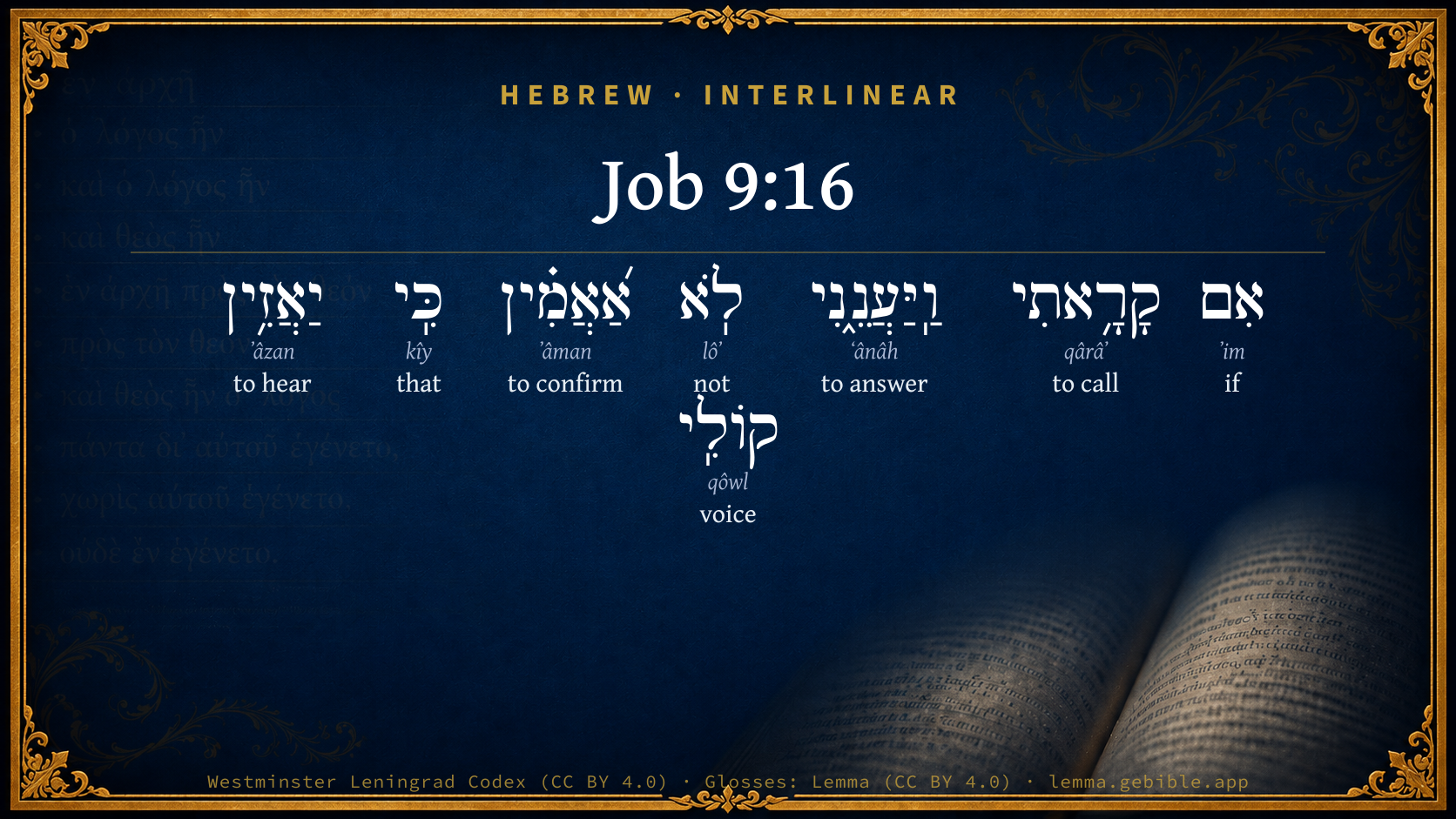
Job 9:16

Hebrew (Westminster Leningrad Codex) Job 9:16 appears in the Hebrew Old Testament. The text above is from the Westminster Leningrad Codex. Each word links to its Strong’s number, a concise gloss, and parsing drawn from the Open Scriptures Hebrew Bible morphology. Click any word for its full Brown-Driver-Briggs (BDB) entry.
Download image
Cite this verse

Job 9:16 (World English Bible). Public Domain. Lemma interlinear Bible study tool, https://lemma.gebible.app/v/job/9/16.

Show BibTeX & RIS
BibTeX
RIS
English Translation
If I had called, and he had answered me, Yet would I not believe that he listened to my voice.
World English Bible · Public Domain
Download a study sheet

One document with this verse’s original text, its word-by-word gloss line, the meaning frame, cross-references with their text, attributed commentary, and full source and license credits — printable, and it pastes into notes with its structure intact.

This verse Autodidact and up

Study sheet (.html) Plain text (.txt)

A passage Seminary Student

Up to 50 verses in one chapter. A passage sheet keeps up to 6 commentary sources and 12 cross-references per verse, in the order this page ranks them, and says so on the sheet whenever that leaves anything out. Ask for a single verse and you get the Autodidact verse sheet above.

Everything on this page stays free to read, with no account — the sheet is a download of what is already on screen, not access to it.

Want to remove ads? Support Godless Engineer
Compare translations 3

The same verse in 3 English versions, stacked beneath the original-language interlinear above. Click any original word for its lexicon entry.

Each is an independent rendering of the whole verse — the interlinear is not word-aligned to these translations.

Highlighted words mark where these versions differ — a whole-verse word diff, not a word-by-word alignment.

  • World English Bible Public Domain
    If I had called, and he had answered me, Yet would I not believe that he listened to my voice.
  • King James Version Public Domain
    If I had called, and he had answered me; yet would I not believe that he had hearkened unto my voice.
  • unfoldingWord Literal Text CC BY-SA 4.0
    If I called and he answered me, I would not believe that he was giving ear to my voice,

unfoldingWord Literal Text — © unfoldingWord, licensed CC BY-SA 4.0. Word-aligned USFM3 via Door43 (git.door43.org/unfoldingWord/en_ult).

Versions to compare (up to 4)

3 of 4 selected

Show all 18 translations

Every available English version of this verse, each an independent rendering of the whole verse.

  • World English Bible Public Domain
    If I had called, and he had answered me, Yet would I not believe that he listened to my voice.
  • Berean Standard Bible Public Domain
    If I summoned Him and He answered me, I do not believe He would listen to my voice.
  • Majority Standard Bible Public Domain
    If I summoned Him and He answered me, I do not believe He would listen to my voice.
  • King James Version Public Domain
    If I had called, and he had answered me; yet would I not believe that he had hearkened unto my voice.
  • American Standard Version (1901) Public Domain
    If I had called, and he had answered me, Yet would I not believe that he hearkened unto my voice.
  • Revised Version (1885) Public Domain
    If I had called, and he had answered me; yet would I not believe that he hearkened unto my voice.
  • Geneva Bible (1599) Public Domain
    If I cry, and he answere me, yet woulde I not beleeue, that he heard my voyce.
  • Douay-Rheims (1899) Public Domain
    And if he should hear me when I call, I should not believe that he had heard my voice.
  • Young's Literal Translation Public Domain
    Though I had called and He answereth me, I do not believe that He giveth ear `to' my voice.
  • Literal Standard Version CC BY-SA 4.0
    Though I had called and He answers me, I do not believe that He gives ear [to] my voice.
  • Unlocked Literal Bible CC BY-SA 4.0
    Even if I called and he answered me, I would not believe that he was listening to my voice.
  • unfoldingWord Literal Text CC BY-SA 4.0
    If I called and he answered me, I would not believe that he was giving ear to my voice,
  • Darby Bible Public Domain
    If I had called, and he had answered me, I would not believe that he hearkened to my voice, --
  • World Messianic Bible Public Domain
    If I had called, and he had answered me, yet I wouldn’t believe that he listened to my voice.
  • Webster's Bible Public Domain
    If I had called, and he had answered me; yet I would not believe that he had hearkened to my voice.
  • Free Bible Version CC BY-SA 4.0
    Even if I called him to come and he responded, I don't believe he would listen to me.
  • Bible in Basic English Public Domain
    If I had sent for him to be present, and he had come, I would have no faith that he would give ear to my voice.
  • JPS Tanakh (1917) Public Domain
    If I had called, and He had answered me; yet would I not believe that He would hearken unto my voice —

Literal Standard Version (2020), Covenant Press — licensed CC BY-SA 4.0. Text via the HelloAO Bible API (eBible.org). Unlocked Literal Bible (unfoldingWord) — licensed CC BY-SA 4.0. Text via the HelloAO Bible API (eBible.org). unfoldingWord Literal Text — © unfoldingWord, licensed CC BY-SA 4.0. Word-aligned USFM3 via Door43 (git.door43.org/unfoldingWord/en_ult). Free Bible Version, Dr. Jonathan Gallagher — licensed CC BY-SA 4.0. Text via the HelloAO Bible API (eBible.org).

Word by word

More ways to search: Search by grammar → Find every occurrence → Compare this word →

Practice this passage: Drill this verse → Learn its vocabulary →

About this verse

These counts appear in no published source. They are computed here, from the morphology-tagged text and Lemma’s own curated glosses. What Lemma adds →

8
words
8
distinct lemmas
Wisdom
section

Shared distinctive vocabulary

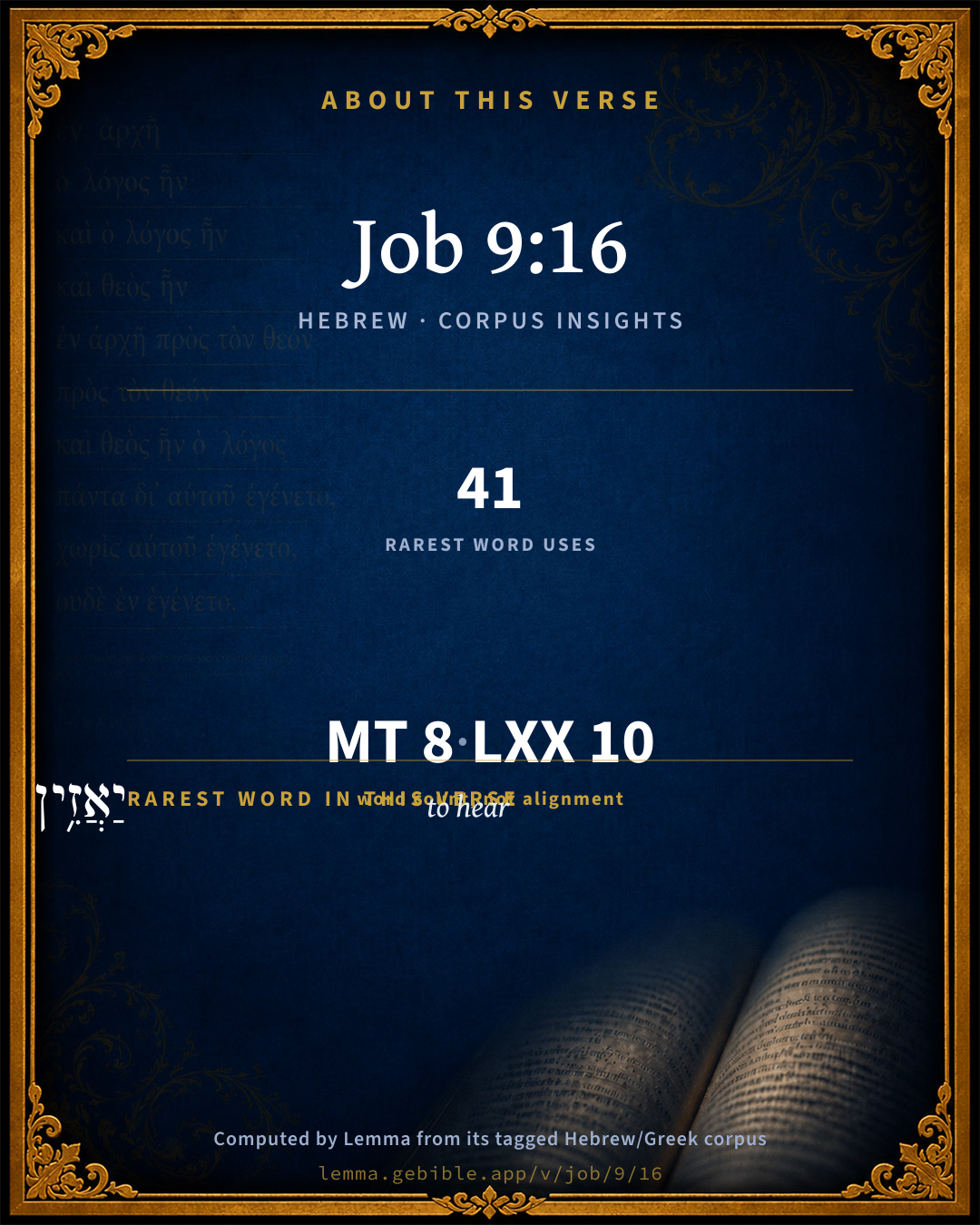
יַאֲזִ֥ין to hear H238 occurs in 41 verses of the Hebrew Bible. Also found in:

Grammatical profile

  • 4 verbs
  • 1 noun
  • 2 conjunctions
  • 1 particle

Verb forms

  • קָרָ֥אתִי Qal · Perfect
  • וַֽיַּעֲנֵ֑נִי Qal · Sequential Imperfect
  • אַ֝אֲמִ֗ין Hiphil · Imperfect
  • יַאֲזִ֥ין Hiphil · Imperfect

Hebrew & Septuagint length

In English translation the verse runs 20 words from the Hebrew and 20 from the Septuagint (LXX English) — the same length.

A rough comparison of the two English renderings, which tokenize alike — not a word-level alignment.

Word counts can differ between the Hebrew and the Greek without any difference in meaning — e.g. the Hebrew direct-object marker אֵת has no separate Greek word, and Greek often adds the article ὁ.

In the original languages it is 8 Hebrew tokens and 10 Greek tokens — but the two are counted differently (Hebrew bundles its prefixes and suffixes into one token; the Greek is in lemma form), so that isn’t a like-for-like length.

Cross-references

9

Topical passages linked to Job 9:16 in the Treasury of Scripture Knowledge — connected by theme and wording, ordered by reader-vote popularity; previews shown in the World English Bible.

  • Exodus 6:9 Moses spoke so to the children of Israel, but they didn't listen to Moses for anguish of spirit, and for cruel bondage.
  • Judges 6:13 Gideon said to him, Oh, my lord, if Yahweh is with us, why then has all this happened to us? and where are all his wondrous works which our fathers told us of, saying, Did not Yahweh bring us up from Egypt? but now Yahweh has cast us off, and delivered us into the hand of Midian.
  • Job 29:24 I smiled on them when they had no confidence. They didn't reject the light of my face.
  • Psalms 18:6 In my distress I called on Yahweh, And cried to my God. He heard my voice out of his temple, My cry before him came into his ears.
  • Psalms 66:18–20 If I cherished sin in my heart, The Lord wouldn't have listened.
  • Psalms 116:1–2 I love Yahweh, because he listens to my voice, And my cries for mercy.
  • Psalms 126:1 When Yahweh brought back those who returned to Zion, We were like those who dream.
  • Luke 24:41 While they still didn't believe for joy, and wondered, he said to them, "Do you have anything here to eat?"
  • Acts 12:14–16 When she recognized Peter's voice, she didn't open the gate for joy, but ran in, and reported that Peter was standing in front of the gate.

Cross-references courtesy of OpenBible.info (CC BY 4.0).

Hebrew and Greek witnesses Masoretic Hebrew ↔ Greek Septuagint

The same verse in the two great witnesses to the Old Testament, shown verse-for-verse.

These are two independent witnesses, not word-aligned to each other, and the Septuagint is shown in lemma (dictionary) form.

Hebrew Job 9:16 Masoretic · Westminster Leningrad Codex

אִם קָרָ֥אתִי וַֽיַּעֲנֵ֑נִי לֹֽא אַ֝אֲמִ֗ין כִּֽי יַאֲזִ֥ין קוֹלִֽי

If I had called, and he had answered me, Yet would I not believe that he listened to my voice.

World English Bible · Public Domain

Greek LXX Job 9:16 Septuagint · lemma form

ἐάν τε καλέω καί ὑποἀκούω οὐ πιστεύω ὅτι εἰςἀκούω ἐγώ

And if I should call and he should not listen, I can’t believe that he has listened to my voice.

LXX2012 (modern English Septuagint) · Public Domain

On this verse, Keil & Delitzsch discusses the Septuagint’s reading. Read the note in Commentary ↓

Hebrew: Westminster Leningrad Codex (CC BY 4.0). Greek: Septuagint (public domain); English from LXX2012 (modern English Septuagint) (Public Domain). How the Septuagint differs from the Hebrew →

Commentary

Notes on Job 9:16 from classic Christian and Jewish commentators (each source and its license shown beneath its notes). The classic Christian expositions comment on the surrounding passage and are grouped to its opening verse, so a note may address several verses; the Jewish commentaries on the Tanakh (Rashi and others) are per-verse, so they appear only where the commentator wrote on this verse.

Lemma curates 59 commentaries, every one of them public domain or Creative Commons licensed, each selected and text-cleaned for this edition rather than reprinted as found. About our sources →

The Cambridge Bible for Schools and Colleges

gen. ed. J. J. S. Perowne

16. In Job_9:14-15 the plea against God is not supposed actually entered upon; the idea of such a plea presents itself to Job’s mind and he pictures the results that would follow upon himself; in Job_9:16 he assumes the plea entered upon, that he had actually cited God, who had appeared, and he describes what would follow at this stage.

if I had called] i. e. cited God as a party in my plea against Him.

that he had hearkened] Rather, that he would hearken. Had Job with a superhuman courage cited God, and had God appeared, Job would not believe that He would listen to him, cf. Job_9:35, ch. Job_13:21 seq., Job_23:6 seq.

The Cambridge Bible for Schools and Colleges (gen. ed. J. J. S. Perowne; Cambridge University Press, 1878–1918) — public domain. Text from a community e-Sword module.

Trapp's Complete Commentary

John Trapp

Job 9:16 If I had called, and he had answered me; [yet] would I not believe that he had hearkened unto my voice.

Ver. 16. If l had called and he had answered] If, in confidence of mine own righteousness, I had sought some good thing at his hands, and he had therein condescended to me, yet would I not believe that he had, in mercy, hearkened to my voice; but rather, for a further mischief, that he might roll himself upon me, as Joseph upon his brethren, and as God did upon the Israelites after their quails; that he might tear them with his tempest, &c. Some think that Job speaketh these words, as despairing of audience, or denying God’s particular providence; but neither of these is likely. Rather it seemeth, saith Pineda, to be the speech of a mind marvellously cast down, and meanly conceited of himself, and of his prayer; and trusting to the goodness of God alone; so Drusius. Job speaketh not this, saith he, out of diffidence, but out of fear of God’s judgments, and sense of his own imperfections.

Yet I would not believe that he had hearkened unto my voice] Namely, for any worth that he findeth in it: what am I, poor creature, that I should think I had carried the matter with God?

John Trapp, A Commentary or Exposition upon All the Books of the Old and New Testament (1647–1656) — public domain. Text from a community e-Sword module.

The Biblical Illustrator

Joseph S. Exell

Job_9:16

Yet would I not believe that He had hearkened unto my voice.

Prerequisites to belief

It is hard to believe in that, some faint earnest of which we do not find in our own souls. A man cannot believe facts which are in the very teeth of his instinctive affinities and dispositions. The head hunters of Borneo would necessarily treat as fables the thousand and one humane institutions which are the products of Christian civilisation. A race of colour-blind barbarians, if such a race existed, would ridicule the idea of finding out the elements of which distant stars are fashioned by observing the bands and lines of colours disclosed by the spectroscope. There must be the beginning of vision in us if we are to receive the fairy tales of the microscopist and the astronomer. God can be made known to us only in these aspects in which we desire, however faintly, to be like Him. (T. G. Selby.)

The Biblical Illustrator, edited by Joseph S. Exell (c. 1880s–1900s) — public domain. Text from a community e-Sword module.

Joseph Benson's Commentary

Job 9:16. If I had called — That is, prayed, as the word קראתי, karati, commonly means, namely, unto my judge for a favourable sentence, as he had just said; and he had answered me — Had given me what I asked; yet would I not believe, &c. — So weak and imperfect are my best prayers; and, I am so infinitely below him, so obnoxious to him, and still so full of the tokens of his displeasure, that I would not believe he had done it because I had asked him; or, that it was owing to my prayers, but that he had bestowed the favour purely for his name’s sake. Bishop Patrick’s paraphrase is, “If I had made supplication, and he had granted my desire, I would not think my prayer had done the business.”

Joseph Benson's Commentary on the Old and New Testaments (1811–1818) — public domain. Text from a community e-Sword module.

Keil & Delitzsch

C. F. Keil & F. Delitzsch

16 If when I called He really answered,

I could not believe that He would hearken to me;

17 He would rather crush me in a tempest,

And only multiply my wounds without cause;

18 He would not suffer me to take my breath,

But would fill me with bitter things.

19 If it is a question of the strength of the strong - : "Behold here!"

And if of right - : "Who will challenge me?"

20 Where I in the right, my mouth must condemn me;

Were I innocent, He would declare me guilty.

The answer of God when called upon, i.e., summoned, is represented in Job 9:16 as an actual result (praet. followed by fut. consec.), therefore Job 9:16 cannot be intended to express: I could not believe that He answers me, but: I could not believe that He, the answerer, would hearken to me; His infinite exaltation would not permit such condescension. The אשׁר which follows, Job 9:17, signifies either quippe qui or quoniam; both shades of meaning are after all blended, as in Job 9:15. The question arises here whether שׁוף signifies conterere, or as cognate form with שׁאף, inhiare, - a question also of importance in the exposition of the Protevangelium. There are in all only three passages in which it occurs: here, Gen 3:15, and Psa 139:11. In Psa 139:11 the meaning conterere is unsuitable, but even the signification inhiare can only be adopted for want of a better: perhaps it may be explained by comparison with צעף, in the sense of obvelare, or as a denominative from נשׁף (the verb of which, נשׁף, is kindred to נשׁב, נשׁם, flare) in the signification obtenebrare. In Gen 3:15, if regarded superficially, the meaning inhiare and conterere are alike suitable, but the meaning inhiare deprives that utterance of God of its prophetic character, which has been recognised from the beginning; and the meaning conterere, contundere, is strongly supported by the translations. We decide in favour of this meaning also in the present passage, with the ancient translations (lxx ἐκτρίψῃ, Targ. מדקדּק, comminuens). Moreover, it is the meaning most generally supported by a comparison with the dialects, whereas the signification inhiare can only be sustained by comparison with שׁאף and the Arabic sâfa (to sniff, track by scent, to smell); besides, "to assail angrily" (Hirz., Ewald) is an inadmissible contortion of inhiare, which signifies in a hostile sense "to seize abruptly" (Schlottm.), properly to snatch, to desire to seize.

Translate therefore: He would crush me in a tempest and multiply (multiplicaret), etc., would not let me take breath (respirare), but (כּי, Ges. 155, 1, e. a.) fill me (ישׂבּיענּי, with Pathach with Rebia mugrasch) with bitter things (ממּררים, with Dag. dirimens, which gives the word a more pathetic expression). The meaning of Job 9:19 is that God stifles the attempt to maintain one's right in the very beginning by His being superior to the creature in strength, and not entering into a dispute with him concerning the right. הנּה (for הנּני as איּה, Job 15:23, for איּו): see, here I am, ready for the contest, is the word of God, similar to quis citare possit me (in Jer 49:19; Jer 50:44), which sounds as an echo of this passage. The creature must always be in the wrong, - a thought true in itself, in connection with which Job forgets that God's right in opposition to the creature is also always the true objective right. פּי, with suffix, accented to indicate its logical connection, as Job 15:6 : my own mouth.

(Note: Olshausen's conjecture, פּיו, lessens the difficulty in Isa 34:16, but here it destroys the strong expression of the violence done to the moral consciousness.)

In ויּעקשׁני the Chirek of the Hiphil is shortened to a Sheva, as Sa1 17:25; vid., Ges. 53, rem. 4. The subject is God, not "my mouth" (Schlottm.): supposing that I were innocent, He would put me down as one morally wrong and to be rejected.

Keil & Delitzsch — Biblical Commentary on the Old Testament (1861–1891) — public domain (CC PDM 1.0). Text via the HelloAO Bible API. (Old Testament only.)

Geneva Bible (1599)

Geneva Bible translators

While I am in my pangs, I cannot but burst forth into many inconveniences, although I know still that God is just.

Geneva Bible (1599) marginal notes — public domain. Text via Bolls.life.

Jamieson, Fausset & Brown

Robert Jamieson, A. R. Fausset & David Brown

would I not believe that he had hearkened unto my voice--who breaketh me (as a tree stripped of its leaves) with a tempest.

Jamieson, Fausset & Brown — Commentary Critical and Explanatory on the Whole Bible (1871) — public domain (CC PDM 1.0). Text via the HelloAO Bible API.

Adam Clarke's Commentary

Verse 16. If I had called, and he had answered] I could scarcely suppose, such is his majesty and such his holiness, that he could condescend to notice a being so mean, and in every respect so infinitely beneath his notice. These sentiments sufficiently confuted that slander of his friends, who said he was presumptuous, had not becoming notions of the majesty of God, and used blasphemous expressions against his sovereign authority.

Adam Clarke's Commentary on the Bible (1810–1826) — public domain. Text from a community e-Sword/MySword module.

John Gill's Exposition

For he breaketh me with a tempest,.... Which rises suddenly, comes powerfully, and carries all before it irresistibly; hereby signifying the nature of his present sore afflictions, which came upon him at once, pressed him down, and utterly destroyed him, against which there was no standing: perhaps he may have some reference to the storm of wind that blew down the house, by which his children were destroyed. Schultens renders it, "a burning tempest" (s), such as is common in the eastern countries, which Thevenot (t) often makes mention of; which kills a man at once, and his flesh becomes as black as a coal, and comes off of his bones, and is plucked off by the hand that would lift him up; with which a man is broken to pieces indeed, to which Job may allude:

and multiplieth my wounds without cause; referring, it may be, to the many boils and ulcers upon his body; though it may also respect the multiplicity of ways in which he had wounded or afflicted him, in his person, in his family, and in his substance, and which he says was done "without cause"; not without a cause or reason in God, who does nothing without one, though it may not be known to men; particularly in afflicting men, it is not without cause or reason; it he punishes men, it is for sin; if he rebukes and chastises his people, it is for their transgressions; to bring them to a sense of them, to humble them for them, to bring them off from them, or to prevent them, or purge them away, and to try their graces, wean them from the world, and fit them for himself: but Job's afflictions were without any such cause intimated by his friends; it was not hypocrisy, nor any notorious sin or sins he had been guilty of, and secretly lived and indulged himself in, as they imagined. Job here suggests his innocence, which he always insisted upon, and refers his afflictions to the sovereign will of God, and to some hidden cause in his own breast, unknown to himself and others: however, so long as he dealt with him after this manner, he could not believe his prayers were heard by him.

(s) "in turbine ardenti", Schultens. (t) Travels, par. 2. B. 1. c. 12. p. 54. B. 3. c. 5. p. 135.

John Gill's Exposition of the Whole Bible (1746–1763) — public domain (CC PDM 1.0). Text via the HelloAO Bible API.

Albert Barnes' Notes on the Bible

If I had called, and he had answered me - It is remarked by Schultens, that the expressions in these verses are all taken from courts of justice. If so, the meaning is, that even if Job should call the Almighty to a judicial action, and he should respond to him, and consent to submit the great question about his innocence, and about the justice of the divine dealings with him, to trial, yet that such was the distance between God and him, that he could not hope successfully to contend with him in the argument. He would, therefore, prostrate himself in a suppliant manner, and implore his mercy and compassion - submitting to him as having all power, and as being a just and righteous Sovereign.

Would I not believe - I cannot believe that he would enter into my complaint. He deals with me in a manner so severe; he acts toward me so much as a sovereign, that I have no reason to suppose that he would not continue to act toward me in the same way still.

Albert Barnes' Notes on the Bible (1834–1885) — public domain. Text from a community e-Sword/MySword module.

Haydock's Catholic Bible Commentary

Voice. So much am I beneath his notice. How unjust were the aspersions of Job’s friends, who accused him of presumption and blasphemy! (Calmet) --- No one ever spoke with greater humility (Haydock) and respect of God’s absolute dominion. (Calmet) --- He will attribute nothing to his own prayers, as he is still in the dark. (Menochius)

George Leo Haydock (1774–1849), Haydock's Catholic Family Bible and Commentary, 1859 edition — public domain. Excludes Psalms (Douay-Rheims chapter numbering differs from Protestant) and Deuterocanonical books (Catholic canon only).

Matthew Poole's English Annotations

If I had called, i.e. prayed, as this word is commonly used, to wit, unto my Judge, for a favourable sentence, as he now said, and therefore it was needless here to mention the object of his calling or prayer.

Yet would I not believe that he had hearkened unto my voice; I could not believe that God had indeed granted my desire, though he had done it; because I am so infinitely below him, and obnoxious to him, and still full of the tokens of his displeasure; and therefore should conclude that it was but a pleasant dream or fancy, and not a real thing: compare Psa 126:1.

Matthew Poole's English Annotations on the Holy Bible (1683–1685) — public domain. Text from a community e-Sword/MySword module.

Whedon's Commentary on the Bible

Daniel D. Whedon

16. If I had called — From Job_9:12-15 he supposes the case that God would take the initiative in summoning to trial; now, that he himself would: Should I summon him, and he answer me, I would hardly believe my senses that there could be such condescension and sense of justice!

Daniel D. Whedon (gen. ed.), Commentary on the Old and New Testaments (1874–1909) — public domain. Text from a community e-Sword module.

The Pulpit Commentary

If I had called, and he had answered me. "It," that is, "I had challenged God to a controversy, and he had granted it, and bidden me to plead my cause at his bar, yet could I not suppose that he had really hearkened to me, and would allow me boldly to stand up before him and freely to challenge his doings. Such condescension on his part, such an abnegation of his supremacy, is inconceivable, and! could not have acted on it." Yet would I not believe that he had hearkened unto my voice; rather, yet could I not believe. It was not that he would not have wished, but that he would not have been able, to believe.

The Pulpit Commentary (1880–1919), ed. H.D.M. Spence-Jones & Joseph S. Exell — public domain. Text from a community e-Sword module.

John Wesley's Explanatory Notes

Yet - I could not believe that God had indeed granted my desire, because I am still full of the tokens of his displeasure; and therefore should conclude that it was but a pleasant dream, and not a real thing.

John Wesley, Explanatory Notes Upon the Whole Bible (1754–1765) — public domain. Text via the GEBible commentary corpus.

unfoldingWord translationNotes

Door43 World Missions Community

For he breaks me with a tempest

Job compares his troubles from God to the effects of a tempest. AT: "He injures me as if with a tempest" (See: Metaphor)

tempest

a powerful or violent storm

multiplies my wounds

"gives me many wounds" or "wounds me again and again"

without cause

"even though I have not given him cause to do so" or "even though I am innocent"

to regain my breath

This is an idiom that means "to be able to breathe again" or (See: Idiom)

he fills me with bitterness

This verse pictures God as filling up Job's life with things that make him bitter. The abstract noun "bitterness" can be expressed as the adjective "bitter." AT: "he fills me up with bitter things" (See: Metaphor and Abstract Nouns)

translationWords

call

believe

voice

breath

unfoldingWord translationNotes — © Distant Shores Media and the Door43 World Missions Community, licensed CC BY-SA 4.0. Source: git.door43.org/Door43/en_tn.

Rashi

Rabbi Shlomo Yitzchaki (Rashi)

I will not believe I will be unable to believe out of my fear for Him, for how do I not see Him?

Rashi on the Tanakh — English translations: “The Judaica Press complete Tanach with Rashi, translated by A. J. Rosenberg” (CC BY 4.0); “Pentateuch with Rashi's commentary by M. Rosenbaum and A.M. Silbermann, 1929-1934” (public domain); “The Metsudah Tanach series, Lakewood, N.J” (CC BY 4.0); and “The Book of Joshua, Metsudah Publications, 1997” (CC BY 4.0). Text via Sefaria.

Lesson kit

Teaching starters — assembled from the data on this page, not authored interpretation. Every prompt links to the verse data it draws on. Edit before teaching.

Job, in the Wisdom, opens this verse with 8 words (8 distinct Hebrew lemmas). Its most distinctive word is ʼâzan (“to hear”). A historical commentator’s framing appears above. Read the whole chapter for the surrounding context.

Discussion questions

  1. How does “to hear” (ʼâzan) shape what this verse is saying?
  2. How does Genesis 4:23, which shares the word «to hear», read alongside this verse?
  3. The translations on this page render this verse differently — a whole-verse word diff, not a word-by-word alignment. What might account for the different wordings?
  4. «קָרָ֥אתִי» is a Qal Perfect verb. How does that grammatical form shape the action described?
  5. Compare how The Cambridge Bible for Schools and Colleges and Trapp's Complete Commentary read this verse. Where do they agree or differ?

Things to notice

Reading settings

Reading text

Shown beneath each verse's original-language words.

Old Testament
Old Testament edition

Read the OT as the Masoretic Hebrew (MT) or the Greek Septuagint (LXX).

English shown for the Greek Septuagint (in the Hebrew ↔ Greek comparison).

Comparing translations? Open the Compare panel on any verse page to stack up to four side by side.