1 Samuel 28:12

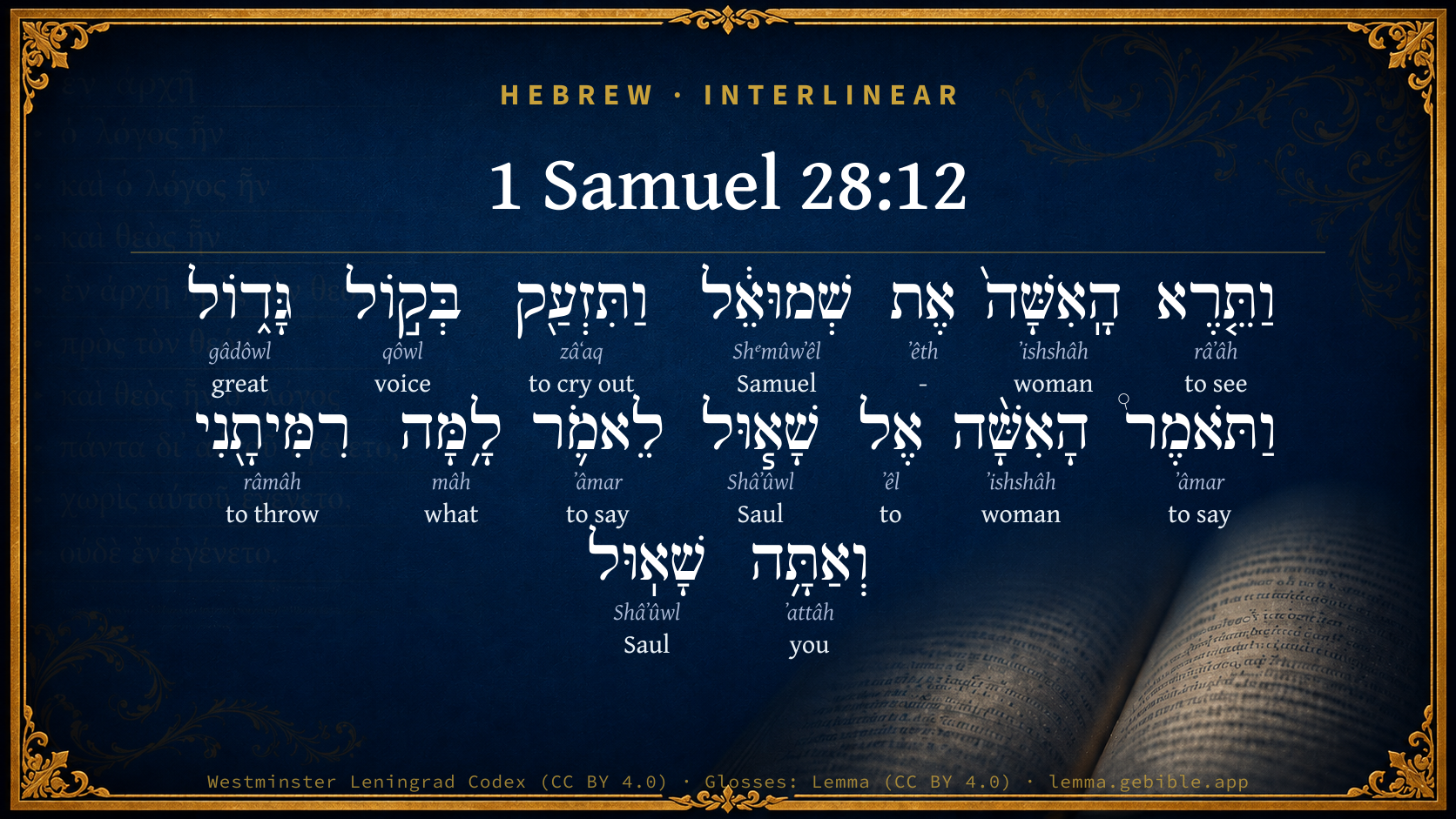
Hebrew (Westminster Leningrad Codex) 1 Samuel 28:12 appears in the Hebrew Old Testament. The text above is from the Westminster Leningrad Codex. Each word links to its Strong’s number, a concise gloss, and parsing drawn from the Open Scriptures Hebrew Bible morphology. Click any word for its full Brown-Driver-Briggs (BDB) entry.
Download image
Cite this verse

1 Samuel 28:12 (World English Bible). Public Domain. Lemma interlinear Bible study tool, https://lemma.gebible.app/v/1-samuel/28/12.

Show BibTeX & RIS
BibTeX
RIS
English Translation
When the woman saw Samuel, she cried with a loud voice; and the woman spoke to Saul, saying, Why have you deceived me? for you are Saul.
World English Bible · Public Domain
Download a study sheet

One document with this verse’s original text, its word-by-word gloss line, the meaning frame, cross-references with their text, attributed commentary, and full source and license credits — printable, and it pastes into notes with its structure intact.

This verse Autodidact and up

Study sheet (.html) Plain text (.txt)

A passage Seminary Student

Up to 50 verses in one chapter. A passage sheet keeps up to 6 commentary sources and 12 cross-references per verse, in the order this page ranks them, and says so on the sheet whenever that leaves anything out. Ask for a single verse and you get the Autodidact verse sheet above.

Everything on this page stays free to read, with no account — the sheet is a download of what is already on screen, not access to it.

Want to remove ads? Support Godless Engineer
Compare translations 3

The same verse in 3 English versions, stacked beneath the original-language interlinear above. Click any original word for its lexicon entry.

Each is an independent rendering of the whole verse — the interlinear is not word-aligned to these translations.

Highlighted words mark where these versions differ — a whole-verse word diff, not a word-by-word alignment.

  • World English Bible Public Domain
    When the woman saw Samuel, she cried with a loud voice; and the woman spoke to Saul, saying, Why have you deceived me? for you are Saul.
  • King James Version Public Domain
    And when the woman saw Samuel, she cried with a loud voice: and the woman spake to Saul, saying, Why hast thou deceived me? for thou art Saul.
  • unfoldingWord Literal Text CC BY-SA 4.0
    And the woman saw Samuel, and she cried out with a loud voice. And the woman spoke to Saul, saying, “Why have you deceived me? For you are Saul!”

unfoldingWord Literal Text — © unfoldingWord, licensed CC BY-SA 4.0. Word-aligned USFM3 via Door43 (git.door43.org/unfoldingWord/en_ult).

Versions to compare (up to 4)

3 of 4 selected

Show all 18 translations

Every available English version of this verse, each an independent rendering of the whole verse.

  • World English Bible Public Domain
    When the woman saw Samuel, she cried with a loud voice; and the woman spoke to Saul, saying, Why have you deceived me? for you are Saul.
  • Berean Standard Bible Public Domain
    But when the woman saw Samuel, she cried out in a loud voice and said to Saul, “Why have you deceived me? You are Saul!”
  • Majority Standard Bible Public Domain
    But when the woman saw Samuel, she cried out in a loud voice and said to Saul, “Why have you deceived me? You are Saul!”
  • King James Version Public Domain
    And when the woman saw Samuel, she cried with a loud voice: and the woman spake to Saul, saying, Why hast thou deceived me? for thou art Saul.
  • American Standard Version (1901) Public Domain
    And when the woman saw Samuel, she cried with a loud voice; and the woman spake to Saul, saying, Why hast thou deceived me? for thou art Saul.
  • Revised Version (1885) Public Domain
    And when the woman saw Samuel, she cried with a loud voice: and the woman spake to Saul, saying, Why hast thou deceived me? for thou art Saul.
  • Geneva Bible (1599) Public Domain
    And when the woman sawe Samuel, she cryed with a loude voyce, and the woman spake to Saul, saying, Why hast thou deceiued me? for thou art Saul.
  • Douay-Rheims (1899) Public Domain
    And when the woman saw Samuel, she cried out with a loud voice, and said to Saul: Why hast thou deceived me? for thou art Saul.
  • Young's Literal Translation Public Domain
    And the woman seeth Samuel, and crieth with a loud voice, and the woman speaketh unto Saul, saying, `Why hast thou deceived me -- and thou Saul?'
  • Literal Standard Version CC BY-SA 4.0
    And the woman sees Samuel, and cries with a loud voice, and the woman speaks to Saul, saying, “Why have you deceived me? For you [are] Saul!”
  • Unlocked Literal Bible CC BY-SA 4.0
    When the woman saw Samuel, she cried with a loud voice and spoke to Saul, saying, “Why have you deceived me? For you are Saul.”
  • unfoldingWord Literal Text CC BY-SA 4.0
    And the woman saw Samuel, and she cried out with a loud voice. And the woman spoke to Saul, saying, “Why have you deceived me? For you are Saul!”
  • Darby Bible Public Domain
    And when the woman saw Samuel, she cried out with a loud voice; and the woman spoke to Saul, saying, Why hast thou deceived me? Even thou art Saul.
  • World Messianic Bible Public Domain
    When the woman saw Samuel, she cried with a loud voice; and the woman spoke to Saul, saying, “Why have you deceived me? For you are Saul!”
  • Webster's Bible Public Domain
    And when the woman saw Samuel, she cried with a loud voice: and the woman spoke to Saul, saying, Why hast thou deceived me? for thou art Saul.
  • Free Bible Version CC BY-SA 4.0
    But when the woman saw Samuel, she shouted loudly, and said to Saul, “Why have you tricked me? You're Saul!”
  • Bible in Basic English Public Domain
    And the woman saw that it was Saul, and she gave a loud cry, and said to Saul, Why have you made use of deceit? for you are Saul.
  • JPS Tanakh (1917) Public Domain
    And when the woman saw Samuel, she cried with a loud voice; and the woman spoke to Saul, saying: 'Why hast thou deceived me? for thou art Saul.'

Literal Standard Version (2020), Covenant Press — licensed CC BY-SA 4.0. Text via the HelloAO Bible API (eBible.org). Unlocked Literal Bible (unfoldingWord) — licensed CC BY-SA 4.0. Text via the HelloAO Bible API (eBible.org). unfoldingWord Literal Text — © unfoldingWord, licensed CC BY-SA 4.0. Word-aligned USFM3 via Door43 (git.door43.org/unfoldingWord/en_ult). Free Bible Version, Dr. Jonathan Gallagher — licensed CC BY-SA 4.0. Text via the HelloAO Bible API (eBible.org).

Word by word

More ways to search: Search by grammar → Find every occurrence → Compare this word →

Practice this passage: Drill this verse → Learn its vocabulary →

רִמִּיתָ֖נִי
râmâh
H7411
“to throw · me”
Verb, Piel, Perfect, 2nd Person, Masculine, Singular + Suffix, Personal, 1st Person, Common, Singular
Part of Speech
Verb
Stem
Piel
Form
Perfect
Person
2nd Person
Gender
Masculine
Number
Singular
Full BDB Definition

Origin: a primitive root

TWOT: 2168 , 2169

to cast, shoot, hurl - (Qal) - to throw - bow-shooters, bowmen (participle) - (Piel) to throw down - to beguile, deceive, mislead, deal treacherously - (Piel) - to beguile, deceive, mislead, trick - to deal treacherously with, betray
  1. וַתֵּ֤רֶא râʼâh H7200 “and · to see” Conjunction + Verb, Qal, Sequential Imperfect, 3rd Person, Feminine, Singular
  2. הָֽאִשָּׁה֙ ʼishshâh H802 “the · woman” Particle, Definite Article + Noun, Common, Feminine, Singular, Absolute
  3. אֶת ʼêth H853 “-” Particle, Direct Object
  4. שְׁמוּאֵ֔ל Shᵉmûwʼêl H8050 “Samuel” Noun, Proper
  5. וַתִּזְעַ֖ק zâʻaq H2199 “and · to cry out” Conjunction + Verb, Qal, Sequential Imperfect, 3rd Person, Feminine, Singular
  6. בְּק֣וֹל qôwl H6963 “in/at · voice” Preposition + Noun, Common, Masculine, Singular, Absolute
  7. גָּד֑וֹל gâdôwl H1419 “great” Adjective, Adjective, Masculine, Singular, Absolute
  8. וַתֹּאמֶר֩ ʼâmar H559 “and · to say” Conjunction + Verb, Qal, Sequential Imperfect, 3rd Person, Feminine, Singular
  9. הָאִשָּׁ֨ה ʼishshâh H802 “the · woman” Particle, Definite Article + Noun, Common, Feminine, Singular, Absolute
  10. אֶל ʼêl H413 “to” Preposition
  11. שָׁא֧וּל Shâʼûwl H7586 “Saul” Noun, Proper
  12. לֵאמֹ֛ר ʼâmar H559 “to say” Preposition + Verb, Qal, Infinitive Construct
  13. לָ֥מָּה mâh H4100 “to/for · what” Preposition + Particle, Interrogative
  14. וְאַתָּ֥ה ʼattâh H859 “and · you” Conjunction + Pronoun, Personal, 2nd Person, Masculine, Singular
  15. שָׁאֽוּל Shâʼûwl H7586 “Saul” Noun, Proper

About this verse

These counts appear in no published source. They are computed here, from the morphology-tagged text and Lemma’s own curated glosses. What Lemma adds →

16
words
13
distinct lemmas
Historical
section

Notable vocabulary

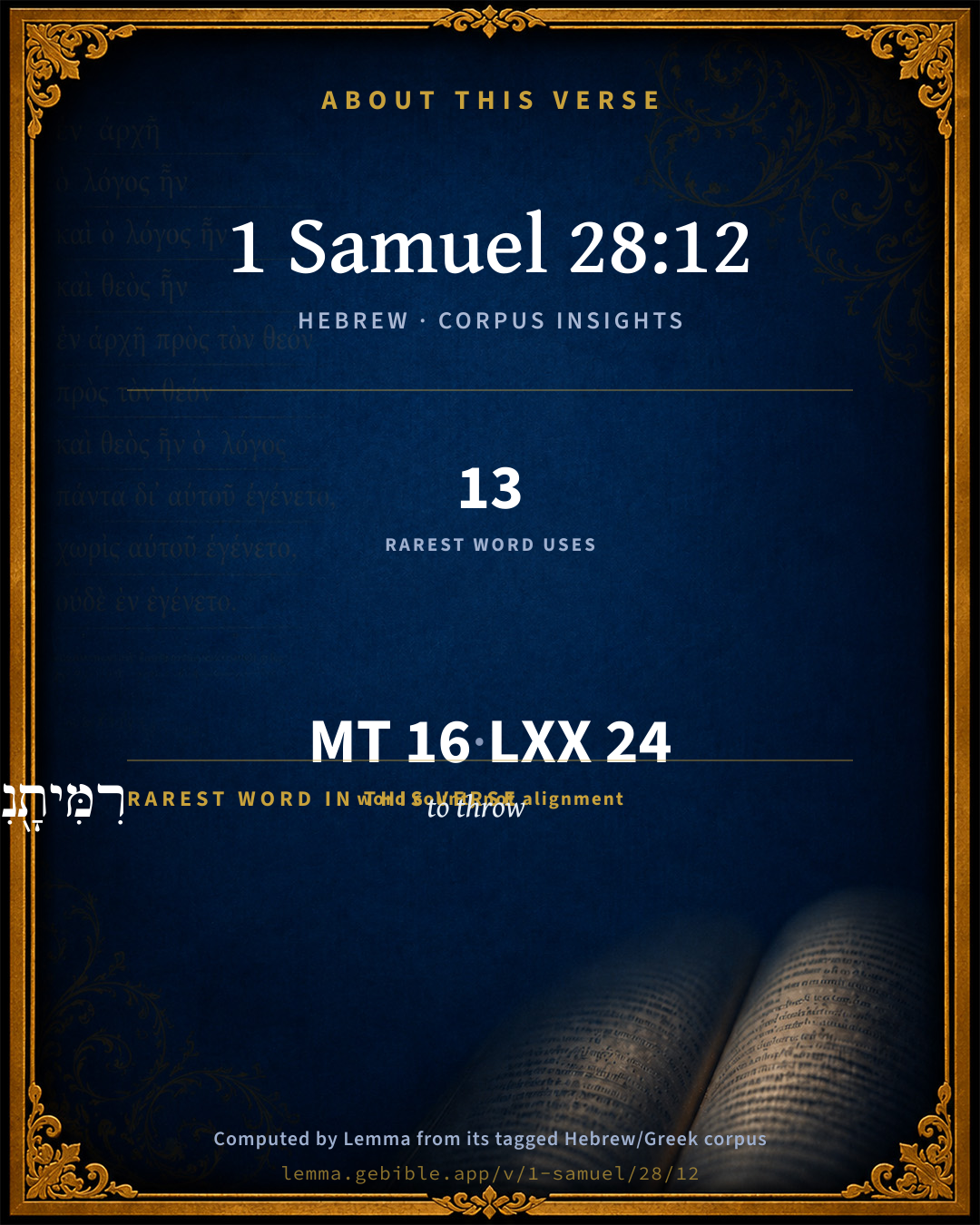
The rarest word here is רִמִּיתָ֖נִי to throw H7411 — appearing just 13 times in the whole Hebrew Bible.

Shared distinctive vocabulary

רִמִּיתָ֖נִי to throw H7411 occurs in 13 verses of the Hebrew Bible. Also found in:

Grammatical profile

  • 5 verbs
  • 6 nouns
  • 1 adjective
  • 1 pronoun
  • 1 preposition
  • 2 particles

Verb forms

  • וַתֵּ֤רֶא Qal · Sequential Imperfect
  • וַתִּזְעַ֖ק Qal · Sequential Imperfect
  • וַתֹּאמֶר֩ Qal · Sequential Imperfect
  • לֵאמֹ֛ר Qal · Infinitive Construct
  • רִמִּיתָ֖נִי Piel · Perfect

Repetition

Words recur within this verse — often emphatic in Hebrew:

  • הָֽאִשָּׁה֙ woman H802 ×2
  • וַתֹּאמֶר֩ to say H559 ×2
  • שָׁא֧וּל Saul H7586 ×2

Hebrew & Septuagint length

In English translation the verse runs 27 words from the Hebrew and 27 from the Septuagint (LXX English) — the same length.

A rough comparison of the two English renderings, which tokenize alike — not a word-level alignment.

Word counts can differ between the Hebrew and the Greek without any difference in meaning — e.g. the Hebrew direct-object marker אֵת has no separate Greek word, and Greek often adds the article ὁ.

In the original languages it is 16 Hebrew tokens and 24 Greek tokens — but the two are counted differently (Hebrew bundles its prefixes and suffixes into one token; the Greek is in lemma form), so that isn’t a like-for-like length.

Cross-references

2

Topical passages linked to 1 Samuel 28:12 in the Treasury of Scripture Knowledge — connected by theme and wording, ordered by reader-vote popularity; previews shown in the World English Bible.

  • 1 Samuel 28:3 Now Samuel was dead, and all Israel had lamented him, and buried him in Ramah, even in his own city. Saul had put away those who had familiar spirits, and the wizards, out of the land.
  • 1 Kings 14:5 Yahweh said to Ahijah, Behold, the wife of Jeroboam comes to inquire of you concerning her son; for he is sick: thus and thus shall you tell her; for it will be, when she comes in, that she will feign herself to be another woman.

Cross-references courtesy of OpenBible.info (CC BY 4.0).

Hebrew and Greek witnesses Masoretic Hebrew ↔ Greek Septuagint

The same verse in the two great witnesses to the Old Testament, shown verse-for-verse.

These are two independent witnesses, not word-aligned to each other, and the Septuagint is shown in lemma (dictionary) form.

Hebrew 1 Samuel 28:12 Masoretic · Westminster Leningrad Codex

וַתֵּ֤רֶא הָֽאִשָּׁה֙ אֶת שְׁמוּאֵ֔ל וַתִּזְעַ֖ק בְּק֣וֹל גָּד֑וֹל וַתֹּאמֶר֩ הָאִשָּׁ֨ה אֶל שָׁא֧וּל לֵאמֹ֛ר לָ֥מָּה רִמִּיתָ֖נִי וְאַתָּ֥ה שָׁאֽוּל

When the woman saw Samuel, she cried with a loud voice; and the woman spoke to Saul, saying, Why have you deceived me? for you are Saul.

World English Bible · Public Domain

Greek LXX 1 Samuel 28:12 Septuagint · lemma form

καί ὁράω ὁ γυνή ὁ σαμουηλ καί ἀναβοάω φωνή μέγας καί εἶπον ὁ γυνή πρός σαούλ ἵνα τίς παραλογίζομαι ἐγώ καί σύ εἰμί σαούλ

And the woman saw Samuel, and cried out with a loud voice: and the woman said to Saul, Why have you deceived me? for you are Saul.

LXX2012 (modern English Septuagint) · Public Domain

On this verse, The Pulpit Commentary discusses the Septuagint’s reading. Read the note in Commentary ↓

Hebrew: Westminster Leningrad Codex (CC BY 4.0). Greek: Septuagint (public domain); English from LXX2012 (modern English Septuagint) (Public Domain). How the Septuagint differs from the Hebrew →

Targum (Aramaic paraphrase)

1

The Targum is the ancient Jewish Aramaic paraphrase of the Hebrew Scriptures — an interpretive translation, not the Hebrew text itself. Onkelos (literal) and Pseudo-Jonathan (expansive) render the Torah, and Jonathan the Prophets. Coverage is partial: where no permissively-licensed English translation exists for a verse, only the Aramaic is shown. This is verse-level text, not a word-by-word alignment to the Hebrew.

  1. Targum Jonathan Prophets (Joshua–Malachi)
    וַחֲזַת אִתְּתָא יַת שְׁמוּאֵל וּצְוָחַת בְּקַל רַב וַאֲמָרַת אִתְּתָא לְשָׁאוּל לְמֵימָר לְמָה שְׁקַרְתְּ בִּי וְאַתְּ שָׁאוּל:

    (no public-domain English translation for this verse)

    Targum Jonathan — Aramaic: “Mikraot Gedolot” (public domain). English: “Sefaria Community Translation” (CC0 1.0 (public-domain dedication)); “London "Chaldee Paraphrase," 1871” (public domain). Text via Sefaria.

Commentary

Notes on 1 Samuel 28:12 from classic Christian and Jewish commentators (each source and its license shown beneath its notes). The classic Christian expositions comment on the surrounding passage and are grouped to its opening verse, so a note may address several verses; the Jewish commentaries on the Tanakh (Rashi and others) are per-verse, so they appear only where the commentator wrote on this verse.

Lemma curates 59 commentaries, every one of them public domain or Creative Commons licensed, each selected and text-cleaned for this edition rather than reprinted as found. About our sources →

Trapp's Complete Commentary

John Trapp

1Sa 28:12 And when the woman saw Samuel, she cried with a loud voice: and the woman spake to Saul, saying, Why hast thou deceived me? for thou [art] Saul.

Ver. 12. And when the woman saw Samuel.] That is, The devil in Samuel’s mantle. Who also told her that it was Saul, whence her outcry.

John Trapp, A Commentary or Exposition upon All the Books of the Old and New Testament (1647–1656) — public domain. Text from a community e-Sword module.

Joseph Benson's Commentary

1Sa 28:12. And when the woman saw Samuel — The particle when, which our translators have inserted here, and which is not in the original text, embarrasses the sense, and is calculated to give the reader a wrong idea of this transaction, leading him to think that some space of time intervened between Saul’s request and Samuel’s appearance, during which the woman was employed in practising her art. Whereas the Hebrew implies no such thing. It is literally, And he (Saul) said, Bring me up Samuel; and the woman saw Samuel, and cried with a loud voice, &c. — The true state of this affair seems to have been, that as soon as Saul had signified whom he wished to have brought up, the woman was about to proceed to her charms and incantations, “designing,” says Dr. Dodd, “either to put some trick upon Saul, by producing an accomplice to represent Samuel; or, may we not believe that evil spirits, really assisting on such occasions, might, and did come in to the aid of execrable wretches, sold to their service like this woman!” Be this, however, as it may, contrary to all her expectation, the moment Saul had mentioned the name of Samuel, the woman saw a venerable figure before her, which made her shriek out with astonishment, Why hast thou deceived me? for thou art Saul — She knew this appearance was not owing to any contrivance of her own, or her associates. It was what she in no wise expected; and she immediately concluded, that it could be no less a person than the king of Israel that this venerable person was really sent to. From all the circumstances of the relation, it appears that the woman herself was convinced, as the Egyptian magicians were upon another occasion, that this was the finger of God. To suppose that the woman herself, by her familiar spirit or spells, raised Samuel, or any evil spirit that personated him; or that she put a trick upon Saul, by causing one of her associates to appear as Samuel, is so contrary to reason, and the circumstances of the story, that no unprejudiced mind can well, upon an attentive perusal, take it in any such light. Indeed, the credit of the historian is implicated in this relation. He expressly says the woman saw Samuel, and if we believe that she did not see Samuel, but only an evil spirit personating him, we must call in question either the ability or integrity of the sacred writer: we must conceive either that he did not know what he wrote about, or that he designed to deceive his readers. Supposing then that both the woman and Saul might be deceived by an impostor in Samuel’s guise; yet we ask, Was this author deceived? Or did he mean to deceive us, when he gives us to understand, that the woman saw Samuel, and was frighted at the sight!

Joseph Benson's Commentary on the Old and New Testaments (1811–1818) — public domain. Text from a community e-Sword module.

Tyndale Open Study Notes

Tyndale Open Resources

28:12 It is not clear why seeing Samuel caused the woman to recognize Saul.

Tyndale Open Study Notes — © Tyndale Open Resources, licensed CC BY-SA 4.0. Text via the HelloAO Bible API.

Adam Clarke's Commentary

Verse 12. When the woman saw Samuel] That Samuel did appear on this occasion, is most evident from the text; nor can this be denied from any legitimate mode of interpretation: and it is as evident that he was neither raised by the power of the devil nor the incantations of the witch, for the appearances which took place at this time were such as she was wholly unacquainted with. Her familiar did not appear; and from the confused description she gives, it is fully evident that she was both surprised and alarmed at what she saw, being so widely different from what she expected to see.

Adam Clarke's Commentary on the Bible (1810–1826) — public domain. Text from a community e-Sword/MySword module.

Ellicott's Commentary for English Readers

(12) And when the woman saw Samuel, she cried with a loud voice.—Nothing is more clear from the narration than that the woman of En-dor saw something she never dreamed of seeing. Whatever did appear that night was different from anything she had seen before. Whether or not she was an impostor matters little to us. From the severe enactments in the Mosaic code respecting these practices, it would seem as though in the background there was something dark and sinister. At all events, on this memorable occasion, the witch was evidently amazed and appalled at the success of her enchantments. Ewald supposes that she burst into a loud cry on seeing Samuel’s shade, because it ascended with such frightfully threatening gestures, as it could have used only against its deadly enemy, Saul; and she then saw that the questioner must be Saul. This can, however, only be taken as an ingenious surmise. There is a singular passage in the Chaggigah Treatise of the Babylonian Talmud (quoted below), which—contrary to the usual interpretation of the word rendered “gods” (1Sa_28:13)—assumes that a second form “came up” with Samuel; and one Jewish interpretation tells us that these were “judges”—so rendering the Elohim of 1Sa_28:13—judges robed in their judicial mantles; and it was the sight of these awful ministers of justice which appalled the consciously guilty woman. Deeply interesting, however, as are these traditions and comments, handed down probably from a school of expositors which flourished before the Christian era, we hardly need anything more to account for the cry of terror which burst from the woman than this appearance of the venerable seer, evidently by her quite unlooked for.

And the woman spake to Saul.—At this juncture the woman recognised in the unknown stranger King Saul. For a moment remembering his stern, ruthless procedure in such cases of sorcery as the one in which she was then engaged, she thinks herself betrayed, and given over to a shameful death of agony; and she turns to the king boeide her with a piteous expostulation, “Why hast thou deceived me?” The question now comes up, How did she come to recognise Saul in the unknown? Ewald’s ingenious suggestion has been mentioned above. Keil suggests that the woman had fallen into a state of clairvoyance, in which she recognised persons who, like Saul in his disguise, were unknown to her by face. Josephus (6:14, 2), no doubt writing from traditional sources, asserts that Samuel had most likely revealed the presence of Saul to the witch. “Samuel saw through Saul’s disguise, which had deceived her whom Saul came to consult, as he spoke to Saul as Saul. So Ahijah the prophet, though blind by age, saw through the disguise of the wife of Jeroboam (1Ki_14:2; 1Ki_14:6).”—Bishop Wordsworth.

On the whole, Josephus’s explanation is probably the true one. It was some word—probably spoken by Samuel—not related here which betrayed the king’s identity to the woman. There is one other possible supposition, but it, of course, belongs to the realms of fancy. We know it was night, and Saul was disguised; no doubt his face was partially covered. Is it not to be imagined that with the appearance of the blessed prophet, with or without a companion, a light filled the dark room of the En-dor house? This would fall upon the king’s face, who, in the agitation of the moment, would likely enough have thrown off the cape or mantle which shrouded his features. Something of the awful supernatural “light” Tennyson describes when he writes of the Holy Grail:—

“ A gentle sound, an awful light!

Three angels bear the Holy Grail:

With folded feet in stoles of white,

On sleeping wings they sail.”—Air Galahad.

A Bible Commentary for English Readers, edited by Charles John Ellicott (1878–1897) — public domain. Text from a community e-Sword module.

The Cambridge Bible for Schools and Colleges

gen. ed. J. J. S. Perowne

12. thou art Saul] The woman had not previously recognised her visitor, but simultaneously with the apparition of Samuel, discovered that he was Saul, either by the fact of the apparition for which she was unprepared, or by her intensified perception in a state of clairvoyance.

The Cambridge Bible for Schools and Colleges (gen. ed. J. J. S. Perowne; Cambridge University Press, 1878–1918) — public domain. Text from a community e-Sword module.

John Gill's Exposition

And when the woman saw Samuel,.... The appearance of him whom she took for Samuel; no mention is made of the methods she used to raise him, to check the curiosity of such as might be desirous to know them, and to prevent the imitation of them; though some think that Samuel, or the apparition, was seen before she made use of any, which surprised her; but this seems not so probable, and is only observed for the sake of an hypothesis; though it must be owned the word "when" is not in the text:

she cried with a loud voice; not so much frightened at what she saw, and the manner of his appearing, and as thinking the resurrection of the dead was come, as say the Jews (b), as what she feared would be the consequence to her, even death by the hand of Saul; for though he had sworn no punishment should come upon her, she might begin to fear she was not safe, perceiving who he was:

and the woman spake to Saul, saying, why hast thou deceived me? for thou art Saul: how she knew this is a question; it could not be by the appearance of Samuel, for it was Samuel she was to bring up; unless with Ben Gersom it can be thought that she understood him of another man, whose name was Samuel, and not Samuel the prophet; and so when she saw him, concluded he was Saul, because of the intimacy between them in his lifetime; but this is not probable, nor does it appear that she as yet knew who it was, but rather she was told by her familiar spirit, or by the apparition, so Josephus (c), that it was Saul that inquired of her; or she guessed at it by some gesture of the apparition to Saul, by way of homage and honour; and so Abarbinel thinks that the clause in Sa1 28:14 respects not Saul's bowing to Samuel, but Samuel bowing to Saul; and so by this means the woman knew who he was.

(b) Pirke Eliezer, c. 33. (c) Antiqu. l. 6. c. 14. sect. 2.

John Gill's Exposition of the Whole Bible (1746–1763) — public domain (CC PDM 1.0). Text via the HelloAO Bible API.

Albert Barnes' Notes on the Bible

It is manifest both that the apparition of Samuel was real, and also that the woman was utterly unprepared for it.

Why hast thou deceived me ... - She perhaps inferred that Samuel would have answered the call of none inferior to the king. Or it may be the presence of an inhabitant of the world of spirits brought a sudden illumination to her mind.

Albert Barnes' Notes on the Bible (1834–1885) — public domain. Text from a community e-Sword/MySword module.

Haydock's Catholic Bible Commentary

CHAPTER XXVIII.

Woman. The Rabbins pretend that she was Abner’s mother, (Calmet) which is extremely improbable, as he was of the tribe of Benjamin, and a man of such renown. (Salien) --- Theodoret follows their opinion, in supposing that the woman was startled, because Samuel appeared in a standing posture, and not with his feet upwards, or lying down on his back, as in a coffin, which they say (Calmet) is the usual manner of spirits appearing to people of her character. (Bellarmine, Purgat. ii. 6.) --- She cried out, because he appeared before she had begun her incantations, and was arrayed like a priest, according to Josephus, (Haydock) in great majesty, or she pretended to see him, the better to impose upon the king; for some think that all was a delusion. (Calmet) --- Saul. This she learnt either from Samuel, (Josephus) or from her familiar spirit. (Menochius)

George Leo Haydock (1774–1849), Haydock's Catholic Family Bible and Commentary, 1859 edition — public domain. Excludes Psalms (Douay-Rheims chapter numbering differs from Protestant) and Deuterocanonical books (Catholic canon only).

Matthew Poole's English Annotations

She cried with a loud voice, for fear of her life, Saul himself being witness of her crime.

Thou art Saul: this she knew, either by some gesture of reverence which this supposed Samuel might show to Saul, as to the king; or by information from this ghost; or from the spirit by whose help she had raised him.

Matthew Poole's English Annotations on the Holy Bible (1683–1685) — public domain. Text from a community e-Sword/MySword module.

Whedon's Commentary on the Bible

Daniel D. Whedon

12. When the woman saw Samuel, she cried with a loud voice — As soon as he said whom he wished to consult, she proceeded, by her peculiar arts, to place herself in a clairvoyant state, and as soon as she came in sensational rapport with Saul’s soul, she saw imaged there the venerable form of the mantled Samuel. She saw him just as he appeared to Saul the last time, and just as his stern and threatening form had haunted that monarch’s soul for years. But Saul and his two men supposed and reported that she saw Samuel actually arise. She discerned, also, the many harrowing fears of defeat that took shape and form in Saul’s imagination, and thus became aware that her consulter was no less a person than the king of Israel. Excessively alarmed at her discovery, she came suddenly out of her clairvoyant state, and said to Saul, Why hast thou deceived me? for thou art Saul. Observe that her alarm is not at the sight of Samuel, but at finding that the very monarch of Israel who had put away all wizards out of the land (see 1Sa_28:3) had himself detected her in her sorceries. Those interpreters who affirm that Samuel really appeared, and frightened the witch by his unexpected coming, are at a loss to tell how she learned so soon that her guest was Saul. Some say she inferred it from the venerable appearance of Samuel; but how this should be when Saul had asked her to bring up Samuel, does not appear. Others say she learned it from something that Samuel said; but as yet Samuel had not spoken. Keil well says, though he teaches that Samuel actually appeared: “Her recognition of Saul may be easily explained if we assume that the woman had fallen into a clairvoyant state, in which she recognised persons who, like Saul in his disguise, were unknown to her by face.”

Daniel D. Whedon (gen. ed.), Commentary on the Old and New Testaments (1874–1909) — public domain. Text from a community e-Sword module.

The Pulpit Commentary

When the woman saw Samuel, she cried with a loud voice. Evidently the last thing that she had expected was that anything else should happen than the usual illusion by which she imposed upon her victims; nor is it certain that anything else did happen. Her assertion that she saw Samuel was probably false; and it was in feigned excitement that she cried out, Why hast thou deceived me? for thou art Saul. She could not but have noticed the tall stature, the dignified manner, and also the intense excitement of her strange visitor; and when he bade her call up the spirit of Samuel, she must have been dull indeed not to know who the stranger was.

Vers. 12-20. (ENDOR.)

The sentence of rejection confirmed.

"And Jehovah hath done for himself, as he spake by me" (ver. 17).

1. The narrative of Saul"s interview with the sorceress is graphic, but brief, incomplete, and in many respects, as might be expected, indefinite. Whether on his request, "Bring me up Samuel," she employed her illicit art is not expressly stated, nor whether any supernatural agency was concerned in what took place. "The woman saw Samuel," and she alone (ver. 14), "and she cried out" (in real or feigned surprise and fear), "Why hast thou deceived me? for thou art Saul." There is no intimation that the name of Samuel or the distinguished stature of her visitor had previously suggested who he was; nor of any "gestures of fearful menace such as he could only show towards a deadly enemy, i.e. towards Saul" (Ewald, Stanley). It was from her description of "gods ascending out of the earth," and of the well known appearance of the venerable judge and prophet, that "he perceived that it was Samuel," and prostrated himself in abject homage before him whom he had formerly moved by his importunity to comply with his request; (1Sa_15:30) and while "stooping with his face to the ground" he heard a voice which he was persuaded was the voice of Samuel. The evidence of an apparition or vision (for there can be no question concerning anything else) depended solely on the testimony of the woman; of the hearing of an unearthly voice on that of Saul, from whom also (unless his two servants were present at the time, which is not likely) the whole account must have been primarily derived.

2. It has been explained in various ways, e.g. , that there was

(1) A real apparition of the prophet (Ecc 46:20), either evoked by the conjurations of the woman (LXX, Josephus, Talmud), or effected by Divine power without her aid, and contrary to her expectation (see, for authorities and arguments, Wordsworth, "Com.;" Waterland, Delany, Sir W. Scott, "Demonology;" Kitto, "D.B. Illus.;" Lindsay, Hengstenberg, Keil).

(2) An illusory appearance produced by demoniacal (or angelic) agency, and, according to some, employed as a medium of Divine revelation (Luther, Calvin, Grotius, Gilpin, "Daemonologia Sacra;" Hall, Patrick, M. Henry).

(3) A mental impression or representation produced by Divine influence.

(4) A superstitious self-deception on the part of the woman, combined with a psychological identifying of herself with the deceased prophet (Erdmann).

(5) A conscious deception practised by her (perhaps not entirely without illusion) on the fearful and superstitious mind of the king, fasting, wearied, terrified, and in the dark (Chandler, W. Scott, "Existence of Evil Spirits;" Thenius); little other than a dream, though terribly real to him. The circumstances of the case were such that the almost dramatic language of the historian may be fairly understood as descriptive of what seemed to Saul, and was afterwards popularly believed, rather than of the actual reality. All that occurred may be accounted for more satisfactorily on this hypothesis than any other. Almost every other involves assumptions concerning the power of necromancy, the reappearance of the dead, evil spirits, etc., which are unsupported by Scripture and exceedingly improbable. A Divine interposition would have been unmistakably indicated in the narrative (which is not the case, ver. 21), inconsistent with the Divine refusal to answer Saul"s inquiry, unnecessary in order to reprove him further for the past (for there is no expressed reproof of his present crime), without adequate theocratic purpose, contrary to the holiness of God, and a confirmation (not a punishment) of "the anti-godly attempt of the sorceress.

3. Its chief significance (however it may be explained) lies in the revelation which it makes of the depth of degradation to which Saul had sunk and the effect of his apostasy. His "sin of divination" (1Sa_15:23) led to despair, and was speedily followed by the full execution of the sentence of his rejection. The silence of God was the silence that precedes the thunderstorm and the earthquake. Observe that

I THERE IS NO APPEAL FROM THE DIVINE JUDGMENT TO ANY OTHER (vers. 16, 17). Saul appears to have clung to the delusion that the sentence of Divine judgment uttered against him might be effectually resisted and entirely revoked; refused to acknowledge and submit to it, and hoped to succeed in his conflict with it when success was plainly perceived by others to be impossible. Hence (and not merely to gratify his curiosity concerning his fate) he sought the counsel of Samuel. In answer to the voice (asking reproachfully the reason why he had "disquieted" the dead, and drawing forth the expression of his feelings and wishes), he pathetically described his distress in consequence of the attack of the Philistines and his abandonment by God, and appealed for aid in his perplexity. Without supposing a desire of revenge on the part of the sorceress, hardly any other reply could be more accordant with his state of mind and deepest convictions than that which came to him. Since (by his own confession) he was abandoned by the Lord, it was useless to expect effectual help from the prophet of the Lord, who was the exponent and executor of his will. No direction was given "what he must do," and no ground of hope afforded that he might find mercy with the Lord himself if he sought it in a right spirit. "The belief that Samuel bad come to revisit him from the dead so worked upon Saul"s mind as to suggest to his conscience what seemed to be spoken in his ear" (Smith"s "Old Testament History").

II THE DIVINE JUDGMENT IS SOMETIMES FELT TO BE IRREVOCABLE. Of this he had occasionally caught a glimpse, but it was now brought home to him with overwhelming force in connection with

1. The consciousness of his present condition, as an object of Divine displeasure, and destined to be replaced in the kingdom by David, to whom he had long ago applied the words of the prophet: (1Sa_13:14 1Sa_15:28) "The Lord hath rent," etc. (ver. 17). "The perfects express the purpose of God which had already been formed, and was now about to be fulfilled" (Keil).

2. The remembrance of his past transgression. "Because," etc. (ver. 18). The sparing of Amalek was the well known cause of his estrangement from Samuel and his rejection; and how vividly does some former act of disobedience sometimes rise before the mind of the sinner, increasing his burden of guilt and justifying his condemnation!

3. The fear of his future fate, now foreseen to be approaching (ver. 19). Israel would share his defeat, he and his sons would be on the morrow numbered with the dead, and the camp spoiled by the enemy. It was a terrible message, an inward realisation and confirmation of the Divine sentence. How little had he profited by resorting to divination! "The Strength of Israel will not lie nor repent.

III THE CONVICTION THAT THE DIVINE JUDGMENT CANNOT BE ALTERED PRODUCES DESPAIR. "And Saul fell straightway all along on the earth," etc. (ver. 20). Up to this moment some hope lingered in his breast.

The wretch condemned with life to part Still, still on hope relies; And every pang that rends the heart Bids expectation rise.

Hope, like the glimmering taper"s light, Adorns and cheers the way; And still, as darker grows the night, Emits a brighter ray". (Goldsmith)

But now it was quite extinguished. "Whilst evil is expected we fear, but when it is certain we despair. Saul was too hardened in his sin to express any grief or plain, either on his own account, or because of the fate of his sons and his people. In solid desperation he went to meet his fate. This was the terrible end of a man whom the spirit of God had once taken possession of and turned into another man, and whom he had endowed with gifts to be leader of the people of God" (O. von Gerlach). "All human history has failed to record a despair deeper or more tragic than his. Over the close of this life broods a thick and comfortless darkness, even the darkness of a night without a star" (Trench, "Shipwrecks").

Remark that

1. If men are forsaken by God, it is only because he has been forsaken bythem.

2. Their only effectual resource in distress is the mercy of God, againstwhom they have sinned.

3. Persistent transgression infallibly ends in misery and despair. D.

The Pulpit Commentary (1880–1919), ed. H.D.M. Spence-Jones & Joseph S. Exell — public domain. Text from a community e-Sword module.

John Wesley's Explanatory Notes

Saw Samuel - The words are express, the woman saw Samuel, instead of the spirit whom she expected to see, God ordering it so for his own glory. She cried with a loud voice - Terrified and astonished, and thence easily conjectured, whom she had been talking with.

John Wesley, Explanatory Notes Upon the Whole Bible (1754–1765) — public domain. Text via the GEBible commentary corpus.

Rashi

Rabbi Shlomo Yitzchaki (Rashi)

She screamed loudly. For she saw him ascending not in the usual manner of those who ascend [through the אוֹב medium], for when one conjures up [the dead], they ascend with their feet upward, while this one was ascending with his head upward, in honor of Shaul.

Rashi on the Tanakh — English translations: “The Judaica Press complete Tanach with Rashi, translated by A. J. Rosenberg” (CC BY 4.0); “Pentateuch with Rashi's commentary by M. Rosenbaum and A.M. Silbermann, 1929-1934” (public domain); “The Metsudah Tanach series, Lakewood, N.J” (CC BY 4.0); and “The Book of Joshua, Metsudah Publications, 1997” (CC BY 4.0). Text via Sefaria.

Lesson kit

Teaching starters — assembled from the data on this page, not authored interpretation. Every prompt links to the verse data it draws on. Edit before teaching.

1 Samuel, in the Historical, opens this verse with 16 words (13 distinct Hebrew lemmas). Its most distinctive word is râmâh (“to throw”). A historical commentator’s framing appears above. Read the whole chapter for the surrounding context.

Discussion questions

  1. How does “to throw” (râmâh) shape what this verse is saying?
  2. How does Genesis 29:25, which shares the word «to throw», read alongside this verse?
  3. What does the repetition of “woman” (2× in this one verse) do in this verse?
  4. These translations render this verse differently; the difference is in the English rendering, not the original. What questions does that raise?
  5. «וַתֵּ֤רֶא» is a Qal Sequential Imperfect verb. How does that grammatical form shape the action described?
  6. Compare how Trapp's Complete Commentary and Joseph Benson's Commentary read this verse. Where do they agree or differ?

Things to notice

Reading settings

Reading text

Shown beneath each verse's original-language words.

Old Testament
Old Testament edition

Read the OT as the Masoretic Hebrew (MT) or the Greek Septuagint (LXX).

English shown for the Greek Septuagint (in the Hebrew ↔ Greek comparison).

Comparing translations? Open the Compare panel on any verse page to stack up to four side by side.