Deuteronomy 5:26

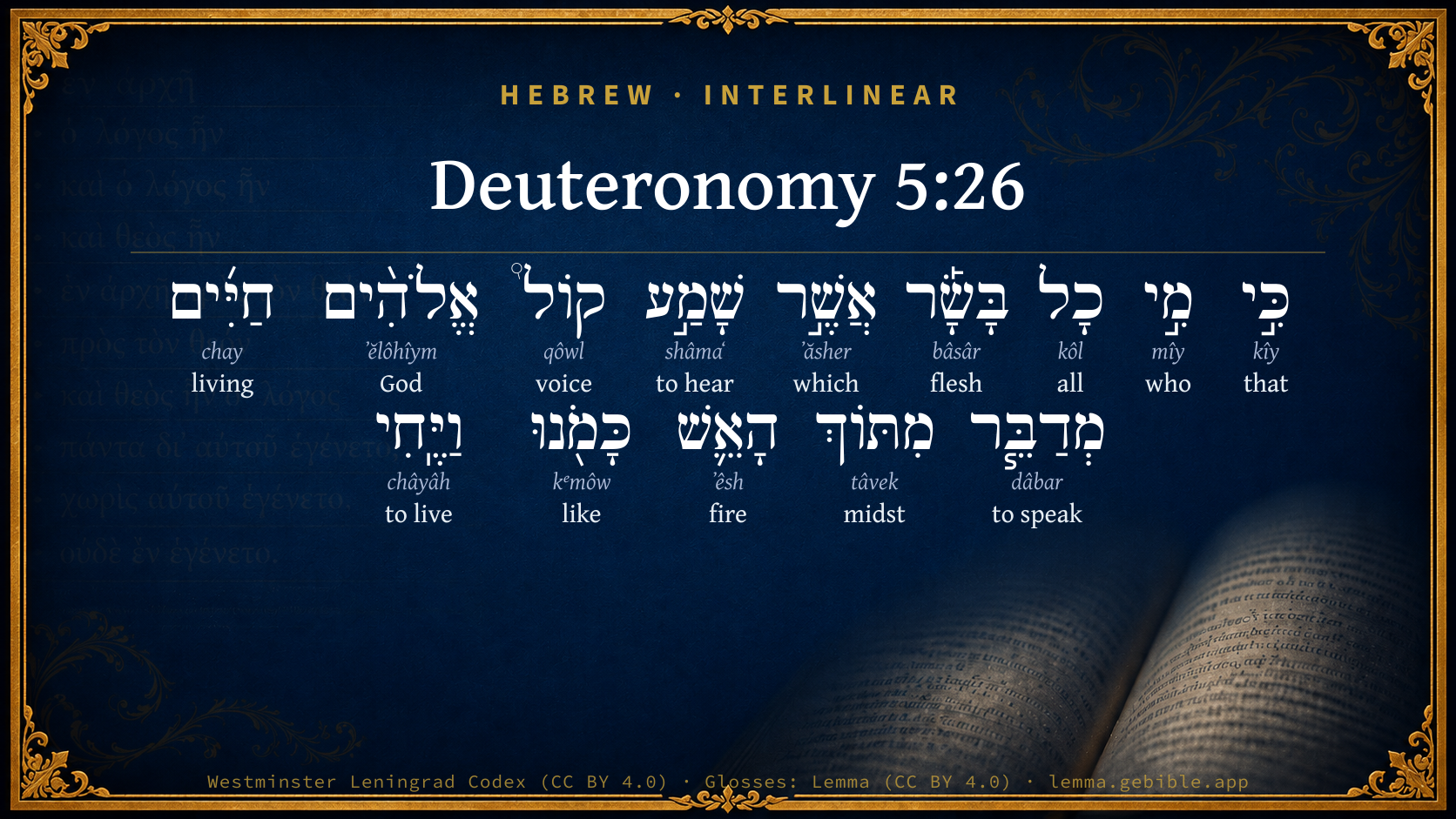
Hebrew (Westminster Leningrad Codex) Deuteronomy 5:26 appears in the Hebrew Old Testament. The text above is from the Westminster Leningrad Codex. Each word links to its Strong’s number, a concise gloss, and parsing drawn from the Open Scriptures Hebrew Bible morphology. Click any word for its full Brown-Driver-Briggs (BDB) entry.
Download image
Cite this verse

Deuteronomy 5:26 (World English Bible). Public Domain. Lemma interlinear Bible study tool, https://lemma.gebible.app/v/deuteronomy/5/26.

Show BibTeX & RIS
BibTeX
RIS
English Translation
For who is there of all flesh, that has heard the voice of the living God speaking out of the midst of the fire, as we have, and lived?
World English Bible · Public Domain
Download a study sheet

One document with this verse’s original text, its word-by-word gloss line, the meaning frame, cross-references with their text, attributed commentary, and full source and license credits — printable, and it pastes into notes with its structure intact.

This verse Autodidact and up

Study sheet (.html) Plain text (.txt)

A passage Seminary Student

Up to 50 verses in one chapter. A passage sheet keeps up to 6 commentary sources and 12 cross-references per verse, in the order this page ranks them, and says so on the sheet whenever that leaves anything out. Ask for a single verse and you get the Autodidact verse sheet above.

Everything on this page stays free to read, with no account — the sheet is a download of what is already on screen, not access to it.

Want to remove ads? Support Godless Engineer
Compare translations 3

The same verse in 3 English versions, stacked beneath the original-language interlinear above. Click any original word for its lexicon entry.

Each is an independent rendering of the whole verse — the interlinear is not word-aligned to these translations.

Highlighted words mark where these versions differ — a whole-verse word diff, not a word-by-word alignment.

  • World English Bible Public Domain
    For who is there of all flesh, that has heard the voice of the living God speaking out of the midst of the fire, as we have, and lived?
  • King James Version Public Domain
    For who is there of all flesh, that hath heard the voice of the living God speaking out of the midst of the fire, as we have, and lived?
  • unfoldingWord Literal Text CC BY-SA 4.0
    For who all flesh that has heard the voice of the living God speak from the midst of the fire like us and has lived?

unfoldingWord Literal Text — © unfoldingWord, licensed CC BY-SA 4.0. Word-aligned USFM3 via Door43 (git.door43.org/unfoldingWord/en_ult).

Versions to compare (up to 4)

3 of 4 selected

Show all 18 translations

Every available English version of this verse, each an independent rendering of the whole verse.

  • World English Bible Public Domain
    For who is there of all flesh, that has heard the voice of the living God speaking out of the midst of the fire, as we have, and lived?
  • Berean Standard Bible Public Domain
    For who of all flesh has heard the voice of the living God speaking out of the fire, as we have, and survived?
  • Majority Standard Bible Public Domain
    For who of all flesh has heard the voice of the living God speaking out of the fire, as we have, and survived?
  • King James Version Public Domain
    For who is there of all flesh, that hath heard the voice of the living God speaking out of the midst of the fire, as we have, and lived?
  • American Standard Version (1901) Public Domain
    For who is there of all flesh, that hath heard the voice of the living God speaking out of the midst of the fire, as we have, and lived?
  • Revised Version (1885) Public Domain
    For who is there of all flesh, that hath heard the voice of the living God speaking out of the midst of the fire, as we have, and lived?
  • Geneva Bible (1599) Public Domain
    For what flesh was there euer, that heard the voyce of the liuing God speaking out of the middes of the fire as we haue, and liued?
  • Douay-Rheims (1899) Public Domain
    What is all flesh, that it should hear the voice of the living God, who speaketh out of the midst of the fire, as we have heard, and be able to live?
  • Young's Literal Translation Public Domain
    For who of all flesh `is' he who hath heard the voice of the living God speaking out of the midst of the fire like us -- and doth live?
  • Literal Standard Version CC BY-SA 4.0
    For who of all flesh [is] he who has heard the voice of the living God speaking out of the midst of the fire like us, and lives?
  • Unlocked Literal Bible CC BY-SA 4.0
    For who besides us is there among all flesh who has heard the voice of the living God speak out of the middle of the fire and lived, as we have done?
  • unfoldingWord Literal Text CC BY-SA 4.0
    For who all flesh that has heard the voice of the living God speak from the midst of the fire like us and has lived?
  • Darby Bible Public Domain
    For who is there of all flesh, that has heard the voice of the living God speaking from the midst of the fire, as we, and has lived?
  • World Messianic Bible Public Domain
    For who is there of all flesh who has heard the voice of the living God speaking out of the middle of the fire, as we have, and lived?
  • Webster's Bible Public Domain
    For who is there of all flesh that hath heard the voice of the living God speaking out of the midst of the fire, as we have, and lived?
  • Free Bible Version CC BY-SA 4.0
    Has anybody else ever heard the living God speak from the fire and survived, as we have?
  • Bible in Basic English Public Domain
    For what man is there in all the earth, who, hearing the voice of the living God as we have, out of the heart of the fire, has been kept from death?
  • JPS Tanakh (1917) Public Domain
    (5-23) For who is there of all flesh, that hath heard the voice of the living God speaking out of the midst of the fire, as we have, and lived?

Literal Standard Version (2020), Covenant Press — licensed CC BY-SA 4.0. Text via the HelloAO Bible API (eBible.org). Unlocked Literal Bible (unfoldingWord) — licensed CC BY-SA 4.0. Text via the HelloAO Bible API (eBible.org). unfoldingWord Literal Text — © unfoldingWord, licensed CC BY-SA 4.0. Word-aligned USFM3 via Door43 (git.door43.org/unfoldingWord/en_ult). Free Bible Version, Dr. Jonathan Gallagher — licensed CC BY-SA 4.0. Text via the HelloAO Bible API (eBible.org).

Word by word

More ways to search: Search by grammar → Find every occurrence → Compare this word →

Practice this passage: Drill this verse → Learn its vocabulary →

כָּמֹ֖נוּ
kᵉmôw
H3644
“like · us”
Preposition + Suffix, Personal, 1st Person, Common, Plural
Part of Speech
Preposition
Full BDB Definition

Origin: a form of the prefix "k-", but used separately [compare H3651 ]

TWOT: TWOT - 938

like, as, the like of which (adverb) - when, according as, as it were (conjunction)
  1. כִּ֣י kîy H3588 “that” Conjunction
  2. מִ֣י mîy H4310 “who” Particle, Interrogative
  3. כָל kôl H3605 “all of” Noun, Common, Masculine, Singular, Construct
  4. בָּשָׂ֡ר bâsâr H1320 “flesh” Noun, Common, Masculine, Singular, Absolute
  5. אֲשֶׁ֣ר ʼăsher H834 “which” Particle, Relative
  6. שָׁמַ֣ע shâmaʻ H8085 “to hear” Verb, Qal, Perfect, 3rd Person, Masculine, Singular
  7. קוֹל֩ qôwl H6963 “voice of” Noun, Common, Masculine, Singular, Construct
  8. אֱלֹהִ֨ים ʼĕlôhîym H430 “God(s)” Noun, Common, Masculine, Plural, Absolute
  9. חַיִּ֜ים chay H2416 “living” Adjective, Adjective, Masculine, Plural, Absolute
  10. מְדַבֵּ֧ר dâbar H1696 “speaking” Verb, Piel, Participle Active, Masculine, Singular, Absolute
  11. מִתּוֹךְ tâvek H8432 “from · midst of” Preposition + Noun, Common, Masculine, Singular, Construct
  12. הָאֵ֛שׁ ʼêsh H784 “the · fire” Particle, Definite Article + Noun, Common, Both, Singular, Absolute
  13. וַיֶּֽחִי châyâh H2421 “and · to live” Conjunction + Verb, Qal, Sequential Imperfect, 3rd Person, Masculine, Singular

About this verse

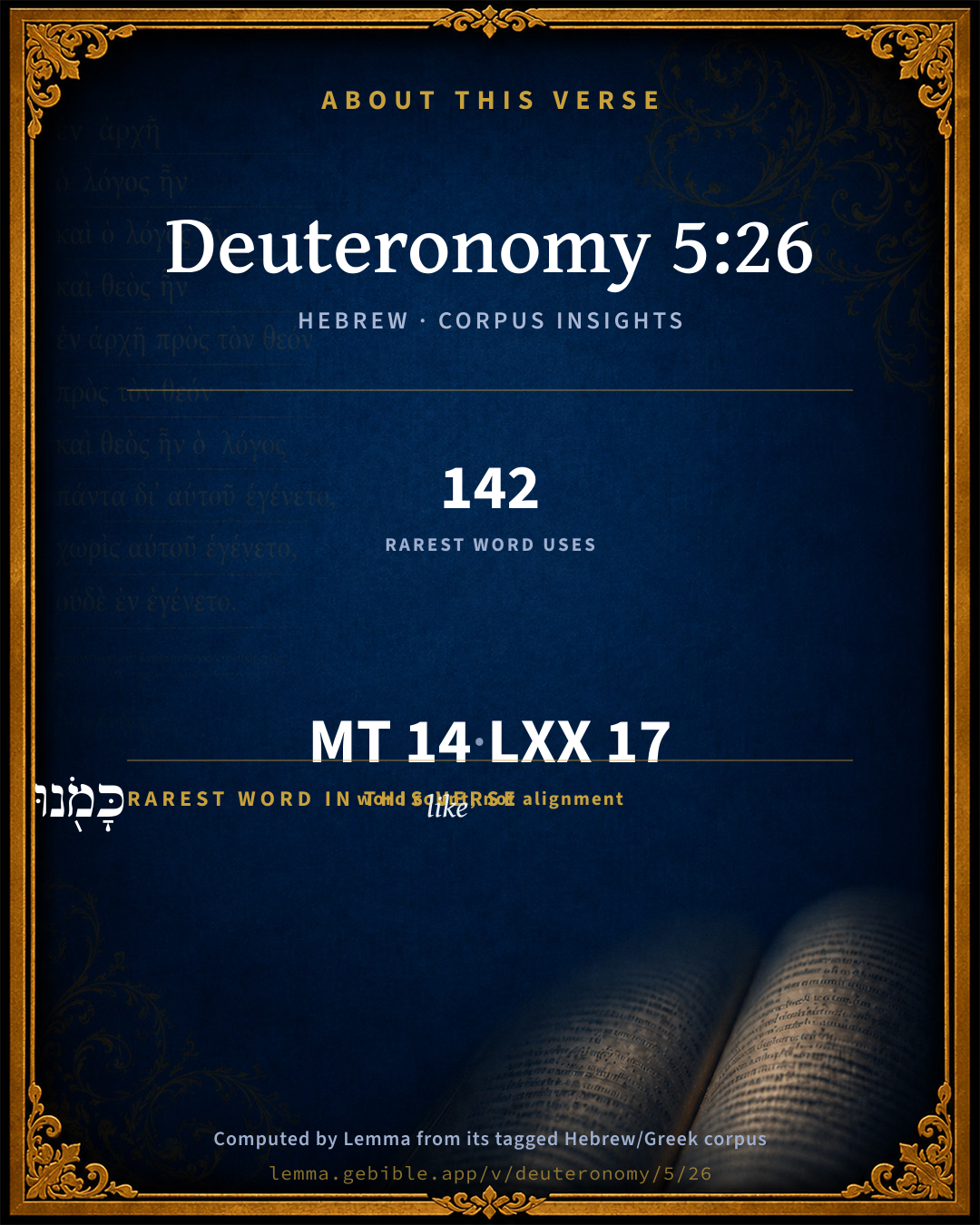
These counts appear in no published source. They are computed here, from the morphology-tagged text and Lemma’s own curated glosses. What Lemma adds →

14
words
14
distinct lemmas
Pentateuch
section

Grammatical profile

  • 3 verbs
  • 6 nouns
  • 1 adjective
  • 1 preposition
  • 1 conjunction
  • 2 particles

Verb forms

  • שָׁמַ֣ע Qal · Perfect
  • מְדַבֵּ֧ר Piel · Participle Active
  • וַיֶּֽחִי Qal · Sequential Imperfect

Hebrew & Septuagint length

In English translation the verse runs 29 words from the Hebrew and 29 from the Septuagint (LXX English) — the same length.

A rough comparison of the two English renderings, which tokenize alike — not a word-level alignment.

Word counts can differ between the Hebrew and the Greek without any difference in meaning — e.g. the Hebrew direct-object marker אֵת has no separate Greek word, and Greek often adds the article ὁ.

In the original languages it is 14 Hebrew tokens and 17 Greek tokens — but the two are counted differently (Hebrew bundles its prefixes and suffixes into one token; the Greek is in lemma form), so that isn’t a like-for-like length.

Cross-references

13

Topical passages linked to Deuteronomy 5:26 in the Treasury of Scripture Knowledge — connected by theme and wording, ordered by reader-vote popularity; previews shown in the World English Bible.

  • Deuteronomy 4:33 Did ever a people hear the voice of God speaking out of the midst of the fire, as you have heard, and live?
  • Romans 3:20 Because by the works of the law, no flesh will be justified in his sight. For through the law comes the knowledge of sin.
  • Genesis 6:12 God saw the earth, and saw that it was corrupt, for all flesh had corrupted their way on the earth.
  • Joshua 3:10 Joshua said, Hereby you shall know that the living God is among you, and that he will without fail drive out from before you the Canaanite, and the Hittite, and the Hivite, and the Perizzite, and the Girgashite, and the Amorite, and the Jebusite.
  • Psalms 42:2 My soul thirsts for God, for the living God. When shall I come and appear before God?
  • Psalms 84:2 My soul longs, and even faints for the courts of Yahweh. My heart and my flesh cry out for the living God.
  • Isaiah 40:6 The voice of one saying, Cry. One said, What shall I cry? All flesh is grass, and all the glory of it is as the flower of the field.
  • Jeremiah 10:10 But Yahweh is the true God; he is the living God, and an everlasting King: at his wrath the earth trembles, and the nations are not able to abide his indignation.
  • Daniel 6:26 I make a decree, that in all the dominion of my kingdom men tremble and fear before the God of Daniel; for he is the living God, and steadfast forever, His kingdom that which shall not be destroyed; and his dominion shall be even to the end.
  • Matthew 26:63 But Jesus held his peace. The high priest answered him, "I adjure you by the living God, that you tell us whether you are the Christ, the Son of God."
  • Acts 14:15 "Men, why are you doing these things? We also are men of like passions with you, and bring you good news, that you should turn from these vain things to the living God, who made the sky and the earth and the sea, and all that is in them;
  • 2 Corinthians 6:16 What agreement has a temple of God with idols? For you are a temple of the living God. Even as God said, "I will dwell in them, and walk in them; and I will be their God, and they will be my people."
  • 1 Thessalonians 1:9 For they themselves report concerning us what kind of a reception we had from you; and how you turned to God from idols, to serve a living and true God,

Cross-references courtesy of OpenBible.info (CC BY 4.0).

Hebrew and Greek witnesses Masoretic Hebrew ↔ Greek Septuagint

The same verse in the two great witnesses to the Old Testament, shown verse-for-verse.

These are two independent witnesses, not word-aligned to each other, and the Septuagint is shown in lemma (dictionary) form.

Hebrew Deuteronomy 5:26 Masoretic · Westminster Leningrad Codex

כִּ֣י מִ֣י כָל בָּשָׂ֡ר אֲשֶׁ֣ר שָׁמַ֣ע קוֹל֩ אֱלֹהִ֨ים חַיִּ֜ים מְדַבֵּ֧ר מִתּוֹךְ הָאֵ֛שׁ כָּמֹ֖נוּ וַיֶּֽחִי

For who is there of all flesh, that has heard the voice of the living God speaking out of the midst of the fire, as we have, and lived?

World English Bible · Public Domain

Greek LXX Deuteronomy 5:26 Septuagint · lemma form

τίς γάρ σάρξ ὅστις ἀκούω φωνή θεός ζάω λαλέω ἐκ μέσος ὁ πῦρ ὡς ἐγώ καί ζάω

For what flesh is there which has heard the voice of the living God, speaking out of the midst of the fire, as we have heard, and shall live?

LXX2012 (modern English Septuagint) · Public Domain

Hebrew: Westminster Leningrad Codex (CC BY 4.0). Greek: Septuagint (public domain); English from LXX2012 (modern English Septuagint) (Public Domain). How the Septuagint differs from the Hebrew →

Targum (Aramaic paraphrase)

2

The Targum is the ancient Jewish Aramaic paraphrase of the Hebrew Scriptures — an interpretive translation, not the Hebrew text itself. Onkelos (literal) and Pseudo-Jonathan (expansive) render the Torah, and Jonathan the Prophets. Coverage is partial: where no permissively-licensed English translation exists for a verse, only the Aramaic is shown. This is verse-level text, not a word-by-word alignment to the Hebrew.

  1. Targum Onkelos Torah (Genesis–Deuteronomy)
    לְוַי דִי יְהֵי לִבָּא הָדֵין לְהוֹן לְמִדְחַל קֳדָמַי וּלְמִטַר יָת כָּל פִּקוּדַי כָּל יוֹמַיָא בְּדִיל דִיֵיטַב לְהוֹן וְלִבְנֵיהוֹן לְעָלָם

    (no public-domain English translation for this verse)

    Targum Onkelos — Aramaic: “Onkelos Genesis” (public domain); “Onkelos Exodus” (public domain); “Onkelos Leviticus” (public domain); “Onkelos Numbers” (public domain); “Onkelos Deuteronomy” (public domain). English: “Sefaria Community Translation” (CC0 1.0 (public-domain dedication)); “J.W. Etheridge. The Targums of Onkelos and Jonathan Ben Uzziel on the Pentateuch. London: Longmans, Green, 1862” (public domain). Text via Sefaria.

  2. Targum Pseudo-Jonathan Torah (Genesis–Deuteronomy)
    לְוַאי דִיהֵי יִצְרָא דְלִבְּהוֹן שְׁלִים בִּרְעוּת דֵּין לְהוֹן לְמִדְחַל מִן קֳדָמַי לְמִנְטוֹר יַת כָּל פִּקּוּדַי כָּל יוֹמַיָא מִן בִּגְלַל דְּיוֹטִיב לְהוֹן וְלִבְנֵיהוֹן לְעַלָם

    O that the disposition of their heart were perfect as this willingness is to fear Me and to keep all My commandments all days, that it may be well with them and with their children for ever!

    Targum Pseudo-Jonathan — Aramaic: “Targum Jonathan on Genesis” (public domain); “Targum Jonathan on Exodus” (public domain); “Targum Jonathan on Leviticus” (public domain); “Targum Jonathan on Numbers” (public domain); “Targum Jonathan on Deuteronomy” (public domain). English: “The Targum of Jonathan ben Uzziel, trans. J. W. Etheridge, London, 1862” (public domain). Text via Sefaria.

Commentary

Notes on Deuteronomy 5:26 from classic Christian and Jewish commentators (each source and its license shown beneath its notes). The classic Christian expositions comment on the surrounding passage and are grouped to its opening verse, so a note may address several verses; the Jewish commentaries on the Tanakh (Rashi and others) are per-verse, so they appear only where the commentator wrote on this verse.

Lemma curates 59 commentaries, every one of them public domain or Creative Commons licensed, each selected and text-cleaned for this edition rather than reprinted as found. About our sources →

Joseph Benson's Commentary

Deu 5:26. Flesh — Is here put for a man in his frail, corruptible, and mortal state.

Joseph Benson's Commentary on the Old and New Testaments (1811–1818) — public domain. Text from a community e-Sword module.

Geneva Bible (1599)

Geneva Bible translators

Or, man.

Geneva Bible (1599) marginal notes — public domain. Text via Bolls.life.

The Cambridge Bible for Schools and Colleges

gen. ed. J. J. S. Perowne

26. flesh] Emphatic; it cannot endure immediate contact with spirit (Isa_31:3).

the living God] Rather, a living God, cp. Deu_4:33. The phrase always occurs in the O.T. without the article even when as in 1Sa_17:26; 1Sa_17:36, and Jer_23:36 it is the living God who is meant. In Jer_10:10 it is indefinite as here. These are all the instances of this form. Kindred forms in Jos_3:10 indefinite; Hos_2:1, 2Ki_19:4; 2Ki_19:16 definite.

The Cambridge Bible for Schools and Colleges (gen. ed. J. J. S. Perowne; Cambridge University Press, 1878–1918) — public domain. Text from a community e-Sword module.

John Gill's Exposition

O that there were such an heart in them,.... Not that there is properly speaking such volitions and wishes in God; but, as Aben Ezra observes, the Scripture speaks after the language of the children of men; and may be considered as upbraiding them with want of such an heart, and with weakness to do what they had promised; and, at most, as approving of those things they spoke of as grateful to him, and profitable to them: the words may be rendered, "who will give (l) that they had such an heart"; not to me, but to them, as Aben Ezra notes; they cannot give it to themselves, nor can any creature give it to them; none but God can, and therefore they ought to have prayed to him to give them an heart to hearken and do; agreeably to which is the Arabic version,"it is to be wished by them, that such an heart would continue with them;''which they by their language signified was in them: that they would fear me; which is not naturally in the heart of man, is a gift of God, a part of the covenant of grace, is implanted in regeneration, and is no inconsiderable branch of it; it is opposed to pride, and is consistent with faith and joy, and is increased by views of the grace and goodness of God, and is a distinguishing character of a good man:

and keep all my commandments always; not only one, but all, and not only at some certain times, but continually; and which are to be kept in faith from a principle of love, with a view to the glory of God, and in the strength of Christ; and to this the fear of God is necessary, for where there is no fear of God, there is no regard to his commandments; but where there is a reverential fear of God, there are faith, hope, love, and every other grace; yea, the Spirit, the author of all, who is in the saints, to enable them to walk in the statutes of the Lord, and to keep his judgments and do them; and such keep the commandments of God, not from a slavish fear, but from a sense of divine goodness:

that it might be well with them, and with their children for ever; for the fear of God, and the keeping of his commandments, issue in the good of men, in their own good, their inward peace, and spiritual welfare; in the good of others, their neighbours, servants, and children, by way of example and instruction; and even in the public peace and prosperity of a nation in which they dwell: not that these things are meritorious of eternal life, but are what are approved of by the Lord, and are grateful to him; which is the chief view in the expression of the text.

(l) "quis det", V. L. Pagninus, Montanus, Vatablus, Drusius; "quis dabit", Piscator.

John Gill's Exposition of the Whole Bible (1746–1763) — public domain (CC PDM 1.0). Text via the HelloAO Bible API.

Matthew Poole's English Annotations

Flesh is here put for man in his frail, corruptible, and mortal state, as Mat 16:17; 1Co 15:50; Eph 6:12; Heb 2:14.

Matthew Poole's English Annotations on the Holy Bible (1683–1685) — public domain. Text from a community e-Sword/MySword module.

John Wesley's Explanatory Notes

Flesh - Is here put for man in his frail, corruptible, and mortal state.

John Wesley, Explanatory Notes Upon the Whole Bible (1754–1765) — public domain. Text via the GEBible commentary corpus.

Ramban (Nachmanides)

Rabbi Moshe ben Nachman (Ramban / Nachmanides)

OH THAT THIS THEIR HEART WOULD REMAIN IN THEM, TO FEAR ME. Scripture uses this expression because man has freedom of choice to be righteous or to be wicked, and “Everything is in the power of Heaven except for fear of Heaven.” It is thus an expression of common usage.And by way of the Truth, [the mystic teachings of the Cabala], the expression [before us] is similar to the verse, And unto man He said: ‘Behold, the fear of the Eternal, that is wisdom; and to depart from evil is understanding.’ And so the Rabbis have said with regard to the reward for [performance of] the commandments:, the small crown-like decorations atop many of the letters of the Torah. He asked G-d what the tagim represented. G-d answered, “Many generation from now, there will live a man named Akiba, the son of Joseph. He will explain every dot and decoration of all letters.” Moses then requested that he be permitted to listen to one of Rabbi Akiba’s lectures. After hearing it, Moses returned to G-d and said, “You have a man like Akiba and you give the Torah through me!” G-d answered, “Be silent; so I have decreed.” Moses then asked that he be shown Rabbi Akiba’s reward. G-d answered, “Turn around,” Moses then saw etc. — Rabbi Akiba was one of the Ten Martyrs from among the greatest Rabbis of the generation who were put to death by command of the Roman Emperor Hadrian for their public defiance of the Roman ban against studying the Torah and the general practice of Judaism. See Vol. II, p. 301, and Note 369. “Moses saw that they [i.e., the Romans] were cutting the flesh of [the martyr] Rabbi Akiba in meat markets. Moses said to G-d, ‘Master of the universe! Is this the reward for such [knowledge of the] Torah!’ The Holy One, blessed be He, replied, ‘Be silent, thus have I decreed.’” You will understand this from what He has said to Moses, And as for thee, stand thou here by Me.

Ramban (Nachmanides) on the Tanakh — English translation: “Commentary on the Torah by Ramban (Nachmanides). Translated and annotated by Charles B. Chavel. New York, Shilo Pub. House, 1971-1976” (CC BY 4.0). Text via Sefaria.

Lesson kit

Teaching starters — assembled from the data on this page, not authored interpretation. Every prompt links to the verse data it draws on. Edit before teaching.

Deuteronomy, in the Pentateuch, opens this verse with 14 words (14 distinct Hebrew lemmas). Its most distinctive word is kᵉmôw (“like”). A historical commentator’s framing appears above. Read the whole chapter for the surrounding context.

Discussion questions

  1. What does “like” (kᵉmôw) contribute to the verse as a whole?
  2. Deuteronomy 4:33 shares this passage’s theme. How do the two illuminate each other?
  3. These translations render this verse differently; the difference is in the English rendering, not the original. What questions does that raise?
  4. The verb «שָׁמַ֣ע» is Qal Perfect. How does its form color the action?
  5. Reading how Joseph Benson's Commentary and Geneva Bible (1599) read this verse, where do the two commentators agree and where do they part?

Things to notice

Reading settings

Reading text

Shown beneath each verse's original-language words.

Old Testament
Old Testament edition

Read the OT as the Masoretic Hebrew (MT) or the Greek Septuagint (LXX).

English shown for the Greek Septuagint (in the Hebrew ↔ Greek comparison).

Comparing translations? Open the Compare panel on any verse page to stack up to four side by side.