Ezra 10:12

Hebrew (Westminster Leningrad Codex) Ezra 10:12 appears in the Hebrew Old Testament. The text above is from the Westminster Leningrad Codex. Each word links to its Strong’s number, a concise gloss, and parsing drawn from the Open Scriptures Hebrew Bible morphology. Click any word for its full Brown-Driver-Briggs (BDB) entry.
Download image
Cite this verse

Ezra 10:12 (World English Bible). Public Domain. Lemma interlinear Bible study tool, https://lemma.gebible.app/v/ezra/10/12.

Show BibTeX & RIS
BibTeX
RIS
English Translation
Then all the assembly answered with a loud voice, As you have said concerning us, so must we do.
World English Bible · Public Domain
Download a study sheet

One document with this verse’s original text, its word-by-word gloss line, the meaning frame, cross-references with their text, attributed commentary, and full source and license credits — printable, and it pastes into notes with its structure intact.

This verse Autodidact and up

Study sheet (.html) Plain text (.txt)

A passage Seminary Student

Up to 50 verses in one chapter. A passage sheet keeps up to 6 commentary sources and 12 cross-references per verse, in the order this page ranks them, and says so on the sheet whenever that leaves anything out. Ask for a single verse and you get the Autodidact verse sheet above.

Everything on this page stays free to read, with no account — the sheet is a download of what is already on screen, not access to it.

Want to remove ads? Support Godless Engineer
Compare translations 3

The same verse in 3 English versions, stacked beneath the original-language interlinear above. Click any original word for its lexicon entry.

Each is an independent rendering of the whole verse — the interlinear is not word-aligned to these translations.

Highlighted words mark where these versions differ — a whole-verse word diff, not a word-by-word alignment.

  • World English Bible Public Domain
    Then all the assembly answered with a loud voice, As you have said concerning us, so must we do.
  • King James Version Public Domain
    Then all the congregation answered and said with a loud voice, As thou hast said, so must we do.
  • unfoldingWord Literal Text CC BY-SA 4.0
    Then all the assembly answered and said in a loud voice, “Thus, according to your word, it is on us to do.

unfoldingWord Literal Text — © unfoldingWord, licensed CC BY-SA 4.0. Word-aligned USFM3 via Door43 (git.door43.org/unfoldingWord/en_ult).

Versions to compare (up to 4)

3 of 4 selected

Show all 18 translations

Every available English version of this verse, each an independent rendering of the whole verse.

  • World English Bible Public Domain
    Then all the assembly answered with a loud voice, As you have said concerning us, so must we do.
  • Berean Standard Bible Public Domain
    And the whole assembly responded in a loud voice: “Truly we must do as you say!
  • Majority Standard Bible Public Domain
    And the whole assembly responded in a loud voice: “Truly we must do as you say!
  • King James Version Public Domain
    Then all the congregation answered and said with a loud voice, As thou hast said, so must we do.
  • American Standard Version (1901) Public Domain
    Then all the assembly answered and said with a loud voice, As thou hast said concerning us, so must we do.
  • Revised Version (1885) Public Domain
    Then all the congregation answered and said with a loud voice, as thou hast said concerning us, so must we do.
  • Geneva Bible (1599) Public Domain
    And all the Congregation answered, and sayd with a loude voyce, So will we do according to thy wordes vnto vs.
  • Douay-Rheims (1899) Public Domain
    And all the multitude answered and said with a loud voice: According to thy word unto us, so be it done.
  • Young's Literal Translation Public Domain
    And all the assembly answer and say `with' a great voice, `Right; according to thy word -- on us to do;
  • Literal Standard Version CC BY-SA 4.0
    And all the assembly answers and says [with] a great voice, “Right; according to your word—on us to do;
  • Unlocked Literal Bible CC BY-SA 4.0
    All the assembly answered in a loud voice, “We will do as you have said.
  • unfoldingWord Literal Text CC BY-SA 4.0
    Then all the assembly answered and said in a loud voice, “Thus, according to your word, it is on us to do.
  • Darby Bible Public Domain
    And the whole congregation answered and said with a loud voice, Yes, it is for us to do according to thy words.
  • World Messianic Bible Public Domain
    Then all the assembly answered with a loud voice, “We must do as you have said concerning us.
  • Webster's Bible Public Domain
    Then all the congregation answered and said with a loud voice, As thou hast said, so must we do.
  • Free Bible Version CC BY-SA 4.0
    The whole assembly answered in a loud voice: “We agree, and we promise to do as you say!
  • Bible in Basic English Public Domain
    Then all the people, answering, said with a loud voice, As you have said, so it is right for us to do.
  • JPS Tanakh (1917) Public Domain
    Then all the congregation answered and said with a loud voice: 'As thou hast said, so it is for us to do.

Literal Standard Version (2020), Covenant Press — licensed CC BY-SA 4.0. Text via the HelloAO Bible API (eBible.org). Unlocked Literal Bible (unfoldingWord) — licensed CC BY-SA 4.0. Text via the HelloAO Bible API (eBible.org). unfoldingWord Literal Text — © unfoldingWord, licensed CC BY-SA 4.0. Word-aligned USFM3 via Door43 (git.door43.org/unfoldingWord/en_ult). Free Bible Version, Dr. Jonathan Gallagher — licensed CC BY-SA 4.0. Text via the HelloAO Bible API (eBible.org).

Word by word

More ways to search: Search by grammar → Find every occurrence → Compare this word →

Practice this passage: Drill this verse → Learn its vocabulary →

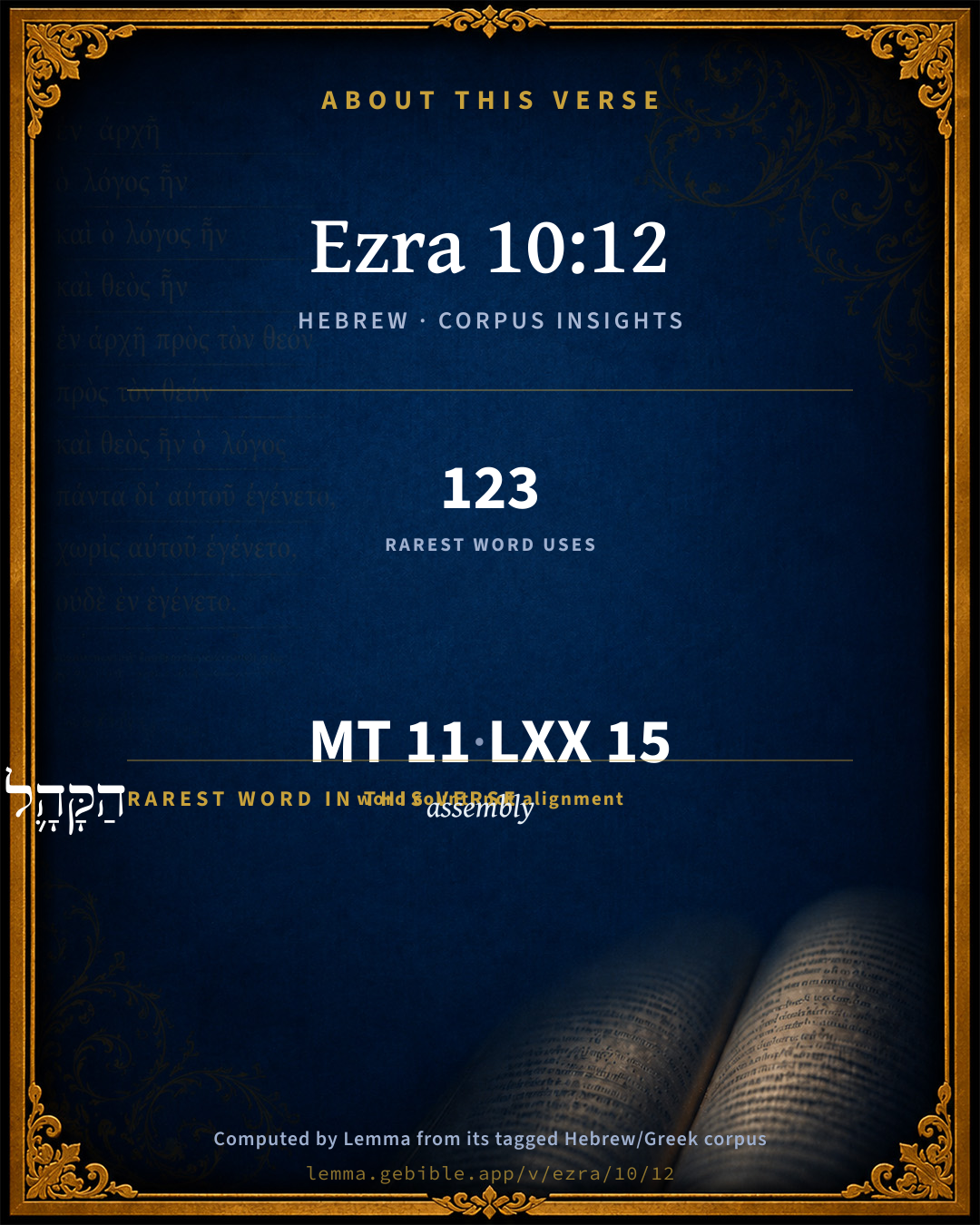
הַקָּהָ֛ל
qâhâl
H6951
“the · assembly”
Particle, Definite Article + Noun, Common, Masculine, Singular, Absolute
Part of Speech
Particle + Noun
Type
Common
Gender
Masculine
Number
Singular
State
Absolute
Full BDB Definition

Origin: from H6950

TWOT: 1991a

assembly, company, congregation, convocation - assembly - for evil counsel, war or invasion, religious purposes - company (of returning exiles) - congregation - as organised body
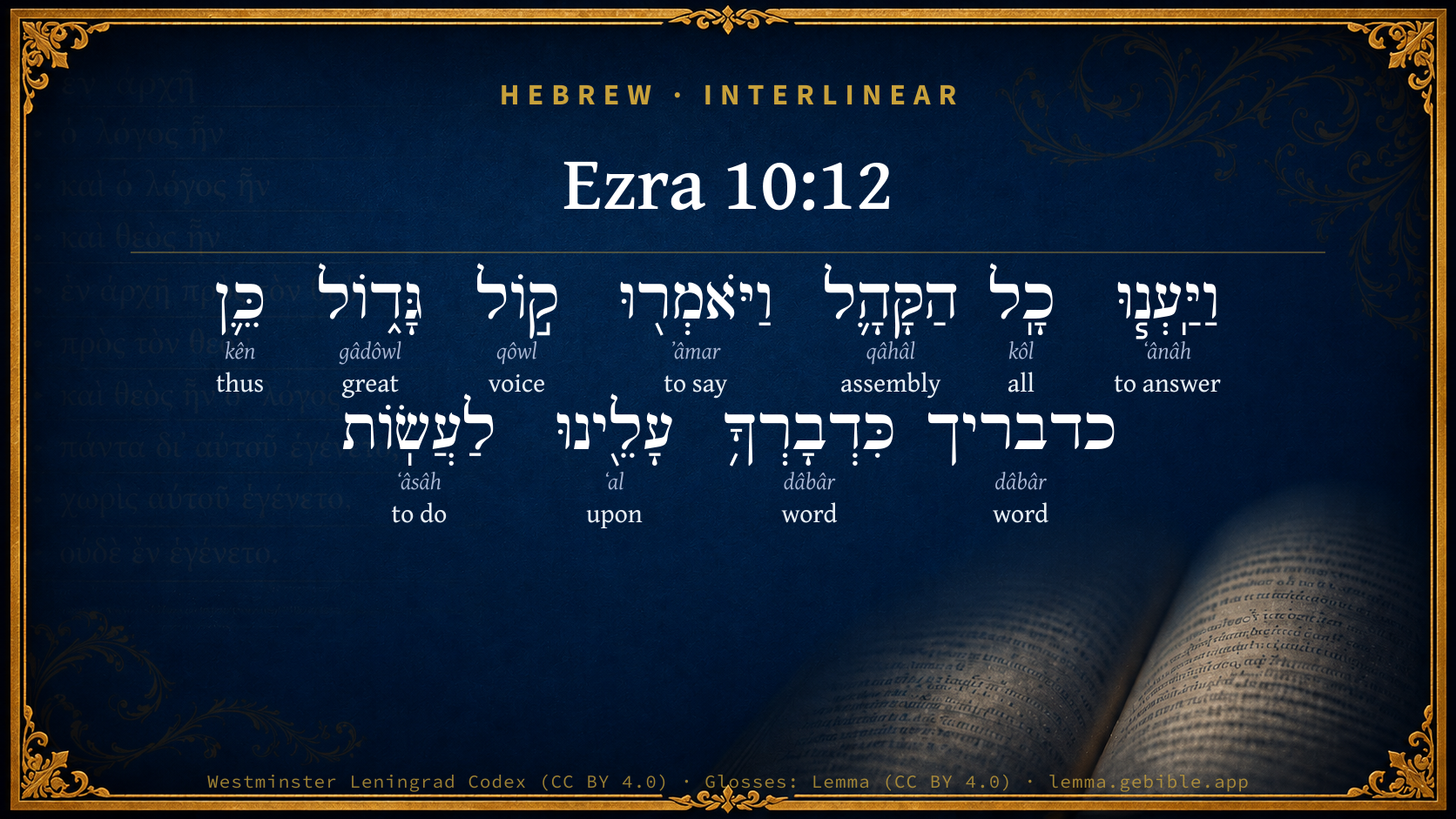
  1. וַיַּֽעְנ֧וּ ʻânâh H6030 “and · to answer” Conjunction + Verb, Qal, Sequential Imperfect, 3rd Person, Masculine, Plural
  2. כָֽל kôl H3605 “all of” Noun, Common, Masculine, Singular, Construct
  3. וַיֹּאמְר֖וּ ʼâmar H559 “and · to say” Conjunction + Verb, Qal, Sequential Imperfect, 3rd Person, Masculine, Plural
  4. ק֣וֹל qôwl H6963 “voice” Noun, Common, Masculine, Singular, Absolute
  5. גָּד֑וֹל gâdôwl H1419 “great” Adjective, Adjective, Masculine, Singular, Absolute
  6. כֵּ֛ן kên H3651 “thus” Particle, Demonstrative
  7. כדבריך dâbâr H1697 “like/as · words · your” Preposition + Noun, Common, Masculine, Plural, Construct + Suffix, Personal, 2nd Person, Masculine, Singular
  8. כִּדְבָרְךָ֥ dâbâr H1697 “like/as · word · your” Preposition + Noun, Common, Masculine, Singular, Construct + Suffix, Personal, 2nd Person, Masculine, Singular
  9. עָלֵ֖ינוּ ʻal H5921 “upon · us” Preposition + Suffix, Personal, 1st Person, Common, Plural
  10. לַעֲשֽׂוֹת ʻâsâh H6213 “to do” Preposition + Verb, Qal, Infinitive Construct

About this verse

These counts appear in no published source. They are computed here, from the morphology-tagged text and Lemma’s own curated glosses. What Lemma adds →

11
words
10
distinct lemmas
Historical
section

Grammatical profile

  • 3 verbs
  • 5 nouns
  • 1 adjective
  • 1 preposition
  • 1 particle

Verb forms

  • וַיַּֽעְנ֧וּ Qal · Sequential Imperfect
  • וַיֹּאמְר֖וּ Qal · Sequential Imperfect
  • לַעֲשֽׂוֹת Qal · Infinitive Construct

Repetition

A word recurs within this verse — often emphatic in Hebrew:

  • כדבריך word H1697 ×2

Hebrew & Septuagint length

In English translation the verse runs 19 words from the Hebrew and 17 from the Septuagint (LXX English) — closely comparable.

A rough comparison of the two English renderings, which tokenize alike — not a word-level alignment.

Word counts can differ between the Hebrew and the Greek without any difference in meaning — e.g. the Hebrew direct-object marker אֵת has no separate Greek word, and Greek often adds the article ὁ.

In the original languages it is 11 Hebrew tokens and 15 Greek tokens — but the two are counted differently (Hebrew bundles its prefixes and suffixes into one token; the Greek is in lemma form), so that isn’t a like-for-like length.

Cross-references

4

Topical passages linked to Ezra 10:12 in the Treasury of Scripture Knowledge — connected by theme and wording, ordered by reader-vote popularity; previews shown in the World English Bible.

  • Ezra 10:3–4 Now therefore let us make a covenant with our God to put away all the wives, and such as are born of them, according to the counsel of my lord, and of those who tremble at the commandment of our God; and let it be done according to the law.
  • Nehemiah 13:23 In those days also saw I the Jews who had married women of Ashdod, of Ammon, [and] of Moab:
  • Psalms 78:37 For their heart was not right with him, Neither were they faithful in his covenant.
  • Psalms 78:57 But turned back, and dealt treacherously like their fathers. They were turned aside like a deceitful bow.

Cross-references courtesy of OpenBible.info (CC BY 4.0).

Hebrew and Greek witnesses Masoretic Hebrew ↔ Greek Septuagint

The same verse in the two great witnesses to the Old Testament, shown verse-for-verse.

These are two independent witnesses, not word-aligned to each other, and the Septuagint is shown in lemma (dictionary) form.

Hebrew Ezra 10:12 Masoretic · Westminster Leningrad Codex

וַיַּֽעְנ֧וּ כָֽל הַקָּהָ֛ל וַיֹּאמְר֖וּ ק֣וֹל גָּד֑וֹל כֵּ֛ן כדבריך כִּדְבָרְךָ֥ עָלֵ֖ינוּ לַעֲשֽׂוֹת

Then all the assembly answered with a loud voice, As you have said concerning us, so must we do.

World English Bible · Public Domain

Greek LXX Ezra 10:12 Septuagint · lemma form

καί ἀποκρίνω πᾶς ὁ ἐκκλησία καί εἶπον μέγας οὗτος ὁ ῥῆμα σύ ἐπί ἐγώ ποιέω

Then all the congregation answered and said, This your word is powerful upon us to do it.

LXX2012 (modern English Septuagint) · Public Domain

In the Septuagint this is one book — Esdras B (2 Esdras): Ezra is chapters 1–10, Nehemiah 11–23.

Hebrew: Westminster Leningrad Codex (CC BY 4.0). Greek: Septuagint (public domain); English from LXX2012 (modern English Septuagint) (Public Domain). How the Septuagint differs from the Hebrew →

Commentary

Notes on Ezra 10:12 from classic Christian and Jewish commentators (each source and its license shown beneath its notes). The classic Christian expositions comment on the surrounding passage and are grouped to its opening verse, so a note may address several verses; the Jewish commentaries on the Tanakh (Rashi and others) are per-verse, so they appear only where the commentator wrote on this verse.

Lemma curates 59 commentaries, every one of them public domain or Creative Commons licensed, each selected and text-cleaned for this edition rather than reprinted as found. About our sources →

Trapp's Complete Commentary

John Trapp

Ezr 10:12 Then all the congregation answered and said with a loud voice, As thou hast said, so must we do.

Ver. 12. Then all the congregation answered and said with a loud voice] But not with a true heart, Heb 10:22. For within a few years they returned to their vomit again.

As thou hast said, so must we do] These were good words, and not unlike those of Laelius, in Lucan, spoken to Caesar:

Iussa sequi tam velle mihi, quam posse, necesse est.

But many of these fair promisers turned back, and dealt unfaithfully, like their fathers; they were turned aside like a deceitful bow, Psa 78:57. Look how a rotten bow, though otherwise fair, when an arrow is drawn to the head, and both eye and arrow is levelled to the mark, yet it miscarrieth; so do the desires, purposes, and promises that unsound hearts conceive in their afflictions, and under just convictions.

John Trapp, A Commentary or Exposition upon All the Books of the Old and New Testament (1647–1656) — public domain. Text from a community e-Sword module.

Adam Clarke's Commentary

Verse 12. As thou hast said, so must we do.] They all resolved to do what Ezra then commanded, they did put away their wives, even those by whom they had children; Ezr 10:44: this was a great hardship on the women and children. Though by the Jewish laws such marriages were null and void, yet as the women they had taken did not know these laws, their case was deplorable. However, we may take it for granted that each of them received a portion according to the circumstances of their husbands, and that they and their children were not turned away desolate, but had such a provision as their necessities required. Humanity must have dictated this, and no law of God is contrary to humanity. After all, there is some room to doubt whether they did put them finally away, for several years after Nehemiah found Jews that had married wives of Ashdod, Ammon, and Moab; Ne 13:23. And if these were not the same women, we find that the same offense was continued.

Adam Clarke's Commentary on the Bible (1810–1826) — public domain. Text from a community e-Sword/MySword module.

The Cambridge Bible for Schools and Colleges

gen. ed. J. J. S. Perowne

12. Then all the congregation, &c.] The deliberations are not recorded. The substance of their decision is here paraphrased. The method of its expression was probably by unanimous acclamation. We can hardly suppose that there was free discussion. The princes debated and harangued the multitude: the multitude listened and expressed disapproval or approbation by cries and shouting.

with a loud voice] Cf. Ezr_3:12; 2Sa_15:23.

As thou hast said, so must we do] R.V. As thou hast said concerning us, so must we do. R.V. marg. ‘As thou hast said, so it behoveth us to do’. Literally the clause runs ‘According to thy word (or words) upon us to do’. It is a disputed point whether ‘upon us’ is to be taken with what precedes or with what follows, i.e. ‘according to thy word respecting us, it is necessary to do’ or ‘according to thy word, it falls upon us to do’. (a) The rendering of the R.V. text is that of the Vulgate ‘juxta verbum tuum ad nos, sic fiat’, and is supported by the traditional Jewish interpretation supplied by the Hebrew accents. The sentence is then clearly greatly condensed, and although the construction of the verb ‘to do’ is very harsh, the meaning is clear. (b) As however the rest of the people’s reply shows no symptom of such compression, the alternative explanation of the rendering in the margin seems preferable. The use of the preposition ‘upon’, with a sense of ‘duty’ or ‘obligation’ occurred in Ezr_10:4. Cf. Neh_13:13; 2Sa_18:11. The people then accept the responsibility in which their assent involves them.

12–14. The resolution of the general assembly epitomised. A general assent to Ezra’s proposal. The time of the year and the magnitude of the task make it necessary to appoint a commission to carry it into execution.

The Cambridge Bible for Schools and Colleges (gen. ed. J. J. S. Perowne; Cambridge University Press, 1878–1918) — public domain. Text from a community e-Sword module.

John Gill's Exposition

Then all the congregation answered and said with a loud voice,.... That they might be heard, and to show that they were willing and ready to comply with what was proposed:

as thou host said, so must we do; being convinced of their sin, they saw it was a duty incumbent on them to put away their strange wives, and that there was a necessity of it, to avert the wrath of God from them.

John Gill's Exposition of the Whole Bible (1746–1763) — public domain (CC PDM 1.0). Text via the HelloAO Bible API.

Whedon's Commentary on the Bible

Daniel D. Whedon

12. All… answered — It was the loud uttered vow and pledge of a vast assembly to conform to the Divine requirement. Compare Jos_1:16-18, notes.

Daniel D. Whedon (gen. ed.), Commentary on the Old and New Testaments (1874–1909) — public domain. Text from a community e-Sword module.

Keil & Delitzsch

C. F. Keil & F. Delitzsch

The whole assembly replied with a loud voice, and therefore with firm resolve: According to thy word it is our duty to do. עלינוּ must not be drawn to what precedes, as in the Vulgate, juxta verbum tuum ad nos, sic fiat, but to what follows, as in Ezr 10:4, Neh 13:13; Sa2 18:11. But - they further remark, Ezr 10:13 - the people are many, - i.e., the assemblage is very large to be able to deal immediately with the several cases; and it is (now) the time of the heavy rains, and there is no power to stand without, - i.e., at the present season we are not able to remain in the open air until the business is discharged; neither is this the work of one day, or of two, for we have transgressed much in this matter, - i.e., one or two days will not suffice to investigate and decide upon all cases, because very many have broken the law in this respect.

Keil & Delitzsch — Biblical Commentary on the Old Testament (1861–1891) — public domain (CC PDM 1.0). Text via the HelloAO Bible API. (Old Testament only.)

unfoldingWord translationNotes

Door43 World Missions Community

this is not only one or two days of work

This litotes can be translated in positive form. AT: "we will need a long time to do all this work" (See: Litotes)

translationWords

assembly

transgress

unfoldingWord translationNotes — © Distant Shores Media and the Door43 World Missions Community, licensed CC BY-SA 4.0. Source: git.door43.org/Door43/en_tn.

Lesson kit

Teaching starters — assembled from the data on this page, not authored interpretation. Every prompt links to the verse data it draws on. Edit before teaching.

Ezra, in the Historical, opens this verse with 11 words (10 distinct Hebrew lemmas). Its most distinctive word is qâhâl (“assembly”). A historical commentator’s framing appears above. Read the whole chapter for the surrounding context.

Discussion questions

  1. How does “assembly” (qâhâl) shape what this verse is saying?
  2. Ezra 10:3–4 shares this passage’s theme. How do the two illuminate each other?
  3. “word” occurs 2× in this one verse. What is the effect of the repetition?
  4. These translations render this verse differently; the difference is in the English rendering, not the original. What questions does that raise?
  5. The verb «וַיַּֽעְנ֧וּ» is Qal Sequential Imperfect. How does its form color the action?
  6. Reading how Trapp's Complete Commentary and Adam Clarke's Commentary read this verse, where do the two commentators agree and where do they part?

Things to notice

Reading settings

Reading text

Shown beneath each verse's original-language words.

Old Testament
Old Testament edition

Read the OT as the Masoretic Hebrew (MT) or the Greek Septuagint (LXX).

English shown for the Greek Septuagint (in the Hebrew ↔ Greek comparison).

Comparing translations? Open the Compare panel on any verse page to stack up to four side by side.