Genesis 26:5

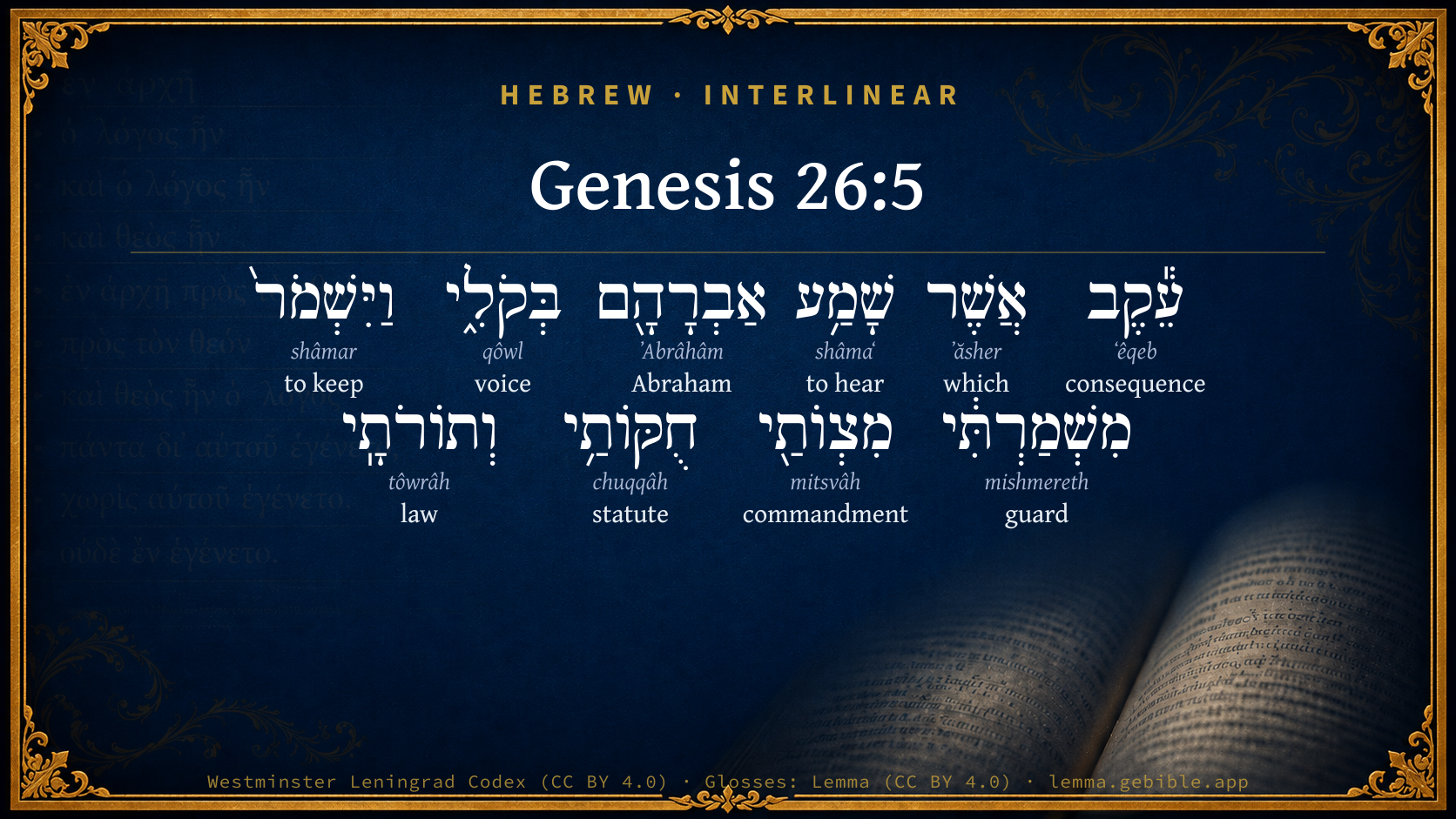
Hebrew (Westminster Leningrad Codex) Genesis 26:5 appears in the Hebrew Old Testament. The text above is from the Westminster Leningrad Codex. Each word links to its Strong’s number, a concise gloss, and parsing drawn from the Open Scriptures Hebrew Bible morphology. Click any word for its full Brown-Driver-Briggs (BDB) entry.
Download image
Cite this verse

Genesis 26:5 (World English Bible). Public Domain. Lemma interlinear Bible study tool, https://lemma.gebible.app/v/genesis/26/5.

Show BibTeX & RIS
BibTeX
RIS
English Translation
because Abraham obeyed my voice, and kept my charge, my commandments, my statutes, and my laws."
World English Bible · Public Domain
Highlights
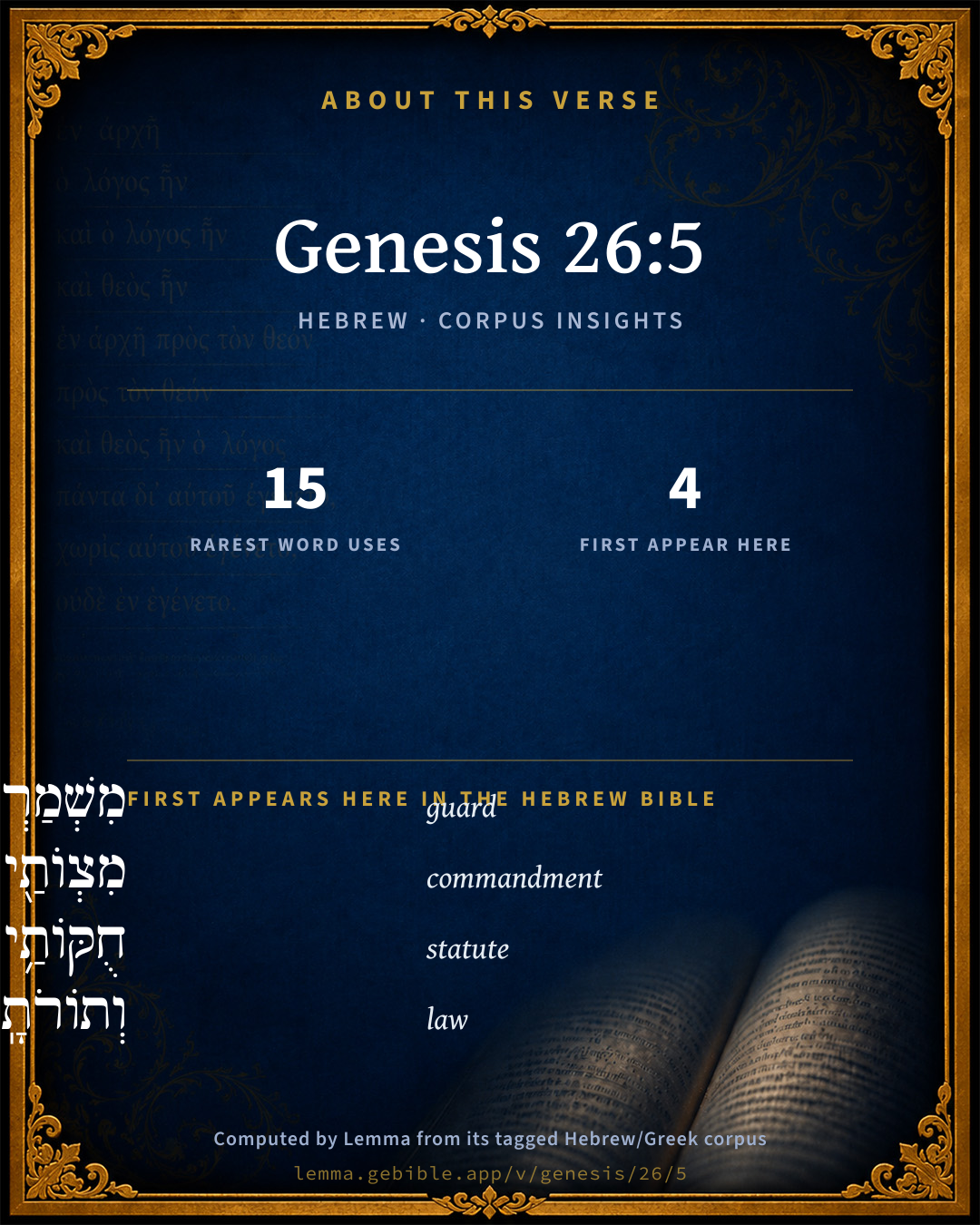
  • 4 first appearances in the Hebrew Bible
Full analysis ↓
Download a study sheet

One document with this verse’s original text, its word-by-word gloss line, the meaning frame, cross-references with their text, attributed commentary, and full source and license credits — printable, and it pastes into notes with its structure intact.

This verse Autodidact and up

Study sheet (.html) Plain text (.txt)

A passage Seminary Student

Up to 50 verses in one chapter. A passage sheet keeps up to 6 commentary sources and 12 cross-references per verse, in the order this page ranks them, and says so on the sheet whenever that leaves anything out. Ask for a single verse and you get the Autodidact verse sheet above.

Everything on this page stays free to read, with no account — the sheet is a download of what is already on screen, not access to it.

Want to remove ads? Support Godless Engineer
Compare translations 3

The same verse in 3 English versions, stacked beneath the original-language interlinear above. Click any original word for its lexicon entry.

Each is an independent rendering of the whole verse — the interlinear is not word-aligned to these translations.

Highlighted words mark where these versions differ — a whole-verse word diff, not a word-by-word alignment.

  • World English Bible Public Domain
    because Abraham obeyed my voice, and kept my charge, my commandments, my statutes, and my laws."
  • King James Version Public Domain
    Because that Abraham obeyed my voice, and kept my charge, my commandments, my statutes, and my laws.
  • unfoldingWord Literal Text CC BY-SA 4.0
    because Abraham obeyed my voice and kept my requirements, my commands, my decrees, and my laws.” Isaac Lies about His Wife Rebekah to the Philistines 26:6-11

unfoldingWord Literal Text — © unfoldingWord, licensed CC BY-SA 4.0. Word-aligned USFM3 via Door43 (git.door43.org/unfoldingWord/en_ult).

Versions to compare (up to 4)

3 of 4 selected

Show all 18 translations

Every available English version of this verse, each an independent rendering of the whole verse.

  • World English Bible Public Domain
    because Abraham obeyed my voice, and kept my charge, my commandments, my statutes, and my laws."
  • Berean Standard Bible Public Domain
    because Abraham listened to My voice and kept My charge, My commandments, My statutes, and My laws.”
  • Majority Standard Bible Public Domain
    because Abraham listened to My voice and kept My charge, My commandments, My statutes, and My laws.”
  • King James Version Public Domain
    Because that Abraham obeyed my voice, and kept my charge, my commandments, my statutes, and my laws.
  • American Standard Version (1901) Public Domain
    Because that Abraham obeyed my voice, and kept my charge, my commandments, my statutes, and my laws.
  • Revised Version (1885) Public Domain
    because that Abraham obeyed my voice, and kept my charge, my commandments, my statutes, and my laws.
  • Geneva Bible (1599) Public Domain
    Because that Abraham obeyed my voyce and kept mine ordinance, my commandements, my statutes, and my Lawes.
  • Douay-Rheims (1899) Public Domain
    Because Abraham obeyed my voice, and kept my precepts and commandments, and observed my ceremonies and laws.
  • Young's Literal Translation Public Domain
    because that Abraham hath hearkened to My voice, and keepeth My charge, My commands, My statutes, and My laws.'
  • Literal Standard Version CC BY-SA 4.0
    because that Abraham has listened to My voice, and keeps My charge, My commands, My statutes, and My laws.”
  • Unlocked Literal Bible CC BY-SA 4.0
    I will do this because Abraham obeyed my voice and kept my instructions, my commandments, my statutes, and my laws.”
  • unfoldingWord Literal Text CC BY-SA 4.0
    because Abraham obeyed my voice and kept my requirements, my commands, my decrees, and my laws.” Isaac Lies about His Wife Rebekah to the Philistines 26:6-11
  • Darby Bible Public Domain
    because that Abraham hearkened to my voice, and kept my charge, my commandments, my statutes, and my laws.
  • World Messianic Bible Public Domain
    because Abraham obeyed my voice, and kept my requirements, my commandments, my statutes, and my laws.”
  • Webster's Bible Public Domain
    Because that Abraham obeyed my voice, and kept my charge, my commandments, my statutes, and my laws.
  • Free Bible Version CC BY-SA 4.0
    because Abraham did what I told him, and kept my requirements, my commands, my regulations, and my laws.”
  • Bible in Basic English Public Domain
    Because Abraham gave ear to my voice and kept my words, my rules, my orders, and my laws.
  • JPS Tanakh (1917) Public Domain
    because that Abraham hearkened to My voice, and kept My charge, My commandments, My statutes, and My laws.'

Literal Standard Version (2020), Covenant Press — licensed CC BY-SA 4.0. Text via the HelloAO Bible API (eBible.org). Unlocked Literal Bible (unfoldingWord) — licensed CC BY-SA 4.0. Text via the HelloAO Bible API (eBible.org). unfoldingWord Literal Text — © unfoldingWord, licensed CC BY-SA 4.0. Word-aligned USFM3 via Door43 (git.door43.org/unfoldingWord/en_ult). Free Bible Version, Dr. Jonathan Gallagher — licensed CC BY-SA 4.0. Text via the HelloAO Bible API (eBible.org).

Word by word

More ways to search: Search by grammar → Find every occurrence → Compare this word →

Practice this passage: Drill this verse → Learn its vocabulary →

עֵ֕קֶב
ʻêqeb
H6118
“consequence”
Noun, Common, Masculine, Singular, Absolute
Part of Speech
Noun
Type
Common
Gender
Masculine
Number
Singular
State
Absolute
Full BDB Definition

Origin: from H6117 in the sense of H6119

TWOT: 1676e

consequence (noun masculine) - consequence - consequence, gain, reward - end - as a consequence, because, consequently (adverb) - as a consequence of, that, because (conjunction)
  1. אֲשֶׁר ʼăsher H834 “which” Particle, Relative
  2. שָׁמַ֥ע shâmaʻ H8085 “to hear” Verb, Qal, Perfect, 3rd Person, Masculine, Singular
  3. אַבְרָהָ֖ם ʼAbrâhâm H85 “Abraham” Noun, Proper
  4. בְּקֹלִ֑י qôwl H6963 “in/at · voice · my” Preposition + Noun, Common, Masculine, Singular, Construct + Suffix, Personal, 1st Person, Common, Singular
  5. וַיִּשְׁמֹר֙ shâmar H8104 “and · to keep” Conjunction + Verb, Qal, Sequential Imperfect, 3rd Person, Masculine, Singular
  6. מִשְׁמַרְתִּ֔י mishmereth H4931 “guard · my” Noun, Common, Feminine, Singular, Construct + Suffix, Personal, 1st Person, Common, Singular
  7. מִצְוֺתַ֖י mitsvâh H4687 “commandments · my” Noun, Common, Feminine, Plural, Construct + Suffix, Personal, 1st Person, Common, Singular
  8. חֻקּוֹתַ֥י chuqqâh H2708 “statutes · my” Noun, Common, Both, Plural, Construct + Suffix, Personal, 1st Person, Common, Singular
  9. וְתוֹרֹתָֽי tôwrâh H8451 “and · laws · my” Conjunction + Noun, Common, Feminine, Plural, Construct + Suffix, Personal, 1st Person, Common, Singular

About this verse

These counts appear in no published source. They are computed here, from the morphology-tagged text and Lemma’s own curated glosses. What Lemma adds →

10
words
10
distinct lemmas
Pentateuch
section

Notable vocabulary

The rarest word here is עֵ֕קֶב consequence H6118 — appearing just 15 times in the whole Hebrew Bible.

First appearance in Scripture

These words make their first canonical appearance in the Hebrew Bible here:

  • מִשְׁמַרְתִּ֔י guard H4931
  • מִצְוֺתַ֖י commandment H4687
  • חֻקּוֹתַ֥י statute H2708
  • וְתוֹרֹתָֽי law H8451

Shared distinctive vocabulary

עֵ֕קֶב consequence H6118 occurs in 15 verses of the Hebrew Bible. Also found in:

Grammatical profile

  • 2 verbs
  • 7 nouns
  • 1 particle

Verb forms

  • שָׁמַ֥ע Qal · Perfect
  • וַיִּשְׁמֹר֙ Qal · Sequential Imperfect

Hebrew & Septuagint length

In English translation the verse runs 16 words from the Hebrew and 21 from the Septuagint (LXX English) — closely comparable.

A rough comparison of the two English renderings, which tokenize alike — not a word-level alignment.

Word counts can differ between the Hebrew and the Greek without any difference in meaning — e.g. the Hebrew direct-object marker אֵת has no separate Greek word, and Greek often adds the article ὁ.

Cross-references

13

Topical passages linked to Genesis 26:5 in the Treasury of Scripture Knowledge — connected by theme and wording, ordered by reader-vote popularity; previews shown in the World English Bible.

  • Matthew 7:24 "Everyone therefore who hears these words of mine, and does them, I will liken him to a wise man, who built his house on a rock.
  • Genesis 22:18 In your seed will all the nations of the earth be blessed, because you have obeyed my voice."
  • Genesis 22:16 and said, "I have sworn by myself, says Yahweh, because you have done this thing, and have not withheld your son, your only son,
  • Psalms 112:1–2 Praise Yah! Blessed is the man who fears Yahweh, Who delights greatly in his commandments.
  • James 2:21 Wasn't Abraham our father justified by works, in that he offered up Isaac his son on the altar?
  • Hebrews 11:8 By faith, Abraham, when he was called, obeyed to go out to the place which he was to receive for an inheritance. He went out, not knowing where he went.
  • Psalms 128:1–6 Blessed is everyone who fears Yahweh, Who walks in his ways.
  • Galatians 5:6 For in Christ Jesus neither circumcision amounts to anything, nor uncircumcision, but faith working through love.
  • Genesis 12:4 So Abram went, as Yahweh had spoken to him. Lot went with him. Abram was seventy-five years old when he departed out of Haran.
  • Genesis 18:19 For I have known him, to the end that he may command his children and his household after him, that they may keep the way of Yahweh, to do righteousness and justice; to the end that Yahweh may bring on Abraham that which he has spoken of him."
  • 1 Corinthians 15:58 Therefore, my beloved brothers, be steadfast, immovable, always abounding in the Lord's work, because you know that your labor is not in vain in the Lord.
  • Genesis 17:23 Abraham took Ishmael his son, all who were born in his house, and all who were bought with his money; every male among the men of Abraham's house, and circumcised the flesh of their foreskin in the same day, as God had said to him.
  • Matthew 5:19 Whoever, therefore, shall break one of these least commandments, and teach others to do so, shall be called least in the Kingdom of Heaven; but whoever shall do and teach them shall be called great in the Kingdom of Heaven.

Cross-references courtesy of OpenBible.info (CC BY 4.0).

Hebrew and Greek witnesses Masoretic Hebrew ↔ Greek Septuagint

The same verse in the two great witnesses to the Old Testament, shown verse-for-verse.

These are two independent witnesses, not word-aligned to each other, and the Septuagint is shown in lemma (dictionary) form.

Hebrew Genesis 26:5 Masoretic · Westminster Leningrad Codex

עֵ֕קֶב אֲשֶׁר שָׁמַ֥ע אַבְרָהָ֖ם בְּקֹלִ֑י וַיִּשְׁמֹר֙ מִשְׁמַרְתִּ֔י מִצְוֺתַ֖י חֻקּוֹתַ֥י וְתוֹרֹתָֽי

because Abraham obeyed my voice, and kept my charge, my commandments, my statutes, and my laws."

World English Bible · Public Domain

Greek LXX Genesis 26:5 Septuagint · lemma form

ἀντί ὅς ὑποἀκούω αβρααμ ὁ πατήρ σύ ὁ ἐμός φωνή καί φυλάσσω ὁ πρόσταγμα ἐγώ καί ὁ ἐντολή ἐγώ καί ὁ δικαίωμα ἐγώ καί ὁ νόμιμος ἐγώ

Because Abraam your father listened to my voice, and kept my injunctions, and my commandments, and my ordinances, and my statutes.

LXX2012 (modern English Septuagint) · Public Domain

Hebrew: Westminster Leningrad Codex (CC BY 4.0). Greek: Septuagint (public domain); English from LXX2012 (modern English Septuagint) (Public Domain). How the Septuagint differs from the Hebrew →

Targum (Aramaic paraphrase)

2

The Targum is the ancient Jewish Aramaic paraphrase of the Hebrew Scriptures — an interpretive translation, not the Hebrew text itself. Onkelos (literal) and Pseudo-Jonathan (expansive) render the Torah, and Jonathan the Prophets. Coverage is partial: where no permissively-licensed English translation exists for a verse, only the Aramaic is shown. This is verse-level text, not a word-by-word alignment to the Hebrew.

  1. Targum Onkelos Torah (Genesis–Deuteronomy)
    חֳלַף דִּי קַבִּיל אַבְרָהָם בְּמֵימְרִי וּנְטַר מַטְּרַת מֵימְרִי פִּקּוֹדַי קְיָמַי וְאוֹרָיָתָי

    (no public-domain English translation for this verse)

    Targum Onkelos — Aramaic: “Onkelos Genesis” (public domain); “Onkelos Exodus” (public domain); “Onkelos Leviticus” (public domain); “Onkelos Numbers” (public domain); “Onkelos Deuteronomy” (public domain). English: “Sefaria Community Translation” (CC0 1.0 (public-domain dedication)); “J.W. Etheridge. The Targums of Onkelos and Jonathan Ben Uzziel on the Pentateuch. London: Longmans, Green, 1862” (public domain). Text via Sefaria.

  2. Targum Pseudo-Jonathan Torah (Genesis–Deuteronomy)
    חוֹלַף דִי קַבֵּיל אַבְרָהָם בְּמֵימְרִי וְנָטַר מַטְרַת מֵימְרִי פִּיקוּדַי קְיָימַי וְאוֹרַיְיתָי

    on account that Abraham obeyed My Word, and kept the keeping of My word, My statutes, My covenants, and My laws.

    Targum Pseudo-Jonathan — Aramaic: “Targum Jonathan on Genesis” (public domain); “Targum Jonathan on Exodus” (public domain); “Targum Jonathan on Leviticus” (public domain); “Targum Jonathan on Numbers” (public domain); “Targum Jonathan on Deuteronomy” (public domain). English: “The Targum of Jonathan ben Uzziel, trans. J. W. Etheridge, London, 1862” (public domain). Text via Sefaria.

Commentary

Notes on Genesis 26:5 from classic Christian and Jewish commentators (each source and its license shown beneath its notes). The classic Christian expositions comment on the surrounding passage and are grouped to its opening verse, so a note may address several verses; the Jewish commentaries on the Tanakh (Rashi and others) are per-verse, so they appear only where the commentator wrote on this verse.

Lemma curates 59 commentaries, every one of them public domain or Creative Commons licensed, each selected and text-cleaned for this edition rather than reprinted as found. About our sources →

Trapp's Complete Commentary

John Trapp

Gen 26:5 Because that Abraham obeyed my voice, and kept my charge, my commandments, my statutes, and my laws.

Ver. 5. Because that Abraham.] His obedience was universal to all the wills of God; and is here alleged, not as the meritorious cause, but as an antecedent, of the blessing. Our good works do truly please God in Christ, and move him, after a sort, to do us good; yet not as merits, but as certain effects of Christ’s merits alone, and such as of his merit. {a}

{a} Rulloc., De Vocatione, p. 25.

John Trapp, A Commentary or Exposition upon All the Books of the Old and New Testament (1647–1656) — public domain. Text from a community e-Sword module.

Joseph Benson's Commentary

Gen 26:5. My voice, my charge, my commandments — This variety of expression seems to be designed to show the universality and exactness of Abraham’s obedience, that he readily complied with every intimation of the divine will. He obeyed the original laws of nature, the revealed laws of divine worship, particularly that of circumcision, and all the extraordinary precepts God gave him, as that of quitting his country, and that (which some think is more especially referred to) respecting the offering up of his son, which Isaac himself had reason enough to remember. Those only shall have the benefit of God’s covenant with their parents that tread in the steps of their obedience. It must be observed, however, as the covenant made with Abraham, and God’s promises to him, were made by God of his mere grace and mercy, so the blessings promised and conferred were so very great, that it is idle to imagine they could be merited by so mean a compensation as Abraham’s obedience which obedience was a debt that he would have owed to God, if there had been neither covenant nor promise made by God, and which was the effect of God’s grace to and in him.

Joseph Benson's Commentary on the Old and New Testaments (1811–1818) — public domain. Text from a community e-Sword module.

Geneva Bible (1599)

Geneva Bible translators

Hebrew, my keeping.

He commendeth Abraham’s obedience, because Isaac should be the more ready to follow the like: for as God made this promise of his free mercy, so doth the confirmation thereof proceed of the same fountain.

Geneva Bible (1599) marginal notes — public domain. Text via Bolls.life.

Adam Clarke's Commentary

Verse 5. Abraham obeyed my voice] מימרי meimeri, my WORD. See Ge 15:1.

My charge] משמרתי misitmarti, from שמר shamar, he kept, observed, &c., the ordinances or appointments of God. These were always of two kinds: 1. Such as tended to promote moral improvement, the increase of piety, the improvement of the age, &c. And 2. Such as were typical of the promised seed, and the salvation which was to come by him. For commandments, statutes, &c., the reader is particularly desired to refer to Le 16:15, &c., where these things are all explained in the alphabetical order of the Hebrew words.

Adam Clarke's Commentary on the Bible (1810–1826) — public domain. Text from a community e-Sword/MySword module.

John Calvin's Commentaries

5. Because that Abraham obeyed my voice. Moses does not mean that Abraham’s obedience was the reason why the promise of God was confirmed and ratified to him; but from what has been said before, (Genesis 22:18,) where we have a similar expression, we learn, that what God freely bestows upon the faithful is sometimes, beyond their desert, ascribed to themselves; that they, knowing their intention to be approved by the Lord, may the more ardently addict and devote themselves entirely to his service: so he now commends the obedience of Abraham, in order that Isaac may be stimulated to an imitation of his example. And although laws, statutes, rites, precepts, and ceremonies, had not yet been written, Moses used these terms, that he might the more clearly show how sedulously Abraham regulated his life according to the will of God alone — how carefully he abstained from all the impurities of the heathen — and how exactly he pursued the straight course of holiness, without turning aside to the right hand or to the left: for the Lord often honors his own law with these titles for the sake of restraining our excesses; as if he should say that it wanted nothing to constitute it a perfect rule, but embraced everything pertaining to absolute holiness. The meaning therefore is, that Abraham, having formed his life in entire accordance with the will of God, walked in his pure service.

John Calvin's Commentaries (1540-1563) — public domain. Text from the Calvin Translation Society English edition (1840s-50s) via the Christian Classics Ethereal Library (ccel.org). Calvin's coverage is partial (roughly two-thirds of the Bible); uncommented books and verses are honest gaps, never fabricated. The 19th-century editor's footnotes and remarks are omitted so the notes are faithfully Calvin's own voice.

The Cambridge Bible for Schools and Colleges

gen. ed. J. J. S. Perowne

5. because that, &c.] The blessing of Isaac is here treated as the reward of the obedience of Abraham; the emphasis is laid on the unity and continuity of the Chosen Family.

my charge … my laws] A strange redundancy of expression, reminding us of the style of Deut. The four words “charge,” “commandments,” “statutes,” “laws,” correspond to the more simple phrase “the way of the Lord” in Gen_18:19. The observance of legal enactments, ascribed to Abraham, is, strictly speaking, an anachronism. Cf. Deu_11:1, “Therefore thou shall love the Lord thy God, and keep his charge, and his statutes, and his judgements, and his commandments, alway”; 1Ki_2:3.

The Cambridge Bible for Schools and Colleges (gen. ed. J. J. S. Perowne; Cambridge University Press, 1878–1918) — public domain. Text from a community e-Sword module.

John Gill's Exposition

Because that Abraham obeyed my voice,.... In all things, and particularly in offering up his son at his command:

and kept my charge; whatever was given him in charge to observe; this, as Aben Ezra thinks, is the general, of which the particulars follow:

my commandments, my statutes, and my laws; whether moral, ceremonial, or civil and judicial; all and everyone which God enjoined him, he was careful to observe. Here seems to be something wanting, for the words are not to be joined with the preceding, as if Abraham's obedience was the cause of the above promises made to Isaac, or to himself: but this is mentioned rather as an example to Isaac, and to stir him up to do the like, as if it was said, because or seeing that Abraham thy father did so and so, do thou likewise.

John Gill's Exposition of the Whole Bible (1746–1763) — public domain (CC PDM 1.0). Text via the HelloAO Bible API.

Haydock's Catholic Bible Commentary

Ceremonies of religion, observed under the law of nature. (Menochius)

George Leo Haydock (1774–1849), Haydock's Catholic Family Bible and Commentary, 1859 edition — public domain. Excludes Psalms (Douay-Rheims chapter numbering differs from Protestant) and Deuterocanonical books (Catholic canon only).

Matthew Poole's English Annotations

Here was a covenant made between God and Abraham; and as, if Abraham had broken the condition of walking before God required on his part, God had been discharged from the promise made on his part; so contrarily, because Abraham performed his condition, God engageth himself to perform his promise to him, and to his seed. But as that promise and covenant was made by God of mere grace, as is evident and confessed; so the mercies promised and performed to him and his are so great and vast, that it is an idle thing to think they could be merited by so mean a compensation as Abraham’s obedience, which was a debt that he owed to God, had there been no such covenant or promise made by God, and which also was an effect of God’s graces to him and in him.

Matthew Poole's English Annotations on the Holy Bible (1683–1685) — public domain. Text from a community e-Sword/MySword module.

Whedon's Commentary on the Bible

Daniel D. Whedon

5. Voice… charge… commandments… statutes… laws — A comprehensive summary of all the various revelations of the divine will. God’s voice denotes more particularly the spoken revelations; his charge the special trusts of promise he had given Abraham to guard; his commandments the occasional precepts given from time to time; his statutes the more permanent prescriptions of his will; his laws the everlasting and unchangeable expressions of his righteousness. Already had God spoken “at sundry times and in divers manners,” (Heb_1:1,) and we note that the son is blessed because of his father’s obedience.

Daniel D. Whedon (gen. ed.), Commentary on the Old and New Testaments (1874–1909) — public domain. Text from a community e-Sword module.

The Pulpit Commentary

Because that Abraham obeyed (literally, hearkened to) my voice (a general description of the patriarch"s obedience, which the next clause further particularizes), and kept my charge, custodierit custodiam (Calvin); observed my observances (Kalisch); the charge being that which is intended to be keptmy commandments, i.e. particular injunctions, specific enactments, express or occasional orders (cf. 2Ch_35:16) my statutes, or permanent ordinances, such as the Passover; literally, that which is graven on tables or monuments (compare Exo_12:14) and my laws which refer to the great doctrines of moral obligation. The three terms express the contents of the Divine observances which Abraham observed.

The Pulpit Commentary (1880–1919), ed. H.D.M. Spence-Jones & Joseph S. Exell — public domain. Text from a community e-Sword module.

John Wesley's Explanatory Notes

Abraham obeyed my voice - Do thou do so too, and the promise shall be sure to thee. A great variety of words is here used to express the Divine Will to which Abraham was obedient, my voice, my charge, my commandments, my statutes, and my laws - Which may intimate, that Abraham's obedience was universal; he obeyed the original laws of nature, the revealed laws of divine worship, particularly that of circumcision, and all the extraordinary precepts God gave him, as that of quitting his country, and that (which some think is more especially referred to) the offering up of his son, which Isaac himself had reason enough to remember. Those only shall have the benefit of God's covenant with their parents, that tread the steps of their obedience.

John Wesley, Explanatory Notes Upon the Whole Bible (1754–1765) — public domain. Text via the GEBible commentary corpus.

Rashi

Rabbi Shlomo Yitzchaki (Rashi)

שמע אברהם בקלי ABRAHAM HEARKENED TO MY VOICE when I put him to the test.

וישמר משמרתי AND KEPT MY CHARGE — This refers to precautionary measures which are intended to make us avoid the infringement of Biblical prohibitions: such are the Rabbinical inhibition of marriage between relatives in the second degree and the Rabbinical regulations regarding not doing certain acts on the Sabbath (cf. Yevamot 21a).

מצותי MY COMMANDMENTS — those matters which, had they not been written in the Torah, we would nevertheless hold that they are fitting matters to be the subject of a commandment, such as robbery and murder (cf. Yoma 67b).

חקותי MY ORDINANCES — matters which our evil inclination and the heathen nations argue against the necessity of prohibiting, such as the eating of swine’s flesh and the wearing of garments made of a mixture of wool and linen — things for which there are no apparent reasons but which are the King’s decrees and enactments imposed on His subjects (Yoma 67b).

ותורתי AND MY LAWS — The plural serves to include with the written Law also the Oral Law which prescribes commands that are an ancient institution given by God to Moses from Sinai (cf. Genesis Rabbah 64:4).

Rashi on the Tanakh — English translations: “The Judaica Press complete Tanach with Rashi, translated by A. J. Rosenberg” (CC BY 4.0); “Pentateuch with Rashi's commentary by M. Rosenbaum and A.M. Silbermann, 1929-1934” (public domain); “The Metsudah Tanach series, Lakewood, N.J” (CC BY 4.0); and “The Book of Joshua, Metsudah Publications, 1997” (CC BY 4.0). Text via Sefaria.

Ramban (Nachmanides)

Rabbi Moshe ben Nachman (Ramban / Nachmanides)

AND HE KEPT MY CHARGE. Rashi comments: “As a reward that Abraham hearkened to My voice when I tested him. And he kept My charge — these are the precautionary decrees instituted by the Sages, which are intended to make us avoid the violation of Biblical laws, such as Second Degrees of forbidden marriages and certain prohibited acts on the Sabbath. My commandments — these are precepts which, had they not been written in the Torah, were requisite to have been written, such as robbery and murder. My statutes — these are matters against which the evil inclination and the heathen nations argue, such as the prohibitions against eating the swine and the wearing of garments woven of wool and linen, there being no apparent rationale for them except that they are decrees of the King imposed on His subjects. And My laws — the plural is intended to include, [besides the Written Law], the Oral Law as well as those rules given to Moses from Sinai.” [Thus far the words of Rashi.]Now if so, all this interpretation is posited on the opinion that Abraham fulfilled and observed the Torah before it was given on Sinai. This is indeed what the Sages of the Midrash said in connection with the verse, And Joseph gave them ‘agaloth’ (wagons), 45:21. The word agaloth (wagons) may also mean “heifers,” thus suggesting that as a mark of identification to his father, Joseph gave his brothers a reference to the law of the Heifer (Deuteronomy 21:6) which he studied with his father just before he became separated from him. The Midrash referred to is in Bereshith Rabbah 95:2. thereby indicating to his father that when he left him they were studying the section dealing with Eglah Arufah. Thus Joseph occupied himself with Torah just as his fathers did. Though the Torah had not yet been given, it is still written of Abraham, And he kept My charge, My commandments, My statutes, and My laws. There the Sages also said that Abraham observed the details of the Torah, which he taught to his children, etc., etc. (Above, 18:19.) Bereshith Rabbah, ibid.The question presents itself: If it be the case [that the laws of the Torah were observed by our ancestors before the Torah was given on Sinai], how did Jacob erect a pillar and marry two sisters in their lifetime, and, in the opinion of our Rabbis, four sisters. Also, Amram [Moses’ father] married his aunt, and Moses our teacher erected twelve pillars., 24:4. How then was it possible that they should be permissive in matters of Torah which Abraham their ancestor had prohibited on himself, and for which G-d appointed him reward, when he [Abraham] was wont to command his children and his household after him to walk in His ways? In the case of Jacob the Sages taught that he observed the Sabbath and established borders for Sabbath distances. In this matter of the Sabbath it is possible though that Jacob observed it because it is equal in importance to the entire Torah since it testifies to the act of Creation.Perhaps then we should say that My charge refers to the Second Degree of marriages which were forbidden to the Sons of Noah;, Note 222, and Seder Vayishlach, Note 148. My commandments applies to robbery and murder; My statutes refers to the laws against eating a limb torn off from a live animal, as well as breeding mixed kinds of cattle or grafting together different species of trees; and My laws refer to civil statutes and the prohibitions against idol worship. The Sons of Noah were commanded concerning all of these matters, and Abraham observed and fulfilled the Will of his Creator, observing even the details and the strictures of their commandments, even as the Sages mentioned: “The tractate of idolatry of our father Abraham contained four hundred chapters.” They further expounded [on the verse referring to Isaac, which says], And he found in that year a hundredfold, that he measured the produce for the purpose of tithing, since the patriarchs were the generous ones of the peoples, giving tithes to the poor or the priests of G-d, such as Shem and Eber and their disciples, just as it is said, And he was a priest of the most high G-d. Now it appears to me from a study of the opinions of our Rabbis that Abraham our father learned the entire Torah by Ruach Hakodesh and occupied himself with its study and the reason for its commandments and its secrets, and he observed it in its entirety as “one who is not commanded but nevertheless observes it.” ) The reason for it, as explained in Tosafoth, is that he who is commanded to do a certain mitzvah (commandment) is under tension lest he might not properly fulfill it, while he who is not commanded therein has no responsibility in the matter and may leave it at his will. Consequently, his reward is less. Furthermore, his observance of the Torah applied only in the Land of Israel, whereas Jacob married two sisters only when outside the Land, and similarly with Amram who married his aunt. For the Commandments are the ordinance of the G-d of the land, even though we have been charged with personal duties in all places. Our Rabbis have already alluded to this secret, and I will yet call your attention to it with the help of G-d. And the matter of the erection of the pillar [by Jacob and Moses referred to above] was a commandment that was innovated at a certain time, as the Sages expounded from the verse, “Neither shalt thou set up a pillar which the Eternal thy G-d hateth, He hated it although it was pleasing to Him in the days of the ancestors.”, Sifre. The reason for the change being that the Canaanites afterward had made it an ordinance of idol worship. And with respect to Joseph concerning whom the Sages expounded that he observed the Sabbath even in Egypt, it was because it is equal in importance to all the commandments, constituting, as it does, a testimony to Creatio ex nihilo. (new), thus implying that G-d created a new world out of an absolute void. Therefore Joseph would do so in order to teach his children faith in the Creation of the world, to remove from their hearts the false doctrine of idolatry and the opinion of the Egyptians. This then is the intent [of the Sages when speaking of the patriarchs and their children observing the Torah].In accordance with the literal meaning of Scripture, you may say that My charge means faith in the Deity, implying that Abraham believed in the unique Divine Name and kept vigilant guard over it in his heart, differing thereby with the worshippers of idols, and calling by the name of the Eternal to bring many to His worship. My commandments refers to all that G-d commanded Abraham: Go out of thy land, the bringing of his son as a burnt-offering, and the expulsion of the maid-servant and her son., 21:12. My statutes refers to walking in the paths of G-d by being gracious and merciful, doing righteousness and judgment, and commanding his children and his household concerning them. And My Laws refers to the circumcision of Abraham himself and his sons and his servants, as well as all Commandments of the Sons of Noah, Note 222, and Seder Vayishlach, Note 148. which constitute their Law.

Ramban (Nachmanides) on the Tanakh — English translation: “Commentary on the Torah by Ramban (Nachmanides). Translated and annotated by Charles B. Chavel. New York, Shilo Pub. House, 1971-1976” (CC BY 4.0). Text via Sefaria.

Radak

Rabbi David Kimhi (Radak)

עקב אשר שמע אברהם, the reason why I have given him the land is because he heeded my voice even to the extent of offering his only son as a burnt-offering.

משמרתי, מצותי, חוקותי, ותורותי, G’d included all the commandments, hinting that all the commandments, i.e. chukotai, contain elements of which the rationale has been revealed and some which have not. Even the seven Noachide laws, applicable universally, contain elements the reason for which has not ever been revealed to the people but whose rationale is familiar only to the wisest scholars. Examples of such commandments are: the prohibition of grafting or crossbreeding, eating (amputated) limbs of a living animal אבר מן החי. To describe such laws, the Torah here mentions the word חוקותי, “My statutes,” whereas the description מצותי refers to commandments which the human mind understands or even applauds. It matters not that these commandments be performed by different parts of the body, i.e. the mouth, the hands, or merely the heart. Similarly, it matters not whether they are positive commandments, requiring action, or negative commandments requiring self-restraint. Some commentators (compare Torah Shleymah 25) claim that Avraham was only 3 years old when he recognised the existence of G’d and began to worship him, so that the numerical value of the letters in the word עקב=172 would comprise the number of years which Avraham carried out G’d’s commandments. Other commentators place the time when Avraham became convinced of monotheism as the only religion as being when he had completed his fortieth year. (Bereshit Rabbah 30,8) This appears to be more probable. Our sages claim that Avraham observed all the commandments spelled out in the written and the oral Torah including such rabbinic ordinances as Eyruv Tavshilim (Yuma 28). They base this on the word משמרתי, seeing this word refers generally to the type of “security fence” סיג, introduced by the Rabbis to safeguard us against violating Biblical injunctions. What the rabbis meant therefore was that Avraham invented such safeguards for himself in order not to violate the basic prohibitions.

Radak on the Tanakh — English translations: “Sefaria Community Translation” (CC0 1.0 (public-domain dedication)); “Eliyahu Munk, HaChut Hameshulash” (CC BY 4.0); “Rabbi Mike Feuer, Jerusalem Anthology” (CC BY 4.0); and “R. David Kimhi on the first book of Psalms, Translated by R.G. Finch, London, 1919” (public domain). Text via Sefaria.

Lesson kit

Teaching starters — assembled from the data on this page, not authored interpretation. Every prompt links to the verse data it draws on. Edit before teaching.

Genesis, in the Pentateuch, opens this verse with 10 words (10 distinct Hebrew lemmas). Its most distinctive word is ʻêqeb (“consequence”). A historical commentator’s framing appears above. Read the whole chapter for the surrounding context.

Discussion questions

  1. What does “consequence” (ʻêqeb) contribute to the verse as a whole?
  2. 4 words make their first appearance in Scripture here. What does this debut establish?
  3. How does Genesis 22:18, which shares the word «consequence», read alongside this verse?
  4. These translations render this verse differently; the difference is in the English rendering, not the original. What questions does that raise?
  5. «שָׁמַ֥ע» is a Qal Perfect verb. How does that grammatical form shape the action described?
  6. Compare how Trapp's Complete Commentary and Joseph Benson's Commentary read this verse. Where do they agree or differ?

Things to notice

Reading settings

Reading text

Shown beneath each verse's original-language words.

Old Testament
Old Testament edition

Read the OT as the Masoretic Hebrew (MT) or the Greek Septuagint (LXX).

English shown for the Greek Septuagint (in the Hebrew ↔ Greek comparison).

Comparing translations? Open the Compare panel on any verse page to stack up to four side by side.