Nehemiah 4:20

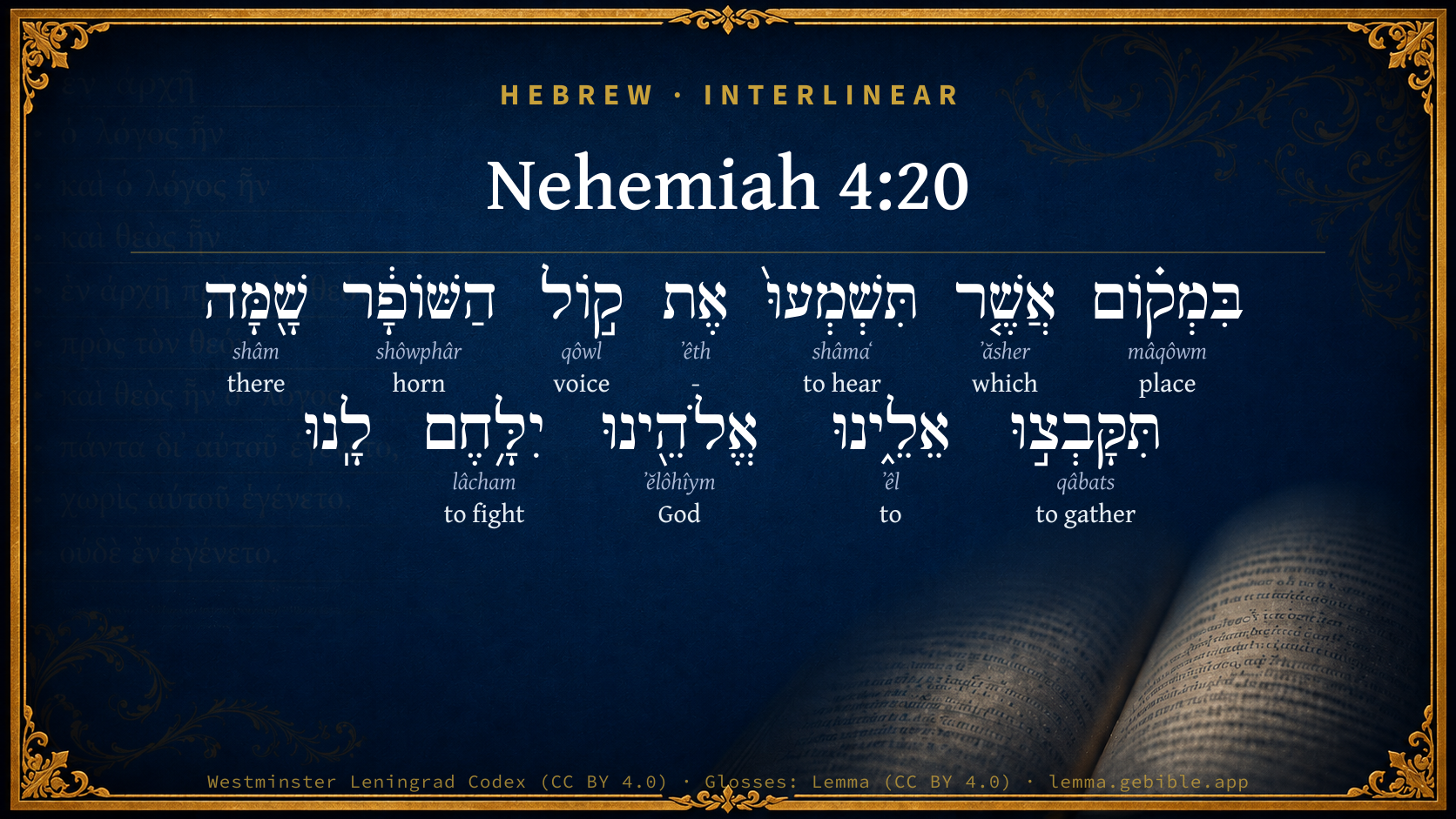
Hebrew (Westminster Leningrad Codex) Nehemiah 4:20 appears in the Hebrew Old Testament. The text above is from the Westminster Leningrad Codex. Each word links to its Strong’s number, a concise gloss, and parsing drawn from the Open Scriptures Hebrew Bible morphology. Click any word for its full Brown-Driver-Briggs (BDB) entry.
Download image
Cite this verse

Nehemiah 4:20 (World English Bible). Public Domain. Lemma interlinear Bible study tool, https://lemma.gebible.app/v/nehemiah/4/20.

Show BibTeX & RIS
BibTeX
RIS
English Translation
in whatever place you hear the sound of the trumpet, resort you there to us; our God will fight for us.
World English Bible · Public Domain
Download a study sheet

One document with this verse’s original text, its word-by-word gloss line, the meaning frame, cross-references with their text, attributed commentary, and full source and license credits — printable, and it pastes into notes with its structure intact.

This verse Autodidact and up

Study sheet (.html) Plain text (.txt)

A passage Seminary Student

Up to 50 verses in one chapter. A passage sheet keeps up to 6 commentary sources and 12 cross-references per verse, in the order this page ranks them, and says so on the sheet whenever that leaves anything out. Ask for a single verse and you get the Autodidact verse sheet above.

Everything on this page stays free to read, with no account — the sheet is a download of what is already on screen, not access to it.

Want to remove ads? Support Godless Engineer
Compare translations 3

The same verse in 3 English versions, stacked beneath the original-language interlinear above. Click any original word for its lexicon entry.

Each is an independent rendering of the whole verse — the interlinear is not word-aligned to these translations.

Highlighted words mark where these versions differ — a whole-verse word diff, not a word-by-word alignment.

  • World English Bible Public Domain
    in whatever place you hear the sound of the trumpet, resort you there to us; our God will fight for us.
  • King James Version Public Domain
    In what place therefore ye hear the sound of the trumpet, resort ye thither unto us: our God shall fight for us.
  • unfoldingWord Literal Text CC BY-SA 4.0
    At the place where you hear the sound of the ram’s horn, you shall gather to us there. Our God will fight for us.”

unfoldingWord Literal Text — © unfoldingWord, licensed CC BY-SA 4.0. Word-aligned USFM3 via Door43 (git.door43.org/unfoldingWord/en_ult).

Versions to compare (up to 4)

3 of 4 selected

Show all 18 translations

Every available English version of this verse, each an independent rendering of the whole verse.

  • World English Bible Public Domain
    in whatever place you hear the sound of the trumpet, resort you there to us; our God will fight for us.
  • Berean Standard Bible Public Domain
    Wherever you hear the sound of the horn, rally to us there. Our God will fight for us!”
  • Majority Standard Bible Public Domain
    Wherever you hear the sound of the horn, rally to us there. Our God will fight for us!”
  • King James Version Public Domain
    In what place therefore ye hear the sound of the trumpet, resort ye thither unto us: our God shall fight for us.
  • American Standard Version (1901) Public Domain
    in what place soever ye hear the sound of the trumpet, resort ye thither unto us; our God will fight for us.
  • Revised Version (1885) Public Domain
    in what place soever ye hear the sound of the trumpet, resort ye thither unto us; our God shall fight for us.
  • Geneva Bible (1599) Public Domain
    In what place therefore ye heare the sound of the trumpet, resort ye thither vnto vs: our God shall fight for vs.
  • Douay-Rheims (1899) Public Domain
    In what place soever you shall hear the sound of the trumpet, run all thither unto us: our God will fight for us.
  • Young's Literal Translation Public Domain
    in the place that ye hear the voice of the trumpet thither ye are gathered unto us; our God doth fight for us.'
  • Literal Standard Version CC BY-SA 4.0
    in the place that you hear the voice of the horn there you are gathered to us; our God fights for us.”
  • Unlocked Literal Bible CC BY-SA 4.0
    You must rush to the place where you hear the trumpet sound and assemble there. Our God will fight for us.”
  • unfoldingWord Literal Text CC BY-SA 4.0
    At the place where you hear the sound of the ram’s horn, you shall gather to us there. Our God will fight for us.”
  • Darby Bible Public Domain
    in what place ye hear the sound of the trumpet, thither shall ye assemble to us; our God will fight for us.
  • World Messianic Bible Public Domain
    Wherever you hear the sound of the shofar, rally there to us. Our God will fight for us.”
  • Webster's Bible Public Domain
    In what place therefore ye hear the sound of the trumpet, resort ye thither to us: our God will fight for us.
  • Free Bible Version CC BY-SA 4.0
    Wherever you are and you hear the sound of the trumpet, run to join us there. Our God will fight for us!”
  • Bible in Basic English Public Domain
    Wherever you may be when the horn is sounded, come here to us; our God will be fighting for us.
  • JPS Tanakh (1917) Public Domain
    (4-14) in what place soever ye hear the sound of the horn, resort ye thither unto us; our God will fight for us.'

Literal Standard Version (2020), Covenant Press — licensed CC BY-SA 4.0. Text via the HelloAO Bible API (eBible.org). Unlocked Literal Bible (unfoldingWord) — licensed CC BY-SA 4.0. Text via the HelloAO Bible API (eBible.org). unfoldingWord Literal Text — © unfoldingWord, licensed CC BY-SA 4.0. Word-aligned USFM3 via Door43 (git.door43.org/unfoldingWord/en_ult). Free Bible Version, Dr. Jonathan Gallagher — licensed CC BY-SA 4.0. Text via the HelloAO Bible API (eBible.org).

Word by word

More ways to search: Search by grammar → Find every occurrence → Compare this word →

Practice this passage: Drill this verse → Learn its vocabulary →

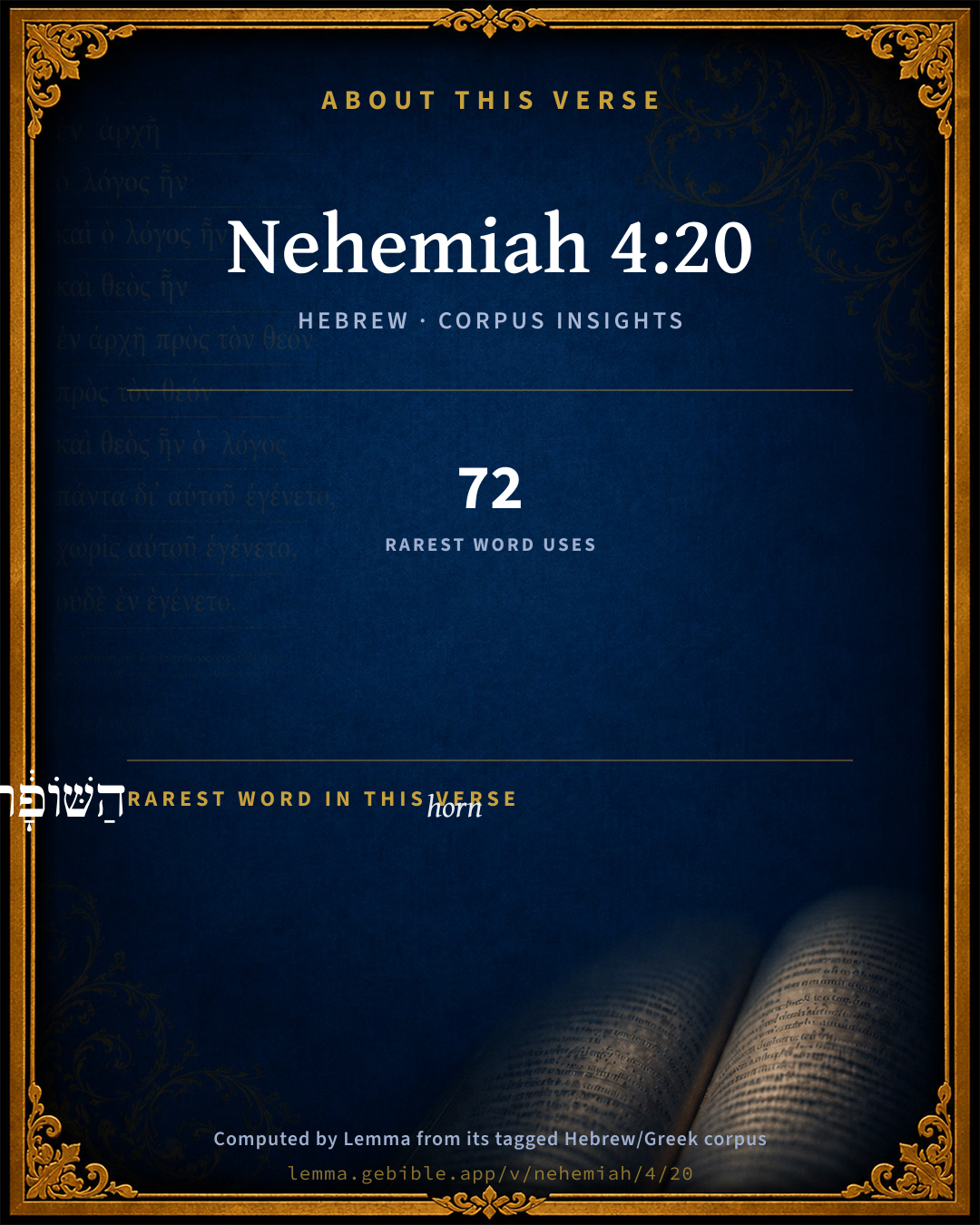
הַשּׁוֹפָ֔ר
shôwphâr
H7782
“the · horn”
Particle, Definite Article + Noun, Common, Masculine, Singular, Absolute
Part of Speech
Particle + Noun
Type
Common
Gender
Masculine
Number
Singular
State
Absolute
Full BDB Definition

Origin: from H8231 in the original sense of incising

TWOT: 2449c

horn, ram's horn
  1. בִּמְק֗וֹם mâqôwm H4725 “in/at · place of” Preposition + Noun, Common, Masculine, Singular, Construct
  2. אֲשֶׁ֤ר ʼăsher H834 “which” Particle, Relative
  3. תִּשְׁמְעוּ֙ shâmaʻ H8085 “to hear” Verb, Qal, Imperfect, 2nd Person, Masculine, Plural
  4. אֶת ʼêth H853 “-” Particle, Direct Object
  5. ק֣וֹל qôwl H6963 “voice of” Noun, Common, Masculine, Singular, Construct
  6. שָׁ֖מָּה shâm H8033 “there · toward” Adverb + Suffix, Demonstrative
  7. תִּקָּבְצ֣וּ qâbats H6908 “to gather” Verb, Niphal, Imperfect, 2nd Person, Masculine, Plural
  8. אֵלֵ֑ינוּ ʼêl H413 “to · us” Preposition + Suffix, Personal, 1st Person, Common, Plural
  9. אֱלֹהֵ֖ינוּ ʼĕlôhîym H430 “God(s) · our” Noun, Common, Masculine, Plural, Construct + Suffix, Personal, 1st Person, Common, Plural
  10. יִלָּ֥חֶם lâcham H3898 “to fight” Verb, Niphal, Imperfect, 3rd Person, Masculine, Singular

About this verse

These counts appear in no published source. They are computed here, from the morphology-tagged text and Lemma’s own curated glosses. What Lemma adds →

12
words
11
distinct lemmas
Historical
section

Grammatical profile

  • 3 verbs
  • 4 nouns
  • 2 prepositions
  • 1 adverb
  • 2 particles

Verb forms

  • תִּשְׁמְעוּ֙ Qal · Imperfect
  • תִּקָּבְצ֣וּ Niphal · Imperfect
  • יִלָּ֥חֶם Niphal · Imperfect

Cross-references

7

Topical passages linked to Nehemiah 4:20 in the Treasury of Scripture Knowledge — connected by theme and wording, ordered by reader-vote popularity; previews shown in the World English Bible.

  • Exodus 14:14 Yahweh will fight for you, and you shall be still."
  • Deuteronomy 1:30 Yahweh your God who goes before you, he will fight for you, according to all that he did for you in Egypt before your eyes,
  • Deuteronomy 20:4 for Yahweh your God is he who goes with you, to fight for you against your enemies, to save you.
  • Deuteronomy 3:22 You shall not fear them; for Yahweh your God, he it is who fights for you.
  • Joshua 23:10 One man of you shall chase a thousand; for Yahweh your God, he it is who fights for you, as he spoke to you.
  • Zechariah 14:3 Then Yahweh will go out and fight against those nations, as when he fought in the day of battle.
  • Exodus 14:25 He took off their chariot wheels, and they drove them heavily; so that the Egyptians said, "Let's flee from the face of Israel, for Yahweh fights for them against the Egyptians!"

Cross-references courtesy of OpenBible.info (CC BY 4.0).

Hebrew and Greek witnesses Masoretic Hebrew ↔ Greek Septuagint

The same verse in the two great witnesses to the Old Testament, shown verse-for-verse.

These are two independent witnesses, not word-aligned to each other, and the Septuagint is shown in lemma (dictionary) form.

Hebrew Nehemiah 4:20 Masoretic · Westminster Leningrad Codex

בִּמְק֗וֹם אֲשֶׁ֤ר תִּשְׁמְעוּ֙ אֶת ק֣וֹל הַשּׁוֹפָ֔ר שָׁ֖מָּה תִּקָּבְצ֣וּ אֵלֵ֑ינוּ אֱלֹהֵ֖ינוּ יִלָּ֥חֶם לָֽנוּ

in whatever place you hear the sound of the trumpet, resort you there to us; our God will fight for us.

World English Bible · Public Domain

Greek LXX Structure differs

The Septuagint has no separate book of Nehemiah. Its Greek text is the second half of Esdras B (2 Esdras), chapters 11–23; Ezra is the first half (1–10).

A verse-for-verse comparison isn’t shown here because the chapters and verses don’t line up. Switch to the LXX edition with the MT / LXX toggle above to read the Greek directly.

Hebrew: Westminster Leningrad Codex (CC BY 4.0). Greek: Septuagint (public domain); English from a public-domain English Septuagint. How the Septuagint differs from the Hebrew →

Commentary

Notes on Nehemiah 4:20 from classic Christian and Jewish commentators (each source and its license shown beneath its notes). The classic Christian expositions comment on the surrounding passage and are grouped to its opening verse, so a note may address several verses; the Jewish commentaries on the Tanakh (Rashi and others) are per-verse, so they appear only where the commentator wrote on this verse.

Lemma curates 59 commentaries, every one of them public domain or Creative Commons licensed, each selected and text-cleaned for this edition rather than reprinted as found. About our sources →

Trapp's Complete Commentary

John Trapp

Neh 4:20 In what place [therefore] ye hear the sound of the trumpet, resort ye thither unto us: our God shall fight for us.

Ver. 20. In what place therefore ye hear the sound of the trumpet] Which, therefore, for the purpose he kept at his own elbow, Neh 4:18, as a matter of trust and importance. Moses committed the blowing of the trumpets unto the sons of Aaron only, Num 10:8. "For if the trumpet give an uncertain sound, who shall prepare himself to the battle?" 1Co 14:8.

Resort you thither unto us] As to your rendezvous, that we may stand against the enemy in an entire body; meanwhile Nehemiah walketh the round, and watches the enemies’ motions, so that of him might be said, as once was of Hannibal, Nullo labore aut corpus fatigari, aut animus vinci poterat, he was indefatigable, insuperable (Liv. decad. 3, lib. 1), or as of Fabius Maximus.

Hic patria est, murique urbis stant pectore in uno (Sil. Ital.).

Our God shall fight for us] Courage therefore my hearts, he is "The Lord strong and mighty, the Lord mighty in battle," Psa 24:8, and may far better say than Henry VIII did, Cui adhaereo praeest, he whom I fight for is sure to prevail.

John Trapp, A Commentary or Exposition upon All the Books of the Old and New Testament (1647–1656) — public domain. Text from a community e-Sword module.

The Biblical Illustrator

Joseph S. Exell

Neh_4:20

So we laboured in the work.

Perseverance

The builders not only began well, but they persevered to the end of their work. Perseverance is s great element of success. It was George Stephensons motto, Persevere; and the celebrated mathematician, Arago, tells us that his master in mathematics gave a word of advice which he found in the binding of one of his text-books. Puzzled and discouraged by the difficulties he met with in his early studies, he was almost ready to give up the pursuit. Some words which he found on the waste leaf used to stiffen the cover of his paper-bound text-book caught his eye, and interested him. It proved to be a short letter from DAlembert to a young person disheartened, like himself, by the difficulties of mathematical study, and who had written to him for counsel. Go on, go on, sir, was the counsel which DAlembert gave him. The difficulties you meet will resolve themselves as you advance. This maxim followed out made him one of the greatest astronomers of his day. And Christians must persevere in the work of God. (J. M. Randall.)

Perseverance

A Christian negro was once asked the meaning of perseverance, and he said, Masse, me think it mean hang on, hold fast, and no let go. And when some one questioned John Wesley on the remarkable success of his followers, Sir, he said, they are all at it, and always at it. (J. M. Randall.)

The Biblical Illustrator, edited by Joseph S. Exell (c. 1880s–1900s) — public domain. Text from a community e-Sword module.

Tyndale Open Study Notes

Tyndale Open Resources

4:20 our God will fight for us! Drawing on Israel’s ancient holy war tradition (Exod 14:14; Deut 1:30; 20:4; Josh 10:14; 23:10), Nehemiah encouraged the people that victory was certain if they trusted in the Lord.

Tyndale Open Study Notes — © Tyndale Open Resources, licensed CC BY-SA 4.0. Text via the HelloAO Bible API.

Geneva Bible (1599)

Geneva Bible translators

Meaning, to resist their enemies, if need required.

Geneva Bible (1599) marginal notes — public domain. Text via Bolls.life.

Adam Clarke's Commentary

Verse 20. Ye hear the sound of the trumpet] As the walls were very extensive, and the workmen consequently much scattered, their enemies might easily attack and destroy them successively, he therefore ordered them all to work as near to each other as they could; and himself, who was everywhere surveying the work, kept a trumpeter always with him, who was to sound when the enemy approached; and all were instantly to run to the place where they heard the sound.

Adam Clarke's Commentary on the Bible (1810–1826) — public domain. Text from a community e-Sword/MySword module.

The Cambridge Bible for Schools and Colleges

gen. ed. J. J. S. Perowne

20. In what place therefore] R.V. in what place soever.

resort ye thither] literally ‘thither shall ye collect or assemble yourselves together’.

our God shall fight for us] The Jews shall fight, and even against foes superior in numbers and strength shall prevail. Their God shall fight for them. See also Exo_15:3-6, ‘The Lord is a man of war … Thy right hand, O Lord, hath dashed in pieces the enemy;’ Exo_14:14, ‘The Lord shall fight for you, and ye shall hold your peace …’ Cf. Deu_1:30; Deu_3:22; Deu_20:4; Deu_28:7.

The Cambridge Bible for Schools and Colleges (gen. ed. J. J. S. Perowne; Cambridge University Press, 1878–1918) — public domain. Text from a community e-Sword module.

John Gill's Exposition

In what place therefore ye hear the sound of the trumpet,.... Be it what part of the wall soever they were at work, even the most distant:

resort ye thither to us; to Nehemiah, and the half of his servants armed, where the trumpet was blown; that was to be the place of rendezvous:

our God shall fight for us; and give us victory over our enemies; none have any reason to be intimidated, when they shall hear the sound of the trumpet.

John Gill's Exposition of the Whole Bible (1746–1763) — public domain (CC PDM 1.0). Text via the HelloAO Bible API.

Haydock's Catholic Bible Commentary

For us. Yet we must act with prudence and courage. (Haydock)

George Leo Haydock (1774–1849), Haydock's Catholic Family Bible and Commentary, 1859 edition — public domain. Excludes Psalms (Douay-Rheims chapter numbering differs from Protestant) and Deuterocanonical books (Catholic canon only).

Lesson kit

Teaching starters — assembled from the data on this page, not authored interpretation. Every prompt links to the verse data it draws on. Edit before teaching.

Nehemiah, in the Historical, opens this verse with 12 words (11 distinct Hebrew lemmas). Its most distinctive word is shôwphâr (“horn”). A historical commentator’s framing appears above. Read the whole chapter for the surrounding context.

Discussion questions

  1. What does “horn” (shôwphâr) contribute to the verse as a whole?
  2. How does Exodus 14:14, which shares this passage’s theme, read alongside this verse?
  3. These translations render this verse differently. What is at stake in choosing one wording over another?
  4. «תִּשְׁמְעוּ֙» is a Qal Imperfect verb. How does that grammatical form shape the action described?
  5. Compare how Trapp's Complete Commentary and The Biblical Illustrator read this verse. Where do they agree or differ?

Things to notice

Reading settings

Reading text

Shown beneath each verse's original-language words.

Old Testament
Old Testament edition

Read the OT as the Masoretic Hebrew (MT) or the Greek Septuagint (LXX).

English shown for the Greek Septuagint (in the Hebrew ↔ Greek comparison).

Comparing translations? Open the Compare panel on any verse page to stack up to four side by side.