2 Samuel 6:15

Hebrew (Westminster Leningrad Codex) 2 Samuel 6:15 appears in the Hebrew Old Testament. The text above is from the Westminster Leningrad Codex. Each word links to its Strong’s number, a concise gloss, and parsing drawn from the Open Scriptures Hebrew Bible morphology. Click any word for its full Brown-Driver-Briggs (BDB) entry.
Download image
Cite this verse

2 Samuel 6:15 (World English Bible). Public Domain. Lemma interlinear Bible study tool, https://lemma.gebible.app/v/2-samuel/6/15.

Show BibTeX & RIS
BibTeX
RIS
English Translation
So David and all the house of Israel brought up the ark of Yahweh with shouting, and with the sound of the trumpet.
World English Bible · Public Domain
Download a study sheet

One document with this verse’s original text, its word-by-word gloss line, the meaning frame, cross-references with their text, attributed commentary, and full source and license credits — printable, and it pastes into notes with its structure intact.

This verse Autodidact and up

Study sheet (.html) Plain text (.txt)

A passage Seminary Student

Up to 50 verses in one chapter. A passage sheet keeps up to 6 commentary sources and 12 cross-references per verse, in the order this page ranks them, and says so on the sheet whenever that leaves anything out. Ask for a single verse and you get the Autodidact verse sheet above.

Everything on this page stays free to read, with no account — the sheet is a download of what is already on screen, not access to it.

Want to remove ads? Support Godless Engineer
Compare translations 3

The same verse in 3 English versions, stacked beneath the original-language interlinear above. Click any original word for its lexicon entry.

Each is an independent rendering of the whole verse — the interlinear is not word-aligned to these translations.

Highlighted words mark where these versions differ — a whole-verse word diff, not a word-by-word alignment.

  • World English Bible Public Domain
    So David and all the house of Israel brought up the ark of Yahweh with shouting, and with the sound of the trumpet.
  • King James Version Public Domain
    So David and all the house of Israel brought up the ark of the LORD with shouting, and with the sound of the trumpet.
  • unfoldingWord Literal Text CC BY-SA 4.0
    And David and all of the house of Israel were bringing up the Box of Yahweh with shouting and with the sound of the shofar,

unfoldingWord Literal Text — © unfoldingWord, licensed CC BY-SA 4.0. Word-aligned USFM3 via Door43 (git.door43.org/unfoldingWord/en_ult).

Versions to compare (up to 4)

3 of 4 selected

Show all 18 translations

Every available English version of this verse, each an independent rendering of the whole verse.

  • World English Bible Public Domain
    So David and all the house of Israel brought up the ark of Yahweh with shouting, and with the sound of the trumpet.
  • Berean Standard Bible Public Domain
    while he and all the house of Israel brought up the ark of the LORD with shouting and the sounding of the ram’s horn.
  • Majority Standard Bible Public Domain
    while he and all the house of Israel brought up the ark of the LORD with shouting and the sounding of the ram’s horn.
  • King James Version Public Domain
    So David and all the house of Israel brought up the ark of the LORD with shouting, and with the sound of the trumpet.
  • American Standard Version (1901) Public Domain
    So David and all the house of Israel brought up the ark of Jehovah with shouting, and with the sound of the trumpet.
  • Revised Version (1885) Public Domain
    So David and all the house of Israel brought up the ark of the LORD with shouting, and with the sound of the trumpet.
  • Geneva Bible (1599) Public Domain
    So Dauid and all the house of Israel, brought the Arke of the Lord with shouting, and sound of trumpet.
  • Douay-Rheims (1899) Public Domain
    And David and all the house of Israel brought the ark of the covenant of the Lord with joyful shouting, and with sound of trumpet.
  • Young's Literal Translation Public Domain
    and David and all the house of Israel are bringing up the ark of Jehovah with shouting, and with the voice of a trumpet,
  • Literal Standard Version CC BY-SA 4.0
    and David and all the house of Israel are bringing up the Ark of YHWH with shouting, and with the voice of a horn,
  • Unlocked Literal Bible CC BY-SA 4.0
    So David and all the house of Israel brought up the ark of Yahweh with shouting and the sound of trumpets.
  • unfoldingWord Literal Text CC BY-SA 4.0
    And David and all of the house of Israel were bringing up the Box of Yahweh with shouting and with the sound of the shofar,
  • Darby Bible Public Domain
    And David and all the house of Israel brought up the ark of Jehovah with shouting, and with the sound of the trumpet.
  • World Messianic Bible Public Domain
    So David and all the house of Israel brought up the LORD’s ark with shouting and with the sound of the shofar.
  • Webster's Bible Public Domain
    So David and all the house of Israel brought up the ark of the LORD with shouting, and with the sound of the trumpet.
  • Free Bible Version CC BY-SA 4.0
    as he and all the Israelites brought along the Ark of the Lord, with plenty of shouting and the sound of horns being blown.
  • Bible in Basic English Public Domain
    So David and all the men of Israel took up the ark of the Lord with cries of joy and sounding of horns.
  • JPS Tanakh (1917) Public Domain
    So David and all the house of Israel brought up the ark of the LORD with shouting, and with the sound of the horn.

Literal Standard Version (2020), Covenant Press — licensed CC BY-SA 4.0. Text via the HelloAO Bible API (eBible.org). Unlocked Literal Bible (unfoldingWord) — licensed CC BY-SA 4.0. Text via the HelloAO Bible API (eBible.org). unfoldingWord Literal Text — © unfoldingWord, licensed CC BY-SA 4.0. Word-aligned USFM3 via Door43 (git.door43.org/unfoldingWord/en_ult). Free Bible Version, Dr. Jonathan Gallagher — licensed CC BY-SA 4.0. Text via the HelloAO Bible API (eBible.org).

Word by word

More ways to search: Search by grammar → Find every occurrence → Compare this word →

Practice this passage: Drill this verse → Learn its vocabulary →

בִּתְרוּעָ֖ה
tᵉrûwʻâh
H8643
“in/at · alarm”
Preposition + Noun, Common, Feminine, Singular, Absolute
Part of Speech
Preposition + Noun
Type
Common
Gender
Feminine
Number
Singular
State
Absolute
Full BDB Definition

Origin: from H7321

TWOT: 2135b

alarm, signal, sound of tempest, shout, shout or blast of war or alarm or joy - alarm of war, war-cry, battle-cry - blast (for march) - shout of joy (with religious impulse) - shout of joy (in general)
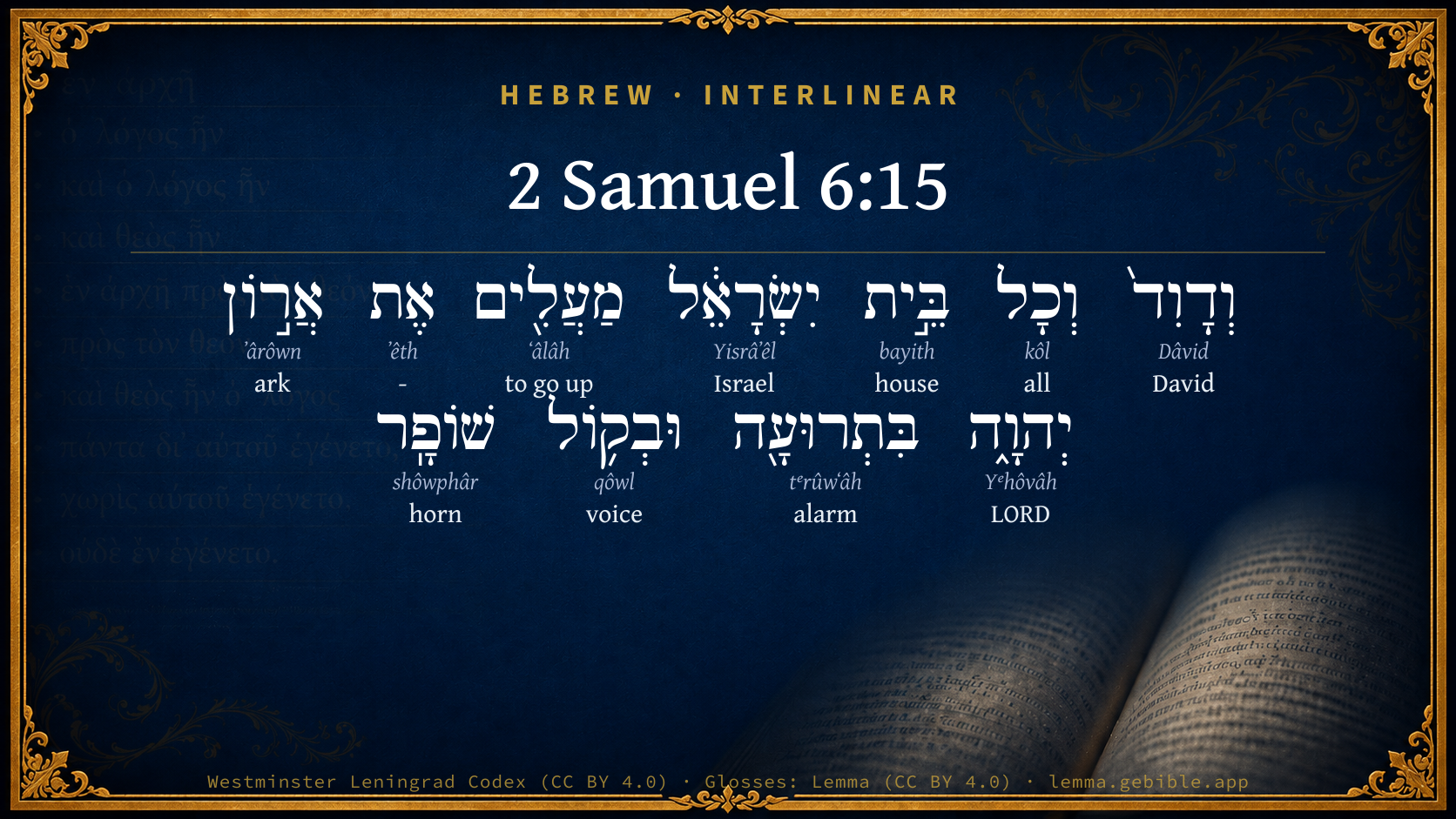
  1. וְדָוִד֙ Dâvid H1732 “and · David” Conjunction + Noun, Proper
  2. וְכָל kôl H3605 “and · all of” Conjunction + Noun, Common, Masculine, Singular, Construct
  3. בֵּ֣ית bayith H1004 “house of” Noun, Common, Masculine, Singular, Construct
  4. יִשְׂרָאֵ֔ל Yisrâʼêl H3478 “Israel” Noun, Proper
  5. מַעֲלִ֖ים ʻâlâh H5927 “going up” Verb, Hiphil, Participle Active, Masculine, Plural, Absolute
  6. אֶת ʼêth H853 “-” Particle, Direct Object
  7. אֲר֣וֹן ʼârôwn H727 “ark of” Noun, Common, Both, Singular, Construct
  8. יְהוָ֑ה Yᵉhôvâh H3068 “LORD” Noun, Proper
  9. וּבְק֥וֹל qôwl H6963 “and · in/at · voice of” Conjunction + Preposition + Noun, Common, Masculine, Singular, Construct
  10. שׁוֹפָֽר shôwphâr H7782 “horn” Noun, Common, Masculine, Singular, Absolute

About this verse

These counts appear in no published source. They are computed here, from the morphology-tagged text and Lemma’s own curated glosses. What Lemma adds →

11
words
11
distinct lemmas
Historical
section

Shared distinctive vocabulary

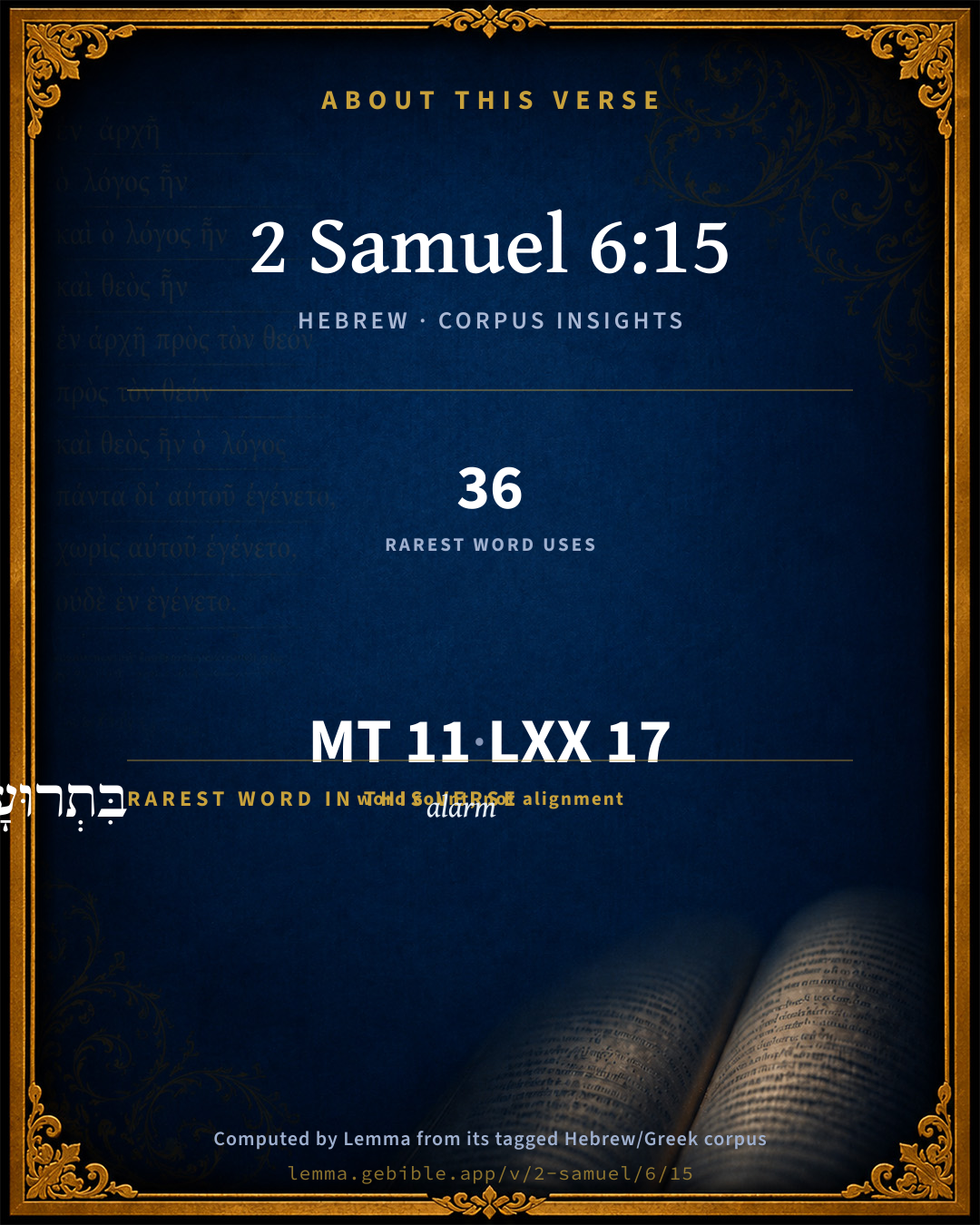
בִּתְרוּעָ֖ה alarm H8643 occurs in 33 verses of the Hebrew Bible. Also found in:

Grammatical profile

  • 1 verb
  • 9 nouns
  • 1 particle

Verb forms

  • מַעֲלִ֖ים Hiphil · Participle Active

Hebrew & Septuagint length

In English translation the verse runs 23 words from the Hebrew and 24 from the Septuagint (LXX English) — closely comparable.

A rough comparison of the two English renderings, which tokenize alike — not a word-level alignment.

Word counts can differ between the Hebrew and the Greek without any difference in meaning — e.g. the Hebrew direct-object marker אֵת has no separate Greek word, and Greek often adds the article ὁ.

In the original languages it is 11 Hebrew tokens and 17 Greek tokens — but the two are counted differently (Hebrew bundles its prefixes and suffixes into one token; the Greek is in lemma form), so that isn’t a like-for-like length.

Cross-references

11

Topical passages linked to 2 Samuel 6:15 in the Treasury of Scripture Knowledge — connected by theme and wording, ordered by reader-vote popularity; previews shown in the World English Bible.

  • Psalms 68:24–27 They have seen your processions, God, Even the processions of my God, my King, into the sanctuary.
  • Numbers 10:1–10 Yahweh spoke to Moses, saying,
  • Joshua 6:4–5 Seven priests shall bear seven trumpets of rams' horns before the ark: and the seventh day you shall compass the city seven times, and the priests shall blow the trumpets.
  • 1 Chronicles 15:16 David spoke to the chief of the Levites to appoint their brothers the singers, with instruments of music, psalteries and harps and cymbals, sounding aloud and lifting up the voice with joy.
  • 1 Chronicles 15:25 So David, and the elders of Israel, and the captains over thousands, went to bring up the ark of the covenant of Yahweh out of the house of Obed-edom with joy.
  • 1 Chronicles 15:28 Thus all Israel brought up the ark of the covenant of Yahweh with shouting, and with sound of the cornet, and with trumpets, and with cymbals, sounding aloud with psalteries and harps.
  • Ezra 3:10–11 When the builders laid the foundation of the temple of Yahweh, they set the priests in their clothing with trumpets, and the Levites the sons of Asaph with cymbals, to praise Yahweh, after the order of David king of Israel.
  • Psalms 47:1 Oh clap your hands, all you nations. Shout to God with the voice of triumph!
  • Psalms 47:5–6 God has gone up with a shout, Yahweh with the sound of a trumpet.
  • Psalms 150:3 Praise him with the sounding of the trumpet! Praise him with harp and lyre!
  • Psalms 132:18 I will clothe his enemies with shame, But on himself, his crown will be resplendant."

Cross-references courtesy of OpenBible.info (CC BY 4.0).

Hebrew and Greek witnesses Masoretic Hebrew ↔ Greek Septuagint

The same verse in the two great witnesses to the Old Testament, shown verse-for-verse.

These are two independent witnesses, not word-aligned to each other, and the Septuagint is shown in lemma (dictionary) form.

Hebrew 2 Samuel 6:15 Masoretic · Westminster Leningrad Codex

וְדָוִד֙ וְכָל בֵּ֣ית יִשְׂרָאֵ֔ל מַעֲלִ֖ים אֶת אֲר֣וֹן יְהוָ֑ה בִּתְרוּעָ֖ה וּבְק֥וֹל שׁוֹפָֽר

So David and all the house of Israel brought up the ark of Yahweh with shouting, and with the sound of the trumpet.

World English Bible · Public Domain

Greek LXX 2 Samuel 6:15 Septuagint · lemma form

καί δαυίδ καί πᾶς ὁ οἶκος ἰσραήλ ἀναἄγω ὁ κιβωτός κύριος μετά κραυγή καί μετά φωνή σάλπιγξ

And David and all the house of Israel brought up the ark of the Lord with shouting, and with the sound of a trumpet.

LXX2012 (modern English Septuagint) · Public Domain

Hebrew: Westminster Leningrad Codex (CC BY 4.0). Greek: Septuagint (public domain); English from LXX2012 (modern English Septuagint) (Public Domain). How the Septuagint differs from the Hebrew →

Targum (Aramaic paraphrase)

1

The Targum is the ancient Jewish Aramaic paraphrase of the Hebrew Scriptures — an interpretive translation, not the Hebrew text itself. Onkelos (literal) and Pseudo-Jonathan (expansive) render the Torah, and Jonathan the Prophets. Coverage is partial: where no permissively-licensed English translation exists for a verse, only the Aramaic is shown. This is verse-level text, not a word-by-word alignment to the Hebrew.

  1. Targum Jonathan Prophets (Joshua–Malachi)
    וְדָוִד וְכָל בֵּית יִשְׂרָאֵל מַסְקִין יַת אֲרוֹנָא דַייָ בְּיַבָּבָא וּבְקַל שׁוֹפָרָא:

    (no public-domain English translation for this verse)

    Targum Jonathan — Aramaic: “Mikraot Gedolot” (public domain). English: “Sefaria Community Translation” (CC0 1.0 (public-domain dedication)); “London "Chaldee Paraphrase," 1871” (public domain). Text via Sefaria.

Commentary

Notes on 2 Samuel 6:15 from classic Christian and Jewish commentators (each source and its license shown beneath its notes). The classic Christian expositions comment on the surrounding passage and are grouped to its opening verse, so a note may address several verses; the Jewish commentaries on the Tanakh (Rashi and others) are per-verse, so they appear only where the commentator wrote on this verse.

Lemma curates 59 commentaries, every one of them public domain or Creative Commons licensed, each selected and text-cleaned for this edition rather than reprinted as found. About our sources →

Trapp's Complete Commentary

John Trapp

2Sa 6:15 So David and all the house of Israel brought up the ark of the LORD with shouting, and with the sound of the trumpet.

Ver. 15. With shouting.] And singing of psalms, {1Ch 16:8} which although they did with all their might, yet no man was wearied out, as Josephus {a} here noteth; much less exanimated and killed outright with vehemency of singing, as Paulus Diaconus {b} saith that eighty men were at Rome, by singing Gregory the Great’s litanies, in the time when a great plague raged there.

{a} Lib. viii. cap. 2.

{b} Lib. iii. cap. 11

John Trapp, A Commentary or Exposition upon All the Books of the Old and New Testament (1647–1656) — public domain. Text from a community e-Sword module.

Joseph Benson's Commentary

2Sa 6:15. So David and all the house of Israel brought up the ark — Undoubtedly this was as solemn and magnificent a procession as can be imagined. The order of it is set forth Psa 68:25, The singers went before, the players upon instruments after, in the midst (that is, between both) the damsels playing with timbrels; then followed, in all likelihood, the several tribes with their princes, elders, &c.; for this seems to be the meaning of that expression, (Psa 68:27,) The princes of Judah and their council. This whole company, with David at the head of them, sung alternately the twenty-fourth Psalm, which was composed for this occasion; which is so noble a composition that scarce any reader can fail to be struck with the beauty and sublimity of it, and its propriety for the occasion.

Joseph Benson's Commentary on the Old and New Testaments (1811–1818) — public domain. Text from a community e-Sword module.

Tyndale Open Study Notes

Tyndale Open Resources

6:15 In 15:10, rams’ horns announce the crowning of a new king; in 20:1, they proclaim rebellion. Here they celebrate placing the Ark in its own tent (see study note on 6:17), which in effect installed Yahweh’s throne in Jerusalem.

Tyndale Open Study Notes — © Tyndale Open Resources, licensed CC BY-SA 4.0. Text via the HelloAO Bible API.

John Gill's Exposition

And as the ark of the Lord came into the city of David,.... Being brought thither on the shoulders of the Levites:

Michal, Saul's daughter, looked through a window; in the king's palace, to see the procession, which was very grand, and in great pomp, attended by a vast number of people, and with music of all sorts. She is said to be Saul's daughter, though David's wife, as having a good deal of her father's haughty temper and disposition, as appears by what follows:

and saw King David leaping and dancing before the Lord; the ark of the Lord, by these outward gestures expressing the inward joy of his heart on this occasion:

and she despised him in her heart; as acting a mean part, quite beneath himself, and unbecoming his royal dignity.

John Gill's Exposition of the Whole Bible (1746–1763) — public domain (CC PDM 1.0). Text via the HelloAO Bible API.

Whedon's Commentary on the Bible

Daniel D. Whedon

15. With shouting — Crying, as they approached the gates of Zion, “Lift up your heads, O ye gates!”

Daniel D. Whedon (gen. ed.), Commentary on the Old and New Testaments (1874–1909) — public domain. Text from a community e-Sword module.

Lesson kit

Teaching starters — assembled from the data on this page, not authored interpretation. Every prompt links to the verse data it draws on. Edit before teaching.

2 Samuel, in the Historical, opens this verse with 11 words (11 distinct Hebrew lemmas). Its most distinctive word is tᵉrûwʻâh (“alarm”). A historical commentator’s framing appears above. Read the whole chapter for the surrounding context.

Discussion questions

  1. How does “alarm” (tᵉrûwʻâh) shape what this verse is saying?
  2. How does Leviticus 23:24, which shares the word «alarm», read alongside this verse?
  3. These translations render this verse differently. What is at stake in choosing one wording over another?
  4. «מַעֲלִ֖ים» is a Hiphil Participle Active verb. How does that grammatical form shape the action described?
  5. Compare how Trapp's Complete Commentary and Joseph Benson's Commentary read this verse. Where do they agree or differ?

Things to notice

Reading settings

Reading text

Shown beneath each verse's original-language words.

Old Testament
Old Testament edition

Read the OT as the Masoretic Hebrew (MT) or the Greek Septuagint (LXX).

English shown for the Greek Septuagint (in the Hebrew ↔ Greek comparison).

Comparing translations? Open the Compare panel on any verse page to stack up to four side by side.