
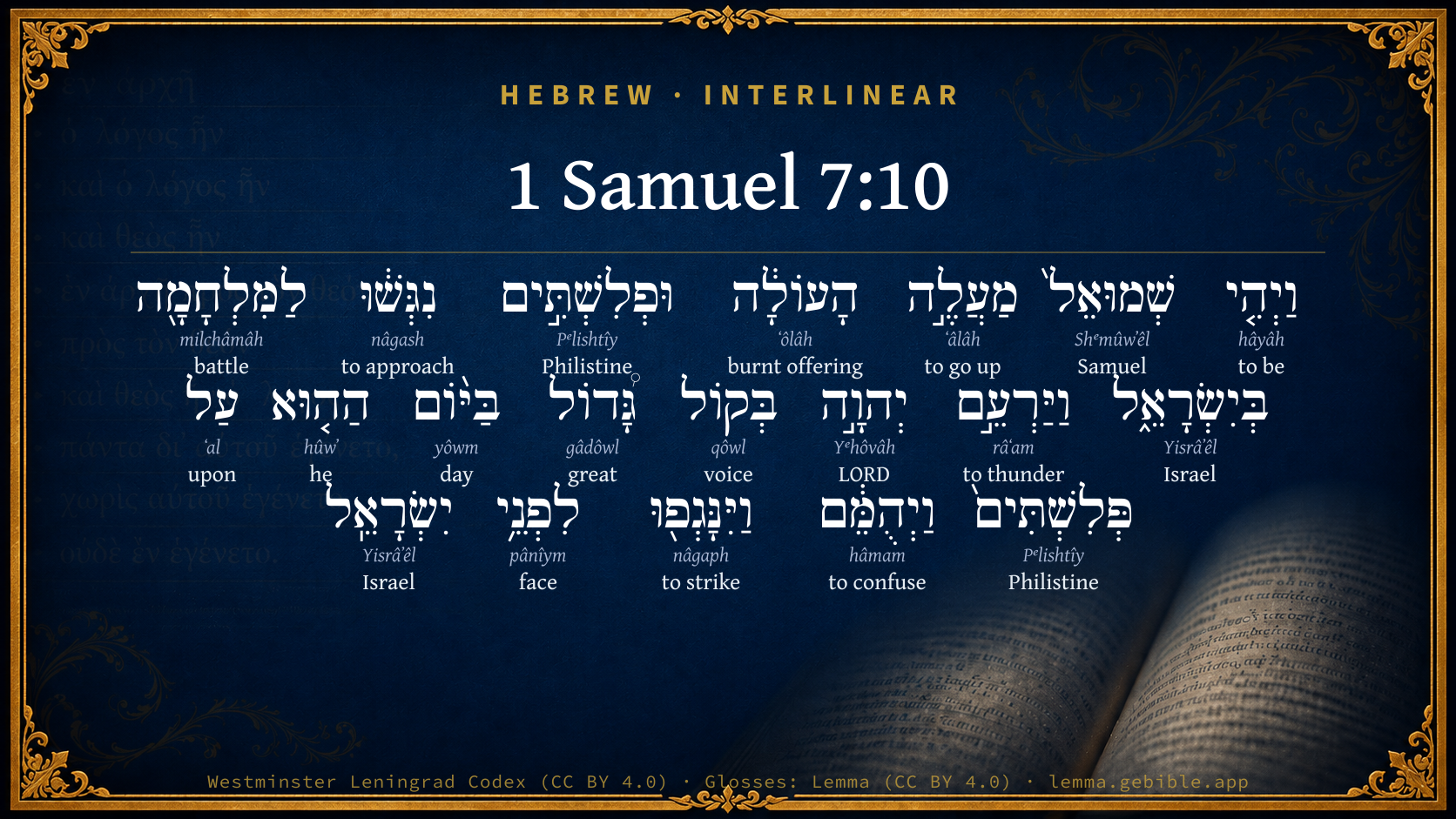
1 Samuel 7:10

Hebrew (Westminster Leningrad Codex) 1 Samuel 7:10 appears in the Hebrew Old Testament. The text above is from the Westminster Leningrad Codex. Each word links to its Strong’s number, a concise gloss, and parsing drawn from the Open Scriptures Hebrew Bible morphology. Click any word for its full Brown-Driver-Briggs (BDB) entry.
Download image
Cite this verse

1 Samuel 7:10 (World English Bible). Public Domain. Lemma interlinear Bible study tool, https://lemma.gebible.app/v/1-samuel/7/10.

Show BibTeX & RIS
BibTeX
RIS
English Translation
As Samuel was offering up the burnt offering, the Philistines drew near to battle against Israel; but Yahweh thundered with a great thunder on that day on the Philistines, and confused them; and they were struck down before Israel.
World English Bible · Public Domain
Download a study sheet

One document with this verse’s original text, its word-by-word gloss line, the meaning frame, cross-references with their text, attributed commentary, and full source and license credits — printable, and it pastes into notes with its structure intact.

This verse Autodidact and up

Study sheet (.html) Plain text (.txt)

A passage Seminary Student

Up to 50 verses in one chapter. A passage sheet keeps up to 6 commentary sources and 12 cross-references per verse, in the order this page ranks them, and says so on the sheet whenever that leaves anything out. Ask for a single verse and you get the Autodidact verse sheet above.

Everything on this page stays free to read, with no account — the sheet is a download of what is already on screen, not access to it.

Want to remove ads? Support Godless Engineer
Compare translations 3

The same verse in 3 English versions, stacked beneath the original-language interlinear above. Click any original word for its lexicon entry.

Each is an independent rendering of the whole verse — the interlinear is not word-aligned to these translations.

Highlighted words mark where these versions differ — a whole-verse word diff, not a word-by-word alignment.

  • World English Bible Public Domain
    As Samuel was offering up the burnt offering, the Philistines drew near to battle against Israel; but Yahweh thundered with a great thunder on that day on the Philistines, and confused them; and they were struck down before Israel.
  • King James Version Public Domain
    And as Samuel was offering up the burnt offering, the Philistines drew near to battle against Israel: but the LORD thundered with a great thunder on that day upon the Philistines, and discomfited them; and they were smitten before Israel.
  • unfoldingWord Literal Text CC BY-SA 4.0
    And Samuel was offering the burnt offering, and the Philistines approached for battle with Israel. And Yahweh thundered with a great sound on that day against the Philistines, and he panicked them, and they were struck to the face of Israel.

unfoldingWord Literal Text — © unfoldingWord, licensed CC BY-SA 4.0. Word-aligned USFM3 via Door43 (git.door43.org/unfoldingWord/en_ult).

Versions to compare (up to 4)

3 of 4 selected

Show all 18 translations

Every available English version of this verse, each an independent rendering of the whole verse.

  • World English Bible Public Domain
    As Samuel was offering up the burnt offering, the Philistines drew near to battle against Israel; but Yahweh thundered with a great thunder on that day on the Philistines, and confused them; and they were struck down before Israel.
  • Berean Standard Bible Public Domain
    As the Philistines drew near to fight against Israel, Samuel was sacrificing the burnt offering. But that day the LORD thundered loudly against the Philistines and threw them into such confusion that they fled before Israel.
  • Majority Standard Bible Public Domain
    As the Philistines drew near to fight against Israel, Samuel was offering up the burnt offering. But that day the LORD thundered loudly against the Philistines and threw them into such confusion that they fled before Israel.
  • King James Version Public Domain
    And as Samuel was offering up the burnt offering, the Philistines drew near to battle against Israel: but the LORD thundered with a great thunder on that day upon the Philistines, and discomfited them; and they were smitten before Israel.
  • American Standard Version (1901) Public Domain
    And as Samuel was offering up the burnt-offering, the Philistines drew near to battle against Israel; but Jehovah thundered with a great thunder on that day upon the Philistines, and discomfited them; and they were smitten down before Israel.
  • Revised Version (1885) Public Domain
    And as Samuel was offering up the burnt offering, the Philistines drew near to battle against Israel: but the LORD thundered with a great thunder on that day upon the Philistines, and discomfited them; and they were smitten down before Israel.
  • Geneva Bible (1599) Public Domain
    And as Samuel offered the burnt offering, the Philistims came to fight against Israel: but the Lord thundred with a great thunder that day vpon the Philistims, and scattered them: so they were slaine before Israel.
  • Douay-Rheims (1899) Public Domain
    And it came to pass, when Samuel was offering the holocaust, the Philistines began the battle against Israel: but the Lord thundered with a great thunder on that day upon the Philistines, and terrified them, and they were overthrown before the face of Israel.
  • Young's Literal Translation Public Domain
    and Samuel is causing the burnt-offering to go up -- and the Philistines have drawn nigh to battle against Israel -- and Jehovah doth thunder with a great noise, on that day, upon the Philistines, and troubleth them, and they are smitten before Israel.
  • Literal Standard Version CC BY-SA 4.0
    and Samuel is causing the burnt-offering to go up—and the Philistines have drawn near to battle against Israel—and YHWH thunders with a great noise, on that day, on the Philistines, and troubles them, and they are struck before Israel.
  • Unlocked Literal Bible CC BY-SA 4.0
    As Samuel was offering up the burnt offering, the Philistines approached to attack Israel. But Yahweh thundered with a loud sound that day against the Philistines and threw them into confusion, and they were routed before Israel.
  • unfoldingWord Literal Text CC BY-SA 4.0
    And Samuel was offering the burnt offering, and the Philistines approached for battle with Israel. And Yahweh thundered with a great sound on that day against the Philistines, and he panicked them, and they were struck to the face of Israel.
  • Darby Bible Public Domain
    And as Samuel was offering up the burnt-offering, the Philistines advanced to battle against Israel. And Jehovah thundered with a great thunder on that day upon the Philistines, and discomfited them; and they were routed before Israel.
  • World Messianic Bible Public Domain
    As Samuel was offering up the burnt offering, the Philistines came near to battle against Israel; but the LORD thundered with a great thunder on that day on the Philistines and confused them; and they were struck down before Israel.
  • Webster's Bible Public Domain
    And as Samuel was offering the burnt-offering, the Philistines drew near to battle against Israel: but the LORD thundered with a great thunder on that day upon the Philistines, and discomfited them; and they were smitten before Israel.
  • Free Bible Version CC BY-SA 4.0
    While Samuel was presenting the burnt offering, the Philistines approached to attack Israel. But the Lord thundered extremely loudly against the Philistines that day, which totally confused them, and they were defeated as Israel watched.
  • Bible in Basic English Public Domain
    And while Samuel was offering the burned offering, the Philistines came near for the attack on Israel; but at the thunder of the Lord's voice that day the Philistines were overcome with fear, and they gave way before Israel.
  • JPS Tanakh (1917) Public Domain
    And as Samuel was offering up the burnt-offering, the Philistines drew near to battle against Israel; but the LORD thundered with a great thunder on that day upon the Philistines, and discomfited them; and they were smitten down before Israel.

Literal Standard Version (2020), Covenant Press — licensed CC BY-SA 4.0. Text via the HelloAO Bible API (eBible.org). Unlocked Literal Bible (unfoldingWord) — licensed CC BY-SA 4.0. Text via the HelloAO Bible API (eBible.org). unfoldingWord Literal Text — © unfoldingWord, licensed CC BY-SA 4.0. Word-aligned USFM3 via Door43 (git.door43.org/unfoldingWord/en_ult). Free Bible Version, Dr. Jonathan Gallagher — licensed CC BY-SA 4.0. Text via the HelloAO Bible API (eBible.org).

Word by word

More ways to search: Search by grammar → Find every occurrence → Compare this word →

Practice this passage: Drill this verse → Learn its vocabulary →

וַיַּרְעֵ֣ם
râʻam
H7481
“and · to thunder”
Conjunction + Verb, Hiphil, Sequential Imperfect, 3rd Person, Masculine, Singular
Part of Speech
Conjunction + Verb
Stem
Hiphil
Form
Sequential Imperfect
Person
3rd Person
Gender
Masculine
Number
Singular
Full BDB Definition

Origin: a primitive root

TWOT: 2189

to thunder - (Qal) - to make the sound of thunder, thunder - to rage - (Hiphil) - to thunder, cause thunder - to tremble, cause to tremble (by extension)
  1. וַיְהִ֤י hâyâh H1961 “and · to be” Conjunction + Verb, Qal, Sequential Imperfect, 3rd Person, Masculine, Singular
  2. שְׁמוּאֵל֙ Shᵉmûwʼêl H8050 “Samuel” Noun, Proper
  3. מַעֲלֶ֣ה ʻâlâh H5927 “going up” Verb, Hiphil, Participle Active, Masculine, Singular, Absolute
  4. הָעוֹלָ֔ה ʻôlâh H5930 “the · burnt offering” Particle, Definite Article + Noun, Common, Feminine, Singular, Absolute
  5. וּפְלִשְׁתִּ֣ים Pᵉlishtîy H6430 “and · Philistines” Conjunction + Noun, Gentilic, Masculine, Plural, Absolute
  6. נִגְּשׁ֔וּ nâgash H5066 “to approach” Verb, Niphal, Perfect, 3rd Person, Common, Plural
  7. לַמִּלְחָמָ֖ה milchâmâh H4421 “to/for the · battle” Preposition, Determined + Noun, Common, Feminine, Singular, Absolute
  8. בְּיִשְׂרָאֵ֑ל Yisrâʼêl H3478 “in/at · Israel” Preposition + Noun, Proper
  9. יְהוָ֣ה Yᵉhôvâh H3068 “LORD” Noun, Proper
  10. בְּקוֹל qôwl H6963 “in/at · voice” Preposition + Noun, Common, Masculine, Singular, Absolute
  11. גָּ֠דוֹל gâdôwl H1419 “great” Adjective, Adjective, Masculine, Singular, Absolute
  12. בַּיּ֨וֹם yôwm H3117 “in/at the · day” Preposition, Determined + Noun, Common, Masculine, Singular, Absolute
  13. הַה֤וּא hûwʼ H1931 “the · he” Particle, Definite Article + Pronoun, Personal, 3rd Person, Masculine, Singular
  14. עַל ʻal H5921 “upon” Preposition
  15. פְּלִשְׁתִּים֙ Pᵉlishtîy H6430 “Philistines” Noun, Gentilic, Masculine, Plural, Absolute
  16. וַיְהֻמֵּ֔ם hâmam H2000 “and · to confuse · them” Conjunction + Verb, Qal, Sequential Imperfect, 3rd Person, Masculine, Singular + Suffix, Personal, 3rd Person, Masculine, Plural
  17. וַיִּנָּגְפ֖וּ nâgaph H5062 “and · to strike” Conjunction + Verb, Niphal, Sequential Imperfect, 3rd Person, Masculine, Plural
  18. לִפְנֵ֥י pânîym H6440 “to/for · face(s) of” Preposition + Noun, Common, Both, Plural, Construct
  19. יִשְׂרָאֵֽל Yisrâʼêl H3478 “Israel” Noun, Proper

About this verse

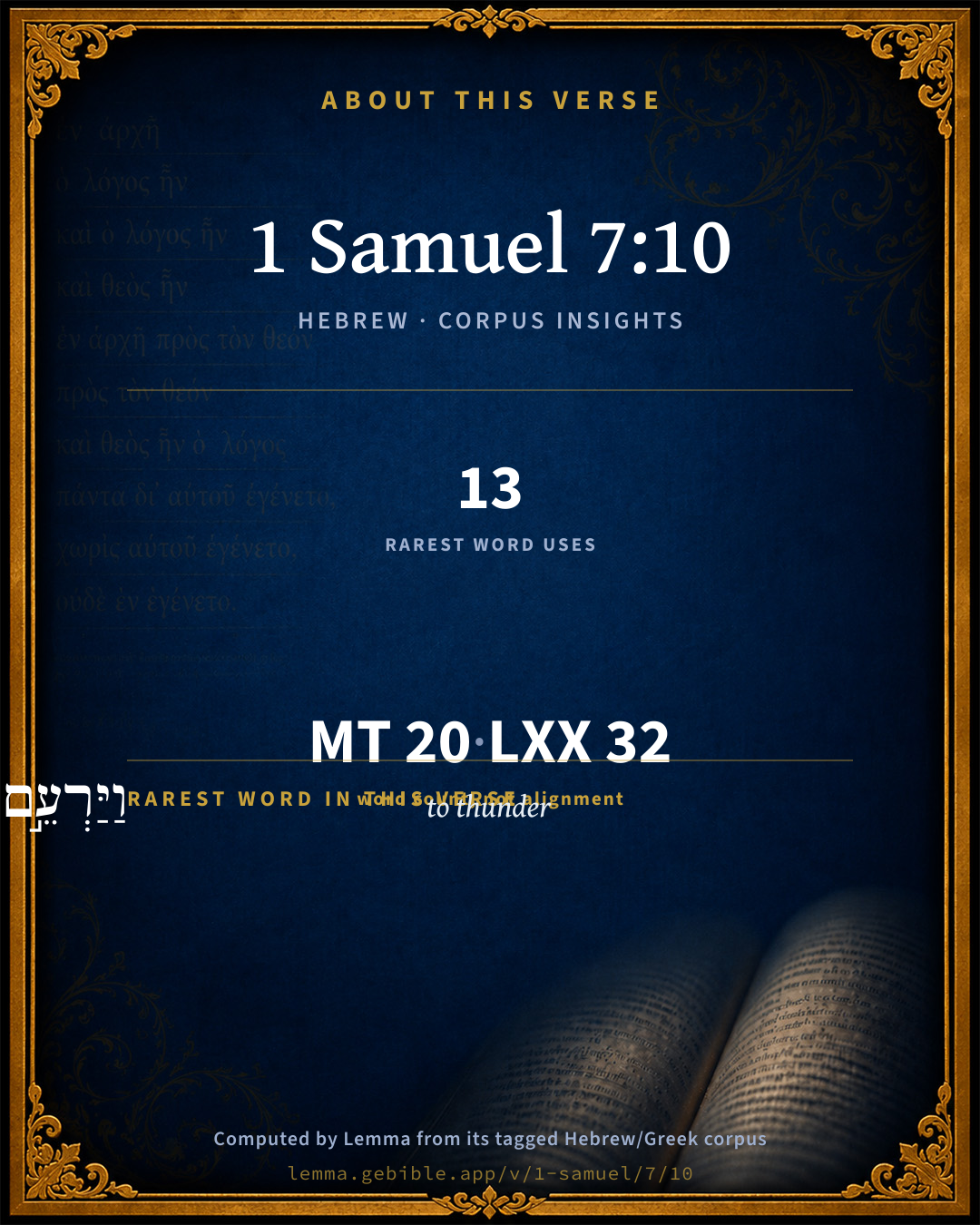
These counts appear in no published source. They are computed here, from the morphology-tagged text and Lemma’s own curated glosses. What Lemma adds →

20
words
18
distinct lemmas
Historical
section

Notable vocabulary

The rarest word here is וַיַּרְעֵ֣ם to thunder H7481 — appearing just 13 times in the whole Hebrew Bible.

Shared distinctive vocabulary

וַיַּרְעֵ֣ם to thunder H7481 occurs in 13 verses of the Hebrew Bible. Also found in:

Grammatical profile

  • 6 verbs
  • 11 nouns
  • 1 adjective
  • 1 pronoun
  • 1 preposition

Verb forms

  • וַיְהִ֤י Qal · Sequential Imperfect
  • מַעֲלֶ֣ה Hiphil · Participle Active
  • נִגְּשׁ֔וּ Niphal · Perfect
  • וַיַּרְעֵ֣ם Hiphil · Sequential Imperfect
  • וַיְהֻמֵּ֔ם Qal · Sequential Imperfect
  • וַיִּנָּגְפ֖וּ Niphal · Sequential Imperfect

Repetition

Words recur within this verse — often emphatic in Hebrew:

  • וּפְלִשְׁתִּ֣ים Philistine H6430 ×2
  • בְּיִשְׂרָאֵ֑ל Israel H3478 ×2

Hebrew & Septuagint length

In English translation the verse runs 39 words from the Hebrew and 39 from the Septuagint (LXX English) — the same length.

A rough comparison of the two English renderings, which tokenize alike — not a word-level alignment.

Word counts can differ between the Hebrew and the Greek without any difference in meaning — e.g. the Hebrew direct-object marker אֵת has no separate Greek word, and Greek often adds the article ὁ.

In the original languages it is 20 Hebrew tokens and 32 Greek tokens — but the two are counted differently (Hebrew bundles its prefixes and suffixes into one token; the Greek is in lemma form), so that isn’t a like-for-like length.

Cross-references

14

Topical passages linked to 1 Samuel 7:10 in the Treasury of Scripture Knowledge — connected by theme and wording, ordered by reader-vote popularity; previews shown in the World English Bible.

  • 1 Samuel 2:10 Those who strive with Yahweh shall be broken to pieces; Against them will he thunder in the sky: Yahweh will judge the ends of the earth; He will give strength to his king, Exalt the horn of his anointed.
  • Joshua 10:10 Yahweh confused them before Israel, and he killed them with a great slaughter at Gibeon, and chased them by the way of the ascent of Beth Horon, and struck them to Azekah, and to Makkedah.
  • Judges 5:20 From the sky the stars fought, From their courses they fought against Sisera.
  • 1 Samuel 12:17 Isn't it wheat harvest today? I will call to Yahweh, that he may send thunder and rain; and you shall know and see that your wickedness is great, which you have done in the sight of Yahweh, in asking you a king.
  • 2 Samuel 22:14–15 Yahweh thundered from heaven, The Most High uttered his voice.
  • Deuteronomy 20:3–4 and shall tell them, Hear, Israel, you draw near this day to battle against your enemies: don't let your heart faint; don't be afraid, nor tremble, neither be scared of them;
  • Zechariah 4:6 Then he answered and spoke to me, saying, "This is the word of Yahweh to Zerubbabel, saying, 'Not by might, nor by power, but by my Spirit,' says Yahweh of Hosts.
  • Exodus 9:23–25 Moses stretched forth his rod toward the heavens, and Yahweh sent thunder, hail, and lightning flashed down to the earth. Yahweh rained hail on the land of Egypt.
  • Judges 4:15 Yahweh confused Sisera, and all his chariots, and all his host, with the edge of the sword before Barak; and Sisera alighted from his chariot, and fled away on his feet.
  • Judges 5:8 They chose new gods; Then was war in the gates: Was there a shield or spear seen Among forty thousand in Israel?
  • Psalms 18:11–14 He made darkness his hiding-place, his pavilion around him, Darkness of waters, thick clouds of the skies.
  • Psalms 77:16–18 The waters saw you, God. The waters saw you, and they writhed. The depths also convulsed.
  • Psalms 97:3–4 A fire goes before him, And burns up his adversaries on every side.
  • Revelation 16:18–21 There were lightnings, sounds, and thunders; and there was a great earthquake, such as was not since there were men on the earth, so great an earthquake, so mighty.

Cross-references courtesy of OpenBible.info (CC BY 4.0).

Hebrew and Greek witnesses Masoretic Hebrew ↔ Greek Septuagint

The same verse in the two great witnesses to the Old Testament, shown verse-for-verse.

These are two independent witnesses, not word-aligned to each other, and the Septuagint is shown in lemma (dictionary) form.

Hebrew 1 Samuel 7:10 Masoretic · Westminster Leningrad Codex

וַיְהִ֤י שְׁמוּאֵל֙ מַעֲלֶ֣ה הָעוֹלָ֔ה וּפְלִשְׁתִּ֣ים נִגְּשׁ֔וּ לַמִּלְחָמָ֖ה בְּיִשְׂרָאֵ֑ל וַיַּרְעֵ֣ם יְהוָ֣ה בְּקוֹל גָּ֠דוֹל בַּיּ֨וֹם הַה֤וּא עַל פְּלִשְׁתִּים֙ וַיְהֻמֵּ֔ם וַיִּנָּגְפ֖וּ לִפְנֵ֥י יִשְׂרָאֵֽל

As Samuel was offering up the burnt offering, the Philistines drew near to battle against Israel; but Yahweh thundered with a great thunder on that day on the Philistines, and confused them; and they were struck down before Israel.

World English Bible · Public Domain

Greek LXX 1 Samuel 7:10 Septuagint · lemma form

καί εἰμί σαμουηλ ἀναφέρω ὁ ὁλοκαύτωσις καί ἀλλόφυλος προςἄγω εἰς πόλεμος ἐπί ἰσραήλ καί βροντάω κύριος ἐν φωνή μέγας ἐν ὁ ἡμέρα ἐκεῖνος ἐπί ὁ ἀλλόφυλος καί συνχέω καί πταίω ἐνώπιον ἰσραήλ

And Samuel was offering the whole burnt offering; and the Philistines drew near to war against Israel; and the Lord thundered with a mighty sound in that day upon the Philistines, and they were confounded and overthrown before Israel.

LXX2012 (modern English Septuagint) · Public Domain

Hebrew: Westminster Leningrad Codex (CC BY 4.0). Greek: Septuagint (public domain); English from LXX2012 (modern English Septuagint) (Public Domain). How the Septuagint differs from the Hebrew →

Targum (Aramaic paraphrase)

1

The Targum is the ancient Jewish Aramaic paraphrase of the Hebrew Scriptures — an interpretive translation, not the Hebrew text itself. Onkelos (literal) and Pseudo-Jonathan (expansive) render the Torah, and Jonathan the Prophets. Coverage is partial: where no permissively-licensed English translation exists for a verse, only the Aramaic is shown. This is verse-level text, not a word-by-word alignment to the Hebrew.

  1. Targum Jonathan Prophets (Joshua–Malachi)
    וַהֲוָה שְׁמוּאֵל מַסִיק עֲלָתָא וּפְלִשְׁתָּאֵי אִתְקְרָבוּ לְאַגָחָא קְרָבָא בְּיִשְׂרָאֵל וְאַכְלִי יְיָ בְּקַל רַב בְּיוֹמָא הַהוּא עַל פְּלִשְׁתָּאֵי וְשַׁגֵישִׁינוּן וְאִתַּבָּרוּ קֳדָם יִשְׂרָאֵל:

    (no public-domain English translation for this verse)

    Targum Jonathan — Aramaic: “Mikraot Gedolot” (public domain). English: “Sefaria Community Translation” (CC0 1.0 (public-domain dedication)); “London "Chaldee Paraphrase," 1871” (public domain). Text via Sefaria.

Commentary

Notes on 1 Samuel 7:10 from classic Christian and Jewish commentators (each source and its license shown beneath its notes). The classic Christian expositions comment on the surrounding passage and are grouped to its opening verse, so a note may address several verses; the Jewish commentaries on the Tanakh (Rashi and others) are per-verse, so they appear only where the commentator wrote on this verse.

Lemma curates 59 commentaries, every one of them public domain or Creative Commons licensed, each selected and text-cleaned for this edition rather than reprinted as found. About our sources →

Trapp's Complete Commentary

John Trapp

1Sa 7:10 And as Samuel was offering up the burnt offering, the Philistines drew near to battle against Israel: but the LORD thundered with a great thunder on that day upon the Philistines, and discomfited them; and they were smitten before Israel.

Ver. 10. And as Samuel was offering.] If Numa, king of Rome, could say, when he was sacrificing, and heard of the enemy’s approach, Eγω δε θυω, Yea, but I am serving my gods, and therefore I fear them not; {a} how much more might Samuel say so!

But the Lord thundered with a great thunder on that day.] As Hannah had foretold; {1Sa 2:10} as happened; {Jos 10:10 Jdg 4:15} as also at the prayers of the thundering legion under Antoninus, the emperor; {b} and in the days of Theodosius, when that good prince, being to fight with Eugenius the tyrant, Dominum Christum solus solum corpore humi fusus mente caelo fixus orabat, he prayed heartily to Jesus Christ, the stars and meteors fought for him, which made Claudian, though a heathen, cry out, O nimium dilecte Deo, &c. {c} So we read of a terrible tempest that fell upon the Turks, fighting against the Persians, which they imputed to the magicians; but the Lord sent it. {d}

And they were smitten before Israel.] Who were not slack to set in with God when he, as out of an engine, {e} appeared for them.

{a} Plut., in Vita Numae.

{b} Euseb., lib. v. cap. 5.

{c} Oros., lib. vii. cap. 35.

{d} Preacher’s Travels, 49.

{e} απο μηχανης.

John Trapp, A Commentary or Exposition upon All the Books of the Old and New Testament (1647–1656) — public domain. Text from a community e-Sword module.

The Expositor's Bible

CHAPTER I X.

NATIONAL DELIVERANCE--THE PHILISTINES SUBDUED.

1Sa_7:10-17.

IT must have been with feelings very different from those of their last encounter, when the ark of God was carried into the battle, that the host of Israel now faced the Philistine army near Mizpeh. Then they had only the symbol of God's gracious presence, now they had the reality. Then their spiritual guides were the wicked Hophni and Phinehas; now their guide was holy Samuel. Then they had rushed into the fight in thoughtless unconcern about their sins; now they had confessed them, and through the blood of sprinkling they had obtained a sense of forgiveness. Then they were puffed up by a vain presumption; now they were animated by a calm but confident hope. Then their advance was hallowed by no prayer; now the cry of needy children had gone up from God's faithful servant. In fact, the battle with the Philistines had already been fought by Samuel on his knees. There can be no more sure token of success than this. Are we engaged in conflict with our own besetting sins? Or are we contending against scandalous transgression in the world around us? Let us first fight the battle on our knees. If we are victorious there we need have little fear of victory in the other battle.

It was as Samuel was offering up the burnt-offering that the Philistines drew near to battle against Israel. There was an unseen ladder that day between earth and heaven, on which the angels of God ascended and descended as in Jacob's vision at Bethel. The smoke of the burnt-offering carried up to God the confession and contrition of the people, their reliance on God's method of atonement, and their prayer for His pardon and His blessing. The great thunder with which God thundered on the Philistines carried down from God the answer and the needed help. There is no need for supposing that the thunder was supernatural. It was an instance of what is so common, a natural force adapted to the purpose of an answer to prayer. What seems to have occurred is this: a vehement thunder-storm had gathered a little to the east, and now broke, probably with violent wind, in the faces of the Philistines, who were advancing up the heights against Mizpeh. Unable to face such a terrific war of the elements, the Philistines would turn round, placing their backs to the storm. The men of Israel, but little embarrassed by it, since it came from behind them, and gave the greater momentum to their force, rushed on the embarrassed enemy, and drove them before them like smoke before the wind. It was just as in former days - God arose, and His enemies were scattered, and they also that hated Him fled before Him. The storm before which the Philistines cowered was like the pillar of fire which had guided Israel through the desert. Jehovah was still the God of Israel; the God of Jacob was once more his refuge.

We have said that this thunderstorm may have been quite a natural phenomenon. Natural, but not casual. Though natural, it was God's answer to Samuel's prayer. But how could this have been? If it was a natural storm, if it was the result of natural law, of atmospheric conditions the operation of which was fixed and certain, it must have taken place whether Samuel prayed or not. Undoubtedly. But the very fact that the laws of nature are fixed and certain, that their operation is definite and regular, enables the great Lord of Providence to make use of them in the natural course of things, for the purpose of answering prayer. For this fact, the uniformity of natural law, enables the Almighty, who sees and plans the end from the beginning, to frame a comprehensive scheme of Providence, that shall not only work out the final result in His time and way, but that shall also work out every intermediate result precisely as He designs and desires. "Known unto God are all His works from the beginning of the world." Now if God has so adjusted the scheme of Providence that the final result of the whole shall wonderfully accomplish His grand design, may He not, must He not, have so adjusted it that every intermediate part shall work out some intermediate design? It is only those who have an unworthy conception of omniscience and omnipotence that can doubt this. Surely if there is a general Providence, there must be a special Providence. If God guides the whole. He must also guide the parts. Every part of the scheme must fall out according to His plan, and may thus be the means of fulfilling some of His promises.

Let us apply this view to the matter of prayer. All true prayer is the fruit of the Holy Spirit working in the human soul. All the prayer that God answers is prayer that God has inspired. The prayer of Samuel was prayer which God had inspired. What more reasonable than that in the great plan of providence there should have been included a provision for the fulfillment of Samuel's prayer at the appropriate moment? The thunderstorm, we may be sure, was a natural phenomenon. But its occurrence at the time was part of that great scheme of Providence which God planned at the beginning, and it was planned to fall out then in order that it might serve as an answer to Samuel's prayer. It was thus an answer to prayer brought about by natural causes. The only thing miraculous about it was its forming a part of that most marvelous scheme - the scheme of Divine providence - a part of the scheme that was to be carried into effect after Samuel had prayed. If the term supernatural may be fitly applied to that scheme which is the sum and substance of all the laws of nature, of all the providence of God, and of all the works and thoughts of man, then it was a miracle; but if not, it was a natural effect.

It is important to bear these truths in mind, because many have the impression that prayer for outward results cannot be answered without a miracle, and that it is unreasonable to suppose that such a multitude of miracles as prayer involves would be wrought every day. If a sick man prays for health, is the answer necessarily a miracle? No; for the answer may come about by purely natural causes. He has been directed to a skilful physician; he has used the right medicine; he has been treated in the way to give full scope to the recuperative power of nature. God, who led him to pray, foresaw the prayer, and in the original scheme of Providence planned that by natural causes the answer should come. We do not deny that prayer may be answered in a supernatural way. We would not affirm that such a thing as supernatural healing is unknown. But it is most useful that the idea should be entertained that such prayer is usually answered by natural means. By not attending to this men often fail to perceive that prayer has been answered. You pray, before you set out on a journey, for protection and safe arrival at the end. You get what you asked - you perform the journey in safety. But perhaps you say, "It would have been all the same whether I had prayed for it or not. I have gone on journeys that I forgot to pray about, and no evil befell me. Some of my fellow-passengers, I am sure, did not pray for safety, yet they were taken care of as much as I was." But these are sophistical arguments. You should feel that your safety in the journey about which you prayed was as much due to God, though only through the operation of natural causes, as if you had had a hairbreadth escape. You should be thankful that in cases where you did not pray for safety God had regard to the habitual set of your mind, your habitual trust in Him, though you did not specially exercise it at these times. Let the means be as natural as they may - to those who have eyes to see the finger of God is in them all the same.

But to return to the Israelites and the Philistines. The defeat of the Philistines was a very thorough one. Not only did they make no attempt to rally after the storm had passed and Israel had fallen on them, but they came no more into the coast of Israel, and the hand of the Lord was against them all the days of Samuel. And besides this, all the cities and tracts of land belonging to Israel which the Philistines had taken were now restored. Another mercy that came to Israel was that "there was peace between Israel and the Amorites"- the Amorites being put here, most likely, for the remains of all the original inhabitants living among or around Israel. Those promises were now fulfilled in which God had said to Moses, "This day will I begin to put the dread of thee and the fear of thee upon the nations that are under the whole heaven, who shall hear report of thee, and shall tremble and be in anguish because of thee" (Deu_2:25). "There shall no man be able to stand before you; for the Lord your God shall lay the fear of you and the dread of you upon all the land ye shall tread upon, as He hath said to thee." It was so apparent that God was among them, and that the power of God was irresistible and overwhelming, that their enemies were frightened to assail them.

The impression thus made on the enemies of Israel corresponds in some degree to the moral influence which God-fearing men sometimes have on an otherwise godless community. The picture in the Song of Solomon - "Who is she that looketh forth as the morning, fair as the moon, clear as the sun, and terrible as an army with banners?" - ascribes even to the fair young bride a terrifying power, a power not appropriate to such a picture in the literal sense, but quite suitable in the figurative. Wherever the life and character of a godly man is such as to recall God, wherever God's image is plainly visible, wherever the results of God's presence are plainly seen, there the idea of a supernatural Power is conveyed, and a certain overawing influence is felt. In the great awakening at Northampton in Jonathan Edwards' days, there was a complete arrest laid on open forms of vice. And whensoever in a community God's presence has been powerfully realized, the taverns have been emptied, the gambling-table deserted, under the sense of His august majesty. Would only that the character and life of all God's servants were so truly godlike that their very presence in a community would have a subduing and restraining influence on the wicked!

Two points yet remain to be noticed: the step taken by Samuel to commemorate this wonderful Divine interposition; and the account given of the prophet and his occupations in his capacity of Judge of Israel.

''Samuel took a stone, and set it between Mizpeh and Shen, and called the name of it Ebenezer, saying, Hitherto hath the Lord helped us."

The position of Shen is not known. But it must have been very near the scene of the defeat of the Philistines - perhaps it was the very spot where that defeat occurred. In that case, Samuel's stone would stand midway between the two scenes of battle: the battle gained by him on his knees at Mizpeh, and the battle gained by the Israelites when they fell on the Philistines demoralized by the thunderstorm.

"Hitherto hath the Lord helped us." The characteristic feature of the inscription lies in the word "hitherto." It was no doubt a testimony to special help obtained in that time of trouble; it was a grateful recognition of that help; and it was an enduring monument to perpetuate the memory of it. But it was more, much more. The word ''hitherto "denotes a series, a chain of similar mercies, an unbroken succession of Divine interpositions and Divine deliverances. The special purpose of this inscription was to link on the present deliverance to all the past, and to form a testimony to the enduring faithfulness and mercy of a covenant-keeping God. But was there not something strange in this inscription, considering the circumstances? Could Samuel have forgot that tragic day at Shiloh - the bewildered, terrified look of the messenger that came from the army to bring the news, the consternation caused by his message, the ghastly horror of Eli and his tragic death, the touching death of the wife of Phinehas, and the sad name which she had with such seeming propriety given to her babe? Was that like God remembering them? or had Samuel forgot how the victorious Philistines soon after dashed upon Shiloh like beasts of prey, plundering, destroying, massacring, till nothing more remained to be done to justify the name of "Ichabod"? How can Samuel blot that chapter out of the history? or how can he say, with that chapter fresh in his recollection, "Hitherto hath the Lord helped us"?

All that Samuel has considered well. Even amid the desolations of Shiloh the Lord was helping them. He was helping them to know themselves, helping them to know their sins, and helping them to know the bitter fruit and woeful punishment of sin. He was helping them to achieve the great end for which he had called them - to keep alive the knowledge of the true God and the practice of His worship, onward to the time when the great promise should be realized, - when He should come in whom all the families of the earth were to be blessed. Samuel's idea of what constituted the nation's glory was large and spiritual. The true glory of the nation was to fulfill the function for which God had taken it into covenant with Himself. Whatever helped them to do this was a blessing, was a token of the Lord's remembrance of them. The links of the long chain denoted by Samuel's "hitherto" were not all of one kind. Some were in the form of mercies, many were in the form of chastenings. For the higher the function for which Israel was called, the more need was there of chastening. The higher the destination of a silver vessel, the greater is the need that the silver be pure, and therefore that it be frequently passed through the furnace. The destination of Israel was the highest that could have been. So Samuel does not merely give thanks for seasons of prosperity, but for checks and chastenings too.

Happy they who, full of faith in the faithfulness and love of God, can take a similar view of His dealings! Happy they who, when special mercies come, deem the occasion worthy to be commemorated by some special memorial, but who can embrace their whole life in the grateful commemoration, and bracket joys and sorrows alike under their "hitherto"! It is not that sorrows are less sorrows to them than to others; it is not that losses of substance entail less inconvenience, or bereavements penetrate less deeply; but that all are seen to be embraced in that gracious plan of which the final consummation is, as the apostle puts it, "to present her to Himself a glorious Church, not having spot or wrinkle or any such thing." And well is it for us, both in individual life and in Church and national life, to think of that plan of God in which mercies and chastenings are united, but all with a gracious purpose! It is remarkable how often in Scripture tears are wiped away with this thought. Zion saying, "The Lord hath forsaken me, and my God hath forgotten me," is assured, "Behold, I have graven thee upon the palms of My hands, thy walls are continually before Me." Rachel weeping for her children, and refusing to be comforted, is thus addressed, "Refrain thy voice from weeping and thine eyes from tears; for thy work shall be rewarded, saith the Lord, and thy children shall come again from the land of the enemy." "Weep not," said our Lord to the woman of Nain; and His first words after His resurrection were, "Woman, why weepest thou?" Vale of tears though this world is, there comes from above a gracious influence to wipe them away; and the march Zionward has in it some- thing of the tread and air of a triumphant procession, for "the ransomed of the Lord shall return and come to Zion with songs and everlasting joy on their heads; they shall obtain joy and gladness, and sorrow and sighing shall flee away."

We have yet to notice the concluding verses of the chapter (1Sa_7:15-17), which give a little picture of the public life of Samuel. He judged Israel all the days of his life. The office of judge had a twofold sphere, external and internal. Externally, it bore on the oppression of the people by foreign enemies, and the judge became the deliverer of the people. But in this sense there was now nothing for Samuel to do, especially after the accession of Saul to the kingdom. The judge seems to have likewise had to do with the administration of justice, and the preservation of the peace and general welfare of the nation. It is very natural to suppose that Samuel would be profoundly concerned to imbue the people with just views of the purpose for which God had called them, and of the law and covenant which He had given them. The three places among which he is said to have made his circuit. Bethel, Gilgal and Mizpeh, were not far from each other, all being situated in the tribes of Benjamin and Judah, - in that part of the land which afterwards constituted the kingdom of the two tribes. To these three places falls to be added Ramah, also in the same neighbourhood, where was his house. In this place he built an altar to the Lord.

Whether this was in connection with the tabernacle or not, we cannot say. We know that in the time of David's wanderings "the house of God" was at Nob (Compare 1Sa_21:1 and Mat_12:4), but we have nothing to show us when it was carried thither. All we can say is, that Samuel's altar must have been a visible memorial of the worship of God, and a solemn protest against any idolatrous rites to which any of the people might at any time be attracted.

In this way Samuel spent his life like Him whose type he was, "always about his Father's business." An unselfish man, having no interests of his own, full of zeal for the service of God and the public welfare; possibly too little at home, taking too little charge of his children, and thus at last in the painful position of one, "whose sons walked not in his ways, but turned aside after lucre, and took bribes, and perverted judgment" (1Sa_8:1). That Samuel attained the highest reputation for sanctity, intercourse with God and holy influence, is plain from various passages of Scripture. In Psa_99:6, he is coupled with Moses and Aaron, as having influence with God, - "they called upon the Lord and He answered them." In Jer_15:1, his name is coupled with that of Moses alone as a powerful intercessor, "Though Moses and Samuel stood before Me, yet My mind could not be toward this people." His mother's act of consecration was wonder-fully fulfilled. Samuel stands out as one of the best and purest of the Hebrew worthies. His name became a perpetual symbol of all that was upright, pure and Godlike. The silent influence of his character was a great power in Israel, inspiring many a young heart with holy awe, and silencing the flippant arrogance of the scoffer. Mothers, did not Hannah do well, do nobly, in dedicating her son to the Lord? Sons and daughters, was it not a noble and honourable life? Then go ye and do likewise. And God be pleased to incline many a heart to the service; a service, which with all its drawbacks, is the highest and the noblest; and which bequeaths so blessed a welcome into the next stage of existence: "Well done, good and faithful servant; enter thou into the joy of thy Lord."

William Robertson Nicoll, ed., The Expositor's Bible (London: Hodder & Stoughton, 1887–1910) — public domain. 65 of 66 books (1 Corinthians is not separately keyed, as that volume carries no machine-parseable verse references); section-level commentary keyed to the opening verse. Introductory and overview sections not keyed to a specific passage are excluded.

Tyndale Open Study Notes

Tyndale Open Resources

7:10 voice of thunder: See 2:10. God often used similar tactics to throw Israel’s enemies into confusion and defeat them (e.g., Exod 14:24; 23:27; Josh 10:10; Judg 4:15).

Tyndale Open Study Notes — © Tyndale Open Resources, licensed CC BY-SA 4.0. Text via the HelloAO Bible API.

Geneva Bible (1599)

Geneva Bible translators

According to the prophecy of Hannah Samuel’s mother, 1 Sam. 2:10.

Geneva Bible (1599) marginal notes — public domain. Text via Bolls.life.

Adam Clarke's Commentary

Verse 10. The Lord thundered with a great thunder] Literally, The Lord thundered with a great voice-he confounded them with a mighty tempest of thunder and lightning, and no doubt slew many by the lightning.

Adam Clarke's Commentary on the Bible (1810–1826) — public domain. Text from a community e-Sword/MySword module.

The Cambridge Bible for Schools and Colleges

gen. ed. J. J. S. Perowne

10. thundered with a great thunder] Lit., with a great voice. Thunder is the “voice of God” (Psa_29:3-4). Cp. ch. 1Sa_2:10; 2Sa_22:14-15.

discomfited them] The Heb. word expresses the confusion of a sudden panic, and is especially used of supernatural defeats. Cp. Exo_14:24 (E. V. troubled); Jos_10:10; Jdg_4:15; 2Sa_22:15.

and they were smitten before Israel] The thunder which dismayed the Philistines gave courage to the Israelites. The verb “they were smitten” (different from the one similarly translated in the next verse) is specially spoken of God, e.g. ch. 1Sa_4:3.

The Cambridge Bible for Schools and Colleges (gen. ed. J. J. S. Perowne; Cambridge University Press, 1878–1918) — public domain. Text from a community e-Sword module.

John Gill's Exposition

And as Samuel was offering up the burnt offering.... Which he might do by a priest, as Ben Gersom suggests, he being only a Levite; though he being a prophet, and an extraordinary person, and this an extraordinary case, he might do it himself, as Gideon and others, as well as offer it in another place than where the tabernacle was; Shiloh being now destroyed, persons and places for sacrifice were now dispensed with: and before Samuel had made an end of offering the sacrifice:

the Philistines drew near to battle against Israel; and were come as far almost as Mizpeh, where Israel were, and Samuel was sacrificing:

but the Lord thundered with a great thunder on that day upon the Philistines; which fulfilled Hannah's prophecy, Sa1 2:10 and this, as Josephus (n) says, was attended with lightning, which flashed in their faces, and shook their weapons out of their hands, so that they fled disarmed; and also with an earthquake, which caused gaps in the earth, into which they fell:

and discomfited them; disturbed, affrighted them, and threw them into confusion and disorder, as well as destroyed many of them:

and they were smitten before Israel; the meaning of which is not that they fled before them, and were killed by them; but that before Israel could come out against them, and fight with them, they were smitten and destroyed, many of them by the thunder and lightning, and by the earth opening upon them, and devouring them; for this phrase, "before Israel", denotes time, as Abarbinel observes, and not place.

(n) Antiqu. l. 6. c. 2. sect. 2.

John Gill's Exposition of the Whole Bible (1746–1763) — public domain (CC PDM 1.0). Text via the HelloAO Bible API.

Haydock's Catholic Bible Commentary

Israel. The princes of the Tyrians had come to the assistance of the enemy; (Ecclesiasticus xlvi. 21.; Calmet) but all in vain. The greatness of the army only increased the greatness of the carnage, when the Lord enters the lists. (Haydock) --- the sacred penman speaks with great modesty of this victory, which is nevertheless one of the most important recorded in Scripture. The Philistines could not recover themselves for 20 years; they found it necessary to restore the cities which they had taken, (Calmet) to relinquish the tribute, and to come to such conditions as Samuel imposed upon them. He suffered them, however, to keep possession of some strong holds, such as Gabaa, from which they were expelled by Jonathan. Salien says in the 22d year of Samuel, and the last of Achitob, the high priest, in the year of the world 2961.

George Leo Haydock (1774–1849), Haydock's Catholic Family Bible and Commentary, 1859 edition — public domain. Excludes Psalms (Douay-Rheims chapter numbering differs from Protestant) and Deuterocanonical books (Catholic canon only).

Matthew Poole's English Annotations

Either by the lightnings, or thunderbolts, or other things which accompanied the cracks of thunder; or by the Israelites, who perceiving them to be affrighted and flee away, pursued and smote them, as the next verse mentions.

Matthew Poole's English Annotations on the Holy Bible (1683–1685) — public domain. Text from a community e-Sword/MySword module.

Whedon's Commentary on the Bible

Daniel D. Whedon

10. The Lord thundered with a great thunder — Rather, with a great voice. Thus in Samuel’s day was Hannah’s prophecy fulfilled. 1Sa_2:10. Compare also the marginal references. This amazing miracle was wrought in answer to Samuel’s prayer, and was a confirmation of his words to Israel as recorded in 1Sa_7:3. It showed, too, that the Jehovah of the exodus was still powerful to save his people and confound their enemies.

Daniel D. Whedon (gen. ed.), Commentary on the Old and New Testaments (1874–1909) — public domain. Text from a community e-Sword module.

The Pulpit Commentary

Vers. 10, 11. As Samuel was offering, etc. We have here a detailed and lively description of the whole event. The lamb is still burning upon the altar, and Samuel still kneeling before it, when the Philistine hosts appear upon the lofty plateau just below the hill of Mizpah, and marshal themselves for battle. It seemed as if Israel"s case were hopeless, and many a heart, no doubt, was bravely straggling against its fears, and scarcely could keep them down. But as the enemy drew near the electric cloud formed in the heavens, and Jehovah thundered with a great voice (so the Hebrew) on that day upon the Philistines. Alarmed at so unusual a phenomenon, the Philistines hesitate in their advance, and Samuel, seeing their consternation, gives the signal for the charge, and Israel, inspirited by the voice of Jehovah, rushes down the hill upon the foe. Full of enthusiasm, they forget the poorness of their weapons, and the weight of their impetuous rush breaks through the opposing line. And now a panic seizes the Philistines; they attempt no further resistance, but flee in dismay from the pursuing Israelites. Their course would lead them down a huge valley 1000 feet deep, at the bottom of which was a torrent rushing over a rocky bed; nor was their flight stayed until they came under Beth-car. Of this place we know nothing, but probably it was a fastness where the Philistines could protect themselves from further attack.

The Pulpit Commentary (1880–1919), ed. H.D.M. Spence-Jones & Joseph S. Exell — public domain. Text from a community e-Sword module.

unfoldingWord translationNotes

Door43 World Missions Community

As Samuel ... Beth Kar

This explains what the writer means by "Yahweh answered him" in (1 Samuel 7:9).

threw them into confusion

The word "confusion" here is used as a casual way of saying the Philistines were unable to think clearly. AT: "made them unable to think clearly" (See: Idiom)

they were routed before Israel

This can be translated in active form. Possible meanings are 1) "Yahweh routed them before Israel" or 2) "Israel routed them" (See: Active or Passive)

routed

To rout people is to defeat them before they can cause any harm.

Beth Kar

This is the name of a place. (See: How to Translate Names)

translationWords

Mizpah

unfoldingWord translationNotes — © Distant Shores Media and the Door43 World Missions Community, licensed CC BY-SA 4.0. Source: git.door43.org/Door43/en_tn.

Lesson kit

Teaching starters — assembled from the data on this page, not authored interpretation. Every prompt links to the verse data it draws on. Edit before teaching.

1 Samuel, in the Historical, opens this verse with 20 words (18 distinct Hebrew lemmas). Its most distinctive word is râʻam (“to thunder”). A historical commentator’s framing appears above. Read the whole chapter for the surrounding context.

Discussion questions

  1. How does “to thunder” (râʻam) shape what this verse is saying?
  2. 1 Samuel 1:6 shares the word «to thunder» with this verse. How do the two illuminate each other?
  3. “Philistine” occurs 2× in this one verse. What is the effect of the repetition?
  4. These translations render this verse differently. What is at stake in choosing one wording over another?
  5. The verb «וַיְהִ֤י» is Qal Sequential Imperfect. How does its form color the action?
  6. Reading how Trapp's Complete Commentary and The Expositor's Bible read this verse, where do the two commentators agree and where do they part?

Things to notice

Reading settings

Reading text

Shown beneath each verse's original-language words.

Old Testament
Old Testament edition

Read the OT as the Masoretic Hebrew (MT) or the Greek Septuagint (LXX).

English shown for the Greek Septuagint (in the Hebrew ↔ Greek comparison).

Comparing translations? Open the Compare panel on any verse page to stack up to four side by side.