Judges 21:2

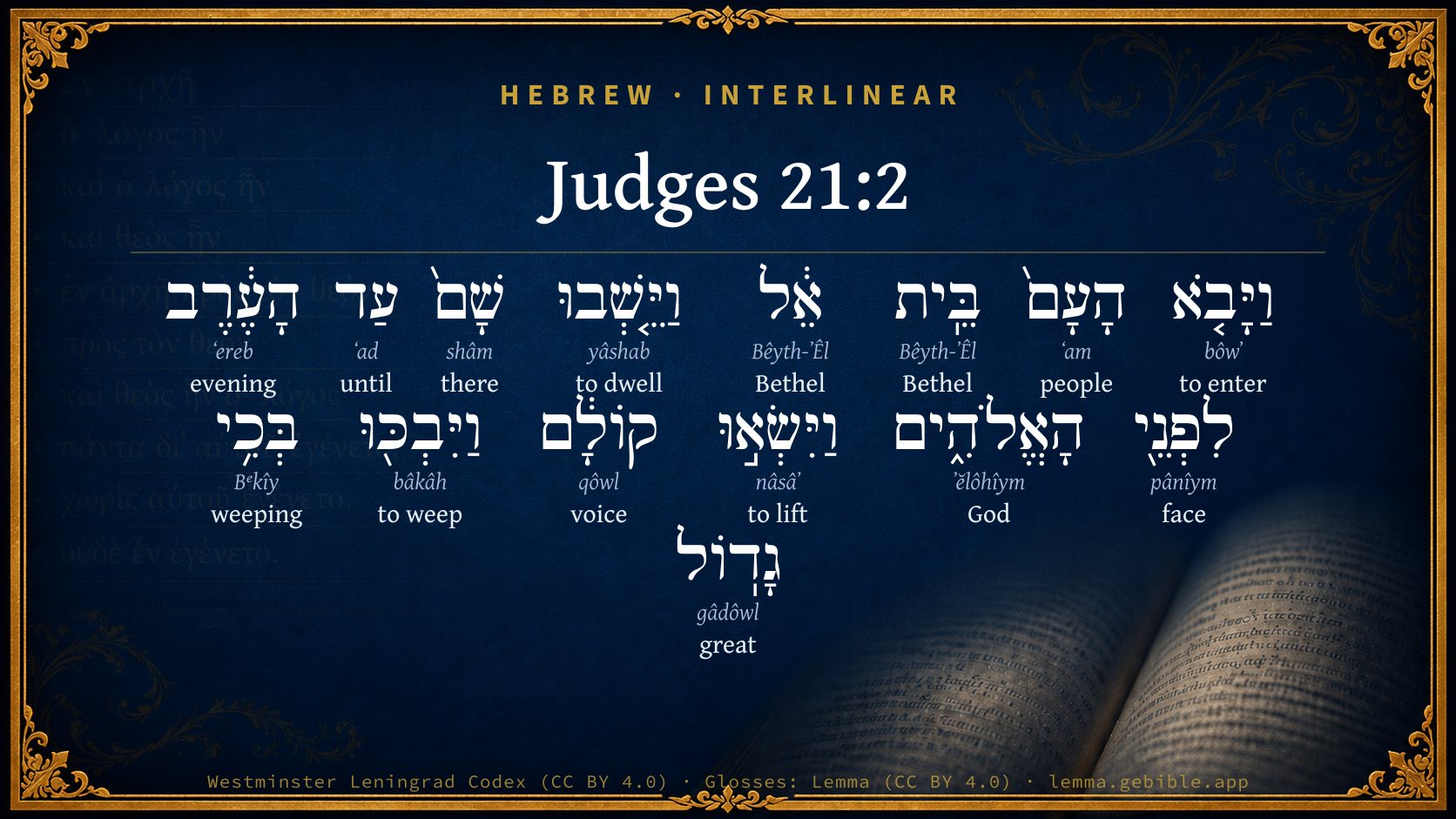
Hebrew (Westminster Leningrad Codex) Judges 21:2 appears in the Hebrew Old Testament. The text above is from the Westminster Leningrad Codex. Each word links to its Strong’s number, a concise gloss, and parsing drawn from the Open Scriptures Hebrew Bible morphology. Click any word for its full Brown-Driver-Briggs (BDB) entry.
Download image
Cite this verse

Judges 21:2 (World English Bible). Public Domain. Lemma interlinear Bible study tool, https://lemma.gebible.app/v/judges/21/2.

Show BibTeX & RIS
BibTeX
RIS
English Translation
The people came to Bethel, and sat there until evening before God, and lifted up their voices, and wept sore.
World English Bible · Public Domain
Download a study sheet

One document with this verse’s original text, its word-by-word gloss line, the meaning frame, cross-references with their text, attributed commentary, and full source and license credits — printable, and it pastes into notes with its structure intact.

This verse Autodidact and up

Study sheet (.html) Plain text (.txt)

A passage Seminary Student

Up to 50 verses in one chapter. A passage sheet keeps up to 6 commentary sources and 12 cross-references per verse, in the order this page ranks them, and says so on the sheet whenever that leaves anything out. Ask for a single verse and you get the Autodidact verse sheet above.

Everything on this page stays free to read, with no account — the sheet is a download of what is already on screen, not access to it.

Want to remove ads? Support Godless Engineer
Compare translations 3

The same verse in 3 English versions, stacked beneath the original-language interlinear above. Click any original word for its lexicon entry.

Each is an independent rendering of the whole verse — the interlinear is not word-aligned to these translations.

Highlighted words mark where these versions differ — a whole-verse word diff, not a word-by-word alignment.

  • World English Bible Public Domain
    The people came to Bethel, and sat there until evening before God, and lifted up their voices, and wept sore.
  • King James Version Public Domain
    And the people came to the house of God, and abode there till even before God, and lifted up their voices, and wept sore;
  • unfoldingWord Literal Text CC BY-SA 4.0
    And the people came Bethel, and they sat there until the evening to the face of God. And they lifted their voice and wept a great weeping.

unfoldingWord Literal Text — © unfoldingWord, licensed CC BY-SA 4.0. Word-aligned USFM3 via Door43 (git.door43.org/unfoldingWord/en_ult).

Versions to compare (up to 4)

3 of 4 selected

Show all 18 translations

Every available English version of this verse, each an independent rendering of the whole verse.

  • World English Bible Public Domain
    The people came to Bethel, and sat there until evening before God, and lifted up their voices, and wept sore.
  • Berean Standard Bible Public Domain
    So the people came to Bethel and sat there before God until evening, lifting up their voices and weeping bitterly.
  • Majority Standard Bible Public Domain
    So the people came to Bethel and sat there before God until evening, lifting up their voices and weeping bitterly.
  • King James Version Public Domain
    And the people came to the house of God, and abode there till even before God, and lifted up their voices, and wept sore;
  • American Standard Version (1901) Public Domain
    And the people came to Beth-el, and sat there till even before God, and lifted up their voices, and wept sore.
  • Revised Version (1885) Public Domain
    And the people came to Beth-el, and sat there till even before God, and lifted up their voices, and wept sore.
  • Geneva Bible (1599) Public Domain
    And the people came vnto ye house of God and abode there till euen before God, and lift vp their voyces, and wept with great lamentation,
  • Douay-Rheims (1899) Public Domain
    And they all came to the house of God in Silo, and abiding before him till the evening, lifted up their voices, and began to lament and weep, saying:
  • Young's Literal Translation Public Domain
    And the people come in to Beth-El, and sit there till the evening before God, and lift up their voice, and weep -- a great weeping,
  • Literal Standard Version CC BY-SA 4.0
    And the people come to Beth-El, and sit there until the evening before God, and lift up their voice, and weep [with] a great weeping,
  • Unlocked Literal Bible CC BY-SA 4.0
    Then the people went to Bethel and sat there before God until the evening, and with loud voices they wept bitterly.
  • unfoldingWord Literal Text CC BY-SA 4.0
    And the people came Bethel, and they sat there until the evening to the face of God. And they lifted their voice and wept a great weeping.
  • Darby Bible Public Domain
    And the people came to Bethel, and sat there till evening before God, and they lifted up their voices and wept bitterly.
  • World Messianic Bible Public Domain
    The people came to Bethel and sat there until evening before God, and lifted up their voices, and wept severely.
  • Webster's Bible Public Domain
    And the people came to the house of God, and abode there till evening before God, and lifted up their voices, and wept bitterly;
  • Free Bible Version CC BY-SA 4.0
    The Israelites went to Bethel and sat there before God until the evening, crying loudly in distress.
  • Bible in Basic English Public Domain
    And the people came to Beth-el, waiting there till evening before God, and gave themselves up to bitter weeping.
  • JPS Tanakh (1917) Public Domain
    And the people came to Beth-el, and sat there till even before God, and lifted up their voices, and wept sore.

Literal Standard Version (2020), Covenant Press — licensed CC BY-SA 4.0. Text via the HelloAO Bible API (eBible.org). Unlocked Literal Bible (unfoldingWord) — licensed CC BY-SA 4.0. Text via the HelloAO Bible API (eBible.org). unfoldingWord Literal Text — © unfoldingWord, licensed CC BY-SA 4.0. Word-aligned USFM3 via Door43 (git.door43.org/unfoldingWord/en_ult). Free Bible Version, Dr. Jonathan Gallagher — licensed CC BY-SA 4.0. Text via the HelloAO Bible API (eBible.org).

Word by word

More ways to search: Search by grammar → Find every occurrence → Compare this word →

Practice this passage: Drill this verse → Learn its vocabulary →

בְּכִ֥י
Bᵉkîy
H1065
“weeping”
Noun, Common, Masculine, Singular, Absolute
Part of Speech
Noun
Type
Common
Gender
Masculine
Number
Singular
State
Absolute
Full BDB Definition

Origin: from H1058

TWOT: 243b

a weeping, weeping
  1. וַיָּבֹ֤א bôwʼ H935 “and · to enter” Conjunction + Verb, Qal, Sequential Imperfect, 3rd Person, Masculine, Singular
  2. הָעָם֙ ʻam H5971 “the · people” Particle, Definite Article + Noun, Common, Masculine, Singular, Absolute
  3. בֵּֽית Bêyth-ʼÊl H1008 “Bethel” Noun, Proper
  4. אֵ֔ל Bêyth-ʼÊl H1008 “Bethel” Noun, Proper
  5. וַיֵּ֤שְׁבוּ yâshab H3427 “and · to dwell” Conjunction + Verb, Qal, Sequential Imperfect, 3rd Person, Masculine, Plural
  6. שָׁם֙ shâm H8033 “there” Adverb
  7. עַד ʻad H5704 “until” Preposition
  8. הָעֶ֔רֶב ʻereb H6153 “the · evening” Particle, Definite Article + Noun, Common, Masculine, Singular, Absolute
  9. לִפְנֵ֖י pânîym H6440 “to/for · face(s) of” Preposition + Noun, Common, Both, Plural, Construct
  10. הָאֱלֹהִ֑ים ʼĕlôhîym H430 “the · God(s)” Particle, Definite Article + Noun, Common, Masculine, Plural, Absolute
  11. וַיִּשְׂא֣וּ nâsâʼ H5375 “and · to lift” Conjunction + Verb, Qal, Sequential Imperfect, 3rd Person, Masculine, Plural
  12. קוֹלָ֔ם qôwl H6963 “voice · their” Noun, Common, Masculine, Singular, Construct + Suffix, Personal, 3rd Person, Masculine, Plural
  13. וַיִּבְכּ֖וּ bâkâh H1058 “and · to weep” Conjunction + Verb, Qal, Sequential Imperfect, 3rd Person, Masculine, Plural
  14. גָדֽוֹל gâdôwl H1419 “great” Adjective, Adjective, Masculine, Singular, Absolute

About this verse

These counts appear in no published source. They are computed here, from the morphology-tagged text and Lemma’s own curated glosses. What Lemma adds →

15
words
14
distinct lemmas
Historical
section

Shared distinctive vocabulary

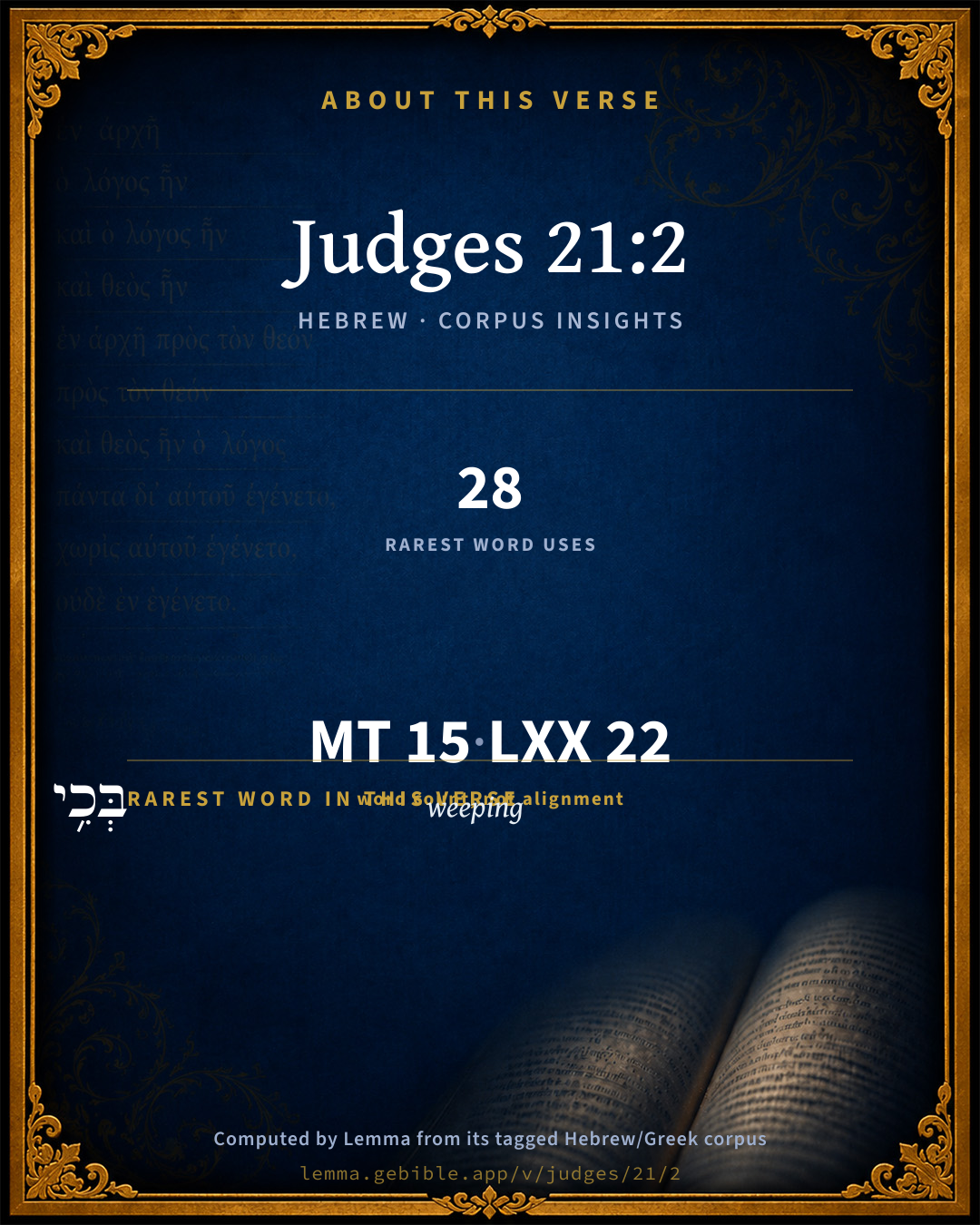
בְּכִ֥י weeping H1065 occurs in 27 verses of the Hebrew Bible. Also found in:

Grammatical profile

  • 4 verbs
  • 8 nouns
  • 1 adjective
  • 1 preposition
  • 1 adverb

Verb forms

  • וַיָּבֹ֤א Qal · Sequential Imperfect
  • וַיֵּ֤שְׁבוּ Qal · Sequential Imperfect
  • וַיִּשְׂא֣וּ Qal · Sequential Imperfect
  • וַיִּבְכּ֖וּ Qal · Sequential Imperfect

Repetition

A word recurs within this verse — often emphatic in Hebrew:

  • בֵּֽית Bethel H1008 ×2

Hebrew & Septuagint length

In English translation the verse runs 20 words from the Hebrew and 25 from the Septuagint (LXX English) — closely comparable.

A rough comparison of the two English renderings, which tokenize alike — not a word-level alignment.

Word counts can differ between the Hebrew and the Greek without any difference in meaning — e.g. the Hebrew direct-object marker אֵת has no separate Greek word, and Greek often adds the article ὁ.

In the original languages it is 15 Hebrew tokens and 22 Greek tokens — but the two are counted differently (Hebrew bundles its prefixes and suffixes into one token; the Greek is in lemma form), so that isn’t a like-for-like length.

Cross-references

8

Topical passages linked to Judges 21:2 in the Treasury of Scripture Knowledge — connected by theme and wording, ordered by reader-vote popularity; previews shown in the World English Bible.

  • Judges 20:26 Then all the children of Israel, and all the people, went up, and came to Bethel, and wept, and sat there before Yahweh, and fasted that day until even; and they offered burnt-offerings and peace-offerings before Yahweh.
  • Judges 20:18 The children of Israel arose, and went up to Bethel, and asked counsel of God; and they said, Who shall go up for us first to battle against the children of Benjamin? Yahweh said, Judah [shall go up] first.
  • 1 Samuel 30:4 Then David and the people who were with him lifted up their voice and wept, until they had no more power to weep.
  • Genesis 27:38 Esau said to his father, "Have you but one blessing, my father? Bless me, even me also, my father." Esau lifted up his voice, and wept.
  • Joshua 18:1 The whole congregation of the children of Israel assembled themselves together at Shiloh, and set up the tent of meeting there: and the land was subdued before them.
  • Judges 2:4 It happened, when the angel of Yahweh spoke these words to all the children of Israel, that the people lifted up their voice, and wept.
  • Judges 20:23 The children of Israel went up and wept before Yahweh until even; and they asked of Yahweh, saying, Shall I again draw near to battle against the children of Benjamin my brother? Yahweh said, Go up against him.
  • Judges 21:12 They found among the inhabitants of Jabesh Gilead four hundred young virgins, who had not known man by lying with him; and they brought them to the camp to Shiloh, which is in the land of Canaan.

Cross-references courtesy of OpenBible.info (CC BY 4.0).

Hebrew and Greek witnesses Masoretic Hebrew ↔ Greek Septuagint

The same verse in the two great witnesses to the Old Testament, shown verse-for-verse.

These are two independent witnesses, not word-aligned to each other, and the Septuagint is shown in lemma (dictionary) form.

Hebrew Judges 21:2 Masoretic · Westminster Leningrad Codex

וַיָּבֹ֤א הָעָם֙ בֵּֽית אֵ֔ל וַיֵּ֤שְׁבוּ שָׁם֙ עַד הָעֶ֔רֶב לִפְנֵ֖י הָאֱלֹהִ֑ים וַיִּשְׂא֣וּ קוֹלָ֔ם וַיִּבְכּ֖וּ בְּכִ֥י גָדֽוֹל

The people came to Bethel, and sat there until evening before God, and lifted up their voices, and wept sore.

World English Bible · Public Domain

Greek LXX Judges 21:2 Septuagint · lemma form

καί ἔρχομαι ὁ λαός εἰς βαιθηλ καί καταἵζω ἐκεῖ ἕως ἑσπέρα ἐνώπιον ὁ θεός καί αἴρω φωνή αὐτός καί κλαίω κλαυθμός μέγας

And the people came to Baethel, and sat there until evening before God: and they lifted up their voice and wept with a great weeping;

LXX2012 (modern English Septuagint) · Public Domain

On this verse, Adam Clarke's Commentary discusses the Septuagint’s reading. Read the note in Commentary ↓

Hebrew: Westminster Leningrad Codex (CC BY 4.0). Greek: Septuagint (public domain); English from LXX2012 (modern English Septuagint) (Public Domain). How the Septuagint differs from the Hebrew →

Targum (Aramaic paraphrase)

1

The Targum is the ancient Jewish Aramaic paraphrase of the Hebrew Scriptures — an interpretive translation, not the Hebrew text itself. Onkelos (literal) and Pseudo-Jonathan (expansive) render the Torah, and Jonathan the Prophets. Coverage is partial: where no permissively-licensed English translation exists for a verse, only the Aramaic is shown. This is verse-level text, not a word-by-word alignment to the Hebrew.

  1. Targum Jonathan Prophets (Joshua–Malachi)
    וַאֲתָא עַמָא לְבֵית אֵל וִיתִיבוּ תַמָן עַד רַמְשָׁא קֳדָם יְיָ וַאֲרִימוּ קָלְהוֹן וּבְכוֹ בְּכִי סַגְיָא:

    (no public-domain English translation for this verse)

    Targum Jonathan — Aramaic: “Mikraot Gedolot” (public domain). English: “Sefaria Community Translation” (CC0 1.0 (public-domain dedication)); “London "Chaldee Paraphrase," 1871” (public domain). Text via Sefaria.

Commentary

Notes on Judges 21:2 from classic Christian and Jewish commentators (each source and its license shown beneath its notes). The classic Christian expositions comment on the surrounding passage and are grouped to its opening verse, so a note may address several verses; the Jewish commentaries on the Tanakh (Rashi and others) are per-verse, so they appear only where the commentator wrote on this verse.

Lemma curates 59 commentaries, every one of them public domain or Creative Commons licensed, each selected and text-cleaned for this edition rather than reprinted as found. About our sources →

Trapp's Complete Commentary

John Trapp

Jdg 21:2 And the people came to the house of God, and abode there till even before God, and lifted up their voices, and wept sore;

Ver. 2. And the people came to the house of God.] That is, To Shiloh, for that was now their Bethel, there to praise God for their recent ctory; and to seek direction what to do, and how to wind out of that labyrinth whereinto they had inconsiderately cast themselves.

“ … qui non moderabitur irae,

Infectum velit esse dolor quod suaserit et mens. ” - Horat.

And abode there till even before God.] To the shame of such as, held but a while longer than ordinary at holy meetings, cry out, as Mal 1:13, "Behold, what a weariness it is! and snuff." They sit in the stocks when they are at prayers, and come out of the church, when the tedious sermon runs somewhat beyond the hour, like prisoners out of a jail.

And lifted up their voices, and wept sore.] Notwithstanding their recent victory, which now they met to praise God for, Adeo nihil est ex omni parte beatum. It is seldom seen that God alloweth men here a perfect contentment. Something they must have to complain of, that they may not set up their rest on this side heaven.

John Trapp, A Commentary or Exposition upon All the Books of the Old and New Testament (1647–1656) — public domain. Text from a community e-Sword module.

Joseph Benson's Commentary

Jdg 21:2. And lift up their voices and wept sore — Some days after their fury was over, and they coolly considered what they had done in the heat of war, their joy and triumph for their victory were turned into mourning and lamentation, for the loss of so many of their brethren.

Joseph Benson's Commentary on the Old and New Testaments (1811–1818) — public domain. Text from a community e-Sword module.

Adam Clarke's Commentary

Verse 2. The people came to the house of God] Literally, the people came בית־אל to Bethel; this is considered as the name of a place by the Chaldee, Syriac, Arabic, and Septuagint.

And wept sore] Their revenge was satisfied, and now reflection brings them to contrition for what they had done.

Adam Clarke's Commentary on the Bible (1810–1826) — public domain. Text from a community e-Sword/MySword module.

Ellicott's Commentary for English Readers

(2) To the house of God.—Rather, to Bethel, as in Jdg_20:18; Jdg_20:27.

Wept sore.—As after their defeat (Jdg_20:26); but this time they were remorseful for the fate of those whom they were then pledged to destroy.

A Bible Commentary for English Readers, edited by Charles John Ellicott (1878–1897) — public domain. Text from a community e-Sword module.

The Cambridge Bible for Schools and Colleges

gen. ed. J. J. S. Perowne

2. came to Beth-el] The characteristics of the B narrative reappear in this chapter: the resort to Beth-el till even cf. Jdg_20:18; Jdg_20:26; the weeping, intensified each time, cf. Jdg_20:23; Jdg_20:26; the offering of sacrifices Jdg_21:4 cf. Jdg_20:26; the post-exilic congregation (Jdg_21:10; Jdg_21:13; Jdg_21:16), and the assembly (Jdg_21:5; Jdg_21:8) cf. Jdg_20:1 n.; the artificial numbers Jdg_21:10.

The Vulgate renders ‘Veneruntque omnes ad domum Dei, in Silo,’ following the theory noticed in Jdg_20:18 n.

The Cambridge Bible for Schools and Colleges (gen. ed. J. J. S. Perowne; Cambridge University Press, 1878–1918) — public domain. Text from a community e-Sword module.

John Gill's Exposition

And the people came to the house of God,.... Not to the city Bethel, as the Targum, Septuagint, and other versions, but to Shiloh, where were the tabernacle and ark; and this is to be understood of the army after they had utterly destroyed the Benjaminites: hence we read of the camp in Shiloh, Jdg 21:12, here they came not so much to rejoice, and be glad, and to return thanks for the victory they had at last obtained, as to lament the unhappy case of the tribe of Benjamin, and to have counsel and advice, and consider of ways and means to repair their loss:

and abode there till even before God; fasting and praying, instead of feasting and rejoicing:

and lifted up their voices, and wept sore; not so much, or at least not only for the 40,000 Israelites that were slain, but for the tribe of Benjamin, in danger of being lost, as follows.

John Gill's Exposition of the Whole Bible (1746–1763) — public domain (CC PDM 1.0). Text via the HelloAO Bible API.

Albert Barnes' Notes on the Bible

To the house of God - It should be, “to Bethel.” See Jdg 20:18.

Albert Barnes' Notes on the Bible (1834–1885) — public domain. Text from a community e-Sword/MySword module.

Haydock's Catholic Bible Commentary

Silo. Hebrew simply, "to Bethel," as chap. xx. 18. Septuagint (Alexandrian), "to Maspha and Bethel." (Haydock)

George Leo Haydock (1774–1849), Haydock's Catholic Family Bible and Commentary, 1859 edition — public domain. Excludes Psalms (Douay-Rheims chapter numbering differs from Protestant) and Deuterocanonical books (Catholic canon only).

Matthew Poole's English Annotations

The people came to the house of God; partly to mourn for the common loss, and partly to ask counsel from God about the repairing of it.

Matthew Poole's English Annotations on the Holy Bible (1683–1685) — public domain. Text from a community e-Sword/MySword module.

Whedon's Commentary on the Bible

Daniel D. Whedon

2. House of God — Rather, Beth-el; see notes on Jdg_20:18; Jdg_20:26-27.

Abode… before God — In solemn penitence and humiliation before the ark of the covenant which was there.

Wept sore — Not so much over their sins, as over the calamities of Benjamin.

Daniel D. Whedon (gen. ed.), Commentary on the Old and New Testaments (1874–1909) — public domain. Text from a community e-Sword module.

The Pulpit Commentary

And the people, etc. The narrative now proceeds. After the people, i.e. the Israelite army, so described Jud_1:20:3, 8, 22, etc., had finished the work of destruction in the cities of Benjamin, they returned to Bethel, (the house of God, A.V, here and in Jud_1:20:18, 26, 31, where see notes) and, their rage having now subsided, gave way to violent grief on account of the destruction of Benjamin their brother. With passionate Oriental feelings they passed the whole day weeping, and probably fasting, (see Jud_1:20:26) before the tabernacle. Wept sore. Hebrew, wept a great weeping. The expression lifted up their voices shows that it was a loud wailing and lamentation.

HOMILIES BY W.F. ADENEY Vers. 2-4. Sorrow for others.

I IT IS NATURAL TO BE DISTRESSED AT THE TROUBLES OF OTHERS.

1. It is natural on personal grounds. We are members one of another, so that if one member suffer, all suffer. The Israelites felt that it would be a common calamity to the whole nation for one tribe to be blotted out. It would not only be a judgment on that tribe, it would be "a breach in the tribes of Israel." England suffers through the wars and famines and storms which devastate even remote countries. If adversity falls upon one great town, one trade, one class, the whole community feels the effect of it. It is foolish, on selfish considerations alone, for the rich and happy to ignore the distresses of the poor and wretched.

2. But it is natural to be distressed at the troubles of others on unselfish grounds. When we are not hardened by sin we must naturally feel sympathy. The law of Christ requires us to bear one another"s burdens. (Gal_6:2) If Jews of old felt for their brethren in their trouble, how can Christians, who owe all their best blessings to the compassion and suffering of Christ for them, harden their hearts against the cries of the world"s misery, when they in turn are expected to show the spirit of Christ in sympathy and vicarious sacrifice?

II IF WE ARE CALLED TO PUNISH MEN FOR THEIR SIN, WE SHOULD ALSO PITY THEM FOR THEIR DISTRESS. Israel had punished the tribe of Benjamin, but the sight of the ruin thus wrought filled all the people with grief. It is right and necessary to be firm in repressing wickedness; yet this should not be done in hot hatred, in callous sternness, nor in complacent self-satisfaction, but with grief, mourning for the distress, and more for the sin occasioning it. So does God chastise, in grief, like a father loving his child, and therefore the more hating the iniquity which produces all the trouble.

III DISTRESS FOR THE TROUBLES OF OTHERS SHOULD LEAD US TO GOD ON THEIR BEHALF. The people came to the house of God, and wept there before God. We should bring all our trouble before God, and, when we know not what to ask for, confide in him and relieve our souls by leaving the burden with him. If we are really and deeply grieved for others, we shall be constrained to do the same with the sorrow of sympathy. All Christians are called to be priests, intercessors for others. We should pray most earnestly for those who will not pray for themselves. We should humble ourselves for their sin, since the oneness of the human family brings shame upon all when any go astray. Such sorrow before God will incline us to fresh acts of self-sacrifice and dedication. As the Israelites offered burnt offerings, we shall consecrate ourselves to God, that we may be more capable of relieving those for whom we grieve. A.

The Pulpit Commentary (1880–1919), ed. H.D.M. Spence-Jones & Joseph S. Exell — public domain. Text from a community e-Sword module.

Lesson kit

Teaching starters — assembled from the data on this page, not authored interpretation. Every prompt links to the verse data it draws on. Edit before teaching.

Judges, in the Historical, opens this verse with 15 words (14 distinct Hebrew lemmas). Its most distinctive word is Bᵉkîy (“weeping”). A historical commentator’s framing appears above. Read the whole chapter for the surrounding context.

Discussion questions

  1. What does “weeping” (Bᵉkîy) contribute to the verse as a whole?
  2. How does Genesis 45:2, which shares the word «weeping», read alongside this verse?
  3. What does the repetition of “Bethel” (2× in this one verse) do in this verse?
  4. These translations render this verse differently; the difference is in the English rendering, not the original. What questions does that raise?
  5. «וַיָּבֹ֤א» is a Qal Sequential Imperfect verb. How does that grammatical form shape the action described?
  6. Compare how Trapp's Complete Commentary and Joseph Benson's Commentary read this verse. Where do they agree or differ?

Things to notice

Reading settings

Reading text

Shown beneath each verse's original-language words.

Old Testament
Old Testament edition

Read the OT as the Masoretic Hebrew (MT) or the Greek Septuagint (LXX).

English shown for the Greek Septuagint (in the Hebrew ↔ Greek comparison).

Comparing translations? Open the Compare panel on any verse page to stack up to four side by side.