2 Samuel 22:7

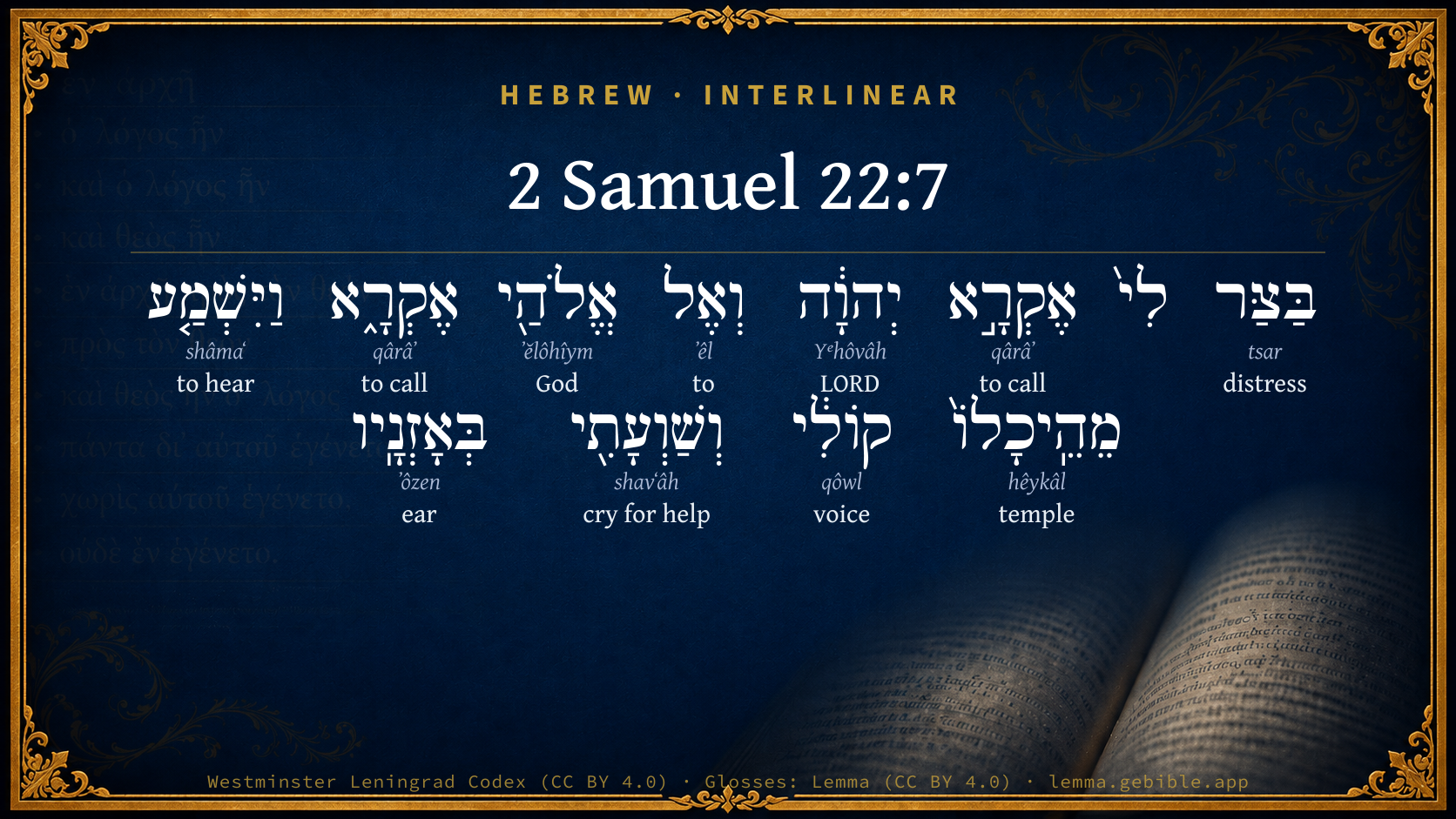
Hebrew (Westminster Leningrad Codex) 2 Samuel 22:7 appears in the Hebrew Old Testament. The text above is from the Westminster Leningrad Codex. Each word links to its Strong’s number, a concise gloss, and parsing drawn from the Open Scriptures Hebrew Bible morphology. Click any word for its full Brown-Driver-Briggs (BDB) entry.
Download image
Cite this verse

2 Samuel 22:7 (World English Bible). Public Domain. Lemma interlinear Bible study tool, https://lemma.gebible.app/v/2-samuel/22/7.

Show BibTeX & RIS
BibTeX
RIS
English Translation
In my distress I called on Yahweh; Yes, I called to my God: He heard my voice out of his temple, My cry [came] into his ears.
World English Bible · Public Domain
Download a study sheet

One document with this verse’s original text, its word-by-word gloss line, the meaning frame, cross-references with their text, attributed commentary, and full source and license credits — printable, and it pastes into notes with its structure intact.

This verse Autodidact and up

Study sheet (.html) Plain text (.txt)

A passage Seminary Student

Up to 50 verses in one chapter. A passage sheet keeps up to 6 commentary sources and 12 cross-references per verse, in the order this page ranks them, and says so on the sheet whenever that leaves anything out. Ask for a single verse and you get the Autodidact verse sheet above.

Everything on this page stays free to read, with no account — the sheet is a download of what is already on screen, not access to it.

Want to remove ads? Support Godless Engineer
Compare translations 3

The same verse in 3 English versions, stacked beneath the original-language interlinear above. Click any original word for its lexicon entry.

Each is an independent rendering of the whole verse — the interlinear is not word-aligned to these translations.

Highlighted words mark where these versions differ — a whole-verse word diff, not a word-by-word alignment.

  • World English Bible Public Domain
    In my distress I called on Yahweh; Yes, I called to my God: He heard my voice out of his temple, My cry [came] into his ears.
  • King James Version Public Domain
    In my distress I called upon the LORD, and cried to my God: and he did hear my voice out of his temple, and my cry did enter into his ears.
  • unfoldingWord Literal Text CC BY-SA 4.0
    In my distress I called Yahweh, and to my God I called. And he heard my voice from his temple, and my cry in his ears.

unfoldingWord Literal Text — © unfoldingWord, licensed CC BY-SA 4.0. Word-aligned USFM3 via Door43 (git.door43.org/unfoldingWord/en_ult).

Versions to compare (up to 4)

3 of 4 selected

Show all 18 translations

Every available English version of this verse, each an independent rendering of the whole verse.

  • World English Bible Public Domain
    In my distress I called on Yahweh; Yes, I called to my God: He heard my voice out of his temple, My cry [came] into his ears.
  • Berean Standard Bible Public Domain
    In my distress I called upon the LORD; I cried out to my God. And from His temple He heard my voice, and my cry for help reached His ears.
  • Majority Standard Bible Public Domain
    In my distress I called upon the LORD; I cried out to my God. And from His temple He heard my voice, and my cry for help reached His ears.
  • King James Version Public Domain
    In my distress I called upon the LORD, and cried to my God: and he did hear my voice out of his temple, and my cry did enter into his ears.
  • American Standard Version (1901) Public Domain
    In my distress I called upon Jehovah; Yea, I called unto my God: And he heard my voice out of his temple, And my cry `came' into his ears.
  • Revised Version (1885) Public Domain
    In my distress I called upon the LORD, yea, I called unto my God: and he heard my voice out of his temple, and my cry came into his ears.
  • Geneva Bible (1599) Public Domain
    But in my tribulation did I call vpon the Lord, and crie to my God, and he did heare my voyce out of his temple, and my crie did enter into his eares.
  • Douay-Rheims (1899) Public Domain
    In my distress I will call upon the Lord, and I will cry to my God: and he will hear my voice out of his temple, and my cry shall come to his ears.
  • Young's Literal Translation Public Domain
    In mine adversity I call Jehovah, And unto my God I call, And He heareth from His temple my voice, And my cry `is' in His ears,
  • Literal Standard Version CC BY-SA 4.0
    In my adversity I call on YHWH, || And I call to my God, || And He hears my voice from His temple, || And my cry [is] in His ears,
  • Unlocked Literal Bible CC BY-SA 4.0
    In my distress I called to Yahweh; I called to my God; he heard my voice from his temple, and my call for help went into his ears.
  • unfoldingWord Literal Text CC BY-SA 4.0
    In my distress I called Yahweh, and to my God I called. And he heard my voice from his temple, and my cry in his ears.
  • Darby Bible Public Domain
    In my distress I called upon Jehovah, And I cried to my God; And he heard my voice out of his temple, And my cry [came] into his ears.
  • World Messianic Bible Public Domain
    In my distress, I called on the LORD. Yes, I called to my God. He heard my voice out of his temple. My cry came into his ears.
  • Webster's Bible Public Domain
    In my distress I called upon the LORD, and cried to my God: and he heard my voice out of his temple, and my cry entered into his ears.
  • Free Bible Version CC BY-SA 4.0
    In my despair I called on the Lord; I called out to my God. He heard my voice from his Temple; my cry for help reached his ears.
  • Bible in Basic English Public Domain
    In my trouble my voice went up to the Lord, and my cry to my God: my voice came to his hearing in his holy Temple, and my prayer came to his ears.
  • JPS Tanakh (1917) Public Domain
    In my distress I called upon the LORD, yea, I called unto my God; and out of His temple He heard my voice, and my cry did enter into His ears.

Literal Standard Version (2020), Covenant Press — licensed CC BY-SA 4.0. Text via the HelloAO Bible API (eBible.org). Unlocked Literal Bible (unfoldingWord) — licensed CC BY-SA 4.0. Text via the HelloAO Bible API (eBible.org). unfoldingWord Literal Text — © unfoldingWord, licensed CC BY-SA 4.0. Word-aligned USFM3 via Door43 (git.door43.org/unfoldingWord/en_ult). Free Bible Version, Dr. Jonathan Gallagher — licensed CC BY-SA 4.0. Text via the HelloAO Bible API (eBible.org).

Word by word

More ways to search: Search by grammar → Find every occurrence → Compare this word →

Practice this passage: Drill this verse → Learn its vocabulary →

וְשַׁוְעָתִ֖י
shavʻâh
H7775
“and · cry for help · my”
Conjunction + Noun, Common, Feminine, Singular, Construct + Suffix, Personal, 1st Person, Common, Singular
Part of Speech
Conjunction + Noun
Type
Common
Gender
Feminine
Number
Singular
State
Construct
Full BDB Definition

Origin: from H7773

TWOT: 2348c

cry for help
  1. בַּצַּר tsar H6862 “in/at the · distress” Preposition, Determined + Adjective, Adjective, Masculine, Singular, Absolute
  2. אֶקְרָ֣א qârâʼ H7121 “to call” Verb, Qal, Imperfect, 1st Person, Common, Singular
  3. יְהוָ֔ה Yᵉhôvâh H3068 “LORD” Noun, Proper
  4. וְאֶל ʼêl H413 “and · to” Conjunction + Preposition
  5. אֱלֹהַ֖י ʼĕlôhîym H430 “God(s) · my” Noun, Common, Masculine, Plural, Construct + Suffix, Personal, 1st Person, Common, Singular
  6. אֶקְרָ֑א qârâʼ H7121 “to call” Verb, Qal, Imperfect, 1st Person, Common, Singular
  7. וַיִּשְׁמַ֤ע shâmaʻ H8085 “and · to hear” Conjunction + Verb, Qal, Sequential Imperfect, 3rd Person, Masculine, Singular
  8. מֵהֵֽיכָלוֹ֙ hêykâl H1964 “from · temple · his” Preposition + Noun, Common, Masculine, Singular, Construct + Suffix, Personal, 3rd Person, Masculine, Singular
  9. קוֹלִ֔י qôwl H6963 “voice · my” Noun, Common, Masculine, Singular, Construct + Suffix, Personal, 1st Person, Common, Singular
  10. בְּאָזְנָֽיו ʼôzen H241 “in/at · ears · his” Preposition + Noun, Common, Feminine, Dual, Construct + Suffix, Personal, 3rd Person, Masculine, Singular

About this verse

These counts appear in no published source. They are computed here, from the morphology-tagged text and Lemma’s own curated glosses. What Lemma adds →

12
words
10
distinct lemmas
Historical
section

Notable vocabulary

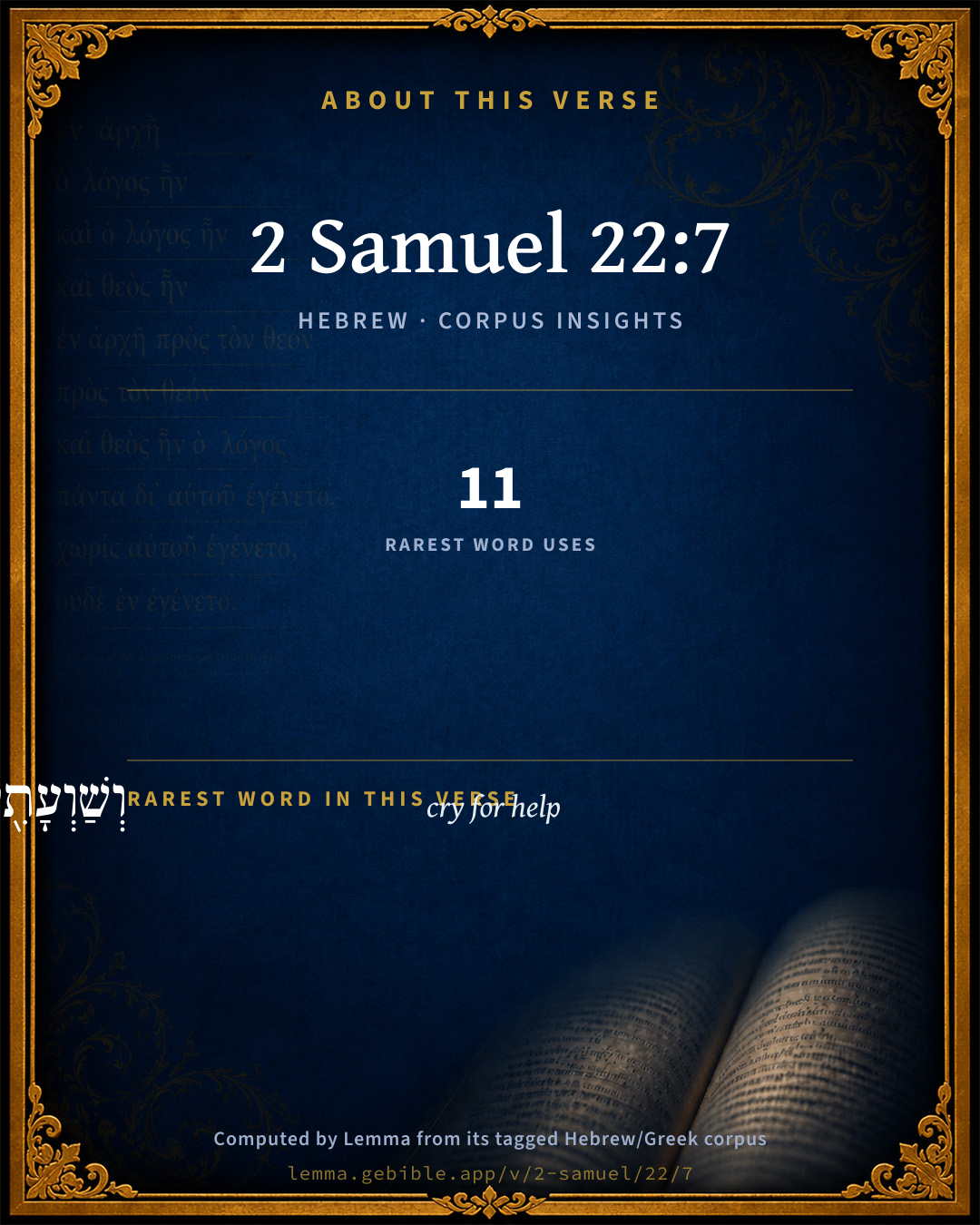
The rarest word here is וְשַׁוְעָתִ֖י cry for help H7775 — appearing just 11 times in the whole Hebrew Bible.

Shared distinctive vocabulary

וְשַׁוְעָתִ֖י cry for help H7775 occurs in 11 verses of the Hebrew Bible. Also found in:

Grammatical profile

  • 3 verbs
  • 6 nouns
  • 1 adjective
  • 2 prepositions

Verb forms

  • אֶקְרָ֣א Qal · Imperfect
  • אֶקְרָ֑א Qal · Imperfect
  • וַיִּשְׁמַ֤ע Qal · Sequential Imperfect

Repetition

A word recurs within this verse — often emphatic in Hebrew:

  • אֶקְרָ֣א to call H7121 ×2

Hebrew & Septuagint length

In English translation the verse runs 27 words from the Hebrew and 34 from the Septuagint (LXX English) — closely comparable.

A rough comparison of the two English renderings, which tokenize alike — not a word-level alignment.

Word counts can differ between the Hebrew and the Greek without any difference in meaning — e.g. the Hebrew direct-object marker אֵת has no separate Greek word, and Greek often adds the article ὁ.

Cross-references

15

Topical passages linked to 2 Samuel 22:7 in the Treasury of Scripture Knowledge — connected by theme and wording, ordered by reader-vote popularity; previews shown in the World English Bible.

  • Psalms 18:6 In my distress I called on Yahweh, And cried to my God. He heard my voice out of his temple, My cry before him came into his ears.
  • Psalms 116:4 Then called I on the name of Yahweh: "Yahweh, I beg you, deliver my soul."
  • Jonah 2:7 "When my soul fainted within me, I remembered Yahweh. My prayer came in to you, into your holy temple.
  • Exodus 3:7 Yahweh said, "I have surely seen the affliction of my people who are in Egypt, and have heard their cry because of their taskmasters, for I know their sorrows.
  • Psalms 27:4 One thing I have asked of Yahweh, that I will seek after, That I may dwell in the house of Yahweh all the days of my life, To see Yahweh's beauty, And to inquire in his temple.
  • Psalms 34:15–17 Yahweh's eyes are toward the righteous. His ears listen to their cry.
  • Psalms 120:1 In my distress, I cried to Yahweh. He answered me.
  • Psalms 34:6 This poor man cried, and Yahweh heard him, And saved him out of all his troubles.
  • Habakkuk 2:20 But Yahweh is in his holy temple. Let all the earth be silent before him!"
  • 1 Kings 8:28–30 Yet have respect for the prayer of your servant, and for his supplication, Yahweh my God, to listen to the cry and to the prayer which your servant prays before you this day;
  • Jonah 2:4 I said, 'I have been banished from your sight; Yet I will look again toward your holy temple.'
  • Matthew 26:38–39 Then he said to them, "My soul is exceedingly sorrowful, even to death. Stay here, and watch with me."
  • Hebrews 5:7 He, in the days of his flesh, having offered up prayers and petitions with strong crying and tears to him who was able to save him from death, and having been heard for his godly fear,
  • James 5:4 Behold, the wages of the laborers who mowed your fields, which you have kept back by fraud, cry out, and the cries of those who reaped have entered into the ears of the Lord of Hosts.
  • Luke 22:44 Being in agony he prayed more earnestly. His sweat became like great drops of blood falling down on the ground.

Cross-references courtesy of OpenBible.info (CC BY 4.0).

Hebrew and Greek witnesses Masoretic Hebrew ↔ Greek Septuagint

The same verse in the two great witnesses to the Old Testament, shown verse-for-verse.

These are two independent witnesses, not word-aligned to each other, and the Septuagint is shown in lemma (dictionary) form.

Hebrew 2 Samuel 22:7 Masoretic · Westminster Leningrad Codex

בַּצַּר לִי֙ אֶקְרָ֣א יְהוָ֔ה וְאֶל אֱלֹהַ֖י אֶקְרָ֑א וַיִּשְׁמַ֤ע מֵהֵֽיכָלוֹ֙ קוֹלִ֔י וְשַׁוְעָתִ֖י בְּאָזְנָֽיו

In my distress I called on Yahweh; Yes, I called to my God: He heard my voice out of his temple, My cry [came] into his ears.

World English Bible · Public Domain

Greek LXX 2 Samuel 22:7 Septuagint · lemma form

ἐν ὁ θλίβω ἐγώ ἐπικαλέω κύριος καί πρός ὁ θεός ἐγώ βοάω καί ἐπιἀκούω ἐκ ναός αὐτός φωνή ἐγώ καί ὁ κραυγή ἐγώ ἐν ὁ οὖς αὐτός

When I am afflicted I will call upon the Lord, and will cry to my God, and he shall hear my voice out of his temple, and my cry shall come into his ears.

LXX2012 (modern English Septuagint) · Public Domain

Hebrew: Westminster Leningrad Codex (CC BY 4.0). Greek: Septuagint (public domain); English from LXX2012 (modern English Septuagint) (Public Domain). How the Septuagint differs from the Hebrew →

Targum (Aramaic paraphrase)

1

The Targum is the ancient Jewish Aramaic paraphrase of the Hebrew Scriptures — an interpretive translation, not the Hebrew text itself. Onkelos (literal) and Pseudo-Jonathan (expansive) render the Torah, and Jonathan the Prophets. Coverage is partial: where no permissively-licensed English translation exists for a verse, only the Aramaic is shown. This is verse-level text, not a word-by-word alignment to the Hebrew.

  1. Targum Jonathan Prophets (Joshua–Malachi)
    אֲמַר דָוִד כַּד עָקָא לִי אֲנָא מְצַלֵי קֳדָם יְיָ וּקְדָם אֱלָהַי אֲנָא מִתְחַנֵן וּמְקַבֵּל מֵהֵיכָלֵיהּ צְלוֹתִי וּבָעוּתִי קֳדָמוֹהִי מִתְעַבְּדָא:

    (no public-domain English translation for this verse)

    Targum Jonathan — Aramaic: “Mikraot Gedolot” (public domain). English: “Sefaria Community Translation” (CC0 1.0 (public-domain dedication)); “London "Chaldee Paraphrase," 1871” (public domain). Text via Sefaria.

Commentary

Notes on 2 Samuel 22:7 from classic Christian and Jewish commentators (each source and its license shown beneath its notes). The classic Christian expositions comment on the surrounding passage and are grouped to its opening verse, so a note may address several verses; the Jewish commentaries on the Tanakh (Rashi and others) are per-verse, so they appear only where the commentator wrote on this verse.

Lemma curates 59 commentaries, every one of them public domain or Creative Commons licensed, each selected and text-cleaned for this edition rather than reprinted as found. About our sources →

Tyndale Open Study Notes

Tyndale Open Resources

22:7 Although his sanctuary sometimes refers to the Tabernacle or Temple, here it refers to God’s heavenly dwelling; neither the Tabernacle nor the Temple were in existence at this time.

Tyndale Open Study Notes — © Tyndale Open Resources, licensed CC BY-SA 4.0. Text via the HelloAO Bible API.

Ellicott's Commentary for English Readers

(7) Called . . . cried.—The original words are the same here, although differing in the parallel place in the psalm.

My cry did enter into his ears.—Literally, my cry in his ears, an elliptical expression which is filled out in the psalm, “my cry came before him, even into his ears.”

A Bible Commentary for English Readers, edited by Charles John Ellicott (1878–1897) — public domain. Text from a community e-Sword module.

The Cambridge Bible for Schools and Colleges

gen. ed. J. J. S. Perowne

7. called … cried] This rendering represents a difference of words found in the Heb. of Psa_18:6, but not here. It is however supported by the Sept. and is probably the true reading.

out of his temple] The palace temple of heaven, where He sits enthroned. Cp. Psa_11:4.

and my cry did enter into his ears] In place of the terse expression my cry was in his ears, Psa_18:6 reads “my cry before him came into his ears.”

The Cambridge Bible for Schools and Colleges (gen. ed. J. J. S. Perowne; Cambridge University Press, 1878–1918) — public domain. Text from a community e-Sword module.

John Gill's Exposition

And he made darkness pavilions round about him, dark waters,

and thick clouds of the skies. See Gill on Psa 18:11.

John Gill's Exposition of the Whole Bible (1746–1763) — public domain (CC PDM 1.0). Text via the HelloAO Bible API.

Haydock's Catholic Bible Commentary

Temple. David was now busy in making preparations for it.

George Leo Haydock (1774–1849), Haydock's Catholic Family Bible and Commentary, 1859 edition — public domain. Excludes Psalms (Douay-Rheims chapter numbering differs from Protestant) and Deuterocanonical books (Catholic canon only).

The Pulpit Commentary

Prayer in distress heard.

The distress referred to is graphically described in vers. 5, 6, 17, 18. The interposition of God for the psalmist"s deliverance is poetically depicted in vers. 8-20. The connecting link is given in this verse. David, in his danger and trouble, called on God, and therefore he was delivered. We have here

I DISTRESS. This may arise from various causes; such as:

1. Enemies. As in David"s case, with the dangers of the battles fought against them. There are many forms less extreme in which the enmity of men may show itself and occasion pain or peril.

2. Circumstances. Worldly losses and anxieties.

3. Personal affliction. Of body or mind. Special distress from afflictions which implicate the nerves, and so the mind itself.

4. Death of dear friends.

5. Conviction of sin. (see Psa_32:3, Psa_32:4) It would be well if this form of distress were more common.

6. Pressure of powerful temptation. The mighty and threatening uprising of inward corruptions, or the pressing solicitations of evil from without.

7. Fear of calamities or of death.

II PRAYER. Natural for men to call upon God when they are in great trouble or danger. Yet all do not; and of many the prayers are unacceptable, because they lack the moral and spiritual elements of successful prayer. (see Hos_7:14) Prayer, to be acceptable, must be:

1. That of a righteous man. (Vers. 21-25; (Jam_5:16; Psa_66:18) Yet the prayers of one who is stirred by his affliction to sincere repentance will be heard; for repentance is the beginning of righteousness.

2. Offered in faith. (Mat_21:22)

3. Importunate and persevering. (Luk_11:8, seq.; 18:1-8.)

4. Accompanied, where practicable, with the use of appropriate means. David fought vigorously as well as prayed earnestly.

III DELIVERANCE. The Almighty heard the psalmist"s voice "out of his temple" (equivalent to "the heavens"), and, interposing in majesty and power, delivered him, discomfiting and scattering his foes. True prayer is always heard and answered; but the deliverance granted is often not according to our conceptions and desires, yet ever according to the perfect wisdom and goodness of our heavenly Father. Sometimes the causes of our distress are removed; sometimes they are allowed to continue, but the distress is allayed, and the causes turned into blessings. So it was with St. Paul"s "thorn in the flesh," although he prayed earnestly and repeatedly (2Co_12:8-10) Spiritual deliverance, however, is always granted to those who truly seek it; and ultimately complete rescue from all that afflicts the Christian.

IV GRATEFUL REMEMBRANCE AND THANKSGIVING. Although David"s victories were wrought through the skill and valour of himself and his troops, he gives to God all the glory of them; for he knew that all was due to him. His example will be followed by the Christian, as he reviews life and calls to mind his distresses and deliverances. He will recognize the hand of God in all, and render praise to him who both furnishes the means of deliverance and exercises the power which renders them successful. Finally, let none wait for trouble before they begin to pray. Live in the habit of prayer, and you will be able, when trouble comes, to pray truly and successfully. Otherwise you may find yourself in the miserable condition of those described in ver. 42, who "looked even unto the Lord, but he answered them not. G.W.

The Pulpit Commentary (1880–1919), ed. H.D.M. Spence-Jones & Joseph S. Exell — public domain. Text from a community e-Sword module.

unfoldingWord translationNotes

Door43 World Missions Community

General Information:

David's song to Yahweh continues. He uses parallelism to emphasize what he is saying. (See: Parallelism)

In my distress

"In my great trouble"

he heard my voice from his temple

David is referring to the heavenly temple where Yahweh dwells. The earthly temple has not yet been built.

my call for help went into his ears

Here the metonym "his ears" refers to Yahweh and his hearing of David's call for help. AT: "he heard my prayer for help" (See: Metonymy)

his ears

David speaks of Yahweh as if he had ears. (See: Personification)

translationWords

voice

temple

unfoldingWord translationNotes — © Distant Shores Media and the Door43 World Missions Community, licensed CC BY-SA 4.0. Source: git.door43.org/Door43/en_tn.

Rashi

Rabbi Shlomo Yitzchaki (Rashi)

In my distress I called to God… He hears. This is typical of the present tense it uses both past and future at the same time.

Rashi on the Tanakh — English translations: “The Judaica Press complete Tanach with Rashi, translated by A. J. Rosenberg” (CC BY 4.0); “Pentateuch with Rashi's commentary by M. Rosenbaum and A.M. Silbermann, 1929-1934” (public domain); “The Metsudah Tanach series, Lakewood, N.J” (CC BY 4.0); and “The Book of Joshua, Metsudah Publications, 1997” (CC BY 4.0). Text via Sefaria.

Lesson kit

Teaching starters — assembled from the data on this page, not authored interpretation. Every prompt links to the verse data it draws on. Edit before teaching.

2 Samuel, in the Historical, opens this verse with 12 words (10 distinct Hebrew lemmas). Its most distinctive word is shavʻâh (“cry for help”). A historical commentator’s framing appears above. Read the whole chapter for the surrounding context.

Discussion questions

  1. How does “cry for help” (shavʻâh) shape what this verse is saying?
  2. Exodus 2:23 shares the word «cry for help» with this verse. How do the two illuminate each other?
  3. “to call” occurs 2× in this one verse. What is the effect of the repetition?
  4. The translations on this page render this verse differently — a whole-verse word diff, not a word-by-word alignment. What might account for the different wordings?
  5. The verb «אֶקְרָ֣א» is Qal Imperfect. How does its form color the action?
  6. Reading how Tyndale Open Study Notes and Ellicott's Commentary for English Readers read this verse, where do the two commentators agree and where do they part?

Things to notice

Reading settings

Reading text

Shown beneath each verse's original-language words.

Old Testament
Old Testament edition

Read the OT as the Masoretic Hebrew (MT) or the Greek Septuagint (LXX).

English shown for the Greek Septuagint (in the Hebrew ↔ Greek comparison).

Comparing translations? Open the Compare panel on any verse page to stack up to four side by side.