
Lamentations 2:7

Hebrew (Westminster Leningrad Codex) Lamentations 2:7 appears in the Hebrew Old Testament. The text above is from the Westminster Leningrad Codex. Each word links to its Strong’s number, a concise gloss, and parsing drawn from the Open Scriptures Hebrew Bible morphology. Click any word for its full Brown-Driver-Briggs (BDB) entry.
Download image
Cite this verse

Lamentations 2:7 (World English Bible). Public Domain. Lemma interlinear Bible study tool, https://lemma.gebible.app/v/lamentations/2/7.

Show BibTeX & RIS
BibTeX
RIS
English Translation
The Lord has cast off his altar, he has abhorred his sanctuary; He has given up into the hand of the enemy the walls of her palaces: They have made a noise in the house of Yahweh, as in the day of a solemn assembly.
World English Bible · Public Domain
Download a study sheet

One document with this verse’s original text, its word-by-word gloss line, the meaning frame, cross-references with their text, attributed commentary, and full source and license credits — printable, and it pastes into notes with its structure intact.

This verse Autodidact and up

Study sheet (.html) Plain text (.txt)

A passage Seminary Student

Up to 50 verses in one chapter. A passage sheet keeps up to 6 commentary sources and 12 cross-references per verse, in the order this page ranks them, and says so on the sheet whenever that leaves anything out. Ask for a single verse and you get the Autodidact verse sheet above.

Everything on this page stays free to read, with no account — the sheet is a download of what is already on screen, not access to it.

Want to remove ads? Support Godless Engineer
Compare translations 3

The same verse in 3 English versions, stacked beneath the original-language interlinear above. Click any original word for its lexicon entry.

Each is an independent rendering of the whole verse — the interlinear is not word-aligned to these translations.

Highlighted words mark where these versions differ — a whole-verse word diff, not a word-by-word alignment.

  • World English Bible Public Domain
    The Lord has cast off his altar, he has abhorred his sanctuary; He has given up into the hand of the enemy the walls of her palaces: They have made a noise in the house of Yahweh, as in the day of a solemn assembly.
  • King James Version Public Domain
    The LORD hath cast off his altar, he hath abhorred his sanctuary, he hath given up into the hand of the enemy the walls of her palaces; they have made a noise in the house of the LORD, as in the day of a solemn feast.
  • unfoldingWord Literal Text CC BY-SA 4.0
    The Lord has rejected his altar; he has abhorred his sanctuary. He has delivered up into the hand of the enemy the walls of her palaces. They raised a shout in the house of Yahweh as on the day of an appointed festival. HETH

unfoldingWord Literal Text — © unfoldingWord, licensed CC BY-SA 4.0. Word-aligned USFM3 via Door43 (git.door43.org/unfoldingWord/en_ult).

Versions to compare (up to 4)

3 of 4 selected

Show all 18 translations

Every available English version of this verse, each an independent rendering of the whole verse.

  • World English Bible Public Domain
    The Lord has cast off his altar, he has abhorred his sanctuary; He has given up into the hand of the enemy the walls of her palaces: They have made a noise in the house of Yahweh, as in the day of a solemn assembly.
  • Berean Standard Bible Public Domain
    The Lord has rejected His altar; He has abandoned His sanctuary; He has delivered the walls of her palaces into the hand of the enemy. They have raised a shout in the house of the LORD as on the day of an appointed feast.
  • Majority Standard Bible Public Domain
    The Lord has rejected His altar; He has abandoned His sanctuary; He has delivered the walls of her palaces into the hand of the enemy. They have raised a shout in the house of the LORD as on the day of an appointed feast.
  • King James Version Public Domain
    The LORD hath cast off his altar, he hath abhorred his sanctuary, he hath given up into the hand of the enemy the walls of her palaces; they have made a noise in the house of the LORD, as in the day of a solemn feast.
  • American Standard Version (1901) Public Domain
    The Lord hath cast off his altar, he hath abhorred his sanctuary; He hath given up into the hand of the enemy the walls of her palaces: They have made a noise in the house of Jehovah, as in the day of a solemn assembly.
  • Revised Version (1885) Public Domain
    The Lord hath cast off his altar, he hath abhorred his sanctuary, he hath given up into the hand of the enemy the walls of her palaces: they have made a noise in the house of the LORD, as in the day of a solemn assembly.
  • Geneva Bible (1599) Public Domain
    The Lord hath forsaken his altar: he hath abhorred his Sanctuarie: he hath giue into the hand of the enemie the walles of her palaces: they haue made a noyse in the House of the Lord, as in the day of solemnitie.
  • Douay-Rheims (1899) Public Domain
    Zain. The Lord hath cast off his altar, he hath cursed his sanctuary: he hath delivered the walls of the towers thereof into the hand of the enemy: they have made a noise in the house of the Lord, as in the day of a solemn feast.
  • Young's Literal Translation Public Domain
    The Lord hath cast off His altar, He hath rejected His sanctuary, He hath shut up into the hand of the enemy The walls of her palaces, A noise they have made in the house of Jehovah Like a day of appointment.
  • Literal Standard Version CC BY-SA 4.0
    The Lord has cast off His altar, || He has rejected His sanctuary, || He has shut up into the hand of the enemy || The walls of her palaces, || A noise they have made in the house of YHWH || Like a day of appointment.
  • Unlocked Literal Bible CC BY-SA 4.0
    The Lord has rejected his altar and disowned his sanctuary. He has given over the walls of her palaces into the hand of the enemy. They have raised a shout in the house of Yahweh, as on the day of an appointed feast.
  • unfoldingWord Literal Text CC BY-SA 4.0
    The Lord has rejected his altar; he has abhorred his sanctuary. He has delivered up into the hand of the enemy the walls of her palaces. They raised a shout in the house of Yahweh as on the day of an appointed festival. HETH
  • Darby Bible Public Domain
    The Lord hath cast off his altar, he hath rejected his sanctuary; he hath given up into the hand of the enemy the walls of her palaces: they have made a noise in the house of Jehovah, as on the day of a set feast.
  • World Messianic Bible Public Domain
    The Lord has cast off his altar. He has abhorred his sanctuary. He has given the walls of her palaces into the hand of the enemy. They have made a noise in the LORD’s house, as in the day of a solemn assembly.
  • Webster's Bible Public Domain
    The Lord hath cast off his altar, he hath abhorred his sanctuary, he hath given up into the hand of the enemy the walls of her palaces; they have made a noise in the house of the LORD, as in the day of a solemn feast.
  • Free Bible Version CC BY-SA 4.0
    The Lord has discarded his altar; he has abandoned his Temple. He has handed it over to the enemy. They were shouting triumphantly in the Lord's Temple just as worshipers did on festival days.
  • Bible in Basic English Public Domain
    The Lord has given up his altar and has been turned in hate from his holy place; he has given up into the hands of the attacker the walls of her great houses: their voices have been loud in the house of the Lord as in the day of a holy meeting.
  • JPS Tanakh (1917) Public Domain
    The Lord hath cast off His altar, He hath abhorred His sanctuary, He hath given up into the hand of the enemy the walls of her palaces; they have made a noise in the house of the LORD, as in the day of a solemn assembly.

Literal Standard Version (2020), Covenant Press — licensed CC BY-SA 4.0. Text via the HelloAO Bible API (eBible.org). Unlocked Literal Bible (unfoldingWord) — licensed CC BY-SA 4.0. Text via the HelloAO Bible API (eBible.org). unfoldingWord Literal Text — © unfoldingWord, licensed CC BY-SA 4.0. Word-aligned USFM3 via Door43 (git.door43.org/unfoldingWord/en_ult). Free Bible Version, Dr. Jonathan Gallagher — licensed CC BY-SA 4.0. Text via the HelloAO Bible API (eBible.org).

Word by word

More ways to search: Search by grammar → Find every occurrence → Compare this word →

Practice this passage: Drill this verse → Learn its vocabulary →

נִאֵ֣ר
nâʼar
H5010
“to abhor”
Verb, Piel, Perfect, 3rd Person, Masculine, Singular
Part of Speech
Verb
Stem
Piel
Form
Perfect
Person
3rd Person
Gender
Masculine
Number
Singular
Full BDB Definition

Origin: a primitive root

TWOT: 1276

(Piel) to abhor, spurn
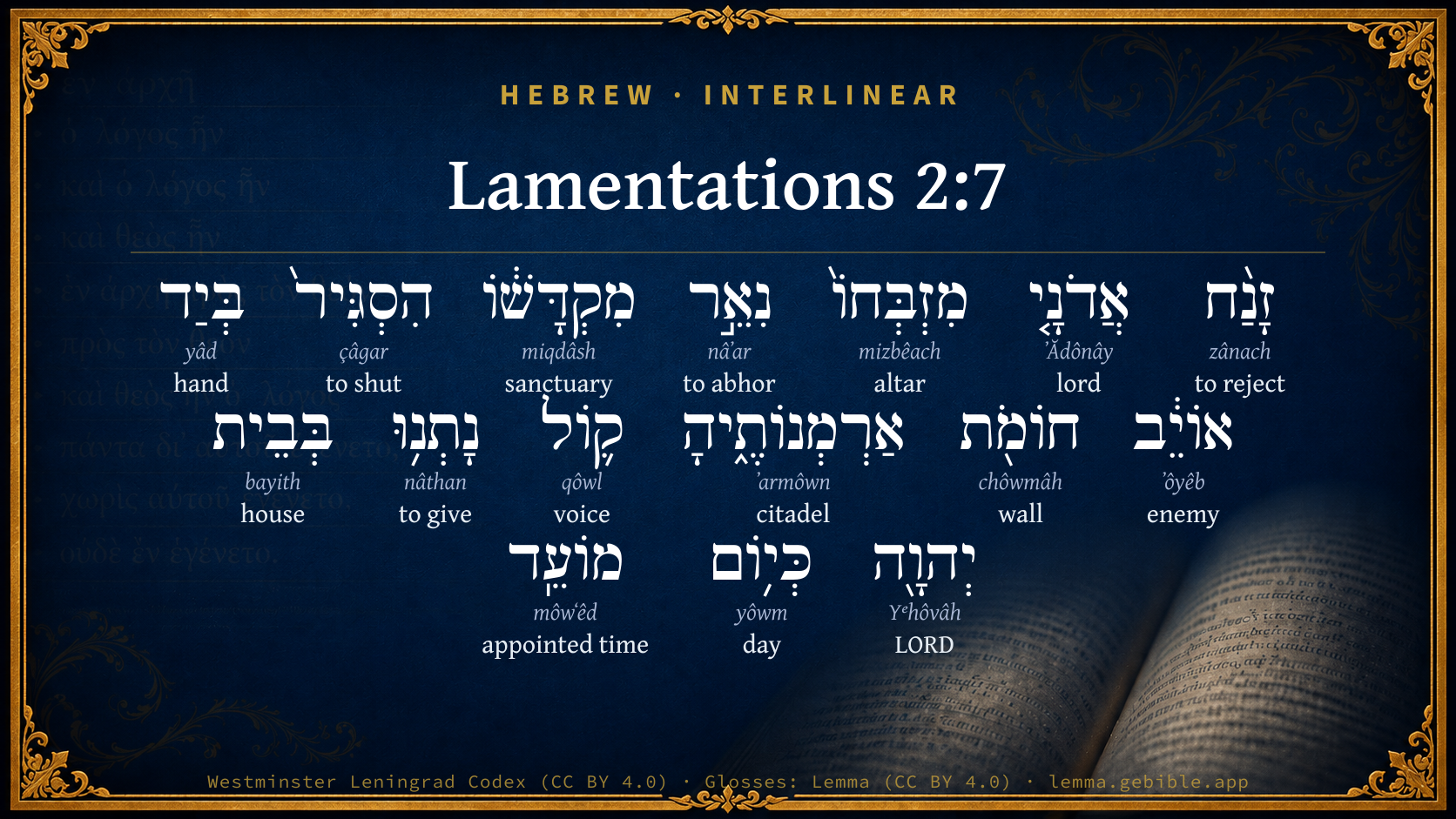
  1. זָנַ֨ח zânach H2186 “to reject” Verb, Qal, Perfect, 3rd Person, Masculine, Singular
  2. אֲדֹנָ֤י ʼĂdônây H136 “Lord · my” Noun, Common, Masculine, Plural, Construct + Suffix, Personal, 1st Person, Common, Singular
  3. מִזְבְּחוֹ֙ mizbêach H4196 “altar · his” Noun, Common, Masculine, Singular, Construct + Suffix, Personal, 3rd Person, Masculine, Singular
  4. מִקְדָּשׁ֔וֹ miqdâsh H4720 “sanctuary · his” Noun, Common, Masculine, Singular, Construct + Suffix, Personal, 3rd Person, Masculine, Singular
  5. הִסְגִּיר֙ çâgar H5462 “to shut” Verb, Hiphil, Perfect, 3rd Person, Masculine, Singular
  6. בְּיַד yâd H3027 “in/at · hand of” Preposition + Noun, Common, Both, Singular, Construct
  7. אוֹיֵ֔ב ʼôyêb H341 “enemy” Verb, Qal, Participle Active, Masculine, Singular, Absolute
  8. חוֹמֹ֖ת chôwmâh H2346 “walls of” Noun, Common, Feminine, Plural, Construct
  9. אַרְמְנוֹתֶ֑יהָ ʼarmôwn H759 “citadels · her” Noun, Common, Masculine, Plural, Construct + Suffix, Personal, 3rd Person, Feminine, Singular
  10. ק֛וֹל qôwl H6963 “voice” Noun, Common, Masculine, Singular, Absolute
  11. נָתְנ֥וּ nâthan H5414 “to give” Verb, Qal, Perfect, 3rd Person, Common, Plural
  12. בְּבֵית bayith H1004 “in/at · house of” Preposition + Noun, Common, Masculine, Singular, Construct
  13. יְהוָ֖ה Yᵉhôvâh H3068 “LORD” Noun, Proper
  14. כְּי֥וֹם yôwm H3117 “like/as · day of” Preposition + Noun, Common, Masculine, Singular, Construct
  15. מוֹעֵֽד môwʻêd H4150 “appointed time” Noun, Common, Masculine, Singular, Absolute

About this verse

These counts appear in no published source. They are computed here, from the morphology-tagged text and Lemma’s own curated glosses. What Lemma adds →

16
words
16
distinct lemmas
Prophets
section

Notable vocabulary

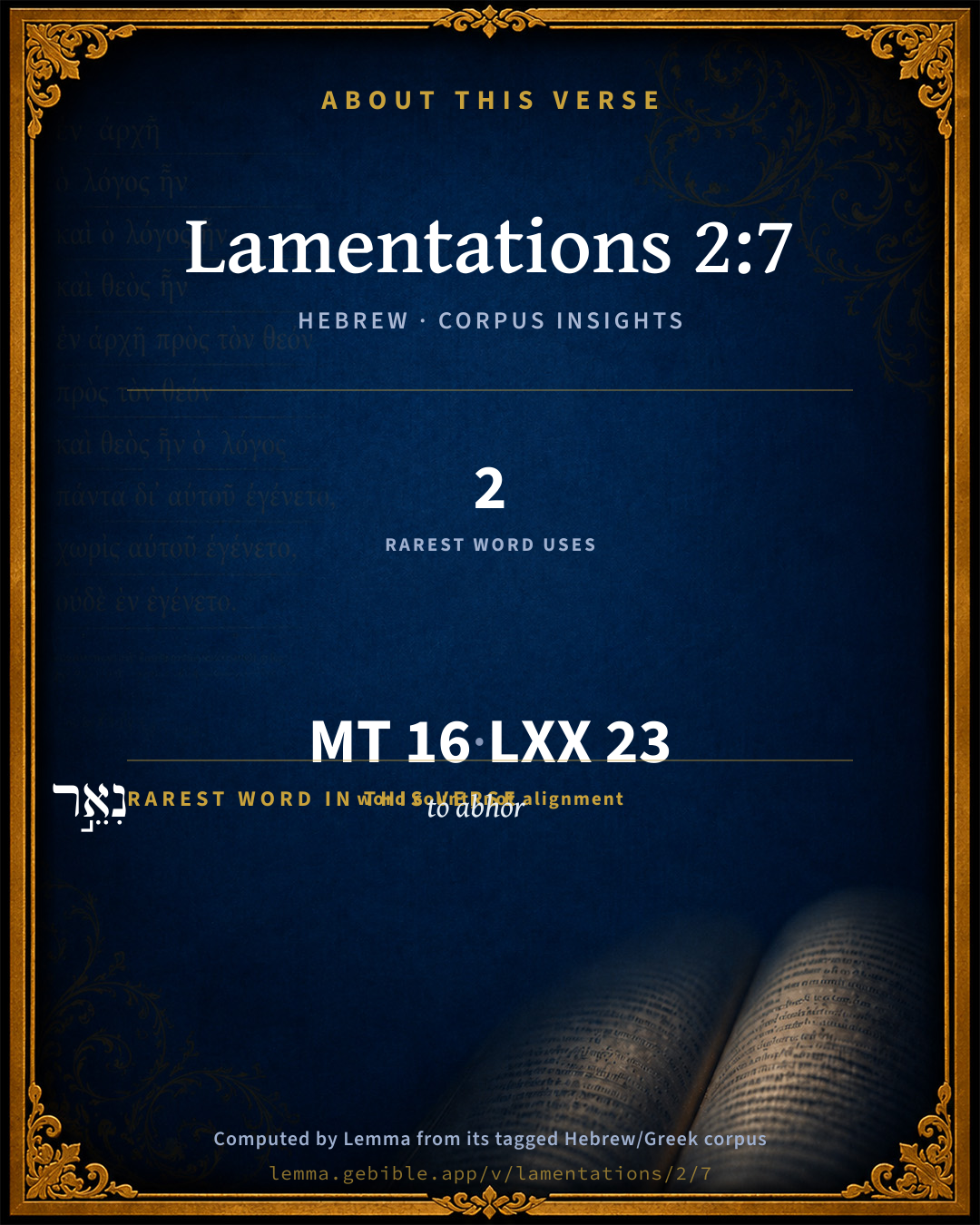
The rarest word here is נִאֵ֣ר to abhor H5010 — appearing just 2 times in the whole Hebrew Bible.

Shared distinctive vocabulary

נִאֵ֣ר to abhor H5010 occurs in 2 verses of the Hebrew Bible. Also found in:

Grammatical profile

  • 5 verbs
  • 11 nouns

Verb forms

  • זָנַ֨ח Qal · Perfect
  • נִאֵ֣ר Piel · Perfect
  • הִסְגִּיר֙ Hiphil · Perfect
  • אוֹיֵ֔ב Qal · Participle Active
  • נָתְנ֥וּ Qal · Perfect

Hebrew & Septuagint length

In English translation the verse runs 45 words from the Hebrew and 43 from the Septuagint (LXX English) — closely comparable.

A rough comparison of the two English renderings, which tokenize alike — not a word-level alignment.

Word counts can differ between the Hebrew and the Greek without any difference in meaning — e.g. the Hebrew direct-object marker אֵת has no separate Greek word, and Greek often adds the article ὁ.

In the original languages it is 16 Hebrew tokens and 23 Greek tokens — but the two are counted differently (Hebrew bundles its prefixes and suffixes into one token; the Greek is in lemma form), so that isn’t a like-for-like length.

Cross-references

23

Topical passages linked to Lamentations 2:7 in the Treasury of Scripture Knowledge — connected by theme and wording, ordered by reader-vote popularity; previews shown in the World English Bible.

  • Psalms 74:3–8 Lift up your feet to the perpetual ruins, All the evil that the enemy has done in the sanctuary.
  • Amos 2:5 But I will send a fire on Judah, And it will devour the palaces of Jerusalem."
  • Ezekiel 24:21 Speak to the house of Israel, Thus says the Lord Yahweh: Behold, I will profane my sanctuary, the pride of your power, the desire of your eyes, and that which your soul pities; and your sons and your daughters whom you have left behind shall fall by the sword.
  • Psalms 78:59–61 When God heard this, he was angry, And greatly abhorred Israel;
  • Jeremiah 52:13 and he burned the house of Yahweh, and the king's house; and all the houses of Jerusalem, even every great house, burned he with fire.
  • Ezekiel 7:20–22 As for the beauty of his ornament, he set it in majesty; but they made the images of their abominations [and] their detestable things therein: therefore have I made it to them as an unclean thing.
  • Leviticus 26:31 I will lay your cities waste, and will bring your sanctuaries to desolation, and I will not take delight in the sweet fragrence of your offerings.
  • Leviticus 26:44 Yet for all that, when they are in the land of their enemies, I will not reject them, neither will I abhor them, to destroy them utterly, and to break my covenant with them; for I am Yahweh their God;
  • 2 Chronicles 36:19 They burnt the house of God, and broke down the wall of Jerusalem, and burnt all the palaces of it with fire, and destroyed all the goodly vessels of it.
  • Psalms 72:4–20 He will judge the poor of the people. He will save the children of the needy, And will break the oppressor in pieces.
  • Isaiah 64:10–11 Your holy cities are become a wilderness, Zion is become a wilderness, Jerusalem a desolation.
  • Jeremiah 7:12–14 But go you now to my place which was in Shiloh, where I caused my name to dwell at the first, and see what I did to it for the wickedness of my people Israel.
  • Jeremiah 26:6 then will I make this house like Shiloh, and will make this city a curse to all the nations of the earth.
  • Jeremiah 26:18 Micah the Morashtite prophesied in the days of Hezekiah king of Judah; and he spoke to all the people of Judah, saying, Thus says Yahweh of Hosts: Zion shall be plowed as a field, and Jerusalem shall become heaps, and the mountain of the house as the high places of a forest.
  • Jeremiah 32:29 and the Chaldeans, who fight against this city, shall come and set this city on fire, and burn it, with the houses, on whose roofs they have offered incense to Baal, and poured out drink-offerings to other gods, to provoke me to anger.
  • Jeremiah 33:3–5 Call to me, and I will answer you, and will show you great things, and difficult, which you don't know.
  • Jeremiah 39:8 The Chaldeans burned the king's house, and the houses of the people, with fire, and broke down the walls of Jerusalem.
  • Lamentations 2:1 How has the Lord covered the daughter of Zion with a cloud in his anger! He has cast down from heaven to the earth the beauty of Israel, And hasn't remembered his footstool in the day of his anger.
  • Lamentations 2:5 The Lord is become as an enemy, he has swallowed up Israel; He has swallowed up all her palaces, he has destroyed his strongholds; He has multiplied in the daughter of Judah mourning and lamentation.
  • Ezekiel 7:24 Therefore I will bring the worst of the nations, and they shall possess their houses: I will also make the pride of the strong to cease; and their holy places shall be profaned.
  • Micah 3:12 Therefore Zion for your sake will be plowed like a field, And Jerusalem will become heaps of rubble, And the mountain of the temple like the high places of a forest.
  • Matthew 24:2 But he answered them, "Don't you see all of these things? Most assuredly I tell you, there will not be left here one stone on another, that will not be thrown down."
  • Acts 6:13–14 and set up false witnesses who said, "This man never stops speaking blasphemous words against this holy place and the law.

Cross-references courtesy of OpenBible.info (CC BY 4.0).

Hebrew and Greek witnesses Masoretic Hebrew ↔ Greek Septuagint

The same verse in the two great witnesses to the Old Testament, shown verse-for-verse.

These are two independent witnesses, not word-aligned to each other, and the Septuagint is shown in lemma (dictionary) form.

Hebrew Lamentations 2:7 Masoretic · Westminster Leningrad Codex

זָנַ֨ח אֲדֹנָ֤י מִזְבְּחוֹ֙ נִאֵ֣ר מִקְדָּשׁ֔וֹ הִסְגִּיר֙ בְּיַד אוֹיֵ֔ב חוֹמֹ֖ת אַרְמְנוֹתֶ֑יהָ ק֛וֹל נָתְנ֥וּ בְּבֵית יְהוָ֖ה כְּי֥וֹם מוֹעֵֽד

The Lord has cast off his altar, he has abhorred his sanctuary; He has given up into the hand of the enemy the walls of her palaces: They have made a noise in the house of Yahweh, as in the day of a solemn assembly.

World English Bible · Public Domain

Greek LXX Lamentations 2:7 Septuagint · lemma form

ἀποὠθέω κύριος θυσιαστήριον αὐτός ἀποτινάσσω ἁγίασμα αὐτός συντρίβω ἐν χείρ ἐχθρός τεῖχος βάρις αὐτός φωνή δίδωμι ἐν οἶκος κύριος ὡς ἐν ἡμέρα ἑορτή

ZAIN. The Lord has rejected his altar, he has cast off his sanctuary, he has broken by the hand of the enemy the wall of her palaces; they have uttered their voice in the house of the Lord as on a feast day.

LXX2012 (modern English Septuagint) · Public Domain

On this verse, Haydock's Catholic Bible Commentary discusses the Septuagint’s reading. Read the note in Commentary ↓

Hebrew: Westminster Leningrad Codex (CC BY 4.0). Greek: Septuagint (public domain); English from LXX2012 (modern English Septuagint) (Public Domain). How the Septuagint differs from the Hebrew →

Commentary

Notes on Lamentations 2:7 from classic Christian and Jewish commentators (each source and its license shown beneath its notes). The classic Christian expositions comment on the surrounding passage and are grouped to its opening verse, so a note may address several verses; the Jewish commentaries on the Tanakh (Rashi and others) are per-verse, so they appear only where the commentator wrote on this verse.

Lemma curates 59 commentaries, every one of them public domain or Creative Commons licensed, each selected and text-cleaned for this edition rather than reprinted as found. About our sources →

Trapp's Complete Commentary

John Trapp

Lam 2:7 The Lord hath cast off his altar, he hath abhorred his sanctuary, he hath given up into the hand of the enemy the walls of her palaces; they have made a noise in the house of the LORD, as in the day of a solemn feast.

Ver. 7. The Lord hath cast off his altar.] She goeth over it again, as the main matter of her grief, that she was bereft of the outward exercises of religion. His altar God had cast into a corner, as that which was an eyesore to him; his sanctuary he abhorred or dissolved, &c. Longe fecit, procul removit a se quasi rem odiosam, sibi ingratam et molestam.

They have made a noise in the house of the Lord.] Where God was wont to be praised with heart and voice, now the enemies reboate and roar out Io triumphe, Io Paean, Victoria, All is our own.

John Trapp, A Commentary or Exposition upon All the Books of the Old and New Testament (1647–1656) — public domain. Text from a community e-Sword module.

Tyndale Open Study Notes

Tyndale Open Resources

2:7 The Temple was destroyed because the sins that the priests and the people had committed within its walls had defiled its holiness (cp. Jer 7:3-15; 26:3-6, 12-13; Ezek 24:21).

Tyndale Open Study Notes — © Tyndale Open Resources, licensed CC BY-SA 4.0. Text via the HelloAO Bible API.

Geneva Bible (1599)

Geneva Bible translators

As the people were accustomed to praise God to the solemn feasts with a loud voice, so now the enemies blaspheme him with shouting and cry.

Geneva Bible (1599) marginal notes — public domain. Text via Bolls.life.

Jamieson, Fausset & Brown

Robert Jamieson, A. R. Fausset & David Brown

they . . . made a noise in . . . house of . . . Lord, as in . . . feast--The foe's shout of triumph in the captured temple bore a resemblance (but oh, how sad a contrast as to the occasion of it!) to the joyous thanksgivings we used to offer in the same place at our "solemn feasts" (compare Lam 2:22).

Jamieson, Fausset & Brown — Commentary Critical and Explanatory on the Whole Bible (1871) — public domain (CC PDM 1.0). Text via the HelloAO Bible API.

Adam Clarke's Commentary

Verse 7. They have made a noise in the house of the Lord] Instead of the silver trumpets of the sanctuary, nothing but the sounds of warlike instruments are to be heard.

Adam Clarke's Commentary on the Bible (1810–1826) — public domain. Text from a community e-Sword/MySword module.

John Calvin's Commentaries

He proceeds with the same subject, and adopts similar words. He says first, that God had abominated his altar; an expression not strictly proper, but the Prophet could not otherwise fully shew to the Jews what they deserved; for had he only spoken of the city, of the lands, of the palaces, of the vineyards, and, in short, of all their possessions, it would have been a much lighter matter; but when he says that God had counted as nothing all their sacred things, — the altar, the Temple, the ark of the covenant, and festive days, — when, therefore, he says, that God had not only disregarded, but had also cast away from him these things, which yet especially availed to conciliate his favor, the people must have hence perceived, except they were beyond measure stupid, how grievously they had provoked God’s wrath against themselves; for this was the same as though heaven and earth were blended together. Had there been an upsetting of all things, had the sun left its place and sunk into darkness, had the earth heaved upwards, the confusion would have hardly been more dreadful, than when God put forth thus his hand against the sanctuary, the altar, the festal days, and all their sacred things. But we must refer to the reason why this was done, even because the Temple had been long polluted by the iniquities of the people, and because all sacred things had been wickedly and disgracefully profaned. We now, then, understand the reason why the Prophet enlarged so much on a subject in itself sufficiently plain.

He afterwards adds, He hath delivered all the palaces, etc.; as though he had said, that the city had not been taken by the valor of enemies, but that the Chaldeans had fought under the authority and banner of God. He, in short, intimates that the Jews had miserably perished, because they perished through their own fault; and that the Chaldeans had proved victorious in battle, and had taken the city, not through their own courage or skill, but because God had resolved to punish that ungodly and wicked people.

It follows in the last place, that the enemies had made a noise in the temple of God as in the day of solemnity. Here also the Prophet shews, that God would have never suffered the enemies insolently to exult and to revel in the very Temple, had not the Israelites deserved all this; for the insolence of their enemies was not unknown to God, and he might have easily checked it if he pleased. Why, then, did he grant so much license to these profane enemies? even because the Jews themselves had previously polluted the Temple, so that he abhorred all their solemn assemblies, as also he declares by Isaiah, that he detested their festivals, Sabbaths, and new moons. (Isaiah 1:13, 14.) But it was a shocking change, when enemies entered the place which God had consecrated for himself, and there insolently boasted and uttered base and wicked calumnies against God! But the sadder the spectacle, the more detestable appeared the impiety of the people, which had been the cause of so great evils. For we ought ever to remember what I have often stated, that these circumstances were noticed by the Prophet, that the people might at length acknowledge themselves guilty as to all these evils, which they would have otherwise ascribed to the Chaldeans. That, then, the Chaldeans polluted the Temple, that they trod under foot all sacred things, all this the Prophet shews was to be ascribed to the Jews themselves, who had, through their own conduct, opened the Temple to the Chaldeans, who had exposed all sacred things to their will and pleasure. It follows, —

John Calvin's Commentaries (1540-1563) — public domain. Text from the Calvin Translation Society English edition (1840s-50s) via the Christian Classics Ethereal Library (ccel.org). Calvin's coverage is partial (roughly two-thirds of the Bible); uncommented books and verses are honest gaps, never fabricated. The 19th-century editor's footnotes and remarks are omitted so the notes are faithfully Calvin's own voice.

Ellicott's Commentary for English Readers

(7) Hath cast off . . . hath abhorred.—The two verbs are used in a like context in Psa_89:38.

His sanctuary.—The word points to the Holy of Holies, and “the walls of her palaces” are therefore those of the Temple rather than of the city.

They have made a noise.—The shouts of the enemies in their triumph, perhaps even the shouts of their worship, had taken the place of the hallelujahs of the “solemn feast.”

A Bible Commentary for English Readers, edited by Charles John Ellicott (1878–1897) — public domain. Text from a community e-Sword module.

The Cambridge Bible for Schools and Colleges

gen. ed. J. J. S. Perowne

7. her palaces] As this word is nowhere else applied to the Temple, it seems best (though parallelism of clauses suggests otherwise) to give the expression its natural sense, as in Lam_2:5. Although the text seems to have suffered some corruption, no correction that can claim to be self-evident has appeared.

a noise] the exultant uproar of the enemy’s triumphant soldiery is likened to the tumultuous character belonging to primitive Semitic and other cults. See W. R. Smith (Religion of the Semites, 1894, p. 261), who deduces from this v. that “even at Jerusalem the worship must have been boisterous indeed.” The Targ. identifies it with the sound made in praying at the passover. The v. implies that the writer is of an age to be familiar with pre-exilic worship.

The Cambridge Bible for Schools and Colleges (gen. ed. J. J. S. Perowne; Cambridge University Press, 1878–1918) — public domain. Text from a community e-Sword module.

John Gill's Exposition

The Lord hath cast off his altar,.... Whether of incense, or of burnt offerings; the sacrifices of which used to be acceptable to him; but now the altar being cast down and demolished, there were no more offerings; nor did he show any desire of them, but the reverse:

he hath abhorred his sanctuary; the temple; by suffering it to be profaned, pulled down, and burnt, it looked as if he had an abhorrence of it, and the service in it; as he had, as it was performed without faith in Christ, love to him, or any view to his glory; see Isa 1:13;

he hath given up into the hand of the enemy the walls of her palaces; both the walls of the sanctuary, and the walls of the houses of the kin, and princes; especially thee former are meant, both by what goes before and follows:

they have made a noise in the house of the Lord, as in the day of a solemn feast; that is the enemy, the Chaldeans, made a noise in the temple, blaspheming God, that had dwelt in it; insulting over the people of God, that had worshipped there; rejoicing in their victories over them; singing their "paeans" to their gods, and other profane songs; indulging themselves in revelling and rioting; making as great a noise with their shouts and songs as the priests, Levites, and people of Israel did, when they sung the songs of Zion on a festival day. The Targum is,

"as the voice of the people of the house of Israel, that prayed in the midst of it in the day of the passover.''

John Gill's Exposition of the Whole Bible (1746–1763) — public domain (CC PDM 1.0). Text via the HelloAO Bible API.

Albert Barnes' Notes on the Bible

sanctuary - The holy of holies; “the walls of her palaces” are those of the sacred buildings.

Albert Barnes' Notes on the Bible (1834–1885) — public domain. Text from a community e-Sword/MySword module.

Haydock's Catholic Bible Commentary

Cursed, or suffered it to be polluted, (Worthington) as he looked on it with horror, after it had been profaned by Achaz, &c. --- Towers. Septuagint, "palaces;" Greek: bareon. --- Feast. What a contrast! The temple used to resound with songs of praise and music: the Chaldeans fill it with insolent shouts of victory.

George Leo Haydock (1774–1849), Haydock's Catholic Family Bible and Commentary, 1859 edition — public domain. Excludes Psalms (Douay-Rheims chapter numbering differs from Protestant) and Deuterocanonical books (Catholic canon only).

Matthew Poole's English Annotations

By

altar and

sanctuary seemeth not to be meant strictly here the places or buildings so called, which are said to be the Lord’s, because he directed the making of them, and they were dedicated to his service, and used for no other use; but the stated worship and communion of the church of the Jews; as altar is taken, 1Co 10:18. God, by his suffering the place to be destroyed where alone they might sacrifice, seemed to have abhorred his own institutions, as it is said, The prayers of the wicked are an abomination to the Lord. He saith the Lord also had destroyed the most stately of their civil edifices; and the enemies, with their triumphs and blasphemies, had made as great noise, to the reproach and dishonour of God, as before those that sang holy songs, or played on instruments, were wont to make in the temple to the honour and glory of God.

Matthew Poole's English Annotations on the Holy Bible (1683–1685) — public domain. Text from a community e-Sword/MySword module.

Whedon's Commentary on the Bible

Daniel D. Whedon

7. Altar… sanctuary… walls of her palaces — These are parts of the house of the Lord. The noise which the enemy makes therein is the shout of triumph and exultation.

Daniel D. Whedon (gen. ed.), Commentary on the Old and New Testaments (1874–1909) — public domain. Text from a community e-Sword module.

The Pulpit Commentary

Her palaces; i.e. those of the daughter of Zion, especially "high buildings" (this is the true meaning of armon) of the temple. They have made a noise, etc. Comp. Psa_74:3, "Thine enemies roar in the midst of thy place of meeting." The passages are parallel, though, whether the calamities referred to are the same in both, cannot a priori be determined. The shouts of triumph of the foe are likened to the festal shouts of the temple worshippers. (comp. Isa_30:29 Amo_5:24)

The Pulpit Commentary (1880–1919), ed. H.D.M. Spence-Jones & Joseph S. Exell — public domain. Text from a community e-Sword module.

John Wesley's Explanatory Notes

They - The enemies with their triumphs and blasphemies, made as great a noise, as those that sang holy songs, or played on instruments, were wont to make to the glory of God.

John Wesley, Explanatory Notes Upon the Whole Bible (1754–1765) — public domain. Text via the GEBible commentary corpus.

unfoldingWord translationNotes

Door43 World Missions Community

He has given over the walls of her palaces into the hand of the enemy

Here the enemy's "hand" refers to the enemy's control. AT: "He has allowed the enemy to capture the walls of her palaces" (See: Metonymy)

the walls of her palaces

Here the word "her" may refer either to the temple or to Jersualem. Possible translations are 1) "the walls of the temple" or 2) "the walls of Jerusalem's palaces." The word "walls" is a synecdoche for the whole building, and the building is a synecdoche for all of Jerusalem. (See: Synecdoche)

They have raised a shout in the house of Yahweh, as on the day of an appointed feast

This is an ironic comparison between the happy, noisy festivals of Israel and the loud shouts of victory of the Babylonians. AT: "They have raised a shout in the house of Yahweh, as the Israelites would during an appointed feast" (See: Irony)

have raised a shout

This is an idiom. AT: "have shouted victoriously" (See: Idiom)

translationWords

lord

reject

altar

sanctuary

hand

house of God

unfoldingWord translationNotes — © Distant Shores Media and the Door43 World Missions Community, licensed CC BY-SA 4.0. Source: git.door43.org/Door43/en_tn.

Rashi

Rabbi Shlomo Yitzchaki (Rashi)

He has abolished Heb. נִאֵר, and so, (Ps. 89:40): “You abrogated (נֵאַרְתָּה) the covenant of Your servant.”

as on a day of a festival For they were making merry and singing in its midst with a loud voice. So did the enemies let out a cry of joy when it was destroyed.

Rashi on the Tanakh — English translations: “The Judaica Press complete Tanach with Rashi, translated by A. J. Rosenberg” (CC BY 4.0); “Pentateuch with Rashi's commentary by M. Rosenbaum and A.M. Silbermann, 1929-1934” (public domain); “The Metsudah Tanach series, Lakewood, N.J” (CC BY 4.0); and “The Book of Joshua, Metsudah Publications, 1997” (CC BY 4.0). Text via Sefaria.

Lesson kit

Teaching starters — assembled from the data on this page, not authored interpretation. Every prompt links to the verse data it draws on. Edit before teaching.

Lamentations, in the Prophets, opens this verse with 16 words (16 distinct Hebrew lemmas). Its most distinctive word is nâʼar (“to abhor”). A historical commentator’s framing appears above. Read the whole chapter for the surrounding context.

Discussion questions

  1. How does “to abhor” (nâʼar) shape what this verse is saying?
  2. Psalms 89:39 shares the word «to abhor» with this verse. How do the two illuminate each other?
  3. These translations render this verse differently. What is at stake in choosing one wording over another?
  4. The verb «זָנַ֨ח» is Qal Perfect. How does its form color the action?
  5. Reading how Trapp's Complete Commentary and Tyndale Open Study Notes read this verse, where do the two commentators agree and where do they part?

Things to notice

Reading settings

Reading text

Shown beneath each verse's original-language words.

Old Testament
Old Testament edition

Read the OT as the Masoretic Hebrew (MT) or the Greek Septuagint (LXX).

English shown for the Greek Septuagint (in the Hebrew ↔ Greek comparison).

Comparing translations? Open the Compare panel on any verse page to stack up to four side by side.