
2 Kings 10:6

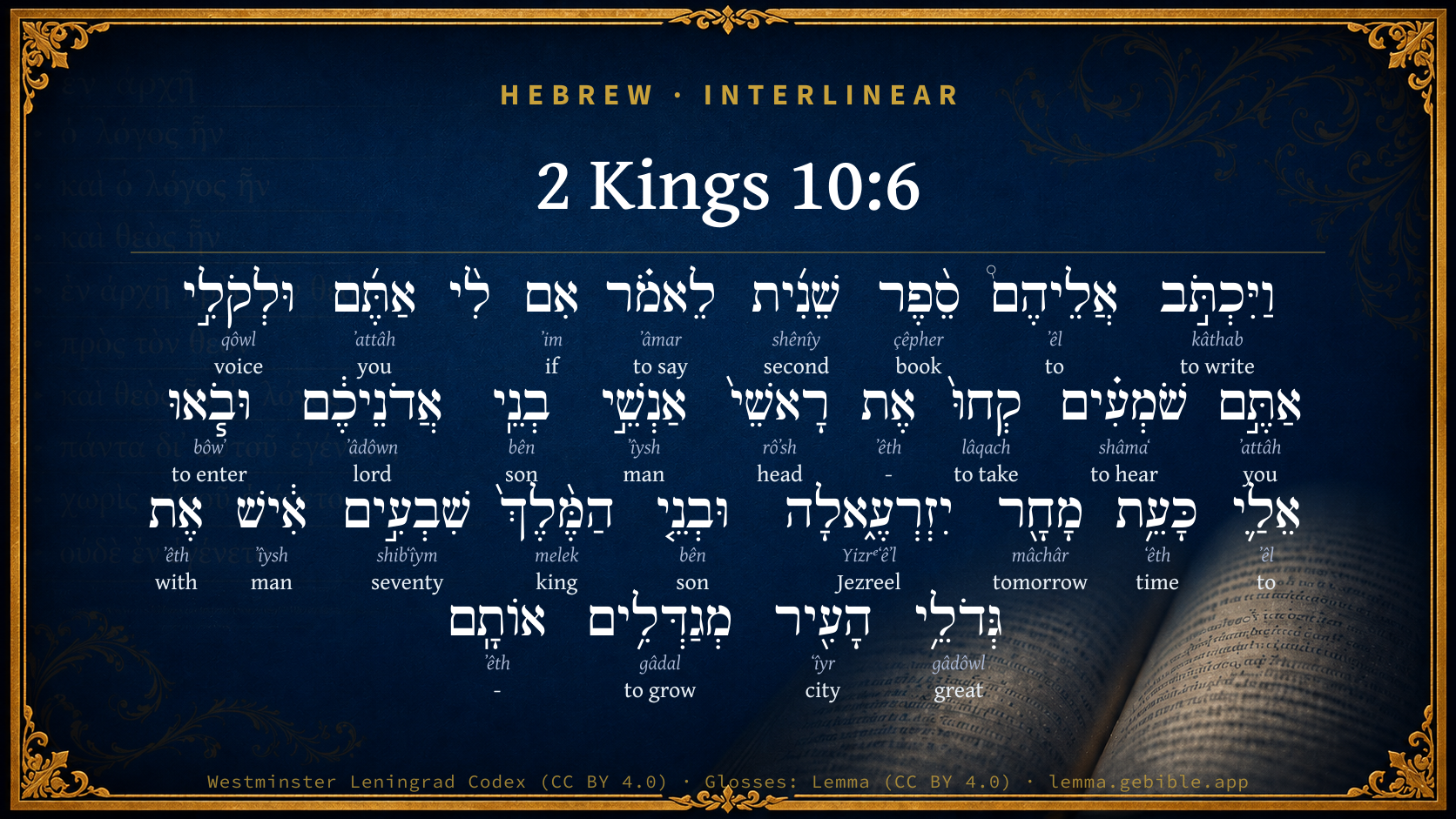
Hebrew (Westminster Leningrad Codex) 2 Kings 10:6 appears in the Hebrew Old Testament. The text above is from the Westminster Leningrad Codex. Each word links to its Strong’s number, a concise gloss, and parsing drawn from the Open Scriptures Hebrew Bible morphology. Click any word for its full Brown-Driver-Briggs (BDB) entry.
Download image
Cite this verse

2 Kings 10:6 (World English Bible). Public Domain. Lemma interlinear Bible study tool, https://lemma.gebible.app/v/2-kings/10/6.

Show BibTeX & RIS
BibTeX
RIS
English Translation
Then he wrote a letter the second time to them, saying, If you be on my side, and if you will listen to my voice, take the heads of the men your master's sons, and come to me to Jezreel by tomorrow this time. Now the king's sons, being seventy persons, were with the great men of the city, who brought them up.
World English Bible · Public Domain
Download a study sheet

One document with this verse’s original text, its word-by-word gloss line, the meaning frame, cross-references with their text, attributed commentary, and full source and license credits — printable, and it pastes into notes with its structure intact.

This verse Autodidact and up

Study sheet (.html) Plain text (.txt)

A passage Seminary Student

Up to 50 verses in one chapter. A passage sheet keeps up to 6 commentary sources and 12 cross-references per verse, in the order this page ranks them, and says so on the sheet whenever that leaves anything out. Ask for a single verse and you get the Autodidact verse sheet above.

Everything on this page stays free to read, with no account — the sheet is a download of what is already on screen, not access to it.

Want to remove ads? Support Godless Engineer
Compare translations 3

The same verse in 3 English versions, stacked beneath the original-language interlinear above. Click any original word for its lexicon entry.

Each is an independent rendering of the whole verse — the interlinear is not word-aligned to these translations.

Highlighted words mark where these versions differ — a whole-verse word diff, not a word-by-word alignment.

  • World English Bible Public Domain
    Then he wrote a letter the second time to them, saying, If you be on my side, and if you will listen to my voice, take the heads of the men your master's sons, and come to me to Jezreel by tomorrow this time. Now the king's sons, being seventy persons, were with the great men of the city, who brought them up.
  • King James Version Public Domain
    Then he wrote a letter the second time to them, saying, If ye be mine, and if ye will hearken unto my voice, take ye the heads of the men your master's sons, and come to me to Jezreel by to morrow this time. Now the king's sons, being seventy persons, were with the great men of the city, which brought them up.
  • unfoldingWord Literal Text CC BY-SA 4.0
    And he wrote a second letter to them, saying, “If you for me and you are listening to my voice, take the heads of the men of the sons of your master and come to me at time tomorrow in Jezreel.” Now the sons of the king 70 men, with the great of the city raising them.

unfoldingWord Literal Text — © unfoldingWord, licensed CC BY-SA 4.0. Word-aligned USFM3 via Door43 (git.door43.org/unfoldingWord/en_ult).

Versions to compare (up to 4)

3 of 4 selected

Show all 18 translations

Every available English version of this verse, each an independent rendering of the whole verse.

  • World English Bible Public Domain
    Then he wrote a letter the second time to them, saying, If you be on my side, and if you will listen to my voice, take the heads of the men your master's sons, and come to me to Jezreel by tomorrow this time. Now the king's sons, being seventy persons, were with the great men of the city, who brought them up.
  • Berean Standard Bible Public Domain
    Then Jehu wrote them a second letter and said: “If you are on my side, and if you will obey me, then bring the heads of your master’s sons to me at Jezreel by this time tomorrow.” Now the sons of the king, seventy in all, were being brought up by the leading men of the city.
  • Majority Standard Bible Public Domain
    Then Jehu wrote them a second letter and said: “If you are on my side, and if you will obey me, then bring the heads of your master’s sons to me at Jezreel by this time tomorrow.” Now the sons of the king, seventy in all, were being brought up by the leading men of the city.
  • King James Version Public Domain
    Then he wrote a letter the second time to them, saying, If ye be mine, and if ye will hearken unto my voice, take ye the heads of the men your master's sons, and come to me to Jezreel by to morrow this time. Now the king's sons, being seventy persons, were with the great men of the city, which brought them up.
  • American Standard Version (1901) Public Domain
    Then he wrote a letter the second time to them, saying, If ye be on my side, and if ye will hearken unto my voice, take ye the heads of the men your master's sons, and come to me to Jezreel by to-morrow this time. Now the king's sons, being seventy persons, were with the great men of the city, who brought them up.
  • Revised Version (1885) Public Domain
    Then he wrote a letter the second time to them, saying, If ye be on my side, and if ye will hearken unto my voice, take ye the heads of the men your master’s sons, and come to me to Jezreel by tomorrow this time. Now the king’s sons, being seventy persons, were with the great men of the city, which brought them up.
  • Geneva Bible (1599) Public Domain
    Then he wrote another letter to them, saying, If ye be mine, and wil obey my voyce, take the heads of ye men that are your masters sonnes, and come to me to Izreel by to morowe this time. (Nowe the Kings sonnes, euen seuentie persons were with the great men of the citie, which brought them vp)
  • Douay-Rheims (1899) Public Domain
    And he wrote letters the second time to them, saying: If you be mine, and will obey me, take the heads of the sons of your master, and come to me to Jezrahel by to morrow this time. Now the king's sons, being seventy men, were brought up with the chief men of the city.
  • Young's Literal Translation Public Domain
    And he writeth unto them a letter a second time, saying, `If ye `are' for me, and to my voice are hearkening, take the heads of the men -- the sons of your lord, and come unto me about this time to-morrow, to Jezreel;' and the sons of the king `are' seventy men, with the great ones of the city those bringing them up.
  • Literal Standard Version CC BY-SA 4.0
    And he writes a letter to them a second time, saying, “If you [are] for me, and are listening to my voice, take the heads of the men—the sons of your lord, and come to me about this time tomorrow, to Jezreel”; and the sons of the king [are] seventy men, with the great ones of the city—those bringing them up.
  • Unlocked Literal Bible CC BY-SA 4.0
    Then Jehu wrote a letter the second time to them, saying, “If you are on my side, and if you will listen to my voice, you must take the heads of the men of your master's descendants, and come to me to Jezreel by tomorrow this time.” Now the king's descendants, seventy in number, were with the important men of the city, who were bringing them up.
  • unfoldingWord Literal Text CC BY-SA 4.0
    And he wrote a second letter to them, saying, “If you for me and you are listening to my voice, take the heads of the men of the sons of your master and come to me at time tomorrow in Jezreel.” Now the sons of the king 70 men, with the great of the city raising them.
  • Darby Bible Public Domain
    And he wrote a letter the second time to them saying, If ye are mine, and will hearken to my voice, take the heads of the men your master's sons, and come to me to Jizreel to-morrow at this time. Now the king's sons, seventy persons, were with the great men of the city, who brought them up.
  • World Messianic Bible Public Domain
    Then he wrote a letter the second time to them, saying, “If you are on my side, and if you will listen to my voice, take the heads of the men who are your master’s sons, and come to me to Jezreel by tomorrow this time.” Now the king’s sons, being seventy persons, were with the great men of the city, who brought them up.
  • Webster's Bible Public Domain
    Then he wrote a letter the second time to them, saying, if ye are mine, and if ye will hearken to my voice, take ye the heads of the men your master's sons, and come to me to Jezreel by to-morrow this time. Now the king's sons being seventy persons, were with the great men of the city, who brought them up.
  • Free Bible Version CC BY-SA 4.0
    Then Jehu wrote them a second letter, saying, “If you are on my side, and if you are going to obey what I say, bring the heads of your master's sons to me in Jezreel by this time tomorrow.” The seventy king's sons were being raised by the leading men of the city.
  • Bible in Basic English Public Domain
    Then he sent them a second letter, saying, If you are on my side, and if you will do my orders, come to me at Jezreel by this time tomorrow, with the heads of your master's sons. Now the king's seventy sons were with the great men of the town, who had the care of them.
  • JPS Tanakh (1917) Public Domain
    Then he wrote a letter the second time to them, saying: 'If ye be on my side, and if ye will hearken unto my voice, take ye the heads of the men your master's sons, and come to me to Jezreel by to-morrow this time.' Now the king's sons, being seventy persons, were with the great men of the city, who brought them up.

Literal Standard Version (2020), Covenant Press — licensed CC BY-SA 4.0. Text via the HelloAO Bible API (eBible.org). Unlocked Literal Bible (unfoldingWord) — licensed CC BY-SA 4.0. Text via the HelloAO Bible API (eBible.org). unfoldingWord Literal Text — © unfoldingWord, licensed CC BY-SA 4.0. Word-aligned USFM3 via Door43 (git.door43.org/unfoldingWord/en_ult). Free Bible Version, Dr. Jonathan Gallagher — licensed CC BY-SA 4.0. Text via the HelloAO Bible API (eBible.org).

Word by word

More ways to search: Search by grammar → Find every occurrence → Compare this word →

Practice this passage: Drill this verse → Learn its vocabulary →

יִזְרְעֶ֑אלָה
Yizrᵉʻêʼl
H3157
“Jezreel · toward”
Noun, Proper + Suffix, Demonstrative
Part of Speech
Noun
Type
Proper
Full BDB Definition

Origin: from H2232 and H410

TWOT: None

Jezreel = "God sows" - a descendant of the father or founder of Etam of Judah (noun proper masculine) - first son of Hosea the prophet (noun proper masculine) - a city in the Nekeb of Judah (noun proper locative) - a city in Issachar on the northwest spur of Mount Gilboa (noun proper locative)
  1. וַיִּכְתֹּ֣ב kâthab H3789 “and · to write” Conjunction + Verb, Qal, Sequential Imperfect, 3rd Person, Masculine, Singular
  2. אֲלֵיהֶם֩ ʼêl H413 “to · them” Preposition + Suffix, Personal, 3rd Person, Masculine, Plural
  3. סֵ֨פֶר çêpher H5612 “book” Noun, Common, Masculine, Singular, Absolute
  4. שֵׁנִ֜ית shênîy H8145 “second” Adjective, Ordinal number, Feminine, Singular, Absolute
  5. לֵאמֹ֗ר ʼâmar H559 “to say” Preposition + Verb, Qal, Infinitive Construct
  6. אִם ʼim H518 “if” Conjunction
  7. אַתֶּ֜ם ʼattâh H859 “you” Pronoun, Personal, 2nd Person, Masculine, Plural
  8. וּלְקֹלִ֣י qôwl H6963 “and · to/for · voice · my” Conjunction + Preposition + Noun, Common, Masculine, Singular, Construct + Suffix, Personal, 1st Person, Common, Singular
  9. אַתֶּ֣ם ʼattâh H859 “you” Pronoun, Personal, 2nd Person, Masculine, Plural
  10. שֹׁמְעִ֗ים shâmaʻ H8085 “hearing” Verb, Qal, Participle Active, Masculine, Plural, Absolute
  11. קְחוּ֙ lâqach H3947 “take” Verb, Qal, Imperative, 2nd Person, Masculine, Plural
  12. אֶת ʼêth H853 “-” Particle, Direct Object
  13. רָאשֵׁי֙ rôʼsh H7218 “heads of” Noun, Common, Masculine, Plural, Construct
  14. אַנְשֵׁ֣י ʼîysh H376 “men of” Noun, Common, Masculine, Plural, Construct
  15. בְנֵֽי bên H1121 “sons of” Noun, Common, Masculine, Plural, Construct
  16. אֲדֹנֵיכֶ֔ם ʼâdôwn H113 “lords · your” Noun, Common, Masculine, Plural, Construct + Suffix, Personal, 2nd Person, Masculine, Plural
  17. וּבֹ֧אוּ bôwʼ H935 “and · enter” Conjunction + Verb, Qal, Imperative, 2nd Person, Masculine, Plural
  18. אֵלַ֛י ʼêl H413 “to · me” Preposition + Suffix, Personal, 1st Person, Common, Singular
  19. כָּעֵ֥ת ʻêth H6256 “like/as the · time” Preposition, Determined + Noun, Common, Both, Singular, Absolute
  20. מָחָ֖ר mâchâr H4279 “tomorrow” Noun, Common, Masculine, Singular, Absolute
  21. וּבְנֵ֤י bên H1121 “and · sons of” Conjunction + Noun, Common, Masculine, Plural, Construct
  22. הַמֶּ֨לֶךְ֙ melek H4428 “the · king” Particle, Definite Article + Noun, Common, Masculine, Singular, Absolute
  23. שִׁבְעִ֣ים shibʻîym H7657 “seventy” Adjective, Cardinal number, Both, Plural, Absolute
  24. אִ֔ישׁ ʼîysh H376 “man” Noun, Common, Masculine, Singular, Absolute
  25. אֶת ʼêth H854 “with” Preposition
  26. גְּדֹלֵ֥י gâdôwl H1419 “great of” Adjective, Adjective, Masculine, Plural, Construct
  27. הָעִ֖יר ʻîyr H5892 “the · city” Particle, Definite Article + Noun, Common, Feminine, Singular, Absolute
  28. מְגַדְּלִ֥ים gâdal H1431 “growing” Verb, Piel, Participle Active, Masculine, Plural, Absolute
  29. אוֹתָֽם ʼêth H853 “- · them” Particle, Direct Object + Suffix, Personal, 3rd Person, Masculine, Plural

About this verse

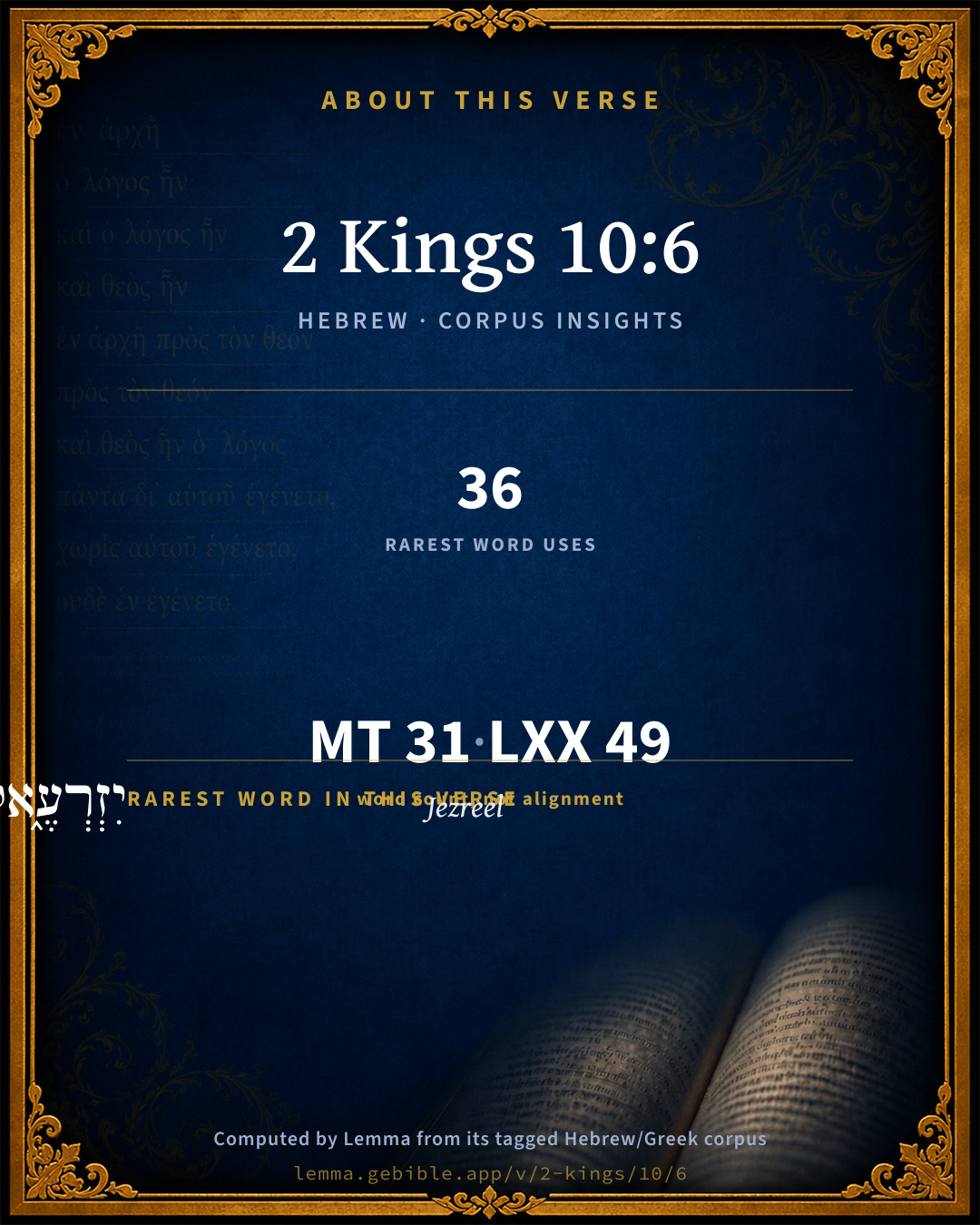
These counts appear in no published source. They are computed here, from the morphology-tagged text and Lemma’s own curated glosses. What Lemma adds →

31
words
25
distinct lemmas
Historical
section

Shared distinctive vocabulary

יִזְרְעֶ֑אלָה Jezreel H3157 occurs in 32 verses of the Hebrew Bible. Also found in:

Grammatical profile

  • 6 verbs
  • 13 nouns
  • 3 adjectives
  • 2 pronouns
  • 4 prepositions
  • 1 conjunction
  • 2 particles

Verb forms

  • וַיִּכְתֹּ֣ב Qal · Sequential Imperfect
  • לֵאמֹ֗ר Qal · Infinitive Construct
  • שֹׁמְעִ֗ים Qal · Participle Active
  • קְחוּ֙ Qal · Imperative
  • וּבֹ֧אוּ Qal · Imperative
  • מְגַדְּלִ֥ים Piel · Participle Active

Repetition

Words recur within this verse — often emphatic in Hebrew:

  • אַנְשֵׁ֣י man H376 ×2
  • בְנֵֽי son H1121 ×2
  • אֲלֵיהֶם֩ to H413 ×2
  • אַתֶּ֜ם you H859 ×2

Hebrew & Septuagint length

In English translation the verse runs 63 words from the Hebrew and 56 from the Septuagint (LXX English) — closely comparable.

A rough comparison of the two English renderings, which tokenize alike — not a word-level alignment.

Word counts can differ between the Hebrew and the Greek without any difference in meaning — e.g. the Hebrew direct-object marker אֵת has no separate Greek word, and Greek often adds the article ὁ.

In the original languages it is 31 Hebrew tokens and 49 Greek tokens — but the two are counted differently (Hebrew bundles its prefixes and suffixes into one token; the Greek is in lemma form), so that isn’t a like-for-like length.

Cross-references

10

Topical passages linked to 2 Kings 10:6 in the Treasury of Scripture Knowledge — connected by theme and wording, ordered by reader-vote popularity; previews shown in the World English Bible.

  • Revelation 2:20–23 But I have this against you, that you tolerate your woman, Jezebel, who calls herself a prophetess. She teaches and seduces my servants to commit sexual immorality, and to eat things sacrificed to idols.
  • Numbers 25:4 Yahweh said to Moses, Take all the chiefs of the people, and hang them up to Yahweh before the sun, that the fierce anger of Yahweh may turn away from Israel.
  • Deuteronomy 5:9 you shall not bow down yourself to them, nor serve them; for I, Yahweh, your God, am a jealous God, visiting the iniquity of the fathers on the children, and on the third and on the fourth generation of those who hate me;
  • Joshua 7:24–25 Joshua, and all Israel with him, took Achan the son of Zerah, and the silver, and the mantle, and the wedge of gold, and his sons, and his daughters, and his oxen, and his donkeys, and his sheep, and his tent, and all that he had: and they brought them up to the valley of Achor.
  • 1 Kings 21:8–11 So she wrote letters in Ahab's name, and sealed them with his seal, and sent the letters to the elders and to the nobles who were in his city, [and] who lived with Naboth.
  • 2 Kings 9:32 He lifted up his face to the window, and said, Who is on my side? who? There looked out to him two or three eunuchs.
  • Job 21:19 You say, 'God lays up his iniquity for his children.' Let him recompense it to himself, that he may know it.
  • Isaiah 14:21–22 Prepare slaughter for his children for the iniquity of their fathers, that they not rise up, and possess the earth, and fill the surface of the world with cities.
  • Matthew 12:30 "He who is not with me is against me, and he who doesn't gather with me, scatters.
  • Luke 9:50 Jesus said to him, "Don't forbid him, for he who is not against us is for us."

Cross-references courtesy of OpenBible.info (CC BY 4.0).

Hebrew and Greek witnesses Masoretic Hebrew ↔ Greek Septuagint

The same verse in the two great witnesses to the Old Testament, shown verse-for-verse.

These are two independent witnesses, not word-aligned to each other, and the Septuagint is shown in lemma (dictionary) form.

Hebrew 2 Kings 10:6 Masoretic · Westminster Leningrad Codex

וַיִּכְתֹּ֣ב אֲלֵיהֶם֩ סֵ֨פֶר שֵׁנִ֜ית לֵאמֹ֗ר אִם לִ֨י אַתֶּ֜ם וּלְקֹלִ֣י אַתֶּ֣ם שֹׁמְעִ֗ים קְחוּ֙ אֶת רָאשֵׁי֙ אַנְשֵׁ֣י בְנֵֽי אֲדֹנֵיכֶ֔ם וּבֹ֧אוּ אֵלַ֛י כָּעֵ֥ת מָחָ֖ר יִזְרְעֶ֑אלָה וּבְנֵ֤י הַמֶּ֨לֶךְ֙ שִׁבְעִ֣ים אִ֔ישׁ אֶת גְּדֹלֵ֥י הָעִ֖יר מְגַדְּלִ֥ים אוֹתָֽם

Then he wrote a letter the second time to them, saying, If you be on my side, and if you will listen to my voice, take the heads of the men your master's sons, and come to me to Jezreel by tomorrow this time. Now the king's sons, being seventy persons, were with the great men of the city, who brought them up.

World English Bible · Public Domain

Greek LXX 2 Kings 10:6 Septuagint · lemma form

καί γράφω πρός αὐτός βιβλίον δεύτερος λέγω εἰ ἐγώ σύ καί ὁ φωνή ἐγώ σύ εἰςἀκούω λαμβάνω ὁ κεφαλή ἀνήρ ὁ υἱός ὁ κύριος σύ καί φέρω πρός ἐγώ ὡς ὁ ὥρα αὔριον εἰς ιεζραελ καί ὁ υἱός ὁ βασιλεύς εἰμί ἑβδομήκοντα ἀνήρ οὗτος ἁδρός ὁ πόλις ἐκτρέφω αὐτός

And Ju wrote them a second letter, saying, If you⌃ are for me, and listen to my voice, take the heads of the men your master's sons, and bring them to me at this time to-morrow in Jezrael. Now the sons of the king were seventy men; these great men of the city brought them up.

LXX2012 (modern English Septuagint) · Public Domain

On this verse, Ellicott's Commentary for English Readers discusses the Septuagint’s reading. Read the note in Commentary ↓

Hebrew: Westminster Leningrad Codex (CC BY 4.0). Greek: Septuagint (public domain); English from LXX2012 (modern English Septuagint) (Public Domain). How the Septuagint differs from the Hebrew →

Targum (Aramaic paraphrase)

1

The Targum is the ancient Jewish Aramaic paraphrase of the Hebrew Scriptures — an interpretive translation, not the Hebrew text itself. Onkelos (literal) and Pseudo-Jonathan (expansive) render the Torah, and Jonathan the Prophets. Coverage is partial: where no permissively-licensed English translation exists for a verse, only the Aramaic is shown. This is verse-level text, not a word-by-word alignment to the Hebrew.

  1. Targum Jonathan Prophets (Joshua–Malachi)
    וּכְתַב לְהוֹן אִגַרְתָּא תִּנְיָנוּת לְמֵימַר אִם דִילִי אַתּוּן וּמִנִי אַתּוּן מְקַבְּלִין סָבוּ יַת רֵישֵׁי גַבְרִי בְּנֵי רִבּוֹנְכוֹן וְתַיְתוֹן לְוָתִי כְּעִדָנָא הָדֵין מְחַר לְיִזְרְעֶאל וּבְנֵי מַלְכָּא שַׁבְעִין גַבְרָא יַת רַבְרְבֵי קַרְתָּא מְרַבָּן יַתְהוֹן:

    (no public-domain English translation for this verse)

    Targum Jonathan — Aramaic: “Mikraot Gedolot” (public domain). English: “Sefaria Community Translation” (CC0 1.0 (public-domain dedication)); “London "Chaldee Paraphrase," 1871” (public domain). Text via Sefaria.

Commentary

Notes on 2 Kings 10:6 from classic Christian and Jewish commentators (each source and its license shown beneath its notes). The classic Christian expositions comment on the surrounding passage and are grouped to its opening verse, so a note may address several verses; the Jewish commentaries on the Tanakh (Rashi and others) are per-verse, so they appear only where the commentator wrote on this verse.

Lemma curates 59 commentaries, every one of them public domain or Creative Commons licensed, each selected and text-cleaned for this edition rather than reprinted as found. About our sources →

Trapp's Complete Commentary

John Trapp

2Ki 10:6 Then he wrote a letter the second time to them, saying, If ye [be] mine, and [if] ye will hearken unto my voice, take ye the heads of the men your master’s sons, and come to me to Jezreel by to morrow this time. Now the king’s sons, [being] seventy persons, [were] with the great men of the city, which brought them up.

Ver. 6. Then he wrote a letter the second time.] Not with black, but with blood; like that letter of Mithridates, king of Pontus, written to the ruin of fourscore thousand Romans trading in his dominions. But it was just in God, that as Ahab and Jezebel, by a letter sent to the elders of Jezreel, shed the blood of Naboth and his sons; so they should have the blood of all their sons shed by a letter sent from Jezreel to the elders of Samaria. God loveth to retaliate.

Take ye the heads of the men.] This was but policy to root out all Ahab’s seed, that there might be no avenger. The poet could say,

“Nηπιος ος κατερα κτεινας, παιδας υπολειπει.” - Arist., Rhet., lib. i. cap. 15.

i.e., He is a fool who killeth the father, and yet suffereth his children to survive.

John Trapp, A Commentary or Exposition upon All the Books of the Old and New Testament (1647–1656) — public domain. Text from a community e-Sword module.

Joseph Benson's Commentary

2Ki 10:6. He wrote a letter the second time — Thus Jezebel is requited for her letter, directed in like manner to the elders of Naboth’s city, whereby his life was wickedly taken away: and it is probable that some of these elders were concerned in that very business, which makes the judgment of God more remarkable. Take ye the heads of the men — This word, men, seems to imply that some of them, at least, were grown up, who doubtless trod in their parents’ steps: and those that were younger were justly cut off for their parents’ sins; of which see on Exo 20:5. “Besides the accomplishment of the divine decree,” says Dr. Dodd, “Jehu had a further design in requesting this cruel service of the rulers, and elders, and great men of the nation, namely, hereby to involve them in the same crime and conspiracy with himself; for, by prevailing with them to murder Ahab’s kinsmen in this manner, he bound them so closely to his interest, that if any of the inferior people had been inclined to oppose his designs, they were, by this means, deprived of any man of distinction to head them; and not only so, but, by this expedient, Jehu thought that he might in a great measure lessen, if not entirely remove the odium of his own cruel and perfidious conduct.”

Joseph Benson's Commentary on the Old and New Testaments (1811–1818) — public domain. Text from a community e-Sword module.

Tyndale Open Study Notes

Tyndale Open Resources

10:6-7 Decapitation of enemies was a common practice in the ancient Near East (6:31-32; 1 Sam 17:46, 51; cp. Matt 14:11).

Tyndale Open Study Notes — © Tyndale Open Resources, licensed CC BY-SA 4.0. Text via the HelloAO Bible API.

Geneva Bible (1599)

Geneva Bible translators

God as a just judge punisheth the wicked children of wicked parents unto the third and fourth generation.

Geneva Bible (1599) marginal notes — public domain. Text via Bolls.life.

Jamieson, Fausset & Brown

Robert Jamieson, A. R. Fausset & David Brown

take ye the heads of the men, your master's sons--The barbarous practice of a successful usurper slaughtering all who may have claims to the throne, has been frequently exemplified in the ancient and modern histories of the East.

Jamieson, Fausset & Brown — Commentary Critical and Explanatory on the Whole Bible (1871) — public domain (CC PDM 1.0). Text via the HelloAO Bible API.

Adam Clarke's Commentary

Verse 6. Come to me to Jezreel] Therefore the letters were not written to Jezreel, but from Jezreel to Samaria.

Adam Clarke's Commentary on the Bible (1810–1826) — public domain. Text from a community e-Sword/MySword module.

Ellicott's Commentary for English Readers

(6) The second time.—Some MSS., the LXX., and the Arabic read “a second letter.”

Take ye the heads.—Jehu knew his men. The cool cynicism of his savage order is worthy of a Sulla or a Marius.

The heads of the men your master’s sons.—Literally, the heads of the men of the sons of your master Some MSS., the Syriac, Arabic, and Vulg., as well as the MSS. mentioned by Origen, omit the word men. Thenius thinks that this word is used to indicate that only male descendants of Ahab were to be put to death (?). The Alexandrian LXX. omits sons; and four Hebrew MSS. read instead house. The Authorised Version, however, is a permissible interpretation of the Hebrew.

Come.—LXX., bring (them) which is a natural conjecture.

To Jezreel.—A journey of more than twenty miles.

By to morrow this time.—Jehu is urgent for despatch, because time is all-important. He wishes to convince the people of Jezreel as soon as possible that none of the royal princes were left to claim the crown, and that the nobles of Samaria have joined his cause.

Now the king’s sons . . . brought them up.—This is a correct translation. According to the Masoretic punctuation, and supposing that the particle ’eth (rendered “with”) might here be used merely to introduce the subject, we might render: “Now the king’s sons were seventy persons; the great men of the city were bringing them up.” But such a usage of ‘eth is very doubtful. (Comp. 2Ki_6:5.) The sentence, in any case, is only a parenthetic reminder of what was stated in 2Ki_10:1. The total seventy is, perhaps, not to be taken as exact, seventy being a favourite round number. (See Note on 1Ch_1:42.)

A Bible Commentary for English Readers, edited by Charles John Ellicott (1878–1897) — public domain. Text from a community e-Sword module.

The Cambridge Bible for Schools and Colleges

gen. ed. J. J. S. Perowne

6. a letter the second time] Before he presents himself to them, he will let their alarm involve them more deeply than he is involved in the destruction of the royal family.

take ye the heads] So Nicanor’s head (1Ma_7:47; 2Ma_15:30) was struck off and brought to Jerusalem, and David smote off the head of Goliath (1Sa_17:54) and brought it with him from the battle-field.

come to me to Jezreel] From what follows we should not discover that they obeyed this part of the order. But no doubt they did, and were ready at the gate, when Jehu came forth on the morrow, to hear what he would say of their prompt obedience. The distance between Jezreel and Samaria was only a journey of a few hours. The heads seem to have been delivered to their new master on the evening of the day on which they were asked for.

Now the king’s sons, &c.] This parenthetic sentence is inserted to show how easy it was, when they were all of one mind, for the tutors to slay the whole family at a blow.

The Cambridge Bible for Schools and Colleges (gen. ed. J. J. S. Perowne; Cambridge University Press, 1878–1918) — public domain. Text from a community e-Sword module.

John Gill's Exposition

Then he wrote a letter the second time to them,.... Having gained his point by the former:

saying, if ye be mine, acknowledge yourselves my subjects and servants:

and if ye will hearken to my voice; obey my commands:

take ye the heads of the men your master's sons; that is, take off their heads:

and come to me to Jezreel by tomorrow this time meaning with the heads along with them:

(now the king's sons, being seventy persons, were with the great men of the city, which brought them up;) they were in their houses, and under their tuition, and so had an authority over them, and could dispose of them at pleasure; they were not ordinary persons to whose care they were committed, but the principal men of the city.

John Gill's Exposition of the Whole Bible (1746–1763) — public domain (CC PDM 1.0). Text via the HelloAO Bible API.

Albert Barnes' Notes on the Bible

The heads of rivals, pretenders, and other obnoxious persons are commonly struck off in the East, and conveyed to the chief ruler, in order that he may be positively certified that his enemies have ceased to live. In the Assyrian sculptures we constantly see soldiers conveying heads from place to place, not, however, in baskets, but in their hands, holding the head by the hair.

Albert Barnes' Notes on the Bible (1834–1885) — public domain. Text from a community e-Sword/MySword module.

Matthew Poole's English Annotations

Then he wrote a letter: thus Jezebel is requited for her letter directed in like manner to the elders of Naboth’s city, whereby his life was wickedly taken away, 1Ki 21:8. And it is probable that some of these elders were concerned in that very business, which makes the judgment of God more remarkable.

Take ye the heads of the men; which word seems to imply that some of them were grown up, who doubtless trod in their parents’ steps; and those that were younger were justly cut off for their parents’ sin; of which See Poole "Exo 20:5"; See Poole "Deu 5:9".

Matthew Poole's English Annotations on the Holy Bible (1683–1685) — public domain. Text from a community e-Sword/MySword module.

The Pulpit Commentary

Then he wrote a letter the second time to them, saying; rather, a second time. The reply of the Samaritan authorities gave Jehu an opportunity, of which he was not slow to take advantage. They might have been contented with their negative response, "We will not make any man king;" but they had gone beyond it they had departed from the line of neutrality, and had placed themselves unreservedly on Jehu"s side. "We are thy servants," they had said, "and will do all that thou shalt bid us." It is always rash to promise absolute obedience to a human being. To volunteer such a promise, when it is not even asked, is the height of folly. If ye be mine as they had said they were, when they called themselves his "slavesand if ye will hearken unto my voicei.e. , obey me, do as I requiretake ye the heads of the men your master"s sons, and come to me to Jezreel. The Samaritan authorities were ordered to bring the heads with them, that they might be seen and counted. In the East generally, the heads of rebels and pretenders, by whatever death they may have died, are cut off, brought to the sovereign, and then exposed in some public place, in order that the public at large may be certified that the men are really dead. (comp. 1Sa_31:9) By tomorrow this time. As Jezreel was not more than about twenty miles from Samaria, the order could be executed by that time. It necessitated, however, very prompt measures, and gave the authorities but little time for consideration. Now the king"s sons, being seventy persons, were with the great men of the city, which brought them up (comp. ver. 1).

The Pulpit Commentary (1880–1919), ed. H.D.M. Spence-Jones & Joseph S. Exell — public domain. Text from a community e-Sword module.

Keil & Delitzsch

C. F. Keil & F. Delitzsch

Jehu then wrote them a second letter, to say that if they would hearken to his voice, they were to send to him on the morrow at this time, to Jezreel, the heads of the sons of their lord; which they willingly did, slaying the seventy men, and sending him their heads in baskets. אד בּני אנשׁי ראשׁי, "the heads of the men of sons of your lord," i.e., of the male descendants of Ahab, in which אנשׁי may be explained from the fact that בּני־אדניכם has the meaning "royal princes" (see the similar case in Jdg 19:22). In order to bring out still more clearly the magnitude of Jehu's demand, the number of the victims required is repeated in the circumstantial clause, "and there were seventy men of the king's sons with (את) the great men of the city, who had brought them up."

Keil & Delitzsch — Biblical Commentary on the Old Testament (1861–1891) — public domain (CC PDM 1.0). Text via the HelloAO Bible API. (Old Testament only.)

unfoldingWord translationNotes

Door43 World Missions Community

wrote a letter the second time to them

Joram had written one letter. This was the next. AT: "again wrote a letter to them" or "wrote another letter to them" (See: Ordinal Numbers)

on my side

To "be on someone's side" means to be loyal to them and supportive of them. AT: "loyal to me" (See: Idiom)

listen

to hear and obey

to my voice

Here Jehu's "voice" refer to what he says. AT: "to what I say" (See: Metonymy)

you must take the heads ... and come to me

It is implied that they are to bring the heads of the Ahab's descendant and present them to Jehu. AT: "you must take the heads ... and bring them to me" (See: Assumed Knowledge and Implicit Information)

you must take the heads of the men of your master's descendants

This refers to killing them and removing their heads. AT: "kill your master's descendants and cut off their heads" (See: Euphemism)

seventy in number ... seventy persons

"70 in number ... 70 persons" (See: Numbers)

who were bringing them up

This means that they were supervising them and teaching them. AT: "who were raising them" or "who were supervising them" (See: Idiom)

sent them to Jehu

This means that they sent people to deliver the baskets to Jehu. AT: "sent people to take them to Jehu" (See: Metonymy)

translationWords

voice

unfoldingWord translationNotes — © Distant Shores Media and the Door43 World Missions Community, licensed CC BY-SA 4.0. Source: git.door43.org/Door43/en_tn.

Rashi

Rabbi Shlomo Yitzchaki (Rashi)

The sons of the king [number] seventy men, and the great men of the city, etc. All this was written in the letter, “And I know their count, seventy men, and they are with the elders of the city who are raising them.

Rashi on the Tanakh — English translations: “The Judaica Press complete Tanach with Rashi, translated by A. J. Rosenberg” (CC BY 4.0); “Pentateuch with Rashi's commentary by M. Rosenbaum and A.M. Silbermann, 1929-1934” (public domain); “The Metsudah Tanach series, Lakewood, N.J” (CC BY 4.0); and “The Book of Joshua, Metsudah Publications, 1997” (CC BY 4.0). Text via Sefaria.

Lesson kit

Teaching starters — assembled from the data on this page, not authored interpretation. Every prompt links to the verse data it draws on. Edit before teaching.

2 Kings, in the Historical, opens this verse with 31 words (25 distinct Hebrew lemmas). Its most distinctive word is Yizrᵉʻêʼl (“Jezreel”). A historical commentator’s framing appears above. Read the whole chapter for the surrounding context.

Discussion questions

  1. The word Yizrᵉʻêʼl carries the sense “Jezreel.” How does it shape the verse?
  2. How does Joshua 15:56, which shares the word «Jezreel», read alongside this verse?
  3. What does the repetition of “man” (2× in this one verse) do in this verse?
  4. These translations render this verse differently. What is at stake in choosing one wording over another?
  5. «וַיִּכְתֹּ֣ב» is a Qal Sequential Imperfect verb. How does that grammatical form shape the action described?
  6. Compare how Trapp's Complete Commentary and Joseph Benson's Commentary read this verse. Where do they agree or differ?

Things to notice

Reading settings

Reading text

Shown beneath each verse's original-language words.

Old Testament
Old Testament edition

Read the OT as the Masoretic Hebrew (MT) or the Greek Septuagint (LXX).

English shown for the Greek Septuagint (in the Hebrew ↔ Greek comparison).

Comparing translations? Open the Compare panel on any verse page to stack up to four side by side.