

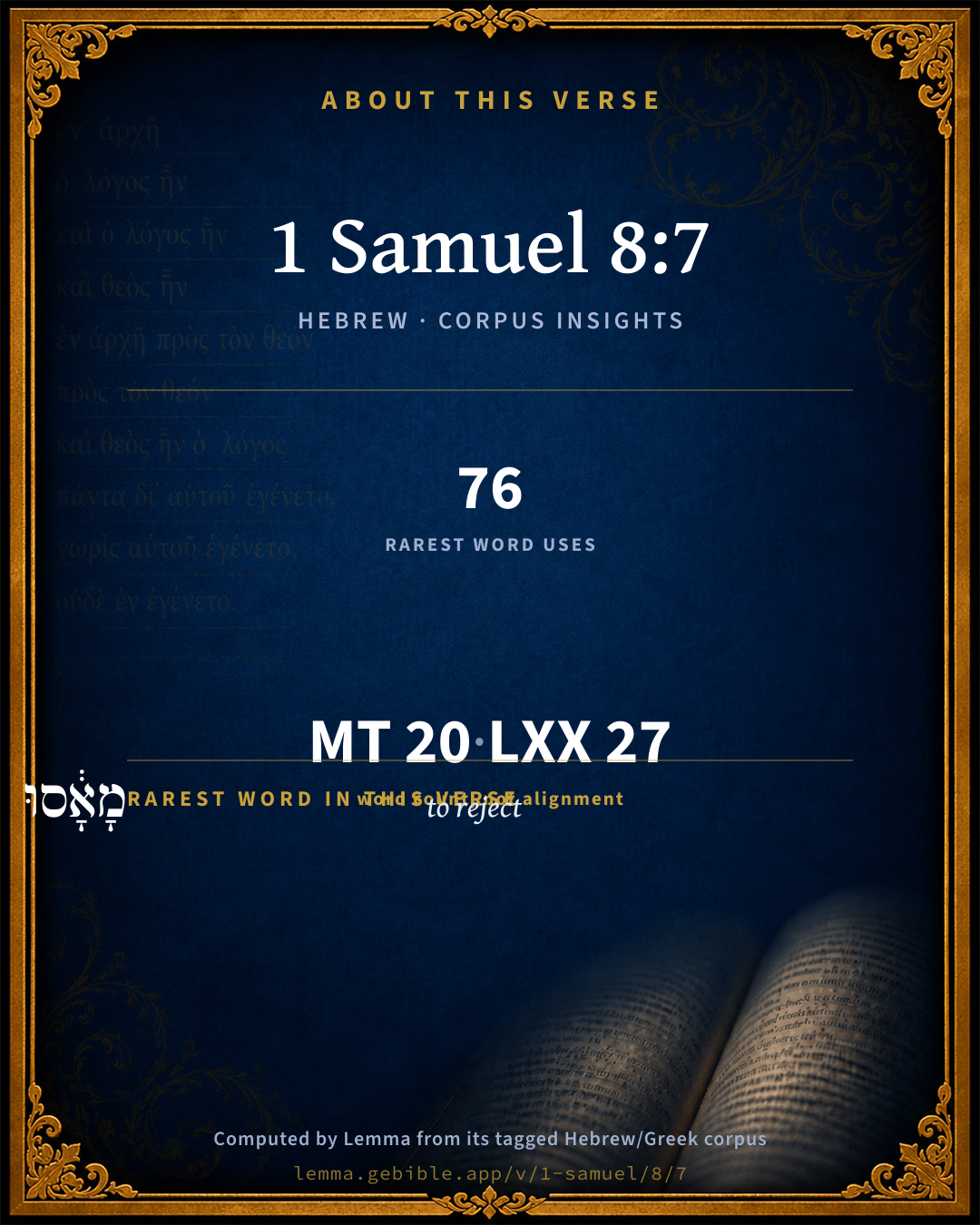
1 Samuel 8:7

Hebrew (Westminster Leningrad Codex) 1 Samuel 8:7 appears in the Hebrew Old Testament. The text above is from the Westminster Leningrad Codex. Each word links to its Strong’s number, a concise gloss, and parsing drawn from the Open Scriptures Hebrew Bible morphology. Click any word for its full Brown-Driver-Briggs (BDB) entry.
Download image
Cite this verse

1 Samuel 8:7 (World English Bible). Public Domain. Lemma interlinear Bible study tool, https://lemma.gebible.app/v/1-samuel/8/7.

Show BibTeX & RIS
BibTeX
RIS
English Translation
Yahweh said to Samuel, Listen to the voice of the people in all that they tell you; for they have not rejected you, but they have rejected me, that I should not be king over them.
World English Bible · Public Domain
Download a study sheet

One document with this verse’s original text, its word-by-word gloss line, the meaning frame, cross-references with their text, attributed commentary, and full source and license credits — printable, and it pastes into notes with its structure intact.

This verse Autodidact and up

Study sheet (.html) Plain text (.txt)

A passage Seminary Student

Up to 50 verses in one chapter. A passage sheet keeps up to 6 commentary sources and 12 cross-references per verse, in the order this page ranks them, and says so on the sheet whenever that leaves anything out. Ask for a single verse and you get the Autodidact verse sheet above.

Everything on this page stays free to read, with no account — the sheet is a download of what is already on screen, not access to it.

Want to remove ads? Support Godless Engineer
Compare translations 3

The same verse in 3 English versions, stacked beneath the original-language interlinear above. Click any original word for its lexicon entry.

Each is an independent rendering of the whole verse — the interlinear is not word-aligned to these translations.

Highlighted words mark where these versions differ — a whole-verse word diff, not a word-by-word alignment.

  • World English Bible Public Domain
    Yahweh said to Samuel, Listen to the voice of the people in all that they tell you; for they have not rejected you, but they have rejected me, that I should not be king over them.
  • King James Version Public Domain
    And the LORD said unto Samuel, Hearken unto the voice of the people in all that they say unto thee: for they have not rejected thee, but they have rejected me, that I should not reign over them.
  • unfoldingWord Literal Text CC BY-SA 4.0
    And Yahweh said to Samuel, “Listen to the voice of the people according to all that they have said to you. For they have not rejected you, but they have rejected me from reigning over them.

unfoldingWord Literal Text — © unfoldingWord, licensed CC BY-SA 4.0. Word-aligned USFM3 via Door43 (git.door43.org/unfoldingWord/en_ult).

Versions to compare (up to 4)

3 of 4 selected

Show all 18 translations

Every available English version of this verse, each an independent rendering of the whole verse.

  • World English Bible Public Domain
    Yahweh said to Samuel, Listen to the voice of the people in all that they tell you; for they have not rejected you, but they have rejected me, that I should not be king over them.
  • Berean Standard Bible Public Domain
    And the LORD said to Samuel, “Listen to the voice of the people in all that they say to you. For it is not you they have rejected, but they have rejected Me as their king.
  • Majority Standard Bible Public Domain
    And the LORD said to Samuel, “Listen to the voice of the people in all that they say to you. For it is not you they have rejected, but they have rejected Me as their king.
  • King James Version Public Domain
    And the LORD said unto Samuel, Hearken unto the voice of the people in all that they say unto thee: for they have not rejected thee, but they have rejected me, that I should not reign over them.
  • American Standard Version (1901) Public Domain
    And Jehovah said unto Samuel, Hearken unto the voice of the people in all that they say unto thee; for they have not rejected thee, but they have rejected me, that I should not be king over them.
  • Revised Version (1885) Public Domain
    And the LORD said unto Samuel, Hearken unto the voice of the people in all that they say unto thee: for they have not rejected thee, but they have rejected me, that I should not be king over them.
  • Geneva Bible (1599) Public Domain
    And the Lord said vnto Samuel, Heare the voyce of the people in all that they shall say vnto thee: for they haue not cast thee away, but they haue cast me away, that I should not reigne ouer the.
  • Douay-Rheims (1899) Public Domain
    And the Lord said to Samuel: Hearken to the voice of the people in all that they say to thee. For they have not rejected thee, but me, that I should not reign over them.
  • Young's Literal Translation Public Domain
    And Jehovah saith unto Samuel, `Hearken to the voice of the people, to all that they say unto thee, for thee they have not rejected, but Me they have rejected, from reigning over them.
  • Literal Standard Version CC BY-SA 4.0
    And YHWH says to Samuel, “Listen to the voice of the people, to all that they say to you, for they have not rejected you, but they have rejected Me from reigning over them.
  • Unlocked Literal Bible CC BY-SA 4.0
    Yahweh said to Samuel, “Obey the voice of the people in everything they say to you; for they have not rejected you, but they have rejected me from being king over them.
  • unfoldingWord Literal Text CC BY-SA 4.0
    And Yahweh said to Samuel, “Listen to the voice of the people according to all that they have said to you. For they have not rejected you, but they have rejected me from reigning over them.
  • Darby Bible Public Domain
    And Jehovah said to Samuel, Hearken unto the voice of the people in all that they say unto thee: for they have not rejected thee, but they have rejected me, that I should not reign over them.
  • World Messianic Bible Public Domain
    The LORD said to Samuel, “Listen to the voice of the people in all that they tell you; for they have not rejected you, but they have rejected me as the king over them.
  • Webster's Bible Public Domain
    And the LORD said to Samuel, Hearken to the voice of the people in all that they say to thee: for they have not rejected thee, but they have rejected me, that I should not reign over them.
  • Free Bible Version CC BY-SA 4.0
    “Do what the people tell you,” the Lord said to Samuel, “because it's not you they're rejecting, but me as their king.
  • Bible in Basic English Public Domain
    And the Lord said to Samuel, Give ear to the voice of the people and what they say to you: they have not been turned away from you, but they have been turned away from me, not desiring me to be king over them.
  • JPS Tanakh (1917) Public Domain
    And the LORD said unto Samuel: 'Hearken unto the voice of the people in all that they say unto thee; for they have not rejected thee, but they have rejected Me, that I should not be king over them.

Literal Standard Version (2020), Covenant Press — licensed CC BY-SA 4.0. Text via the HelloAO Bible API (eBible.org). Unlocked Literal Bible (unfoldingWord) — licensed CC BY-SA 4.0. Text via the HelloAO Bible API (eBible.org). unfoldingWord Literal Text — © unfoldingWord, licensed CC BY-SA 4.0. Word-aligned USFM3 via Door43 (git.door43.org/unfoldingWord/en_ult). Free Bible Version, Dr. Jonathan Gallagher — licensed CC BY-SA 4.0. Text via the HelloAO Bible API (eBible.org).

Word by word

More ways to search: Search by grammar → Find every occurrence → Compare this word →

Practice this passage: Drill this verse → Learn its vocabulary →

מָאָ֔סוּ
mâʼaç
H3988
“to reject”
Verb, Qal, Perfect, 3rd Person, Common, Plural
Part of Speech
Verb
Stem
Qal
Form
Perfect
Person
3rd Person
Gender
Common
Number
Plural
Full BDB Definition

Origin: a primitive root

TWOT: 1139 , 1140

to reject, despise, refuse - (Qal) - to reject, refuse - to despise - (Niphal) to be rejected - (Niphal) to flow, run
  1. וַיֹּ֤אמֶר ʼâmar H559 “and · to say” Conjunction + Verb, Qal, Sequential Imperfect, 3rd Person, Masculine, Singular
  2. יְהוָה֙ Yᵉhôvâh H3068 “LORD” Noun, Proper
  3. אֶל ʼêl H413 “to” Preposition
  4. שְׁמוּאֵ֔ל Shᵉmûwʼêl H8050 “Samuel” Noun, Proper
  5. שְׁמַע֙ shâmaʻ H8085 “hear” Verb, Qal, Imperative, 2nd Person, Masculine, Singular
  6. בְּק֣וֹל qôwl H6963 “in/at · voice of” Preposition + Noun, Common, Masculine, Singular, Construct
  7. הָעָ֔ם ʻam H5971 “the · people” Particle, Definite Article + Noun, Common, Masculine, Singular, Absolute
  8. לְכֹ֥ל kôl H3605 “to/for · all” Preposition + Noun, Common, Masculine, Singular, Absolute
  9. אֲשֶׁר ʼăsher H834 “which” Particle, Relative
  10. יֹאמְר֖וּ ʼâmar H559 “to say” Verb, Qal, Imperfect, 3rd Person, Masculine, Plural
  11. אֵלֶ֑יךָ ʼêl H413 “to · you” Preposition + Suffix, Personal, 2nd Person, Masculine, Singular
  12. כִּ֣י kîy H3588 “that” Conjunction
  13. לֹ֤א lôʼ H3808 “not” Particle, Negative
  14. אֹֽתְךָ֙ ʼêth H853 “- · you” Particle, Direct Object + Suffix, Personal, 2nd Person, Masculine, Singular
  15. כִּֽי kîy H3588 “that” Conjunction
  16. אֹתִ֥י ʼêth H853 “- · me” Particle, Direct Object + Suffix, Personal, 1st Person, Common, Singular
  17. מָאֲס֖וּ mâʼaç H3988 “to reject” Verb, Qal, Perfect, 3rd Person, Common, Plural
  18. מִמְּלֹ֥ךְ mâlak H4427 “from · to reign” Preposition + Verb, Qal, Infinitive Construct
  19. עֲלֵיהֶֽם ʻal H5921 “upon · them” Preposition + Suffix, Personal, 3rd Person, Masculine, Plural

About this verse

These counts appear in no published source. They are computed here, from the morphology-tagged text and Lemma’s own curated glosses. What Lemma adds →

20
words
15
distinct lemmas
Historical
section

Grammatical profile

  • 6 verbs
  • 5 nouns
  • 3 prepositions
  • 2 conjunctions
  • 4 particles

Verb forms

  • וַיֹּ֤אמֶר Qal · Sequential Imperfect
  • שְׁמַע֙ Qal · Imperative
  • יֹאמְר֖וּ Qal · Imperfect
  • מָאָ֔סוּ Qal · Perfect
  • מָאֲס֖וּ Qal · Perfect
  • מִמְּלֹ֥ךְ Qal · Infinitive Construct

Repetition

Words recur within this verse — often emphatic in Hebrew:

  • וַיֹּ֤אמֶר to say H559 ×2
  • מָאָ֔סוּ to reject H3988 ×2
  • אֶל to H413 ×2
  • כִּ֣י that H3588 ×2

Hebrew & Septuagint length

In English translation the verse runs 36 words from the Hebrew and 34 from the Septuagint (LXX English) — closely comparable.

A rough comparison of the two English renderings, which tokenize alike — not a word-level alignment.

Word counts can differ between the Hebrew and the Greek without any difference in meaning — e.g. the Hebrew direct-object marker אֵת has no separate Greek word, and Greek often adds the article ὁ.

In the original languages it is 20 Hebrew tokens and 27 Greek tokens — but the two are counted differently (Hebrew bundles its prefixes and suffixes into one token; the Greek is in lemma form), so that isn’t a like-for-like length.

Cross-references

14

Topical passages linked to 1 Samuel 8:7 in the Treasury of Scripture Knowledge — connected by theme and wording, ordered by reader-vote popularity; previews shown in the World English Bible.

  • Luke 10:16 Whoever listens to you listens to me, and whoever rejects you rejects me. Whoever rejects me rejects him who sent me."
  • 1 Samuel 10:19 but you have this day rejected your God, who himself saves you out of all your calamities and your distresses; and you have said to him, [No], but set a king over us. Now therefore present yourselves before Yahweh by your tribes, and by your thousands.
  • Exodus 16:8 Moses said, "Now Yahweh shall give you meat to eat in the evening, and in the morning bread to satisfy you; because Yahweh hears your murmurings which you murmur against him. And who are we? Your murmurings are not against us, but against Yahweh."
  • Luke 19:14 But his citizens hated him, and sent an envoy after him, saying, 'We don't want this man to reign over us.'
  • Luke 19:27 But bring those enemies of mine who didn't want me to reign over them here, and kill them before me.'"
  • Hosea 13:10–11 Where is your king now, that he may save you in all your cities? And your judges, of whom you said, 'Give me a king and princes?'
  • Matthew 10:40 He who receives you receives me, and he who receives me receives him who sent me.
  • Psalms 81:11–12 But my people didn't listen to my voice. Israel desired none of me.
  • Numbers 22:20 God came to Balaam at night, and said to him, If the men are come to call you, rise up, go with them; but only the word which I speak to you, that shall you do.
  • 1 Samuel 12:17–19 Isn't it wheat harvest today? I will call to Yahweh, that he may send thunder and rain; and you shall know and see that your wickedness is great, which you have done in the sight of Yahweh, in asking you a king.
  • Isaiah 66:4 I also will choose their delusions, and will bring their fears on them; because when I called, none did answer; when I spoke, they did not hear: but they did that which was evil in my eyes, and chose that in which I didn't delight.
  • Matthew 10:24–25 "A disciple is not above his teacher, nor a servant above his lord.
  • John 13:16 Most assuredly I tell you, a servant is not greater than his lord, neither one who is sent greater than he who sent him.
  • John 15:20–21 Remember the word that I said to you: 'A servant is not greater than his lord.' If they persecuted me, they will also persecute you. If they kept my word, they will keep yours also.

Cross-references courtesy of OpenBible.info (CC BY 4.0).

Hebrew and Greek witnesses Masoretic Hebrew ↔ Greek Septuagint

The same verse in the two great witnesses to the Old Testament, shown verse-for-verse.

These are two independent witnesses, not word-aligned to each other, and the Septuagint is shown in lemma (dictionary) form.

Hebrew 1 Samuel 8:7 Masoretic · Westminster Leningrad Codex

וַיֹּ֤אמֶר יְהוָה֙ אֶל שְׁמוּאֵ֔ל שְׁמַע֙ בְּק֣וֹל הָעָ֔ם לְכֹ֥ל אֲשֶׁר יֹאמְר֖וּ אֵלֶ֑יךָ כִּ֣י לֹ֤א אֹֽתְךָ֙ מָאָ֔סוּ כִּֽי אֹתִ֥י מָאֲס֖וּ מִמְּלֹ֥ךְ עֲלֵיהֶֽם

Yahweh said to Samuel, Listen to the voice of the people in all that they tell you; for they have not rejected you, but they have rejected me, that I should not be king over them.

World English Bible · Public Domain

Greek LXX 1 Samuel 8:7 Septuagint · lemma form

καί εἶπον κύριος πρός σαμουηλ ἀκούω ὁ φωνή ὁ λαός καθά ἄν λαλέω σύ ὅτι οὐ σύ ἐκοὐθενέω ἀλλά ἤ ἐγώ ἐκοὐθενέω ὁ μή βασιλεύω ἐπί αὐτός

And the Lord said to Samuel, Hear the voice of the people, in whatever they shall say to you; for they have not rejected you, but they have rejected me from reigning over them.

LXX2012 (modern English Septuagint) · Public Domain

Hebrew: Westminster Leningrad Codex (CC BY 4.0). Greek: Septuagint (public domain); English from LXX2012 (modern English Septuagint) (Public Domain). How the Septuagint differs from the Hebrew →

Targum (Aramaic paraphrase)

1

The Targum is the ancient Jewish Aramaic paraphrase of the Hebrew Scriptures — an interpretive translation, not the Hebrew text itself. Onkelos (literal) and Pseudo-Jonathan (expansive) render the Torah, and Jonathan the Prophets. Coverage is partial: where no permissively-licensed English translation exists for a verse, only the Aramaic is shown. This is verse-level text, not a word-by-word alignment to the Hebrew.

  1. Targum Jonathan Prophets (Joshua–Malachi)
    וַאֲמַר יְיָ לִשְׁמוּאֵל קַבֵּיל לְמֵימָר עַמָא לְכֹל דְיֵמְרוּן לָךְ אֲרֵי לָא יָתָךְ רְחִיקוּ אֲרֵי בְּפוּלְחָנִי קָצוּ מִלְמֶהֱוֵי מַלְכָּא עֲלֵיהוֹן:

    (no public-domain English translation for this verse)

    Targum Jonathan — Aramaic: “Mikraot Gedolot” (public domain). English: “Sefaria Community Translation” (CC0 1.0 (public-domain dedication)); “London "Chaldee Paraphrase," 1871” (public domain). Text via Sefaria.

Commentary

Notes on 1 Samuel 8:7 from classic Christian and Jewish commentators (each source and its license shown beneath its notes). The classic Christian expositions comment on the surrounding passage and are grouped to its opening verse, so a note may address several verses; the Jewish commentaries on the Tanakh (Rashi and others) are per-verse, so they appear only where the commentator wrote on this verse.

Lemma curates 59 commentaries, every one of them public domain or Creative Commons licensed, each selected and text-cleaned for this edition rather than reprinted as found. About our sources →

Trapp's Complete Commentary

John Trapp

1Sa 8:7 And the LORD said unto Samuel, Hearken unto the voice of the people in all that they say unto thee: for they have not rejected thee, but they have rejected me, that I should not reign over them.

Ver. 7. Hearken unto the voice of the people.] Verba sunt irati, these words were uttered in anger, as appeareth by Hos 13:11, q.d., Let them have a king, since they will needs have it so, but they shall soon have enough of him. Deus saepe dat iratus, quod negat propitius. It is not safe to prescribe to God, nor to be too importunate for any temporal blessing. Those in the gospel that indented for a penny a day had it, but had no good content with it.

For they have not rejected thee.] That is, Thee only, but me also. And if Phocion could say to one that was to die with him, Mayest thou not be glad to fare as Phocion fareth? {a} how much more might Samuel take his rejection well, since God also was rejected. Christ was in like sort afterwards cast off by those that cried, We have no king but Caesar!

{a} Plutarch.

John Trapp, A Commentary or Exposition upon All the Books of the Old and New Testament (1647–1656) — public domain. Text from a community e-Sword module.

Matthew Poole's English Annotations

Hearken unto the voice of the people; God grants their desire in anger, and for their punishment, as is affirmed, Hos 13:11. Compare Num 22:13,20; Deu 1:22; Psa 77:20.

They have not rejected thee, i.e. not thee only, nor principally; compare Gen 32:28; Exo 16:7; Hos 6:6; Mat 10:20; but this injury and contumely reflects chiefly upon me and my government,

that I should not reign over them, to wit, by my immediate and peculiar government, which was the great honour, safety, and happiness of his people, if they had had wit to know it, or hearts to prize it. And all the infelicities of Israel, under this kind of government, did not proceed from the nature of the government, but from the ungovernableness and wickedness of the people, which, they might be sure, would produce the same or greater calamities under their kingly government.

Quest. First, Did not God reign over them when they had kings?

Answ. Yes, in a general way, but not in such a peculiar manner as he did by the judges, who were generally raised and called by God’s particular appointment, endowed and sanctified by his Spirit, directed and assisted by his special providence upon all emergencies; whereas all things were for the most part contrary in their kings.

Quest. Secondly, Was it simply unlawful for the people to desire a king?

Answ. No, as appears from Deu 17:14; but herein was their sin, that they desired it upon sinful grounds, of which see on 1Sa 8:7, and in an impetuous manner, and at an unseasonable time, and without asking leave or advice from God; which in so weighty and difficult a case they could not neglect without great sin.

Matthew Poole's English Annotations on the Holy Bible (1683–1685) — public domain. Text from a community e-Sword/MySword module.

The Biblical Illustrator

Joseph S. Exell

1Sa_8:7-9

Hearken unto the voice of the people in all that they say unto thee.

Prayer answered under protest

Prayer is certainly a most salutary exercise whenever one is agitated beyond his strength. When the elders of Israel came to Samuel he discovered that the complication was too deep for an old man like him to deal with; and so he went in prayer to God In thy end we shall learn that the petition of these malcontents was granted, but with the answer came retribution and ultimate dismay. Prayers are sometimes answered under protest Let us, then, move on at once in our search.

I. We shall have to begin with a fair and detailed exposition of the narrative as it meets us.

1. This verse, besides its bearing upon our main point, contains a valuable lesson of its own: Rejecting Divine Providence is rejecting Divine government and forfeiting Divine favour. There is no sense in a declaration that we accept Gods law in general, but reserve the right to practical freedom in reference to particulars. The end of all civil government, says an ancient thinker, writing for our times as wisely as for his own, is to live well according to the Divine pleasure. We are surely Christians, but in general, you know; not quite so particular as we might be, possibly, but with a decided respect for religion always. Now this will not do; Jesus Christ, is everything to a man, or He is nothing. In all human history there has never been a fitter leader to command our loyalty or to win our love. We have been told that the ancient Persian kings used to elect, for the education and training of their princes, the four best men in the kingdom--the justest man, the wisest man, the bravest man, and the most temperate man--so that each new sovereign might have the highest advantages, and come to the regal throne best fitted to rule over the people. Christ is the Prince of a kingdom that, is supreme in the universe. When the Providences of God summon us to follow Jesus as our Lord, to reject Him is also to reject the Lord that made us, and defy Him when He is most our friend.

2. You must bear in mind, also, as this narrative proceeds, that wilful disobedience, continuously repeated, becomes settled rebellion. The reply which Samuel received reminded him that this was not a new case of sudden refusal of the Divine sovereignty. That nation had actually got into the habit of it. They had never shown anything more commendable since they came up out of the land of Pharaoh; they proved an awkward and ungainly people when Moses was trying to manage them in the wilderness. When one throws off Gods beneficent restraints, it is surprising to see how awfully wicked he can be as in a moment of rapid demoralisation. Things apparently innocent are made the baleful occasion, sometimes even the instrument, of violent outbreak in vice. It is one of the intense severities of Montaigne to say of these atheistic people that they infect innocent matter with their own venom. Some sceptics like to do this in their reckless arguments. They force natural science, always loyal and reverent to the Creator of the universe, to speak a lie and bring false testimony against God. It is the deliberate counting out of Divine government which puts this universe in such a false position. The only effective manner in which to deal with such a dangerous experience is found in letting it have its own way until it shall be weary and worn with its follies and be ready to return penitently to God.

3. So now we come to the point that we started to reach. Human prayers are sometimes granted with a Divine protest. Solemn moment is that in which God gives to any man or nation in judgment what was asked of Him in petulance and pride! Now let us understand that circumstances may erect; a foreordained fact into a responsible sin, for which those who are the actors are to be held accountable in the end. The Lord said these malcontents in Israel might have their wish, and yet he charges on them the guilt the transaction involved. Furthermore, this very demand of the people had been foreseen and publicly predicted three hundred years before. And yet this whole proceeding was now wrong; it was premature and hasty, and it was conducted without reference to the over-ruling will of Jehovah. Gods Providence does not constrain any mans iniquity. Foreordination has nothing to do with free will. Those elders were doing their own behest, not Gods; and they suffered for it.

II. We turn now from this story to the one principle it so vividly illustrates. It is worth our while to press a valuable admonition like that which is given here. We are told to let our hearts go forth in prayer continually unto God, and God will grant us our desires. But here we learn that not even the answers we obtain are to be trusted always. What does this mean in real experience?

1. It means that all petitions are to be offered, and all desires are to be pressed, according to the Lords will before our will. If we thrust ourselves forward, Divine Providence will frequently hedge up the way. If now we urge on, sometimes the barrier is seen to move quietly away; then we can have our request if we continue to press it. But is this safe or wise? that is the sober question. It is the creature erecting itself against the supreme judgment of its Creator and taking its case into its own hands. When a man is intelligent, and his conscience tells him that God is not exactly granting, but only permitting, his prayer, is it best for him to persevere in it in the confident hope that courage will carry him through into safety?

2. And for another thing, this declaration means that under protest God grants a Christians prayer, the answer will be a positive discipline rather than a blessing. (C. S. Robinson, D. D.)

The Biblical Illustrator, edited by Joseph S. Exell (c. 1880s–1900s) — public domain. Text from a community e-Sword module.

Joseph Benson's Commentary

1Sa 8:7. The Lord said, Hearken unto the people, &c. — He grants their desire in anger, for their punishment. For these, it is plain, are the words of displeasure, being as much as to say, Let them have their will. Samuel took it very ill that they should be dissatisfied with his government: but God tells him that he himself had more reason to be angry. For, in truth, they had thrown off his authority who was their king, as Samuel tells them afterward, 1Sa 12:12; and who had governed them by judges, whom he raised up and extraordinarily inspired when he saw occasion; as he had before conducted them by Moses and Joshua, who never ordained any thing of moment without a special command from God. They have not rejected thee — Merely or chiefly. They have rejected me — This injury and contumely reflects chiefly upon me and my government. Should not reign — By my immediate government, which was the great honour, safety, and happiness of this people, if they had had hearts to prize it.

Joseph Benson's Commentary on the Old and New Testaments (1811–1818) — public domain. Text from a community e-Sword module.

Tyndale Open Study Notes

Tyndale Open Resources

8:7 Do everything they say: God rarely instructed a prophet to heed the voice of the errant populace. The will of the people and the will of God would converge in King David (see 2 Sam 7:8-17). • they are rejecting me: Their rejection of judgeship was a deeper rejection of God’s rule and sovereignty (see also 1 Sam 12:1-17).

Tyndale Open Study Notes — © Tyndale Open Resources, licensed CC BY-SA 4.0. Text via the HelloAO Bible API.

Adam Clarke's Commentary

Verse 7. They have rejected me] They wish to put that government in the hands of a mortal, which was always in the hands of their GOD. But hearken unto their voice-grant them what they request. So we find God grants that in his displeasure which he withholds in his mercy.

Adam Clarke's Commentary on the Bible (1810–1826) — public domain. Text from a community e-Sword/MySword module.

Ellicott's Commentary for English Readers

(7) Hearken unto the voice of the people.—The words spoken to Samuel, probably in a vision, by the Most High are very touching and very sad. Very touching, in their extreme tenderness to the noble old man. Take courage, they seem to say, “my old true servant, and be not dismayed at this apparently bitter proof of the ingratitude of the people you loved so well. This deliberate complaint on the part of Israel is directed not against you, the judge, but against Me, the invisible King. They have ever been the same—incapable of becoming my true subjects, and of winning on earth the lofty position I would have given them; you must give them now their hearts’ desire. It has all been foreseen and provided for; only make them understand what they are asking. Then give them their earthly king.” Very sad, for it was the deliberate abandonment by the Eternal God of His first intention as regarded Israel—the deliberate lowering of the grand ideal once formed for His chosen people. Here, as is not unfrequent in the Divine records, we have a corner of the veil which hangs between the creature and the Creator lifted for a moment. We see how sadly possible it is for man in the exercise of his perfect freewill to mar the glorious work arranged for him by his God. We see too in the records of such a transaction as this (see Deu_17:14) how all was foreseen by the King of heaven, and we catch sight of the sorrowful regret—if we may use the term—of the Creator for the perverse folly of His creatures.

A Bible Commentary for English Readers, edited by Charles John Ellicott (1878–1897) — public domain. Text from a community e-Sword module.

John Gill's Exposition

And the Lord said unto Samuel,.... He appeared to him in a vision or dream, and by an articulate voice delivered to him what follows:

hearken unto the voice of the people in all that they say unto thee; not as approving of what they said, but permitting and allowing what they asked, as a punishment of them for their disloyalty and ingratitude, and as resenting their ill behaviour to him; for it was in anger he assented to their request, Hos 13:11.

for they have not rejected thee, but they have rejected me that I should not reign over them; most interpreters supply the word "only", as if the sense was, that they had not only rejected Samuel from judging them, but the Lord also from reigning over them; and which is spoken to comfort Samuel, and to alleviate the pressure on his mind for the ill treatment he had met with; for since they had served the Lord after this manner, it was no wonder he should be ill used, and might bear it with great patience: but I see no reason why the word may not be taken absolutely, that they had not rejected Samuel from all share in the government, at least from judging the people; for so he continued all the days of his life, even after they had a king over them; but they entirely rejected the sole and peculiar government of God over them.

John Gill's Exposition of the Whole Bible (1746–1763) — public domain (CC PDM 1.0). Text via the HelloAO Bible API.

Haydock's Catholic Bible Commentary

Thee. "God, in anger, grants a person what he desires wrongfully." (St. Augustine) --- He permits the people to follow their own plans; and the Hebrews believe, that he gave them Saul to punish them, being well apprised of his proud and cruel nature. (Cuneus Rep.) (Calmet) --- Rejected, &c. The government of Israel hitherto had been a theocracy: in which God himself immediately ruled, by laws which he had enacted, and by judges extraordinarily raised up by himself: and therefore he complains that his people rejected him, in desiring a change of government, (Challoner) and wishing to appoint their own magistrates. The priests and judges had been commissioned by God, Exodus xix., and Deuteronomy xvii. (Worthington)

George Leo Haydock (1774–1849), Haydock's Catholic Family Bible and Commentary, 1859 edition — public domain. Excludes Psalms (Douay-Rheims chapter numbering differs from Protestant) and Deuterocanonical books (Catholic canon only).

Whedon's Commentary on the Bible

Daniel D. Whedon

7. They have not rejected thee, but… me — These words imply that in his intercourse with Jehovah, Samuel had complained that the people had rejected him, and were dissatisfied with his administration; but it was rather against the Theocracy itself that their disaffection lay. They failed to understand or acknowledge that their misfortunes came not from lack of power and care on the part of Jehovah, but because of their own sins. Had they humbly and devoutly inquired the will of God in the matter, and asked for a governor after his own heart, and not after the model of the heathen powers, a most propitious change might have been effected in their form of government. To punish them for their ingratitude and disaffection he gave them a king in his anger, and took him away in his wrath. Hos_13:11.

Daniel D. Whedon (gen. ed.), Commentary on the Old and New Testaments (1874–1909) — public domain. Text from a community e-Sword module.

The Pulpit Commentary

In prayer then the answer came to him that the request of the people must be granted, however wrongly it had been urged. In itself it was wrong; for they have not rejected thee, but they have rejected me, that I should not reign over them. As we saw above, they wanted no theocratic king, whose first duty would be to maintain the Mosaic law, (Deu_17:18, Deu_17:19) and protect the priest and prophet in the discharge of their legitimate functions; all they wanted was a soldier who would put an end to their state of anarchy, and enable them to cultivate their fields without the danger of seeing the produce swept off by marauders.

The Pulpit Commentary (1880–1919), ed. H.D.M. Spence-Jones & Joseph S. Exell — public domain. Text from a community e-Sword module.

John Wesley's Explanatory Notes

Hearken - God grants their desire in anger, and for their punishment. Rejected me - This injury and contumely, reflects chiefly upon me and my government. Should not reign - By my immediate government, which was the great honour, safety, and happiness of this people, if they had had hearts to prize it.

John Wesley, Explanatory Notes Upon the Whole Bible (1754–1765) — public domain. Text via the GEBible commentary corpus.

Lesson kit

Teaching starters — assembled from the data on this page, not authored interpretation. Every prompt links to the verse data it draws on. Edit before teaching.

1 Samuel, in the Historical, opens this verse with 20 words (15 distinct Hebrew lemmas). Its most distinctive word is mâʼaç (“to reject”). A historical commentator’s framing appears above. Read the whole chapter for the surrounding context.

Discussion questions

  1. How does “to reject” (mâʼaç) shape what this verse is saying?
  2. How does Luke 10:16, which shares this passage’s theme, read alongside this verse?
  3. What does the repetition of “to say” (2× in this one verse) do in this verse?
  4. These translations render this verse differently. What is at stake in choosing one wording over another?
  5. «וַיֹּ֤אמֶר» is a Qal Sequential Imperfect verb. How does that grammatical form shape the action described?
  6. Compare how Trapp's Complete Commentary and Matthew Poole's English Annotations read this verse. Where do they agree or differ?

Things to notice

Reading settings

Reading text

Shown beneath each verse's original-language words.

Old Testament
Old Testament edition

Read the OT as the Masoretic Hebrew (MT) or the Greek Septuagint (LXX).

English shown for the Greek Septuagint (in the Hebrew ↔ Greek comparison).

Comparing translations? Open the Compare panel on any verse page to stack up to four side by side.