
Deuteronomy 5:23

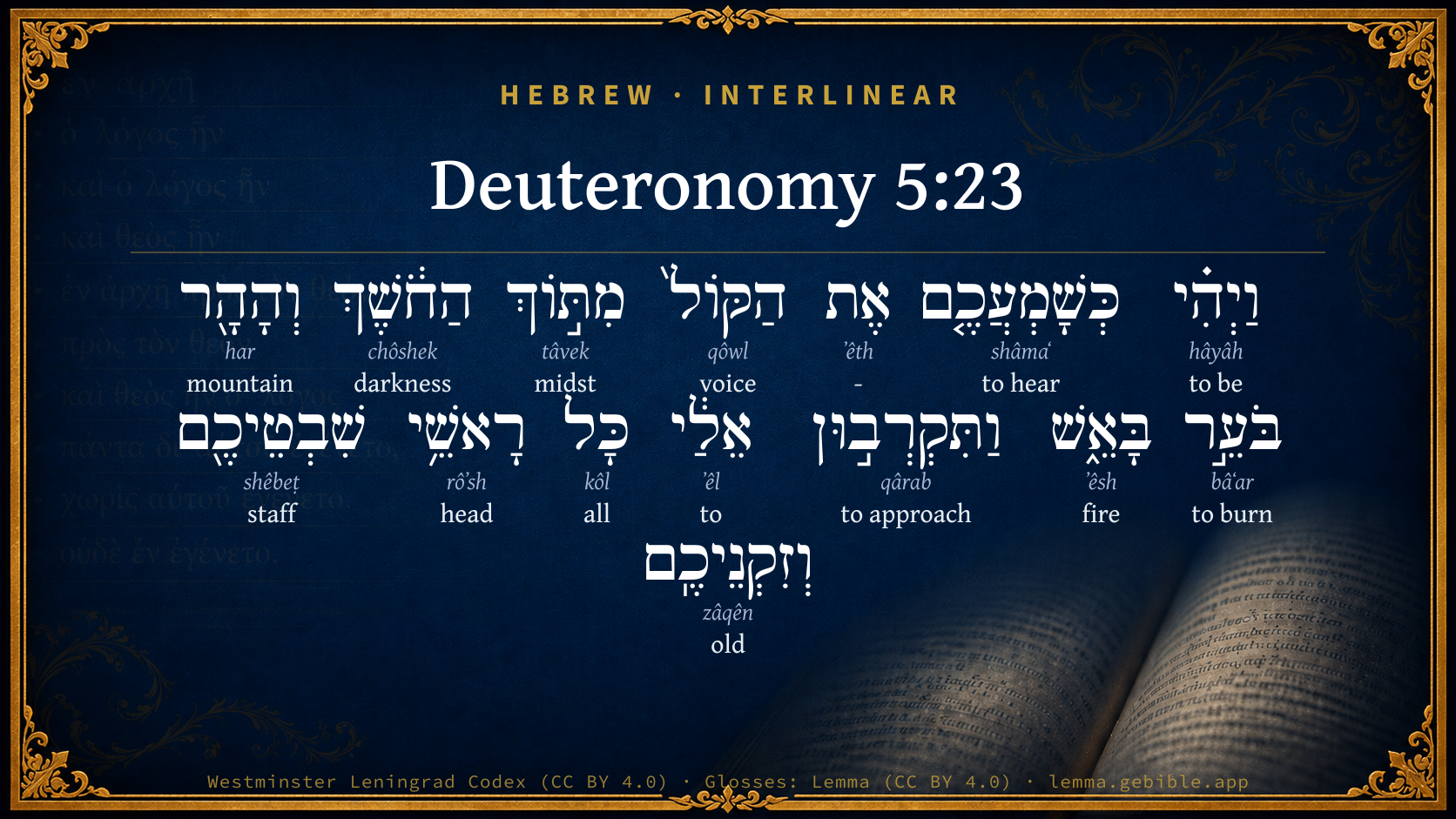
Hebrew (Westminster Leningrad Codex) Deuteronomy 5:23 appears in the Hebrew Old Testament. The text above is from the Westminster Leningrad Codex. Each word links to its Strong’s number, a concise gloss, and parsing drawn from the Open Scriptures Hebrew Bible morphology. Click any word for its full Brown-Driver-Briggs (BDB) entry.
Download image
Cite this verse

Deuteronomy 5:23 (World English Bible). Public Domain. Lemma interlinear Bible study tool, https://lemma.gebible.app/v/deuteronomy/5/23.

Show BibTeX & RIS
BibTeX
RIS
English Translation
It happened, when you heard the voice out of the midst of the darkness, while the mountain was burning with fire, that you came near to me, even all the heads of your tribes, and your elders;
World English Bible · Public Domain
Download a study sheet

One document with this verse’s original text, its word-by-word gloss line, the meaning frame, cross-references with their text, attributed commentary, and full source and license credits — printable, and it pastes into notes with its structure intact.

This verse Autodidact and up

Study sheet (.html) Plain text (.txt)

A passage Seminary Student

Up to 50 verses in one chapter. A passage sheet keeps up to 6 commentary sources and 12 cross-references per verse, in the order this page ranks them, and says so on the sheet whenever that leaves anything out. Ask for a single verse and you get the Autodidact verse sheet above.

Everything on this page stays free to read, with no account — the sheet is a download of what is already on screen, not access to it.

Want to remove ads? Support Godless Engineer
Compare translations 3

The same verse in 3 English versions, stacked beneath the original-language interlinear above. Click any original word for its lexicon entry.

Each is an independent rendering of the whole verse — the interlinear is not word-aligned to these translations.

Highlighted words mark where these versions differ — a whole-verse word diff, not a word-by-word alignment.

  • World English Bible Public Domain
    It happened, when you heard the voice out of the midst of the darkness, while the mountain was burning with fire, that you came near to me, even all the heads of your tribes, and your elders;
  • King James Version Public Domain
    And it came to pass, when ye heard the voice out of the midst of the darkness, (for the mountain did burn with fire,) that ye came near unto me, even all the heads of your tribes, and your elders;
  • unfoldingWord Literal Text CC BY-SA 4.0
    And it happened, when you heard the voice in the midst of the darkness, and the mountain was burning with fire, then you approached me—all the heads of your tribes and your elders.

unfoldingWord Literal Text — © unfoldingWord, licensed CC BY-SA 4.0. Word-aligned USFM3 via Door43 (git.door43.org/unfoldingWord/en_ult).

Versions to compare (up to 4)

3 of 4 selected

Show all 18 translations

Every available English version of this verse, each an independent rendering of the whole verse.

  • World English Bible Public Domain
    It happened, when you heard the voice out of the midst of the darkness, while the mountain was burning with fire, that you came near to me, even all the heads of your tribes, and your elders;
  • Berean Standard Bible Public Domain
    And when you heard the voice out of the darkness while the mountain was blazing with fire, all the heads of your tribes and your elders approached me,
  • Majority Standard Bible Public Domain
    And when you heard the voice out of the darkness while the mountain was blazing with fire, all the heads of your tribes and your elders approached me,
  • King James Version Public Domain
    And it came to pass, when ye heard the voice out of the midst of the darkness, (for the mountain did burn with fire,) that ye came near unto me, even all the heads of your tribes, and your elders;
  • American Standard Version (1901) Public Domain
    And it came to pass, when ye heard the voice out of the midst of the darkness, while the mountain was burning with fire, that ye came near unto me, even all the heads of your tribes, and your elders;
  • Revised Version (1885) Public Domain
    And it came to pass, when ye heard the voice out of the midst of the darkness, while the mountain did burn with fire, that ye came near unto me, even all the heads of your tribes, and your elders;
  • Geneva Bible (1599) Public Domain
    And when ye heard the voyce out of the middes of the darkenes, (for the mountaine did burne with fire) then ye came to me, all the chiefe of your tribes, and your Elders:
  • Douay-Rheims (1899) Public Domain
    But you, after you heard the voice out of the midst of the darkness, and saw the mountain burn, came to me, all the princes of the tribes and the elders, and you said:
  • Young's Literal Translation Public Domain
    `And it cometh to pass as ye hear the voice out of the midst of the darkness, and of the mountain burning with fire, that ye come near unto me, all the heads of your tribes, and your elders,
  • Literal Standard Version CC BY-SA 4.0
    And it comes to pass, as you hear the voice out of the midst of the darkness and of the mountain burning with fire, that you come near to me, all [the] heads of your tribes and your elderly,
  • Unlocked Literal Bible CC BY-SA 4.0
    It came about, when you heard the voice out of the middle of the darkness, while the mountain was burning, that you came near to me—all your elders and the heads of your tribes.
  • unfoldingWord Literal Text CC BY-SA 4.0
    And it happened, when you heard the voice in the midst of the darkness, and the mountain was burning with fire, then you approached me—all the heads of your tribes and your elders.
  • Darby Bible Public Domain
    And it came to pass, when ye heard the voice from the midst of the darkness, and the mountain burned with fire, that ye came near to me, all the heads of your tribes, and your elders;
  • World Messianic Bible Public Domain
    When you heard the voice out of the middle of the darkness, while the mountain was burning with fire, you came near to me, even all the heads of your tribes, and your elders;
  • Webster's Bible Public Domain
    And it came to pass, when ye heard the voice from the midst of the darkness, (for the mountain did burn with fire,) that ye came near to me, even all the heads of your tribes, and your elders;
  • Free Bible Version CC BY-SA 4.0
    When you heard the voice that came from the darkness while the mountain was on fire, all your tribal leaders and elders came to me,
  • Bible in Basic English Public Domain
    And after hearing the voice which came out of the dark while the mountain was burning with fire, all the heads of your tribes and your chiefs came to me,
  • JPS Tanakh (1917) Public Domain
    (5-20) And it came to pass, when ye heard the voice out of the midst of the darkness, while the mountain did burn with fire, that ye came near unto me, even all the heads of your tribes, and your elders;

Literal Standard Version (2020), Covenant Press — licensed CC BY-SA 4.0. Text via the HelloAO Bible API (eBible.org). Unlocked Literal Bible (unfoldingWord) — licensed CC BY-SA 4.0. Text via the HelloAO Bible API (eBible.org). unfoldingWord Literal Text — © unfoldingWord, licensed CC BY-SA 4.0. Word-aligned USFM3 via Door43 (git.door43.org/unfoldingWord/en_ult). Free Bible Version, Dr. Jonathan Gallagher — licensed CC BY-SA 4.0. Text via the HelloAO Bible API (eBible.org).

Word by word

More ways to search: Search by grammar → Find every occurrence → Compare this word →

Practice this passage: Drill this verse → Learn its vocabulary →

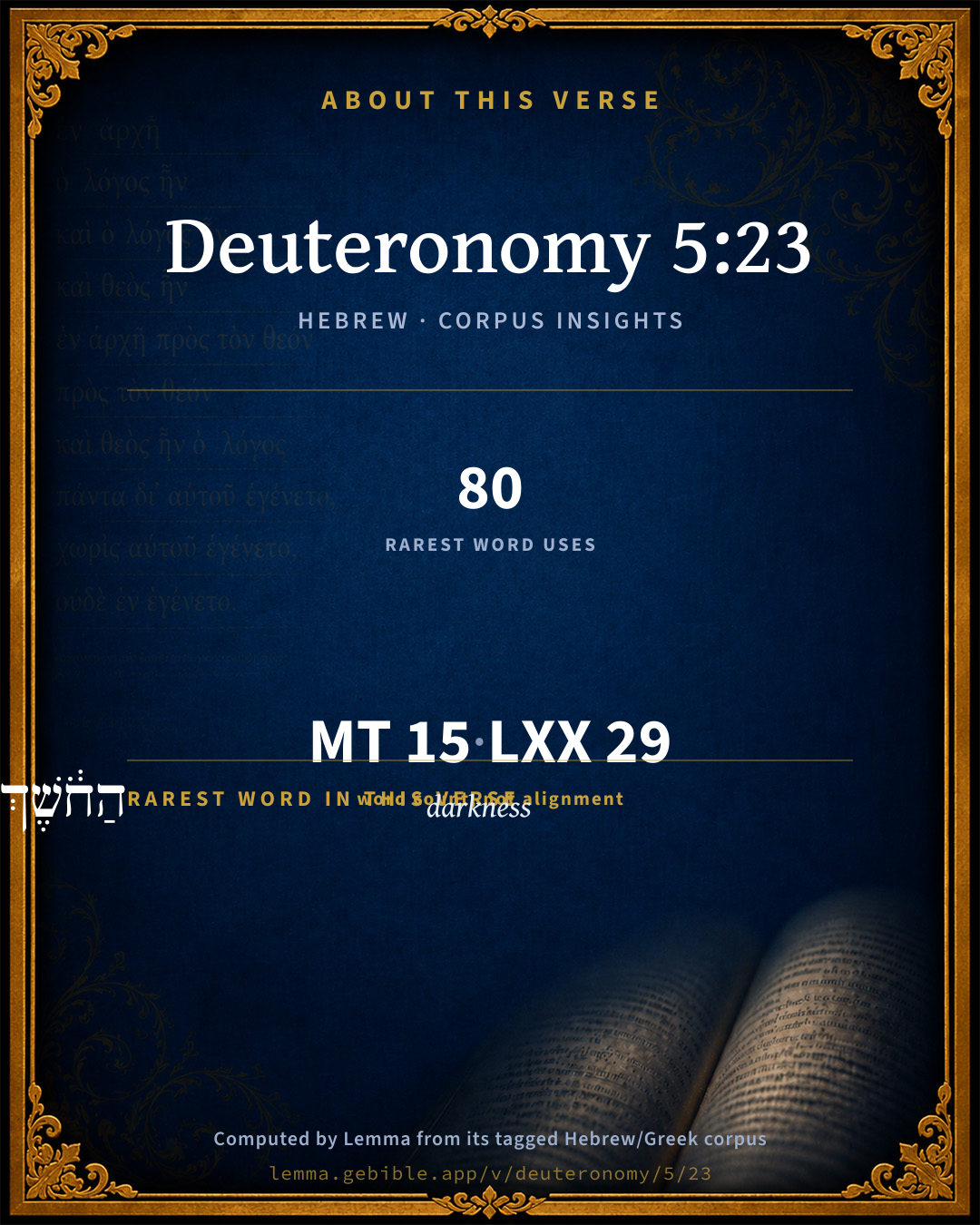
הַחֹ֔שֶׁךְ
chôshek
H2822
“the · darkness”
Particle, Definite Article + Noun, Common, Masculine, Singular, Absolute
Part of Speech
Particle + Noun
Type
Common
Gender
Masculine
Number
Singular
State
Absolute
Full BDB Definition

Origin: from H2821

TWOT: 769a

darkness, obscurity - darkness - secret place
  1. וַיְהִ֗י hâyâh H1961 “and · to be” Conjunction + Verb, Qal, Sequential Imperfect, 3rd Person, Masculine, Singular
  2. כְּשָׁמְעֲכֶ֤ם shâmaʻ H8085 “like/as · to hear · you” Preposition + Verb, Qal, Infinitive Construct + Suffix, Personal, 2nd Person, Masculine, Plural
  3. אֶת ʼêth H853 “-” Particle, Direct Object
  4. הַקּוֹל֙ qôwl H6963 “the · voice” Particle, Definite Article + Noun, Common, Masculine, Singular, Absolute
  5. מִתּ֣וֹךְ tâvek H8432 “from · midst of” Preposition + Noun, Common, Masculine, Singular, Construct
  6. וְהָהָ֖ר har H2022 “and · the · mountain” Conjunction + Particle, Definite Article + Noun, Common, Masculine, Singular, Absolute
  7. בֹּעֵ֣ר bâʻar H1197 “burning” Verb, Qal, Participle Active, Masculine, Singular, Absolute
  8. בָּאֵ֑שׁ ʼêsh H784 “in/at the · fire” Preposition, Determined + Noun, Common, Both, Singular, Absolute
  9. וַתִּקְרְב֣וּן qârab H7126 “and · to approach” Conjunction + Verb, Qal, Sequential Imperfect, 2nd Person, Masculine, Plural + Suffix, n
  10. אֵלַ֔י ʼêl H413 “to · me” Preposition + Suffix, Personal, 1st Person, Common, Singular
  11. כָּל kôl H3605 “all of” Noun, Common, Masculine, Singular, Construct
  12. רָאשֵׁ֥י rôʼsh H7218 “heads of” Noun, Common, Masculine, Plural, Construct
  13. שִׁבְטֵיכֶ֖ם shêbeṭ H7626 “staffs · your” Noun, Common, Masculine, Plural, Construct + Suffix, Personal, 2nd Person, Masculine, Plural
  14. וְזִקְנֵיכֶֽם zâqên H2205 “and · old · your” Conjunction + Adjective, Adjective, Masculine, Plural, Construct + Suffix, Personal, 2nd Person, Masculine, Plural

About this verse

These counts appear in no published source. They are computed here, from the morphology-tagged text and Lemma’s own curated glosses. What Lemma adds →

15
words
15
distinct lemmas
Pentateuch
section

Grammatical profile

  • 4 verbs
  • 8 nouns
  • 1 adjective
  • 1 preposition
  • 1 particle

Verb forms

  • וַיְהִ֗י Qal · Sequential Imperfect
  • כְּשָׁמְעֲכֶ֤ם Qal · Infinitive Construct
  • בֹּעֵ֣ר Qal · Participle Active
  • וַתִּקְרְב֣וּן Qal · Sequential Imperfect

Hebrew & Septuagint length

In English translation the verse runs 37 words from the Hebrew and 38 from the Septuagint (LXX English) — closely comparable.

A rough comparison of the two English renderings, which tokenize alike — not a word-level alignment.

Word counts can differ between the Hebrew and the Greek without any difference in meaning — e.g. the Hebrew direct-object marker אֵת has no separate Greek word, and Greek often adds the article ὁ.

In the original languages it is 15 Hebrew tokens and 29 Greek tokens — but the two are counted differently (Hebrew bundles its prefixes and suffixes into one token; the Greek is in lemma form), so that isn’t a like-for-like length.

Cross-references

2

Topical passages linked to Deuteronomy 5:23 in the Treasury of Scripture Knowledge — connected by theme and wording, ordered by reader-vote popularity; previews shown in the World English Bible.

  • Exodus 20:18–19 All the people perceived the thunderings, the lightnings, the sound of the trumpet, and the mountain smoking. When the people saw it, they trembled, and stayed at a distance.
  • Hebrews 12:18–21 For you have not come to a mountain that might be touched, and that burned with fire, and to blackness, darkness, tempest,

Cross-references courtesy of OpenBible.info (CC BY 4.0).

Hebrew and Greek witnesses Masoretic Hebrew ↔ Greek Septuagint

The same verse in the two great witnesses to the Old Testament, shown verse-for-verse.

These are two independent witnesses, not word-aligned to each other, and the Septuagint is shown in lemma (dictionary) form.

Hebrew Deuteronomy 5:23 Masoretic · Westminster Leningrad Codex

וַיְהִ֗י כְּשָׁמְעֲכֶ֤ם אֶת הַקּוֹל֙ מִתּ֣וֹךְ הַחֹ֔שֶׁךְ וְהָהָ֖ר בֹּעֵ֣ר בָּאֵ֑שׁ וַתִּקְרְב֣וּן אֵלַ֔י כָּל רָאשֵׁ֥י שִׁבְטֵיכֶ֖ם וְזִקְנֵיכֶֽם

It happened, when you heard the voice out of the midst of the darkness, while the mountain was burning with fire, that you came near to me, even all the heads of your tribes, and your elders;

World English Bible · Public Domain

Greek LXX Deuteronomy 5:23 Septuagint · lemma form

καί γίγνομαι ὡς ἀκούω ὁ φωνή ἐκ μέσος ὁ πῦρ καί ὁ ὄρος καίω πῦρ καί προςἔρχομαι πρός ἐγώ πᾶς ὁ ἡγέομαι ὁ φυλή σύ καί ὁ γερουσία σύ

And it came to pass when you⌃ heard the voice out of the midst of the fire, for the mountain burned with fire, that you⌃ came to me, even all the heads of your tribes, and your elders:

LXX2012 (modern English Septuagint) · Public Domain

Hebrew: Westminster Leningrad Codex (CC BY 4.0). Greek: Septuagint (public domain); English from LXX2012 (modern English Septuagint) (Public Domain). How the Septuagint differs from the Hebrew →

Targum (Aramaic paraphrase)

2

The Targum is the ancient Jewish Aramaic paraphrase of the Hebrew Scriptures — an interpretive translation, not the Hebrew text itself. Onkelos (literal) and Pseudo-Jonathan (expansive) render the Torah, and Jonathan the Prophets. Coverage is partial: where no permissively-licensed English translation exists for a verse, only the Aramaic is shown. This is verse-level text, not a word-by-word alignment to the Hebrew.

  1. Targum Onkelos Torah (Genesis–Deuteronomy)
    אֲרֵי מָן כָּל בִּשְׂרָא דִי שְׁמַע קָל מֵימְרָא דַיְיָ קַיָמָא מְמַלֵל מִגוֹ אֶשָׁתָא כְּוָתָנָא וְאִתְקַיָם

    (no public-domain English translation for this verse)

    Targum Onkelos — Aramaic: “Onkelos Genesis” (public domain); “Onkelos Exodus” (public domain); “Onkelos Leviticus” (public domain); “Onkelos Numbers” (public domain); “Onkelos Deuteronomy” (public domain). English: “Sefaria Community Translation” (CC0 1.0 (public-domain dedication)); “J.W. Etheridge. The Targums of Onkelos and Jonathan Ben Uzziel on the Pentateuch. London: Longmans, Green, 1862” (public domain). Text via Sefaria.

  2. Targum Pseudo-Jonathan Torah (Genesis–Deuteronomy)
    אֲרוּם הֵי דֵין כָּל בַּר בִּישְרָא דְשָׁמַע קַל מֵימְרָא דֶאֱלָהָא קַיֵּים מְמַלֵּיל מִגּוֹ אֵישָׁתָא כְּוָותָנָא וְאִתְקַיֵּים

    For who, of all the offspring of flesh, hath heard the voice of the Word of the Living God speaking from amid the fire as we, and hath lived?

    Targum Pseudo-Jonathan — Aramaic: “Targum Jonathan on Genesis” (public domain); “Targum Jonathan on Exodus” (public domain); “Targum Jonathan on Leviticus” (public domain); “Targum Jonathan on Numbers” (public domain); “Targum Jonathan on Deuteronomy” (public domain). English: “The Targum of Jonathan ben Uzziel, trans. J. W. Etheridge, London, 1862” (public domain). Text via Sefaria.

Commentary

Notes on Deuteronomy 5:23 from classic Christian and Jewish commentators (each source and its license shown beneath its notes). The classic Christian expositions comment on the surrounding passage and are grouped to its opening verse, so a note may address several verses; the Jewish commentaries on the Tanakh (Rashi and others) are per-verse, so they appear only where the commentator wrote on this verse.

Lemma curates 59 commentaries, every one of them public domain or Creative Commons licensed, each selected and text-cleaned for this edition rather than reprinted as found. About our sources →

Trapp's Complete Commentary

John Trapp

Deu 5:23 And it came to pass, when ye heard the voice out of the midst of the darkness, (for the mountain did burn with fire,) that ye came near unto me, [even] all the heads of your tribes, and your elders;

Ver. 23. Even all the heads of your tribes.] These are called "all Israel," {Deu 5:1} as being their representatives.

John Trapp, A Commentary or Exposition upon All the Books of the Old and New Testament (1647–1656) — public domain. Text from a community e-Sword module.

Matthew Henry's Commentary

Here, I. Moses reminds them of the agreement of both the parties that were now treating, in the mediation of Moses.

1. Here is the consternation that the people were put into by that extreme terror with which the law was given. They owned that they could not bear it any more: "This great fire will consume us; this dreadful voice will be fatal to us; we shall certainly die if we hear it any more," Deu 5:25. They wondered that they were not already struck dead with it, and took it for an extraordinary instance of the divine power and goodness, not only that they were thus spoken to, but that they were enabled to bear it. For who ever heard the voice of the living God, as we have, and lived? God's appearances have always been terrible to man, ever since the fall: but Christ, having taken away sin, invites us to come boldly to the throne of grace.

2. Their earnest request that God would henceforth speak to them by Moses, with a promise that they would hear what he said as from God himself, and do it, Deu 5:27. It seems by this, (1.) That they expected to receive further commands from God and were willing to hear more from him. (2.) That they thought Moses able to bear those discoveries of the divine glory which they by reason of guilt were sensible of their inability to stand up under. They believed him to be a favourite of Heaven, and also one that would be faithful to them; yet at other times they murmured at him, and but a little before this were ready to stone him, Exo 17:4. See how men's convictions correct their passions. (3.) That now they were in a good mind, under the strong convictions of the word they heard. Many have their consciences startled by the law that have them not purified; fair promises are extorted from them, but no good principles fixed and rooted in them.

3. God's approbation of their request. (1.) He commends what they said, Deu 5:28. They spoke it to Moses, but God took notice of it; for there is not a word in our tongue but he knows it. He acknowledges, They have well said. Their owning the necessity of a mediator to deal between them and God was well said. Their desire to receive further directions from God by Moses, and their promise to observe what directions should be given them, were well said. And what is well said shall have its praise with God, and should have with us. What is good, as far as it goes, let it be commended. (2.) He wishes they were but sincere in it: O that there were such a heart in them! Deu 5:29. [1.] Such a heart as they should have, a heart to fear God, and keep his commandments for ever. Note, The God of heaven is truly and earnestly desirous of the welfare and salvation of poor sinners. He has given abundant proof that he is so: he gives us time and space to repent, by his mercies invites us to repentance, and waits to be gracious; he has sent his Son to redeem us, published a general offer of pardon and life, promised his Spirit to those that pray for him, and has said and sworn that he has no pleasure in the ruin of sinners. [2.] Such a heart as they now had, or one would think they had. Note, It would be well with many if there were always such a heart in them as there seems to be sometimes, when they are under conviction of sin, or the rebukes of Providence, or when they come to look death in the face: How gracious will they be when these pangs come upon them! O that there were always such a heart in them! (3.) He appoints Moses to be his messenger to them, to receive the law from his mouth and to communicate it to them, Deu 5:31. Here the matter was settled by consent of both parties that God should hence-forward speak to us by men like ourselves, by Moses and the prophets, by the apostles and the evangelists, and, if we believe not these, neither should we be persuaded though God should speak to us as he did to Israel at Mount Sinai, or send expresses from heaven or hell.

II. Hence he infers a charge to them to observe and do all that God had commanded them, Deu 5:32, Deu 5:33. Seeing God had shown himself so tender of them, and so willing to consider their frame and gratify them in what they desired, and withal so ready to make the best of them, - seeing they themselves had desired to have Moses for their teacher, who was now teaching them, - and seeing they had promised so solemnly, and under the influence of so many good causes and considerations, that they would hear and do, he charges them to walk in all the ways that God had commanded them, assuring them that it would be highly for their advantage to do so. The only way to be happy is to be holy. Say to the righteous, It shall be well with them.

Matthew Henry's Commentary on the Whole Bible (1708–1710) — public domain (CC PDM 1.0). Text via the HelloAO Bible API.

Jamieson, Fausset & Brown

Robert Jamieson, A. R. Fausset & David Brown

And . . . ye came near unto me--(See on Exo 20:19).

Jamieson, Fausset & Brown — Commentary Critical and Explanatory on the Whole Bible (1871) — public domain (CC PDM 1.0). Text via the HelloAO Bible API.

Adam Clarke's Commentary

Verse 23. - &c. And it came to pass, when ye heard the voice] See Clarke on Ex 20:18, &c.

Adam Clarke's Commentary on the Bible (1810–1826) — public domain. Text from a community e-Sword/MySword module.

Ellicott's Commentary for English Readers

(23-27) The speech of the elders to Moses is more fully and exactly described here than in Exodus 20, where it is briefly summarised as expressing the mind of the whole people.

(25) Why should we die?—The instinctive dread of death awakened by the Divine presence, and especially by the declaration of the Divine law, bears eloquent testimony to the truth that man was made to bear the Divine likeness, and to live a holy life.

(26) For who is there of all flesh, that hath heard.—A famous passage in the Talmud makes all nations hear the words of the Law, every people in its own language. The thought is remarkable as bringing out a further analogy between the revelation at Sinai and the revelation on the Day of Pentecost, when every man heard in his own language the wonderful works of God.

A Bible Commentary for English Readers, edited by Charles John Ellicott (1878–1897) — public domain. Text from a community e-Sword module.

The Cambridge Bible for Schools and Colleges

gen. ed. J. J. S. Perowne

23. ye came near unto me] Deu_1:22.

even all the heads of your tribes, and your elders] Perhaps a gloss (so Dill., Steuern., Berth.), for Deu_5:24 continues and ye (not they), and through the rest of the section the people as a whole are addressed.

23–27. The people, fearing the fatal effect of hearing God’s voice directly, request Moses to act as mediator. See Exo_20:19-21, E, a much simpler form of the narrative, but containing in Deu_5:20 a saying of Moses not repeated here.

The Cambridge Bible for Schools and Colleges (gen. ed. J. J. S. Perowne; Cambridge University Press, 1878–1918) — public domain. Text from a community e-Sword module.

John Gill's Exposition

For who is there of all flesh,.... What man was there in any age, that was ever heard of or can be named:

that hath heard the voice of the living God; who lives in and of himself, and is the author and giver of life to all his creatures, whereby he is distinguished from and is opposed unto the lifeless deities of the Gentiles; and which makes him and his voice heard the more awful and tremendous, and especially as

speaking out of the midst of the fire: which was the present case:

as we have, and lived? of this there never was the like instance; for though some had seen God and lived, as Jacob did, and therefore called the name of the place where he saw him Penuel, Gen 32:30, and Moses had heard the voice of the angel of the Lord out of a bush, which seemed to be burning, and was not consumed, Exo 3:2, yet none ever heard the voice of the Lord out of real fire, and particularly expressing such words as he did, but the Israelites. Zoroastres, the founder of the Magi among the Persians, and of their religion, seems to have had respect to this, and to have applied falsely this to himself, which belonged to Moses and the people of Israel; for it is said (k),"one reason the Persians have fire in so much veneration is, because they say that Zoroastres, being caught up to heaven, did not see God, but heard him speaking with him out of the midst of fire.''

(k) Hyde Hist. Relig. Vet. Pers. c. 8. p. 160.

John Gill's Exposition of the Whole Bible (1746–1763) — public domain (CC PDM 1.0). Text via the HelloAO Bible API.

Albert Barnes' Notes on the Bible

These verses contain a much fuller narrative of the events briefly described in Exo 20:18-21. Here it is important to call attention to the fact that it was on the entreaties of the people that Moses had taken on him to be the channel of communication between God and them. God approved Deu 5:28 the request of the people, because it showed a feeling of their own unworthiness to enter into direct communion with God. The terrors of Sinai had done their work; they had awakened the consciousness of sin.

Albert Barnes' Notes on the Bible (1834–1885) — public domain. Text from a community e-Sword/MySword module.

Haydock's Catholic Bible Commentary

You said, by the mouths of your princes, Exodus xx. 19.

George Leo Haydock (1774–1849), Haydock's Catholic Family Bible and Commentary, 1859 edition — public domain. Excludes Psalms (Douay-Rheims chapter numbering differs from Protestant) and Deuterocanonical books (Catholic canon only).

Whedon's Commentary on the Bible

Daniel D. Whedon

23-33. The Lord… hath showed us his glory — The entire passage gives a more detailed account of the events related in Exo_20:18-21. Jehovah’s answer to the prayer of the people, which is omitted in Exodus, is here given, that Moses may remind them that it was at their request he became for them spokesman with God.

Daniel D. Whedon (gen. ed.), Commentary on the Old and New Testaments (1874–1909) — public domain. Text from a community e-Sword module.

The Pulpit Commentary

Vers. 23-27. In a purely historical narrative such as that in Exodus, a condensed statement of what took place on this occasion was sufficient; but in an address to the people, it was fitting that Hoses should give it in fuller detail, especially in view of what follows.

Vers. 23-28. The element of terror in religion.

I THE FACT OF TERROR. It is not unnatural that man should tremble in presence of any near manifestation of the Divine. The chief cause of this terror is the consciousness of sin. Guilty man fears his Judge. The text is an instance of this terror, but the same thing has often been witnessed.

1. In presence of unusual appearances of nature. Comets, eclipses, unusual darkness, thunderstorms, earthquakes, etc.

2. Under the powerful preaching of judgment. Felix under the preaching of. (Act_24:25) Massillon bringing the French court to their feet in terror, as he described the Lord"s coming. Whitfield"s oratory and its effects.

3. In prospect of death. There are few in whom the approach of death does not awaken serious alarms. The effect is most conspicuous in times of sudden danger, as in shipwrecks, etc.

II THE INFLUENCE OF TERROR. Usually, as here:

1. It extorts confession of the truth. The Israelites spoke of God in juster terms than ever they had done before, or perhaps ever did again. Terror draws from the soul strange acknowledgments. The white face of the scoffer shows how little, in his heart, he disbelieves in the God he would fain have disavowed. The self-righteous man is made suddenly aware of his sins. The blasphemer stops his oaths, and begins to pray. The liar for once finds himself speaking the truth.

2. It awakens the cry for a mediator. Thus we see it leading men to send for ministers or lay Christians to pray for them, or crying for mercy to the Savior or to saints.

3. It prompts to vows and promises. In their terrified moods, men are willing to promise anything whatever they think will please or propitiate God (ver. 27). They will repent, will pray, will go to church, will make restitution for wrongs, will abandon vices, etc.

III THE INEFFICACY OF TERROR AS AN INSTRUMENT OF CONVERSION. Terror, when excited by just views of sin, has its uses. It breaks up the hardened crust of indifference, ploughs into the nature, and prepares it for the reception of better teaching. But terror of itself cannot change the heart. It is the message of love which alone can exalt, renovate, and truly convert. Not the Law, but the cross. The Law is only useful when employed as a schoolmaster to bring to Christ. These Israelites soon forgot their terrors, and in less than forty days had made for themselves a golden calf. The jailor"s terrors (Act_16:27) would have wrought death, but the words, "Believe on the Lord Jesus Christ," etc. (ver. 31), made him live anew. J.O.

The Pulpit Commentary (1880–1919), ed. H.D.M. Spence-Jones & Joseph S. Exell — public domain. Text from a community e-Sword module.

unfoldingWord translationNotes

Door43 World Missions Community

General Information:

Moses continues to remind the people of Israel what happened in the past.

heard the voice

The word "voice" is a metonym for the sound of the voice or for the person who was speaking. AT: "heard the sound of the voice" or "heard Yahweh speaking" (See: Synecdoche)

translationWords

voice

elder

head

tribe

Yahweh

God

glory

unfoldingWord translationNotes — © Distant Shores Media and the Door43 World Missions Community, licensed CC BY-SA 4.0. Source: git.door43.org/Door43/en_tn.

Ramban (Nachmanides)

Rabbi Moshe ben Nachman (Ramban / Nachmanides)

FOR WHO IS THERE OF ALL FLESH, THAT HATH HEARD THE VOICE OF ‘ELOKIM CHAYIM’ (THE LIVING G-D) SPEAKING OUT OF THE FIRE, AS WE HAVE, AND LIVED? Rabbi Abraham ibn Ezra explained that the term living [living G-d] is to distinguish between G-d and the host of heaven which cannot move by itself [but by the living G-d Who is the First Cause].” It is possible to explain that he mentioned this in order to indicate that, if someone hears the voice of G-d with Whom is the fountain of life, his soul will cleave to its “foundation” and he will no longer live the life of the flesh. Similarly Joshua said, Hereby ye shall know that ‘E-il chai’ is in your midst; Behold, the ark of the covenant of the Lord of all the earth., Verse 11. Ramban’s intent in citing this verse is to show that the Divine Name, E-il chai, used by Joshua in the preceding Verse 10, is not synonymous with the Name Elokim chayim, used in the verse before us. There, Joshua continued to explain it, Behold the ark of the covenant of the Lord of all the earth, thus intimating that E-il chai means “G-d Who gives life to the entire world,” or “G-d of all the living”, while Elokim chayim means “the living G-d,” and therefore alludes to the fact that the soul of someone who hears the voice of G-d will cleave to its “foundation” etc., as explained in the text. See my Hebrew commentary, p. 369. If so, [that E-il chai, as Joshua explained it, means ‘the Lord of all the earth,’ thus intimating that E-il chai means “G-d of all the living,” and is unlike the expression here, Elokim chayim, which means “the living G-d”] and he swore ‘b’chei’ of the world is an oath by His Great Name [meaning that “he swore by Him Who gives life to the world”].

Ramban (Nachmanides) on the Tanakh — English translation: “Commentary on the Torah by Ramban (Nachmanides). Translated and annotated by Charles B. Chavel. New York, Shilo Pub. House, 1971-1976” (CC BY 4.0). Text via Sefaria.

Lesson kit

Teaching starters — assembled from the data on this page, not authored interpretation. Every prompt links to the verse data it draws on. Edit before teaching.

Deuteronomy, in the Pentateuch, opens this verse with 15 words (15 distinct Hebrew lemmas). Its most distinctive word is chôshek (“darkness”). A historical commentator’s framing appears above. Read the whole chapter for the surrounding context.

Discussion questions

  1. How does “darkness” (chôshek) shape what this verse is saying?
  2. How does Exodus 20:18–19, which shares this passage’s theme, read alongside this verse?
  3. These translations render this verse differently; the difference is in the English rendering, not the original. What questions does that raise?
  4. «וַיְהִ֗י» is a Qal Sequential Imperfect verb. How does that grammatical form shape the action described?
  5. Compare how Trapp's Complete Commentary and Matthew Henry's Commentary read this verse. Where do they agree or differ?

Things to notice

Reading settings

Reading text

Shown beneath each verse's original-language words.

Old Testament
Old Testament edition

Read the OT as the Masoretic Hebrew (MT) or the Greek Septuagint (LXX).

English shown for the Greek Septuagint (in the Hebrew ↔ Greek comparison).

Comparing translations? Open the Compare panel on any verse page to stack up to four side by side.