
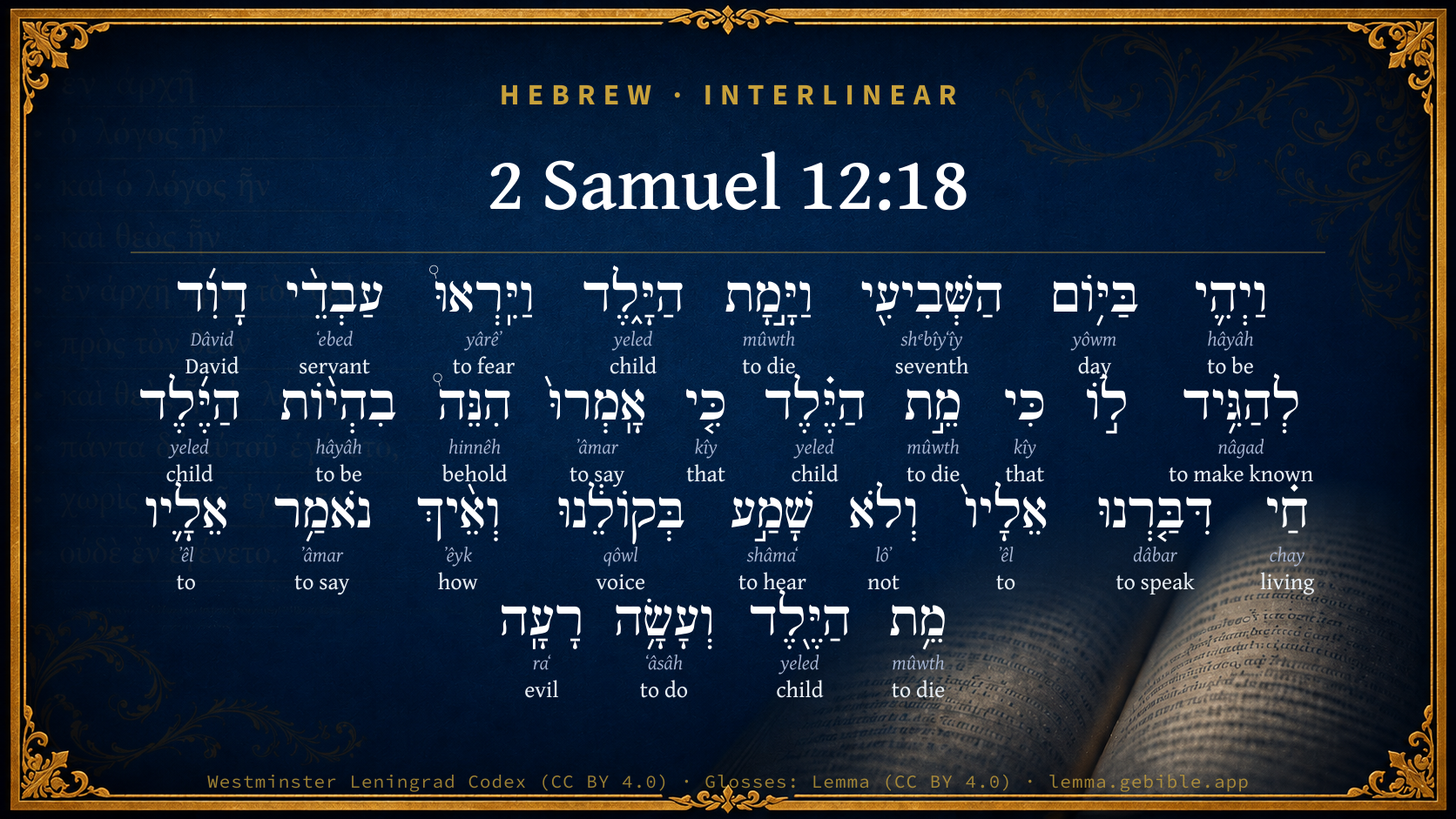
2 Samuel 12:18

Hebrew (Westminster Leningrad Codex) 2 Samuel 12:18 appears in the Hebrew Old Testament. The text above is from the Westminster Leningrad Codex. Each word links to its Strong’s number, a concise gloss, and parsing drawn from the Open Scriptures Hebrew Bible morphology. Click any word for its full Brown-Driver-Briggs (BDB) entry.
Download image
Cite this verse

2 Samuel 12:18 (World English Bible). Public Domain. Lemma interlinear Bible study tool, https://lemma.gebible.app/v/2-samuel/12/18.

Show BibTeX & RIS
BibTeX
RIS
English Translation
It happened on the seventh day, that the child died. The servants of David feared to tell him that the child was dead; for they said, Behold, while the child was yet alive, we spoke to him, and he didn't listen to our voice: how will he then vex himself, if we tell him that the child is dead!
World English Bible · Public Domain
Download a study sheet

One document with this verse’s original text, its word-by-word gloss line, the meaning frame, cross-references with their text, attributed commentary, and full source and license credits — printable, and it pastes into notes with its structure intact.

This verse Autodidact and up

Study sheet (.html) Plain text (.txt)

A passage Seminary Student

Up to 50 verses in one chapter. A passage sheet keeps up to 6 commentary sources and 12 cross-references per verse, in the order this page ranks them, and says so on the sheet whenever that leaves anything out. Ask for a single verse and you get the Autodidact verse sheet above.

Everything on this page stays free to read, with no account — the sheet is a download of what is already on screen, not access to it.

Want to remove ads? Support Godless Engineer
Compare translations 3

The same verse in 3 English versions, stacked beneath the original-language interlinear above. Click any original word for its lexicon entry.

Each is an independent rendering of the whole verse — the interlinear is not word-aligned to these translations.

Highlighted words mark where these versions differ — a whole-verse word diff, not a word-by-word alignment.

  • World English Bible Public Domain
    It happened on the seventh day, that the child died. The servants of David feared to tell him that the child was dead; for they said, Behold, while the child was yet alive, we spoke to him, and he didn't listen to our voice: how will he then vex himself, if we tell him that the child is dead!
  • King James Version Public Domain
    And it came to pass on the seventh day, that the child died. And the servants of David feared to tell him that the child was dead: for they said, Behold, while the child was yet alive, we spake unto him, and he would not hearken unto our voice: how will he then vex himself, if we tell him that the child is dead?
  • unfoldingWord Literal Text CC BY-SA 4.0
    And it happened on the seventh day that the child died, and the servants of David were afraid to declare to him that the child had died, for they said, “Behold, while the child was living, we spoke to him, but he did not listen to our voice. So how shall we say to him, ‘The child has died’? For he will do harm.”

unfoldingWord Literal Text — © unfoldingWord, licensed CC BY-SA 4.0. Word-aligned USFM3 via Door43 (git.door43.org/unfoldingWord/en_ult).

Versions to compare (up to 4)

3 of 4 selected

Show all 18 translations

Every available English version of this verse, each an independent rendering of the whole verse.

  • World English Bible Public Domain
    It happened on the seventh day, that the child died. The servants of David feared to tell him that the child was dead; for they said, Behold, while the child was yet alive, we spoke to him, and he didn't listen to our voice: how will he then vex himself, if we tell him that the child is dead!
  • Berean Standard Bible Public Domain
    On the seventh day the child died. But David’s servants were afraid to tell him that the child was dead, for they said, “Look, while the child was alive, we spoke to him, and he would not listen to us. So how can we tell him the child is dead? He may even harm himself.”
  • Majority Standard Bible Public Domain
    On the seventh day the child died. But David’s servants were afraid to tell him that the child was dead, for they said, “Look, while the child was alive, we spoke to him, and he would not listen to us. So how can we tell him the child is dead? He may even harm himself.”
  • King James Version Public Domain
    And it came to pass on the seventh day, that the child died. And the servants of David feared to tell him that the child was dead: for they said, Behold, while the child was yet alive, we spake unto him, and he would not hearken unto our voice: how will he then vex himself, if we tell him that the child is dead?
  • American Standard Version (1901) Public Domain
    And it came to pass on the seventh day, that the child died. And the servants of David feared to tell him that the child was dead; for they said, Behold, while the child was yet alive, we spake unto him, and he hearkened not unto our voice: how will he then vex himself, if we tell him that the child is dead!
  • Revised Version (1885) Public Domain
    And it came to pass on the seventh day, that the child died. And the servants of David feared to tell him that the child was dead: for they said, Behold, while the child was yet alive, we spake unto him, and he hearkened not unto our voice: how will he then vex himself, if we tell him that the child is dead?
  • Geneva Bible (1599) Public Domain
    So on the seuenth day the child dyed: and the seruants of Dauid feared to tell him that the childe was dead: for they sayde, Beholde, while the childe was aliue, we spake vnto him, and he woulde not hearken vnto our voyce: how then shall we say vnto him, The childe is dead, to vexe him more?
  • Douay-Rheims (1899) Public Domain
    And it came to pass on the seventh day that the child died: and the servants of David feared to tell him, that the child was dead. For they said: Behold when the child was yet alive, we spoke to him, and he would not hearken to our voice: how much more will he afflict himself if we tell him that the child is dead?
  • Young's Literal Translation Public Domain
    and it cometh to pass on the seventh day, that the lad dieth, and the servants of David fear to declare to him that the lad is dead, for they said, `Lo, in the lad being alive we spake unto him, and he did not hearken to our voice; and how do we say unto him, The lad is dead? -- then he hath done evil.'
  • Literal Standard Version CC BY-SA 4.0
    and it comes to pass on the seventh day, that the boy dies, and the servants of David fear to declare to him that the boy is dead, for they said, “Behold, in the boy being alive we spoke to him, and he did not listen to our voice; and how do we say to him, The boy is dead? Then he has done evil.”
  • Unlocked Literal Bible CC BY-SA 4.0
    It came about on the seventh day that the child died. David's servants were afraid to tell him that the child was dead, for they said, “Look, while the child was still alive we spoke to him, and he did not listen to our voice. What might he do to himself if we tell him that the boy is dead?!”
  • unfoldingWord Literal Text CC BY-SA 4.0
    And it happened on the seventh day that the child died, and the servants of David were afraid to declare to him that the child had died, for they said, “Behold, while the child was living, we spoke to him, but he did not listen to our voice. So how shall we say to him, ‘The child has died’? For he will do harm.”
  • Darby Bible Public Domain
    And it came to pass on the seventh day, that the child died. And the servants of David feared to tell him that the child was dead; for they said, Behold, while the child was yet alive, we spoke to him, and he would not hearken to our voice; and how shall we say to him, The child is dead? he may do some harm.
  • World Messianic Bible Public Domain
    On the seventh day, the child died. David’s servants were afraid to tell him that the child was dead, for they said, “Behold, while the child was yet alive, we spoke to him and he didn’t listen to our voice. How will he then harm himself if we tell him that the child is dead?”
  • Webster's Bible Public Domain
    And it came to pass on the seventh day, that the child died. And the servants of David feared to tell him that the child was dead: for they said, Behold while the child was yet alive, we spoke to him, and he would not hearken to our voice: how will he then be grieved, if we tell him that the child is dead?
  • Free Bible Version CC BY-SA 4.0
    On the seventh day the child died. But David's officials were scared to tell him that the child was dead, for they said to each other, “Look, while the child was still alive, we talked with him, and he refused to listen to us. How on earth can we tell him the child is dead? He may do something really bad!”
  • Bible in Basic English Public Domain
    And then on the seventh day the child's death took place. And David's servants were in fear of giving him the news of the child's death: for they said, Truly, while the child was still living he gave no attention when we said anything to him: what will he do to himself if we give him word that the child is dead?
  • JPS Tanakh (1917) Public Domain
    And it came to pass on the seventh day, that the child died. And the servants of David feared to tell him that the child was dead; for they said: 'Behold, while the child was yet alive, we spoke unto him, and he hearkened not unto our voice; how then shall we tell him that the child is dead, so that he do himself some harm?'

Literal Standard Version (2020), Covenant Press — licensed CC BY-SA 4.0. Text via the HelloAO Bible API (eBible.org). Unlocked Literal Bible (unfoldingWord) — licensed CC BY-SA 4.0. Text via the HelloAO Bible API (eBible.org). unfoldingWord Literal Text — © unfoldingWord, licensed CC BY-SA 4.0. Word-aligned USFM3 via Door43 (git.door43.org/unfoldingWord/en_ult). Free Bible Version, Dr. Jonathan Gallagher — licensed CC BY-SA 4.0. Text via the HelloAO Bible API (eBible.org).

Word by word

More ways to search: Search by grammar → Find every occurrence → Compare this word →

Practice this passage: Drill this verse → Learn its vocabulary →

וְאֵ֨יךְ
ʼêyk
H349
“and · how”
Conjunction + Particle, Interrogative
Part of Speech
Conjunction + Particle
Type
Interrogative
Full BDB Definition

Origin: prolonged from H335

TWOT: 75

how? (interrogative adverb) - how! (in lamentation) (interjection) - expression of satisfaction (interjection)
  1. וַיְהִ֛י hâyâh H1961 “and · to be” Conjunction + Verb, Qal, Sequential Imperfect, 3rd Person, Masculine, Singular
  2. בַּיּ֥וֹם yôwm H3117 “in/at the · day” Preposition, Determined + Noun, Common, Masculine, Singular, Absolute
  3. הַשְּׁבִיעִ֖י shᵉbîyʻîy H7637 “the · seventh” Particle, Definite Article + Adjective, Ordinal number, Masculine, Singular, Absolute
  4. וַיָּ֣מָת mûwth H4191 “and · to die” Conjunction + Verb, Qal, Sequential Imperfect, 3rd Person, Masculine, Singular
  5. הַיָּ֑לֶד yeled H3206 “the · child” Particle, Definite Article + Noun, Common, Masculine, Singular, Absolute
  6. וַיִּֽרְאוּ֩ yârêʼ H3372 “and · to fear” Conjunction + Verb, Qal, Sequential Imperfect, 3rd Person, Masculine, Plural
  7. עַבְדֵ֨י ʻebed H5650 “servants of” Noun, Common, Masculine, Plural, Construct
  8. דָוִ֜ד Dâvid H1732 “David” Noun, Proper
  9. לְהַגִּ֥יד nâgad H5046 “to make known” Preposition + Verb, Hiphil, Infinitive Construct
  10. כִּי kîy H3588 “that” Conjunction
  11. מֵ֣ת mûwth H4191 “to die” Verb, Qal, Perfect, 3rd Person, Masculine, Singular
  12. הַיֶּ֗לֶד yeled H3206 “the · child” Particle, Definite Article + Noun, Common, Masculine, Singular, Absolute
  13. כִּ֤י kîy H3588 “that” Conjunction
  14. אָֽמְרוּ֙ ʼâmar H559 “to say” Verb, Qal, Perfect, 3rd Person, Common, Plural
  15. הִנֵּה֩ hinnêh H2009 “behold” Particle, Demonstrative
  16. בִהְי֨וֹת hâyâh H1961 “in/at · to be” Preposition + Verb, Qal, Infinitive Construct
  17. הַיֶּ֜לֶד yeled H3206 “the · child” Particle, Definite Article + Noun, Common, Masculine, Singular, Absolute
  18. חַ֗י chay H2416 “living” Adjective, Adjective, Masculine, Singular, Absolute
  19. דִּבַּ֤רְנוּ dâbar H1696 “to speak” Verb, Piel, Perfect, 1st Person, Common, Plural
  20. אֵלָיו֙ ʼêl H413 “to · him” Preposition + Suffix, Personal, 3rd Person, Masculine, Singular
  21. וְלֹא lôʼ H3808 “and · not” Conjunction + Particle, Negative
  22. שָׁמַ֣ע shâmaʻ H8085 “to hear” Verb, Qal, Perfect, 3rd Person, Masculine, Singular
  23. בְּקוֹלֵ֔נוּ qôwl H6963 “in/at · voice · our” Preposition + Noun, Common, Masculine, Singular, Construct + Suffix, Personal, 1st Person, Common, Plural
  24. נֹאמַ֥ר ʼâmar H559 “to say” Verb, Qal, Imperfect, 1st Person, Common, Plural
  25. אֵלָ֛יו ʼêl H413 “to · him” Preposition + Suffix, Personal, 3rd Person, Masculine, Singular
  26. מֵ֥ת mûwth H4191 “to die” Verb, Qal, Perfect, 3rd Person, Masculine, Singular
  27. הַיֶּ֖לֶד yeled H3206 “the · child” Particle, Definite Article + Noun, Common, Masculine, Singular, Absolute
  28. וְעָשָׂ֥ה ʻâsâh H6213 “and · to do” Conjunction + Verb, Qal, Sequential Perfect, 3rd Person, Masculine, Singular
  29. רָעָֽה raʻ H7451 “evil” Noun, Common, Feminine, Singular, Absolute

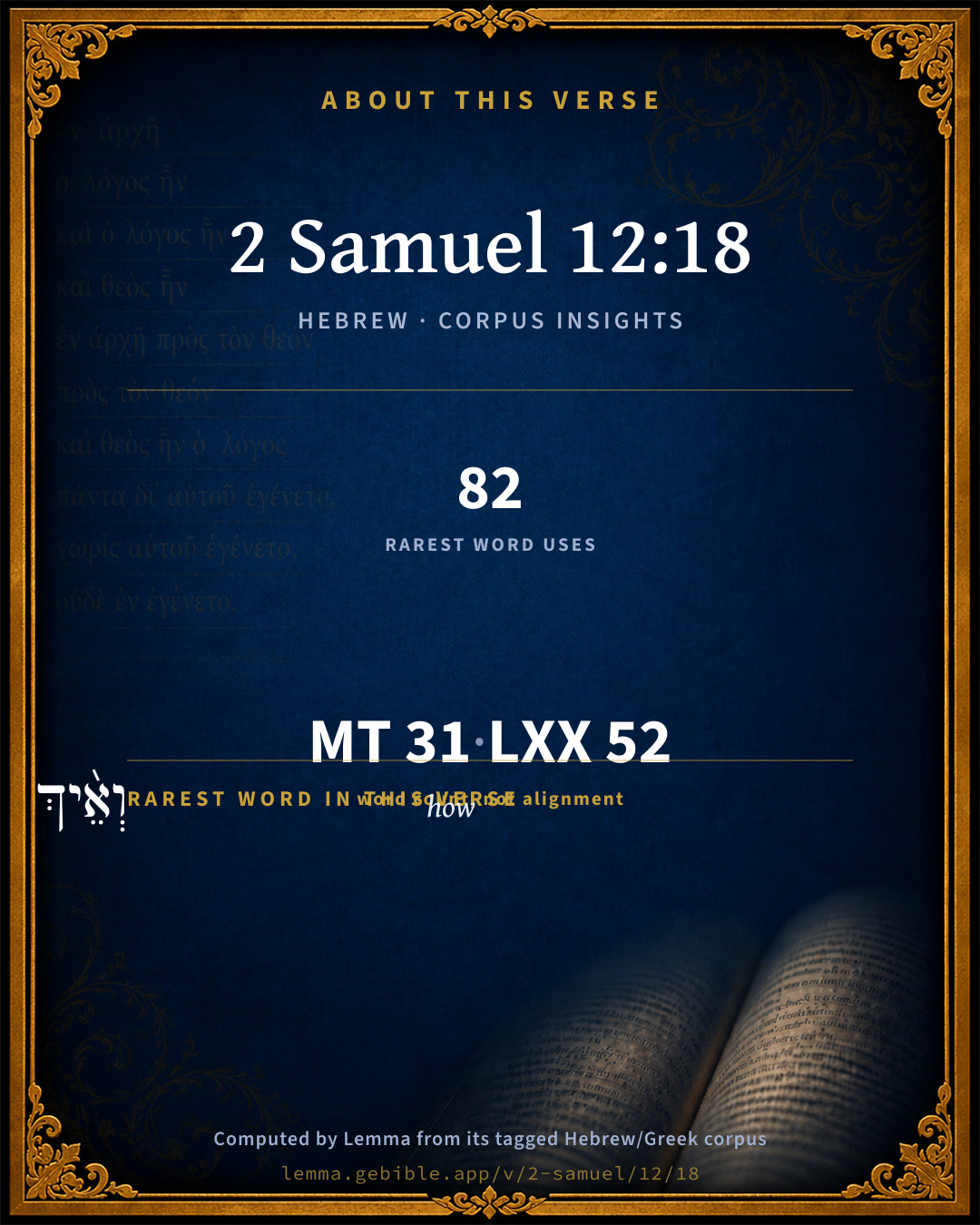
About this verse

These counts appear in no published source. They are computed here, from the morphology-tagged text and Lemma’s own curated glosses. What Lemma adds →

31
words
21
distinct lemmas
Historical
section

Grammatical profile

  • 12 verbs
  • 9 nouns
  • 2 adjectives
  • 3 prepositions
  • 2 conjunctions
  • 3 particles

Verb forms

  • וַיְהִ֛י Qal · Sequential Imperfect
  • וַיָּ֣מָת Qal · Sequential Imperfect
  • וַיִּֽרְאוּ֩ Qal · Sequential Imperfect
  • לְהַגִּ֥יד Hiphil · Infinitive Construct
  • מֵ֣ת Qal · Perfect
  • אָֽמְרוּ֙ Qal · Perfect
  • בִהְי֨וֹת Qal · Infinitive Construct
  • דִּבַּ֤רְנוּ Piel · Perfect
  • שָׁמַ֣ע Qal · Perfect
  • נֹאמַ֥ר Qal · Imperfect
  • מֵ֥ת Qal · Perfect
  • וְעָשָׂ֥ה Qal · Sequential Perfect

Repetition

Words recur within this verse — often emphatic in Hebrew:

  • הַיָּ֑לֶד child H3206 ×4
  • וַיָּ֣מָת to die H4191 ×3
  • וַיְהִ֛י to be H1961 ×2
  • אָֽמְרוּ֙ to say H559 ×2
  • כִּי that H3588 ×2
  • אֵלָיו֙ to H413 ×2

Hebrew & Septuagint length

In English translation the verse runs 59 words from the Hebrew and 65 from the Septuagint (LXX English) — closely comparable.

A rough comparison of the two English renderings, which tokenize alike — not a word-level alignment.

Word counts can differ between the Hebrew and the Greek without any difference in meaning — e.g. the Hebrew direct-object marker אֵת has no separate Greek word, and Greek often adds the article ὁ.

In the original languages it is 31 Hebrew tokens and 52 Greek tokens — but the two are counted differently (Hebrew bundles its prefixes and suffixes into one token; the Greek is in lemma form), so that isn’t a like-for-like length.

Cross-references

1

Topical passages linked to 2 Samuel 12:18 in the Treasury of Scripture Knowledge — connected by theme and wording, ordered by reader-vote popularity; previews shown in the World English Bible.

  • Numbers 20:15 how our fathers went down into Egypt, and we lived in Egypt a long time; and the Egyptians dealt ill with us, and our fathers:

Cross-references courtesy of OpenBible.info (CC BY 4.0).

Hebrew and Greek witnesses Masoretic Hebrew ↔ Greek Septuagint

The same verse in the two great witnesses to the Old Testament, shown verse-for-verse.

These are two independent witnesses, not word-aligned to each other, and the Septuagint is shown in lemma (dictionary) form.

Hebrew 2 Samuel 12:18 Masoretic · Westminster Leningrad Codex

וַיְהִ֛י בַּיּ֥וֹם הַשְּׁבִיעִ֖י וַיָּ֣מָת הַיָּ֑לֶד וַיִּֽרְאוּ֩ עַבְדֵ֨י דָוִ֜ד לְהַגִּ֥יד ל֣וֹ כִּי מֵ֣ת הַיֶּ֗לֶד כִּ֤י אָֽמְרוּ֙ הִנֵּה֩ בִהְי֨וֹת הַיֶּ֜לֶד חַ֗י דִּבַּ֤רְנוּ אֵלָיו֙ וְלֹא שָׁמַ֣ע בְּקוֹלֵ֔נוּ וְאֵ֨יךְ נֹאמַ֥ר אֵלָ֛יו מֵ֥ת הַיֶּ֖לֶד וְעָשָׂ֥ה רָעָֽה

It happened on the seventh day, that the child died. The servants of David feared to tell him that the child was dead; for they said, Behold, while the child was yet alive, we spoke to him, and he didn't listen to our voice: how will he then vex himself, if we tell him that the child is dead!

World English Bible · Public Domain

Greek LXX 2 Samuel 12:18 Septuagint · lemma form

καί γίγνομαι ἐν ὁ ἡμέρα ὁ ἕβδομος καί ἀποθνήσκω ὁ παιδάριον καί φοβέω ὁ δοῦλος δαυίδ ἀναἀγγέλλω αὐτός ὅτι θνήσκω ὁ παιδάριον ὅτι εἶπον ἰδού ἐν ὁ ἔτι ὁ παιδάριον ζάω λαλέω πρός αὐτός καί οὐ εἰςἀκούω ὁ φωνή ἐγώ καί πῶς εἶπον πρός αὐτός ὅτι θνήσκω ὁ παιδάριον καί ποιέω κακός

And it came to pass on the seventh day that the child died: and the servants of David were afraid to tell him that the child was dead; for they said, Behold, while the child was yet alive we spoke to him, and he listened not to our voice; and you should we tell him that the child is dead?—so would he do himself harm.

LXX2012 (modern English Septuagint) · Public Domain

Hebrew: Westminster Leningrad Codex (CC BY 4.0). Greek: Septuagint (public domain); English from LXX2012 (modern English Septuagint) (Public Domain). How the Septuagint differs from the Hebrew →

Targum (Aramaic paraphrase)

1

The Targum is the ancient Jewish Aramaic paraphrase of the Hebrew Scriptures — an interpretive translation, not the Hebrew text itself. Onkelos (literal) and Pseudo-Jonathan (expansive) render the Torah, and Jonathan the Prophets. Coverage is partial: where no permissively-licensed English translation exists for a verse, only the Aramaic is shown. This is verse-level text, not a word-by-word alignment to the Hebrew.

  1. Targum Jonathan Prophets (Joshua–Malachi)
    וַהֲוָה בְּיוֹמָא שְׁבִיעָאָה וּמִית רַבְיָא וּדְחִילוּ עַבְדֵי דָוִד לְחַוָאָה לֵיהּ אֲרֵי מִית רַבְיָא אֲרֵי אֲמַרוּ כַּד הֲוָה רַבְיָא קַיָם מַלֵילְנָא עִמֵיהּ וְלָא קַבֵּיל מִנָנָא וְאֵיכְדֵין נֵימַר לֵיהּ מִית רַבְיָא וְיַעְבֵּד בִּישָׁא:

    (no public-domain English translation for this verse)

    Targum Jonathan — Aramaic: “Mikraot Gedolot” (public domain). English: “Sefaria Community Translation” (CC0 1.0 (public-domain dedication)); “London "Chaldee Paraphrase," 1871” (public domain). Text via Sefaria.

Commentary

Notes on 2 Samuel 12:18 from classic Christian and Jewish commentators (each source and its license shown beneath its notes). The classic Christian expositions comment on the surrounding passage and are grouped to its opening verse, so a note may address several verses; the Jewish commentaries on the Tanakh (Rashi and others) are per-verse, so they appear only where the commentator wrote on this verse.

Lemma curates 59 commentaries, every one of them public domain or Creative Commons licensed, each selected and text-cleaned for this edition rather than reprinted as found. About our sources →

Trapp's Complete Commentary

John Trapp

2Sa 12:18 And it came to pass on the seventh day, that the child died. And the servants of David feared to tell him that the child was dead: for they said, Behold, while the child was yet alive, we spake unto him, and he would not hearken unto our voice: how will he then vex himself, if we tell him that the child is dead?

Ver. 18. And it came to pass on the seventh day,] viz., Of the child’s sickness, a critical day; or, After his birth, and then he died without circumcision, and yet was saved. {2Sa 12:23} Gratia non est alligata symbolis, God’s grace is not tied unto the signs.

That the child died.] Repentance may come too late in respect of temporal chastisements, {1Co 11:32} which yet are not penal but medicinal. Thus Moses and Aaron were kept out of Canaan for their disobedience at the waters of Meribah.

John Trapp, A Commentary or Exposition upon All the Books of the Old and New Testament (1647–1656) — public domain. Text from a community e-Sword module.

Joseph Benson's Commentary

2Sa 12:18. On the seventh day the child died — The seventh from the beginning of the distemper. “Thus was the first instance of the divine vengeance for David’s guilt speedily and rigidly executed; other instances of it were fulfilled in their order, before his own eyes, as will abundantly appear in the sequel of this history; and the most dreadful of all the rest, The sword shall never depart from thy house, sadly and successively fulfilled in his posterity; from the death of Amnon, by the order of his own brother, to the slaughter of the sons of Zedekiah before his own eyes, by the king of Babylon.” We may learn from hence, therefore, that God is no respecter of persons, for David’s guilt was as signally and dreadfully punished in his own person, and in his posterity, as perhaps any guilt in any other person since Adam. “The Jews are of opinion that his own decree of repaying the robbery four-fold was strictly executed upon him. The deflouring of Tamar by her own brother; the death of four sons, three of them before his own eyes, and one by the hand of his brother; the unnatural rebellion of one son, which brought him almost to the brink of ruin; the prostitution of ten wives in the sight of all his subjects; and the successive and signal massacre of his posterity; besides the distress of his own public shame and infamy, added to at least one cruel disease.” These are surely awful proofs that God did not connive at sin in David any more than in any other. Why then are the scoffers so fond of urging and dwelling on the heinous crimes of David? Do the Holy Scriptures deny them? No, they set them forth with all their aggravating circumstances, but at the same time they assure us they were followed by such a train of calamities as is enough to make every sinner tremble; since it affords an indubitable proof that the ALMIGHTY GOVERNOR of the world is of purer eyes than to behold iniquity without detestation, and that every species of vice and wickedness, in whomsoever it is found, will certainly be punished under his government. Let the reader consider these things, and then say, whether David’s example be an encouragement to sin? Who would incur his guilt to go through such a scene of sorrow and suffering? See Delaney.

Joseph Benson's Commentary on the Old and New Testaments (1811–1818) — public domain. Text from a community e-Sword module.

Geneva Bible (1599)

Geneva Bible translators

Hebrew, and he will do himself evil.

Geneva Bible (1599) marginal notes — public domain. Text via Bolls.life.

John Gill's Exposition

And when David saw that his servants whispered,.... For they said the above to one another with a low voice, that he might not hear them, though in the same room with them:

David perceived the child was dead; he guessed it was, and that this was the thing they were whispering about among themselves:

therefore David said unto his servants, is the child dead? and they said, he is dead; for putting the question to them so closely, they could not avoid giving the answer they did, and which he was prepared to receive, by what he had observed in them.

John Gill's Exposition of the Whole Bible (1746–1763) — public domain (CC PDM 1.0). Text via the HelloAO Bible API.

Haydock's Catholic Bible Commentary

Day. After his birth, when he had received circumcision; (Salien) or on the 7th day since the commencement of his malady. (Calmet; Menochius)

George Leo Haydock (1774–1849), Haydock's Catholic Family Bible and Commentary, 1859 edition — public domain. Excludes Psalms (Douay-Rheims chapter numbering differs from Protestant) and Deuterocanonical books (Catholic canon only).

Matthew Poole's English Annotations

On the seventh day; either,

1. From the beginning of the distemper. Or rather,

2. From the day of his birth, which is the most usual way of computation of men’s days or years; for it is apparent that this happened during the time of David’s fasting and lying upon the earth, 2Sa 12:20, which it is not probable that it lasted for seven days.

They said, whispering among themselves, 2Sa 12:19.

Matthew Poole's English Annotations on the Holy Bible (1683–1685) — public domain. Text from a community e-Sword/MySword module.

John Wesley's Explanatory Notes

Seventh day - From the beginning of the distemper.

John Wesley, Explanatory Notes Upon the Whole Bible (1754–1765) — public domain. Text via the GEBible commentary corpus.

Lesson kit

Teaching starters — assembled from the data on this page, not authored interpretation. Every prompt links to the verse data it draws on. Edit before teaching.

2 Samuel, in the Historical, opens this verse with 31 words (21 distinct Hebrew lemmas). Its most distinctive word is ʼêyk (“how”). A historical commentator’s framing appears above. Read the whole chapter for the surrounding context.

Discussion questions

  1. How does “how” (ʼêyk) shape what this verse is saying?
  2. How does Numbers 20:15, which shares this passage’s theme, read alongside this verse?
  3. What does the repetition of “child” (4× in this one verse) do in this verse?
  4. These translations render this verse differently. What is at stake in choosing one wording over another?
  5. «וַיְהִ֛י» is a Qal Sequential Imperfect verb. How does that grammatical form shape the action described?
  6. Compare how Trapp's Complete Commentary and Joseph Benson's Commentary read this verse. Where do they agree or differ?

Things to notice

Reading settings

Reading text

Shown beneath each verse's original-language words.

Old Testament
Old Testament edition

Read the OT as the Masoretic Hebrew (MT) or the Greek Septuagint (LXX).

English shown for the Greek Septuagint (in the Hebrew ↔ Greek comparison).

Comparing translations? Open the Compare panel on any verse page to stack up to four side by side.