
1 Kings 14:6

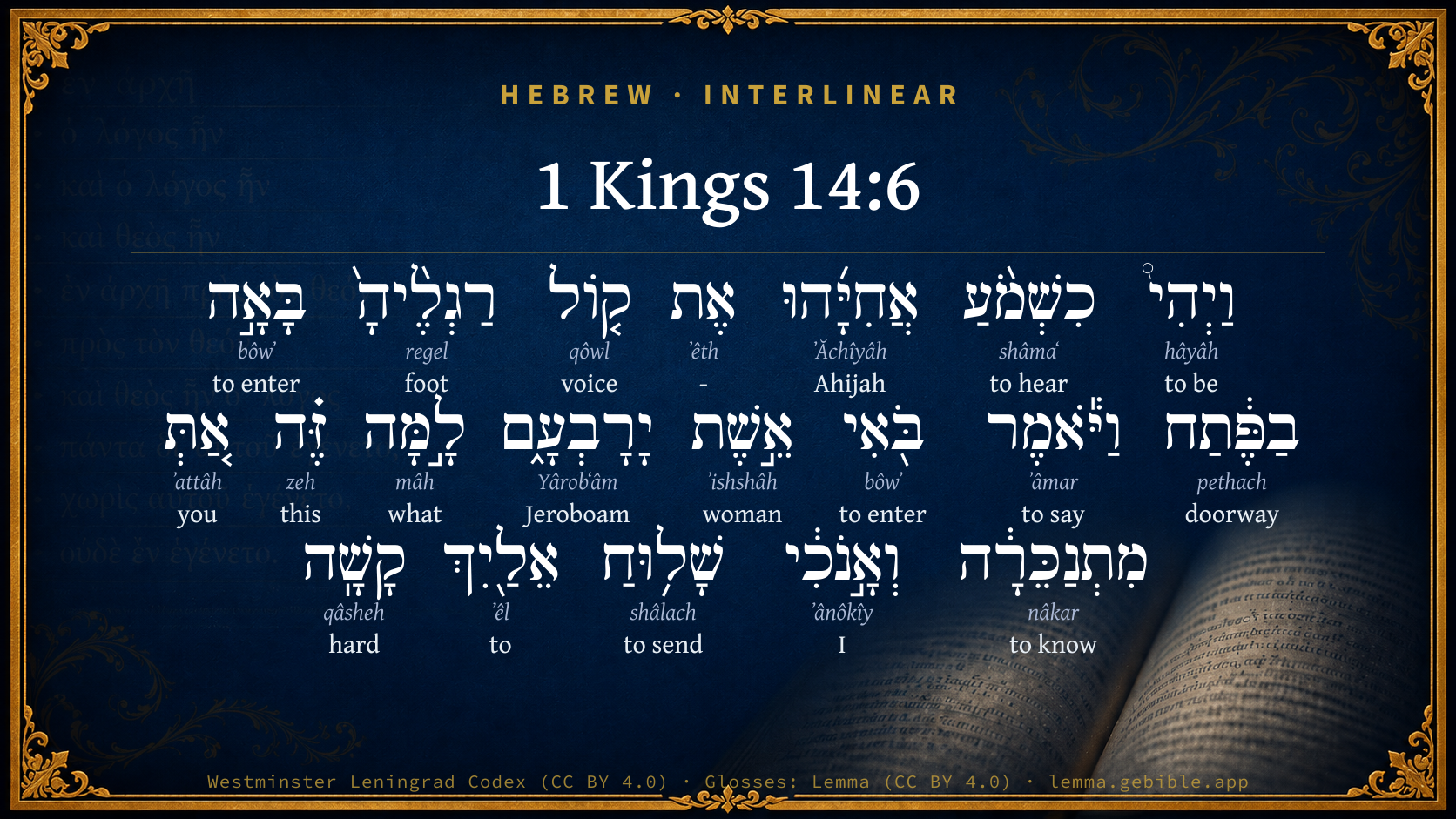
Hebrew (Westminster Leningrad Codex) 1 Kings 14:6 appears in the Hebrew Old Testament. The text above is from the Westminster Leningrad Codex. Each word links to its Strong’s number, a concise gloss, and parsing drawn from the Open Scriptures Hebrew Bible morphology. Click any word for its full Brown-Driver-Briggs (BDB) entry.
Download image
Cite this verse

1 Kings 14:6 (World English Bible). Public Domain. Lemma interlinear Bible study tool, https://lemma.gebible.app/v/1-kings/14/6.

Show BibTeX & RIS
BibTeX
RIS
English Translation
It was so, when Ahijah heard the sound of her feet, as she came in at the door, that he said, Come in, you wife of Jeroboam; why feign you yourself to be another? for I am sent to you with heavy news.
World English Bible · Public Domain
Download a study sheet

One document with this verse’s original text, its word-by-word gloss line, the meaning frame, cross-references with their text, attributed commentary, and full source and license credits — printable, and it pastes into notes with its structure intact.

This verse Autodidact and up

Study sheet (.html) Plain text (.txt)

A passage Seminary Student

Up to 50 verses in one chapter. A passage sheet keeps up to 6 commentary sources and 12 cross-references per verse, in the order this page ranks them, and says so on the sheet whenever that leaves anything out. Ask for a single verse and you get the Autodidact verse sheet above.

Everything on this page stays free to read, with no account — the sheet is a download of what is already on screen, not access to it.

Want to remove ads? Support Godless Engineer
Compare translations 3

The same verse in 3 English versions, stacked beneath the original-language interlinear above. Click any original word for its lexicon entry.

Each is an independent rendering of the whole verse — the interlinear is not word-aligned to these translations.

Highlighted words mark where these versions differ — a whole-verse word diff, not a word-by-word alignment.

  • World English Bible Public Domain
    It was so, when Ahijah heard the sound of her feet, as she came in at the door, that he said, Come in, you wife of Jeroboam; why feign you yourself to be another? for I am sent to you with heavy news.
  • King James Version Public Domain
    And it was so, when Ahijah heard the sound of her feet, as she came in at the door, that he said, Come in, thou wife of Jeroboam; why feignest thou thyself to be another? for I am sent to thee with heavy tidings.
  • unfoldingWord Literal Text CC BY-SA 4.0
    And it happened, when Ahijah heard the sound of her feet coming into the entrance, that he said, “Enter, wife of Jeroboam. Why is this, you are disguising yourself? Now I have been sent to you harshly.

unfoldingWord Literal Text — © unfoldingWord, licensed CC BY-SA 4.0. Word-aligned USFM3 via Door43 (git.door43.org/unfoldingWord/en_ult).

Versions to compare (up to 4)

3 of 4 selected

Show all 18 translations

Every available English version of this verse, each an independent rendering of the whole verse.

  • World English Bible Public Domain
    It was so, when Ahijah heard the sound of her feet, as she came in at the door, that he said, Come in, you wife of Jeroboam; why feign you yourself to be another? for I am sent to you with heavy news.
  • Berean Standard Bible Public Domain
    So when Ahijah heard the sound of her feet entering the door, he said, “Come in, wife of Jeroboam! Why are you disguised? For I have been sent to you with bad news.
  • Majority Standard Bible Public Domain
    So when Ahijah heard the sound of her feet entering the door, he said, “Come in, wife of Jeroboam! Why are you disguised? For I have been sent to you with bad news.
  • King James Version Public Domain
    And it was so, when Ahijah heard the sound of her feet, as she came in at the door, that he said, Come in, thou wife of Jeroboam; why feignest thou thyself to be another? for I am sent to thee with heavy tidings.
  • American Standard Version (1901) Public Domain
    And it was so, when Ahijah heard the sound of her feet, as she came in at the door, that he said, Come in, thou wife of Jeroboam; why feignest thou thyself to be another? for I am sent to thee with heavy tidings.
  • Revised Version (1885) Public Domain
    And it was so, when Ahijah heard the sound of her feet, as she came in at the door, that he said, Come in, thou wife of Jeroboam; why feignest thou thyself to be another? for I am sent to thee with heavy tidings.
  • Geneva Bible (1599) Public Domain
    Therefore when Ahiiah heard the sounde of her feete as shee came in at the doore, hee saide, Come in, thou wife of Ieroboam: why feinest thou thus thy selfe to bee an other? I am sent to thee with heauie tidings.
  • Douay-Rheims (1899) Public Domain
    Ahias heard the sound of her feet coming in at the door, and said: Come in, thou wife of Jeroboam: why dost thou feign thyself to be another? But I am sent to thee with heavy tidings.
  • Young's Literal Translation Public Domain
    And it cometh to pass, at Ahijah's hearing the sound of her feet `as' she came in to the opening, that he saith, `Come in, wife of Jeroboam, why is this -- thou art making thyself strange? and I am sent unto thee `with' a sharp thing:
  • Literal Standard Version CC BY-SA 4.0
    And it comes to pass, at Ahijah’s hearing the sound of her feet [as] she came to the opening, that he says, “Come in, wife of Jeroboam, why is this [that] you are making yourself strange? And I am sent to you [with] a sharp thing.
  • Unlocked Literal Bible CC BY-SA 4.0
    When Ahijah heard the sound of her feet as she came in at the door, he said, “Come in, wife of Jeroboam. Why do you pretend to be someone you are not? I have been sent to you with bad news.
  • unfoldingWord Literal Text CC BY-SA 4.0
    And it happened, when Ahijah heard the sound of her feet coming into the entrance, that he said, “Enter, wife of Jeroboam. Why is this, you are disguising yourself? Now I have been sent to you harshly.
  • Darby Bible Public Domain
    And it was so, when Ahijah heard the sound of her feet, as she came in at the door, that he said, Come in, thou wife of Jeroboam; why feignest thou to be another? But I am sent to thee with a hard [message].
  • World Messianic Bible Public Domain
    So when Ahijah heard the sound of her feet as she came in at the door, he said, “Come in, Jeroboam’s wife! Why do you pretend to be another? For I am sent to you with heavy news.
  • Webster's Bible Public Domain
    And it was so, when Ahijah heard the sound of her feet, as she came in at the door, that he said, Come in, thou wife of Jeroboam; why feignest thou thyself to be another? for I am sent to thee with heavy tidings.
  • Free Bible Version CC BY-SA 4.0
    So as soon as Ahijah heard her footsteps at the door, he called out, “Come in, wife of Jeroboam! Why do you bother coming in disguise? I have been given some bad news for you.
  • Bible in Basic English Public Domain
    Then Ahijah, hearing the sound of her footsteps coming in at the door, said, Come in, O wife of Jeroboam; why do you make yourself seem like another? for I am sent to you with bitter news.
  • JPS Tanakh (1917) Public Domain
    And it was so, when Ahijah heard the sound of her feet, as she came in at the door, that he said: 'Come in, thou wife of Jeroboam; why feignest thou thyself to be another? for I am sent to thee with heavy tidings.

Literal Standard Version (2020), Covenant Press — licensed CC BY-SA 4.0. Text via the HelloAO Bible API (eBible.org). Unlocked Literal Bible (unfoldingWord) — licensed CC BY-SA 4.0. Text via the HelloAO Bible API (eBible.org). unfoldingWord Literal Text — © unfoldingWord, licensed CC BY-SA 4.0. Word-aligned USFM3 via Door43 (git.door43.org/unfoldingWord/en_ult). Free Bible Version, Dr. Jonathan Gallagher — licensed CC BY-SA 4.0. Text via the HelloAO Bible API (eBible.org).

Word by word

More ways to search: Search by grammar → Find every occurrence → Compare this word →

Practice this passage: Drill this verse → Learn its vocabulary →

אֲחִיָּ֜הוּ
ʼĂchîyâh
H281
“Ahijah”
Noun, Proper
Part of Speech
Noun
Type
Proper
Full BDB Definition

Origin: from H251 and H3050

TWOT: None

Ahiah or Ahijah = "brother of Jehovah (Yahu)" - grandson of Phinehas - scribe of Solomon - a prophet who predicted the revolt of the Northern tribes - father of Baasha, who usurped the Northern throne - grandson of Hezron (or mother of 1-4 above) - a Benjamite, son of Ehud - one of David's heroes - a Levite during David's time - a chief man under Nehemiah
  1. וַיְהִי֩ hâyâh H1961 “and · to be” Conjunction + Verb, Qal, Sequential Imperfect, 3rd Person, Masculine, Singular
  2. כִשְׁמֹ֨עַ shâmaʻ H8085 “like/as · to hear” Preposition + Verb, Qal, Infinitive Construct
  3. אֶת ʼêth H853 “-” Particle, Direct Object
  4. ק֤וֹל qôwl H6963 “voice of” Noun, Common, Masculine, Singular, Construct
  5. רַגְלֶ֨יהָ֙ regel H7272 “feet · her” Noun, Common, Feminine, Dual, Construct + Suffix, Personal, 3rd Person, Feminine, Singular
  6. בָּאָ֣ה bôwʼ H935 “entering” Verb, Qal, Participle Active, Feminine, Singular, Absolute
  7. בַפֶּ֔תַח pethach H6607 “in/at the · doorway” Preposition, Determined + Noun, Common, Masculine, Singular, Absolute
  8. וַיֹּ֕אמֶר ʼâmar H559 “and · to say” Conjunction + Verb, Qal, Sequential Imperfect, 3rd Person, Masculine, Singular
  9. בֹּ֖אִי bôwʼ H935 “enter” Verb, Qal, Imperative, 2nd Person, Feminine, Singular
  10. אֵ֣שֶׁת ʼishshâh H802 “woman of” Noun, Common, Feminine, Singular, Construct
  11. יָרָבְעָ֑ם Yârobʻâm H3379 “Jeroboam” Noun, Proper
  12. לָ֣מָּה mâh H4100 “to/for · what” Preposition + Particle, Interrogative
  13. זֶּ֗ה zeh H2088 “this” Pronoun, Demonstrative, Masculine, Singular
  14. אַ֚תְּ ʼattâh H859 “you” Pronoun, Personal, 2nd Person, Feminine, Singular
  15. מִתְנַכֵּרָ֔ה nâkar H5234 “knowing” Verb, Hithpael, Participle Active, Feminine, Singular, Absolute
  16. וְאָ֣נֹכִ֔י ʼânôkîy H595 “and · I” Conjunction + Pronoun, Personal, 1st Person, Common, Singular
  17. שָׁל֥וּחַ shâlach H7971 “sent” Verb, Qal, Participle Passive, Masculine, Singular, Absolute
  18. אֵלַ֖יִךְ ʼêl H413 “to · you” Preposition + Suffix, Personal, 2nd Person, Feminine, Singular
  19. קָשָֽׁה qâsheh H7186 “hard” Adjective, Adjective, Feminine, Singular, Absolute

About this verse

These counts appear in no published source. They are computed here, from the morphology-tagged text and Lemma’s own curated glosses. What Lemma adds →

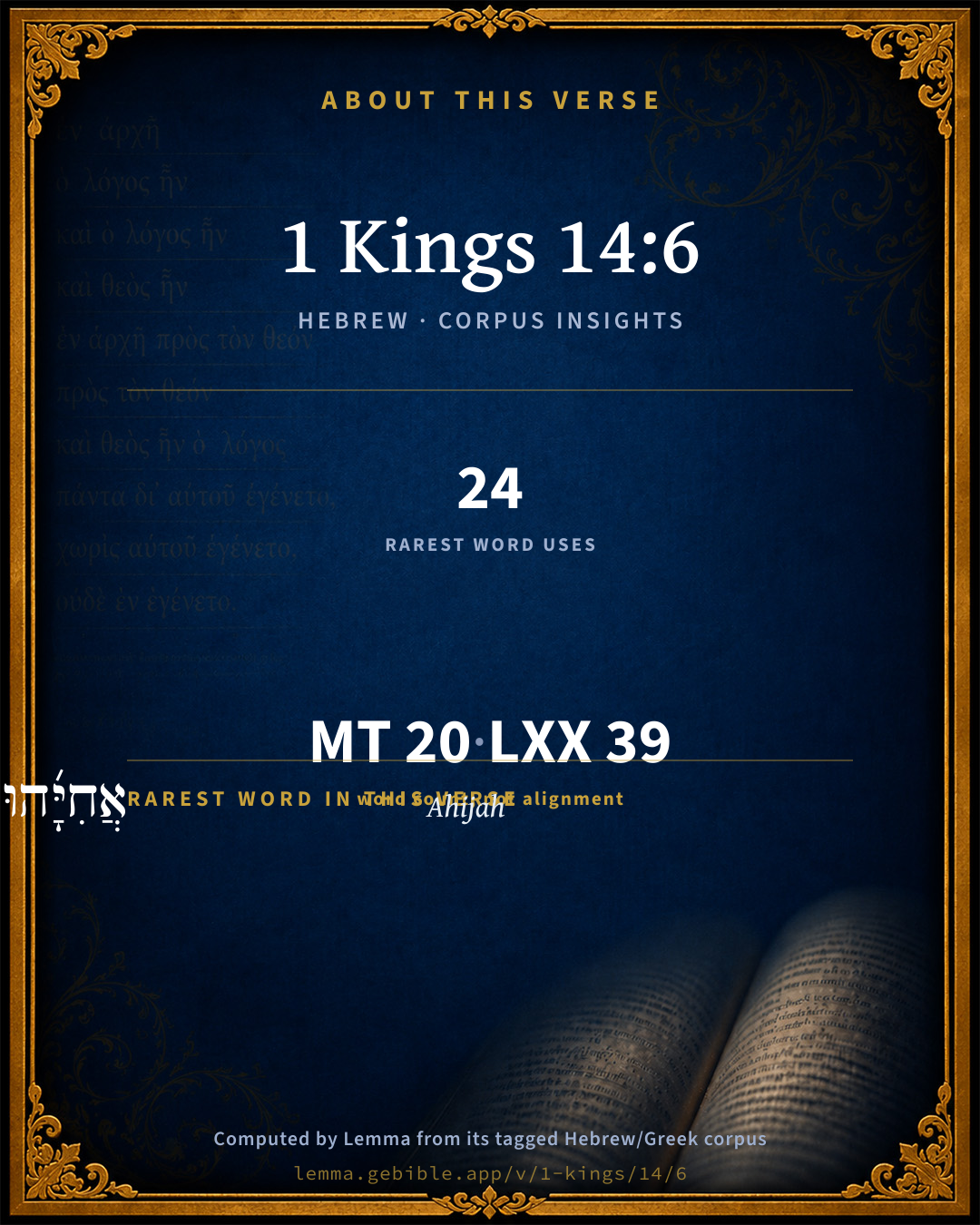
20
words
19
distinct lemmas
Historical
section

Notable vocabulary

The rarest word here is אֲחִיָּ֜הוּ Ahijah H281 — appearing just 24 times in the whole Hebrew Bible.

Shared distinctive vocabulary

אֲחִיָּ֜הוּ Ahijah H281 occurs in 23 verses of the Hebrew Bible. Also found in:

Grammatical profile

  • 7 verbs
  • 6 nouns
  • 1 adjective
  • 3 pronouns
  • 1 preposition
  • 2 particles

Verb forms

  • וַיְהִי֩ Qal · Sequential Imperfect
  • כִשְׁמֹ֨עַ Qal · Infinitive Construct
  • בָּאָ֣ה Qal · Participle Active
  • וַיֹּ֕אמֶר Qal · Sequential Imperfect
  • בֹּ֖אִי Qal · Imperative
  • מִתְנַכֵּרָ֔ה Hithpael · Participle Active
  • שָׁל֥וּחַ Qal · Participle Passive

Repetition

A word recurs within this verse — often emphatic in Hebrew:

  • בָּאָ֣ה to enter H935 ×2

Hebrew & Septuagint length

In the original languages it is 20 Hebrew tokens and 39 Greek tokens — but the two are counted differently (Hebrew bundles its prefixes and suffixes into one token; the Greek is in lemma form), so that isn’t a like-for-like length.

Cross-references

23

Topical passages linked to 1 Kings 14:6 in the Treasury of Scripture Knowledge — connected by theme and wording, ordered by reader-vote popularity; previews shown in the World English Bible.

  • 1 Samuel 15:16 Then Samuel said to Saul, Stay, and I will tell you what Yahweh has said to me this night. He said to him, Say on.
  • 1 Samuel 15:26 Samuel said to Saul, I will not return with you; for you have rejected the word of Yahweh, and Yahweh has rejected you from being king over Israel.
  • 1 Samuel 28:18 Because you didn't obey the voice of Yahweh, and didn't execute his fierce wrath on Amalek, therefore has Yahweh done this thing to you this day.
  • 1 Kings 13:20–22 It happened, as they sat at the table, that the word of Yahweh came to the prophet who brought him back;
  • 1 Kings 14:2 Jeroboam said to his wife, Please get up and disguise yourself, that you not be known to be the wife of Jeroboam; and get you to Shiloh: behold, there is Ahijah the prophet, who spoke concerning me that I should be king over this people.
  • 1 Kings 14:5 Yahweh said to Ahijah, Behold, the wife of Jeroboam comes to inquire of you concerning her son; for he is sick: thus and thus shall you tell her; for it will be, when she comes in, that she will feign herself to be another woman.
  • 1 Kings 14:10–11 therefore, behold, I will bring evil on the house of Jeroboam, and will cut off from Jeroboam every man-child, him who is shut up and him who is left at large in Israel, and will utterly sweep away the house of Jeroboam, as a man sweeps away dung, until it be all gone.
  • 1 Kings 20:42 He said to him, Thus says Yahweh, Because you have let go out of your hand the man whom I had devoted to destruction, therefore your life shall go for his life, and your people for his people.
  • 1 Kings 21:18–24 Arise, go down to meet Ahab king of Israel, who dwells in Samaria: behold, he is in the vineyard of Naboth, where he is gone down to take possession of it.
  • 1 Kings 22:8 The king of Israel said to Jehoshaphat, there is yet one man by whom we may inquire of Yahweh, Micaiah the son of Imlah: but I hate him; for he does not prophesy good concerning me, but evil. Jehoshaphat said, "Don't let the king say so."
  • Job 5:13 He takes the wise in their own craftiness; The counsel of the cunning is carried headlong.
  • Psalms 33:10 Yahweh brings the counsel of the nations to nothing. He makes the thoughts of the peoples to be of no effect.
  • Jeremiah 21:2–7 Please inquire of Yahweh for us; for Nebuchadrezzar king of Babylon makes war against us: peradventure Yahweh will deal with us according to all his wondrous works, that he may go up from us.
  • Ezekiel 2:4–5 The children are impudent and stiff-hearted: I do sent you to them; and you shall tell them, Thus says the Lord Yahweh.
  • Ezekiel 14:3–5 Son of man, these men have taken their idols into their heart, and put the stumbling block of their iniquity before their face: should I be inquired of at all by them?
  • Ezekiel 14:7–8 For everyone of the house of Israel, or of the strangers who sojourn in Israel, who separates himself from me, and takes his idols into his heart, and puts the stumbling block of his iniquity before his face, and comes to the prophet to inquire for himself of me; I Yahweh will answer him by myself:
  • Daniel 4:19–25 Then Daniel, whose name was Belteshazzar, was stricken mute for a while, and his thoughts troubled him. The king answered, Belteshazzar, don't let the dream, or the interpretation, trouble you. Belteshazzar answered, My lord, the dream be to those who hate you, and the interpretation of it to your adversaries.
  • Daniel 5:17–28 Then Daniel answered before the king, Let your gifts be to yourself, and give your rewards to another; nevertheless I will read the writing to the king, and make known to him the interpretation.
  • Mark 14:21 For the Son of Man goes, even as it is written about him, but woe to that man by whom the Son of Man is betrayed! It would be better for that man if he had not been born."
  • Luke 20:20–23 They watched him, and sent out spies, who pretended to be righteous, that they might trap him in something he said, so as to deliver him up to the power and authority of the governor.
  • Acts 5:3–5 But Peter said, "Ananias, why has Satan filled your heart to lie to the Holy Spirit, and to keep back part of the price of the land?
  • Acts 5:9–10 But Peter asked her, "How is it that you have agreed together to tempt the Spirit of the Lord? Behold, the feet of those who have buried your husband are at the door, and they will carry you out."
  • Hebrews 4:13 There is no creature that is hidden from his sight, but all things are naked and laid open before the eyes of him with whom we have to do.

Cross-references courtesy of OpenBible.info (CC BY 4.0).

Hebrew and Greek witnesses Masoretic Hebrew ↔ Greek Septuagint

The same verse in the two great witnesses to the Old Testament, shown verse-for-verse.

These are two independent witnesses, not word-aligned to each other, and the Septuagint is shown in lemma (dictionary) form.

Hebrew 1 Kings 14:6 Masoretic · Westminster Leningrad Codex

וַיְהִי֩ כִשְׁמֹ֨עַ אֲחִיָּ֜הוּ אֶת ק֤וֹל רַגְלֶ֨יהָ֙ בָּאָ֣ה בַפֶּ֔תַח וַיֹּ֕אמֶר בֹּ֖אִי אֵ֣שֶׁת יָרָבְעָ֑ם לָ֣מָּה זֶּ֗ה אַ֚תְּ מִתְנַכֵּרָ֔ה וְאָ֣נֹכִ֔י שָׁל֥וּחַ אֵלַ֖יִךְ קָשָֽׁה

It was so, when Ahijah heard the sound of her feet, as she came in at the door, that he said, Come in, you wife of Jeroboam; why feign you yourself to be another? for I am sent to you with heavy news.

World English Bible · Public Domain

Greek LXX 1 Kings 14:6 Septuagint · lemma form

καί λαμβάνω πᾶς ὁ θησαυρός οἶκος κύριος καί ὁ θησαυρός οἶκος ὁ βασιλεύς καί ὁ δόρυ ὁ χρυσοῦς ὅς λαμβάνω δαυίδ ἐκ χείρ ὁ παῖς αδρααζαρ βασιλεύς σουβα καί εἰςφέρω αὐτός εἰς ἰερουσαλήμ ὁ πᾶς λαμβάνω ὅπλον ὁ χρυσοῦς

No English rendering of this Greek verse — the small residue in the structurally divergent books.

On this verse, The Cambridge Bible for Schools and Colleges discusses the Septuagint’s reading. Read the note in Commentary ↓

Hebrew: Westminster Leningrad Codex (CC BY 4.0). Greek: Septuagint (public domain); English from a public-domain English Septuagint. How the Septuagint differs from the Hebrew →

Targum (Aramaic paraphrase)

1

The Targum is the ancient Jewish Aramaic paraphrase of the Hebrew Scriptures — an interpretive translation, not the Hebrew text itself. Onkelos (literal) and Pseudo-Jonathan (expansive) render the Torah, and Jonathan the Prophets. Coverage is partial: where no permissively-licensed English translation exists for a verse, only the Aramaic is shown. This is verse-level text, not a word-by-word alignment to the Hebrew.

  1. Targum Jonathan Prophets (Joshua–Malachi)
    וַהֲוָה כַּד שְׁמַע אֲחִיָה יַת קַל רִגְלָאָה עָלַת בְתַרְעָא וַאֲמַר עוּלִי אִתַּת יָרָבְעָם לְמָא דְנַן אַתְּ מִשְׁתַּנְיָא וַאֲנָא שְׁלִיחַ לְאִתְנַבָּאָה עֲלָךְ פִּתְגָמִין קָשָׁן:

    (no public-domain English translation for this verse)

    Targum Jonathan — Aramaic: “Mikraot Gedolot” (public domain). English: “Sefaria Community Translation” (CC0 1.0 (public-domain dedication)); “London "Chaldee Paraphrase," 1871” (public domain). Text via Sefaria.

Commentary

Notes on 1 Kings 14:6 from classic Christian and Jewish commentators (each source and its license shown beneath its notes). The classic Christian expositions comment on the surrounding passage and are grouped to its opening verse, so a note may address several verses; the Jewish commentaries on the Tanakh (Rashi and others) are per-verse, so they appear only where the commentator wrote on this verse.

Lemma curates 59 commentaries, every one of them public domain or Creative Commons licensed, each selected and text-cleaned for this edition rather than reprinted as found. About our sources →

Trapp's Complete Commentary

John Trapp

1Ki 14:6 And it was [so], when Ahijah heard the sound of her feet, as she came in at the door, that he said, Come in, thou wife of Jeroboam; why feignest thou thyself [to be] another? for I [am] sent to thee [with] heavy [tidings].

Ver. 6. Come in, thou wife of Jeroboam.] How God laughs in heaven at the frivolous fetches of crafty politicians and double-minded dissemblers! Surely when they think themselves most sure, he shameth them with a defeat. What an idleness is it for foolish hypocrites to hope that they can dance: in a net unseen of Heaven!

For I am sent to thee with heavy tidings.] Heb., Hard. Jeroboam was hard-hearted and refractory: a hard and heavy message is therefore sent unto him, that a hard knot may have a hard wedge. Neither is the voice of God’s word ever any better to the guilty, if impenitent. It is as the knuckles of a man’s hand were to Belshazzar, to write them their destiny, or as Daniel was to him, to read it unto them.

John Trapp, A Commentary or Exposition upon All the Books of the Old and New Testament (1647–1656) — public domain. Text from a community e-Sword module.

The Biblical Illustrator

Joseph S. Exell

1Ki_14:6

Why feignest thou thyself to be another?

A cheat exposed

I. Wickedness involves others, trying to make them its dupes, its allies, and its scapegoats. Jeroboam proposed to hoodwink the Lords prophet. Iniquity is a brag, but it is a great coward. It lays the plan, gets some one else to execute it--puts down the gunpowder train, gets some one else to touch it off--contrives mischief, gets some one else to work it--starts the lie, gets some one else to circulate it. Jeroboam plots the lie, contrives the imposition, and gets his wife to execute it. Stand off from all imposition and chicanery. Do not consent to be anybodys dupe, anybodys ally in wickedness, anybodys scapegoat.

II. Royalty sometimes passes in disguise. The frock, the veil, the hood of the peasant woman hid the queenly character of this woman of Tirzah. Nobody suspected that she was a queen or a princess as she passed by; but she was just as much a queen as though she stood in the palace, her robes encrusted with diamonds. Glory veiled. Affluence hidden. A queen in mask. A princess in disguise. When you think of a queen you do not think of Catharine of Russia, or Maria Theresa of Germany, or Mary Queen of Scots. When you think of a queen you think of a plain woman who sat opposite your father at the table, or winked with him down the path of life arm in arm--sometimes to the thanksgiving banquet, sometimes to the grave, but always side by side, soothing your little sorrows and adjusting your little quarrels. Mother, mother! Ah! she was the queen. Your father knew it. You knew it. She was the queen, but the queen in disguise. The world did not recognise it.

III. How people put on masks, and how the Lord tears them off. It was a terrible moment in the history of this woman of Tirzah when the prophet accosted her, practically saying, I know who you are; you cannot cheat me; you cannot impose upon me; why feignest thou thyself to be another? She had a right to ask for the restoration of her son: she had no right to practise that falsehood. It is never right to do wrong.

IV. How precise, and accurate, and particular, are Gods providences. Just at the moment that woman entered the city the child died. Just as it was prophesied, so it turned out, so it always turns out. The sickness comes, the death occurs; the nation is born, the despotism is overthrown at the appointed time. God drives the universe with a stiff rein. Events do not just happen so. Things do not go slipshod. In all the book of Gods providences there is not one if. Gods providences are never caught in deshabille. To God there are no surprises, no disappointments, and no accidents. The most insignificant event flung out in the ages is the connecting link between two great chains--the chain of eternity past and the chain of eternity to come. (T. De Witt Talmage, D. D.)

A hearer in disguise

I. We have before us the occasional hearer. Jeroboam and his wife did not often go to hear Ahijah. They were not people who went to worship Jehovah; they neither feared God nor regarded His prophet.

1. This occasional hearer was totally destitute of all true piety. Most occasional hearers are. Those who have true religion are not occasional hearers.

2. The second remark about these occasional hearers is, that when they do come, they very generally come because they are in trouble. When Jeroboams wife came and spoke to the prophet, it was because the dear child was ill at home.

3. This woman would not have come but that her husband sent her on the ground that he had heard Ahijah preach before. It was this prophet who took Jeroboams mantle and rent it in pieces, and told him he was to be king over the ten tribes. That message proved true; therefore Jeroboam had confidence in Ahijah.

4. They had one godly member of their family, and that brought them to see the prophet. Their child was sick and ill, and it was that which led them to inquire at the hands of the Lord.

5. But there is one sad reflection which should alarm the occasional hearer. Though Jeroboams wife did come to the prophet that once, and heard tidings, yet she and her husband perished after all.

II. The useless disguise. Jeroboams wife thought to herself, If I go to see Ahijah, as he knows me to be the wife of Jeroboam, he is sure to speak angrily, and give me very bad news. Strange to tell, though the poor old gentleman was blind, she thought it necessary to put on a disguise. There was a Judas among the twelve; there was a Demas among the early disciples; and we must always expect to find chaff on Gods floor mingled with the wheat. After the most searching ministry, there are still some who will wrap themselves about with a mantle of deception.

III. The heavy tidings. Sinner, unrepenting sinner, I have heavy tidings for thee. The wrath of God abideth on thee. (C. H. Spurgeon.)

The Biblical Illustrator, edited by Joseph S. Exell (c. 1880s–1900s) — public domain. Text from a community e-Sword module.

Joseph Benson's Commentary

1Ki 14:6. Come in, thou wife of Jeroboam — He called her aloud by her name before she entered the house, doubtless to her great surprise, and thus not only showed that he knew her, notwithstanding the disguise in which she had come, but discovered to all about him who she was. By which discovery he both reproved their folly, who thought to conceal themselves from God, and withal gave her assurance of the truth and certainty of that message which he was to deliver, that she might give the greater credit to his words.

Joseph Benson's Commentary on the Old and New Testaments (1811–1818) — public domain. Text from a community e-Sword module.

Geneva Bible (1599)

Geneva Bible translators

For God ofttimes discloseth unto his the craft and subtlety of the wicked.

Geneva Bible (1599) marginal notes — public domain. Text via Bolls.life.

The Cambridge Bible for Schools and Colleges

gen. ed. J. J. S. Perowne

6. For I am sent to thee with heavy tidings] The LXX. (Alex.) rendering, which gives a word for word version of the Hebrew, will explain the italics of the A. V. καὶ ἐγὼ εἰμὶ ἀπόστολος πρός σε σκληρός.

The Cambridge Bible for Schools and Colleges (gen. ed. J. J. S. Perowne; Cambridge University Press, 1878–1918) — public domain. Text from a community e-Sword module.

John Gill's Exposition

Go tell Jeroboam,.... Thy husband:

thus saith the Lord God of Israel; so he continued to be, though they had revolted from him:

forasmuch as I exalted thee from among the people; the common people, from a low estate in which he was:

and made thee prince over my people Israel; so they were when he made them king over them; and there were some among them still that loved the Lord, served and feared him, of which the prophet himself, now speaking, was an instance.

John Gill's Exposition of the Whole Bible (1746–1763) — public domain (CC PDM 1.0). Text via the HelloAO Bible API.

Albert Barnes' Notes on the Bible

For I am sent to thee - Rather, “I also am sent to thee.” As thou hast a message to me from thy husband, so have I a message to thee from the Lord.

Albert Barnes' Notes on the Bible (1834–1885) — public domain. Text from a community e-Sword/MySword module.

Haydock's Catholic Bible Commentary

Tidings. Hebrew, "I am a hard messenger to thee." (Calmet)

George Leo Haydock (1774–1849), Haydock's Catholic Family Bible and Commentary, 1859 edition — public domain. Excludes Psalms (Douay-Rheims chapter numbering differs from Protestant) and Deuterocanonical books (Catholic canon only).

Matthew Poole's English Annotations

By this discovery he both reproves their folly, who thought to conceal themselves or their designs from that God from whom they expected and desired the discovery of the most secret things; and withal gives her assurance of the truth and certainty of that message which he was to deliver.

Matthew Poole's English Annotations on the Holy Bible (1683–1685) — public domain. Text from a community e-Sword/MySword module.

The Pulpit Commentary

And it was so, when Ahijah heard the sound Heb. voice of her feet as she came in ha; B; should strictly be plural, in agreement with h; yl,gr" feet. It is in the singular, probably because the writer is thinking of the woman. (But see Ewald, 317 a, and cf. 1Sa_4:15) at Heb. in the door, that he said, Come in, thou wife of Jeroboam; why feignest thou thyself to be another? Heb. makest thyself strange, as in ver. 5 for the Heb. "and" brings out the meaning much better, which is, "Thou art cleverly playing a part, and I all the while have a message," etc. I am sent to thee with heavy same word as in 1Ki_12:13; there translated rough tidings. Heb. omits. For the construction see Ewald, 284 c.

The Pulpit Commentary (1880–1919), ed. H.D.M. Spence-Jones & Joseph S. Exell — public domain. Text from a community e-Sword module.

John Wesley's Explanatory Notes

Thou wife - By which discovery he both reproves their folly, who thought to conceal themselves from God, and withal gives her assurance of the truth, and certainty of that message which he was to deliver. 8. David - Who though he fell into some sins, yet, first, he constantly persevered in the true worship of God; from which thou art revolted. Secondly, he heartily repented of, and turned from all his sins whereas thou art obstinate and incorrigible.

John Wesley, Explanatory Notes Upon the Whole Bible (1754–1765) — public domain. Text via the GEBible commentary corpus.

unfoldingWord translationNotes

Door43 World Missions Community

Why do you pretend to be someone you are not?

This question shows that Ahijah knew she was disguised. AT: "Stop pretending to be someone else; I know who you are." (See: Rhetorical Question)

I have been sent to you with bad news

This can be stated in active form. AT: "Yahweh told me to give you bad news" (See: Active or Passive)

I raised you

"I exalted you"

I tore the kingdom away

God forcefully removed most of the kingdom like a person tears a piece of cloth. (See: Metaphor)

followed me

"obeyed me"

with all his heart

Here the "heart" refers to a person's will and desire. AT: "with all his will" or "with complete commitment" (See: Metonymy)

what was right in my eyes

The eyes represent seeing, and seeing represents thoughts or judgment. AT: "what I judged to be right" or "what I considered to be right" (See: Metaphor)

translationWords

send

God

Israel

raise

kingdom

family

David

servant

command

heart

unfoldingWord translationNotes — © Distant Shores Media and the Door43 World Missions Community, licensed CC BY-SA 4.0. Source: git.door43.org/Door43/en_tn.

Rashi

Rabbi Shlomo Yitzchaki (Rashi)

Sent to tell you. From the Holy One Blessed Is He, with a harsh message.

Rashi on the Tanakh — English translations: “The Judaica Press complete Tanach with Rashi, translated by A. J. Rosenberg” (CC BY 4.0); “Pentateuch with Rashi's commentary by M. Rosenbaum and A.M. Silbermann, 1929-1934” (public domain); “The Metsudah Tanach series, Lakewood, N.J” (CC BY 4.0); and “The Book of Joshua, Metsudah Publications, 1997” (CC BY 4.0). Text via Sefaria.

Lesson kit

Teaching starters — assembled from the data on this page, not authored interpretation. Every prompt links to the verse data it draws on. Edit before teaching.

1 Kings, in the Historical, opens this verse with 20 words (19 distinct Hebrew lemmas). Its most distinctive word is ʼĂchîyâh (“Ahijah”). A historical commentator’s framing appears above. Read the whole chapter for the surrounding context.

Discussion questions

  1. How does “Ahijah” (ʼĂchîyâh) shape what this verse is saying?
  2. 1 Samuel 14:3 shares the word «Ahijah» with this verse. How do the two illuminate each other?
  3. “to enter” occurs 2× in this one verse. What is the effect of the repetition?
  4. These translations render this verse differently. What is at stake in choosing one wording over another?
  5. The verb «וַיְהִי֩» is Qal Sequential Imperfect. How does its form color the action?
  6. Reading how Trapp's Complete Commentary and The Biblical Illustrator read this verse, where do the two commentators agree and where do they part?

Things to notice

Reading settings

Reading text

Shown beneath each verse's original-language words.

Old Testament
Old Testament edition

Read the OT as the Masoretic Hebrew (MT) or the Greek Septuagint (LXX).

English shown for the Greek Septuagint (in the Hebrew ↔ Greek comparison).

Comparing translations? Open the Compare panel on any verse page to stack up to four side by side.