Zechariah 11:3

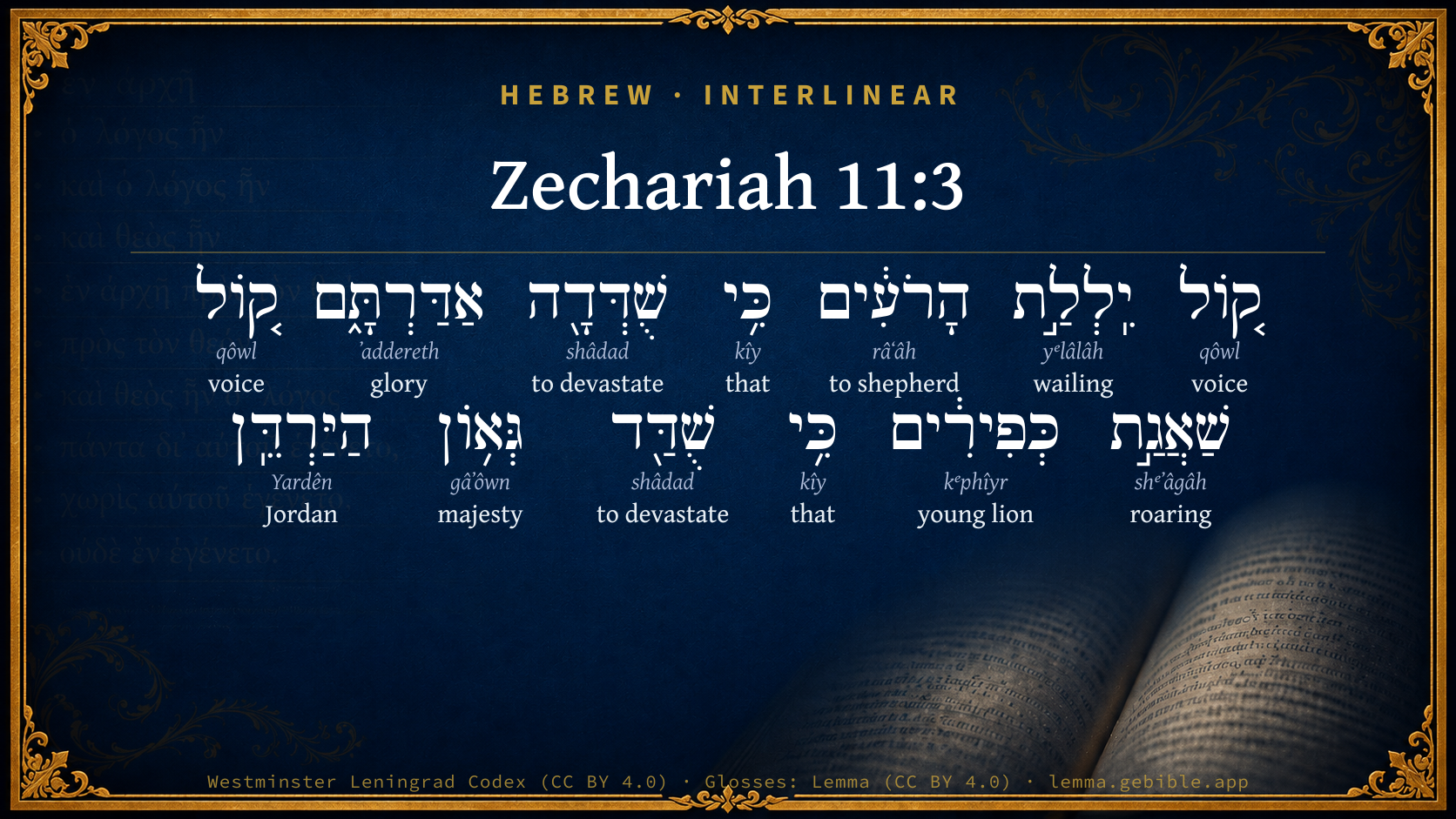
Hebrew (Westminster Leningrad Codex) Zechariah 11:3 appears in the Hebrew Old Testament. The text above is from the Westminster Leningrad Codex. Each word links to its Strong’s number, a concise gloss, and parsing drawn from the Open Scriptures Hebrew Bible morphology. Click any word for its full Brown-Driver-Briggs (BDB) entry.
Download image
Cite this verse

Zechariah 11:3 (World English Bible). Public Domain. Lemma interlinear Bible study tool, https://lemma.gebible.app/v/zechariah/11/3.

Show BibTeX & RIS
BibTeX
RIS
English Translation
A voice of the wailing of the shepherds! For their glory is destroyed: a voice of the roaring of young lions! For the pride of the Jordan is ruined.
World English Bible · Public Domain
Download a study sheet

One document with this verse’s original text, its word-by-word gloss line, the meaning frame, cross-references with their text, attributed commentary, and full source and license credits — printable, and it pastes into notes with its structure intact.

This verse Autodidact and up

Study sheet (.html) Plain text (.txt)

A passage Seminary Student

Up to 50 verses in one chapter. A passage sheet keeps up to 6 commentary sources and 12 cross-references per verse, in the order this page ranks them, and says so on the sheet whenever that leaves anything out. Ask for a single verse and you get the Autodidact verse sheet above.

Everything on this page stays free to read, with no account — the sheet is a download of what is already on screen, not access to it.

Want to remove ads? Support Godless Engineer
Compare translations 3

The same verse in 3 English versions, stacked beneath the original-language interlinear above. Click any original word for its lexicon entry.

Each is an independent rendering of the whole verse — the interlinear is not word-aligned to these translations.

Highlighted words mark where these versions differ — a whole-verse word diff, not a word-by-word alignment.

  • World English Bible Public Domain
    A voice of the wailing of the shepherds! For their glory is destroyed: a voice of the roaring of young lions! For the pride of the Jordan is ruined.
  • King James Version Public Domain
    There is a voice of the howling of the shepherds; for their glory is spoiled: a voice of the roaring of young lions; for the pride of Jordan is spoiled.
  • unfoldingWord Literal Text CC BY-SA 4.0
    The shepherds howl, for their glory has been destroyed! The voice of the young lions’ roar, for the pride of the Jordan River has been devastated!

unfoldingWord Literal Text — © unfoldingWord, licensed CC BY-SA 4.0. Word-aligned USFM3 via Door43 (git.door43.org/unfoldingWord/en_ult).

Versions to compare (up to 4)

3 of 4 selected

Show all 18 translations

Every available English version of this verse, each an independent rendering of the whole verse.

  • World English Bible Public Domain
    A voice of the wailing of the shepherds! For their glory is destroyed: a voice of the roaring of young lions! For the pride of the Jordan is ruined.
  • Berean Standard Bible Public Domain
    Listen to the wailing of the shepherds, for their glory is in ruins. Listen to the roaring of the young lions, for the thickets of the Jordan are destroyed.
  • Majority Standard Bible Public Domain
    Listen to the wailing of the shepherds, for their glory is in ruins. Listen to the roaring of the young lions, for the thickets of the Jordan are destroyed.
  • King James Version Public Domain
    There is a voice of the howling of the shepherds; for their glory is spoiled: a voice of the roaring of young lions; for the pride of Jordan is spoiled.
  • American Standard Version (1901) Public Domain
    A voice of the wailing of the shepherds! for their glory is destroyed: a voice of the roaring of young lions! for the pride of the Jordan is laid waste.
  • Revised Version (1885) Public Domain
    A voice of the howling of the shepherds! for their glory is spoiled: a voice of the roaring of young lions! for the pride of Jordan is spoiled.
  • Geneva Bible (1599) Public Domain
    There is the voyce of the houling of the shepherdes: for their glorie is destroyed: the voyce of ye roaring of lyons whelpes: for the pride of Iorden is destroyed.
  • Douay-Rheims (1899) Public Domain
    The voice of the howling of the shepherds, because their glory is laid waste: the voice of the roaring of the lions, because the pride of the Jordan is spoiled.
  • Young's Literal Translation Public Domain
    A voice of the howling of the shepherds! For destroyed was their robe of honour, A voice of the roaring of young lions! For destroyed was the excellency of Jordan.
  • Literal Standard Version CC BY-SA 4.0
    A voice of the howling of the shepherds! For their robe of honor was destroyed, || A voice of the roaring of young lions! For the excellence of Jordan was destroyed.
  • Unlocked Literal Bible CC BY-SA 4.0
    The shepherds howl, for their glory has been destroyed! The voice of the young lions' roar, for the pride of the Jordan River has been devastated!
  • unfoldingWord Literal Text CC BY-SA 4.0
    The shepherds howl, for their glory has been destroyed! The voice of the young lions’ roar, for the pride of the Jordan River has been devastated!
  • Darby Bible Public Domain
    A voice of howling of the shepherds; for their glory is spoiled: a voice of roaring of young lions; for the pride of Jordan is spoiled.
  • World Messianic Bible Public Domain
    A voice of the wailing of the shepherds! For their glory is destroyed—a voice of the roaring of young lions! For the pride of the Jordan is ruined.
  • Webster's Bible Public Domain
    There is a voice of the howling of the shepherds; for their glory is destroyed: a voice of the roaring of young lions; for the pride of Jordan is laid waste.
  • Free Bible Version CC BY-SA 4.0
    Listen to the howls of the shepherds, for their pastureland is destroyed. Listen to the roars of the young lions, for their Jordan habitat is ruined.
  • Bible in Basic English Public Domain
    The sound of the crying of the keepers of the flock! for their glory is made waste: the sound of the loud crying of the young lions! for the pride of Jordan is made waste.
  • JPS Tanakh (1917) Public Domain
    Hark! the wailing of the shepherds, for their glory is spoiled; Hark! the roaring of young lions, for the thickets of the Jordan are spoiled.

Literal Standard Version (2020), Covenant Press — licensed CC BY-SA 4.0. Text via the HelloAO Bible API (eBible.org). Unlocked Literal Bible (unfoldingWord) — licensed CC BY-SA 4.0. Text via the HelloAO Bible API (eBible.org). unfoldingWord Literal Text — © unfoldingWord, licensed CC BY-SA 4.0. Word-aligned USFM3 via Door43 (git.door43.org/unfoldingWord/en_ult). Free Bible Version, Dr. Jonathan Gallagher — licensed CC BY-SA 4.0. Text via the HelloAO Bible API (eBible.org).

Word by word

More ways to search: Search by grammar → Find every occurrence → Compare this word →

Practice this passage: Drill this verse → Learn its vocabulary →

יִֽלְלַ֣ת
yᵉlâlâh
H3215
“wailing of”
Noun, Common, Feminine, Singular, Construct
Part of Speech
Noun
Type
Common
Gender
Feminine
Number
Singular
State
Construct
Full BDB Definition

Origin: from H3214

TWOT: 868b

a howling (of distress), wailing
  1. ק֚וֹל qôwl H6963 “voice of” Noun, Common, Masculine, Singular, Construct
  2. הָרֹעִ֔ים râʻâh H7462 “the · shepherding” Particle, Definite Article + Verb, Qal, Participle Active, Masculine, Plural, Absolute
  3. כִּ֥י kîy H3588 “that” Conjunction
  4. שֻׁדְּדָ֖ה shâdad H7703 “to devastate” Verb, Pual, Perfect, 3rd Person, Feminine, Singular
  5. אַדַּרְתָּ֑ם ʼaddereth H155 “glory · their” Noun, Common, Feminine, Singular, Construct + Suffix, Personal, 3rd Person, Masculine, Plural
  6. ק֚וֹל qôwl H6963 “voice of” Noun, Common, Masculine, Singular, Construct
  7. שַׁאֲגַ֣ת shᵉʼâgâh H7581 “roaring of” Noun, Common, Feminine, Singular, Construct
  8. כְּפִירִ֔ים kᵉphîyr H3715 “young lions” Noun, Common, Masculine, Plural, Absolute
  9. כִּ֥י kîy H3588 “that” Conjunction
  10. שֻׁדַּ֖ד shâdad H7703 “to devastate” Verb, Pual, Perfect, 3rd Person, Masculine, Singular
  11. גְּא֥וֹן gâʼôwn H1347 “majesty of” Noun, Common, Masculine, Singular, Construct
  12. הַיַּרְדֵּֽן Yardên H3383 “the · Jordan” Particle, Definite Article + Noun, Proper

About this verse

These counts appear in no published source. They are computed here, from the morphology-tagged text and Lemma’s own curated glosses. What Lemma adds →

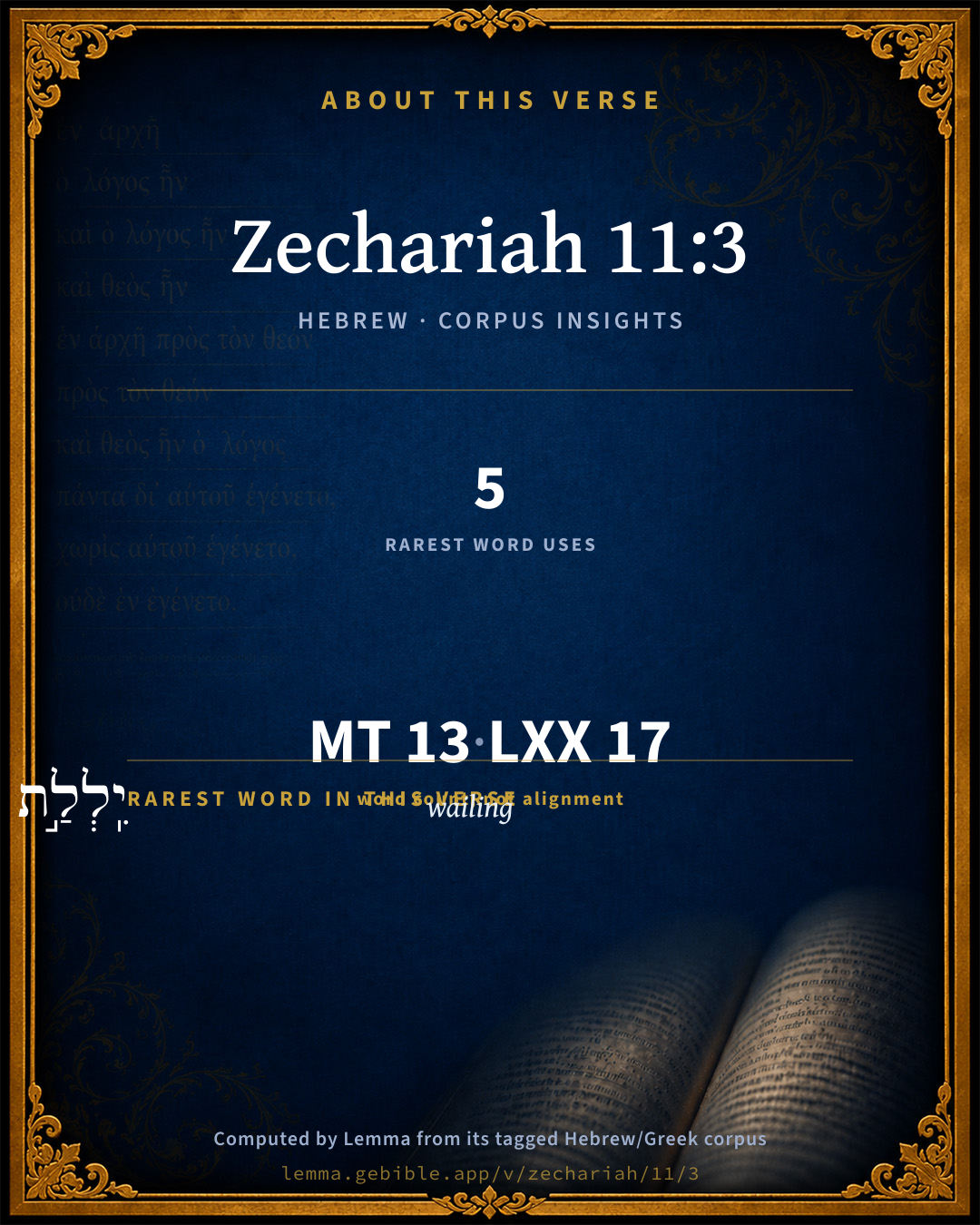
13
words
10
distinct lemmas
Prophets
section

Notable vocabulary

The rarest word here is יִֽלְלַ֣ת wailing H3215 — appearing just 5 times in the whole Hebrew Bible.

Shared distinctive vocabulary

יִֽלְלַ֣ת wailing H3215 occurs in 4 verses of the Hebrew Bible. Also found in:

Grammatical profile

  • 3 verbs
  • 8 nouns
  • 2 conjunctions

Verb forms

  • הָרֹעִ֔ים Qal · Participle Active
  • שֻׁדְּדָ֖ה Pual · Perfect
  • שֻׁדַּ֖ד Pual · Perfect

Repetition

Words recur within this verse — often emphatic in Hebrew:

  • ק֚וֹל voice H6963 ×2
  • שֻׁדְּדָ֖ה to devastate H7703 ×2
  • כִּ֥י that H3588 ×2

Hebrew & Septuagint length

In English translation the verse runs 29 words from the Hebrew and 27 from the Septuagint (LXX English) — closely comparable.

A rough comparison of the two English renderings, which tokenize alike — not a word-level alignment.

Word counts can differ between the Hebrew and the Greek without any difference in meaning — e.g. the Hebrew direct-object marker אֵת has no separate Greek word, and Greek often adds the article ὁ.

In the original languages it is 13 Hebrew tokens and 17 Greek tokens — but the two are counted differently (Hebrew bundles its prefixes and suffixes into one token; the Greek is in lemma form), so that isn’t a like-for-like length.

Cross-references

31

Topical passages linked to Zechariah 11:3 in the Treasury of Scripture Knowledge — connected by theme and wording, ordered by reader-vote popularity; previews shown in the World English Bible.

  • Jeremiah 50:44 Behold, [the enemy] shall come up like a lion from the pride of the Jordan against the strong habitation: for I will suddenly make them run away from it; and whoever is chosen, him will I appoint over it: for who is like me? and who will appoint me a time? and who is the shepherd who can stand before me?
  • Jeremiah 25:34–36 Wail, you shepherds, and cry; and wallow [in ashes], you principal of the flock; for the days of your slaughter and of your dispersions are fully come, and you shall fall like a goodly vessel.
  • 1 Samuel 4:21–22 She named the child Ichabod, saying, The glory is departed from Israel; because the ark of God was taken, and because of her father-in-law and her husband.
  • Psalms 22:21 Save me from the lion's mouth; Yes, from the horns of the wild oxen you have answered me.
  • Isaiah 65:15 You shall leave your name for a curse to my chosen; and the Lord Yahweh will kill you; and he will call his servants by another name:
  • Jeremiah 2:15 The young lions have roared on him, and yelled; and they have made his land waste: his cities are burned up, without inhabitant.
  • Jeremiah 2:30 In vain have I struck your children; they received no correction: your own sword has devoured your prophets, like a destroying lion.
  • Jeremiah 7:4 Don't you trust in lying words, saying, The temple of Yahweh, the temple of Yahweh, the temple of Yahweh, are these.
  • Jeremiah 7:11–14 Is this house, which is called by my name, become a den of robbers in your eyes? Behold, I, even I, have seen it, says Yahweh.
  • Jeremiah 26:6 then will I make this house like Shiloh, and will make this city a curse to all the nations of the earth.
  • Jeremiah 49:19 Behold, he shall come up like a lion from the pride of the Jordan against the strong habitation: for I will suddenly make them run away from it; and whoever is chosen, him will I appoint over it: for who is like me? and who will appoint me a time? and who is the shepherd who will stand before me?
  • Ezekiel 19:3–6 She brought up one of her cubs: he became a young lion, and he learned to catch the prey; he devoured men.
  • Ezekiel 24:21–25 Speak to the house of Israel, Thus says the Lord Yahweh: Behold, I will profane my sanctuary, the pride of your power, the desire of your eyes, and that which your soul pities; and your sons and your daughters whom you have left behind shall fall by the sword.
  • Hosea 1:9–10 He said, "Call his name Lo-Ammi; for you are not my people, and I will not be yours.
  • Hosea 10:5 The inhabitants of Samaria will be in terror for the calves of Beth Aven; For its people will mourn over it, Along with its priests who rejoiced over it, For its glory, because it has departed from it.
  • Joel 1:13 Put on sackcloth and mourn, you priests! Wail, you ministers of the altar. Come, lie all night in sackcloth, you ministers of my God, For the meal offering and the drink offering are withheld from your God's house.
  • Amos 8:8 Won't the land tremble for this, And everyone mourn who dwells in it? Yes, it will rise up wholly like the River; And it will be stirred up and sink again, like the River of Egypt.
  • Zephaniah 1:10 In that day, says Yahweh, there will be the noise of a cry from the fish gate, a wailing from the second quarter, and a great crashing from the hills.
  • Zephaniah 3:3 Her princes in the midst of her are roaring lions. Her judges are evening wolves. They leave nothing until the next day.
  • Zephaniah 3:11 In that day you will not be disappointed for all your doings, in which you have transgressed against me; for then I will take away out of the midst of you your proudly exulting ones, and you will no more be haughty in my holy mountain.
  • Zechariah 11:8 I cut off the three shepherds in one month; for my soul was weary of them, and their soul also loathed me.
  • Zechariah 11:15–17 Yahweh said to me, "Take for yourself yet again the equipment of a foolish shepherd.
  • Matthew 3:7–10 But when he saw many of the Pharisees and Sadducees coming for his baptism, he said to them, "You offspring of vipers, who warned you to flee from the wrath to come?
  • Matthew 21:43–45 "Therefore I tell you, the Kingdom of God will be taken away from you, and will be given to a nation bringing forth its fruits.
  • Matthew 23:13–38 "Woe to you, scribes and Pharisees, hypocrites! For you devour widows' houses, and as a pretense you make long prayers. Therefore you will receive greater condemnation.
  • Acts 6:11–14 Then they secretly induced men to say, "We have heard him speak blasphemous words against Moses and God."
  • Acts 7:52 Which of the prophets didn't your fathers persecute? They killed those who foretold the coming of the Righteous One, of whom you have now become betrayers and murderers.
  • Acts 22:21–22 "He said to me, 'Depart, for I will send you out far from here to the Gentiles.'"
  • Romans 11:7–12 What then? That which Israel seeks for, that he didn't obtain, but the chosen ones obtained it, and the rest were hardened.
  • James 5:1–6 Come now, you rich, weep and howl for your miseries that are coming on you.
  • Matthew 15:14 Leave them alone. They are blind guides of the blind. If the blind guide the blind, both will fall into a pit."

Cross-references courtesy of OpenBible.info (CC BY 4.0).

Hebrew and Greek witnesses Masoretic Hebrew ↔ Greek Septuagint

The same verse in the two great witnesses to the Old Testament, shown verse-for-verse.

These are two independent witnesses, not word-aligned to each other, and the Septuagint is shown in lemma (dictionary) form.

Hebrew Zechariah 11:3 Masoretic · Westminster Leningrad Codex

ק֚וֹל יִֽלְלַ֣ת הָרֹעִ֔ים כִּ֥י שֻׁדְּדָ֖ה אַדַּרְתָּ֑ם ק֚וֹל שַׁאֲגַ֣ת כְּפִירִ֔ים כִּ֥י שֻׁדַּ֖ד גְּא֥וֹן הַיַּרְדֵּֽן

A voice of the wailing of the shepherds! For their glory is destroyed: a voice of the roaring of young lions! For the pride of the Jordan is ruined.

World English Bible · Public Domain

Greek LXX Zechariah 11:3 Septuagint · lemma form

φωνή θρηνέω ποιμήν ὅτι ταλαιπωρέω ὁ μεγαλωσύνη αὐτός φωνή ὠρύομαι λέων ὅτι ταλαιπωρέω ὁ φρύαγμα ὁ ἰορδάνης

There is a voice of the shepherds mourning; for their greatness is brought low: a voice of roaring lions; for the pride of Jordan is brought down.

LXX2012 (modern English Septuagint) · Public Domain

Hebrew: Westminster Leningrad Codex (CC BY 4.0). Greek: Septuagint (public domain); English from LXX2012 (modern English Septuagint) (Public Domain). How the Septuagint differs from the Hebrew →

Targum (Aramaic paraphrase)

1

The Targum is the ancient Jewish Aramaic paraphrase of the Hebrew Scriptures — an interpretive translation, not the Hebrew text itself. Onkelos (literal) and Pseudo-Jonathan (expansive) render the Torah, and Jonathan the Prophets. Coverage is partial: where no permissively-licensed English translation exists for a verse, only the Aramaic is shown. This is verse-level text, not a word-by-word alignment to the Hebrew.

  1. Targum Jonathan Prophets (Joshua–Malachi)
    קַל צִוְחַת מַלְכַיָא אֲרֵי אִתְבְּזִיזוּ מְחוֹזֵיהוֹן קַל נִיהֲמַתְהוֹן כִבְנֵי אַרְיְוָן כַּד יָבֵישׁ עֲלֵיהוֹן רוּם יַרְדְנָא:

    (no public-domain English translation for this verse)

    Targum Jonathan — Aramaic: “Mikraot Gedolot” (public domain). English: “Sefaria Community Translation” (CC0 1.0 (public-domain dedication)); “London "Chaldee Paraphrase," 1871” (public domain). Text via Sefaria.

Commentary

Notes on Zechariah 11:3 from classic Christian and Jewish commentators (each source and its license shown beneath its notes). The classic Christian expositions comment on the surrounding passage and are grouped to its opening verse, so a note may address several verses; the Jewish commentaries on the Tanakh (Rashi and others) are per-verse, so they appear only where the commentator wrote on this verse.

Lemma curates 59 commentaries, every one of them public domain or Creative Commons licensed, each selected and text-cleaned for this edition rather than reprinted as found. About our sources →

Trapp's Complete Commentary

John Trapp

Zec 11:3 [There is] a voice of the howling of the shepherds; for their glory is spoiled: a voice of the roaring of young lions; for the pride of Jordan is spoiled.

Ver. 3. There is a voice of the howling of the shepherds] Potentes potenter torquebuntur. "The loftiness of man shall be bowed down, and the haughtiness of men shall be made low: and the Lord alone shall be exalted in that day," Isa 2:17. The shepherds were grown foolish, Zec 11:15, idol shepherds, Zec 11:17, they cared for no other instruments but forcipes et mulctram, the shears and the milk pail; they were become "greedy dogs, which could never have enough," Isa 56:11 (they were sick of the bulimy, or appetitus caninus a greedy dog), yea, they were so many young lions, ramping and ravening, as it is here and Eze 19:2-3. Both princes and priests were turned tyrants, and instead of feeding the people in the integrity of their hearts, and guiding them with the skilfulness of their hands, Psa 78:72, preyed upon them, and "plucked the skin from off them, and their flesh from off their bones," Mic 3:2.

For the pride of Jordan is spoiled] The swelling of Jordan dried up by the Romans, as Jerome interprets it; or, the proud and stately palaces and possessions that the great ones had gotten upon the banks of Jordan for fruitfulness and pleasance, as a Lapide; or the numerous and proud nation of the Jews likened to the yearly overflowing of Jordan, whereof see Jos 3:15 Jer 49:19, as Diodati.

John Trapp, A Commentary or Exposition upon All the Books of the Old and New Testament (1647–1656) — public domain. Text from a community e-Sword module.

The Biblical Illustrator

Joseph S. Exell

Zec_11:3

For their glory is spoiled

Bad men in high office

I.

The men here reffered to called shepherds, which is a designation of men in power, men who politically and ecclesiastically presided over the people, the leaders. The shepherds have sometimes reached their positrons irrespective of the will of the people. The shepherds referred to here had an ambitious character. Likened to young lions.

1. That a man in high office who has a bad character is of all men the most contemptible A bad character in a pauper makes him contemptible; but a bad character in a king makes him ten times the more contemptible.

2. That it is the duty of all peoples to promote those alone to high office who have a high moral character.

II. Bad men in high office greatly distressed. There is a voice of the howling of the shepherds, etc. The glory of these shepherds being spoiled, says Wardlaw, signifies the bringing down of all their honour and power and the wealth and luxury which, by the abuse of their power, they had acquired, all becoming a prey to the sacking and pillaging besiegers. The pride of Jordan lay in its evergreens and brushwood with which its banks were enriched and adorned; and these being the covert and habitation of the young lions, the two parts of the figure are appropriate. As the lions howl and roar in dismay and fury when dislodged from their refuges and dwelling places, whether by the swelling flood sweeping over their lairs, or from the cutting down or the burning of their habitations, so should the priests and rulers of Jerusalem be alarmed and struck with desperation and rage, when they found their city, within whose walls they had counted themselves secure from the very possibility of hostile entrance, laid open to the outrage of an exasperated enemy, and all its resources given up to plunder and destruction--country as well as city thrown into confusion and desolation! Such rulers may well be distressed--

1. Because all the keen-sighted and honest men over whom they preside despise them.

2. Because the Righteous Governor of the world has denounced them. (Homilist.)

The Biblical Illustrator, edited by Joseph S. Exell (c. 1880s–1900s) — public domain. Text from a community e-Sword module.

Tyndale Open Study Notes

Tyndale Open Resources

11:3 Shepherds and lions figuratively represent the leaders of Lebanon and Bashan, lamenting the destruction of their forested slopes, their pride, and their livelihood (see 11:1-2).

Tyndale Open Study Notes — © Tyndale Open Resources, licensed CC BY-SA 4.0. Text via the HelloAO Bible API.

Geneva Bible (1599)

Geneva Bible translators

That is, the renown of Judah and Israel should perish.

Geneva Bible (1599) marginal notes — public domain. Text via Bolls.life.

Jamieson, Fausset & Brown

Robert Jamieson, A. R. Fausset & David Brown

shepherds--the Jewish rulers.

their glory--their wealth and magnificence; or that of the temple, "their glory" (Mar 13:1; Luk 21:5).

young lions--the princes, so described on account of their cruel rapacity.

pride of Jordan--its thickly wooded banks, the lair of "lions" (Jer 12:5; Jer 49:19). Image for Judea "spoiled" of the magnificence of its rulers ("the young lions"). The valley of the Jordan forms a deeper gash than any on the earth. The land at Lake Merom is on a level with the Mediterranean Sea; at the Sea of Tiberias it falls six hundred fifty feet below that level, and to double that depression at the Dead Sea, that is, in all, 1950 feet below the Mediterranean; in twenty miles' interval there is a fall of from three thousand to four thousand feet.

Jamieson, Fausset & Brown — Commentary Critical and Explanatory on the Whole Bible (1871) — public domain (CC PDM 1.0). Text via the HelloAO Bible API.

Adam Clarke's Commentary

Verse 3. Young lions] Princes and rulers. By shepherds, kings or priests may be intended.

Adam Clarke's Commentary on the Bible (1810–1826) — public domain. Text from a community e-Sword/MySword module.

John Calvin's Commentaries

He then adds, The voice of the howling of shepherds; for their excellency, or their courage, is laid waste. Here he has אדר, ader, and before אדירים, adirim, in the masculine gender. We see then that the Prophet confirms the same thing in other words, “Howl now,” he says, “shall the shepherds.” He intimates that the beginning of this dreadful judgment would be with the chief men, as they were especially the cause of the public ruin. He then says, that the dignity of the great was now approaching its fall, and hence he bids them to howl. He does not in these words exhort them to repentance, but follows the same strain of doctrine. By God’s command he here declares, that the shepherds who took pride in their power, could not escape the judgment which they had deserved: and as this is a mode of speaking usually adopted by the Prophets, I shall no longer dwell on the subject.

He afterwards adds, The voice of the roaring of lions. He no doubt gives here the name of lions, by way of metaphor, to those who cruelly exercised their power over the people. But he also alludes to the banks of Jordan, where there were lions, as it is well known. Since then lions were found along the whole course of Jordan, as it is evident from many passages, he compares shepherds to lions, even the governors who had abused their authority by exercising tyranny over the people: Fallen then has the pride or the excellency of Jordan. In short, it is now sufficiently evident, that the Prophet threatens final destruction both to the kingdom of Judah and to the kingdom of Israel. Both kingdoms were indeed then abolished; but I speak of the countries themselves. The meaning is — that neither Judea nor the land of the ten tribes would be free from God’s vengeance. He afterwards adds —

John Calvin's Commentaries (1540-1563) — public domain. Text from the Calvin Translation Society English edition (1840s-50s) via the Christian Classics Ethereal Library (ccel.org). Calvin's coverage is partial (roughly two-thirds of the Bible); uncommented books and verses are honest gaps, never fabricated. The 19th-century editor's footnotes and remarks are omitted so the notes are faithfully Calvin's own voice.

The Cambridge Bible for Schools and Colleges

gen. ed. J. J. S. Perowne

3. There is a voice] More literally and forcibly, A voice of the howling of the shepherds! R. V.

the shepherds] Here again the figurative reference appears through the literal, Comp. Zec_10:3, and Zec_11:5 below. But the literal reference holds good. “The desolating storm sweeps from the highlands to the lowlands. The very shepherds are forced to howl, because their splendour is laid waste, namely, the pasture lands, in which they were wont to tend and feed their flocks in the days of peace and quiet. The conflagration extends even to the south of the land. Judah is wrapped in flames. The close thickets which fringed the Jordan river as it ran along through the territory of the southern kingdom are consumed by the fire.… ‘The pride of Jordan’ is rendered desolate, and hence the voice of the roaring of lions is heard wailing over the general ruin.” Wright.

young lions] Comp. Jer_25:36-38; Jer_49:19.

Zec_11:4-14. The rejection by them of Jehovah’s shepherd is the cause of the calamity which is to fall upon them. “Subjicit rationem cur Deus tam severe agere cogitet cum populo suo, quoniam insanabilis sit eorum malitia.” Rosenm.

The Cambridge Bible for Schools and Colleges (gen. ed. J. J. S. Perowne; Cambridge University Press, 1878–1918) — public domain. Text from a community e-Sword module.

John Gill's Exposition

There is a voice of the howling of the shepherds,.... Which may be understood either of the civil rulers among the Jews, who now lose their honour and their riches; and so the Targum, Jarchi, and Aben Ezra, interpret it of kings; or of the ecclesiastical rulers, the elders of the people, the Scribes and Pharisees:

for their glory is spoiled; their power and authority; their riches and wealth; their places of honour and profit; their offices, posts, and employments, whether in civil or religious matters, are taken from them, and they are deprived of them:

a voice of the roaring of young lions; of princes, comparable to them for their power, tyranny, and cruelty: the Targum is,

"their roaring is as the roaring of young lions:''

for the pride of Jordan is spoiled; a place where lions and their young ones resorted, as Jarchi observes; See Gill on Jer 49:19. Jordan is here put for the whole land of Judea now wasted, and so its pride and glory gone; as if the waters of Jordan were dried up, the pride and glory of that, and which it showed when its waters swelled and overflowed; hence called by Pliny (x) "ambitiosus amnis", a haughty and ambitious swelling river.

(x) Nat. Hist. l. 5. c. 15.

John Gill's Exposition of the Whole Bible (1746–1763) — public domain (CC PDM 1.0). Text via the HelloAO Bible API.

Albert Barnes' Notes on the Bible

A voice of the howling of the shepherds, for their glory is spoiled - It echoes on from Jeremiah before the captivity, “Howl, ye shepherds - A voice of the cry of the shepherds. and an howling of the principal of the flock; for the Lord hath spoiled their pasture” Jer 25:34, Jer 25:36. There is one chorus of desolation, the mighty and the lowly; the shepherds and the young lions; what is at other times opposed is joined in one wailing. “The pride of Jordan” are the stately oaks on its banks, which shroud it from sight, until you reach its edges, and which, after the captivity of the ten tribes, became the haunt of lions and their chief abode in Palestine, “on account of the burning heat, and the nearness of the desert, and the breadth of the vast solitude and jungles” (Jerome). See Jer 49:19; Jer 50:44; 2Ki 17:25. The lion lingered there even to the close of the 12th cent. Phocas in Reland Palaest. i. 274. Cyril says in the present, “there are very many lions there, roaring horribly and striking fear into the inhabitants”).

Albert Barnes' Notes on the Bible (1834–1885) — public domain. Text from a community e-Sword/MySword module.

Haydock's Catholic Bible Commentary

Pride, or farther banks, covered with shrubs, among which lions dwelt, Jeremias l. 44. (Calmet)

George Leo Haydock (1774–1849), Haydock's Catholic Family Bible and Commentary, 1859 edition — public domain. Excludes Psalms (Douay-Rheims chapter numbering differs from Protestant) and Deuterocanonical books (Catholic canon only).

Matthew Poole's English Annotations

There is; it is as certain as if present, as sure all these shall howl, as if the things for which they do howl were already acted.

A voice of the howling, a most bitter, loud, passionate, and dismal howling, of the shepherds: literally thus; The enemy having broken in hath driven away or eaten up their flocks of sheep, their herds; and they, undone, howl most bitterly on the mountains, where the echo more doubles the horror than the noise. Or figuratively, shepherds are governors, magistrates, and civil officers, together with priests and prophets, who are over the people as shepherds over the flocks.

For their glory is spoiled; what was their honour, their safety, their joy, is spoiled, taken from them and given to others.

A voice of the roaring, the dismal outcries, of young lions; of men in authority among the Jews, who should have been shepherds to defend, but were as lions to tear and devour, and which lurked in Jerusalem, and in the cities of Judea, wheresoever they could lie in wait to tear the poor and weak.

For the pride of Jordan is spoiled; the great forests on the banks of Jordan, called here the pride of Jordan, either because of the stately situation of them; or, because the prophet would keep the decorum of his allegory, he calls these

the pride of Jordan, for that the young lions were wont to walk proudly, to range over it without fear. So did these men-lions securely prey in Jerusalem and its fellow cities; but these are cut down, and now they must no more range through to seek a prey: so all from the north to the east of the land of Canaan is represented as made a spoil.

Matthew Poole's English Annotations on the Holy Bible (1683–1685) — public domain. Text from a community e-Sword/MySword module.

The Pulpit Commentary

There is a voice. The Hebrew is more terse and forcible, "A voice of the howling of the shepherds!" or, "Hark! a howling," etc. (Jer_25:34, etc.) The destruction spreads from the north southwards along the Jordan valley. Their glory. The noble trees in whose shadow they rejoiced. Young lions. Which had their lairs in the forests now laid waste. (Jer_49:19) The pride of Jordan. The thickets that clothed the banks of Jordan are called its "pride". (Jer_12:5) The lion is not now found in Palestine, but must have been common in earlier times, especially in such places as the brushwood and reedy coverts which line the margin of the Jordan. The prophet introduces the inanimate and animate creation trees, men, beasts alike deploring the calamity. And the terms in which this is depicted point to some great disaster and ruin, and, as it seems, to the final catastrophe of the destruction of Jerusalem by the Romans, the punishment of the rejection of Messiah. This reference becomes plainer as we proceed. It is inadmissible to refer the passage (as some do) to the Assyrian invasions mentioned in 2Ki_15:29 and 1Ch_5:26. Holding the post-exilian origin of the prophecy, we are bound to interpret it in accordance with this view, which, indeed, presents fewer difficulties than the other.

Bad men in high office.

"There is a voice of the howling of the shepherds; for their glory is spoiled: a voice of the roaring of young lions; for the pride of Jordan is spoiled." We have here two subjects of thought.

I BAD MEN IN HIGH OFFICE. The men referred to here are called "shepherds," which is a designation of men in power, men who politically and ecclesiastically presided over the people the leaders. Communities of men everywhere and in all times have had "shepherds," men who guided and ruled them. These "shepherds" have sometimes reached their position irrespectively of the will of the people, sometimes with the will of the people, sometimes against the will of the people. In this country we have a number of "shepherds," politically from the mayor to the queen, ecclesiastically from the assistant curate to the archbishop. The "shepherds" referred to in the text had unfortunately what, alas! the leaders of the people in all ages have too frequently had an ambitious character. Hence they are here called, "young lions," "a voice of the roaring of young lions;" or, as Keil has it, a "loud roaring of the young lions." They were hungry, ravenous, and rapacious, fattening upon the people of their charge. Elsewhere they are represented as "ravening wolves." How often have men in high office, both in state and Church, been of this character! Such as they care nothing for the people, only so far as they can make use of them, feed and fatten on them. Observe:

1. That a man in high office who has a bad character is of all men the most contemptible. A bad character in a pauper makes him contemptible; but a bad character in a king makes him ten times the more contemptible. When God commands us to honour our parents, and to honour the king, it implies that the parents and the king are honour worthy; if they are corrupt in character, they should be die, honoured and denounced.

2. That it is the duty of all peoples to promote those alone to high office who have a high moral character. Alas! they have not done so; hence they have often had unworthy magistrates, judges, kings, bishops.

II BAD MEN IN HIGH OFFICE GREATLY DISTRESSED. "There is a voice of the howling of the shepherds; for their glory is spoiled: a voice of the roaring of young lions; for the pride of Jordan is spoiled." "The glory of these shepherds being spoiled," says Wardlaw, "signifies the brining down of all their honour and power, and the wealth and luxury which, by the abuse of their power they had acquired, all becoming a prey to the sacking and pillaging besiegers. The pride of Jordan lay in it, s evergreens and brushwood with which its banks were enriched and adorned; and these being the covert and habitation of the young lions, the two parts of the figure are appropriate. As the lions howl and roar in dismay and fury when dislodged from their refuges and dwelling places, whether by the swelling flood sweeping over their lairs, or from the cutting down or the burning of their habitations, so should the priests and rulers of Jerusalem be alarmed and struck with desperation and rage, when they found their city, within whose walls they had counted themselves secure from the very possibility of hostile entrance, laid open to the outrage of an exasperated enemy, and all its resources given up to plunder and destruction country as well as city thrown into confusion and desolation!" Such rulers may well be distressed. Let them howl:

1. Because all the keen-sighted and honest men over whom they preside despise them. Though the hordes of miserable sycophants worship them on account of the glitter and pageantry of their elevated position, the Carlyles, the Thackerays, and the unsophisticated millions regard them with ineffable disdain.

2. Because the righteous Governor of the world has denounced them. "Woe unto you, scribes and Pharisees, hypocrites! for ye devour widows" houses, and for a pretence make long prayer: therefore ye shall receive the greater damnation Woe unto you, scribes and Pharisees, hypocrites! for ye pay tithe of mint and anise and cummin, and have omitted the weightier matters of the Law, judgment, mercy, and faith: these ought ye to have done, and not to leave the other undone. Ye blind guides, which strain at a gnat, and swallow a camel. Woe unto you scribes and Pharisees, hypocrites! for ye make clean the outside of the cup and of the platter, but within they are full of extortion and excess". D.T. (Mat_23:14, etc.)

The Pulpit Commentary (1880–1919), ed. H.D.M. Spence-Jones & Joseph S. Exell — public domain. Text from a community e-Sword module.

John Wesley's Explanatory Notes

Of the shepherds - The enemy having driven away their flocks and herds. Their glory - What was their honour. Of Jordan - The great forests on the banks of Jordan, where the young lions were wont to range.

John Wesley, Explanatory Notes Upon the Whole Bible (1754–1765) — public domain. Text via the GEBible commentary corpus.

Rashi

Rabbi Shlomo Yitzchaki (Rashi)

the shepherds The kings.

for their glory אַדַּרְתָּם

the roar of the young lions The princes shall weep.

for the pride of the Jordan has been spoiled The pride of the Jordan, which is the place of the young lions and the old lions. Our Sages (Yoma 39b) explained “Open your doors, O Lebanon,” as the prophet prophesying about the destruction of the Second Temple; that forty years prior to the destruction, the doors of the Temple proper would open by themselves. Rabban Yochanan ben Zakkai rebuked them. He said, “Temple, how long will you terrify yourself? I know that you will eventually be destroyed. Zechariah the son of Iddo has already prophesied concerning you: ‘Open your doors, O Lebanon, etc.’”

Rashi on the Tanakh — English translations: “The Judaica Press complete Tanach with Rashi, translated by A. J. Rosenberg” (CC BY 4.0); “Pentateuch with Rashi's commentary by M. Rosenbaum and A.M. Silbermann, 1929-1934” (public domain); “The Metsudah Tanach series, Lakewood, N.J” (CC BY 4.0); and “The Book of Joshua, Metsudah Publications, 1997” (CC BY 4.0). Text via Sefaria.

Lesson kit

Teaching starters — assembled from the data on this page, not authored interpretation. Every prompt links to the verse data it draws on. Edit before teaching.

Zechariah, in the Prophets, opens this verse with 13 words (10 distinct Hebrew lemmas). Its most distinctive word is yᵉlâlâh (“wailing”). A historical commentator’s framing appears above. Read the whole chapter for the surrounding context.

Discussion questions

  1. How does “wailing” (yᵉlâlâh) shape what this verse is saying?
  2. Isaiah 15:8 shares the word «wailing» with this verse. How do the two illuminate each other?
  3. “voice” occurs 2× in this one verse. What is the effect of the repetition?
  4. These translations render this verse differently. What is at stake in choosing one wording over another?
  5. The verb «הָרֹעִ֔ים» is Qal Participle Active. How does its form color the action?
  6. Reading how Trapp's Complete Commentary and The Biblical Illustrator read this verse, where do the two commentators agree and where do they part?

Things to notice

Reading settings

Reading text

Shown beneath each verse's original-language words.

Old Testament
Old Testament edition

Read the OT as the Masoretic Hebrew (MT) or the Greek Septuagint (LXX).

English shown for the Greek Septuagint (in the Hebrew ↔ Greek comparison).

Comparing translations? Open the Compare panel on any verse page to stack up to four side by side.