Deuteronomy 4:33

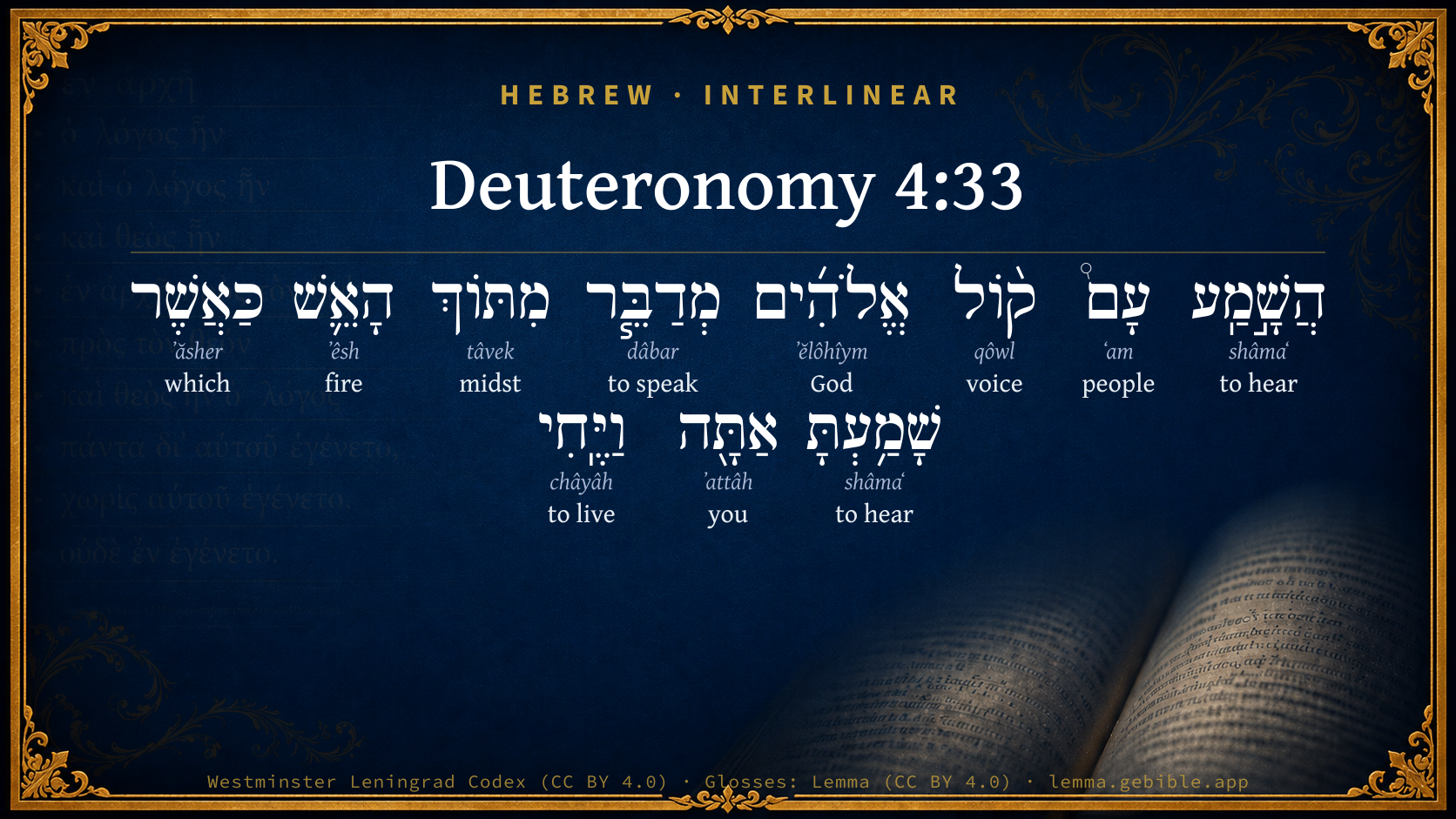
Hebrew (Westminster Leningrad Codex) Deuteronomy 4:33 appears in the Hebrew Old Testament. The text above is from the Westminster Leningrad Codex. Each word links to its Strong’s number, a concise gloss, and parsing drawn from the Open Scriptures Hebrew Bible morphology. Click any word for its full Brown-Driver-Briggs (BDB) entry.
Download image
Cite this verse

Deuteronomy 4:33 (World English Bible). Public Domain. Lemma interlinear Bible study tool, https://lemma.gebible.app/v/deuteronomy/4/33.

Show BibTeX & RIS
BibTeX
RIS
English Translation
Did ever a people hear the voice of God speaking out of the midst of the fire, as you have heard, and live?
World English Bible · Public Domain
Download a study sheet

One document with this verse’s original text, its word-by-word gloss line, the meaning frame, cross-references with their text, attributed commentary, and full source and license credits — printable, and it pastes into notes with its structure intact.

This verse Autodidact and up

Study sheet (.html) Plain text (.txt)

A passage Seminary Student

Up to 50 verses in one chapter. A passage sheet keeps up to 6 commentary sources and 12 cross-references per verse, in the order this page ranks them, and says so on the sheet whenever that leaves anything out. Ask for a single verse and you get the Autodidact verse sheet above.

Everything on this page stays free to read, with no account — the sheet is a download of what is already on screen, not access to it.

Want to remove ads? Support Godless Engineer
Compare translations 3

The same verse in 3 English versions, stacked beneath the original-language interlinear above. Click any original word for its lexicon entry.

Each is an independent rendering of the whole verse — the interlinear is not word-aligned to these translations.

Highlighted words mark where these versions differ — a whole-verse word diff, not a word-by-word alignment.

  • World English Bible Public Domain
    Did ever a people hear the voice of God speaking out of the midst of the fire, as you have heard, and live?
  • King James Version Public Domain
    Did ever people hear the voice of God speaking out of the midst of the fire, as thou hast heard, and live?
  • unfoldingWord Literal Text CC BY-SA 4.0
    Did a people hear the voice of God speaking from the midst of the fire, as you, you have heard, and live?

unfoldingWord Literal Text — © unfoldingWord, licensed CC BY-SA 4.0. Word-aligned USFM3 via Door43 (git.door43.org/unfoldingWord/en_ult).

Versions to compare (up to 4)

3 of 4 selected

Show all 18 translations

Every available English version of this verse, each an independent rendering of the whole verse.

  • World English Bible Public Domain
    Did ever a people hear the voice of God speaking out of the midst of the fire, as you have heard, and live?
  • Berean Standard Bible Public Domain
    Has a people ever heard the voice of God speaking out of the fire, as you have, and lived?
  • Majority Standard Bible Public Domain
    Has a people ever heard the voice of God speaking out of the fire, as you have, and lived?
  • King James Version Public Domain
    Did ever people hear the voice of God speaking out of the midst of the fire, as thou hast heard, and live?
  • American Standard Version (1901) Public Domain
    Did ever a people hear the voice of God speaking out of the midst of the fire, as thou hast heard, and live?
  • Revised Version (1885) Public Domain
    Did ever people hear the voice of God speaking out of the midst of the fire, as thou hast heard, and live?
  • Geneva Bible (1599) Public Domain
    Did euer people heare the voyce of God speaking out of the middes of a fire, as thou hast heard, and liued?
  • Douay-Rheims (1899) Public Domain
    That a people should hear the voice of God speaking out of the midst of fire, as thou hast heard, and lived:
  • Young's Literal Translation Public Domain
    Hath a people heard the voice of God speaking out of the midst of the fire, as thou hast heard, thou -- and doth live?
  • Literal Standard Version CC BY-SA 4.0
    Has a people heard the voice of God speaking out of the midst of the fire, as you have heard, you—and live?
  • Unlocked Literal Bible CC BY-SA 4.0
    Did ever a people hear the voice of God speaking out of the midst of the fire, as you have heard, and live?
  • unfoldingWord Literal Text CC BY-SA 4.0
    Did a people hear the voice of God speaking from the midst of the fire, as you, you have heard, and live?
  • Darby Bible Public Domain
    Did [ever] people hear the voice of God speaking from the midst of the fire, as thou hast heard, and live?
  • World Messianic Bible Public Domain
    Did a people ever hear the voice of God speaking out of the middle of the fire, as you have heard, and live?
  • Webster's Bible Public Domain
    Did ever people hear the voice of God speaking from the midst of the fire, as thou hast heard, and live?
  • Free Bible Version CC BY-SA 4.0
    Has a people ever heard the voice of God speaking out of the fire, like you have, and survived?
  • Bible in Basic English Public Domain
    Has any people ever gone on living after hearing the voice of God out of the heart of the fire as you did?
  • JPS Tanakh (1917) Public Domain
    Did ever a people hear the voice of God speaking out of the midst of the fire, as thou hast heard, and live?

Literal Standard Version (2020), Covenant Press — licensed CC BY-SA 4.0. Text via the HelloAO Bible API (eBible.org). Unlocked Literal Bible (unfoldingWord) — licensed CC BY-SA 4.0. Text via the HelloAO Bible API (eBible.org). unfoldingWord Literal Text — © unfoldingWord, licensed CC BY-SA 4.0. Word-aligned USFM3 via Door43 (git.door43.org/unfoldingWord/en_ult). Free Bible Version, Dr. Jonathan Gallagher — licensed CC BY-SA 4.0. Text via the HelloAO Bible API (eBible.org).

Word by word

More ways to search: Search by grammar → Find every occurrence → Compare this word →

Practice this passage: Drill this verse → Learn its vocabulary →

וַיֶּֽחִי
châyâh
H2421
“and · to live”
Conjunction + Verb, Qal, Sequential Imperfect, 3rd Person, Masculine, Singular
Part of Speech
Conjunction + Verb
Stem
Qal
Form
Sequential Imperfect
Person
3rd Person
Gender
Masculine
Number
Singular
Full BDB Definition

Origin: a primitive root [compare H2331 , H2421 ]

TWOT: 644

to live, have life, remain alive, sustain life, live prosperously, live for ever, be quickened, be alive, be restored to life or health - (Qal) - to live - to have life - to continue in life, remain alive - to sustain life, to live on or upon - to live (prosperously) - to revive, be quickened - from sickness - from discouragement - from faintness - from death - (Piel) - to preserve alive, let live - to give life - to quicken, revive, refresh - to restore to life - to cause to grow - to restore - to revive - (Hiphil) - to preserve alive, let live - to quicken, revive - to restore (to health) - to revive - to restore to life

  1. הֲשָׁ֣מַֽע shâmaʻ H8085 “to hear” Particle, Interrogative + Verb, Qal, Perfect, 3rd Person, Masculine, Singular
  2. עָם֩ ʻam H5971 “people” Noun, Common, Masculine, Singular, Absolute
  3. ק֨וֹל qôwl H6963 “voice of” Noun, Common, Masculine, Singular, Construct
  4. אֱלֹהִ֜ים ʼĕlôhîym H430 “God(s)” Noun, Common, Masculine, Plural, Absolute
  5. מְדַבֵּ֧ר dâbar H1696 “speaking” Verb, Piel, Participle Active, Masculine, Singular, Absolute
  6. מִתּוֹךְ tâvek H8432 “from · midst of” Preposition + Noun, Common, Masculine, Singular, Construct
  7. הָאֵ֛שׁ ʼêsh H784 “the · fire” Particle, Definite Article + Noun, Common, Both, Singular, Absolute
  8. כַּאֲשֶׁר ʼăsher H834 “like/as · which” Preposition + Particle, Relative
  9. שָׁמַ֥עְתָּ shâmaʻ H8085 “to hear” Verb, Qal, Perfect, 2nd Person, Masculine, Singular
  10. אַתָּ֖ה ʼattâh H859 “you” Pronoun, Personal, 2nd Person, Masculine, Singular

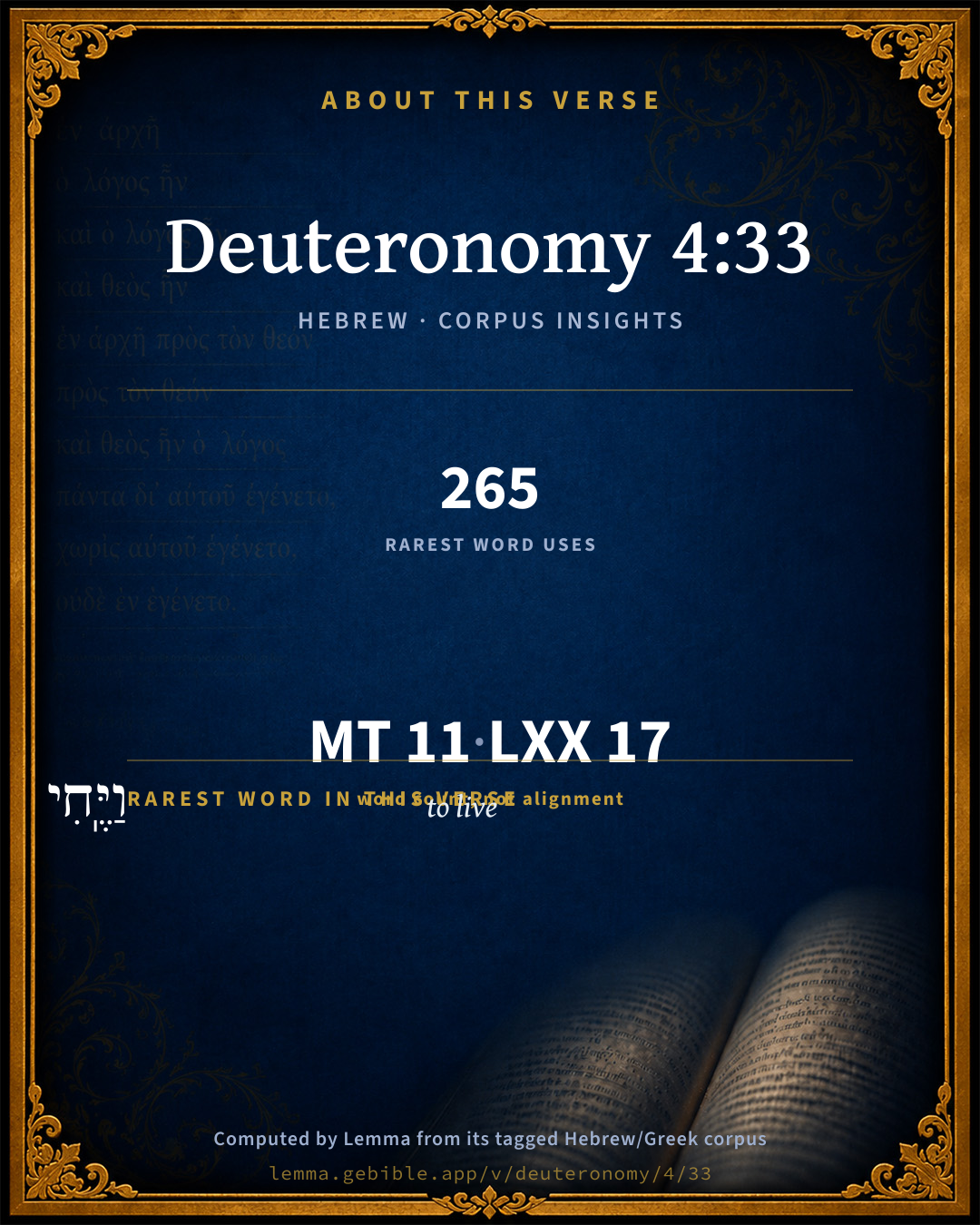
About this verse

These counts appear in no published source. They are computed here, from the morphology-tagged text and Lemma’s own curated glosses. What Lemma adds →

11
words
10
distinct lemmas
Pentateuch
section

Grammatical profile

  • 4 verbs
  • 5 nouns
  • 1 pronoun
  • 1 particle

Verb forms

  • הֲשָׁ֣מַֽע Qal · Perfect
  • מְדַבֵּ֧ר Piel · Participle Active
  • שָׁמַ֥עְתָּ Qal · Perfect
  • וַיֶּֽחִי Qal · Sequential Imperfect

Repetition

A word recurs within this verse — often emphatic in Hebrew:

  • הֲשָׁ֣מַֽע to hear H8085 ×2

Hebrew & Septuagint length

In English translation the verse runs 23 words from the Hebrew and 26 from the Septuagint (LXX English) — closely comparable.

A rough comparison of the two English renderings, which tokenize alike — not a word-level alignment.

Word counts can differ between the Hebrew and the Greek without any difference in meaning — e.g. the Hebrew direct-object marker אֵת has no separate Greek word, and Greek often adds the article ὁ.

In the original languages it is 11 Hebrew tokens and 17 Greek tokens — but the two are counted differently (Hebrew bundles its prefixes and suffixes into one token; the Greek is in lemma form), so that isn’t a like-for-like length.

Cross-references

10

Topical passages linked to Deuteronomy 4:33 in the Treasury of Scripture Knowledge — connected by theme and wording, ordered by reader-vote popularity; previews shown in the World English Bible.

  • Deuteronomy 5:24 and you said, Behold, Yahweh our God has shown us his glory and his greatness, and we have heard his voice out of the midst of the fire: we have seen this day that God does speak with man, and he lives.
  • Judges 6:22 Gideon saw that he was the angel of Yahweh; and Gideon said, Alas, Lord Yahweh! because I have seen the angel of Yahweh face to face.
  • Exodus 33:20 He said, "You cannot see my face, for man may not see me and live."
  • Exodus 24:11 He didn't lay his hand on the nobles of the children of Israel. They saw God, and ate and drank.
  • Deuteronomy 5:26 For who is there of all flesh, that has heard the voice of the living God speaking out of the midst of the fire, as we have, and lived?
  • Exodus 19:18–19 Mount Sinai, the whole of it, smoked, because Yahweh descended on it in fire; and its smoke ascended like the smoke of a furnace, and the whole mountain quaked greatly.
  • Exodus 20:18–19 All the people perceived the thunderings, the lightnings, the sound of the trumpet, and the mountain smoking. When the people saw it, they trembled, and stayed at a distance.
  • Exodus 20:22 Yahweh said to Moses, "This is what you shall tell the children of Israel: 'You yourselves have seen that I have talked with you from heaven.
  • Deuteronomy 4:24–26 For Yahweh your God is a devouring fire, a jealous God.
  • Deuteronomy 9:10 Yahweh delivered to me the two tables of stone written with the finger of God; and on them [was written] according to all the words, which Yahweh spoke with you on the mountain out of the midst of the fire in the day of the assembly.

Cross-references courtesy of OpenBible.info (CC BY 4.0).

Hebrew and Greek witnesses Masoretic Hebrew ↔ Greek Septuagint

The same verse in the two great witnesses to the Old Testament, shown verse-for-verse.

These are two independent witnesses, not word-aligned to each other, and the Septuagint is shown in lemma (dictionary) form.

Hebrew Deuteronomy 4:33 Masoretic · Westminster Leningrad Codex

הֲשָׁ֣מַֽע עָם֩ ק֨וֹל אֱלֹהִ֜ים מְדַבֵּ֧ר מִתּוֹךְ הָאֵ֛שׁ כַּאֲשֶׁר שָׁמַ֥עְתָּ אַתָּ֖ה וַיֶּֽחִי

Did ever a people hear the voice of God speaking out of the midst of the fire, as you have heard, and live?

World English Bible · Public Domain

Greek LXX Deuteronomy 4:33 Septuagint · lemma form

εἰ ἀκούω ἔθνος φωνή θεός ζάω λαλέω ἐκ μέσος ὁ πῦρ ὅς τρόπος ἀκούω σύ καί ζάω

if a nation have heard the voice of the living God speaking out of the midst of the fire, as you have heard and have lived;

LXX2012 (modern English Septuagint) · Public Domain

On this verse, The Cambridge Bible for Schools and Colleges discusses the Septuagint’s reading. Read the note in Commentary ↓

Hebrew: Westminster Leningrad Codex (CC BY 4.0). Greek: Septuagint (public domain); English from LXX2012 (modern English Septuagint) (Public Domain). How the Septuagint differs from the Hebrew →

Targum (Aramaic paraphrase)

2

The Targum is the ancient Jewish Aramaic paraphrase of the Hebrew Scriptures — an interpretive translation, not the Hebrew text itself. Onkelos (literal) and Pseudo-Jonathan (expansive) render the Torah, and Jonathan the Prophets. Coverage is partial: where no permissively-licensed English translation exists for a verse, only the Aramaic is shown. This is verse-level text, not a word-by-word alignment to the Hebrew.

  1. Targum Onkelos Torah (Genesis–Deuteronomy)
    הַשְׁמַע עַמָא קַל מֵימְרָא דַיְיָ מְמַלֵל מִגוֹ אֶשָׁתָא כְּמָא דִי שְׁמַעַתְּ אַתְּ וְיִתְקַיָם

    (no public-domain English translation for this verse)

    Targum Onkelos — Aramaic: “Onkelos Genesis” (public domain); “Onkelos Exodus” (public domain); “Onkelos Leviticus” (public domain); “Onkelos Numbers” (public domain); “Onkelos Deuteronomy” (public domain). English: “Sefaria Community Translation” (CC0 1.0 (public-domain dedication)); “J.W. Etheridge. The Targums of Onkelos and Jonathan Ben Uzziel on the Pentateuch. London: Longmans, Green, 1862” (public domain). Text via Sefaria.

  2. Targum Pseudo-Jonathan Torah (Genesis–Deuteronomy)
    הַאֶפְשָׁר דְּשָׁמַע עַמָא קַל מֵימְרָא דַיְיָ אֱלָהָא קַיֵּם דִּמְמַלֵל מִגּוֹ אֵישָׁא הֵיכְמָא דִשְׁמַעְתּוּן אַתּוּן וְאִתְקַיָּים

    Hath it ever been that a people should hear the voice of the Word of the Lord, the Living God, speaking from the midst of fire, as you heard, and remained alive?

    Targum Pseudo-Jonathan — Aramaic: “Targum Jonathan on Genesis” (public domain); “Targum Jonathan on Exodus” (public domain); “Targum Jonathan on Leviticus” (public domain); “Targum Jonathan on Numbers” (public domain); “Targum Jonathan on Deuteronomy” (public domain). English: “The Targum of Jonathan ben Uzziel, trans. J. W. Etheridge, London, 1862” (public domain). Text via Sefaria.

Commentary

Notes on Deuteronomy 4:33 from classic Christian and Jewish commentators (each source and its license shown beneath its notes). The classic Christian expositions comment on the surrounding passage and are grouped to its opening verse, so a note may address several verses; the Jewish commentaries on the Tanakh (Rashi and others) are per-verse, so they appear only where the commentator wrote on this verse.

Lemma curates 59 commentaries, every one of them public domain or Creative Commons licensed, each selected and text-cleaned for this edition rather than reprinted as found. About our sources →

Adam Clarke's Commentary

Verse 33. Did ever people hear the voice of God] It seems to have been a general belief that if God appeared to men, it was for the purpose of destroying them; and indeed most of the extraordinary manifestations of God were in the way of judgment; but here it was different; God did appear in a sovereign and extraordinary manner; but it was for the deliverance and support of the people.

1. They heard his voice speaking with them in a distinct, articulate manner.

2. They saw the fire, the symbol of his presence, the appearances of which demonstrated it to be supernatural.

3. Notwithstanding God appeared so terrible, yet no person was destroyed, for he came, not to destroy, but to save.

Adam Clarke's Commentary on the Bible (1810–1826) — public domain. Text from a community e-Sword/MySword module.

The Cambridge Bible for Schools and Colleges

gen. ed. J. J. S. Perowne

33. voice of God] Rather, the voice of a god, and with Sam. and LXX add living. Cp. Deu_5:26.

and live] Deu_5:23 ff. The well-known belief of ancient man that it meant death to come into close converse with the Deity.

The Cambridge Bible for Schools and Colleges (gen. ed. J. J. S. Perowne; Cambridge University Press, 1878–1918) — public domain. Text from a community e-Sword module.

John Gill's Exposition

Did ever people hear the voice of God speaking out of the midst of fire,.... None ever heard the voice of God as they did, much less speaking such words as they heard, and still less out of the midst of fire, which was their case, Deu 4:12.

as thou hast heard, and live? which was stranger still, when they might have expected they should, and doubtless feared they would be, as it was wonderful they were not, consumed by it.

John Gill's Exposition of the Whole Bible (1746–1763) — public domain (CC PDM 1.0). Text via the HelloAO Bible API.

Haydock's Catholic Bible Commentary

And lived. It was generally supposed that those who had seen a vision of God, or of his angel, would instantly die. See Genesis xvi. 13. (Haydock) (Chap. v. 24.)

George Leo Haydock (1774–1849), Haydock's Catholic Family Bible and Commentary, 1859 edition — public domain. Excludes Psalms (Douay-Rheims chapter numbering differs from Protestant) and Deuterocanonical books (Catholic canon only).

Matthew Poole's English Annotations

i.e. And was not overwhelmed and consumed by such a glorious appearance. See Exo 24:11; 33:20

Matthew Poole's English Annotations on the Holy Bible (1683–1685) — public domain. Text from a community e-Sword/MySword module.

The Pulpit Commentary

Cf. ver. 12; v, 22-26; Gen_16:13.

The Pulpit Commentary (1880–1919), ed. H.D.M. Spence-Jones & Joseph S. Exell — public domain. Text from a community e-Sword module.

John Wesley's Explanatory Notes

And live - And was not overwhelmed and consumed by such a glorious appearance.

John Wesley, Explanatory Notes Upon the Whole Bible (1754–1765) — public domain. Text via the GEBible commentary corpus.

Lesson kit

Teaching starters — assembled from the data on this page, not authored interpretation. Every prompt links to the verse data it draws on. Edit before teaching.

Deuteronomy, in the Pentateuch, opens this verse with 11 words (10 distinct Hebrew lemmas). Its most distinctive word is châyâh (“to live”). A historical commentator’s framing appears above. Read the whole chapter for the surrounding context.

Discussion questions

  1. How does “to live” (châyâh) shape what this verse is saying?
  2. How does Deuteronomy 5:24, which shares this passage’s theme, read alongside this verse?
  3. What does the repetition of “to hear” (2× in this one verse) do in this verse?
  4. The translations on this page render this verse differently — a whole-verse word diff, not a word-by-word alignment. What might account for the different wordings?
  5. «הֲשָׁ֣מַֽע» is a Qal Perfect verb. How does that grammatical form shape the action described?
  6. Compare how Adam Clarke's Commentary and The Cambridge Bible for Schools and Colleges read this verse. Where do they agree or differ?

Things to notice

Reading settings

Reading text

Shown beneath each verse's original-language words.

Old Testament
Old Testament edition

Read the OT as the Masoretic Hebrew (MT) or the Greek Septuagint (LXX).

English shown for the Greek Septuagint (in the Hebrew ↔ Greek comparison).

Comparing translations? Open the Compare panel on any verse page to stack up to four side by side.