
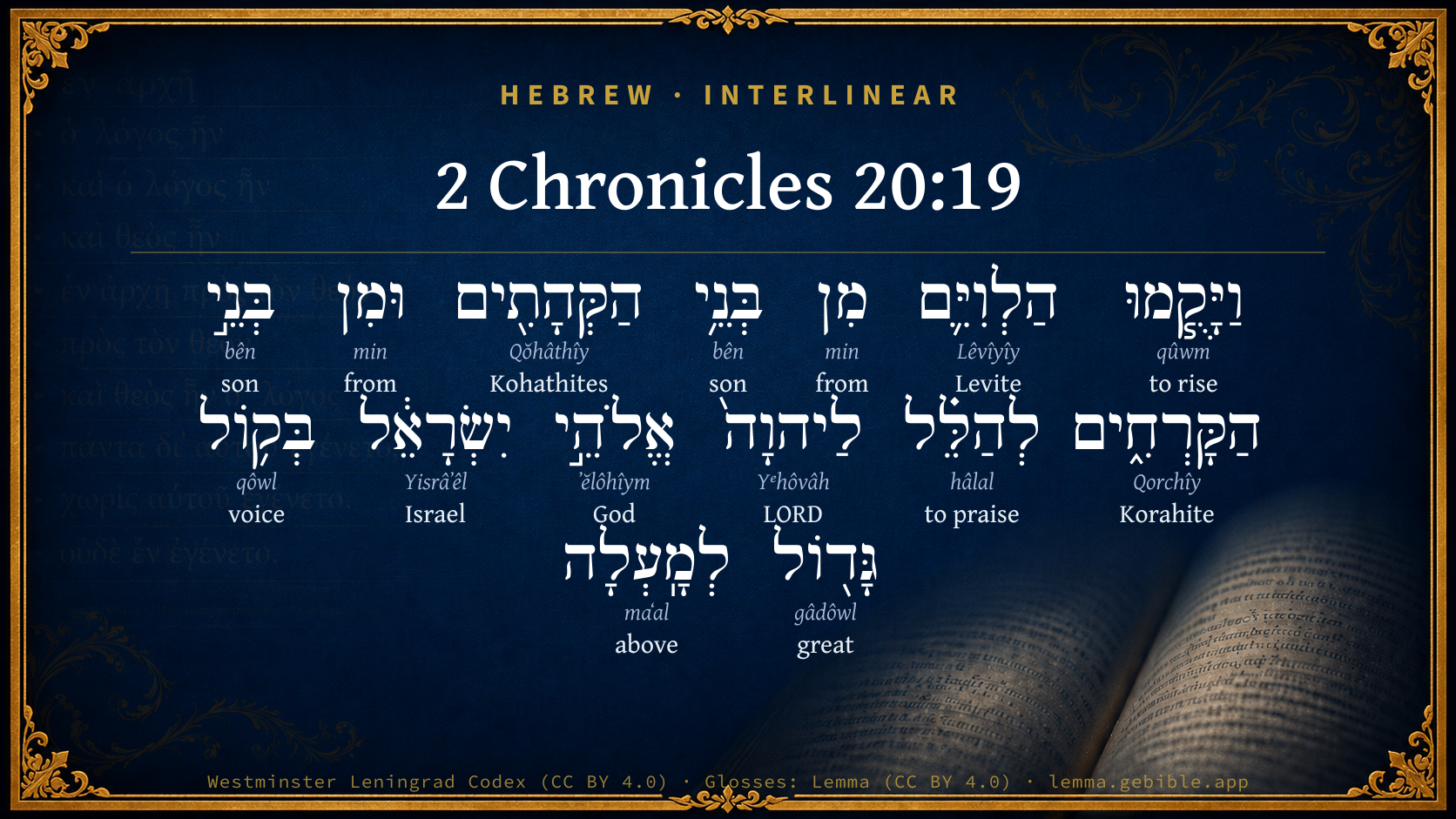
2 Chronicles 20:19

Hebrew (Westminster Leningrad Codex) 2 Chronicles 20:19 appears in the Hebrew Old Testament. The text above is from the Westminster Leningrad Codex. Each word links to its Strong’s number, a concise gloss, and parsing drawn from the Open Scriptures Hebrew Bible morphology. Click any word for its full Brown-Driver-Briggs (BDB) entry.
Download image
Cite this verse

2 Chronicles 20:19 (World English Bible). Public Domain. Lemma interlinear Bible study tool, https://lemma.gebible.app/v/2-chronicles/20/19.

Show BibTeX & RIS
BibTeX
RIS
English Translation
The Levites, of the children of the Kohathites and of the children of the Korahites, stood up to praise Yahweh, the God of Israel, with an exceeding loud voice.
World English Bible · Public Domain
Download a study sheet

One document with this verse’s original text, its word-by-word gloss line, the meaning frame, cross-references with their text, attributed commentary, and full source and license credits — printable, and it pastes into notes with its structure intact.

This verse Autodidact and up

Study sheet (.html) Plain text (.txt)

A passage Seminary Student

Up to 50 verses in one chapter. A passage sheet keeps up to 6 commentary sources and 12 cross-references per verse, in the order this page ranks them, and says so on the sheet whenever that leaves anything out. Ask for a single verse and you get the Autodidact verse sheet above.

Everything on this page stays free to read, with no account — the sheet is a download of what is already on screen, not access to it.

Want to remove ads? Support Godless Engineer
Compare translations 3

The same verse in 3 English versions, stacked beneath the original-language interlinear above. Click any original word for its lexicon entry.

Each is an independent rendering of the whole verse — the interlinear is not word-aligned to these translations.

Highlighted words mark where these versions differ — a whole-verse word diff, not a word-by-word alignment.

  • World English Bible Public Domain
    The Levites, of the children of the Kohathites and of the children of the Korahites, stood up to praise Yahweh, the God of Israel, with an exceeding loud voice.
  • King James Version Public Domain
    And the Levites, of the children of the Kohathites, and of the children of the Korhites, stood up to praise the LORD God of Israel with a loud voice on high.
  • unfoldingWord Literal Text CC BY-SA 4.0
    And the Levites, from the sons of the Kohathites and from the sons of the Korahites, stood up to praise Yahweh, the God of Israel, with a great voice upwards.

unfoldingWord Literal Text — © unfoldingWord, licensed CC BY-SA 4.0. Word-aligned USFM3 via Door43 (git.door43.org/unfoldingWord/en_ult).

Versions to compare (up to 4)

3 of 4 selected

Show all 18 translations

Every available English version of this verse, each an independent rendering of the whole verse.

  • World English Bible Public Domain
    The Levites, of the children of the Kohathites and of the children of the Korahites, stood up to praise Yahweh, the God of Israel, with an exceeding loud voice.
  • Berean Standard Bible Public Domain
    And the Levites from the Kohathites and Korahites stood up to praise the LORD, the God of Israel, shouting in a very loud voice.
  • Majority Standard Bible Public Domain
    And the Levites from the Kohathites and Korahites stood up to praise the LORD, the God of Israel, shouting in a very loud voice.
  • King James Version Public Domain
    And the Levites, of the children of the Kohathites, and of the children of the Korhites, stood up to praise the LORD God of Israel with a loud voice on high.
  • American Standard Version (1901) Public Domain
    And the Levites, of the children of the Kohathites and of the children of the Korahites, stood up to praise Jehovah, the God of Israel, with an exceeding loud voice.
  • Revised Version (1885) Public Domain
    And the Levites, of the children of the Kohathites and of the children of the Korahites, stood up to praise the LORD, the God of Israel, with an exceeding loud voice.
  • Geneva Bible (1599) Public Domain
    And the Leuites of the children of the Kohathites and of the childre of the Corhites stood vp to prayse the Lord God of Israel with a loude voyce on hie.
  • Douay-Rheims (1899) Public Domain
    And the Levites of the sons of Caath, and of the sons of Core praised the Lord the God of Israel with a loud voice, on high.
  • Young's Literal Translation Public Domain
    And the Levites, of the sons of the Kohathites, and of the sons of the Korhites, rise to give praise to Jehovah, God of Israel, with a loud voice on high.
  • Literal Standard Version CC BY-SA 4.0
    And the Levites, of the sons of the Kohathites, and of the sons of the Korahites, rise to give praise to YHWH, God of Israel, with a loud voice on high.
  • Unlocked Literal Bible CC BY-SA 4.0
    The Levites, those of the descendants of the Kohathites and Korahites, stood up to praise Yahweh, the God of Israel, with a very loud voice.
  • unfoldingWord Literal Text CC BY-SA 4.0
    And the Levites, from the sons of the Kohathites and from the sons of the Korahites, stood up to praise Yahweh, the God of Israel, with a great voice upwards.
  • Darby Bible Public Domain
    And the Levites, of the sons of the Kohathites, and of the sons of the Korahites, stood up to praise Jehovah the God of Israel with an exceeding loud voice.
  • World Messianic Bible Public Domain
    The Levites, of the children of the Kohathites and of the children of the Korahites, stood up to praise the LORD, the God of Israel, with an exceedingly loud voice.
  • Webster's Bible Public Domain
    And the Levites, of the children of the Kohathites, and of the children of the Korhites, stood up to praise the LORD God of Israel with a loud voice on high.
  • Free Bible Version CC BY-SA 4.0
    Then the Levites from the Kohathites and Korahites stood to praise the Lord, the God of Israel, shouting loudly.
  • Bible in Basic English Public Domain
    And the Levites, the children of the Kohathites and the Korahites, got to their feet and gave praise to the Lord, the God of Israel, with a loud voice.
  • JPS Tanakh (1917) Public Domain
    And the Levites, of the children of the Kohathites and of the children of the Korahites, stood up to praise the LORD, the God of Israel, with an exceeding loud voice.

Literal Standard Version (2020), Covenant Press — licensed CC BY-SA 4.0. Text via the HelloAO Bible API (eBible.org). Unlocked Literal Bible (unfoldingWord) — licensed CC BY-SA 4.0. Text via the HelloAO Bible API (eBible.org). unfoldingWord Literal Text — © unfoldingWord, licensed CC BY-SA 4.0. Word-aligned USFM3 via Door43 (git.door43.org/unfoldingWord/en_ult). Free Bible Version, Dr. Jonathan Gallagher — licensed CC BY-SA 4.0. Text via the HelloAO Bible API (eBible.org).

Word by word

More ways to search: Search by grammar → Find every occurrence → Compare this word →

Practice this passage: Drill this verse → Learn its vocabulary →

הַקָּרְחִ֑ים
Qorchîy
H7145
“the · Korahites”
Particle, Definite Article + Noun, Gentilic, Masculine, Plural, Absolute
Part of Speech
Particle + Noun
Type
Gentilic
Gender
Masculine
Number
Plural
State
Absolute
Full BDB Definition

Origin: patronymic from H7141

TWOT: None

Korahite = "one of Korah" - descendants of Korah the son of Levi
  1. וַיָּקֻ֧מוּ qûwm H6965 “and · to rise” Conjunction + Verb, Qal, Sequential Imperfect, 3rd Person, Masculine, Plural
  2. הַלְוִיִּ֛ם Lêvîyîy H3881 “the · Levites” Particle, Definite Article + Noun, Gentilic, Masculine, Plural, Absolute
  3. מִן min H4480 “from” Preposition
  4. בְּנֵ֥י bên H1121 “sons of” Noun, Common, Masculine, Plural, Construct
  5. הַקְּהָתִ֖ים Qŏhâthîy H6956 “the · Kohathites” Particle, Definite Article + Noun, Gentilic, Masculine, Plural, Absolute
  6. וּמִן min H4480 “and · from” Conjunction + Preposition
  7. בְּנֵ֣י bên H1121 “sons of” Noun, Common, Masculine, Plural, Construct
  8. לְהַלֵּ֗ל hâlal H1984 “to praise” Preposition + Verb, Piel, Infinitive Construct
  9. לַיהוָה֙ Yᵉhôvâh H3068 “to/for · LORD” Preposition + Noun, Proper
  10. אֱלֹהֵ֣י ʼĕlôhîym H430 “God(s) of” Noun, Common, Masculine, Plural, Construct
  11. יִשְׂרָאֵ֔ל Yisrâʼêl H3478 “Israel” Noun, Proper
  12. בְּק֥וֹל qôwl H6963 “in/at · voice” Preposition + Noun, Common, Masculine, Singular, Absolute
  13. גָּד֖וֹל gâdôwl H1419 “great” Adjective, Adjective, Masculine, Singular, Absolute
  14. לְמָֽעְלָה maʻal H4605 “to/for · above · toward” Preposition + Adverb + Suffix, Demonstrative

About this verse

These counts appear in no published source. They are computed here, from the morphology-tagged text and Lemma’s own curated glosses. What Lemma adds →

15
words
13
distinct lemmas
Historical
section

Notable vocabulary

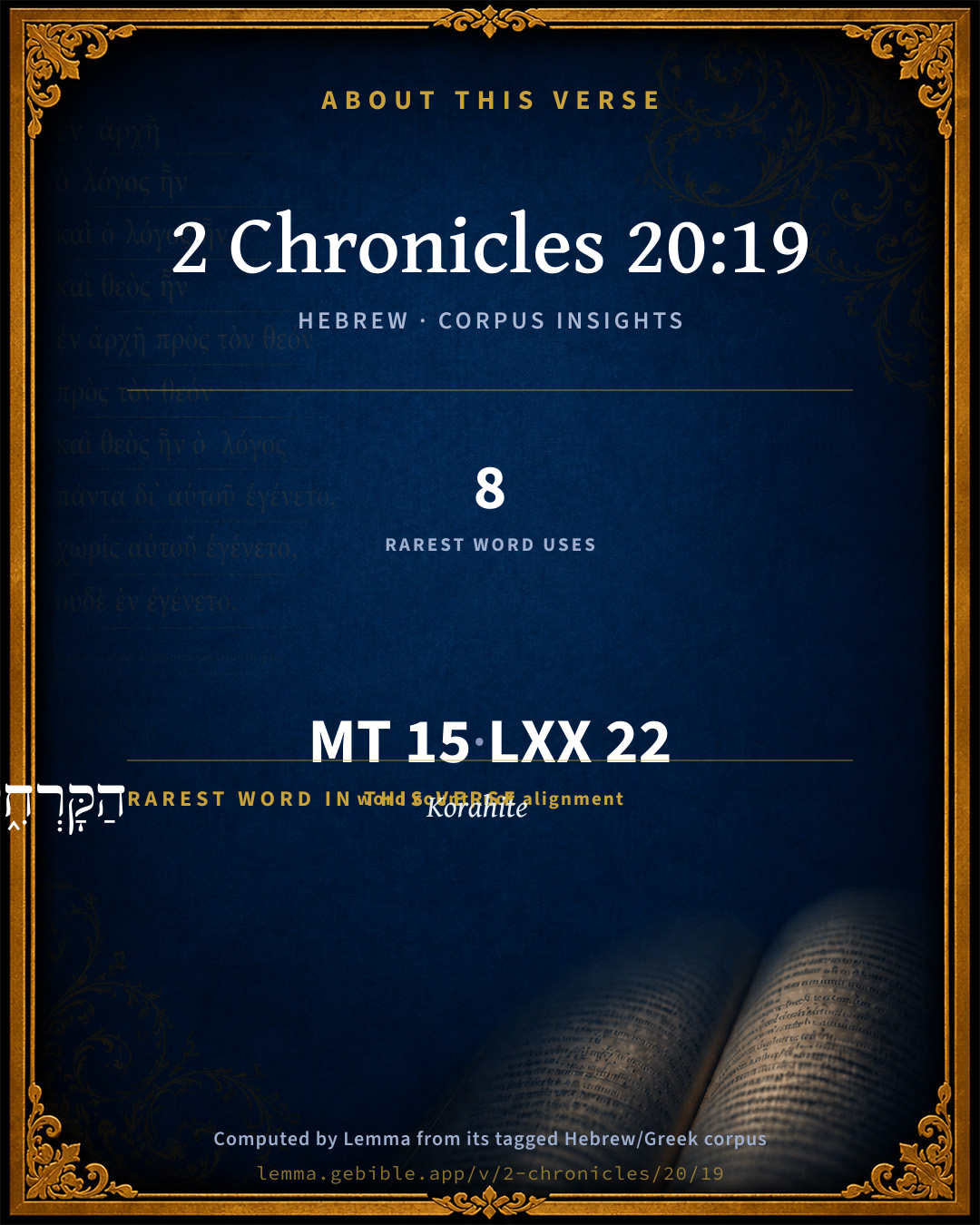
The rarest word here is הַקָּרְחִ֑ים Korahite H7145 — appearing just 8 times in the whole Hebrew Bible.

Shared distinctive vocabulary

הַקָּרְחִ֑ים Korahite H7145 occurs in 8 verses of the Hebrew Bible. Also found in:

Grammatical profile

  • 2 verbs
  • 9 nouns
  • 1 adjective
  • 2 prepositions
  • 1 adverb

Verb forms

  • וַיָּקֻ֧מוּ Qal · Sequential Imperfect
  • לְהַלֵּ֗ל Piel · Infinitive Construct

Repetition

Words recur within this verse — often emphatic in Hebrew:

  • בְּנֵ֥י son H1121 ×2
  • מִן from H4480 ×2

Hebrew & Septuagint length

In English translation the verse runs 29 words from the Hebrew and 30 from the Septuagint (LXX English) — closely comparable.

A rough comparison of the two English renderings, which tokenize alike — not a word-level alignment.

Word counts can differ between the Hebrew and the Greek without any difference in meaning — e.g. the Hebrew direct-object marker אֵת has no separate Greek word, and Greek often adds the article ὁ.

In the original languages it is 15 Hebrew tokens and 22 Greek tokens — but the two are counted differently (Hebrew bundles its prefixes and suffixes into one token; the Greek is in lemma form), so that isn’t a like-for-like length.

Cross-references

12

Topical passages linked to 2 Chronicles 20:19 in the Treasury of Scripture Knowledge — connected by theme and wording, ordered by reader-vote popularity; previews shown in the World English Bible.

  • 1 Chronicles 15:16–22 David spoke to the chief of the Levites to appoint their brothers the singers, with instruments of music, psalteries and harps and cymbals, sounding aloud and lifting up the voice with joy.
  • 1 Chronicles 16:5 Asaph the chief, and second to him Zechariah, Jeiel, and Shemiramoth, and Jehiel, and Mattithiah, and Eliab, and Benaiah, and Obed-edom, and Jeiel, with psalteries and with harps; and Asaph with cymbals, sounding aloud;
  • 1 Chronicles 16:42 and with them Heman and Jeduthun [with] trumpets and cymbals for those that should sound aloud, and [with] instruments for the songs of God; and the sons of Jeduthun to be at the gate.
  • 1 Chronicles 23:5 and four thousand were doorkeepers; and four thousand praised Yahweh with the instruments which I made, [said David], for giving praise.
  • 1 Chronicles 25:1–7 Moreover, David and the captains of the host set apart for the service certain of the sons of Asaph, and of Heman, and of Jeduthun, who should prophesy with harps, with psalteries, and with cymbals: and the number of those who did the work according to their service was:
  • 2 Chronicles 5:13 it happened, when the trumpeters and singers were as one, to make one sound to be heard in praising and thanking Yahweh; and when they lifted up their voice with the trumpets and cymbals and instruments of music, and praised Yahweh, [saying], For he is good; for his loving kindness endures forever; that then the house was filled with a cloud, even the house of Yahweh,
  • Ezra 3:12–13 But many of the priests and Levites and heads of fathers' [houses], the old men who had seen the first house, when the foundation of this house was laid before their eyes, wept with a loud voice; and many shouted aloud for joy:
  • Nehemiah 12:42–43 and Maaseiah, and Shemaiah, and Eleazar, and Uzzi, and Jehohanan, and Malchijah, and Elam, and Ezer. The singers sang loud, with Jezrahiah their overseer.
  • Psalms 44:1 We have heard with our ears, God; Our fathers have told us, What work you did in their days, In the days of old.
  • Psalms 49:1 Hear this, all you peoples. Listen, all you inhabitants of the world,
  • Psalms 81:1 Sing aloud to God, our strength! Make a joyful shout to the God of Jacob!
  • Psalms 95:1–2 Oh come, let's sing to Yahweh. Let's shout aloud to the rock of our salvation!

Cross-references courtesy of OpenBible.info (CC BY 4.0).

Hebrew and Greek witnesses Masoretic Hebrew ↔ Greek Septuagint

The same verse in the two great witnesses to the Old Testament, shown verse-for-verse.

These are two independent witnesses, not word-aligned to each other, and the Septuagint is shown in lemma (dictionary) form.

Hebrew 2 Chronicles 20:19 Masoretic · Westminster Leningrad Codex

וַיָּקֻ֧מוּ הַלְוִיִּ֛ם מִן בְּנֵ֥י הַקְּהָתִ֖ים וּמִן בְּנֵ֣י הַקָּרְחִ֑ים לְהַלֵּ֗ל לַיהוָה֙ אֱלֹהֵ֣י יִשְׂרָאֵ֔ל בְּק֥וֹל גָּד֖וֹל לְמָֽעְלָה

The Levites, of the children of the Kohathites and of the children of the Korahites, stood up to praise Yahweh, the God of Israel, with an exceeding loud voice.

World English Bible · Public Domain

Greek LXX 2 Chronicles 20:19 Septuagint · lemma form

καί ἀναἵστημι ὁ λευείτης ἀπό ὁ υἱός κααθ καί ἀπό ὁ υἱός κορε αἰνέω κύριος θεός ἰσραήλ ἐν φωνή μέγας εἰς ὕψος

And the Levites of the children of Caath, and they of the sons of Core, rose up to praise the Lord God of Israel with a loud voice on high.

LXX2012 (modern English Septuagint) · Public Domain

Hebrew: Westminster Leningrad Codex (CC BY 4.0). Greek: Septuagint (public domain); English from LXX2012 (modern English Septuagint) (Public Domain). How the Septuagint differs from the Hebrew →

Commentary

Notes on 2 Chronicles 20:19 from classic Christian and Jewish commentators (each source and its license shown beneath its notes). The classic Christian expositions comment on the surrounding passage and are grouped to its opening verse, so a note may address several verses; the Jewish commentaries on the Tanakh (Rashi and others) are per-verse, so they appear only where the commentator wrote on this verse.

Lemma curates 59 commentaries, every one of them public domain or Creative Commons licensed, each selected and text-cleaned for this edition rather than reprinted as found. About our sources →

Trapp's Complete Commentary

John Trapp

2Ch 20:19 And the Levites, of the children of the Kohathites, and of the children of the Korhites, stood up to praise the LORD God of Israel with a loud voice on high.

Ver. 19. Stood up to praise the Lord.] So sure they were of the victory, that even before they had it they sang an επινοκιον, a triumphant song. As to God, so to true faith, all things are present, all things are possible.

John Trapp, A Commentary or Exposition upon All the Books of the Old and New Testament (1647–1656) — public domain. Text from a community e-Sword module.

Jamieson, Fausset & Brown

Robert Jamieson, A. R. Fausset & David Brown

the Levites . . . stood up to praise the Lord--doubtless by the king's command. Their anthem was sung with such a joyful acclaim as showed that they universally regarded the victory as already obtained.

Jamieson, Fausset & Brown — Commentary Critical and Explanatory on the Whole Bible (1871) — public domain (CC PDM 1.0). Text via the HelloAO Bible API.

Ellicott's Commentary for English Readers

(19) And the Levites.—The Levites are the first to rise up, in order to break forth into a hymn of thanksgiving.

Of the children of the Kohathites, and of the children of the Korhites.—Sons of the Kohathites specifies the clan, and sons of the Korhites the house of the musicians who rose up on this occasion. The Korhites were the leading division of Kohath (1Ch_6:22). And is explanatory; even, namely some of the sons of Korah. The “sons of Korah” were a guild of Levitical minstrels of the first rank. (Comp. the headings of many psalms, e.g., 44-49, connecting them with their authorship.)

To praise the Lord God of Israel.—1Ch_16:14 (hallel).

A Bible Commentary for English Readers, edited by Charles John Ellicott (1878–1897) — public domain. Text from a community e-Sword module.

The Cambridge Bible for Schools and Colleges

gen. ed. J. J. S. Perowne

19. the Korhites] R.V. the Korahites. The Korahites were a branch of the Kohathites (1Ch_6:22 [7 Heb.], 37, 38 [22, 23 Heb.]); the Chronicler simply defines his first statement; those who stood up to praise were Kohathites by clan, Korahites by family.

a loud voice on high] R.V. an exceeding loud voice.

The Cambridge Bible for Schools and Colleges (gen. ed. J. J. S. Perowne; Cambridge University Press, 1878–1918) — public domain. Text from a community e-Sword module.

John Gill's Exposition

And the Levites, of the children of the Kohathites, and of the children of the Korhites,.... Who were of the posterity of Kohath, in the line of Korah:

stood up to praise the Lord God of Israel with a loud voice on high; in high notes; they being the course in turn at this time for this service.

John Gill's Exposition of the Whole Bible (1746–1763) — public domain (CC PDM 1.0). Text via the HelloAO Bible API.

Haydock's Catholic Bible Commentary

High. Rejoicing at the promised deliverance. C.

George Leo Haydock (1774–1849), Haydock's Catholic Family Bible and Commentary, 1859 edition — public domain. Excludes Psalms (Douay-Rheims chapter numbering differs from Protestant) and Deuterocanonical books (Catholic canon only).

Matthew Poole's English Annotations

The Levites stood up, by Jehoshaphat’s appointment.

With a loud voice on high, i.e. with most loud voice, with heart and voice lifted up; whereby they showed their full assurance of the victory, as if it were already accomplished.

Matthew Poole's English Annotations on the Holy Bible (1683–1685) — public domain. Text from a community e-Sword/MySword module.

Whedon's Commentary on the Bible

Daniel D. Whedon

19. The Korhites — Descendants of Korah, who was also a son of Kohath, but mentioned particularly here, as it would seem, on account of the prominence of his children on this occasion.

Daniel D. Whedon (gen. ed.), Commentary on the Old and New Testaments (1874–1909) — public domain. Text from a community e-Sword module.

The Pulpit Commentary

Of the children of the Korhites; i.e., with Revised Version, of the Korahites, who were the best of the Kohathite family. (1Ch_6:22; also at head of Psalm 42-49., Authorized Version and Revised Version) Keil would translate, "Of the sons of Kohath, yea, of the Korahites."

The Pulpit Commentary (1880–1919), ed. H.D.M. Spence-Jones & Joseph S. Exell — public domain. Text from a community e-Sword module.

John Wesley's Explanatory Notes

Stood up - By Jehoshaphat's appointment. On high - With heart and voice lifted up: whereby they shewed their full assurance of the victory.

John Wesley, Explanatory Notes Upon the Whole Bible (1754–1765) — public domain. Text via the GEBible commentary corpus.

Lesson kit

Teaching starters — assembled from the data on this page, not authored interpretation. Every prompt links to the verse data it draws on. Edit before teaching.

2 Chronicles, in the Historical, opens this verse with 15 words (13 distinct Hebrew lemmas). Its most distinctive word is Qorchîy (“Korahite”). A historical commentator’s framing appears above. Read the whole chapter for the surrounding context.

Discussion questions

  1. How does “Korahite” (Qorchîy) shape what this verse is saying?
  2. Exodus 6:24 shares the word «Korahite» with this verse. How do the two illuminate each other?
  3. “son” occurs 2× in this one verse. What is the effect of the repetition?
  4. These translations render this verse differently; the difference is in the English rendering, not the original. What questions does that raise?
  5. The verb «וַיָּקֻ֧מוּ» is Qal Sequential Imperfect. How does its form color the action?
  6. Reading how Trapp's Complete Commentary and Jamieson, Fausset & Brown read this verse, where do the two commentators agree and where do they part?

Things to notice

Reading settings

Reading text

Shown beneath each verse's original-language words.

Old Testament
Old Testament edition

Read the OT as the Masoretic Hebrew (MT) or the Greek Septuagint (LXX).

English shown for the Greek Septuagint (in the Hebrew ↔ Greek comparison).

Comparing translations? Open the Compare panel on any verse page to stack up to four side by side.