
1 Samuel 19:6

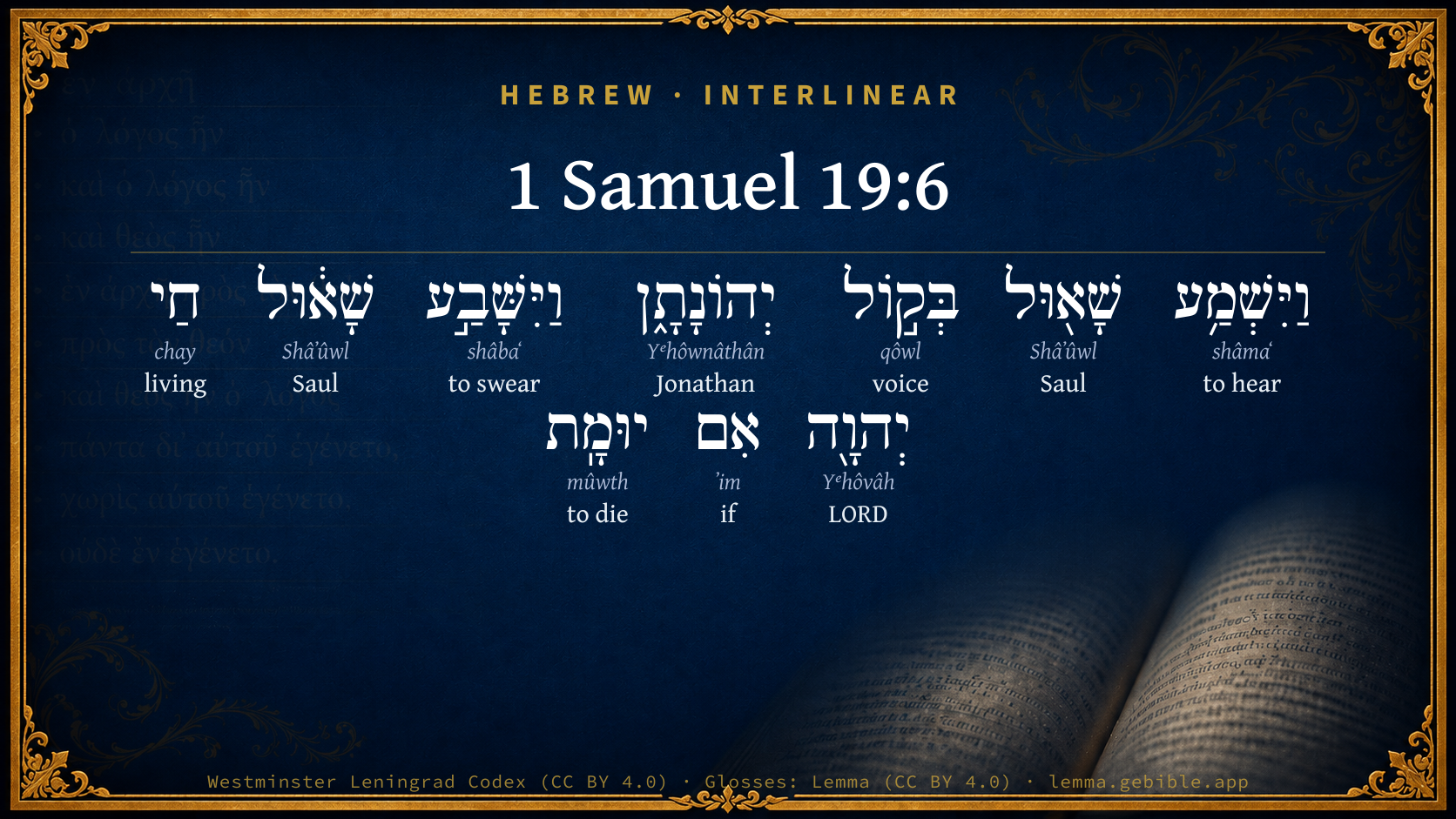
Hebrew (Westminster Leningrad Codex) 1 Samuel 19:6 appears in the Hebrew Old Testament. The text above is from the Westminster Leningrad Codex. Each word links to its Strong’s number, a concise gloss, and parsing drawn from the Open Scriptures Hebrew Bible morphology. Click any word for its full Brown-Driver-Briggs (BDB) entry.
Download image
Cite this verse

1 Samuel 19:6 (World English Bible). Public Domain. Lemma interlinear Bible study tool, https://lemma.gebible.app/v/1-samuel/19/6.

Show BibTeX & RIS
BibTeX
RIS
English Translation
Saul listened to the voice of Jonathan: and Saul swore, As Yahweh lives, he shall not be put to death.
World English Bible · Public Domain
Download a study sheet

One document with this verse’s original text, its word-by-word gloss line, the meaning frame, cross-references with their text, attributed commentary, and full source and license credits — printable, and it pastes into notes with its structure intact.

This verse Autodidact and up

Study sheet (.html) Plain text (.txt)

A passage Seminary Student

Up to 50 verses in one chapter. A passage sheet keeps up to 6 commentary sources and 12 cross-references per verse, in the order this page ranks them, and says so on the sheet whenever that leaves anything out. Ask for a single verse and you get the Autodidact verse sheet above.

Everything on this page stays free to read, with no account — the sheet is a download of what is already on screen, not access to it.

Want to remove ads? Support Godless Engineer
Compare translations 3

The same verse in 3 English versions, stacked beneath the original-language interlinear above. Click any original word for its lexicon entry.

Each is an independent rendering of the whole verse — the interlinear is not word-aligned to these translations.

Highlighted words mark where these versions differ — a whole-verse word diff, not a word-by-word alignment.

  • World English Bible Public Domain
    Saul listened to the voice of Jonathan: and Saul swore, As Yahweh lives, he shall not be put to death.
  • King James Version Public Domain
    And Saul hearkened unto the voice of Jonathan: and Saul sware, As the LORD liveth, he shall not be slain.
  • unfoldingWord Literal Text CC BY-SA 4.0
    And Saul listened to the voice of Jonathan, and Saul swore, “The life of Yahweh, he shall not be killed”

unfoldingWord Literal Text — © unfoldingWord, licensed CC BY-SA 4.0. Word-aligned USFM3 via Door43 (git.door43.org/unfoldingWord/en_ult).

Versions to compare (up to 4)

3 of 4 selected

Show all 18 translations

Every available English version of this verse, each an independent rendering of the whole verse.

  • World English Bible Public Domain
    Saul listened to the voice of Jonathan: and Saul swore, As Yahweh lives, he shall not be put to death.
  • Berean Standard Bible Public Domain
    Saul listened to the voice of Jonathan and swore an oath: “As surely as the LORD lives, David will not be put to death.”
  • Majority Standard Bible Public Domain
    Saul listened to the voice of Jonathan and swore an oath: “As surely as the LORD lives, David will not be put to death.”
  • King James Version Public Domain
    And Saul hearkened unto the voice of Jonathan: and Saul sware, As the LORD liveth, he shall not be slain.
  • American Standard Version (1901) Public Domain
    And Saul hearkened unto the voice of Jonathan: and Saul sware, As Jehovah liveth, he shall not be put to death.
  • Revised Version (1885) Public Domain
    And Saul hearkened unto the voice of Jonathan: and Saul sware, As the LORD liveth, he shall not be put to death.
  • Geneva Bible (1599) Public Domain
    Then Saul hearkened vnto the voyce of Ionathan, and Saul sware, As the Lord liueth, he shall not dye.
  • Douay-Rheims (1899) Public Domain
    And when Saul heard this he was appeased with the words of Jonathan, and swore: As the Lord liveth he shall not be slain.
  • Young's Literal Translation Public Domain
    And Saul hearkeneth to the voice of Jonathan, and Saul sweareth, `Jehovah liveth -- he doth not die.'
  • Literal Standard Version CC BY-SA 4.0
    And Saul listens to the voice of Jonathan, and Saul swears, “YHWH lives—he does not die.”
  • Unlocked Literal Bible CC BY-SA 4.0
    Saul listened to Jonathan. Saul swore, “As Yahweh lives, he will not be put to death.”
  • unfoldingWord Literal Text CC BY-SA 4.0
    And Saul listened to the voice of Jonathan, and Saul swore, “The life of Yahweh, he shall not be killed”
  • Darby Bible Public Domain
    And Saul hearkened to the voice of Jonathan, and Saul swore, [As] Jehovah liveth, he shall not be put to death!
  • World Messianic Bible Public Domain
    Saul listened to the voice of Jonathan; and Saul swore, “As the LORD lives, he shall not be put to death.”
  • Webster's Bible Public Domain
    And Saul hearkened to the voice of Jonathan: and Saul swore, As the LORD liveth, he shall not be slain.
  • Free Bible Version CC BY-SA 4.0
    Saul accepted what Jonathan had to say, and promised with an oath: “I swear on the life of the Lord, he won't be put to death.”
  • Bible in Basic English Public Domain
    And Saul gave ear to the voice of Jonathan, and said with an oath, By the living Lord, he is not to be put to death.
  • JPS Tanakh (1917) Public Domain
    And Saul hearkened unto the voice of Jonathan; and Saul swore: 'As the LORD liveth, he shall not be put to death.'

Literal Standard Version (2020), Covenant Press — licensed CC BY-SA 4.0. Text via the HelloAO Bible API (eBible.org). Unlocked Literal Bible (unfoldingWord) — licensed CC BY-SA 4.0. Text via the HelloAO Bible API (eBible.org). unfoldingWord Literal Text — © unfoldingWord, licensed CC BY-SA 4.0. Word-aligned USFM3 via Door43 (git.door43.org/unfoldingWord/en_ult). Free Bible Version, Dr. Jonathan Gallagher — licensed CC BY-SA 4.0. Text via the HelloAO Bible API (eBible.org).

Word by word

More ways to search: Search by grammar → Find every occurrence → Compare this word →

Practice this passage: Drill this verse → Learn its vocabulary →

יְהוֹנָתָ֑ן
Yᵉhôwnâthân
H3083
“Jonathan”
Noun, Proper
Part of Speech
Noun
Type
Proper
Full BDB Definition

Origin: from H3068 and H5414

TWOT: None

Jonathan or Jehonathan = "Jehovah has given" - a son of king Saul and a friend of David - a son of the high priest Abiathar and the last descendant of Eli of whom we hear - a nephew of David who like David slew a giant of Gath - an uncle of David - one of David's mighty warriors - one of David's treasurers - a scribe in the time of Jeremiah - a Levite and father of Zechariah, a priest who blew the trumpet at the dedication of the wall - a son or descendant of Gershom, the son of Moses, and a priest to the tribe of Dan - a son of Kareah and a brother of Johanan; a Judaite captain after the fall of Jerusalem - another Judaite father of Peleth - father of Ebed in the time of Ezra - son of Asahel in the time of Ezra - a priest of the family of Melicu in the time of Nehemiah - son of Joiada and his successor to the high priesthood in the time of Nehemiah
  1. וַיִּשְׁמַ֥ע shâmaʻ H8085 “and · to hear” Conjunction + Verb, Qal, Sequential Imperfect, 3rd Person, Masculine, Singular
  2. שָׁא֖וּל Shâʼûwl H7586 “Saul” Noun, Proper
  3. בְּק֣וֹל qôwl H6963 “in/at · voice of” Preposition + Noun, Common, Masculine, Singular, Construct
  4. וַיִּשָּׁבַ֣ע shâbaʻ H7650 “and · to swear” Conjunction + Verb, Niphal, Sequential Imperfect, 3rd Person, Masculine, Singular
  5. שָׁא֔וּל Shâʼûwl H7586 “Saul” Noun, Proper
  6. חַי chay H2416 “living” Adjective, Adjective, Masculine, Singular, Absolute
  7. יְהוָ֖ה Yᵉhôvâh H3068 “LORD” Noun, Proper
  8. אִם ʼim H518 “if” Conjunction
  9. יוּמָֽת mûwth H4191 “to die” Verb, Hophal, Imperfect, 3rd Person, Masculine, Singular

About this verse

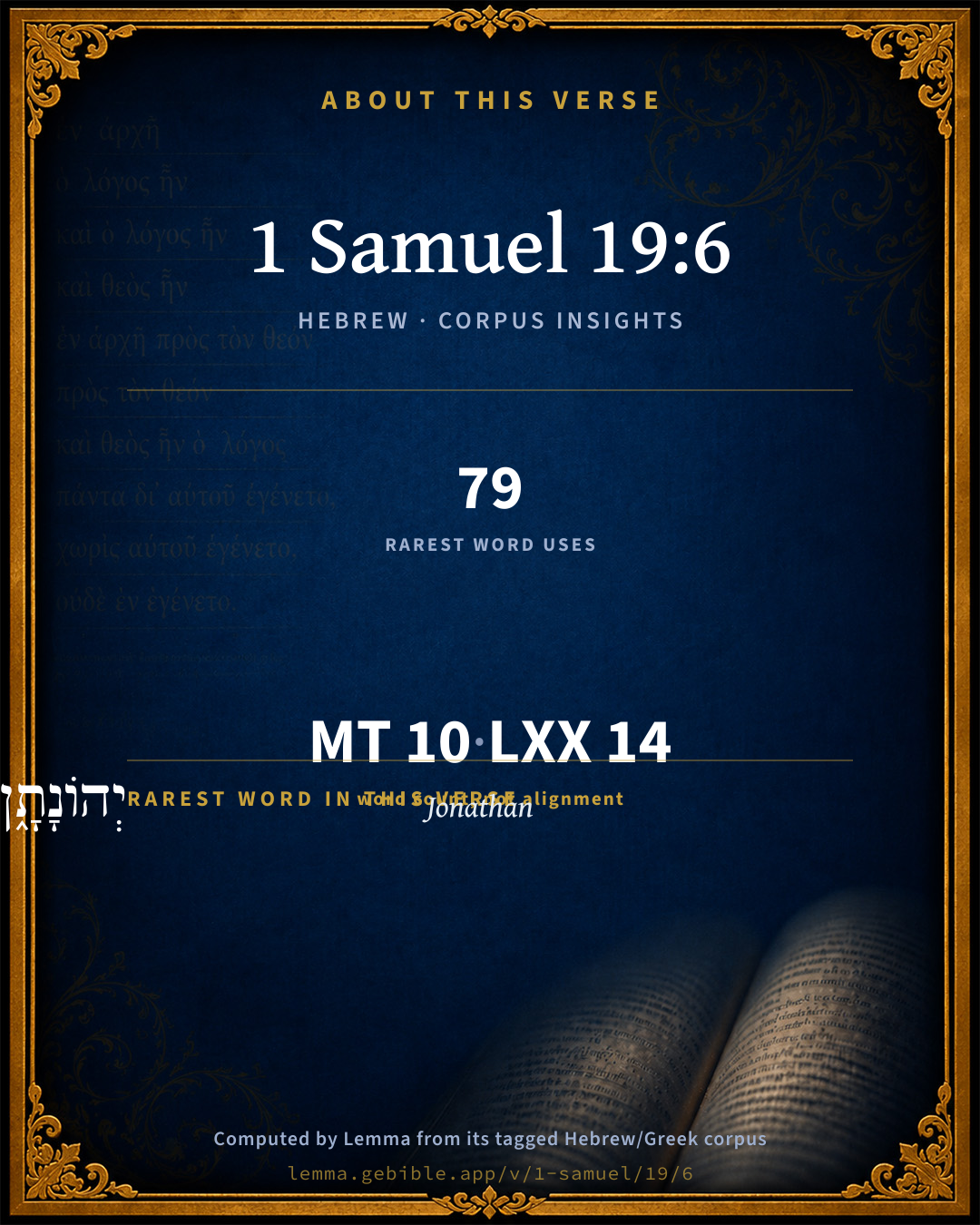
These counts appear in no published source. They are computed here, from the morphology-tagged text and Lemma’s own curated glosses. What Lemma adds →

10
words
9
distinct lemmas
Historical
section

Grammatical profile

  • 3 verbs
  • 5 nouns
  • 1 adjective
  • 1 conjunction

Verb forms

  • וַיִּשְׁמַ֥ע Qal · Sequential Imperfect
  • וַיִּשָּׁבַ֣ע Niphal · Sequential Imperfect
  • יוּמָֽת Hophal · Imperfect

Repetition

A word recurs within this verse — often emphatic in Hebrew:

  • שָׁא֖וּל Saul H7586 ×2

Hebrew & Septuagint length

In English translation the verse runs 20 words from the Hebrew and 20 from the Septuagint (LXX English) — the same length.

A rough comparison of the two English renderings, which tokenize alike — not a word-level alignment.

Word counts can differ between the Hebrew and the Greek without any difference in meaning — e.g. the Hebrew direct-object marker אֵת has no separate Greek word, and Greek often adds the article ὁ.

In the original languages it is 10 Hebrew tokens and 14 Greek tokens — but the two are counted differently (Hebrew bundles its prefixes and suffixes into one token; the Greek is in lemma form), so that isn’t a like-for-like length.

Cross-references

6

Topical passages linked to 1 Samuel 19:6 in the Treasury of Scripture Knowledge — connected by theme and wording, ordered by reader-vote popularity; previews shown in the World English Bible.

  • Proverbs 26:24–25 A malicious man disguises himself with his lips, But he harbors evil in his heart.
  • Jeremiah 5:2 Though they say, As Yahweh lives; surely they swear falsely.
  • 1 Samuel 14:39 For, as Yahweh lives, who saves Israel, though it be in Jonathan my son, he shall surely die. But there was not a man among all the people who answered him.
  • 1 Samuel 19:10–11 Saul sought to strike David even to the wall with the spear; but he slipped away out of Saul's presence, and he struck the spear into the wall: and David fled, and escaped that night.
  • 1 Samuel 28:10 Saul swore to her by Yahweh, saying, As Yahweh lives, there shall no punishment happen to you for this thing.
  • Psalms 15:4 In whose eyes a vile man is despised, But who honors those who fear Yahweh; He who keeps an oath even when it hurts, and doesn't change;

Cross-references courtesy of OpenBible.info (CC BY 4.0).

Hebrew and Greek witnesses Masoretic Hebrew ↔ Greek Septuagint

The same verse in the two great witnesses to the Old Testament, shown verse-for-verse.

These are two independent witnesses, not word-aligned to each other, and the Septuagint is shown in lemma (dictionary) form.

Hebrew 1 Samuel 19:6 Masoretic · Westminster Leningrad Codex

וַיִּשְׁמַ֥ע שָׁא֖וּל בְּק֣וֹל יְהוֹנָתָ֑ן וַיִּשָּׁבַ֣ע שָׁא֔וּל חַי יְהוָ֖ה אִם יוּמָֽת

Saul listened to the voice of Jonathan: and Saul swore, As Yahweh lives, he shall not be put to death.

World English Bible · Public Domain

Greek LXX 1 Samuel 19:6 Septuagint · lemma form

καί ἀκούω σαούλ ὁ φωνή ιωναθαν καί ὄμνυμι σαούλ λέγω ζάω κύριος εἰ ἀποθνήσκω

And Saul listened to the voice of Jonathan; and Saul swore, saying, As the Lord lives, he shall not die.

LXX2012 (modern English Septuagint) · Public Domain

Hebrew: Westminster Leningrad Codex (CC BY 4.0). Greek: Septuagint (public domain); English from LXX2012 (modern English Septuagint) (Public Domain). How the Septuagint differs from the Hebrew →

Targum (Aramaic paraphrase)

1

The Targum is the ancient Jewish Aramaic paraphrase of the Hebrew Scriptures — an interpretive translation, not the Hebrew text itself. Onkelos (literal) and Pseudo-Jonathan (expansive) render the Torah, and Jonathan the Prophets. Coverage is partial: where no permissively-licensed English translation exists for a verse, only the Aramaic is shown. This is verse-level text, not a word-by-word alignment to the Hebrew.

  1. Targum Jonathan Prophets (Joshua–Malachi)
    וְקַבֵּל שָׁאוּל לְמֵימָר יְהוֹנָתָן וְקַיֵם שָׁאוּל קְיָם חַי יְיָ אִם יִתְקְטֵל:

    (no public-domain English translation for this verse)

    Targum Jonathan — Aramaic: “Mikraot Gedolot” (public domain). English: “Sefaria Community Translation” (CC0 1.0 (public-domain dedication)); “London "Chaldee Paraphrase," 1871” (public domain). Text via Sefaria.

Commentary

Notes on 1 Samuel 19:6 from classic Christian and Jewish commentators (each source and its license shown beneath its notes). The classic Christian expositions comment on the surrounding passage and are grouped to its opening verse, so a note may address several verses; the Jewish commentaries on the Tanakh (Rashi and others) are per-verse, so they appear only where the commentator wrote on this verse.

Lemma curates 59 commentaries, every one of them public domain or Creative Commons licensed, each selected and text-cleaned for this edition rather than reprinted as found. About our sources →

Trapp's Complete Commentary

John Trapp

1Sa 19:6 And Saul hearkened unto the voice of Jonathan: and Saul sware, [As] the LORD liveth, he shall not be slain.

Ver. 6. And Saul hearkened to the voice of Jonathan.] So far did Jonathan’s oratory and David’s innocency together triumph in Saul’s conscience.

And Saul sware.] He was a customary swearer, and made little reckoning of an oath. His bare word should have been as the laws of the Medes and Persians: how much more when bound thus with an oath? That was a great dishonour to the heathen Romans, that it should be said of them by Mirrhanes the Persian general, Romanis promittere promptum est, promissis autem quanquam iuramento fermatis minime stare, {a} they are free of their fair promises, but careless of performing the same, yea, although they have sworn to them. But what a base shame is it to the modern Romanists, those pseudo-Christians, that they should so break their promises and oaths made not to Turks only, as did Ladislaus, king of Hungary, by the consent and counsel of the Pope’s legate, - but to Protestants: witness their proceedings against John Huss, and Jerome of Prague, contrary to the emperor’s safe conduct; and the horrible massacre in France, &e.

He shall not be slain.] And it is very likely Saul now spake as he thought. But if good thoughts look at any time into a wicked heart, they stay not there, as those that like not their lodging. The flashes of lightning may be discerned in the darkest prisons, but they are soon gone thence again: so here.

{a} Procop., lib. i., De Bell. Pers.

John Trapp, A Commentary or Exposition upon All the Books of the Old and New Testament (1647–1656) — public domain. Text from a community e-Sword module.

Joseph Benson's Commentary

1Sa 19:6-9. Saul sware, As the Lord liveth — And, without all doubt, he intended what he said, feeling a real change in himself for the present. “God,” says Mr. Henry, “inclined the heart of Saul to hearken to the voice of Jonathan.” From this, however, and other similar instances, it appears that Saul was of a hasty, precipitate temper; and that he had too little reverence for an oath. And as he swore inconsiderately, so, he as quickly and inconsiderately broke his oath; which may be a lesson to us never to take an oath upon any occasion, but with the greatest seriousness and an inward veneration, 1Sa 19:8-9. And there was war again — The battles of which were only between parties, for David commanded no more than a thousand men, 1Sa 18:13. And if the whole army of the Philistines had been gathered together, Abner would have commanded the army of Israel against them; for he was captain of the host. David went out and fought with the Philistines — So David continues his good services, though they were ill requited. They who are ill paid for doing good, yet must not be weary of well-doing, remembering how bountiful a benefactor God is, even to the evil and unthankful. The evil spirit was upon Saul — David’s successes against the Philistines revived his envy, and the devil watched the opportunity as he had done before. And David played with his hand — He did not omit his duty to Saul, though he knew his danger.

Joseph Benson's Commentary on the Old and New Testaments (1811–1818) — public domain. Text from a community e-Sword module.

Tyndale Open Study Notes

Tyndale Open Resources

19:6 vowed: Violating a vow is a serious offense against God (see Num 30:2; Deut 23:21-23; cp. Eccl 5:4-5). But Saul soon disregarded his promise and again sought to kill David (1 Sam 19:9-24).

Tyndale Open Study Notes — © Tyndale Open Resources, licensed CC BY-SA 4.0. Text via the HelloAO Bible API.

Geneva Bible (1599)

Geneva Bible translators

Whatsoever he pretended outwardly, yet his heart was full of malice.

Geneva Bible (1599) marginal notes — public domain. Text via Bolls.life.

Adam Clarke's Commentary

Verse 6. He shall not be slain.] In consequence of this oath, we may suppose he issued orders contrary to those which he had given the preceding day.

Adam Clarke's Commentary on the Bible (1810–1826) — public domain. Text from a community e-Sword/MySword module.

Ellicott's Commentary for English Readers

(6) And Saul hearkened.—The moving eloquence of Jonathan touched Saul’s heart, and for a brief space something of the old noble spirit influenced the king, and he swore he would not attempt his life.

A Bible Commentary for English Readers, edited by Charles John Ellicott (1878–1897) — public domain. Text from a community e-Sword module.

The Cambridge Bible for Schools and Colleges

gen. ed. J. J. S. Perowne

6. Saul sware] Sincerely no doubt for the time, but with no real repentance for his murderous design.

The Cambridge Bible for Schools and Colleges (gen. ed. J. J. S. Perowne; Cambridge University Press, 1878–1918) — public domain. Text from a community e-Sword module.

John Gill's Exposition

And Saul hearkened unto the voice of Jonathan,.... Not only heard him out what he had to say, but was affected with it, and wrought upon by it, and was convicted for the present that he was wrong in seeking the life of David, and therefore would desist from it; the Lord working upon his mind by what Jonathan said, and inclined him to listen to it, and act accordingly:

and Saul sware, as the Lord liveth, he shall not be slain; this oath he added to what he said to Jonathan, for the confirmation of it; and which was taken either with a real intention to keep it, though that intention did not long continue; or with a view to deceive Jonathan, that he might acquaint David with it, and so prevent his flight and escape, and that he might the more easily fall into his hands; but the former seems rather to be the case.

John Gill's Exposition of the Whole Bible (1746–1763) — public domain (CC PDM 1.0). Text via the HelloAO Bible API.

Haydock's Catholic Bible Commentary

Slain. His inconstant temper might cause him to be moved with the expostulation of his son; but he presently relapsed, if he were ever sincere. (Calmet) --- The Scripture seems to insinuate that he was. (Menochius)

George Leo Haydock (1774–1849), Haydock's Catholic Family Bible and Commentary, 1859 edition — public domain. Excludes Psalms (Douay-Rheims chapter numbering differs from Protestant) and Deuterocanonical books (Catholic canon only).

Matthew Poole's English Annotations

This great change is not to be ascribed to any true repentance for his sin against David, or any better affection which he now had to him; but merely to his own worldly interest, because he was convinced by Jonathan’s discourse that he could not kill him without great inconvenience and shame to himself.

Matthew Poole's English Annotations on the Holy Bible (1683–1685) — public domain. Text from a community e-Sword/MySword module.

John Wesley's Explanatory Notes

As the Lord, &c. - And without all doubt, he intended what he said, feeling a real change in himself for the present. "God," says Mr. Henry, "inclined the heart of Saul to hearken to the voice of Jonathan."

John Wesley, Explanatory Notes Upon the Whole Bible (1754–1765) — public domain. Text via the GEBible commentary corpus.

Keil & Delitzsch

C. F. Keil & F. Delitzsch

These words made an impression upon Saul. He swore, "As Jehovah liveth, he (David) shall not be put to death;" whereupon Jonathan reported these words to David, and brought him to Saul, so that he was with him again as before. But this reconciliation, unfortunately, did not last long.

Keil & Delitzsch — Biblical Commentary on the Old Testament (1861–1891) — public domain (CC PDM 1.0). Text via the HelloAO Bible API. (Old Testament only.)

unfoldingWord translationNotes

Door43 World Missions Community

he will not be put to death

This can be stated in active form. AT: "I will not put him to death" or "I will not kill him" or "I will certainly keep him alive" (See: Active or Passive)

he was in his presence

David was in Saul's presence.

translationWords

oath

die

call

unfoldingWord translationNotes — © Distant Shores Media and the Door43 World Missions Community, licensed CC BY-SA 4.0. Source: git.door43.org/Door43/en_tn.

Lesson kit

Teaching starters — assembled from the data on this page, not authored interpretation. Every prompt links to the verse data it draws on. Edit before teaching.

1 Samuel, in the Historical, opens this verse with 10 words (9 distinct Hebrew lemmas). Its most distinctive word is Yᵉhôwnâthân (“Jonathan”). A historical commentator’s framing appears above. Read the whole chapter for the surrounding context.

Discussion questions

  1. The word Yᵉhôwnâthân carries the sense “Jonathan.” How does it shape the verse?
  2. Proverbs 26:24–25 shares this passage’s theme. How do the two illuminate each other?
  3. “Saul” occurs 2× in this one verse. What is the effect of the repetition?
  4. These translations render this verse differently. What is at stake in choosing one wording over another?
  5. The verb «וַיִּשְׁמַ֥ע» is Qal Sequential Imperfect. How does its form color the action?
  6. Reading how Trapp's Complete Commentary and Joseph Benson's Commentary read this verse, where do the two commentators agree and where do they part?

Things to notice

Reading settings

Reading text

Shown beneath each verse's original-language words.

Old Testament
Old Testament edition

Read the OT as the Masoretic Hebrew (MT) or the Greek Septuagint (LXX).

English shown for the Greek Septuagint (in the Hebrew ↔ Greek comparison).

Comparing translations? Open the Compare panel on any verse page to stack up to four side by side.