
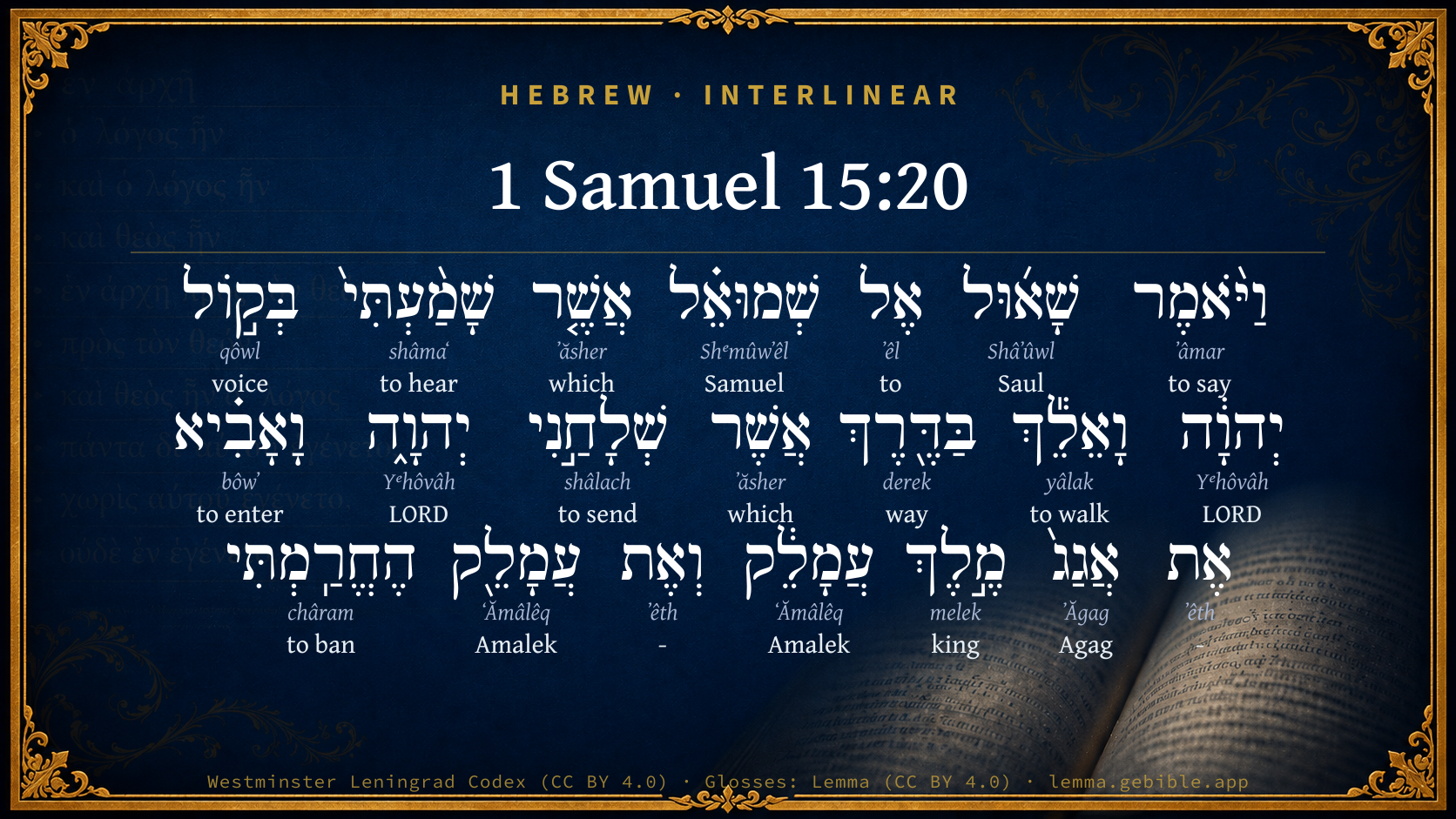
1 Samuel 15:20

Hebrew (Westminster Leningrad Codex) 1 Samuel 15:20 appears in the Hebrew Old Testament. The text above is from the Westminster Leningrad Codex. Each word links to its Strong’s number, a concise gloss, and parsing drawn from the Open Scriptures Hebrew Bible morphology. Click any word for its full Brown-Driver-Briggs (BDB) entry.
Download image
Cite this verse

1 Samuel 15:20 (World English Bible). Public Domain. Lemma interlinear Bible study tool, https://lemma.gebible.app/v/1-samuel/15/20.

Show BibTeX & RIS
BibTeX
RIS
English Translation
Saul said to Samuel, Yes, I have obeyed the voice of Yahweh, and have gone the way which Yahweh sent me, and have brought Agag the king of Amalek, and have utterly destroyed the Amalekites.
World English Bible · Public Domain
Download a study sheet

One document with this verse’s original text, its word-by-word gloss line, the meaning frame, cross-references with their text, attributed commentary, and full source and license credits — printable, and it pastes into notes with its structure intact.

This verse Autodidact and up

Study sheet (.html) Plain text (.txt)

A passage Seminary Student

Up to 50 verses in one chapter. A passage sheet keeps up to 6 commentary sources and 12 cross-references per verse, in the order this page ranks them, and says so on the sheet whenever that leaves anything out. Ask for a single verse and you get the Autodidact verse sheet above.

Everything on this page stays free to read, with no account — the sheet is a download of what is already on screen, not access to it.

Want to remove ads? Support Godless Engineer
Compare translations 3

The same verse in 3 English versions, stacked beneath the original-language interlinear above. Click any original word for its lexicon entry.

Each is an independent rendering of the whole verse — the interlinear is not word-aligned to these translations.

Highlighted words mark where these versions differ — a whole-verse word diff, not a word-by-word alignment.

  • World English Bible Public Domain
    Saul said to Samuel, Yes, I have obeyed the voice of Yahweh, and have gone the way which Yahweh sent me, and have brought Agag the king of Amalek, and have utterly destroyed the Amalekites.
  • King James Version Public Domain
    And Saul said unto Samuel, Yea, I have obeyed the voice of the LORD, and have gone the way which the LORD sent me, and have brought Agag the king of Amalek, and have utterly destroyed the Amalekites.
  • unfoldingWord Literal Text CC BY-SA 4.0
    But Saul said to Samuel that, “I have listened to the voice of Yahweh, and I have gone on the way that Yahweh sent me. And I have brought Agag, the king of Amalek, and I have devoted Amalek.

unfoldingWord Literal Text — © unfoldingWord, licensed CC BY-SA 4.0. Word-aligned USFM3 via Door43 (git.door43.org/unfoldingWord/en_ult).

Versions to compare (up to 4)

3 of 4 selected

Show all 18 translations

Every available English version of this verse, each an independent rendering of the whole verse.

  • World English Bible Public Domain
    Saul said to Samuel, Yes, I have obeyed the voice of Yahweh, and have gone the way which Yahweh sent me, and have brought Agag the king of Amalek, and have utterly destroyed the Amalekites.
  • Berean Standard Bible Public Domain
    “But I did obey the LORD,” Saul replied. “I went on the mission that the LORD gave me. I brought back Agag king of Amalek and devoted the Amalekites to destruction.
  • Majority Standard Bible Public Domain
    “But I did obey the LORD,” Saul replied. “I went on the mission that the LORD gave me. I brought back Agag king of Amalek and devoted the Amalekites to destruction.
  • King James Version Public Domain
    And Saul said unto Samuel, Yea, I have obeyed the voice of the LORD, and have gone the way which the LORD sent me, and have brought Agag the king of Amalek, and have utterly destroyed the Amalekites.
  • American Standard Version (1901) Public Domain
    And Saul said unto Samuel, Yea, I have obeyed the voice of Jehovah, and have gone the way which Jehovah sent me, and have brought Agag the king of Amalek, and have utterly destroyed the Amalekites.
  • Revised Version (1885) Public Domain
    And Saul said unto Samuel, Yea, I have obeyed the voice of the LORD, and have gone the way which the LORD sent me, and have brought Agag the king of Amalek, and have utterly destroyed the Amalekites.
  • Geneva Bible (1599) Public Domain
    And Saul saide vnto Samuel, Yea, I haue obeyed the voyce of the Lord, and haue gone the way which the Lord sent me, and haue brought Agag the King of Amalek, and haue destroyed the Amalekites.
  • Douay-Rheims (1899) Public Domain
    And Saul said to Samuel: Yea I have hearkened to the voice of the Lord, and have walked in the way by which the Lord sent me, and have brought Agag the king of Amalec, and Amalec I have slain.
  • Young's Literal Translation Public Domain
    And Saul saith unto Samuel, `Because -- I have hearkened to the voice of Jehovah, and I go in the way which Jehovah hath sent me, and bring in Agag king of Amalek, and Amalek I have devoted;
  • Literal Standard Version CC BY-SA 4.0
    And Saul says to Samuel, “Because—I have listened to the voice of YHWH, and I go in the way which YHWH has sent me, and bring in Agag king of Amalek, and I have devoted Amalek;
  • Unlocked Literal Bible CC BY-SA 4.0
    Then Saul said to Samuel, “I have indeed obeyed the voice of Yahweh, and have gone on the way that Yahweh sent me. I have captured Agag, the king of Amalek, and have completely destroyed the Amalekites.
  • unfoldingWord Literal Text CC BY-SA 4.0
    But Saul said to Samuel that, “I have listened to the voice of Yahweh, and I have gone on the way that Yahweh sent me. And I have brought Agag, the king of Amalek, and I have devoted Amalek.
  • Darby Bible Public Domain
    And Saul said to Samuel, I have indeed hearkened to the voice of Jehovah, and have gone the way which Jehovah sent me, and have brought Agag the king of Amalek, and have utterly destroyed the Amalekites.
  • World Messianic Bible Public Domain
    Saul said to Samuel, “But I have obeyed the LORD’s voice, and have gone the way which the LORD sent me, and have brought Agag the king of Amalek, and have utterly destroyed the Amalekites.
  • Webster's Bible Public Domain
    And Saul said to Samuel, Yea, I have obeyed the voice of the LORD, and have gone the way which the LORD sent me, and have brought Agag the king of Amalek, and have utterly destroyed the Amalekites.
  • Free Bible Version CC BY-SA 4.0
    “But I did do what the Lord ordered!” Saul replied. “I went and did what the Lord sent me to do. I brought back Agag, king of Amalek, and completely destroyed the Amalekites.
  • Bible in Basic English Public Domain
    And Saul said, Truly, I have done the orders of the Lord and have gone the way the Lord sent me; I have taken Agag, the king of Amalek, and have given the Amalekites up to destruction.
  • JPS Tanakh (1917) Public Domain
    And Saul said unto Samuel: 'Yea, I have hearkened to the voice of the LORD, and have gone the way which the LORD sent me, and have brought Agag the king of Amalek, and have utterly destroyed the Amalekites.

Literal Standard Version (2020), Covenant Press — licensed CC BY-SA 4.0. Text via the HelloAO Bible API (eBible.org). Unlocked Literal Bible (unfoldingWord) — licensed CC BY-SA 4.0. Text via the HelloAO Bible API (eBible.org). unfoldingWord Literal Text — © unfoldingWord, licensed CC BY-SA 4.0. Word-aligned USFM3 via Door43 (git.door43.org/unfoldingWord/en_ult). Free Bible Version, Dr. Jonathan Gallagher — licensed CC BY-SA 4.0. Text via the HelloAO Bible API (eBible.org).

Word by word

More ways to search: Search by grammar → Find every occurrence → Compare this word →

Practice this passage: Drill this verse → Learn its vocabulary →

אֲגַג֙
ʼĂgag
H90
“Agag”
Noun, Proper
Part of Speech
Noun
Type
Proper
Full BDB Definition

Origin: of uncertain derivation, compare with H89

TWOT: None

Agag = "I will overtop" - king of Amalek, spared by Saul but slain by Samuel
  1. וַיֹּ֨אמֶר ʼâmar H559 “and · to say” Conjunction + Verb, Qal, Sequential Imperfect, 3rd Person, Masculine, Singular
  2. שָׁא֜וּל Shâʼûwl H7586 “Saul” Noun, Proper
  3. אֶל ʼêl H413 “to” Preposition
  4. שְׁמוּאֵ֗ל Shᵉmûwʼêl H8050 “Samuel” Noun, Proper
  5. אֲשֶׁ֤ר ʼăsher H834 “which” Particle, Relative
  6. שָׁמַ֨עְתִּי֙ shâmaʻ H8085 “to hear” Verb, Qal, Perfect, 1st Person, Common, Singular
  7. בְּק֣וֹל qôwl H6963 “in/at · voice of” Preposition + Noun, Common, Masculine, Singular, Construct
  8. יְהוָ֔ה Yᵉhôvâh H3068 “LORD” Noun, Proper
  9. וָאֵלֵ֕ךְ yâlak H3212 “and · to walk” Conjunction + Verb, Qal, Sequential Imperfect, 1st Person, Common, Singular
  10. בַּדֶּ֖רֶךְ derek H1870 “in/at the · way” Preposition, Determined + Noun, Common, Both, Singular, Absolute
  11. אֲשֶׁר ʼăsher H834 “which” Particle, Relative
  12. שְׁלָחַ֣נִי shâlach H7971 “to send · me” Verb, Qal, Perfect, 3rd Person, Masculine, Singular + Suffix, Personal, 1st Person, Common, Singular
  13. יְהוָ֑ה Yᵉhôvâh H3068 “LORD” Noun, Proper
  14. וָאָבִ֗יא bôwʼ H935 “and · to enter” Conjunction + Verb, Hiphil, Sequential Imperfect, 1st Person, Common, Singular
  15. אֶת ʼêth H853 “-” Particle, Direct Object
  16. מֶ֣לֶךְ melek H4428 “king of” Noun, Common, Masculine, Singular, Construct
  17. עֲמָלֵ֔ק ʻĂmâlêq H6002 “Amalek” Noun, Proper
  18. וְאֶת ʼêth H853 “and · -” Conjunction + Particle, Direct Object
  19. עֲמָלֵ֖ק ʻĂmâlêq H6002 “Amalek” Noun, Proper
  20. הֶחֱרַֽמְתִּי châram H2763 “to ban” Verb, Hiphil, Perfect, 1st Person, Common, Singular

About this verse

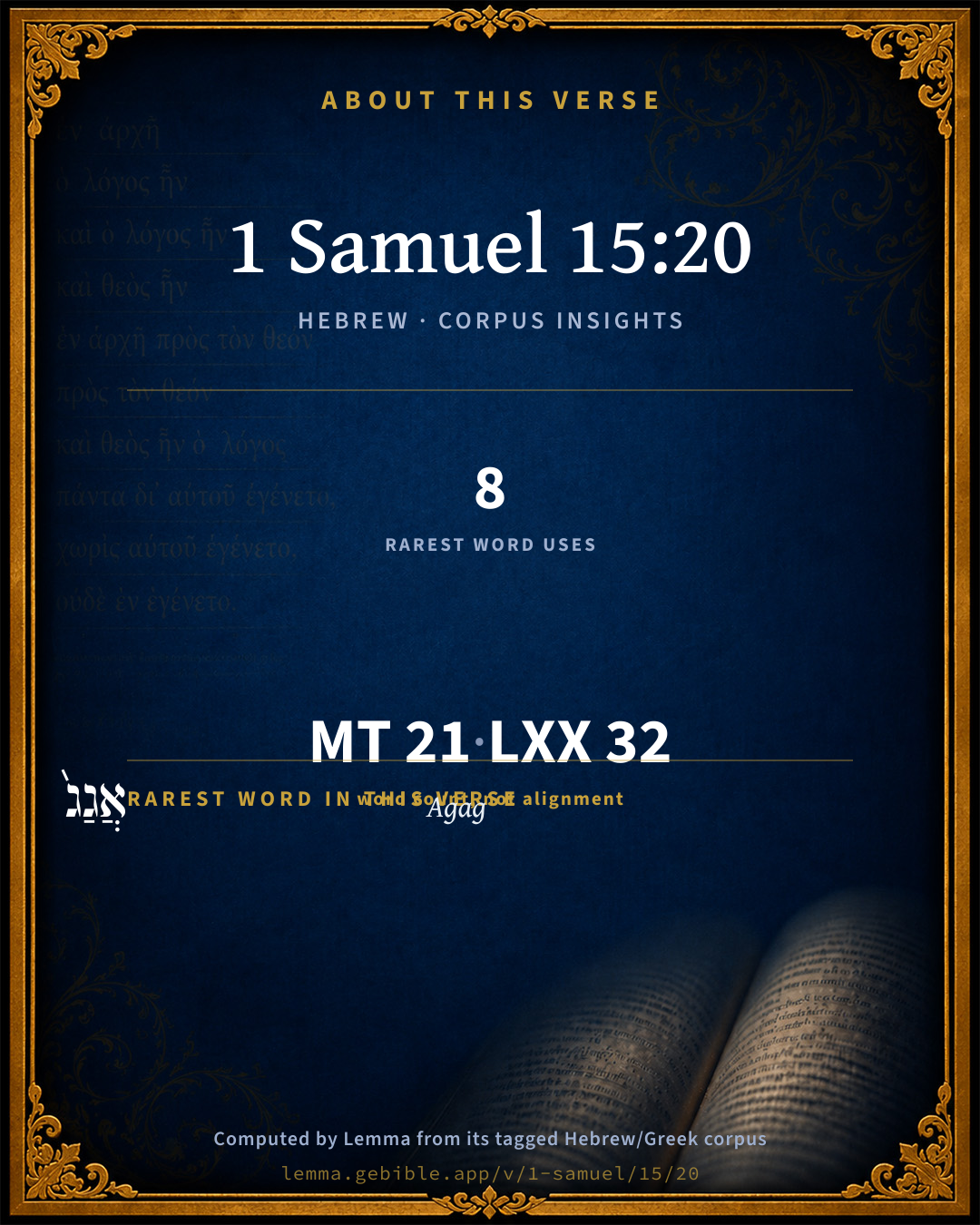
These counts appear in no published source. They are computed here, from the morphology-tagged text and Lemma’s own curated glosses. What Lemma adds →

21
words
17
distinct lemmas
Historical
section

Notable vocabulary

The rarest word here is אֲגַג֙ Agag H90 — appearing just 8 times in the whole Hebrew Bible.

Shared distinctive vocabulary

אֲגַג֙ Agag H90 occurs in 6 verses of the Hebrew Bible. Also found in:

Grammatical profile

  • 6 verbs
  • 10 nouns
  • 1 preposition
  • 4 particles

Verb forms

  • וַיֹּ֨אמֶר Qal · Sequential Imperfect
  • שָׁמַ֨עְתִּי֙ Qal · Perfect
  • וָאֵלֵ֕ךְ Qal · Sequential Imperfect
  • שְׁלָחַ֣נִי Qal · Perfect
  • וָאָבִ֗יא Hiphil · Sequential Imperfect
  • הֶחֱרַֽמְתִּי Hiphil · Perfect

Repetition

Words recur within this verse — often emphatic in Hebrew:

  • יְהוָ֔ה LORD H3068 ×2
  • עֲמָלֵ֔ק Amalek H6002 ×2
  • אֲשֶׁ֤ר which H834 ×2

Hebrew & Septuagint length

In English translation the verse runs 35 words from the Hebrew and 37 from the Septuagint (LXX English) — closely comparable.

A rough comparison of the two English renderings, which tokenize alike — not a word-level alignment.

Word counts can differ between the Hebrew and the Greek without any difference in meaning — e.g. the Hebrew direct-object marker אֵת has no separate Greek word, and Greek often adds the article ὁ.

In the original languages it is 21 Hebrew tokens and 32 Greek tokens — but the two are counted differently (Hebrew bundles its prefixes and suffixes into one token; the Greek is in lemma form), so that isn’t a like-for-like length.

Cross-references

11

Topical passages linked to 1 Samuel 15:20 in the Treasury of Scripture Knowledge — connected by theme and wording, ordered by reader-vote popularity; previews shown in the World English Bible.

  • 1 Samuel 15:13 Samuel came to Saul; and Saul said to him, Blessed are you by Yahweh: I have performed the commandment of Yahweh.
  • Matthew 19:20 The young man said to him, "All these things I have observed from my youth. What do I still lack?"
  • Romans 10:3 For being ignorant of God's righteousness, and seeking to establish their own righteousness, they didn't subject themselves to the righteousness of God.
  • 1 Samuel 15:3 Now go and strike Amalek, and utterly destroy all that they have, and don't spare them; but kill both man and woman, infant and suckling, ox and sheep, camel and donkey.
  • 1 Samuel 15:8 He took Agag the king of the Amalekites alive, and utterly destroyed all the people with the edge of the sword.
  • Job 33:9 'I am clean, without disobedience. I am innocent, neither is there iniquity in me:
  • Job 34:5 For Job has said, 'I am righteous, God has taken away my right:
  • Job 35:2 "Do you think this to be your right, Or do you say, 'My righteousness is more than God's,'
  • Job 40:8 Will you even annul my judgment? Will you condemn me, that you may be justified?
  • Luke 10:29 But he, desiring to justify himself, asked Jesus, "Who is my neighbor?"
  • Luke 18:11 The Pharisee stood and prayed to himself like this: 'God, I thank you, that I am not like the rest of men, extortioners, unrighteous, adulterers, or even like this tax collector.

Cross-references courtesy of OpenBible.info (CC BY 4.0).

Hebrew and Greek witnesses Masoretic Hebrew ↔ Greek Septuagint

The same verse in the two great witnesses to the Old Testament, shown verse-for-verse.

These are two independent witnesses, not word-aligned to each other, and the Septuagint is shown in lemma (dictionary) form.

Hebrew 1 Samuel 15:20 Masoretic · Westminster Leningrad Codex

וַיֹּ֨אמֶר שָׁא֜וּל אֶל שְׁמוּאֵ֗ל אֲשֶׁ֤ר שָׁמַ֨עְתִּי֙ בְּק֣וֹל יְהוָ֔ה וָאֵלֵ֕ךְ בַּדֶּ֖רֶךְ אֲשֶׁר שְׁלָחַ֣נִי יְהוָ֑ה וָאָבִ֗יא אֶת אֲגַג֙ מֶ֣לֶךְ עֲמָלֵ֔ק וְאֶת עֲמָלֵ֖ק הֶחֱרַֽמְתִּי

Saul said to Samuel, Yes, I have obeyed the voice of Yahweh, and have gone the way which Yahweh sent me, and have brought Agag the king of Amalek, and have utterly destroyed the Amalekites.

World English Bible · Public Domain

Greek LXX 1 Samuel 15:20 Septuagint · lemma form

καί εἶπον σαούλ πρός σαμουηλ διά ὁ ἀκούω ἐγώ ὁ φωνή ὁ λαός καί πορεύομαι ἐν ὁ ὁδός ὅς ἀποστέλλω ἐγώ κύριος καί ἄγω ὁ αγαγ βασιλεύς αμαληκ καί ὁ αμαληκ ἐκὀλεθρεύω

And Saul said to Samuel, Because I listened to the voice of the people: yet I went the way by which the Lord sent me, and I brought Agag the king of Amalec, and I destroyed Amalec.

LXX2012 (modern English Septuagint) · Public Domain

On this verse, Haydock's Catholic Bible Commentary discusses the Septuagint’s reading. Read the note in Commentary ↓

Hebrew: Westminster Leningrad Codex (CC BY 4.0). Greek: Septuagint (public domain); English from LXX2012 (modern English Septuagint) (Public Domain). How the Septuagint differs from the Hebrew →

Targum (Aramaic paraphrase)

1

The Targum is the ancient Jewish Aramaic paraphrase of the Hebrew Scriptures — an interpretive translation, not the Hebrew text itself. Onkelos (literal) and Pseudo-Jonathan (expansive) render the Torah, and Jonathan the Prophets. Coverage is partial: where no permissively-licensed English translation exists for a verse, only the Aramaic is shown. This is verse-level text, not a word-by-word alignment to the Hebrew.

  1. Targum Jonathan Prophets (Joshua–Malachi)
    וַאֲמַר שָׁאוּל לִשְׁמוּאֵל דְקַבְּלִית לְמֵימְרָא דַייָ וַאֲזָלִית בְּאוֹרְחָא דְשַׁלְחַנִי יְיָ וְאַיְתֵיתִי יַת אֲגָג מַלְכָּא דַעֲמָלֵק וְיַת עֲמַלְקָאָה גַמְרִית:

    (no public-domain English translation for this verse)

    Targum Jonathan — Aramaic: “Mikraot Gedolot” (public domain). English: “Sefaria Community Translation” (CC0 1.0 (public-domain dedication)); “London "Chaldee Paraphrase," 1871” (public domain). Text via Sefaria.

Commentary

Notes on 1 Samuel 15:20 from classic Christian and Jewish commentators (each source and its license shown beneath its notes). The classic Christian expositions comment on the surrounding passage and are grouped to its opening verse, so a note may address several verses; the Jewish commentaries on the Tanakh (Rashi and others) are per-verse, so they appear only where the commentator wrote on this verse.

Lemma curates 59 commentaries, every one of them public domain or Creative Commons licensed, each selected and text-cleaned for this edition rather than reprinted as found. About our sources →

Trapp's Complete Commentary

John Trapp

1Sa 15:20 And Saul said unto Samuel, Yea, I have obeyed the voice of the LORD, and have gone the way which the LORD sent me, and have brought Agag the king of Amalek, and have utterly destroyed the Amalekites.

Ver. 20. Yea, I have obeyed the voice of the Lord.] He thinketh to overcome the prophet, and to make his penny good silver. He putteth God to his proofs, as those did in Jer 2:25. Et pudet non esse impudentem, as Augustine speaks.

John Trapp, A Commentary or Exposition upon All the Books of the Old and New Testament (1647–1656) — public domain. Text from a community e-Sword module.

The Biblical Illustrator

Joseph S. Exell

1Sa_15:20

Yea, I have obeyed the voice of the Lord, and have gone the way which the Lord sent me.

Sauls obedience

We invite your attention to some features of Sauls character, as drawn out by the way in which he obeyed the Divine command.

1. First, let us notice the zeal and alacrity with which Saul proceeded to carry out the Divine will. Unlike Moses, who complained of his want of eloquence when bidden to go to Pharaoh in Jehovahs name, and plead for the deliverance of his oppressed countrymen--unlike Jonah, who positively refused to bear the dread message with which he was charged to the inhabitants of the great city of Nineveh, and fled to Tarshish, to escape an unwelcome tax--Saul displayed a commendable zeal in executing the command that was laid upon him. It is obvious that he undertook the work willingly, and executed it zealously. No victory could be more complete. The King was a prisoner. The people were slain. In the Kings estimation the Divine command was fully carried out. Saul does not seem to have had the slightest misgiving as to the correctness of his own interpretation of the Divine command. He felt that be bad done a great work, and that on this occasion no one could breathe a word against him. Poor deluded, self-conceited King of Israel! We are often told that history repeats itself, and it is certain that the history of Saul, King of Israel, has been often reproduced in the history of the Church of Christ. Jehu did a work for God, and he did it with alacrity. He destroyed the worshippers of Baal--nay, more than this, for it is said that he destroyed Baal out of Israel. And yet the future of that man was a sad one. We read that he took no heed to walk in the law of the Lord God of Israel with all his heart; for he departed not from the sins of Jeroboam, which made Israel to sin (2Ki_10:1-36). The Pharisees in the time of our Lord had a zeal for God. They reverenced the law of Moses, and paid to it a certain obedience (Mat_23:1-39). And yet upon no body of men did our Divine Master so pour forth the torrent of His indignation as upon those arrogant, self-righteous, self-satisfied Pharisees. And is there not a voice of warning for us in these instances of antiquity Men of wealth may dedicate that wealth to God. They may build a church, or a hospital, or a school. And yet that building so externally lovely may be hideous--hideous, I say, to that God that seeth in secret. Self, and self alone, may have been its foundation stone It may be but a monument of human selfishness and ambition. Another man may take an interest in the missionary cause and devote his wealth to the spreading abroad of the knowledge of God. This indeed is a good object, and worthy of our best energies But, oh! if men engage in the work from any but the highest motive--the desire of saving precious souls for whom Christ has died--if being men of narrow views they seize it as an opportunity for advancing their own religions party; if above all they allow their so-called religious zeal to deaden their instincts of common justice and even humanity; if they would fain silence all but those as narrow-minded as themselves--surely they have not caught fully the spirit of our Divine Master.

2. We have seen that Sauls obedience was marred by a spirit of boastful self-confidence. And his history is instructive, because the spirit of Saul still lives in the religious professor of the present day. Tell the respectable man as he leaves the church porch that he is a sinner, that there is iniquity in his holy things--sin in his prayers, sin in his praises--tell him, in the touching language of the good Bishop Beveridge, that his very repentance needs to be repented of, and that his tears need washing in the blood of Christ, and he indignantly repudiates the charge, and says, Yea, I have obeyed the voice of the Lord, and have gone the way which the Lord sent me. Self-confidence is the mark of the natural man. Self-distrust is the mark of the genuine disciple of Christ. (C. B. Brigstocke.)

The Biblical Illustrator, edited by Joseph S. Exell (c. 1880s–1900s) — public domain. Text from a community e-Sword module.

Joseph Benson's Commentary

1Sa 15:20-21. Have brought Agag the king — To be dealt with as God pleaseth. Strange stupidity! to imagine such a partial obedience could be pleasing unto God. But the people took of the spoil — It was a mean thing to throw all the blame on the people, whom he ought to have governed better; and it was worst of all to pretend religion for his disobedience. The things which should have been utterly destroyed — Here he shows that he was conscious he had not done as he was commanded.

Joseph Benson's Commentary on the Old and New Testaments (1811–1818) — public domain. Text from a community e-Sword module.

Geneva Bible (1599)

Geneva Bible translators

He standeth most impudently in his own defense both against God and his own conscience.

Geneva Bible (1599) marginal notes — public domain. Text via Bolls.life.

Ellicott's Commentary for English Readers

(20) Yea, I have obeyed . . .—These and the words which follow are simply a repetition of the king’s former excuse for his act: but they show us what was the state of Saul’s mind: he evidently disbelieved in the power of the Eternal as a heart reader. If he could justify himself before Samuel, that was all he cared for. He asserted his own integrity of purpose and his great zeal for the public sacrifice to God, knowing all the while that low earthly reasons had been the springs of his conduct. He reiterated the plea that what he had done was in accordance with the voice of the people, conscious all the while that the plea was false.

A Bible Commentary for English Readers, edited by Charles John Ellicott (1878–1897) — public domain. Text from a community e-Sword module.

The Cambridge Bible for Schools and Colleges

gen. ed. J. J. S. Perowne

20. Yea, I have obeyed] Saul still persists in justifying his conduct. (a) He had fulfilled his mission and destroyed the Amalekites, and brought Agag with him in proof thereof. (b) The people had brought home the spoil for sacrifice, not for themselves.

The Cambridge Bible for Schools and Colleges (gen. ed. J. J. S. Perowne; Cambridge University Press, 1878–1918) — public domain. Text from a community e-Sword module.

John Gill's Exposition

And Saul said to Samuel, yea, I have obeyed the voice of the Lord,.... Here Saul breaks in upon Samuel before he had declared all that the Lord had said unto him; for having expostulated with him for not obeying the voice of the Lord, he could not forbear interrupting him, but with the utmost assurance affirms he had obeyed the voice of the Lord; but then it was very imperfectly, and poor proof does he give of it:

and have gone the way which the Lord sent me; it is very true he went into the country of Amalek, but he did not do there all the Lord commanded him:

and have brought Agag the king of Amalek; took him alive, and brought him captive; whereas he ought to have destroyed him at once, and not have reserved him for triumph; a sad proof this of his obeying the voice of the Lord:

and have utterly destroyed the Amalekites; all that came in his way, in which he did right; but then he had not destroyed the principal of them, their king.

John Gill's Exposition of the Whole Bible (1746–1763) — public domain (CC PDM 1.0). Text via the HelloAO Bible API.

Haydock's Catholic Bible Commentary

Lord. Septuagint, "of the people."

George Leo Haydock (1774–1849), Haydock's Catholic Family Bible and Commentary, 1859 edition — public domain. Excludes Psalms (Douay-Rheims chapter numbering differs from Protestant) and Deuterocanonical books (Catholic canon only).

Matthew Poole's English Annotations

He addeth obstinacy and impenitency to his crime, and justifies his fact, though he hath nothing of any moment to say but what he said before. So he gives Samuel the lie, and reflects upon him as one that had falsely accused him.

Have brought Agag to be dealt with as God pleaseth, and as thou thinkest fit.

Matthew Poole's English Annotations on the Holy Bible (1683–1685) — public domain. Text from a community e-Sword/MySword module.

Whedon's Commentary on the Bible

Daniel D. Whedon

20. Yea, I have obeyed — Still the guilty spirit seeks to justify itself. Strange stupidity! Sullen perversity! How prone are sinners to throw their guilt on others, or else to plead for it a religious motive! Saul did both.

Daniel D. Whedon (gen. ed.), Commentary on the Old and New Testaments (1874–1909) — public domain. Text from a community e-Sword module.

The Pulpit Commentary

Vers. 20, 21. Saul"s justifcation of himself is remarkable, as he seems entirely unconscious of having done anything wrong. His education had no doubt been defective, (1Sa_10:12) and his knowledge of the law was probably very small; but he must have listened to Samuel"s injunctions in a very off hand way, and have troubled himself about very little more than that he was to make war upon the Amalekites. There may even have been the wish in his mind to let Samuel know that he was now king, and would carry on affairs after his own fashion. The very form of his answer requires notice; for the word rendered yea is literally in that, or because, and may be paraphrased as follows: Do you reproach me thus because I have obeyed you? See, there is Agag in proof of our victory; and if the people have spared the cattle, it was with the best of intentions. The next clause, the chief of the things which should have been utterly destroyed, reads in the A.V like an ironical parenthesis. It is not so, but an important part of Saul"s defence. These sheep and oxen were "the best of the devoted things," selected as the first fruits for sacrifice. Saul may not have known that such a sacrifice was forbidden. (Deu_13:15-17) The words, to sacrifice unto Jehovah thy God, imply that Samuel ought to be pleased at the victorious army doing this public homage to the Deity whose prophet he was. It was virtually a compliment to himself, and is very much in accordance with the notions of the generality of people now, who consider that attendance at a place of worship, or sending their children to school, is a favour to the clergyman.

The Pulpit Commentary (1880–1919), ed. H.D.M. Spence-Jones & Joseph S. Exell — public domain. Text from a community e-Sword module.

John Wesley's Explanatory Notes

The king - To be dealt with as God pleaseth.

John Wesley, Explanatory Notes Upon the Whole Bible (1754–1765) — public domain. Text via the GEBible commentary corpus.

Keil & Delitzsch

C. F. Keil & F. Delitzsch

"Yea, I have hearkened to the voice of Jehovah (אשׁר serving, like כּי ekil , to introduce the reply: here it is used in the sense of asseveration, utique, yea), and have brought Agag the king of the Amalekites, and banned Amalek." Bringing Agag he mentioned probably as a practical proof that he had carried out the war of extermination against the Amalekites.

Keil & Delitzsch — Biblical Commentary on the Old Testament (1861–1891) — public domain (CC PDM 1.0). Text via the HelloAO Bible API. (Old Testament only.)

unfoldingWord translationNotes

Door43 World Missions Community

I have indeed obeyed the voice of Yahweh

This is an emphatic statement. It is unclear if Saul thought this was true, or if he was simply making excuses for his sin.

the voice of Yahweh

Here "voice" refers to the commands that Yahweh spoke. AT: "the things that Yahweh commanded" (See: Metonymy)

Agag

This is the name of the king of the Amalekites. (See: How to Translate Names)

But the people took

This appears to be shifting the blame to the people.

things devoted to destruction

"animals that Yahweh commanded them to destroy"

Gilgal

This is the name of a place. (See: How to Translate Names)

translationWords

Amalek

ewe

unfoldingWord translationNotes — © Distant Shores Media and the Door43 World Missions Community, licensed CC BY-SA 4.0. Source: git.door43.org/Door43/en_tn.

Lesson kit

Teaching starters — assembled from the data on this page, not authored interpretation. Every prompt links to the verse data it draws on. Edit before teaching.

1 Samuel, in the Historical, opens this verse with 21 words (17 distinct Hebrew lemmas). Its most distinctive word is ʼĂgag (“Agag”). A historical commentator’s framing appears above. Read the whole chapter for the surrounding context.

Discussion questions

  1. The word ʼĂgag carries the sense “Agag.” How does it shape the verse?
  2. Numbers 24:7 shares the word «Agag» with this verse. How do the two illuminate each other?
  3. “LORD” occurs 2× in this one verse. What is the effect of the repetition?
  4. The translations on this page render this verse differently — a whole-verse word diff, not a word-by-word alignment. What might account for the different wordings?
  5. The verb «וַיֹּ֨אמֶר» is Qal Sequential Imperfect. How does its form color the action?
  6. Reading how Trapp's Complete Commentary and The Biblical Illustrator read this verse, where do the two commentators agree and where do they part?

Things to notice

Reading settings

Reading text

Shown beneath each verse's original-language words.

Old Testament
Old Testament edition

Read the OT as the Masoretic Hebrew (MT) or the Greek Septuagint (LXX).

English shown for the Greek Septuagint (in the Hebrew ↔ Greek comparison).

Comparing translations? Open the Compare panel on any verse page to stack up to four side by side.