
1 Kings 18:26

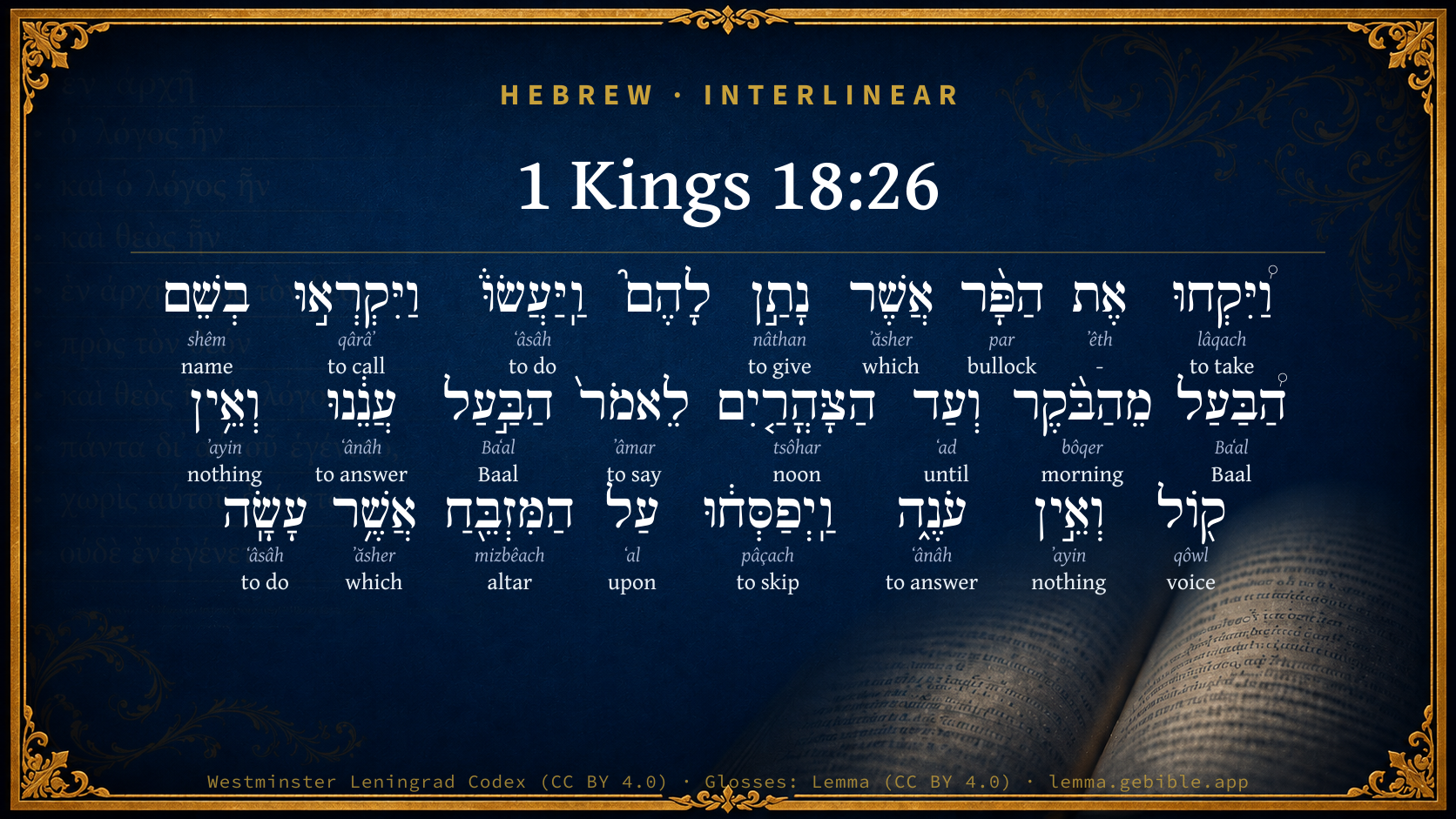
Hebrew (Westminster Leningrad Codex) 1 Kings 18:26 appears in the Hebrew Old Testament. The text above is from the Westminster Leningrad Codex. Each word links to its Strong’s number, a concise gloss, and parsing drawn from the Open Scriptures Hebrew Bible morphology. Click any word for its full Brown-Driver-Briggs (BDB) entry.
Download image
Cite this verse

1 Kings 18:26 (World English Bible). Public Domain. Lemma interlinear Bible study tool, https://lemma.gebible.app/v/1-kings/18/26.

Show BibTeX & RIS
BibTeX
RIS
English Translation
They took the bull which was given them, and they dressed it, and called on the name of Baal from morning even until noon, saying, Baal, hear us. But there was no voice, nor any who answered. They leaped about the altar which was made.
World English Bible · Public Domain
Download a study sheet

One document with this verse’s original text, its word-by-word gloss line, the meaning frame, cross-references with their text, attributed commentary, and full source and license credits — printable, and it pastes into notes with its structure intact.

This verse Autodidact and up

Study sheet (.html) Plain text (.txt)

A passage Seminary Student

Up to 50 verses in one chapter. A passage sheet keeps up to 6 commentary sources and 12 cross-references per verse, in the order this page ranks them, and says so on the sheet whenever that leaves anything out. Ask for a single verse and you get the Autodidact verse sheet above.

Everything on this page stays free to read, with no account — the sheet is a download of what is already on screen, not access to it.

Want to remove ads? Support Godless Engineer
Compare translations 3

The same verse in 3 English versions, stacked beneath the original-language interlinear above. Click any original word for its lexicon entry.

Each is an independent rendering of the whole verse — the interlinear is not word-aligned to these translations.

Highlighted words mark where these versions differ — a whole-verse word diff, not a word-by-word alignment.

  • World English Bible Public Domain
    They took the bull which was given them, and they dressed it, and called on the name of Baal from morning even until noon, saying, Baal, hear us. But there was no voice, nor any who answered. They leaped about the altar which was made.
  • King James Version Public Domain
    And they took the bullock which was given them, and they dressed it, and called on the name of Baal from morning even until noon, saying, O Baal, hear us. But there was no voice, nor any that answered. And they leaped upon the altar which was made.
  • unfoldingWord Literal Text CC BY-SA 4.0
    And they took the bull that one gave to them, and they prepared, and they called on the name of Baal from morning and to midday, saying, “Baal, answer us!” But no voice, and no answering. And they limped beside the altar that one had made.

unfoldingWord Literal Text — © unfoldingWord, licensed CC BY-SA 4.0. Word-aligned USFM3 via Door43 (git.door43.org/unfoldingWord/en_ult).

Versions to compare (up to 4)

3 of 4 selected

Show all 18 translations

Every available English version of this verse, each an independent rendering of the whole verse.

  • World English Bible Public Domain
    They took the bull which was given them, and they dressed it, and called on the name of Baal from morning even until noon, saying, Baal, hear us. But there was no voice, nor any who answered. They leaped about the altar which was made.
  • Berean Standard Bible Public Domain
    And they took the bull that was given them, prepared it, and called on the name of Baal from morning until noon, shouting, “O Baal, answer us!” But there was no sound, and no one answered as they leaped around the altar they had made.
  • Majority Standard Bible Public Domain
    And they took the bull that was given them, prepared it, and called on the name of Baal from morning until noon, shouting, “O Baal, answer us!” But there was no sound, and no one answered as they leaped around the altar they had made.
  • King James Version Public Domain
    And they took the bullock which was given them, and they dressed it, and called on the name of Baal from morning even until noon, saying, O Baal, hear us. But there was no voice, nor any that answered. And they leaped upon the altar which was made.
  • American Standard Version (1901) Public Domain
    And they took the bullock which was given them, and they dressed it, and called on the name of Baal from morning even until noon, saying, O Baal, hear us. But there was no voice, nor any that answered. And they leaped about the altar which was made.
  • Revised Version (1885) Public Domain
    And they took the bullock which was given them, and they dressed it, and called on the name of Baal from morning even until noon, saying, O Baal, hear us. But there was no voice, nor any that answered. And they leaped about the altar which was made.
  • Geneva Bible (1599) Public Domain
    So they tooke the one bullocke, that was giuen them, and they prepared it, and called on the name of Baal, from morning to noone, saying, O Baal, heare vs: but there was no voyce, nor any to answere: and they leapt vpon the altar that was made.
  • Douay-Rheims (1899) Public Domain
    And they took the bullock which he gave them, and dressed it: and they called on the name of Baal from morning even till noon, saying: O Baal, hear us. But there was no voice, nor any that answered: and they leaped over the altar that they had made.
  • Young's Literal Translation Public Domain
    And they take the bullock that `one' gave to them, and prepare, and call in the name of Baal from the morning even till the noon, saying, `O Baal, answer us!' and there is no voice, and there is none answering; and they leap on the altar that one had made.
  • Literal Standard Version CC BY-SA 4.0
    And they take the bullock that [one] gave to them, and prepare [it], and call in the name of Ba‘al from the morning even until the noon, saying, “O Ba‘al, answer us!” And there is no voice, and there is none answering; and they leap on the altar that one had made.
  • Unlocked Literal Bible CC BY-SA 4.0
    They took the bull that was given to them and prepared it, and they called on the name of Baal from morning until noon, saying, “Baal, hear us.” But there was no voice, nor anyone who answered. They danced around the altar they had made.
  • unfoldingWord Literal Text CC BY-SA 4.0
    And they took the bull that one gave to them, and they prepared, and they called on the name of Baal from morning and to midday, saying, “Baal, answer us!” But no voice, and no answering. And they limped beside the altar that one had made.
  • Darby Bible Public Domain
    And they took the bullock which had been given them, and sacrificed it, and called on the name of Baal from morning until noon, saying, O Baal, answer us! But there was no voice, and none answered. And they leaped about the altar that had been made.
  • World Messianic Bible Public Domain
    They took the bull which was given them, and they dressed it, and called on the name of Baal from morning even until noon, saying, “Baal, hear us!” But there was no voice, and nobody answered. They leaped about the altar which was made.
  • Webster's Bible Public Domain
    And they took the bullock which was given them, and they dressed it, and called on the name of Baal from morning even until noon, saying, O Baal, hear us. But there was no voice, nor any that answered. And they leaped upon the altar which was made.
  • Free Bible Version CC BY-SA 4.0
    So they took the bull provided and prepared it. Then they called on Baal by name from morning until noon. “Baal, answer us!” they pleaded. But no voice was heard, no one answered. They hobbled in a dance around the altar they had made.
  • Bible in Basic English Public Domain
    So they took the ox which was given them, and made it ready, crying out to Baal from morning till the middle of the day, and saying, O Baal, give ear to us. But there was no voice and no answer. And they were jumping up and down before the altar they had made.
  • JPS Tanakh (1917) Public Domain
    And they took the bullock which was given them, and they dressed it, and called on the name of Baal from morning even until noon, saying: 'O Baal, answer us.' But there was no voice, nor any that answered. And they danced in halting wise about the altar which was made.

Literal Standard Version (2020), Covenant Press — licensed CC BY-SA 4.0. Text via the HelloAO Bible API (eBible.org). Unlocked Literal Bible (unfoldingWord) — licensed CC BY-SA 4.0. Text via the HelloAO Bible API (eBible.org). unfoldingWord Literal Text — © unfoldingWord, licensed CC BY-SA 4.0. Word-aligned USFM3 via Door43 (git.door43.org/unfoldingWord/en_ult). Free Bible Version, Dr. Jonathan Gallagher — licensed CC BY-SA 4.0. Text via the HelloAO Bible API (eBible.org).

Word by word

More ways to search: Search by grammar → Find every occurrence → Compare this word →

Practice this passage: Drill this verse → Learn its vocabulary →

וַֽיְפַסְּח֔וּ
pâçach
H6452
“and · to skip”
Conjunction + Verb, Piel, Sequential Imperfect, 3rd Person, Masculine, Plural
Part of Speech
Conjunction + Verb
Stem
Piel
Form
Sequential Imperfect
Person
3rd Person
Gender
Masculine
Number
Plural
Full BDB Definition

Origin: a primitive root

TWOT: 1786 , 1787

to pass over, spring over - (Qal) to pass over - (Piel) to skip, pass over - to limp - (Qal) to limp - (Niphal) to be lame - (Piel) to limp
  1. וַ֠יִּקְחוּ lâqach H3947 “and · to take” Conjunction + Verb, Qal, Sequential Imperfect, 3rd Person, Masculine, Plural
  2. אֶת ʼêth H853 “-” Particle, Direct Object
  3. הַפָּ֨ר par H6499 “the · bullock” Particle, Definite Article + Noun, Common, Masculine, Singular, Absolute
  4. אֲשֶׁר ʼăsher H834 “which” Particle, Relative
  5. נָתַ֣ן nâthan H5414 “to give” Verb, Qal, Perfect, 3rd Person, Masculine, Singular
  6. וַֽיַּעֲשׂוּ֒ ʻâsâh H6213 “and · to do” Conjunction + Verb, Qal, Sequential Imperfect, 3rd Person, Masculine, Plural
  7. וַיִּקְרְא֣וּ qârâʼ H7121 “and · to call” Conjunction + Verb, Qal, Sequential Imperfect, 3rd Person, Masculine, Plural
  8. בְשֵׁם shêm H8034 “in/at · name of” Preposition + Noun, Common, Masculine, Singular, Construct
  9. הַ֠בַּעַל Baʻal H1168 “the · Baal” Particle, Definite Article + Noun, Proper
  10. מֵהַבֹּ֨קֶר bôqer H1242 “from · the · morning” Preposition + Particle, Definite Article + Noun, Common, Masculine, Singular, Absolute
  11. וְעַד ʻad H5704 “and · until” Conjunction + Preposition
  12. הַצָּהֳרַ֤יִם tsôhar H6672 “the · noon” Particle, Definite Article + Noun, Common, Masculine, Plural, Absolute
  13. לֵאמֹר֙ ʼâmar H559 “to say” Preposition + Verb, Qal, Infinitive Construct
  14. הַבַּ֣עַל Baʻal H1168 “the · Baal” Particle, Definite Article + Noun, Proper
  15. עֲנֵ֔נוּ ʻânâh H6030 “answer · us” Verb, Qal, Imperative, 2nd Person, Masculine, Singular + Suffix, Personal, 1st Person, Common, Plural
  16. וְאֵ֥ין ʼayin H369 “and · nothing” Conjunction + Particle, Negative
  17. ק֖וֹל qôwl H6963 “voice” Noun, Common, Masculine, Singular, Absolute
  18. וְאֵ֣ין ʼayin H369 “and · nothing” Conjunction + Particle, Negative
  19. עֹנֶ֑ה ʻânâh H6030 “answering” Verb, Qal, Participle Active, Masculine, Singular, Absolute
  20. עַל ʻal H5921 “upon” Preposition
  21. הַמִּזְבֵּ֖חַ mizbêach H4196 “the · altar” Particle, Definite Article + Noun, Common, Masculine, Singular, Absolute
  22. אֲשֶׁ֥ר ʼăsher H834 “which” Particle, Relative
  23. עָשָֽׂה ʻâsâh H6213 “to do” Verb, Qal, Perfect, 3rd Person, Masculine, Singular

About this verse

These counts appear in no published source. They are computed here, from the morphology-tagged text and Lemma’s own curated glosses. What Lemma adds →

25
words
19
distinct lemmas
Historical
section

Notable vocabulary

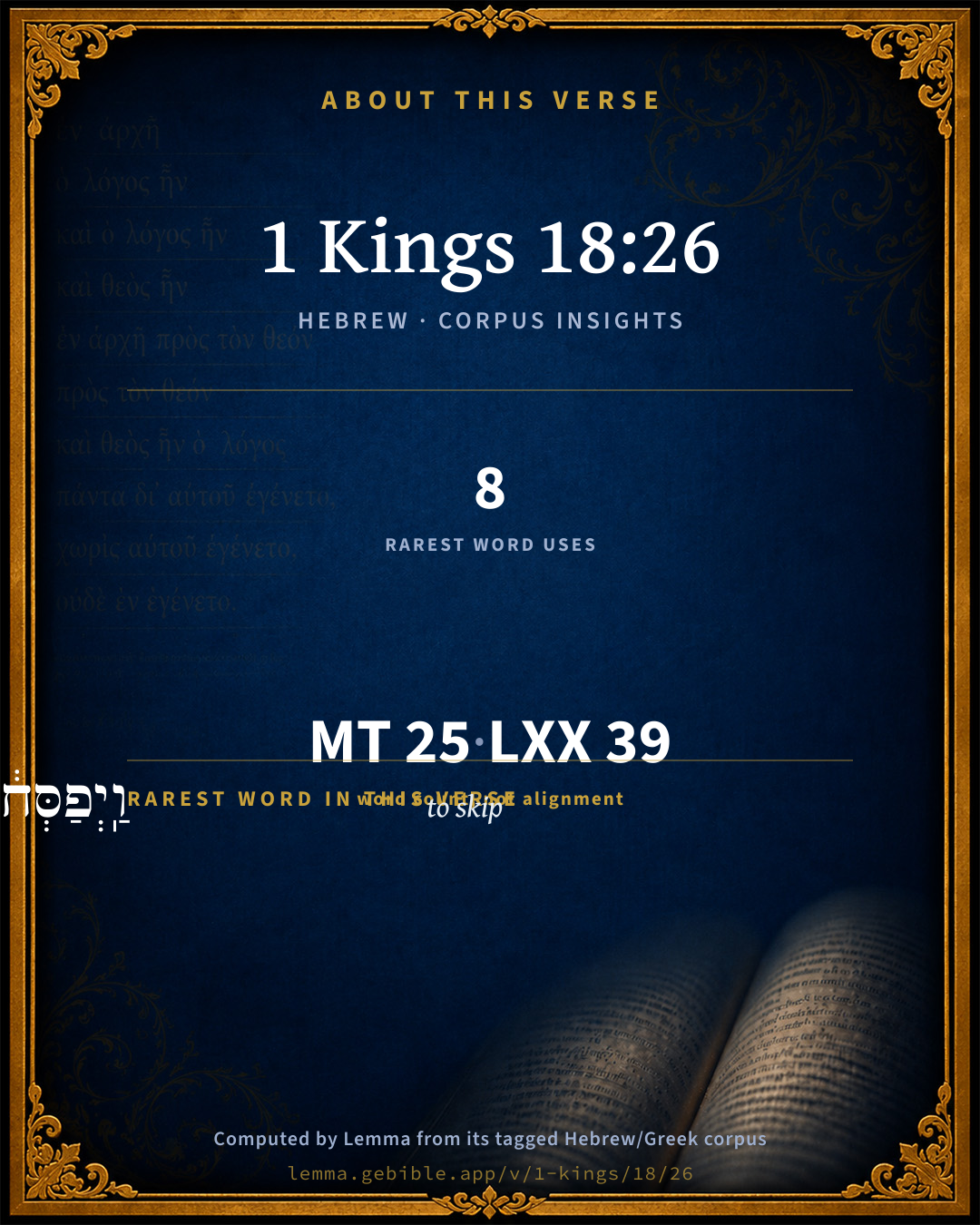
The rarest word here is וַֽיְפַסְּח֔וּ to skip H6452 — appearing just 8 times in the whole Hebrew Bible.

Shared distinctive vocabulary

וַֽיְפַסְּח֔וּ to skip H6452 occurs in 8 verses of the Hebrew Bible. Also found in:

Grammatical profile

  • 9 verbs
  • 8 nouns
  • 3 prepositions
  • 5 particles

Verb forms

  • וַ֠יִּקְחוּ Qal · Sequential Imperfect
  • נָתַ֣ן Qal · Perfect
  • וַֽיַּעֲשׂוּ֒ Qal · Sequential Imperfect
  • וַיִּקְרְא֣וּ Qal · Sequential Imperfect
  • לֵאמֹר֙ Qal · Infinitive Construct
  • עֲנֵ֔נוּ Qal · Imperative
  • עֹנֶ֑ה Qal · Participle Active
  • וַֽיְפַסְּח֔וּ Piel · Sequential Imperfect
  • עָשָֽׂה Qal · Perfect

Repetition

Words recur within this verse — often emphatic in Hebrew:

  • וַֽיַּעֲשׂוּ֒ to do H6213 ×2
  • הַ֠בַּעַל Baal H1168 ×2
  • עֲנֵ֔נוּ to answer H6030 ×2
  • וְאֵ֥ין nothing H369 ×2
  • אֲשֶׁר which H834 ×2

Hebrew & Septuagint length

In English translation the verse runs 45 words from the Hebrew and 49 from the Septuagint (LXX English) — closely comparable.

A rough comparison of the two English renderings, which tokenize alike — not a word-level alignment.

Word counts can differ between the Hebrew and the Greek without any difference in meaning — e.g. the Hebrew direct-object marker אֵת has no separate Greek word, and Greek often adds the article ὁ.

In the original languages it is 25 Hebrew tokens and 39 Greek tokens — but the two are counted differently (Hebrew bundles its prefixes and suffixes into one token; the Greek is in lemma form), so that isn’t a like-for-like length.

Cross-references

14

Topical passages linked to 1 Kings 18:26 in the Treasury of Scripture Knowledge — connected by theme and wording, ordered by reader-vote popularity; previews shown in the World English Bible.

  • Jeremiah 10:5 They are like a palm tree, of turned work, and don't speak: they must be carried, because they can't go. Don't be afraid of them; for they can't do evil, neither is it in them to do good."
  • Matthew 6:7 In praying, don't use vain repetitions, as the Gentiles do; for they think that they will be heard for their much speaking.
  • 1 Corinthians 8:4 Therefore concerning the eating of things sacrificed to idols, we know that no idol is anything in the world, and that there is no other God but one.
  • 1 Corinthians 12:2 You know that when you were heathen, you were led away to those mute idols, however you might be led.
  • 1 Kings 18:24 You call on the name of your god, and I will call on the name of Yahweh; and the God who answers by fire, let him be God." All the people answered, "It is well said."
  • Psalms 115:4–8 Their idols are silver and gold, The work of men's hands.
  • Psalms 135:15–20 The idols of the nations are silver and gold, The work of men's hands.
  • Isaiah 37:38 It happened, as he was worshipping in the house of Nisroch his god, that Adrammelech and Sharezer his sons struck him with the sword; and they escaped into the land of Ararat. Esar Haddon his son reigned in his place.
  • Isaiah 44:17 The residue of it he makes a god, even his engraved image; he falls down to it and worships, and prays to it, and says, Deliver me; for you are my god.
  • Isaiah 45:20 Assemble yourselves and come; draw near together, you who have escaped from the nations: they have no knowledge who carry the wood of their engraved image, and pray to a god that can't save.
  • Daniel 5:23 but have lifted up yourself against the Lord of heaven; and they have brought the vessels of his house before you, and you and your lords, your wives and your concubines, have drunk wine from them; and you have praised the gods of silver and gold, of brass, iron, wood, and stone, which don't see, nor hear, nor know; and the God in whose hand your breath is, and whose are all your ways, you have not glorified.
  • Habakkuk 2:18 "What value does the engraved image have, that its maker has engraved it; the molten image, even the teacher of lies, that he who fashions its form trusts in it, to make mute idols?
  • Zephaniah 1:9 In that day, I will punish all those who leap over the threshold, who fill their master's house with violence and deceit.
  • 1 Corinthians 10:19–20 What am I saying then? That a thing sacrificed to idols is anything, or that an idol is anything?

Cross-references courtesy of OpenBible.info (CC BY 4.0).

Hebrew and Greek witnesses Masoretic Hebrew ↔ Greek Septuagint

The same verse in the two great witnesses to the Old Testament, shown verse-for-verse.

These are two independent witnesses, not word-aligned to each other, and the Septuagint is shown in lemma (dictionary) form.

Hebrew 1 Kings 18:26 Masoretic · Westminster Leningrad Codex

וַ֠יִּקְחוּ אֶת הַפָּ֨ר אֲשֶׁר נָתַ֣ן לָהֶם֮ וַֽיַּעֲשׂוּ֒ וַיִּקְרְא֣וּ בְשֵׁם הַ֠בַּעַל מֵהַבֹּ֨קֶר וְעַד הַצָּהֳרַ֤יִם לֵאמֹר֙ הַבַּ֣עַל עֲנֵ֔נוּ וְאֵ֥ין ק֖וֹל וְאֵ֣ין עֹנֶ֑ה וַֽיְפַסְּח֔וּ עַל הַמִּזְבֵּ֖חַ אֲשֶׁ֥ר עָשָֽׂה

They took the bull which was given them, and they dressed it, and called on the name of Baal from morning even until noon, saying, Baal, hear us. But there was no voice, nor any who answered. They leaped about the altar which was made.

World English Bible · Public Domain

Greek LXX 1 Kings 18:26 Septuagint · lemma form

καί λαμβάνω ὁ μόσχος καί ποιέω καί ἐπικαλέω ἐν ὄνομα ὁ βααλ ἐκ πρωΐθεν ἕως μεσημβρία καί εἶπον ἐπιἀκούω ἐγώ ὁ βααλ ἐπιἀκούω ἐγώ καί οὐ εἰμί φωνή καί οὐ εἰμί ἀκρόασις καί διατρέχω ἐπί ὁ θυσιαστήριον ὅς ποιέω

And they took the calf and dressed it, and called on the name of Baal from morning till noon, and said, hear us, O Baal, hear us. And there was no voice, neither was there hearing, and they ran up and down on the altar which they had made.

LXX2012 (modern English Septuagint) · Public Domain

On this verse, The Cambridge Bible for Schools and Colleges discusses the Septuagint’s reading. Read the note in Commentary ↓

Hebrew: Westminster Leningrad Codex (CC BY 4.0). Greek: Septuagint (public domain); English from LXX2012 (modern English Septuagint) (Public Domain). How the Septuagint differs from the Hebrew →

Targum (Aramaic paraphrase)

1

The Targum is the ancient Jewish Aramaic paraphrase of the Hebrew Scriptures — an interpretive translation, not the Hebrew text itself. Onkelos (literal) and Pseudo-Jonathan (expansive) render the Torah, and Jonathan the Prophets. Coverage is partial: where no permissively-licensed English translation exists for a verse, only the Aramaic is shown. This is verse-level text, not a word-by-word alignment to the Hebrew.

  1. Targum Jonathan Prophets (Joshua–Malachi)
    וּנְסִיבוּ יַת תּוֹרָא דִיהַב לְהוֹן וַעֲבַדוּ וּקְרוֹ בְּשׁוּם בַּעֲלָא מִצַפְרָא וְעַד עִדָן טִיהֲרָא לְמֵימַר בַּעֲלָא עֲנֵינָא וְלֵית קַל וְלֵית דַעֲנֵי וְאִשְׁתַּטוּ עַל אֱגוֹרָא דַעֲבָד:

    (no public-domain English translation for this verse)

    Targum Jonathan — Aramaic: “Mikraot Gedolot” (public domain). English: “Sefaria Community Translation” (CC0 1.0 (public-domain dedication)); “London "Chaldee Paraphrase," 1871” (public domain). Text via Sefaria.

Commentary

Notes on 1 Kings 18:26 from classic Christian and Jewish commentators (each source and its license shown beneath its notes). The classic Christian expositions comment on the surrounding passage and are grouped to its opening verse, so a note may address several verses; the Jewish commentaries on the Tanakh (Rashi and others) are per-verse, so they appear only where the commentator wrote on this verse.

Lemma curates 59 commentaries, every one of them public domain or Creative Commons licensed, each selected and text-cleaned for this edition rather than reprinted as found. About our sources →

Trapp's Complete Commentary

John Trapp

1Ki 18:26 And they took the bullock which was given them, and they dressed [it], and called on the name of Baal from morning even until noon, saying, O Baal, hear us. But [there was] no voice, nor any that answered. And they leaped upon the altar which was made.

Ver. 26. And they leaped upon the altar.] Or, Leaped up and down at the altar, as if they had been in some prophetical ecstasy, or would have fetched fire from heaven. The heathen Corybantes, Luperci and Salii, those Roman priests, used many antic and strange gestures in their idol services.

John Trapp, A Commentary or Exposition upon All the Books of the Old and New Testament (1647–1656) — public domain. Text from a community e-Sword module.

Joseph Benson's Commentary

1Ki 18:26. They took the bullock which was given them — Which, being chosen by them, was now put into their hands by those who had the beasts in their custody till they were taken away for sacrifice; and dressed it — Cut it in pieces, and laid the parts upon the wood. From morning — From the time of the morning sacrifice; which advantage Elijah suffered them to take. They leaped upon — Or, beside the altar; or, before it. They used some superstitious and disorderly gestures; either pretending to be actuated by the spirit of their god, and to be in a kind of religious ecstasy, or in a way of devotion to their god.

Joseph Benson's Commentary on the Old and New Testaments (1811–1818) — public domain. Text from a community e-Sword module.

Geneva Bible (1599)

Geneva Bible translators

As men ravished with some strange spirit.

Geneva Bible (1599) marginal notes — public domain. Text via Bolls.life.

Adam Clarke's Commentary

Verse 26. From morning even until noon] It seems that the priests of Baal employed the whole day in their desperate rites. The time is divided into two periods:

1. From morning until noon; this was employed in preparing and offering the sacrifice, and in earnest supplication for the celestial fire. Still there was no answer, and at noon Elijah began to mock and ridicule them, and this excited them to commence anew. And,

2. They continued from noon till the time of offering the evening sacrifice, dancing up and down, cutting themselves with knives, mingling their own blood with their sacrifice, praying, supplicating, and acting in the most frantic manner.

And they leaped upon the altar] Perhaps it will be more correct to read with the margin, they leaped up and down at the altar; they danced round it with strange and hideous cries and gesticulations, tossing their heads to and fro, with a great variety of bodily contortions.

A heathen priest, a high priest of Budhoo, has been just showing me the manner in which they dance and jump up and down, and from side to side, twisting their bodies in all manner of ways, when making their offerings to their demon gods; a person all the while beating furiously on a tom-tom, or drum, to excite and sustain those frantic attitudes; at the same time imploring the succour of their god, frequently in some such language as this: "O loving brother devil, hear me, and receive my offering!" To perform these sacrificial attitudes they have persons who are taught to practice them from their earliest years, according to directions laid down in religious books; and to make the joints and body pliant, much anointing of the parts and mechanical management are used; and they have masters, whose business it is to teach these attitudes and contortions according to the rules laid down in those books. It seems therefore that this was a very general practice of idolatry, as indeed are the others mentioned in this chapter.

Adam Clarke's Commentary on the Bible (1810–1826) — public domain. Text from a community e-Sword/MySword module.

Ellicott's Commentary for English Readers

(26) O Baal, hear us.—This repeated cry—the ever-recurring burden of the prayer, uttered probably first in measured chant, afterwards in a wild excited cry—stands in an instructive contrast (which has been splendidly emphasised in Mendelssohn’s music) with the simple, earnest solemnity of the prayer of Elijah. It has been obvious to see m it an illustration of our Lord’s condemnation of the worship of the heathen, who “think that they shall be heard for their much speaking” (Mat_6:7). There is a grave irony in the notice of the blank silence which followed this frenzied cry. “There was no voice, nor any to answer, nor any that regarded.”

They leaped upon—properly, leaped up and down at the altar, in one of those wild dances, at once expressing and stimulating frenzy, in which Oriental religions delight, even to this day.

A Bible Commentary for English Readers, edited by Charles John Ellicott (1878–1897) — public domain. Text from a community e-Sword module.

The Cambridge Bible for Schools and Colleges

gen. ed. J. J. S. Perowne

26. which was given them] These words are omitted in the LXX., which represents ‘hear us’ in the latter part of the verse twice over.

and they leaped upon [R.V. about] the altar] One part of the heathen worship consisted in a dance around the altar, during which the devotees wrought themselves up to a pitch of frenzy, and then their action took the form of wild leaping. Such was probably the kind of worship of the Salii whom Numa instituted at Rome, and hence their name = Jumpers. The dances of the Aborigines of Australia were very much of this fashion.

The Cambridge Bible for Schools and Colleges (gen. ed. J. J. S. Perowne; Cambridge University Press, 1878–1918) — public domain. Text from a community e-Sword module.

John Gill's Exposition

And they cried aloud,.... Trying to make him hear, if possible:

and cut themselves after their manner with knives and lancets, till the blood gushed out upon them; so the priests of Heathen deities used to slash themselves on their shoulders, arms, and thighs, in their devotions to them, as many writers observe (z), fancying their gods were delighted with human blood; particularly the priests of Bellona (a), and the worshippers of the Syrian goddess (b), and of the Egyptian Isis (c).

(z) Vid. Kipping. Antiqu. Roman. l. 1. c. 10. p. 202. (a) Tertul Apolog. c. 9. Lactant. Institut. l. 1. c. 21. (b) Apulei Metamorph. l. 8. (c) Herodot. Euterpe, c. 61. Manetho. Apotelesm. l. 1. ver. 243, 244. Seneca de vita beata, c. 27.

John Gill's Exposition of the Whole Bible (1746–1763) — public domain (CC PDM 1.0). Text via the HelloAO Bible API.

Albert Barnes' Notes on the Bible

And called on the name of Baal from morning even until noon - Compare the parallel in the conduct of the Greeks of Ephesus. Act 19:34. The words “O Baal, hear us,” probably floated on the air as the refrain of a long and varied hymn of supplication.

They leaped upon the altar which was made - The marginal rendering is preferable to this. Wild dancing has always been a devotional exercise in the East, and remains so to this day; witness the dancing dervishes. It was practiced especially in the worship of Nature-powers, like the Dea Phrygia (Cybele), the Dea Syra (Astarte?), and the like.

Albert Barnes' Notes on the Bible (1834–1885) — public domain. Text from a community e-Sword/MySword module.

Haydock's Catholic Bible Commentary

That they. Hebrew, "which he (Achaz) had made;" (Calmet) or, "which was made." (Haydock) --- The altar of Elias was erected afterwards, ver. 30. The prophets of Baal acted in a foolish manner, (Calmet) as if in jest, but really despairing of success. (Haydock) --- The pagans were accustomed to dance around their altars: --- Pingues spatiatur ad aras. (Virgil, Æneid iv.) --- and some would translate, "near the altar." We might apply to these prophets, the verses of Horace:--- Dedit risusque jocosque,

Dum, flamma sine, thura liquescere limine sacro

Persuadere cupit: credat Judæus Apella

Non ego. (Sat. i. 5.)

George Leo Haydock (1774–1849), Haydock's Catholic Family Bible and Commentary, 1859 edition — public domain. Excludes Psalms (Douay-Rheims chapter numbering differs from Protestant) and Deuterocanonical books (Catholic canon only).

Matthew Poole's English Annotations

They took the bullock which was given them; which being chosen by them, 1Ki 18:25, was now put into their hands by those who had the beasts in their custody, till they were taken away for sacrifice.

They dressed it; cut it in pieces, and laid the parts in or upon the wood.

From morning; from the time of the morning sacrifice; which advantage Elijah suffered them to take for their sacrifice.

Upon the altar; or, over the altar; which might easily be done, the altar being low, and suddenly made for the present use. Or rather, beside (as the Hebrew (al) oft signifies) the altar; or, before it. They used some superstitious, unusual, and disorderly gestures, either pretending to be acted by the spirit of their god, and to be in a kind of holy rage, and religious ecstasy; or in way of devotion to their god; which they might borrow from the practice of their progenitors, who, amongst other things, used dancing in God’s service and presence, as Exo 15:20; 32:19; Jdg 21:21; 2Sa 6:14.

Which was made, Heb. which he made; either, first, Elijah; which some think was already made, though the making of it be not mentioned till afterwards, 1Ki 18:31, and that it was their design, by leaping upon his altar, to overthrow it. Or rather, secondly, Ahab on their behalf; or any other person; that being only a Hebraism, the third person active being put for the passive verb, as our translators well render it.

Matthew Poole's English Annotations on the Holy Bible (1683–1685) — public domain. Text from a community e-Sword/MySword module.

Whedon's Commentary on the Bible

Daniel D. Whedon

26. They leaped upon the altar — The word translated leaped is the Piel form of the same word rendered halt in 1Ki_18:21. They danced and tottered around and upon the altar they had made, from morning till noon, and yet no answer from Baal. This, says Stanley, “is the exact picture of Oriental fanaticism, such as may still be seen in Eastern religions. As the Mussulman dervishes work themselves into a frenzy by the invocation of Allah! Allah! until the words themselves are lost in inarticulate gasps — as the pilgrims round the church of St. John at Samaria formerly, and round the chapel of the Holy Sepulchre now, race, run, and tumble, in order to bring down the Divine fire into the midst of them — so the four hundred and fifty prophets of Baal performed their wild dances round their altar, or upon it, springing up or sinking down with the fantastic gestures which Orientals alone can command, as if by an internal mechanism, and screaming with that sustained energy which believes it will be heard for its much speaking.”

Daniel D. Whedon (gen. ed.), Commentary on the Old and New Testaments (1874–1909) — public domain. Text from a community e-Sword module.

The Pulpit Commentary

And they took the bullock which was given them Heb. which he (or one) gave; i.e., they declined to choose, and they dressed it, and called on the name of from morning even until noon, saying, O Baal, hear us Heb. answer us. Same word as below. They thought they would be heard for their much speaking. But there was no voice Heb. and not a voice, nor any that answered. And they leaped or limped . Same word as that translated "halt" in ver. 21. Gesenius thinks the word is "used scornfully of the awkward dancing of the priests of Baal." But it seems more natural to understand it as descriptive of what actually occurred, i.e., of the reeling, swaying, bacchantie dance of the priests, which was probably not unlike that of the dancing dervishes or the Indian devil worshippers of our own time upon or near, i.e. , around the altar which was made, Heb. he, that is, o ne made, hc; ; impersonal. But some MSS. and most versions read Wv.

The Pulpit Commentary (1880–1919), ed. H.D.M. Spence-Jones & Joseph S. Exell — public domain. Text from a community e-Sword module.

John Wesley's Explanatory Notes

Dressed - Cut it in pieces, and laid the parts upon the wood. From morning - From the time of the morning sacrifice; which advantage Elijah suffered them to take. They leapt upon - Or, beside the altar: or, before it. They used some superstitious and disorderly gestures, either pretending to be acted by the spirit of their God, and to be in a kind of religious extasy; or, in way of devotion to their God.

John Wesley, Explanatory Notes Upon the Whole Bible (1754–1765) — public domain. Text via the GEBible commentary corpus.

Rashi

Rabbi Shlomo Yitzchaki (Rashi)

That he gave them. For it slipped away from them so that it would not be offered to the idol, and it ran under Eliyahu’s cloak. He said to the ox, “Go, for through the both of you the Omnipresent will be sanctified.”

And they jumped on the altar that he had made. [Targum] Yonoson rendered, “and they raved [ואשתטו], [i.e.,] they were dancing according to their custom, on their altar.

And they jumped. [ויפסחו means] the same as ויפסעו [=they stepped].

Rashi on the Tanakh — English translations: “The Judaica Press complete Tanach with Rashi, translated by A. J. Rosenberg” (CC BY 4.0); “Pentateuch with Rashi's commentary by M. Rosenbaum and A.M. Silbermann, 1929-1934” (public domain); “The Metsudah Tanach series, Lakewood, N.J” (CC BY 4.0); and “The Book of Joshua, Metsudah Publications, 1997” (CC BY 4.0). Text via Sefaria.

Lesson kit

Teaching starters — assembled from the data on this page, not authored interpretation. Every prompt links to the verse data it draws on. Edit before teaching.

1 Kings, in the Historical, opens this verse with 25 words (19 distinct Hebrew lemmas). Its most distinctive word is pâçach (“to skip”). A historical commentator’s framing appears above. Read the whole chapter for the surrounding context.

Discussion questions

  1. The word pâçach carries the sense “to skip.” How does it shape the verse?
  2. Exodus 12:13 shares the word «to skip» with this verse. How do the two illuminate each other?
  3. “to do” occurs 2× in this one verse. What is the effect of the repetition?
  4. The translations on this page render this verse differently — a whole-verse word diff, not a word-by-word alignment. What might account for the different wordings?
  5. The verb «וַ֠יִּקְחוּ» is Qal Sequential Imperfect. How does its form color the action?
  6. Reading how Trapp's Complete Commentary and Joseph Benson's Commentary read this verse, where do the two commentators agree and where do they part?

Things to notice

Reading settings

Reading text

Shown beneath each verse's original-language words.

Old Testament
Old Testament edition

Read the OT as the Masoretic Hebrew (MT) or the Greek Septuagint (LXX).

English shown for the Greek Septuagint (in the Hebrew ↔ Greek comparison).

Comparing translations? Open the Compare panel on any verse page to stack up to four side by side.