
1 Samuel 4:6

Hebrew (Westminster Leningrad Codex) 1 Samuel 4:6 appears in the Hebrew Old Testament. The text above is from the Westminster Leningrad Codex. Each word links to its Strong’s number, a concise gloss, and parsing drawn from the Open Scriptures Hebrew Bible morphology. Click any word for its full Brown-Driver-Briggs (BDB) entry.
Download image
Cite this verse

1 Samuel 4:6 (World English Bible). Public Domain. Lemma interlinear Bible study tool, https://lemma.gebible.app/v/1-samuel/4/6.

Show BibTeX & RIS
BibTeX
RIS
English Translation
When the Philistines heard the noise of the shout, they said, What means the noise of this great shout in the camp of the Hebrews? They understood that the ark of Yahweh was come into the camp.
World English Bible · Public Domain
Download a study sheet

One document with this verse’s original text, its word-by-word gloss line, the meaning frame, cross-references with their text, attributed commentary, and full source and license credits — printable, and it pastes into notes with its structure intact.

This verse Autodidact and up

Study sheet (.html) Plain text (.txt)

A passage Seminary Student

Up to 50 verses in one chapter. A passage sheet keeps up to 6 commentary sources and 12 cross-references per verse, in the order this page ranks them, and says so on the sheet whenever that leaves anything out. Ask for a single verse and you get the Autodidact verse sheet above.

Everything on this page stays free to read, with no account — the sheet is a download of what is already on screen, not access to it.

Want to remove ads? Support Godless Engineer
Compare translations 3

The same verse in 3 English versions, stacked beneath the original-language interlinear above. Click any original word for its lexicon entry.

Each is an independent rendering of the whole verse — the interlinear is not word-aligned to these translations.

Highlighted words mark where these versions differ — a whole-verse word diff, not a word-by-word alignment.

  • World English Bible Public Domain
    When the Philistines heard the noise of the shout, they said, What means the noise of this great shout in the camp of the Hebrews? They understood that the ark of Yahweh was come into the camp.
  • King James Version Public Domain
    And when the Philistines heard the noise of the shout, they said, What meaneth the noise of this great shout in the camp of the Hebrews? And they understood that the ark of the LORD was come into the camp.
  • unfoldingWord Literal Text CC BY-SA 4.0
    And the Philistines heard the sound of the shout, and they said, “What the sound of this great shout in the camp of the Hebrews?” Then they learned that the Box of Yahweh had come into the camp.

unfoldingWord Literal Text — © unfoldingWord, licensed CC BY-SA 4.0. Word-aligned USFM3 via Door43 (git.door43.org/unfoldingWord/en_ult).

Versions to compare (up to 4)

3 of 4 selected

Show all 18 translations

Every available English version of this verse, each an independent rendering of the whole verse.

  • World English Bible Public Domain
    When the Philistines heard the noise of the shout, they said, What means the noise of this great shout in the camp of the Hebrews? They understood that the ark of Yahweh was come into the camp.
  • Berean Standard Bible Public Domain
    On hearing the noise of the shout, the Philistines asked, “What is this loud shouting in the camp of the Hebrews?” And when they realized that the ark of the LORD had entered the camp,
  • Majority Standard Bible Public Domain
    On hearing the noise of the shout, the Philistines asked, “What is this loud shouting in the camp of the Hebrews?” And when they realized that the ark of the LORD had entered the camp,
  • King James Version Public Domain
    And when the Philistines heard the noise of the shout, they said, What meaneth the noise of this great shout in the camp of the Hebrews? And they understood that the ark of the LORD was come into the camp.
  • American Standard Version (1901) Public Domain
    And when the Philistines heard the noise of the shout, they said, What meaneth the noise of this great shout in the camp of the Hebrews? And they understood that the ark of Jehovah was come into the camp.
  • Revised Version (1885) Public Domain
    And when the Philistines heard the noise of the shout, they said, What meaneth the noise of this great shout in the camp of the Hebrews? And they understood that the ark of the LORD was come into the camp.
  • Geneva Bible (1599) Public Domain
    And when the Philistims heard the noyse of the shoute, they said, What meaneth the sound of this mightie shoute in the host of the Ebrewes? and they vnderstoode, that the Arke of the Lord was come into the hoste.
  • Douay-Rheims (1899) Public Domain
    And the Philistines heard the noise of the shout, and they said: What is this noise of a great shout in the camp of the Hebrews? And they understood that the ark of the Lord was come into the camp.
  • Young's Literal Translation Public Domain
    And the Philistines hear the noise of the shouting, and say, `What `is' the noise of this great shout in the camp of the Hebrews?' and they perceive that the ark of Jehovah hath come in unto the camp.
  • Literal Standard Version CC BY-SA 4.0
    And the Philistines hear the noise of the shouting, and say, “What [is] the noise of this great shout in the camp of the Hebrews?” And they perceive that the Ark of YHWH has come into the camp.
  • Unlocked Literal Bible CC BY-SA 4.0
    When the Philistines heard the noise of the shouting, they said, “What does this loud shouting in the camp of the Hebrews mean?” Then they realized that the ark of Yahweh had come into the camp.
  • unfoldingWord Literal Text CC BY-SA 4.0
    And the Philistines heard the sound of the shout, and they said, “What the sound of this great shout in the camp of the Hebrews?” Then they learned that the Box of Yahweh had come into the camp.
  • Darby Bible Public Domain
    And the Philistines heard the noise of the shout, and said, What is the noise of this great shout in the camp of the Hebrews? And they understood that the ark of Jehovah had come into the camp.
  • World Messianic Bible Public Domain
    When the Philistines heard the noise of the shout, they said, “What does the noise of this great shout in the camp of the Hebrews mean?” They understood that the LORD’s ark had come into the camp.
  • Webster's Bible Public Domain
    And when the Philistines heard the noise of the shout, they said, What meaneth the noise of this great shout in the camp of the Hebrews? And they understood that the ark of the LORD had come into the camp.
  • Free Bible Version CC BY-SA 4.0
    When the Philistines heard all the shouting, they asked, “What's the meaning of this shouting in the Israelite camp?” When they found out that the Ark of the Lord had arrived in the camp,
  • Bible in Basic English Public Domain
    And the Philistines, hearing the noise of their cry, said, What is this great cry among the tents of the Hebrews? Then it became clear to them that the ark of the Lord had come to the tent-circle.
  • JPS Tanakh (1917) Public Domain
    And when the Philistines heard the noise of the shout, they said: 'What meaneth the noise of this great shout in the camp of the Hebrews?' And they knew that the ark of the LORD was come into the camp.

Literal Standard Version (2020), Covenant Press — licensed CC BY-SA 4.0. Text via the HelloAO Bible API (eBible.org). Unlocked Literal Bible (unfoldingWord) — licensed CC BY-SA 4.0. Text via the HelloAO Bible API (eBible.org). unfoldingWord Literal Text — © unfoldingWord, licensed CC BY-SA 4.0. Word-aligned USFM3 via Door43 (git.door43.org/unfoldingWord/en_ult). Free Bible Version, Dr. Jonathan Gallagher — licensed CC BY-SA 4.0. Text via the HelloAO Bible API (eBible.org).

Word by word

More ways to search: Search by grammar → Find every occurrence → Compare this word →

Practice this passage: Drill this verse → Learn its vocabulary →

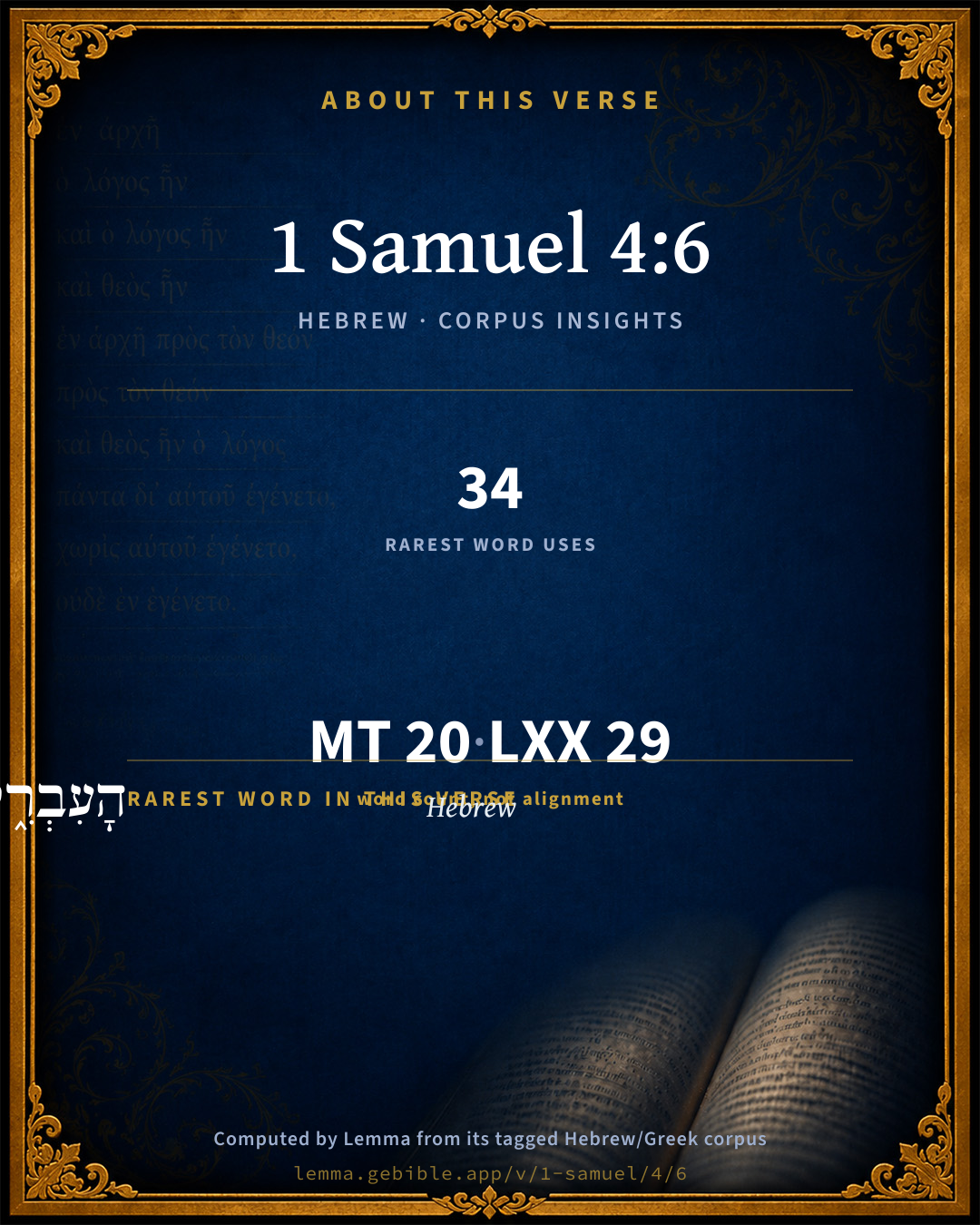
הָעִבְרִ֑ים
ʻIbrîy
H5680
“the · Hebrews”
Particle, Definite Article + Noun, Gentilic, Masculine, Plural, Absolute
Part of Speech
Particle + Noun
Type
Gentilic
Gender
Masculine
Number
Plural
State
Absolute
Full BDB Definition

Origin: patronymic from H5677

TWOT: None

Hebrew = "one from beyond" - a designation of the patriarchs and the Israelites (noun proper) - a designation of the patriarchs and the Israelites (adjective)
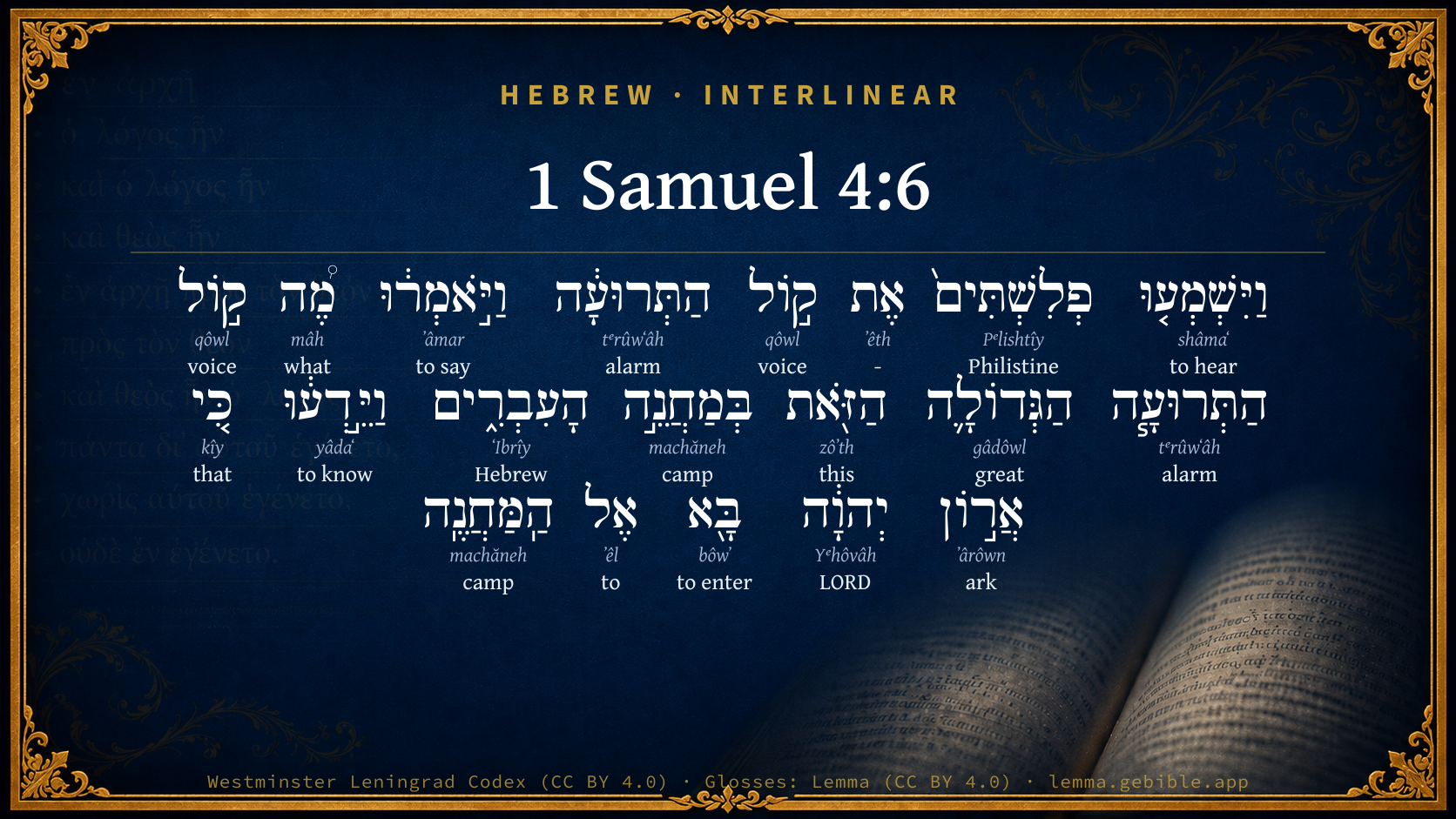
  1. וַיִּשְׁמְע֤וּ shâmaʻ H8085 “and · to hear” Conjunction + Verb, Qal, Sequential Imperfect, 3rd Person, Masculine, Plural
  2. פְלִשְׁתִּים֙ Pᵉlishtîy H6430 “Philistines” Noun, Gentilic, Masculine, Plural, Absolute
  3. אֶת ʼêth H853 “-” Particle, Direct Object
  4. ק֣וֹל qôwl H6963 “voice of” Noun, Common, Masculine, Singular, Construct
  5. הַתְּרוּעָ֔ה tᵉrûwʻâh H8643 “the · alarm” Particle, Definite Article + Noun, Common, Feminine, Singular, Absolute
  6. וַיֹּ֣אמְר֔וּ ʼâmar H559 “and · to say” Conjunction + Verb, Qal, Sequential Imperfect, 3rd Person, Masculine, Plural
  7. מֶ֠ה mâh H4100 “what” Particle, Interrogative
  8. ק֣וֹל qôwl H6963 “voice of” Noun, Common, Masculine, Singular, Construct
  9. הַתְּרוּעָ֧ה tᵉrûwʻâh H8643 “the · alarm” Particle, Definite Article + Noun, Common, Feminine, Singular, Absolute
  10. הַגְּדוֹלָ֛ה gâdôwl H1419 “the · great” Particle, Definite Article + Adjective, Adjective, Feminine, Singular, Absolute
  11. הַזֹּ֖את zôʼth H2063 “the · this” Particle, Definite Article + Pronoun, Demonstrative, Feminine, Singular
  12. בְּמַחֲנֵ֣ה machăneh H4264 “in/at · camp of” Preposition + Noun, Common, Both, Singular, Construct
  13. וַיֵּ֣דְע֔וּ yâdaʻ H3045 “and · to know” Conjunction + Verb, Qal, Sequential Imperfect, 3rd Person, Masculine, Plural
  14. כִּ֚י kîy H3588 “that” Conjunction
  15. אֲר֣וֹן ʼârôwn H727 “ark of” Noun, Common, Both, Singular, Construct
  16. יְהוָ֔ה Yᵉhôvâh H3068 “LORD” Noun, Proper
  17. בָּ֖א bôwʼ H935 “to enter” Verb, Qal, Perfect, 3rd Person, Masculine, Singular
  18. אֶל ʼêl H413 “to” Preposition
  19. הַֽמַּחֲנֶֽה machăneh H4264 “the · camp” Particle, Definite Article + Noun, Common, Both, Singular, Absolute

About this verse

These counts appear in no published source. They are computed here, from the morphology-tagged text and Lemma’s own curated glosses. What Lemma adds →

20
words
17
distinct lemmas
Historical
section

Shared distinctive vocabulary

הָעִבְרִ֑ים Hebrew H5680 occurs in 32 verses of the Hebrew Bible. Also found in:

Grammatical profile

  • 4 verbs
  • 10 nouns
  • 1 adjective
  • 1 pronoun
  • 1 preposition
  • 1 conjunction
  • 2 particles

Verb forms

  • וַיִּשְׁמְע֤וּ Qal · Sequential Imperfect
  • וַיֹּ֣אמְר֔וּ Qal · Sequential Imperfect
  • וַיֵּ֣דְע֔וּ Qal · Sequential Imperfect
  • בָּ֖א Qal · Perfect

Repetition

Words recur within this verse — often emphatic in Hebrew:

  • ק֣וֹל voice H6963 ×2
  • הַתְּרוּעָ֔ה alarm H8643 ×2
  • בְּמַחֲנֵ֣ה camp H4264 ×2

Hebrew & Septuagint length

In English translation the verse runs 37 words from the Hebrew and 35 from the Septuagint (LXX English) — closely comparable.

A rough comparison of the two English renderings, which tokenize alike — not a word-level alignment.

Word counts can differ between the Hebrew and the Greek without any difference in meaning — e.g. the Hebrew direct-object marker אֵת has no separate Greek word, and Greek often adds the article ὁ.

In the original languages it is 20 Hebrew tokens and 29 Greek tokens — but the two are counted differently (Hebrew bundles its prefixes and suffixes into one token; the Greek is in lemma form), so that isn’t a like-for-like length.

Cross-references

1

Topical passages linked to 1 Samuel 4:6 in the Treasury of Scripture Knowledge — connected by theme and wording, ordered by reader-vote popularity; previews shown in the World English Bible.

  • Exodus 32:17–18 When Joshua heard the noise of the people as they shouted, he said to Moses, "There is the noise of war in the camp."

Cross-references courtesy of OpenBible.info (CC BY 4.0).

Hebrew and Greek witnesses Masoretic Hebrew ↔ Greek Septuagint

The same verse in the two great witnesses to the Old Testament, shown verse-for-verse.

These are two independent witnesses, not word-aligned to each other, and the Septuagint is shown in lemma (dictionary) form.

Hebrew 1 Samuel 4:6 Masoretic · Westminster Leningrad Codex

וַיִּשְׁמְע֤וּ פְלִשְׁתִּים֙ אֶת ק֣וֹל הַתְּרוּעָ֔ה וַיֹּ֣אמְר֔וּ מֶ֠ה ק֣וֹל הַתְּרוּעָ֧ה הַגְּדוֹלָ֛ה הַזֹּ֖את בְּמַחֲנֵ֣ה הָעִבְרִ֑ים וַיֵּ֣דְע֔וּ כִּ֚י אֲר֣וֹן יְהוָ֔ה בָּ֖א אֶל הַֽמַּחֲנֶֽה

When the Philistines heard the noise of the shout, they said, What means the noise of this great shout in the camp of the Hebrews? They understood that the ark of Yahweh was come into the camp.

World English Bible · Public Domain

Greek LXX 1 Samuel 4:6 Septuagint · lemma form

καί ἀκούω ὁ ἀλλόφυλος ὁ κραυγή καί εἶπον ὁ ἀλλόφυλος τίς ὁ κραυγή ὁ μέγας οὗτος ἐν παρεμβολή ὁ εβραῖος καί γιγνώσκω ὅτι κιβωτός κύριος ἥκω εἰς ὁ παρεμβολή

And the Philistines heard the cry, and the Philistines said, What is this great cry in the camp of the Hebrews: and they understood that the ark of the Lord was come into the camp.

LXX2012 (modern English Septuagint) · Public Domain

On this verse, Keil & Delitzsch discusses the Septuagint’s reading. Read the note in Commentary ↓

Hebrew: Westminster Leningrad Codex (CC BY 4.0). Greek: Septuagint (public domain); English from LXX2012 (modern English Septuagint) (Public Domain). How the Septuagint differs from the Hebrew →

Targum (Aramaic paraphrase)

1

The Targum is the ancient Jewish Aramaic paraphrase of the Hebrew Scriptures — an interpretive translation, not the Hebrew text itself. Onkelos (literal) and Pseudo-Jonathan (expansive) render the Torah, and Jonathan the Prophets. Coverage is partial: where no permissively-licensed English translation exists for a verse, only the Aramaic is shown. This is verse-level text, not a word-by-word alignment to the Hebrew.

  1. Targum Jonathan Prophets (Joshua–Malachi)
    וּשְׁמָעוּ פְלִשְׁתָּאֵי יַת קַל יַבָּבָא וַאַמַרוּ מָה קָל יַבָּבָא רַבָּא הָדֵין בְמַשְׁרִיתָא דִיהוּדָאֵי וִידָעוּ אֲרֵי אֲרוֹנָא דַייָ אָתָא לְמַשְׁרִיתָא:

    (no public-domain English translation for this verse)

    Targum Jonathan — Aramaic: “Mikraot Gedolot” (public domain). English: “Sefaria Community Translation” (CC0 1.0 (public-domain dedication)); “London "Chaldee Paraphrase," 1871” (public domain). Text via Sefaria.

Commentary

Notes on 1 Samuel 4:6 from classic Christian and Jewish commentators (each source and its license shown beneath its notes). The classic Christian expositions comment on the surrounding passage and are grouped to its opening verse, so a note may address several verses; the Jewish commentaries on the Tanakh (Rashi and others) are per-verse, so they appear only where the commentator wrote on this verse.

Lemma curates 59 commentaries, every one of them public domain or Creative Commons licensed, each selected and text-cleaned for this edition rather than reprinted as found. About our sources →

Trapp's Complete Commentary

John Trapp

1Sa 4:6 And when the Philistines heard the noise of the shout, they said, What [meaneth] the noise of this great shout in the camp of the Hebrews? And they understood that the ark of the LORD was come into the camp.

Ver. 6. And they understood.] Per exploratores, saith Vatablus, by their scouts and intelligencers.

John Trapp, A Commentary or Exposition upon All the Books of the Old and New Testament (1647–1656) — public domain. Text from a community e-Sword module.

Tyndale Open Study Notes

Tyndale Open Resources

4:6-7 Like the Israelites, the Philistines regarded the Ark as a powerful talisman (see 4:2-3) and believed that its presence in battle would mean sure disaster for them.

Tyndale Open Study Notes — © Tyndale Open Resources, licensed CC BY-SA 4.0. Text via the HelloAO Bible API.

The Cambridge Bible for Schools and Colleges

gen. ed. J. J. S. Perowne

6. the Hebrews] This name is used (a) by foreigners, as here (cp. ch. 1Sa_29:3): (b) by the Israelites in speaking of themselves to foreigners (Exo_2:7): (c) when the Israelites are contrasted with foreigners (1Sa_13:3, note, 7). It is either (1) a derivative from eber, a word meaning beyond, and was originally applied to Abraham as coming from beyond the Euphrates: or (2) a patronymic from Eber (Gen_10:21; Gen_10:24), signifying the descendants of Eber.

6–9. Observe how vividly the successive emotions of the Philistines are painted: astonishment, when they heard the triumphant shout of the vanquished army: dismay, when they learnt its cause: manly resolution, when they had recovered from the first panic.

The Cambridge Bible for Schools and Colleges (gen. ed. J. J. S. Perowne; Cambridge University Press, 1878–1918) — public domain. Text from a community e-Sword module.

John Gill's Exposition

And when the Philistines heard the noise of the shout,.... For it being so loud as to make the earth ring, it was heard in the camp of the Philistines, which might not be at any great distance from the camp of Israel; how far from each other were Aphek and Ebenezer is not certain:

they said, what meaneth the noise of this great shout in the camp of the Hebrews? they could not conceive what should be the reason of it, seeing they had no occasion to shout for joy, having been lately defeated; and a shout is made generally just before a battle is begun, and the onset made, or when victory is obtained; neither of which was the case now:

and they understood that the ark of the Lord was come into the camp: this they understood by spies, which they sent to find out the meaning of the shout; which is more probable than that they came to the knowledge of it by deserters; seeing it is not very likely that any Israelites would desert to the Philistines.

John Gill's Exposition of the Whole Bible (1746–1763) — public domain (CC PDM 1.0). Text via the HelloAO Bible API.

Albert Barnes' Notes on the Bible

Of the Hebrews - This was the name by which the Israelites were known to foreign nations (compare Exo 1:15; Exo 2:6).

Albert Barnes' Notes on the Bible (1834–1885) — public domain. Text from a community e-Sword/MySword module.

Matthew Poole's English Annotations

Timely understood, by information from the Israelites, who would readily tell them of it to affright them.

Matthew Poole's English Annotations on the Holy Bible (1683–1685) — public domain. Text from a community e-Sword/MySword module.

The Pulpit Commentary

But they, sure of its talismanic influence, shout for joy as they see its approach, and the Philistines ask the meaning of the great shout in the camp of the Hebrews. This name is constantly given to the Israelites by those not belonging to them, and probably has a certain amount of animosity in it, as showing that they were foreigners; literally, passers over, people who in the person of Abraham had come from the other side of the Euphrates, and having began as feeble immigrants, had ended in obtaining possession of the land, and ousting the rightful inhabitants.

The Pulpit Commentary (1880–1919), ed. H.D.M. Spence-Jones & Joseph S. Exell — public domain. Text from a community e-Sword module.

Keil & Delitzsch

C. F. Keil & F. Delitzsch

When the Philistines heard the noise, and learned on inquiry that the ark of Jehovah had come into the camp, they were thrown into alarm, for "they thought (lit. said), God (Elohim) is come into the camp, and said, 'Woe unto us! For such a thing has not happened yesterday and the day before (i.e., never till now). Woe to us! Who will deliver us from the hand of these mighty gods? These are the very gods that smote Egypt with all kinds of plagues in the wilderness.' " The Philistines spoke of the God of Israel in the plural., האדּירים האלהים, as heathen who only knew of gods, and not of one Almighty God. Just as all the heathen feared the might of the gods of other nations in a certain degree, so the Philistines also were alarmed at the might of the God of the Israelites, and that all the more because the report of His deeds in the olden time had reached their ears (see Exo 15:14-15). The expression "in the wilderness" does not compel us to refer the words "smote with all the plagues" exclusively to the destruction of Pharaoh and his army in the Red Sea (Exo 14:23.). "All the plagues" include the rest of the plagues which God inflicted upon Egypt, without there being any necessity to supply the copula ו before בּמּדבּר, as in the lxx and Syriac. By this addition an antithesis is introduced into the words, which, if it really were intended, would require to be indicated by a previous בּארץ or בּארצם. According to the notions of the Philistines, all the wonders of God for the deliverance of Israel out of Egypt took place in the desert, because even when Israel was in Goshen they dwelt on the border of the desert, and were conducted thence to Canaan.

Keil & Delitzsch — Biblical Commentary on the Old Testament (1861–1891) — public domain (CC PDM 1.0). Text via the HelloAO Bible API. (Old Testament only.)

Lesson kit

Teaching starters — assembled from the data on this page, not authored interpretation. Every prompt links to the verse data it draws on. Edit before teaching.

1 Samuel, in the Historical, opens this verse with 20 words (17 distinct Hebrew lemmas). Its most distinctive word is ʻIbrîy (“Hebrew”). A historical commentator’s framing appears above. Read the whole chapter for the surrounding context.

Discussion questions

  1. What does “Hebrew” (ʻIbrîy) contribute to the verse as a whole?
  2. Genesis 14:13 shares the word «Hebrew» with this verse. How do the two illuminate each other?
  3. “voice” occurs 2× in this one verse. What is the effect of the repetition?
  4. The translations on this page render this verse differently — a whole-verse word diff, not a word-by-word alignment. What might account for the different wordings?
  5. The verb «וַיִּשְׁמְע֤וּ» is Qal Sequential Imperfect. How does its form color the action?
  6. Reading how Trapp's Complete Commentary and Tyndale Open Study Notes read this verse, where do the two commentators agree and where do they part?

Things to notice

Reading settings

Reading text

Shown beneath each verse's original-language words.

Old Testament
Old Testament edition

Read the OT as the Masoretic Hebrew (MT) or the Greek Septuagint (LXX).

English shown for the Greek Septuagint (in the Hebrew ↔ Greek comparison).

Comparing translations? Open the Compare panel on any verse page to stack up to four side by side.