Ezekiel 43:2

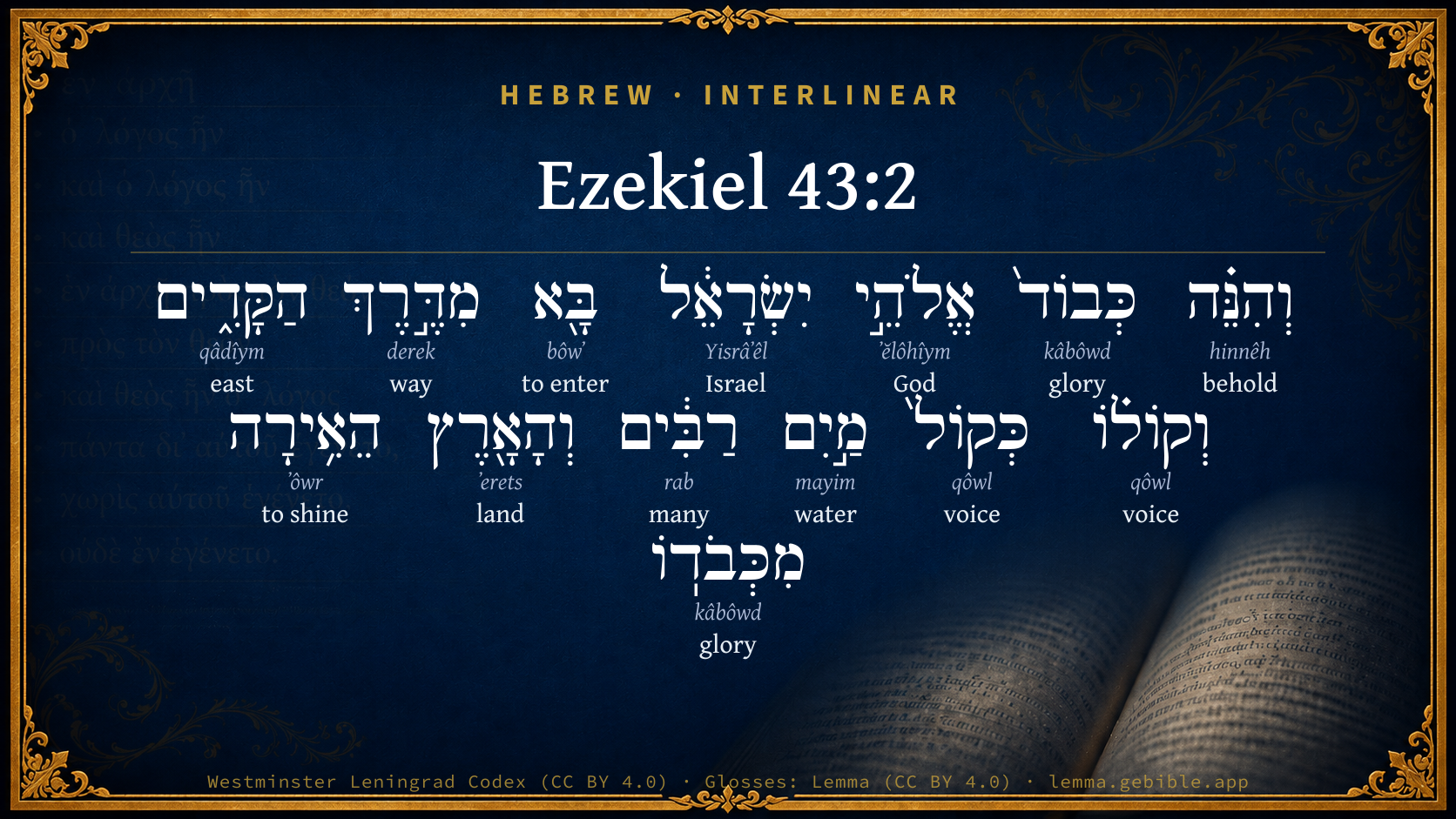
Hebrew (Westminster Leningrad Codex) Ezekiel 43:2 appears in the Hebrew Old Testament. The text above is from the Westminster Leningrad Codex. Each word links to its Strong’s number, a concise gloss, and parsing drawn from the Open Scriptures Hebrew Bible morphology. Click any word for its full Brown-Driver-Briggs (BDB) entry.
Download image
Cite this verse

Ezekiel 43:2 (World English Bible). Public Domain. Lemma interlinear Bible study tool, https://lemma.gebible.app/v/ezekiel/43/2.

Show BibTeX & RIS
BibTeX
RIS
English Translation
Behold, the glory of the God of Israel came from the way of the east: and his voice was like the sound of many waters; and the earth shined with his glory.
World English Bible · Public Domain
Download a study sheet

One document with this verse’s original text, its word-by-word gloss line, the meaning frame, cross-references with their text, attributed commentary, and full source and license credits — printable, and it pastes into notes with its structure intact.

This verse Autodidact and up

Study sheet (.html) Plain text (.txt)

A passage Seminary Student

Up to 50 verses in one chapter. A passage sheet keeps up to 6 commentary sources and 12 cross-references per verse, in the order this page ranks them, and says so on the sheet whenever that leaves anything out. Ask for a single verse and you get the Autodidact verse sheet above.

Everything on this page stays free to read, with no account — the sheet is a download of what is already on screen, not access to it.

Want to remove ads? Support Godless Engineer
Compare translations 3

The same verse in 3 English versions, stacked beneath the original-language interlinear above. Click any original word for its lexicon entry.

Each is an independent rendering of the whole verse — the interlinear is not word-aligned to these translations.

Highlighted words mark where these versions differ — a whole-verse word diff, not a word-by-word alignment.

  • World English Bible Public Domain
    Behold, the glory of the God of Israel came from the way of the east: and his voice was like the sound of many waters; and the earth shined with his glory.
  • King James Version Public Domain
    And, behold, the glory of the God of Israel came from the way of the east: and his voice was like a noise of many waters: and the earth shined with his glory.
  • unfoldingWord Literal Text CC BY-SA 4.0
    Behold! The glory of the God of Israel came from the east; his voice was like the sound of many waters, and the earth shone with his glory.

unfoldingWord Literal Text — © unfoldingWord, licensed CC BY-SA 4.0. Word-aligned USFM3 via Door43 (git.door43.org/unfoldingWord/en_ult).

Versions to compare (up to 4)

3 of 4 selected

Show all 18 translations

Every available English version of this verse, each an independent rendering of the whole verse.

  • World English Bible Public Domain
    Behold, the glory of the God of Israel came from the way of the east: and his voice was like the sound of many waters; and the earth shined with his glory.
  • Berean Standard Bible Public Domain
    and I saw the glory of the God of Israel coming from the east. His voice was like the roar of many waters, and the earth shone with His glory.
  • Majority Standard Bible Public Domain
    and I saw the glory of the God of Israel coming from the east. His voice was like the roar of many waters, and the earth shone with His glory.
  • King James Version Public Domain
    And, behold, the glory of the God of Israel came from the way of the east: and his voice was like a noise of many waters: and the earth shined with his glory.
  • American Standard Version (1901) Public Domain
    And, behold, the glory of the God of Israel came from the way of the east: and his voice was like the sound of many waters; and the earth shined with his glory.
  • Revised Version (1885) Public Domain
    And behold, the glory of the God of Israel came from the way of the east: and his voice was like the sound of many waters: and the earth shined with his glory.
  • Geneva Bible (1599) Public Domain
    And beholde, the glorie of the God of Israel came from out of the East, whose voyce was like a noyse of great waters, and the earth was made light with his glorie.
  • Douay-Rheims (1899) Public Domain
    And behold the glory of the God of Israel came in by the way of the east: and his voice was like the noise of many waters, and the earth shone with his majesty.
  • Young's Literal Translation Public Domain
    And lo, the honour of the God of Israel hath come from the way of the east, and His voice `is' as the noise of many waters, and the earth hath shone from His honour.
  • Literal Standard Version CC BY-SA 4.0
    And behold, the glory of the God of Israel has come from the way of the east, and His voice [is] as the noise of many waters, and the earth has shone from His glory.
  • Unlocked Literal Bible CC BY-SA 4.0
    Behold! The glory of the God of Israel came from the east; his voice was like the sound of many waters, and the earth shone with his glory.
  • unfoldingWord Literal Text CC BY-SA 4.0
    Behold! The glory of the God of Israel came from the east; his voice was like the sound of many waters, and the earth shone with his glory.
  • Darby Bible Public Domain
    And behold, the glory of the God of Israel came from the way of the east; and his voice was like the voice of many waters; and the earth was lit up with his glory.
  • World Messianic Bible Public Domain
    Behold, the glory of the God of Israel came from the way of the east. His voice was like the sound of many waters; and the earth was illuminated with his glory.
  • Webster's Bible Public Domain
    And behold, the glory of the God of Israel came from the way of the east: and his voice was like a noise of many waters: and the earth shined with his glory.
  • Free Bible Version CC BY-SA 4.0
    There I saw the glory of Israel's God coming from the east. His voice sounded like a thundering waterfall, and the earth blazed bright with his glory.
  • Bible in Basic English Public Domain
    And there was the glory of the God of Israel coming from the way of the east: and his voice was like the sound of great waters, and the earth was shining with his glory.
  • JPS Tanakh (1917) Public Domain
    and, behold, the glory of the God of Israel came from the way of the east; and His voice was like the sound of many waters; and the earth did shine with His glory.

Literal Standard Version (2020), Covenant Press — licensed CC BY-SA 4.0. Text via the HelloAO Bible API (eBible.org). Unlocked Literal Bible (unfoldingWord) — licensed CC BY-SA 4.0. Text via the HelloAO Bible API (eBible.org). unfoldingWord Literal Text — © unfoldingWord, licensed CC BY-SA 4.0. Word-aligned USFM3 via Door43 (git.door43.org/unfoldingWord/en_ult). Free Bible Version, Dr. Jonathan Gallagher — licensed CC BY-SA 4.0. Text via the HelloAO Bible API (eBible.org).

Word by word

More ways to search: Search by grammar → Find every occurrence → Compare this word →

Practice this passage: Drill this verse → Learn its vocabulary →

הֵאִ֥ירָה
ʼôwr
H215
“to shine”
Verb, Hiphil, Perfect, 3rd Person, Feminine, Singular
Part of Speech
Verb
Stem
Hiphil
Form
Perfect
Person
3rd Person
Gender
Feminine
Number
Singular
Full BDB Definition

Origin: a primitive root

TWOT: 52

to be or become light, shine - (Qal) - to become light (day) - to shine (of the sun) - to become bright - (Niphal) - to be illuminated - to become lighted up - (Hiphil) - to give light, shine (of sun, moon, and stars) - to illumine, light up, cause to shine, shine - to kindle, light (candle, wood) - lighten (of the eyes, his law, etc) - to make shine (of the face)
  1. וְהִנֵּ֗ה hinnêh H2009 “and · behold” Conjunction + Particle, Demonstrative
  2. כְּבוֹד֙ kâbôwd H3519 “glory of” Noun, Common, Both, Singular, Construct
  3. אֱלֹהֵ֣י ʼĕlôhîym H430 “God(s) of” Noun, Common, Masculine, Plural, Construct
  4. יִשְׂרָאֵ֔ל Yisrâʼêl H3478 “Israel” Noun, Proper
  5. בָּ֖א bôwʼ H935 “to enter” Verb, Qal, Perfect, 3rd Person, Masculine, Singular
  6. מִדֶּ֣רֶךְ derek H1870 “from · way of” Preposition + Noun, Common, Both, Singular, Construct
  7. הַקָּדִ֑ים qâdîym H6921 “the · east” Particle, Definite Article + Noun, Common, Masculine, Singular, Absolute
  8. וְקוֹל֗וֹ qôwl H6963 “and · voice · his” Conjunction + Noun, Common, Masculine, Singular, Construct + Suffix, Personal, 3rd Person, Masculine, Singular
  9. כְּקוֹל֙ qôwl H6963 “like/as · voice of” Preposition + Noun, Common, Masculine, Singular, Construct
  10. מַ֣יִם mayim H4325 “water(s)” Noun, Common, Masculine, Plural, Absolute
  11. רַבִּ֔ים rab H7227 “many” Adjective, Adjective, Masculine, Plural, Absolute
  12. וְהָאָ֖רֶץ ʼerets H776 “and · the · land” Conjunction + Particle, Definite Article + Noun, Common, Both, Singular, Absolute
  13. מִכְּבֹדֽוֹ kâbôwd H3519 “from · glory · his” Preposition + Noun, Common, Both, Singular, Construct + Suffix, Personal, 3rd Person, Masculine, Singular

About this verse

These counts appear in no published source. They are computed here, from the morphology-tagged text and Lemma’s own curated glosses. What Lemma adds →

14
words
12
distinct lemmas
Prophets
section

Shared distinctive vocabulary

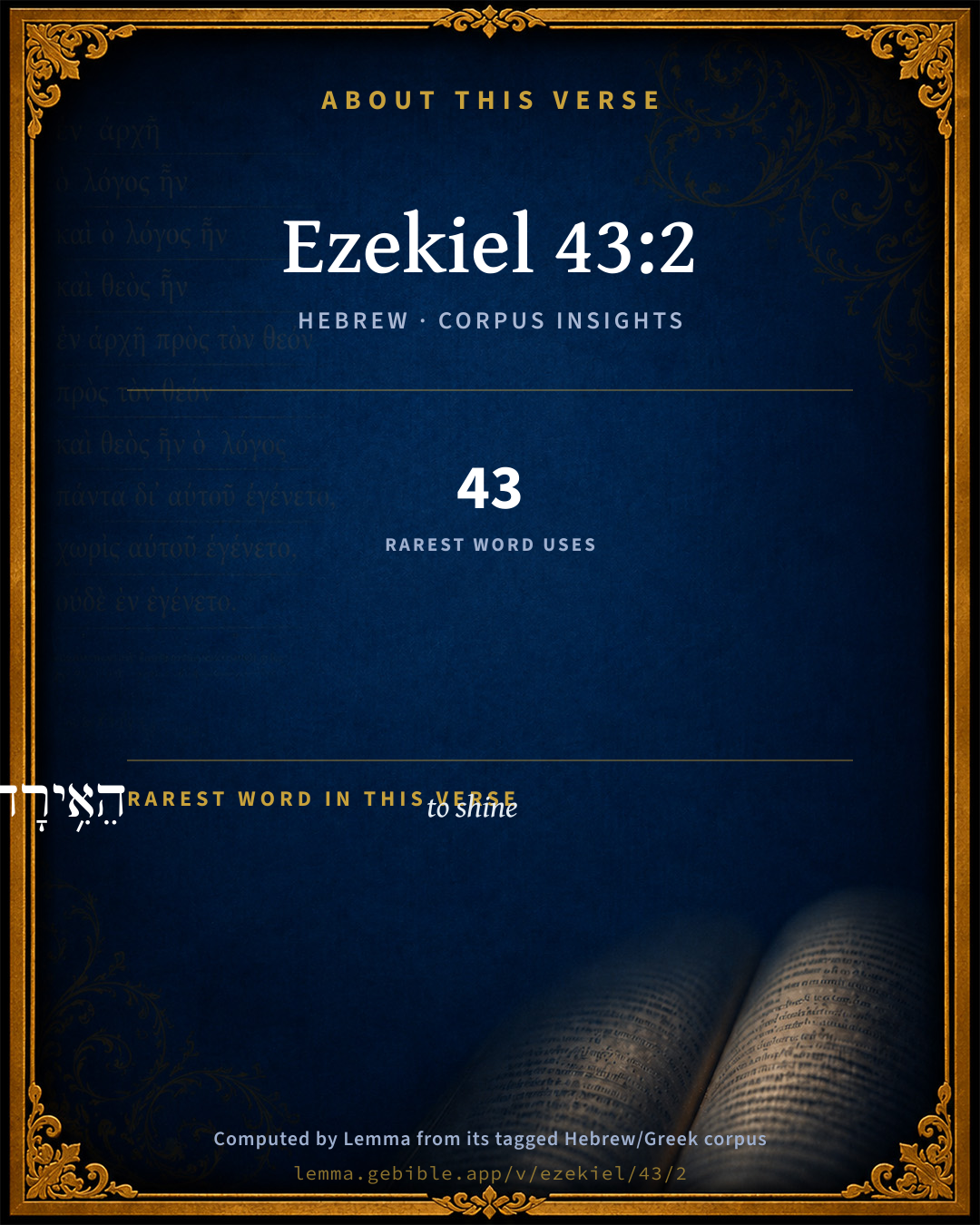
הֵאִ֥ירָה to shine H215 occurs in 43 verses of the Hebrew Bible. Also found in:

Grammatical profile

  • 2 verbs
  • 10 nouns
  • 1 adjective
  • 1 particle

Verb forms

  • בָּ֖א Qal · Perfect
  • הֵאִ֥ירָה Hiphil · Perfect

Repetition

Words recur within this verse — often emphatic in Hebrew:

  • כְּבוֹד֙ glory H3519 ×2
  • וְקוֹל֗וֹ voice H6963 ×2

Hebrew & Septuagint length

In English translation the verse runs 32 words from the Hebrew and 41 from the Septuagint (LXX English) — closely comparable.

A rough comparison of the two English renderings, which tokenize alike — not a word-level alignment.

Word counts can differ between the Hebrew and the Greek without any difference in meaning — e.g. the Hebrew direct-object marker אֵת has no separate Greek word, and Greek often adds the article ὁ.

Cross-references

18

Topical passages linked to Ezekiel 43:2 in the Treasury of Scripture Knowledge — connected by theme and wording, ordered by reader-vote popularity; previews shown in the World English Bible.

  • Revelation 18:1 After these things, I saw another angel coming down out of the sky, having great authority. The earth was illuminated with his glory.
  • Isaiah 6:3 One called to another, and said, "Holy, holy, holy, is Yahweh of Hosts! The whole earth is full of his glory!"
  • Ezekiel 11:23 The glory of Yahweh went up from the midst of the city, and stood on the mountain which is on the east side of the city.
  • Ezekiel 10:18–19 The glory of Yahweh went forth from over the threshold of the house, and stood over the cherubim.
  • Revelation 1:15 His feet were like burnished brass, as if it had been refined in a furnace. His voice was like the voice of many waters.
  • Revelation 14:2 I heard a sound from heaven, like the sound of many waters, and like the sound of a great thunder. The sound which I heard was like that of harpists playing on their harps.
  • Ezekiel 1:28 As the appearance of the bow that is in the cloud in the day of rain, so was the appearance of the brightness round about. This was the appearance of the likeness of the glory of Yahweh. When I saw it, I fell on my face, and I heard a voice of one that spoke.
  • Ezekiel 10:4 The glory of Yahweh mounted up from the cherub, [and stood] over the threshold of the house; and the house was filled with the cloud, and the court was full of the brightness of Yahweh's glory.
  • Ezekiel 1:24 When they went, I heard the noise of their wings like the noise of great waters, like the voice of the Almighty, a noise of tumult like the noise of a host: when they stood, they let down their wings.
  • Ezekiel 3:23 Then I arose, and went forth into the plain: and, behold, the glory of Yahweh stood there, as the glory which I saw by the river Chebar; and I fell on my face.
  • Revelation 19:6 I heard something like the voice of a great multitude, and like the voice of many waters, and like the voice of mighty thunders, saying, "Hallelujah! For the Lord our God, the Almighty, reigns!
  • Revelation 21:23 The city has no need for the sun, neither of the moon, to shine, for the very glory of God illuminated it, and its lamp is the Lamb.
  • Isaiah 60:1–3 Arise, shine; for your light is come, and the glory of Yahweh is risen on you.
  • Ezekiel 9:3 The glory of the God of Israel was gone up from the cherub, whereupon it was, to the threshold of the house: and he called to the man clothed in linen, who had the writer's inkhorn by his side.
  • Habakkuk 2:14 For the earth will be filled with the knowledge of the glory of Yahweh, as the waters cover the sea.
  • Habakkuk 3:3 God came from Teman, The Holy One from Mount Paran. Selah. His glory covered the heavens, And his praise filled the earth.
  • John 12:41 Isaiah said these things when he saw his glory, and spoke of him.
  • Revelation 19:1 After these things I heard something like a loud voice of a great multitude in heaven, saying, "Hallelujah! Salvation, power, and glory belong to our God:

Cross-references courtesy of OpenBible.info (CC BY 4.0).

Hebrew and Greek witnesses Masoretic Hebrew ↔ Greek Septuagint

The same verse in the two great witnesses to the Old Testament, shown verse-for-verse.

These are two independent witnesses, not word-aligned to each other, and the Septuagint is shown in lemma (dictionary) form.

Hebrew Ezekiel 43:2 Masoretic · Westminster Leningrad Codex

וְהִנֵּ֗ה כְּבוֹד֙ אֱלֹהֵ֣י יִשְׂרָאֵ֔ל בָּ֖א מִדֶּ֣רֶךְ הַקָּדִ֑ים וְקוֹל֗וֹ כְּקוֹל֙ מַ֣יִם רַבִּ֔ים וְהָאָ֖רֶץ הֵאִ֥ירָה מִכְּבֹדֽוֹ

Behold, the glory of the God of Israel came from the way of the east: and his voice was like the sound of many waters; and the earth shined with his glory.

World English Bible · Public Domain

Greek LXX Ezekiel 43:2 Septuagint · lemma form

καί ἰδού δόξα θεός ἰσραήλ ἄρχω κατά ὁ ὁδός ὁ πύλη ὁ βλέπω πρός ἀνατολή καί φωνή ὁ παρεμβολή ὡς φωνή διπλασιάζω πολύς καί ὁ γῆ ἐκλάμπω ὡς φέγγος ἀπό ὁ δόξα κυκλόθεν

And, behold, the glory of the God of Israel came by the eastern way; and there was a voice of an army, as the sound of many redoubling their shouts, and the earth shone like light from the glory round about.

LXX2012 (modern English Septuagint) · Public Domain

On this verse, John Gill's Exposition discusses the Septuagint’s reading. Read the note in Commentary ↓

Hebrew: Westminster Leningrad Codex (CC BY 4.0). Greek: Septuagint (public domain); English from LXX2012 (modern English Septuagint) (Public Domain). How the Septuagint differs from the Hebrew →

Targum (Aramaic paraphrase)

1

The Targum is the ancient Jewish Aramaic paraphrase of the Hebrew Scriptures — an interpretive translation, not the Hebrew text itself. Onkelos (literal) and Pseudo-Jonathan (expansive) render the Torah, and Jonathan the Prophets. Coverage is partial: where no permissively-licensed English translation exists for a verse, only the Aramaic is shown. This is verse-level text, not a word-by-word alignment to the Hebrew.

  1. Targum Jonathan Prophets (Joshua–Malachi)
    וְהָא יְקָר אֱלָהָא דְיִשְׂרָאֵל אִתְגְלֵי מֵאוֹרַח מַדִינְחָא וְקַל מְבָרְכֵי שְׁמֵהּ כְּקַל מַיִין סַגִיאִין וְאַרְעָא נַהֲרַת מִזִיו יְקָרֵהּ:

    (no public-domain English translation for this verse)

    Targum Jonathan — Aramaic: “Mikraot Gedolot” (public domain). English: “Sefaria Community Translation” (CC0 1.0 (public-domain dedication)); “London "Chaldee Paraphrase," 1871” (public domain). Text via Sefaria.

Commentary

Notes on Ezekiel 43:2 from classic Christian and Jewish commentators (each source and its license shown beneath its notes). The classic Christian expositions comment on the surrounding passage and are grouped to its opening verse, so a note may address several verses; the Jewish commentaries on the Tanakh (Rashi and others) are per-verse, so they appear only where the commentator wrote on this verse.

Lemma curates 59 commentaries, every one of them public domain or Creative Commons licensed, each selected and text-cleaned for this edition rather than reprinted as found. About our sources →

Trapp's Complete Commentary

John Trapp

Eze 43:2 And, behold, the glory of the God of Israel came from the way of the east: and his voice [was] like a noise of many waters: and the earth shined with his glory.

Ver. 2. And behold the glory,] i.e., The vision of the glory. God, who by the east gate had left the temple and the city, {Eze 10:19} doth now the same way return, and filleth the house with the glory of his presence.

And his voice was like a noise of many waters.] Importing the multitude of his attendants, and his irresistible power, in his gospel especially, which is the power of God to salvation, and, like a mighty torrent, bears down all before it.

And the earth shined with his glory.] How can it do otherwise when the Sun of righteousness cometh in place, and irradiateth both organ and object. {2Co 4:6} Into Solomon’s temple God came in a thick cloud; not so here. Light is now more diffused than ever. Woe be to those that wink, or who seek straws to put out their eyes with, as Bernard hath it.

John Trapp, A Commentary or Exposition upon All the Books of the Old and New Testament (1647–1656) — public domain. Text from a community e-Sword module.

Adam Clarke's Commentary

Verse 2. The glory of the God of Israel came from the way of the east] This was the chariot of cherubim, wheels, c., which he saw at the river Chebar. And this glory, coming from the east, is going to enter into the eastern gate of the temple, and thence to shine out upon the whole earth. Is there not a mystery here? All knowledge, all religion, and all arts and sciences, have travelled, according to the course of the sun, FROM EAST TO WEST! From that quarter the Divine glory at first came and thence the rays of Divine light continue to diffuse themselves over the face of the earth. From thence came the Bible, and through that the new covenant. From thence came the prophets, the apostles, and the first missionaries, that brought the knowledge of God to Europe, to the isles of the sea, and to the west first, and afterwards to these northern regions.

Adam Clarke's Commentary on the Bible (1810–1826) — public domain. Text from a community e-Sword/MySword module.

The Cambridge Bible for Schools and Colleges

gen. ed. J. J. S. Perowne

2. and his voice] and the sound of him was like the sound. Reference is to the sound made by the cherubim in their flight.

The Cambridge Bible for Schools and Colleges (gen. ed. J. J. S. Perowne; Cambridge University Press, 1878–1918) — public domain. Text from a community e-Sword module.

John Gill's Exposition

And, behold, the glory of the God of Israel came from the way of the east,.... The God of Israel is Jehovah the Father, the covenant God of literal Israel; and the covenant God and Father of the whole spiritual Israel, or his elect, whether Jews or Gentiles; whom he has taken into covenant, loves, cares, provides for, and protects: Christ, who is the brightness of his Father's glory, whose glory is the glory of the only begotten of the Father, is here meant; and who has the same glorious attributes, the same glorious names, and the same worship, honour, and glory, his Father has; and in whom, as Mediator, is displayed the glory of all the divine perfections: he is said to "come from the way of the east"; which agrees with him in his character as the rising sun of righteousness; and with his incarnation, when as the day spring from on high, from heaven, he visited us, was born in the east, where his star appeared; from this part of the world his Gospel first came; here it was first preached, and churches planted; and though these parts have been forsaken by him a long time, he will return hither again; when he will dry up the river Euphrates, and make way for the kings and kingdoms of the east to be converted to him, Rev 7:2, to which a "behold" is prefixed, as a note exciting attention, and raising admiration; as it was matter of wonder and joy to the prophet, to see the glory of the Lord returning to his house, the same way he departed, Eze 10:4,

and his voice was like a noise of many waters; this is to be understood of his Gospel, in which he speaks to men, and which is a voice of love, grace, and mercy; of peace and reconciliation; of pardon and righteousness; of life, liberty, and salvation: and the metaphor here used is expressive of the swiftness of its motion in the world; of its general spread in it, and all over it; of the noise it will make, as it always does among men, wherever it comes; and of the rapidity and force of it, being attended with almighty power; and is a soul shaking, heart melting, soul quickening, enlightening, alluring, and comforting voice; see Dan 10:6. The Targum is,

"and the voice of them that bless his name is as the voice of many waters.''

The Septuagint and Arabic versions, the voice of the camp or army.

And the earth shined with his glory; with the brightness of his glory, as the Targum; with his glorious Gospel, in which the glory of his person, office, and grace, is displayed; this will be spread all over the earth, and that will be enlightened by it: it will remove the darkness and infidelity, error, superstition, idolatry, and all false doctrines from the world, and the darkness of calamity and distress from the church; which will cast a lustre and glory upon it; and with the brightness of which the Lord will destroy antichrist, and by it set up his kingdom in the world, and reign before his ancients gloriously: this will bring on Zion's light and glory, to which kings will come, and upon which will be a defence; Rev 18:1.

John Gill's Exposition of the Whole Bible (1746–1763) — public domain (CC PDM 1.0). Text via the HelloAO Bible API.

Haydock's Catholic Bible Commentary

Majesty. The world is enlightened by the preaching of the gospel; and the Church triumphant [in heaven] shall shine in perfection, when that which is sown in corruption shall put on incorruption, 1 Corinthians xv. (St. Jerome) --- The blessed Virgin Mary conceiving Jesus Christ may be insinuated. (St. Thomas Aquinas, [Summa Theologiae] p. 3. q. 27. a. 3.) (Worthington)

George Leo Haydock (1774–1849), Haydock's Catholic Family Bible and Commentary, 1859 edition — public domain. Excludes Psalms (Douay-Rheims chapter numbering differs from Protestant) and Deuterocanonical books (Catholic canon only).

Matthew Poole's English Annotations

Behold: sometimes this word is expletive, but here surely it stands for more; it expresseth, no doubt, the joy the prophet had to see this excellent sight, which should not be seen there more than sixty year’s; for in the sixth year of the captivity the glory of God left the city, Eze 11:22,23; and now the prophet foreseeth its return after the settling the temple, its buildings, and ordinances, which took up a great time, as is evident, Joh 2:20, which time of forty-six years (viz. thirty in Cyrus, eight in Cambyses, and some six in Darius) is very near accounted. So that between the departure and the return of the glory of God, are about one hundred and six or eight years, and about fourscore between this vision and the accomplishment. The glory: see Eze 1:28.

Of the God of Israel; of him who is an infinitely glorious Being, yet in covenant with us, as a peculiar people of God.

Came from the way of the east: when the glory departed it went eastward, and now that it returns it comes from the east.

His voice: though by the voice of God thunder is sometimes meant, yet here it was an articulate voice, as appears Eze 43:7,8. Perhaps this might be attended with thunder, as usually in such cases.

Like a noise of many waters; terrible, and a mighty voice, as the noise of mighty waves of the sea; so Eze 1:24; Rev 1:15.

The earth; not the whole earth, but that part about Jerusalem and the temple.

Shined with his glory; the rays of glory, like the sun-beams, made the dark earth to shine with glorious light.

Matthew Poole's English Annotations on the Holy Bible (1683–1685) — public domain. Text from a community e-Sword/MySword module.

The Pulpit Commentary

Scarcely had the prophet taken up his station at or near the gate when the glory of the God of Israel (see on Eze_1:28 Eze_3:23) came from the way of the east, as if intending to enter the temple by the very door through which it had previously departed from the temple. (comp. Eze_10:19 Eze_11:22, Eze_11:23) The voles which proceeded from the theophany and resembled the noise of many waters, is after the LXX (kai fwnh thv parembolhv) by Keil and Smend understood to have been the sound produced by the motion of the wheels and the rustling of the wings of the cherubim, (see on Eze_1:2, 4 10:5) but is better taken, with Kliefoth and Hengstenberg, to signify the voice of the Almighty himself, i.e. of the personal Jehovah (comp. . (Rev_1:15) The statement that the earth shined with his glory (comp. (Rev_18:1) has by Havernick, Kliefoth, and others been supposed to indicate the absence of that "cloud" in which the glory of Jehovah appeared in both the Mosaic tabernacle (Exo_40:34, Exo_40:35) and the Solomonic temple, (1Ki_8:10, 1Ki_8:11) and thereby to point to the clearer and more resplendent manifestations of the Godhead, which were to be given in connection with the new dispensation for which Ezekiel"s "house" was being prepared. This, however, as Keil has shown, cannot be main-rained in face of the facts that in both Exodus and 1 Kings "the glory of the Lord" is used synonymously with "the cloud," and that in Ezekiel"s vision "the glory" and "the cloud" were alike present. (see Eze_10:3, Eze_10:4) Kliefoth and Schroder hold "the earth" which was illumined to have been "the whole globe," "the entire region of humanity," as in Isa_6:3 Isa_60:1, etc.; butthere does not appear ground for departing from the ordinary sense of the words, that "the path" of the advancing God was irradiated by the brilliance of his material glory.

Ver. 2. The glory of the God of Israel.

The visionary glory that dazzled the eyes of the rapt seer is but an earthly suggestion of that ineffable glory in which the unseen God is ever clothed.

We may take the manifestation of glory as a type and suggestion of that higher wonder.

I IN WHAT THE GLORY OF THE GOD OF ISRAEL CONSISTS.

1. The radiance of heavenly light. The glory is like the effulgence of sunlight, the raying forth of beams of splendor from the central fountain of light.

(1) It is perfect truth. All error and falsehood are excluded. God dwells in infinite knowledge and wisdom and truthfulness.

(2) It is absolute holiness. No stain or fleck of sin ever touches the supreme purity of God.

(3) It is infinite love. The glory of God is most seen in his goodness. By wonderful deeds of grace he manifests his glory.

(4) It is unutterable joy. The joy of truth, holiness, and love must ever dwell in the heart of God. God smiles over his creatures: that is his glory.

2. The wealth of heavenly voices. "His voice was like a noise of many waters." God has broken the silence of eternity. He has called to his lost and wayward children. With variety of utterance and of truth God has made his voice heard. His gospel message is his glory.

II HOW THE GLORY OF THE GOD OF ISRAEL APPEARS. Ezekiel saw the glory dawn in the east like the pure, bright light of a rising sun.

1. It was not always manifest. There had been a night previous to this glad dawn. There had been dark days in the Captivity, when even the radiance of God seemed to be dimmed.

(1) In the world"s history there have been awful, blank ages, out of which all Divine glory seems to have been excluded.

(2) In individual experience there are sad days when the soul exclaims, "My God, my God, why hast thou forsaken me?

2. It is made manifest.

(1) To the world, in Christ, who manifested forth the glory of his Father. Thus St. John says, And we beheld his glory, the glory as of the Only Begotten of the Father". (Joh_1:14)

(2) To the individual, by faith. When we truly seek for the brightness of God"s countenance in Christ, and trust his grace, there rises a light in the darkness, and God"s glory appears.

III THE RESULTS THAT FOLLOW THE MANIFESTATION OF THE GLORY OF THE GOD OF ISRAEL. "And the earth shined with his glory." This radiance was not confined to celestial regions. It was no vain pageantry displayed among the clouds. It came into the world as a brightness for earthly things. This is ever the case with manifestations of God"s glory. It is especially so with Christ who" tabernacled among us," and so brought the celestial glory to dwell on earth. The shining forth of God"s truth and goodness makes a new day for the world. It is already reflected in purified, gladdened-lives; it will be fully seen in a renewal of the whole face of society. That which seems to be most remote and unpractical is thus most closely associated with the needs and hopes of mankind. The world pines and despairs for lack of more visions of Divine truth and goodness. The perfect day will be when this light shines into the darkest places of the earth, i.e. when all men have received "the glorious gospel of the blessed God."

The Pulpit Commentary (1880–1919), ed. H.D.M. Spence-Jones & Joseph S. Exell — public domain. Text from a community e-Sword module.

John Wesley's Explanatory Notes

Came - When the glory departed, it went eastward, and now it returns, it comes from the east. And his voice - Though by the voice of God, thunder is sometimes meant, yet here it was an articulate voice.

John Wesley, Explanatory Notes Upon the Whole Bible (1754–1765) — public domain. Text via the GEBible commentary corpus.

Lesson kit

Teaching starters — assembled from the data on this page, not authored interpretation. Every prompt links to the verse data it draws on. Edit before teaching.

Ezekiel, in the Prophets, opens this verse with 14 words (12 distinct Hebrew lemmas). Its most distinctive word is ʼôwr (“to shine”). A historical commentator’s framing appears above. Read the whole chapter for the surrounding context.

Discussion questions

  1. What does “to shine” (ʼôwr) contribute to the verse as a whole?
  2. Genesis 1:15 shares the word «to shine» with this verse. How do the two illuminate each other?
  3. “glory” occurs 2× in this one verse. What is the effect of the repetition?
  4. The translations on this page render this verse differently — a whole-verse word diff, not a word-by-word alignment. What might account for the different wordings?
  5. The verb «בָּ֖א» is Qal Perfect. How does its form color the action?
  6. Reading how Trapp's Complete Commentary and Adam Clarke's Commentary read this verse, where do the two commentators agree and where do they part?

Things to notice

Reading settings

Reading text

Shown beneath each verse's original-language words.

Old Testament
Old Testament edition

Read the OT as the Masoretic Hebrew (MT) or the Greek Septuagint (LXX).

English shown for the Greek Septuagint (in the Hebrew ↔ Greek comparison).

Comparing translations? Open the Compare panel on any verse page to stack up to four side by side.