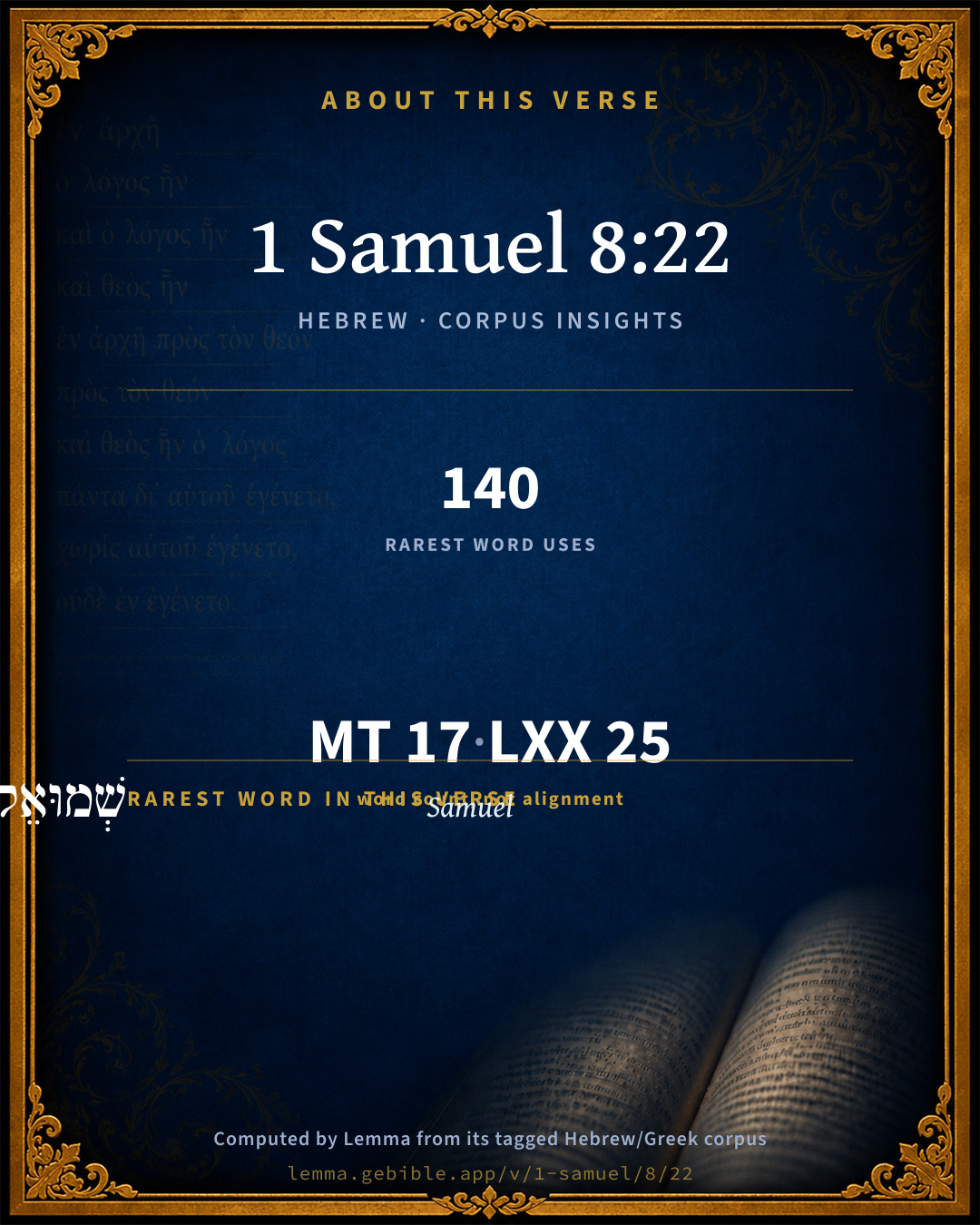
1 Samuel 8:22

Hebrew (Westminster Leningrad Codex) 1 Samuel 8:22 appears in the Hebrew Old Testament. The text above is from the Westminster Leningrad Codex. Each word links to its Strong’s number, a concise gloss, and parsing drawn from the Open Scriptures Hebrew Bible morphology. Click any word for its full Brown-Driver-Briggs (BDB) entry.
Download image
Cite this verse

1 Samuel 8:22 (World English Bible). Public Domain. Lemma interlinear Bible study tool, https://lemma.gebible.app/v/1-samuel/8/22.

Show BibTeX & RIS
BibTeX
RIS
English Translation
Yahweh said to Samuel, Listen to their voice, and make them a king. Samuel said to the men of Israel, Go you every man to his city.
World English Bible · Public Domain
Download a study sheet

One document with this verse’s original text, its word-by-word gloss line, the meaning frame, cross-references with their text, attributed commentary, and full source and license credits — printable, and it pastes into notes with its structure intact.

This verse Autodidact and up

Study sheet (.html) Plain text (.txt)

A passage Seminary Student

Up to 50 verses in one chapter. A passage sheet keeps up to 6 commentary sources and 12 cross-references per verse, in the order this page ranks them, and says so on the sheet whenever that leaves anything out. Ask for a single verse and you get the Autodidact verse sheet above.

Everything on this page stays free to read, with no account — the sheet is a download of what is already on screen, not access to it.

Want to remove ads? Support Godless Engineer
Compare translations 3

The same verse in 3 English versions, stacked beneath the original-language interlinear above. Click any original word for its lexicon entry.

Each is an independent rendering of the whole verse — the interlinear is not word-aligned to these translations.

Highlighted words mark where these versions differ — a whole-verse word diff, not a word-by-word alignment.

  • World English Bible Public Domain
    Yahweh said to Samuel, Listen to their voice, and make them a king. Samuel said to the men of Israel, Go you every man to his city.
  • King James Version Public Domain
    And the LORD said to Samuel, Hearken unto their voice, and make them a king. And Samuel said unto the men of Israel, Go ye every man unto his city.
  • unfoldingWord Literal Text CC BY-SA 4.0
    And Yahweh said to Samuel, “Listen to their voice, and you shall make a king reign over them.” And Samuel said to the men of Israel, “Go, a man to his city.”

unfoldingWord Literal Text — © unfoldingWord, licensed CC BY-SA 4.0. Word-aligned USFM3 via Door43 (git.door43.org/unfoldingWord/en_ult).

Versions to compare (up to 4)

3 of 4 selected

Show all 18 translations

Every available English version of this verse, each an independent rendering of the whole verse.

  • World English Bible Public Domain
    Yahweh said to Samuel, Listen to their voice, and make them a king. Samuel said to the men of Israel, Go you every man to his city.
  • Berean Standard Bible Public Domain
    “Listen to their voice,” the LORD said to Samuel. “Appoint a king for them.” Then Samuel told the men of Israel, “Everyone must go back to his city.”
  • Majority Standard Bible Public Domain
    “Listen to their voice,” the LORD said to Samuel. “Appoint a king for them.” Then Samuel told the men of Israel, “Everyone must go back to his city.”
  • King James Version Public Domain
    And the LORD said to Samuel, Hearken unto their voice, and make them a king. And Samuel said unto the men of Israel, Go ye every man unto his city.
  • American Standard Version (1901) Public Domain
    And Jehovah said to Samuel, Hearken unto their voice, and make them a king. And Samuel said unto the men of Israel, Go ye every man unto his city.
  • Revised Version (1885) Public Domain
    And the LORD said to Samuel, Hearken unto their voice, and make them a king. And Samuel said unto the men of Israel, Go ye every man unto his city.
  • Geneva Bible (1599) Public Domain
    And the Lord saide to Samuel, Hearken vnto their voyce, and make them a King. And Samuel said vnto the men of Israel, Goe euery man vnto his citie.
  • Douay-Rheims (1899) Public Domain
    And the Lord said to Samuel: Hearken to their voice, and make them a king. And Samuel said to the men of Israel: Let every man go to his city.
  • Young's Literal Translation Public Domain
    and Jehovah saith unto Samuel, `Hearken to their voice, and thou hast caused to reign over them a king.' And Samuel saith unto the men of Israel, `Go ye each to his city.'
  • Literal Standard Version CC BY-SA 4.0
    and YHWH says to Samuel, “Listen to their voice, and you have caused a king to reign over them.” And Samuel says to the men of Israel, “Go, each man, to his city.”
  • Unlocked Literal Bible CC BY-SA 4.0
    Yahweh said to Samuel, “Obey their voice and cause someone to be king for them.” So Samuel said to the men of Israel, “Every man must go to his own city.”
  • unfoldingWord Literal Text CC BY-SA 4.0
    And Yahweh said to Samuel, “Listen to their voice, and you shall make a king reign over them.” And Samuel said to the men of Israel, “Go, a man to his city.”
  • Darby Bible Public Domain
    And Jehovah said to Samuel, Hearken unto their voice, and make them a king. And Samuel said to the men of Israel, Go ye every man to his city.
  • World Messianic Bible Public Domain
    The LORD said to Samuel, “Listen to their voice, and make them a king.” Samuel said to the men of Israel, “Everyone go to your own city.”
  • Webster's Bible Public Domain
    And the LORD said to Samuel, Hearken to their voice, and make them a king. And Samuel said to the men of Israel, Go ye every man to his city.
  • Free Bible Version CC BY-SA 4.0
    The Lord told Samuel, “Do what they say and give them a king.” Then Samuel told the Israelites, “Go back to your homes.”
  • Bible in Basic English Public Domain
    And the Lord said to Samuel, Give ear to their voice and make a king for them. Then Samuel said to the men of Israel, Let every man go back to his town.
  • JPS Tanakh (1917) Public Domain
    And the LORD said to Samuel: 'Hearken unto their voice, and make them a king.' And Samuel said unto the men of Israel: 'Go ye every man unto his city.'

Literal Standard Version (2020), Covenant Press — licensed CC BY-SA 4.0. Text via the HelloAO Bible API (eBible.org). Unlocked Literal Bible (unfoldingWord) — licensed CC BY-SA 4.0. Text via the HelloAO Bible API (eBible.org). unfoldingWord Literal Text — © unfoldingWord, licensed CC BY-SA 4.0. Word-aligned USFM3 via Door43 (git.door43.org/unfoldingWord/en_ult). Free Bible Version, Dr. Jonathan Gallagher — licensed CC BY-SA 4.0. Text via the HelloAO Bible API (eBible.org).

Word by word

More ways to search: Search by grammar → Find every occurrence → Compare this word →

Practice this passage: Drill this verse → Learn its vocabulary →

שְׁמוּאֵל֙
Shᵉmûwʼêl
H8050
“Samuel”
Noun, Proper
Part of Speech
Noun
Type
Proper
Full BDB Definition

Origin: from the pass part of H8085 and H410

TWOT: None

Samuel = "his name is El" - son of Elkanah by his wife Hannah and judge or prophet of Israel during the days of Saul and David - son Ammihud and the prince of the tribe of Simeon who was chosen to divide the land of Canaan between the tribes. Spelled 'Shemuel' - son of Tola and grandson of Issachar. Spelled 'Shemuel'
  1. וַיֹּ֨אמֶר ʼâmar H559 “and · to say” Conjunction + Verb, Qal, Sequential Imperfect, 3rd Person, Masculine, Singular
  2. יְהוָ֤ה Yᵉhôvâh H3068 “LORD” Noun, Proper
  3. אֶל ʼêl H413 “to” Preposition
  4. שְׁמַ֣ע shâmaʻ H8085 “hear” Verb, Qal, Imperative, 2nd Person, Masculine, Singular
  5. בְּקוֹלָ֔ם qôwl H6963 “in/at · voice · their” Preposition + Noun, Common, Masculine, Singular, Construct + Suffix, Personal, 3rd Person, Masculine, Plural
  6. וְהִמְלַכְתָּ֥ mâlak H4427 “and · to reign” Conjunction + Verb, Hiphil, Sequential Perfect, 2nd Person, Masculine, Singular
  7. מֶ֑לֶךְ melek H4428 “king” Noun, Common, Masculine, Singular, Absolute
  8. וַיֹּ֤אמֶר ʼâmar H559 “and · to say” Conjunction + Verb, Qal, Sequential Imperfect, 3rd Person, Masculine, Singular
  9. שְׁמוּאֵל֙ Shᵉmûwʼêl H8050 “Samuel” Noun, Proper
  10. אֶל ʼêl H413 “to” Preposition
  11. אַנְשֵׁ֣י ʼîysh H376 “men of” Noun, Common, Masculine, Plural, Construct
  12. יִשְׂרָאֵ֔ל Yisrâʼêl H3478 “Israel” Noun, Proper
  13. לְכ֖וּ yâlak H3212 “walk” Verb, Qal, Imperative, 2nd Person, Masculine, Plural
  14. אִ֥ישׁ ʼîysh H376 “man” Noun, Common, Masculine, Singular, Absolute
  15. לְעִירֽוֹ ʻîyr H5892 “to/for · city · his” Preposition + Noun, Common, Feminine, Singular, Construct + Suffix, Personal, 3rd Person, Masculine, Singular

About this verse

These counts appear in no published source. They are computed here, from the morphology-tagged text and Lemma’s own curated glosses. What Lemma adds →

17
words
12
distinct lemmas
Historical
section

Grammatical profile

  • 5 verbs
  • 9 nouns
  • 3 prepositions

Verb forms

  • וַיֹּ֨אמֶר Qal · Sequential Imperfect
  • שְׁמַ֣ע Qal · Imperative
  • וְהִמְלַכְתָּ֥ Hiphil · Sequential Perfect
  • וַיֹּ֤אמֶר Qal · Sequential Imperfect
  • לְכ֖וּ Qal · Imperative

Repetition

Words recur within this verse — often emphatic in Hebrew:

  • וַיֹּ֨אמֶר to say H559 ×2
  • שְׁמוּאֵל֙ Samuel H8050 ×2
  • אַנְשֵׁ֣י man H376 ×2
  • אֶל to H413 ×2

Hebrew & Septuagint length

In English translation the verse runs 27 words from the Hebrew and 30 from the Septuagint (LXX English) — closely comparable.

A rough comparison of the two English renderings, which tokenize alike — not a word-level alignment.

Word counts can differ between the Hebrew and the Greek without any difference in meaning — e.g. the Hebrew direct-object marker אֵת has no separate Greek word, and Greek often adds the article ὁ.

In the original languages it is 17 Hebrew tokens and 25 Greek tokens — but the two are counted differently (Hebrew bundles its prefixes and suffixes into one token; the Greek is in lemma form), so that isn’t a like-for-like length.

Cross-references

2

Topical passages linked to 1 Samuel 8:22 in the Treasury of Scripture Knowledge — connected by theme and wording, ordered by reader-vote popularity; previews shown in the World English Bible.

  • 1 Samuel 8:7 Yahweh said to Samuel, Listen to the voice of the people in all that they tell you; for they have not rejected you, but they have rejected me, that I should not be king over them.
  • Hosea 13:11 I have given you a king in my anger, And have taken him away in my wrath.

Cross-references courtesy of OpenBible.info (CC BY 4.0).

Hebrew and Greek witnesses Masoretic Hebrew ↔ Greek Septuagint

The same verse in the two great witnesses to the Old Testament, shown verse-for-verse.

These are two independent witnesses, not word-aligned to each other, and the Septuagint is shown in lemma (dictionary) form.

Hebrew 1 Samuel 8:22 Masoretic · Westminster Leningrad Codex

וַיֹּ֨אמֶר יְהוָ֤ה אֶל שְׁמוּאֵל֙ שְׁמַ֣ע בְּקוֹלָ֔ם וְהִמְלַכְתָּ֥ לָהֶ֖ם מֶ֑לֶךְ וַיֹּ֤אמֶר שְׁמוּאֵל֙ אֶל אַנְשֵׁ֣י יִשְׂרָאֵ֔ל לְכ֖וּ אִ֥ישׁ לְעִירֽוֹ

Yahweh said to Samuel, Listen to their voice, and make them a king. Samuel said to the men of Israel, Go you every man to his city.

World English Bible · Public Domain

Greek LXX 1 Samuel 8:22 Septuagint · lemma form

καί εἶπον κύριος πρός σαμουηλ ἀκούω ὁ φωνή αὐτός καί βασιλεύω αὐτός βασιλεύς καί εἶπον σαμουηλ πρός ἀνήρ ἰσραήλ ἀποτρέχω ἕκαστος εἰς ὁ πόλις αὐτός

And the Lord said to Samuel, Listen to their voice, and appoint them a king. And Samuel said to the men of Israel, Let each man depart to his city.

LXX2012 (modern English Septuagint) · Public Domain

Hebrew: Westminster Leningrad Codex (CC BY 4.0). Greek: Septuagint (public domain); English from LXX2012 (modern English Septuagint) (Public Domain). How the Septuagint differs from the Hebrew →

Targum (Aramaic paraphrase)

1

The Targum is the ancient Jewish Aramaic paraphrase of the Hebrew Scriptures — an interpretive translation, not the Hebrew text itself. Onkelos (literal) and Pseudo-Jonathan (expansive) render the Torah, and Jonathan the Prophets. Coverage is partial: where no permissively-licensed English translation exists for a verse, only the Aramaic is shown. This is verse-level text, not a word-by-word alignment to the Hebrew.

  1. Targum Jonathan Prophets (Joshua–Malachi)
    וַאֲמַר יְיָ לִשְׁמוּאֵל קַבֵּיל לְמֵימְרֵיהוֹן וְתַמְלִיךְ לְהוֹן מַלְכָּא וַאֲמַר שְׁמוּאֵל לֶאֱנָשֵׁי יִשְׂרָאֵל אֱזִילוּ גְבַר לְקַרְתֵּיהּ:

    (no public-domain English translation for this verse)

    Targum Jonathan — Aramaic: “Mikraot Gedolot” (public domain). English: “Sefaria Community Translation” (CC0 1.0 (public-domain dedication)); “London "Chaldee Paraphrase," 1871” (public domain). Text via Sefaria.

Commentary

Notes on 1 Samuel 8:22 from classic Christian and Jewish commentators (each source and its license shown beneath its notes). The classic Christian expositions comment on the surrounding passage and are grouped to its opening verse, so a note may address several verses; the Jewish commentaries on the Tanakh (Rashi and others) are per-verse, so they appear only where the commentator wrote on this verse.

Lemma curates 59 commentaries, every one of them public domain or Creative Commons licensed, each selected and text-cleaned for this edition rather than reprinted as found. About our sources →

Trapp's Complete Commentary

John Trapp

1Sa 8:22 And the LORD said to Samuel, Hearken unto their voice, and make them a king. And Samuel said unto the men of Israel, Go ye every man unto his city.

Ver. 22. Go ye, &c., ] q.d., Your request is granted, and shall shortly be accomplished. Meanwhile wait God’s pleasure.

John Trapp, A Commentary or Exposition upon All the Books of the Old and New Testament (1647–1656) — public domain. Text from a community e-Sword module.

The Biblical Illustrator

Joseph S. Exell

1Sa_8:22

Hearken unto their voice, and make them a king.

Vox populi, vox Dei

Perhaps there is no proverb which is more familiar, as it is certain there is none more faulty, than this: The voice of the people is the voice of God. And since the motto is Latin, it might as well go now with a comment upon it from one of the greatest of the old Roman philosophers, even Cicero himself, who says in his treatise Concerning Laws: It is most absurd to suppose that all the things are just which are found in the enactments and institutions of a State. There is no such power in the sentence and command of fools as that by their vote the nature of things can be reversed. The law did not begin when first written, but when it first had existence; that is, when the Divine mind first had existence.

1. The story gives us the date to start with, and connects present histories with those of a great and honoured past. Samuel is still at the nations head, but failing: And it came to pass, when Samuel was old, that he made his sons judges over Israel. Piety cannot be transmitted according to physical laws; and yet it seems as if we might insist, upon the signal benefits of being born of good stock rather than of corrupt.

2. Who were these sons of Samuel? Unfortunately there is no account of them that gives any satisfaction. The lesson we learn here is worth pressing a little: noble names do not change bad hearts nor make wicked men fit to hold high office. Samuel probably hoped a great deal for those sons of his when he fixed upon them such names as these in the reverent regard for the old faith of Israel. Joel signifies Jehovah is God; and Abiah means Jehovah is my Father. We have no evidence that these children cared for their fine names while they were little, as Samuel did for his when he moved reverently around in the ministrations of the Tabernacle, a devout lad, obedient to God and to Eli. We surely might expect that a maiden called Sophia ought not to be a fool, for her name means wisdom. And just so Gertrude suggests a character of all-truth. And Alfred becomes a pledge of all-peace. And Leonard must not be a coward as long as he is called lion-like. Francis is to be frank, and Anna is to be gracious, or intelligent people will laugh when their names are called out in the room. Surely Nathanael, Theodore, Elnathan, and Dorothy ought to bear in mind every day and hour that their names all alike signify the gift of God.

3. The illustration of all this grows more and more vivid as the story moves on; the next verse reads: And his sons walked not, in his ways, but turned aside after lucre, and took bribes and perverted judgment. The lesson we learn from this is explanatory as well as full of admonition: covetousness is idolatry. A curious word is this here rendered lucre; it is precisely that which Moses employed when he was defining the duties and charactor of a judge: Moreover, thou shalt provide out of all the people able men, such as fear God, men of truth, hating covetousness. That word covetousness is the same as the word lucre in this verse before us. The old Hebrew Targum translates it, the mammon of falsehood.

4. At this point the Scripture narrative begins to indicate the effect of all this disastrous corruption in Samuels own family. Then all the elders of Israel gathered themselves together, and came to Samuel unto Ramah. Croakers always find easy companionship: that is our lesson now. Ravens are said to detect afar off birds of the same black feather and the same lugubrious voice. These elders of Israel in the story might surely have been about better business than ministering to popular discontent. They were living under a theocracy, and God was overhead; they could have interfered before for the suppression of these corrupt judges, and in a wiser way. It was a remark of Lord Beaconsfield that it is much easier to be critical than to be correct. Joel and Abiah were bad enough; we wonder if the monarchists liked the atmosphere better when Saul came into power. The plan proceeds plausibly. It is fashionable to prate about the voice of the people: vox populi, vox Dei: here the voice of the people is directly against the voice of God on a great moral and political issue. A thousand votes for a wrong is not enough to make it right: once nothing is nothing, twice nothing is nothing, tea times nothing is nothing, a thousand times nothing is nothing: how many Israelite elders would be necessary so to multiply nothing as to make it foot up something at last? Just as many, we reply, as at any time it would take of wrong-headed men to make wrong right.

5. But now let us bear in mind that when a mean thing has to get itself done somehow, it requires a vast amount of meaningless talk for its advancement into recognition and success. Our practical lesson from this part of the story is this: graceful language is sometimes used to conceal thought, and not express it. Diplomacy has a certain strong flavour of antiquity about it. Just notice how these crafty elders plead their hypocritical arguments for an overthrow of the government, and shake the conscientious scruples of the faithful old man by the humiliating and cruel arraignment of his sons. Those were not the real reasons why they wanted a king. Lord Bacon declares that in all wise human governments they that sit at the helm do more happily bring their purposes about, and insinuate more easily into the minds of the people, by pretext and oblique courses than by direct methods; so that all sceptres and maces of authority ought in very deed to be crooked in the upper end. It was an old saying of Pascal that the world is satisfied with words, and few care to dive beneath the surface of them. Logic has very little to de with the utterances of a bad heart when politicians begin to reason; and there is truth in the sarcasm of one of the wittiest of Frenchmen: When the major of an argument is an error, and the minor a passion, it is to be feared that the conclusion will be a crime, for this is a syllogism of self-love. Why did they not suppress the sons and cling to God.

6. We become more and more sure as we read on that majorities are not to be trusted among even the wisest of men. Majorities can be gotten on almost every occasion for the right or for the wrong indiscriminately, according to the popular epidemic of enthusiasm at the time. What is wanted in our day is the virtue of an individual courage and of a personal conviction. We need voters with a conscience that impels them to stand by the right measures and support the righteous men for administering them. (C. S. Robinson, D. D.)

.

The Biblical Illustrator, edited by Joseph S. Exell (c. 1880s–1900s) — public domain. Text from a community e-Sword module.

Joseph Benson's Commentary

1Sa 8:22. Go ye every man unto his city — Betake yourselves to your several homes and employments, till you hear more from me in this matter. Thus he bade them leave the business unto him, intimating, that he doubted not but God would set a king over them.

Joseph Benson's Commentary on the Old and New Testaments (1811–1818) — public domain. Text from a community e-Sword module.

Tyndale Open Study Notes

Tyndale Open Resources

8:22 give them a king: See study note on 8:7; cp. Rom 1:24-26.

Tyndale Open Study Notes — © Tyndale Open Resources, licensed CC BY-SA 4.0. Text via the HelloAO Bible API.

Geneva Bible (1599)

Geneva Bible translators

Or, grant their request.

Geneva Bible (1599) marginal notes — public domain. Text via Bolls.life.

Adam Clarke's Commentary

Verse 22. Hearken unto their voice] Let them have what they desire, and let them abide the consequences.

Go ye every man unto his city.] It seems the elders of the people had tarried all this time with Samuel, and when he had received his ultimate answer from God, he told them of it and dismissed them.

ON this account we may observe:

1. That GOD did not change the government of Israel; it was the people themselves who changed it.

2. That though God permitted them to have a king, yet he did not approve of him.

3. That, notwithstanding he did not suffer them to choose the man, he ordered his servant Samuel to choose him by lot, he disposing of that lot.

4. That God never gave up the supreme government; he was still KING in Israel, and the king, so called, was only the vicegerent or deputy of the Lord.

5. That no king of Judah attempted to be supreme, therefore they never made new laws, nor altered the old; which was a positive confession that God was the supreme Legislator.

6. That an absolute monarchy is always an evil, and is contrary to all the rights, civil and religious, of mankind; a mode of government that all people should avoid, as pregnant with evils to mankind.

7. That although it was a sin in the Israelites to desire a king, that is, to change a constitution of which God was the author, yet kingly government, properly understood, is a good of the first magnitude to the civil happiness of mankind.

8. That by kingly government, properly understood, I mean such a monarchical government as that of Great Britain, where the king, the nobles, and the people, are duly mixed, each having his proper part in the government, and each preventing the other from running to excess, and all limited by law.

9. That the three grand forms of government which have obtained among mankind, viz., monarchy, aristocracy, and democracy, have each certain advantages without which no state can be well preserved; but they have evils by which any state may be injured.

10. That, from a proper mixture of these, the advantages of the whole may be reaped without any of their attendant evils, and that this is the British constitution; which, not merely the wisdom of our ancestors, but the providence of God has given unto us, and of which no other state has had common sense enough to avail themselves, though they see that because of this the British empire is the most powerful and the most happy in the universe, and likely at last to give laws to the whole world.

The manner of our king is constitutional, widely different from that of Saul, and from that of any other potentate in the four quarters of the globe. He is the father of his people, and the people feel and love him as such. He has all the power necessary to do good; they have all the liberty necessary to their political happiness, had they only a diminution of taxes, which at present are too heavy for any nation to bear.

Adam Clarke's Commentary on the Bible (1810–1826) — public domain. Text from a community e-Sword/MySword module.

Ellicott's Commentary for English Readers

(22) Hearken unto their voice.—And for the third time (see 1Sa_8:7; 1Sa_8:9) the voice of the Eternal, which Samuel the seer knew so well, used the same expression, bidding the reluctant and indignant old man comply with the request of the people. God had allowed His servant to remonstrate, well knowing all the time what would be the result of his remonstrances.

So now, with the self-same words with which He had spoken to the seer when at the first he laid the petition of Israel before the eternal throne, He finally directs Samuel respecting the course of action he was to pursue on this momentous occasion.

The men of Israel.—That is, to the elders. The words which follow, “Go ye every man unto his city,” show that these elders were in truth a representative body, drawn from the chief centres of the land.

Attention has already been drawn to the perfect trust which the Eternal must have placed in Samuel the judge, seeing that He entrusted him with all the arrangements connected with this vital change in the Hebrew constitution, although his own downfall from power was necessarily involved in it. The confidence of the God-Friend of Israel in their upright judge was evidently shared in by the people. It was to their ruler, to the earthly head of their republic, that they in the first instance carried, through their representative chiefs, their request, which in other words said, “Let kings for the future, and not judges like yourself, rule over us.” The elders of Israel seem to have listened respectfully to the urgent remonstrances of their great judge, and to have deliberated carefully over them, and then, still respectfully, but firmly, to have reiterated their first request, which asked for a king instead of a judge. Again they watched him go alone into the presence of the Eternal, and after the seer’s solitary prayer, the “elders,” at the bidding of their judge, dispersed quietly, each one journeying to his own city. They loved and trusted the patriot Samuel, and though they were ready to depose him, they waited till he should give them a sign.

A Bible Commentary for English Readers, edited by Charles John Ellicott (1878–1897) — public domain. Text from a community e-Sword module.

John Gill's Exposition

And the Lord said to Samuel,.... an audible voice, or by an impulse upon his mind:

hearken unto their voice, and make them a king; since they will have a king, let them have one, and let them know that they shall have one:

and Samuel said unto the men of Israel: the elders of the people that addressed him on this occasion, Sa1 8:4.

go ye every man unto his city; signifying they might return in peace, and be assured their request would be granted, and a king would be appointed in a short time, and which they might report to their fellow citizens; and they might expect to hear from him quickly, as soon as he had instructions from the Lord who should be their king, which right he had reserved to himself; and therefore in the mean while they might rest contented that they would have one in a little time.

Next: 1 Samuel Chapter 9

John Gill's Exposition of the Whole Bible (1746–1763) — public domain (CC PDM 1.0). Text via the HelloAO Bible API.

Albert Barnes' Notes on the Bible

A repetition for the third time 1Sa 8:7, 1Sa 8:9 of the expression of God’s will in the matter, marks Samuel’s great unwillingness to comply with the people’s request. Besides the natural aversion which he felt to being thrust aside after so many years of faithful and laborious service, and the natural prejudice which he would feel at his age against a new form of government, he doubtless saw how much of the evil heart of unbelief there was in the desire to have a visible king for their leader, instead of trusting to the invisible Lord who had hitherto led them. But God had His own purpose in setting up the kingdom which was to be typical of the kingdom of His only begotten Son.

Albert Barnes' Notes on the Bible (1834–1885) — public domain. Text from a community e-Sword/MySword module.

Matthew Poole's English Annotations

Betake yourselves to your several occasions, till you hear more from me in this matter; for God hath heard your words, and will give way to your irregular and obstinate desire; and accordingly I shall wait upon God for the determination of the person, which he hath wholly reserved to himself, as for judges, so for the king also, Deu 17:15, and for the regulation of all the circumstances.

Matthew Poole's English Annotations on the Holy Bible (1683–1685) — public domain. Text from a community e-Sword/MySword module.

The Pulpit Commentary

Hearken unto their voice. The Divine consent is now given for the third time to their request (see vers. 7, 9). For the will of God ever leaves the will of man free, even when overruling it to the carrying out of some higher and fore ordained purpose. Everything was ripe in Israel for the change, but it was due to the moderation and disinterestedness of Samuel that the revolution was made without bloodshed or armed struggle. Ordinary rulers too often resist a popular demand, and stem back the flowing current of thought till it breaks through the opposing barrier, and sweeps with resistless violence all opposition away. Samuel yielded, and the nation trusted him so thoroughly that they left the choice of the king entirely to him, permitted him to settle the terms and limits of the monarchy, or, as we should say, to give the nation a constitution, (1Sa_10:25) and treated him throughout the rest of his life with the deepest respect. He was deprived neither of his prophetic rank nor of his judicial functions, for "Samuel judged Israel all the days of his life", (1Sa_7:15) i.e. he remained to the last a coordinate power by the side of a king so self-willed and energetic even as Saul. Go ye every man unto his city. Prudence forbade a hasty choice. It would be well to let the agitation subside, or otherwise some busy intriguer among the elders might have managed to get himself selected by the popular voice. We gather from 1Sa_10:27 that there were leading men who felt aggrieved when the choice fell on none of them. But how wonderful is the confidence reposed in Samuel by the nation, when thus it left to the ruler whom virtually it was setting aside the choice of the person to whom he should cede his powers.

HOMILIES BY D. FRASER

Ver. 22.

The unwise demand granted.

The government by judges fell into discredit. Samuel, indeed, was without reproach; but when advancing age made the burden of public affairs too heavy for him, his sons, to whom he naturally delegated his authority, proved unrighteous rulers. They do not seem to have been licentious, like the sons of Eli, but they were covetous, and corrupted the fountains of justice by taking bribes. What a persistent thing sin is! How it repeats itself! How hard it is to eradicate it! Samuel"s lifelong example of integrity was lost upon his sons. The terrible fate of Eli"s family was lost on them too. To the dignity of justice, to the honour of truth, they were indifferent for filthy luere"s sake. Then the elders of Israel asked Samuel to set a king over them.

I THE IMPROPRIETY OF THE REQUEST.

1. It followed a bad precedent. The experiment had been tried about 150years before. The people asked Gideon to be their hereditary prince, and that hero declined the proposal, as inconsistent with a pure theocracy. After his death Abimelech was king for three years; but his career began in cruelty, ended soon in disaster and death, and no one from that time had sought the royal dignity.

2. It proceeded on a wrong principle. The desire to be as the other nationsround about was in fiat contradiction to the revealed purpose of God that Israel should be separate as a people unto him. The wish to have a king to lead them out to battle betrayed a thirst for war unworthy of a holy nation, and a mistrust of the Lord"s power to defend them. Here, indeed, is the point in which they departed from the permissive law regarding a king recorded in the seventeenth chapter of Deuteronomy. A regal government was not to be reckoned inconsistent with the theocracy, provided the king was not a foreigner, and was chosen by Jehovah, whose vicegerent he should be. The elders asked for a king not after the mind of the Lord, but after the pattern of the heathen round about.

II REASONS OF THE DIVINE CONSENT.

1. A headstrong people must learn by experience. The elders and people ofIsrael were warned of the risk they ran. A king such as they desired would

2. restrain their ancient liberties, and subordinate all their rights and interests to the maintenance of his court and army. They heard Samuel"s warning, and persisted in their demand. So the Lord bade his servant make them a king. If men will not take advice, let them have their way. Wisdom seldom comes to wilful men but through sharp lessons of the results of folly.

3. The way must be prepared for the king and the kingdom that God wouldchoose. It is important to remember that Divine purposes are accomplished on earth not by direct fiats of authority or exertions of power, but through long and complex processes of human action and counteraction, by the corrections of experience, the smart of suffering, and the recoil from danger. It was God"s design to constitute Israel into a kingdom under a sure covenant a kingdom which should furnish the basis for glowing prophetic visions of the kingdom of Christ; but this design was not to be fulfilled abruptly, or by a sudden assertion of the Divine will. The way was prepared by the failure of all other devices for holding together the Hebrew people. First the government by judges lost credit; then the kingdom as set up by popular desire failed; so that the tribes, seeing the ruin of their own devices, might be ready to receive the kingdom as God would have it, and the man whom he would choose to "feed Jacob his people and Israel his inheritance.

III ILLUSTRATIONS OF THE SAME PROCESS.

1. Men have set up their own devices in the administration of the Church; and with what result? They have not been content with an unseen Lord and King. The early patriarchates may be described as a government by judges; but men were not content therewith, and Latin Christianity set up an ecclesiastical and spiritual supremacy on earth, a Saul-like kingship at Rome. Those parts of the Western Church which broke away from this doomed kingdom at the Reformation, for the most part gave power to secular princes in exchange for their protection. All such arrangements are temporary devices; but they are witnesses and preludes to something higher and more Divine. They prepare the way for the reign of Jesus Christ, as the broken, confused reign of Saul prepared for the strong kingdom of David.

2. Inward Christian experience can tell a similar tale. What plans have to betried and found wanting, what thrones of confusion in the heart to be subverted, before the Lord alone is exalted! We are permitted to have our own way that we may learn how small our wisdom is, how vain are our devices. We exalt our own righteousness, our own will, our own religious confidence. It is our Saul; and the issue is confusion and disorder, till we renounce our pride and vainglory, and receive the Son of David Jehovah"s true Anointed, to reign over and rule in us. Self religion starts thus but we will have a king." The religion which is taught of God says, "Blessed be the king that cometh in the name of the Lord! F.

The Pulpit Commentary (1880–1919), ed. H.D.M. Spence-Jones & Joseph S. Exell — public domain. Text from a community e-Sword module.

John Wesley's Explanatory Notes

Go - Betake yourselves to your several occasions, till you hear more from me in this matter.

John Wesley, Explanatory Notes Upon the Whole Bible (1754–1765) — public domain. Text via the GEBible commentary corpus.

Lesson kit

Teaching starters — assembled from the data on this page, not authored interpretation. Every prompt links to the verse data it draws on. Edit before teaching.

1 Samuel, in the Historical, opens this verse with 17 words (12 distinct Hebrew lemmas). Its most distinctive word is Shᵉmûwʼêl (“Samuel”). A historical commentator’s framing appears above. Read the whole chapter for the surrounding context.

Discussion questions

  1. The word Shᵉmûwʼêl carries the sense “Samuel.” How does it shape the verse?
  2. 1 Samuel 8:7 shares this passage’s theme. How do the two illuminate each other?
  3. “to say” occurs 2× in this one verse. What is the effect of the repetition?
  4. The translations on this page render this verse differently — a whole-verse word diff, not a word-by-word alignment. What might account for the different wordings?
  5. The verb «וַיֹּ֨אמֶר» is Qal Sequential Imperfect. How does its form color the action?
  6. Reading how Trapp's Complete Commentary and The Biblical Illustrator read this verse, where do the two commentators agree and where do they part?

Things to notice

Reading settings

Reading text

Shown beneath each verse's original-language words.

Old Testament
Old Testament edition

Read the OT as the Masoretic Hebrew (MT) or the Greek Septuagint (LXX).

English shown for the Greek Septuagint (in the Hebrew ↔ Greek comparison).

Comparing translations? Open the Compare panel on any verse page to stack up to four side by side.