
Deuteronomy 5:24

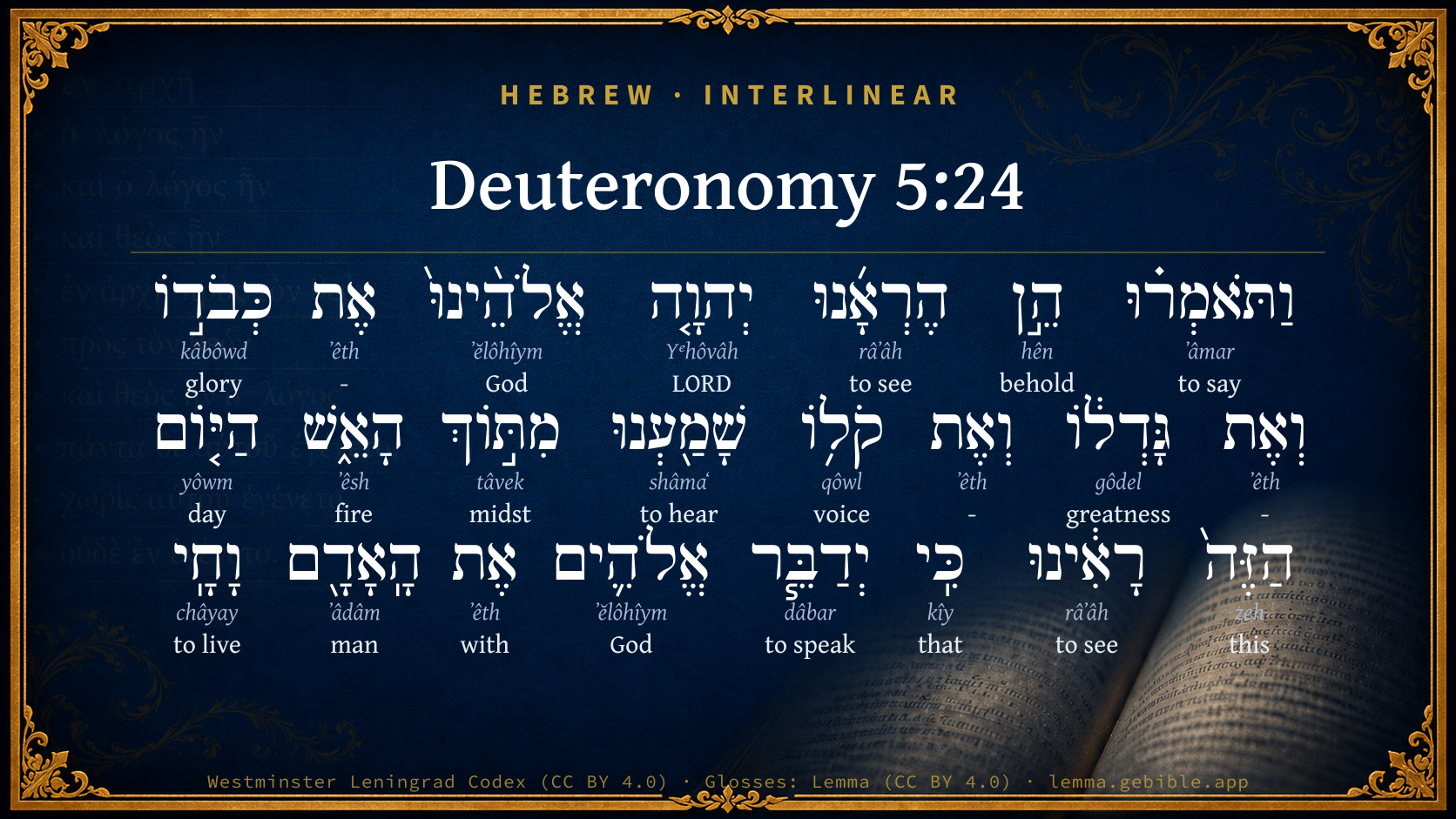
Hebrew (Westminster Leningrad Codex) Deuteronomy 5:24 appears in the Hebrew Old Testament. The text above is from the Westminster Leningrad Codex. Each word links to its Strong’s number, a concise gloss, and parsing drawn from the Open Scriptures Hebrew Bible morphology. Click any word for its full Brown-Driver-Briggs (BDB) entry.
Download image
Cite this verse

Deuteronomy 5:24 (World English Bible). Public Domain. Lemma interlinear Bible study tool, https://lemma.gebible.app/v/deuteronomy/5/24.

Show BibTeX & RIS
BibTeX
RIS
English Translation
and you said, Behold, Yahweh our God has shown us his glory and his greatness, and we have heard his voice out of the midst of the fire: we have seen this day that God does speak with man, and he lives.
World English Bible · Public Domain
Download a study sheet

One document with this verse’s original text, its word-by-word gloss line, the meaning frame, cross-references with their text, attributed commentary, and full source and license credits — printable, and it pastes into notes with its structure intact.

This verse Autodidact and up

Study sheet (.html) Plain text (.txt)

A passage Seminary Student

Up to 50 verses in one chapter. A passage sheet keeps up to 6 commentary sources and 12 cross-references per verse, in the order this page ranks them, and says so on the sheet whenever that leaves anything out. Ask for a single verse and you get the Autodidact verse sheet above.

Everything on this page stays free to read, with no account — the sheet is a download of what is already on screen, not access to it.

Want to remove ads? Support Godless Engineer
Compare translations 3

The same verse in 3 English versions, stacked beneath the original-language interlinear above. Click any original word for its lexicon entry.

Each is an independent rendering of the whole verse — the interlinear is not word-aligned to these translations.

Highlighted words mark where these versions differ — a whole-verse word diff, not a word-by-word alignment.

  • World English Bible Public Domain
    and you said, Behold, Yahweh our God has shown us his glory and his greatness, and we have heard his voice out of the midst of the fire: we have seen this day that God does speak with man, and he lives.
  • King James Version Public Domain
    And ye said, Behold, the LORD our God hath showed us his glory and his greatness, and we have heard his voice out of the midst of the fire: we have seen this day that God doth talk with man, and he liveth.
  • unfoldingWord Literal Text CC BY-SA 4.0
    And you said, ‘Behold, Yahweh our God has shown us his glory and his greatness, and we have heard his voice from the midst of the fire. This day we have seen that God speaks to man, yet he lives.

unfoldingWord Literal Text — © unfoldingWord, licensed CC BY-SA 4.0. Word-aligned USFM3 via Door43 (git.door43.org/unfoldingWord/en_ult).

Versions to compare (up to 4)

3 of 4 selected

Show all 18 translations

Every available English version of this verse, each an independent rendering of the whole verse.

  • World English Bible Public Domain
    and you said, Behold, Yahweh our God has shown us his glory and his greatness, and we have heard his voice out of the midst of the fire: we have seen this day that God does speak with man, and he lives.
  • Berean Standard Bible Public Domain
    and you said, “Behold, the LORD our God has shown us His glory and greatness, and we have heard His voice out of the fire. Today we have seen that a man can live even if God speaks with him.
  • Majority Standard Bible Public Domain
    and you said, “Behold, the LORD our God has shown us His glory and greatness, and we have heard His voice out of the fire. Today we have seen that a man can live even if God speaks with him.
  • King James Version Public Domain
    And ye said, Behold, the LORD our God hath showed us his glory and his greatness, and we have heard his voice out of the midst of the fire: we have seen this day that God doth talk with man, and he liveth.
  • American Standard Version (1901) Public Domain
    and ye said, Behold, Jehovah our God hath showed us his glory and his greatness, and we have heard his voice out of the midst of the fire: we have seen this day that God doth speak with man, and he liveth.
  • Revised Version (1885) Public Domain
    and ye said, Behold, the LORD our God hath shewed us his glory and his greatness, and we have heard his voice out of the midst of the fire: we have seen this day that God doth speak with man, and he liveth.
  • Geneva Bible (1599) Public Domain
    And ye sayd, Beholde, the Lord our God hath shewed vs his glory and his greatnes, and we haue heard his voyce out of the middes of the fire: we haue seene this day that God doeth talke with man, and he liueth.
  • Douay-Rheims (1899) Public Domain
    Behold the Lord our God hath shewn us his majesty and his greatness, we have heard his voice out of the midst of the fire, and have proved this day that God speaking with man, man hath lived.
  • Young's Literal Translation Public Domain
    and say, Lo, Jehovah our God hath shewed us His honour, and His greatness; and His voice we have heard out of the midst of the fire; this day we have seen that God doth speak with man -- and he hath lived.
  • Literal Standard Version CC BY-SA 4.0
    and say, Behold, our God YHWH has showed us His glory and His greatness; and we have heard His voice out of the midst of the fire; this day we have seen that God speaks with man—and he has lived.
  • Unlocked Literal Bible CC BY-SA 4.0
    You said, 'Look, Yahweh our God has shown us his glory and his greatness, and we have heard his voice out of the middle of the fire; we have seen today that when God speaks with people, they can live.
  • unfoldingWord Literal Text CC BY-SA 4.0
    And you said, ‘Behold, Yahweh our God has shown us his glory and his greatness, and we have heard his voice from the midst of the fire. This day we have seen that God speaks to man, yet he lives.
  • Darby Bible Public Domain
    and ye said, Behold, Jehovah our God has shewn us his glory and his greatness, and we have heard his voice from the midst of the fire: we have seen this day that God talks with man, and he lives.
  • World Messianic Bible Public Domain
    and you said, “Behold, the LORD our God has shown us his glory and his greatness, and we have heard his voice out of the middle of the fire. We have seen today that God does speak with man, and he lives.
  • Webster's Bible Public Domain
    And ye said, Behold, the LORD our God hath shown us his glory and his greatness, and we have heard his voice from the midst of the fire: we have seen this day that God doth talk with man, and he liveth.
  • Free Bible Version CC BY-SA 4.0
    and said, “Listen, the Lord our God has revealed his glory and majesty to us, and we have heard his voice that came from the fire. Today we have seen that human beings don't die even when God speaks with them.
  • Bible in Basic English Public Domain
    And said, The Lord has let us see his glory and his power, and his voice has come to us out of the fire: today we have seen that a man may go on living even after hearing the voice of God.
  • JPS Tanakh (1917) Public Domain
    (5-21) and ye said: 'Behold, the LORD our God hath shown us His glory and His greatness, and we have heard His voice out of the midst of the fire; we have seen this day that God doth speak with man, and he liveth.

Literal Standard Version (2020), Covenant Press — licensed CC BY-SA 4.0. Text via the HelloAO Bible API (eBible.org). Unlocked Literal Bible (unfoldingWord) — licensed CC BY-SA 4.0. Text via the HelloAO Bible API (eBible.org). unfoldingWord Literal Text — © unfoldingWord, licensed CC BY-SA 4.0. Word-aligned USFM3 via Door43 (git.door43.org/unfoldingWord/en_ult). Free Bible Version, Dr. Jonathan Gallagher — licensed CC BY-SA 4.0. Text via the HelloAO Bible API (eBible.org).

Word by word

More ways to search: Search by grammar → Find every occurrence → Compare this word →

Practice this passage: Drill this verse → Learn its vocabulary →

גָּדְל֔וֹ
gôdel
H1433
“greatness · his”
Noun, Common, Masculine, Singular, Construct + Suffix, Personal, 3rd Person, Masculine, Singular
Part of Speech
Noun
Type
Common
Gender
Masculine
Number
Singular
State
Construct
Full BDB Definition

Origin: from H1431

TWOT: 315b

greatness - greatness, magnitude - magnificence - pride, insolence (bad sense)
  1. וַתֹּאמְר֗וּ ʼâmar H559 “and · to say” Conjunction + Verb, Qal, Sequential Imperfect, 2nd Person, Masculine, Plural
  2. הֵ֣ן hên H2005 “behold” Particle, Demonstrative
  3. הֶרְאָ֜נוּ râʼâh H7200 “to see · us” Verb, Hiphil, Perfect, 3rd Person, Masculine, Singular + Suffix, Personal, 1st Person, Common, Plural
  4. יְהוָ֤ה Yᵉhôvâh H3068 “LORD” Noun, Proper
  5. אֱלֹהֵ֨ינוּ֙ ʼĕlôhîym H430 “God(s) · our” Noun, Common, Masculine, Plural, Construct + Suffix, Personal, 1st Person, Common, Plural
  6. אֶת ʼêth H853 “-” Particle, Direct Object
  7. כְּבֹד֣וֹ kâbôwd H3519 “glory · his” Noun, Common, Both, Singular, Construct + Suffix, Personal, 3rd Person, Masculine, Singular
  8. וְאֶת ʼêth H853 “and · -” Conjunction + Particle, Direct Object
  9. וְאֶת ʼêth H853 “and · -” Conjunction + Particle, Direct Object
  10. קֹל֥וֹ qôwl H6963 “voice · his” Noun, Common, Masculine, Singular, Construct + Suffix, Personal, 3rd Person, Masculine, Singular
  11. שָׁמַ֖עְנוּ shâmaʻ H8085 “to hear” Verb, Qal, Perfect, 1st Person, Common, Plural
  12. מִתּ֣וֹךְ tâvek H8432 “from · midst of” Preposition + Noun, Common, Masculine, Singular, Construct
  13. הָאֵ֑שׁ ʼêsh H784 “the · fire” Particle, Definite Article + Noun, Common, Both, Singular, Absolute
  14. הַיּ֤וֹם yôwm H3117 “the · day” Particle, Definite Article + Noun, Common, Masculine, Singular, Absolute
  15. הַזֶּה֙ zeh H2088 “the · this” Particle, Definite Article + Pronoun, Demonstrative, Masculine, Singular
  16. רָאִ֔ינוּ râʼâh H7200 “to see” Verb, Qal, Perfect, 1st Person, Common, Plural
  17. כִּֽי kîy H3588 “that” Conjunction
  18. יְדַבֵּ֧ר dâbar H1696 “to speak” Verb, Piel, Imperfect, 3rd Person, Masculine, Singular
  19. אֱלֹהִ֛ים ʼĕlôhîym H430 “God(s)” Noun, Common, Masculine, Plural, Absolute
  20. אֶת ʼêth H854 “with” Preposition
  21. הָֽאָדָ֖ם ʼâdâm H120 “the · man” Particle, Definite Article + Noun, Common, Masculine, Singular, Absolute
  22. וָחָֽי châyay H2425 “and · to live” Conjunction + Verb, Qal, Sequential Perfect, 3rd Person, Masculine, Singular

About this verse

These counts appear in no published source. They are computed here, from the morphology-tagged text and Lemma’s own curated glosses. What Lemma adds →

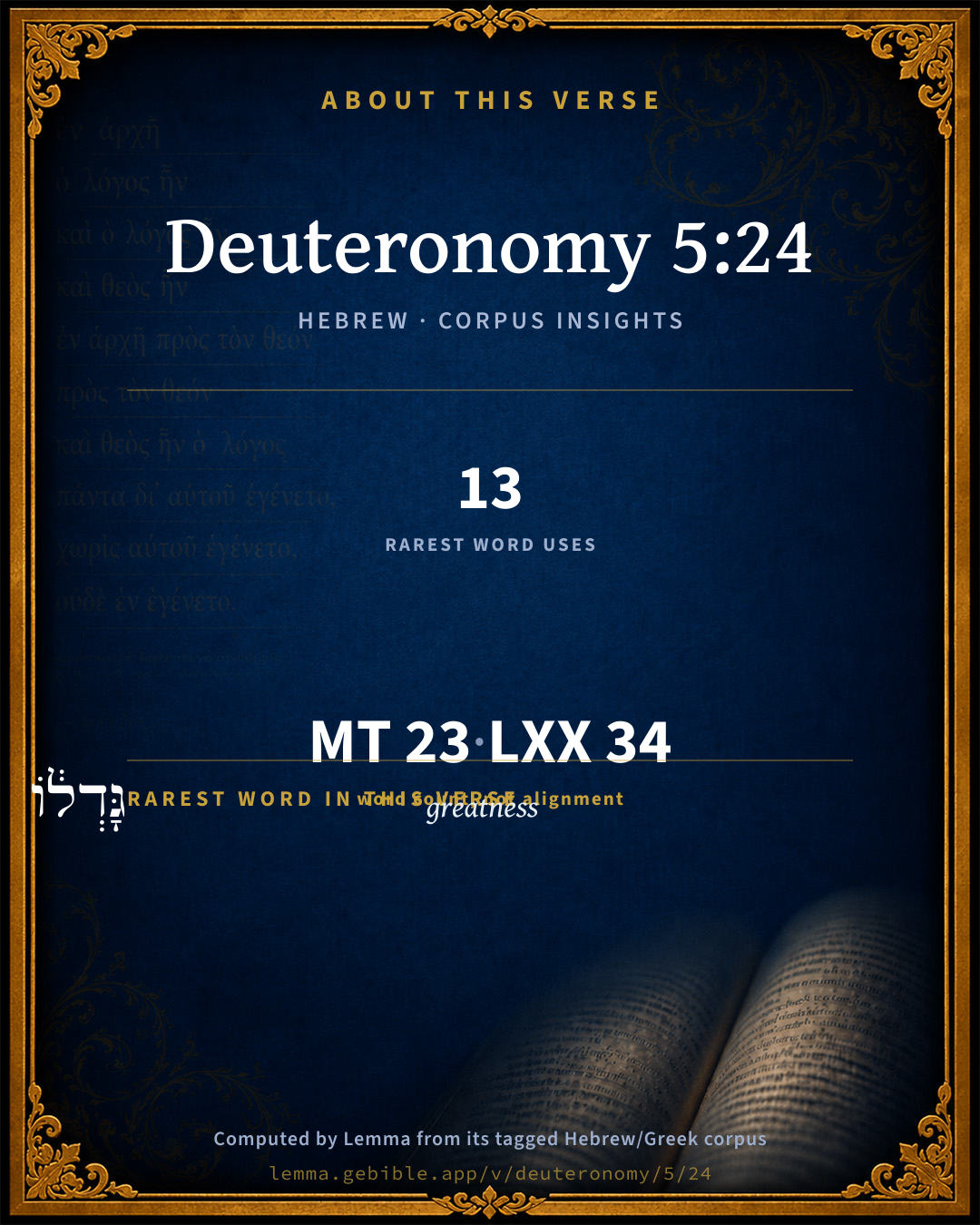
23
words
19
distinct lemmas
Pentateuch
section

Notable vocabulary

The rarest word here is גָּדְל֔וֹ greatness H1433 — appearing just 13 times in the whole Hebrew Bible.

Shared distinctive vocabulary

גָּדְל֔וֹ greatness H1433 occurs in 13 verses of the Hebrew Bible. Also found in:

Grammatical profile

  • 6 verbs
  • 10 nouns
  • 1 pronoun
  • 1 preposition
  • 1 conjunction
  • 4 particles

Verb forms

  • וַתֹּאמְר֗וּ Qal · Sequential Imperfect
  • הֶרְאָ֜נוּ Hiphil · Perfect
  • שָׁמַ֖עְנוּ Qal · Perfect
  • רָאִ֔ינוּ Qal · Perfect
  • יְדַבֵּ֧ר Piel · Imperfect
  • וָחָֽי Qal · Sequential Perfect

Repetition

Words recur within this verse — often emphatic in Hebrew:

  • הֶרְאָ֜נוּ to see H7200 ×2
  • אֱלֹהֵ֨ינוּ֙ God H430 ×2

Hebrew & Septuagint length

In English translation the verse runs 42 words from the Hebrew and 41 from the Septuagint (LXX English) — closely comparable.

A rough comparison of the two English renderings, which tokenize alike — not a word-level alignment.

Word counts can differ between the Hebrew and the Greek without any difference in meaning — e.g. the Hebrew direct-object marker אֵת has no separate Greek word, and Greek often adds the article ὁ.

In the original languages it is 23 Hebrew tokens and 34 Greek tokens — but the two are counted differently (Hebrew bundles its prefixes and suffixes into one token; the Greek is in lemma form), so that isn’t a like-for-like length.

Cross-references

6

Topical passages linked to Deuteronomy 5:24 in the Treasury of Scripture Knowledge — connected by theme and wording, ordered by reader-vote popularity; previews shown in the World English Bible.

  • Exodus 19:19 When the sound of the trumpet grew louder and louder, Moses spoke, and God answered him by a voice.
  • Deuteronomy 4:33 Did ever a people hear the voice of God speaking out of the midst of the fire, as you have heard, and live?
  • Exodus 33:20 He said, "You cannot see my face, for man may not see me and live."
  • Genesis 32:30 Jacob called the name of the place Peniel: for, he said, "I have seen God face to face, and my life is preserved."
  • Deuteronomy 5:4–5 Yahweh spoke with you face to face on the mountain out of the midst of the fire,
  • Judges 13:22 Manoah said to his wife, We shall surely die, because we have seen God.

Cross-references courtesy of OpenBible.info (CC BY 4.0).

Hebrew and Greek witnesses Masoretic Hebrew ↔ Greek Septuagint

The same verse in the two great witnesses to the Old Testament, shown verse-for-verse.

These are two independent witnesses, not word-aligned to each other, and the Septuagint is shown in lemma (dictionary) form.

Hebrew Deuteronomy 5:24 Masoretic · Westminster Leningrad Codex

וַתֹּאמְר֗וּ הֵ֣ן הֶרְאָ֜נוּ יְהוָ֤ה אֱלֹהֵ֨ינוּ֙ אֶת כְּבֹד֣וֹ וְאֶת גָּדְל֔וֹ וְאֶת קֹל֥וֹ שָׁמַ֖עְנוּ מִתּ֣וֹךְ הָאֵ֑שׁ הַיּ֤וֹם הַזֶּה֙ רָאִ֔ינוּ כִּֽי יְדַבֵּ֧ר אֱלֹהִ֛ים אֶת הָֽאָדָ֖ם וָחָֽי

and you said, Behold, Yahweh our God has shown us his glory and his greatness, and we have heard his voice out of the midst of the fire: we have seen this day that God does speak with man, and he lives.

World English Bible · Public Domain

Greek LXX Deuteronomy 5:24 Septuagint · lemma form

καί λέγω ἰδού δεικνύω ἐγώ κύριος ὁ θεός ἐγώ ὁ δόξα αὐτός καί ὁ φωνή αὐτός ἀκούω ἐκ μέσος ὁ πῦρ ἐν ὁ ἡμέρα οὗτος ὁράω ὅτι λαλέω ὁ θεός πρός ἄνθρωπος καί ζάω

and you⌃ said, Behold, the Lord our God has shown us his glory, and we have heard his voice out of the midst of the fire: this day we have seen that God shall speak to man, and he shall live.

LXX2012 (modern English Septuagint) · Public Domain

Hebrew: Westminster Leningrad Codex (CC BY 4.0). Greek: Septuagint (public domain); English from LXX2012 (modern English Septuagint) (Public Domain). How the Septuagint differs from the Hebrew →

Targum (Aramaic paraphrase)

2

The Targum is the ancient Jewish Aramaic paraphrase of the Hebrew Scriptures — an interpretive translation, not the Hebrew text itself. Onkelos (literal) and Pseudo-Jonathan (expansive) render the Torah, and Jonathan the Prophets. Coverage is partial: where no permissively-licensed English translation exists for a verse, only the Aramaic is shown. This is verse-level text, not a word-by-word alignment to the Hebrew.

  1. Targum Onkelos Torah (Genesis–Deuteronomy)
    קְרַב אַתְּ וּשְׁמַע יָת כָּל דִי יֵימַר יְיָ אֱלָהָנָא וְאַתְּ תְּמַלֵל עִמָנָא יָת כָּל דִי מַלֵל יְיָ אֱלָהָנָא עִמָךְ וּנְקַבֵּל וְנַעְבֵּד

    (no public-domain English translation for this verse)

    Targum Onkelos — Aramaic: “Onkelos Genesis” (public domain); “Onkelos Exodus” (public domain); “Onkelos Leviticus” (public domain); “Onkelos Numbers” (public domain); “Onkelos Deuteronomy” (public domain). English: “Sefaria Community Translation” (CC0 1.0 (public-domain dedication)); “J.W. Etheridge. The Targums of Onkelos and Jonathan Ben Uzziel on the Pentateuch. London: Longmans, Green, 1862” (public domain). Text via Sefaria.

  2. Targum Pseudo-Jonathan Torah (Genesis–Deuteronomy)
    קְרֵיב אַתְּ וְתִשְׁמַע יַת כָּל מַה דְּיֵימַר יְיָ אֱלָהָנָא וְאַנְתְּ תְּמַלֵּיל עִמָּנָא יַת כָּל דִּימַלֵיל יְיָ אֱלָהָנָא לָךְ וּנְקַבֵּיל וְנַעֲבֵיד

    Go thou nigh, and hear all that the Lord our God shall say, and speak thou with us all that the Lord our God will say to thee, and we will hearken and will do.

    Targum Pseudo-Jonathan — Aramaic: “Targum Jonathan on Genesis” (public domain); “Targum Jonathan on Exodus” (public domain); “Targum Jonathan on Leviticus” (public domain); “Targum Jonathan on Numbers” (public domain); “Targum Jonathan on Deuteronomy” (public domain). English: “The Targum of Jonathan ben Uzziel, trans. J. W. Etheridge, London, 1862” (public domain). Text via Sefaria.

Commentary

Notes on Deuteronomy 5:24 from classic Christian and Jewish commentators (each source and its license shown beneath its notes). The classic Christian expositions comment on the surrounding passage and are grouped to its opening verse, so a note may address several verses; the Jewish commentaries on the Tanakh (Rashi and others) are per-verse, so they appear only where the commentator wrote on this verse.

Lemma curates 59 commentaries, every one of them public domain or Creative Commons licensed, each selected and text-cleaned for this edition rather than reprinted as found. About our sources →

The Biblical Illustrator

Joseph S. Exell

Deu_5:24

God doth talk with man, and he liveth.

Talking with God

There is no doubt that Adam was originally made for converse with his Maker. The voice of the Lord had no terrors for him until he had sinned. From that time forth the voice of the Lord was in itself calculated to strike terror into man. And as man shrank from Gods talking to him, so we may feel assured he shrank from talking to God; and so, except in a very few cases, such as Enoch and Abraham and Job, and such holy men, a spirit of estrangement was set up. The great remedy is provided for us by our Lord Jesus Christ. He has taught us to call the Most High our Father. Our Father which art in heaven. He has by this one name given us many reasons why we may go to God at all times, and talk with Him. Some reader of these pages is, perhaps, timid, and shrinks from the idea altogether. He says, I reverence God too much to embrace this idea of talking with Him; I can pray, and praise, but not talk. Well, to begin with, what is your prayer but one half of talking, your telling Him what you want? And what is the answer to prayer but the other half of talking--His telling you that He has heard and granted your petitions? But let us not insist on this, but rather turn to the word Father, which Jesus has taught us to use. We cannot imagine a father living in the same house as his child, and never speaking to him; never wishing to be spoken to by him. Our common notion of a father, our experience of the relationship forbids the thought. Now there are not two kinds of fatherhoods; that of God is essentially the same as ours, only it is perfect (Mat_7:11). To come now to this talking itself. There are various kinds of talking. Prayer is no doubt a talking with God, but we shall not dwell upon it here. We mean by talking something--if we might so express ourselves with reverence--more free, less set, than our regular prayer. This talking is very independent of place; of church, or bedside, or our ordinary spot for prayer--and of times--of the morning, or noontide, or evening prayer; it has nothing whatever to do with them. Much of this talking is carried on when we are walking about, or perhaps in the train, or in the streets, or in snatches of time in business hours. And sometimes this talking is carried on without any particular aim. We are not of set purpose offering adoration, or putting up prayer. We talk just because our hearts like to be in communion with Him; and we wish to say we love and honour Him. But what good will come of all this?

1. To begin with, our talking to God involves His talking to us. He never allows His people to keep on speaking to Him, without taking any notice of them, or making any answer. That would not be fatherly on His part. By His Spirit and by His providence He answers us in turn.

2. In such talking we might acquaint ourselves much with God, and be at peace. How much slavish fear--how much death fear would take its departure, if we were accustomed to talk as with a friend with that One, in whose hands are all things, in that land whither we are going!

3. How near would this habit keep us to God in all our daily life! We never could stray far from Him if we kept it up. Matters which may be of the utmost moment, though we know it not, and which would never, perhaps, have been the subject of prayer and so of blessing, will thus be brought before Him, and be remembered by Him for good.

4. And when the time of need comes for strong prayer, this habit will be at work--it will give us encouragement. The God we have so often talked to will be no stranger. (P. B. Power, M. A.)

The Biblical Illustrator, edited by Joseph S. Exell (c. 1880s–1900s) — public domain. Text from a community e-Sword module.

Keil & Delitzsch

C. F. Keil & F. Delitzsch

Deu 5:24-27 contain a rhetorical, and at the same time really a more exact, account of the events described in Exo 20:18-20 (15-17). ואתּ (Deu 5:24), a contraction of ואתּה, as in Num 11:15 (cf. Ewald, 184, a.). Jehovah's reply to the words of the people (Deu 5:28-31) is passed over in Ex 20. God approved of what the people said, because it sprang from a consciousness of the unworthiness of any sinner to come into the presence of the holy God; and He added, "Would that there were always this heart in them to fear Me," i.e., would that they were always of the same mind to fear Me and keep all My commandments, that it might be well with them and their children for ever. He then directed the people to return to their tents, and appointed Moses as the mediator, to whom He would address all the law, that he might teach it to the people (cf. Deu 4:5). Having been thus entreated by the people to take the office of mediator, and appointed to that office by the Lord, Moses could very well bring his account of these events to a close (Deu 5:32, Deu 5:33), by exhorting them to observe carefully all the commandments of the Lord, and not to turn aside to the right hand or to the left, i.e., not to depart in any way from the mode of life pointed out in the commandments (cf. Deu 17:11, Deu 17:20; Deu 28:14; Jos 1:7, etc.), that it might be well with them, etc. (cf. Deu 4:40). וטוב, perfect with ו rel. instead of the imperfect.

Keil & Delitzsch — Biblical Commentary on the Old Testament (1861–1891) — public domain (CC PDM 1.0). Text via the HelloAO Bible API. (Old Testament only.)

The Cambridge Bible for Schools and Colleges

gen. ed. J. J. S. Perowne

24. his greatness] See Deu_3:24.

24–26. See on Deu_4:33. It was contrary to expectation that the people survived the voice of God: they would not repeat the risk.

The Cambridge Bible for Schools and Colleges (gen. ed. J. J. S. Perowne; Cambridge University Press, 1878–1918) — public domain. Text from a community e-Sword module.

John Gill's Exposition

Go thou near,.... To the mount, and to God on it:

and hear all that the Lord our God shall say; for they supposed, by the continuance of the Lord on the mount, and the fire burning on it, that he had more to say, which they were not averse to hear; but desired it might be not immediately delivered to them, but by the means of Moses; the sound of the words, and the sight of the fire, being so terrible to them:

and speak thou unto us all that the Lord our God shall speak unto thee: they did not doubt, knowing the faithfulness of Moses, his declaring all unto them that should be told him by the Lord; and they were desirous that he should, they did not want to have anything withheld from them, only they could not bear to see and hear things immediately from the Lord:

and we will hear it and do it; hearken to it, and receive it, as the word of God, and not man, and yield a ready and cheerful obedience, even to everything that should be required; see Exo 20:19.

John Gill's Exposition of the Whole Bible (1746–1763) — public domain (CC PDM 1.0). Text via the HelloAO Bible API.

Rashi

Rabbi Shlomo Yitzchaki (Rashi)

ואת תדבר אלינו AND SPEAK THOU (את the feminine form of the pronoun) TO US — you weakened my strength as that of a woman, (cf. Rashi on Numbers 11:15), for I was distressed because of you (because of your words) and you weakened my hands, since I saw that you were not anxious to approach Him out of love. Indeed, was it not better for you to learn from the mouth of the Almighty God, and not to learn from me?!

Rashi on the Tanakh — English translations: “The Judaica Press complete Tanach with Rashi, translated by A. J. Rosenberg” (CC BY 4.0); “Pentateuch with Rashi's commentary by M. Rosenbaum and A.M. Silbermann, 1929-1934” (public domain); “The Metsudah Tanach series, Lakewood, N.J” (CC BY 4.0); and “The Book of Joshua, Metsudah Publications, 1997” (CC BY 4.0). Text via Sefaria.

Ramban (Nachmanides)

Rabbi Moshe ben Nachman (Ramban / Nachmanides)

V’AT’ (AND THOU) [Moses] SPEAK UNTO US. “[The feminine form of the word v’at indicates] that you caused my strength to be sapped like that of a woman, for I was distressed because of you and you weakened my hands when I realized that you were not anxious to approach Him out of love. For was it not better to learn directly from the Almighty rather than from me?!” Thus far is Rashi’s language from words of the Agadah. If so, Moses is saying that he was concerned [over their failure to approach G-d] and G-d informed him [in the following verses] that they did so because they feared Him and it was beneficial to them! But the subject is, as I have explained there, that they thought that G-d wanted to communicate the entire Torah to them; however, the [Divine] Will before Him was to proclaim to them only the Ten Commandments as they desired.Know that now they requested of Moses that they should not hear the voice of the Glorious Name — neither on that day nor during any of the succeeding generations — for it is not at all times that miracles occur [and, as they said in Verse 21, their very survival after hearing the voice of G-d was a miracle in itself, a miracle that could not be expected to recur during future revelations], and that they do not want another such Revelation; rather, they will believe in the prophets and do G-d’s will [as revealed] through them. In compliance Moses told them, A prophet will the Eternal thy G-d raise up unto thee, from the midst of thee, of thy brethren, like unto me; unto him ye shall hearken; according to all that thou didst desire of the Eternal thy G-d in Horeb. etc., 18:15-16. If so, the meaning of this request [of the people in the verse before us — and thou shalt speak unto us — that they wished to hear from prophets rather than from G-d] was meant for future generations.

Ramban (Nachmanides) on the Tanakh — English translation: “Commentary on the Torah by Ramban (Nachmanides). Translated and annotated by Charles B. Chavel. New York, Shilo Pub. House, 1971-1976” (CC BY 4.0). Text via Sefaria.

Lesson kit

Teaching starters — assembled from the data on this page, not authored interpretation. Every prompt links to the verse data it draws on. Edit before teaching.

Deuteronomy, in the Pentateuch, opens this verse with 23 words (19 distinct Hebrew lemmas). Its most distinctive word is gôdel (“greatness”). A historical commentator’s framing appears above. Read the whole chapter for the surrounding context.

Discussion questions

  1. What does “greatness” (gôdel) contribute to the verse as a whole?
  2. Numbers 14:19 shares the word «greatness» with this verse. How do the two illuminate each other?
  3. “to see” occurs 2× in this one verse. What is the effect of the repetition?
  4. The translations on this page render this verse differently — a whole-verse word diff, not a word-by-word alignment. What might account for the different wordings?
  5. The verb «וַתֹּאמְר֗וּ» is Qal Sequential Imperfect. How does its form color the action?
  6. Reading how The Biblical Illustrator and Keil & Delitzsch read this verse, where do the two commentators agree and where do they part?

Things to notice

Reading settings

Reading text

Shown beneath each verse's original-language words.

Old Testament
Old Testament edition

Read the OT as the Masoretic Hebrew (MT) or the Greek Septuagint (LXX).

English shown for the Greek Septuagint (in the Hebrew ↔ Greek comparison).

Comparing translations? Open the Compare panel on any verse page to stack up to four side by side.