
1 Kings 19:13

Hebrew (Westminster Leningrad Codex) 1 Kings 19:13 appears in the Hebrew Old Testament. The text above is from the Westminster Leningrad Codex. Each word links to its Strong’s number, a concise gloss, and parsing drawn from the Open Scriptures Hebrew Bible morphology. Click any word for its full Brown-Driver-Briggs (BDB) entry.
Download image
Cite this verse

1 Kings 19:13 (World English Bible). Public Domain. Lemma interlinear Bible study tool, https://lemma.gebible.app/v/1-kings/19/13.

Show BibTeX & RIS
BibTeX
RIS
English Translation
It was so, when Elijah heard it, that he wrapped his face in his mantle, and went out, and stood in the entrance of the cave. Behold, there came a voice to him, and said, What are you doing here, Elijah?
World English Bible · Public Domain
Download a study sheet

One document with this verse’s original text, its word-by-word gloss line, the meaning frame, cross-references with their text, attributed commentary, and full source and license credits — printable, and it pastes into notes with its structure intact.

This verse Autodidact and up

Study sheet (.html) Plain text (.txt)

A passage Seminary Student

Up to 50 verses in one chapter. A passage sheet keeps up to 6 commentary sources and 12 cross-references per verse, in the order this page ranks them, and says so on the sheet whenever that leaves anything out. Ask for a single verse and you get the Autodidact verse sheet above.

Everything on this page stays free to read, with no account — the sheet is a download of what is already on screen, not access to it.

Want to remove ads? Support Godless Engineer
Compare translations 3

The same verse in 3 English versions, stacked beneath the original-language interlinear above. Click any original word for its lexicon entry.

Each is an independent rendering of the whole verse — the interlinear is not word-aligned to these translations.

Highlighted words mark where these versions differ — a whole-verse word diff, not a word-by-word alignment.

  • World English Bible Public Domain
    It was so, when Elijah heard it, that he wrapped his face in his mantle, and went out, and stood in the entrance of the cave. Behold, there came a voice to him, and said, What are you doing here, Elijah?
  • King James Version Public Domain
    And it was so, when Elijah heard it, that he wrapped his face in his mantle, and went out, and stood in the entering in of the cave. And, behold, there came a voice unto him, and said, What doest thou here, Elijah?
  • unfoldingWord Literal Text CC BY-SA 4.0
    And it happened when Elijah heard that he wrapped his face in his cloak. And he went out and stood at the entrance of the cave. And behold, a voice to him, and it said, “What to you here, Elijah?”

unfoldingWord Literal Text — © unfoldingWord, licensed CC BY-SA 4.0. Word-aligned USFM3 via Door43 (git.door43.org/unfoldingWord/en_ult).

Versions to compare (up to 4)

3 of 4 selected

Show all 18 translations

Every available English version of this verse, each an independent rendering of the whole verse.

  • World English Bible Public Domain
    It was so, when Elijah heard it, that he wrapped his face in his mantle, and went out, and stood in the entrance of the cave. Behold, there came a voice to him, and said, What are you doing here, Elijah?
  • Berean Standard Bible Public Domain
    When Elijah heard it, he wrapped his face in his cloak and went out and stood at the mouth of the cave. Suddenly a voice came to him and said, “What are you doing here, Elijah?”
  • Majority Standard Bible Public Domain
    When Elijah heard it, he wrapped his face in his cloak and went out and stood at the mouth of the cave. Suddenly a voice came to him and said, “What are you doing here, Elijah?”
  • King James Version Public Domain
    And it was so, when Elijah heard it, that he wrapped his face in his mantle, and went out, and stood in the entering in of the cave. And, behold, there came a voice unto him, and said, What doest thou here, Elijah?
  • American Standard Version (1901) Public Domain
    And it was so, when Elijah heard it, that he wrapped his face in his mantle, and went out, and stood in the entrance of the cave. And, behold, there came a voice unto him, and said, What doest thou here, Elijah?
  • Revised Version (1885) Public Domain
    And it was so, when Elijah heard it, that he wrapped his face in his mantle, and went out, and stood in the entering in of the cave. And, behold, there came a voice unto him, and said, What doest thou here, Elijah?
  • Geneva Bible (1599) Public Domain
    And when Eliiah heard it, he couered his face with his mantel, and went out, and stoode in the entring in of ye caue: and behold, there came a voyce vnto him, and sayd, What doest thou here, Eliiah?
  • Douay-Rheims (1899) Public Domain
    And when Elias heard it, he covered his face with his mantle, and coming forth stood in the entering in of the cave, and behold a voice unto him, saying: What dost thou here, Elias? And he answered:
  • Young's Literal Translation Public Domain
    and it cometh to pass, at Elijah's hearing `it', that he wrappeth his face in his robe, and goeth out, and standeth at the opening of the cave, and lo, unto him `is' a voice, and it saith, `What -- to thee, here, Elijah?'
  • Literal Standard Version CC BY-SA 4.0
    and it comes to pass, at Elijah’s hearing [it], that he wraps his face in his robe, and goes out, and stands at the opening of the cave, and behold, a voice [speaks] to him, and it says, “What are you [doing] here, Elijah?”
  • Unlocked Literal Bible CC BY-SA 4.0
    When Elijah heard the voice, he wrapped his face in his cloak, went out, and stood at the entrance of the cave. Then a voice came to him that said, “What are you doing here, Elijah?”
  • unfoldingWord Literal Text CC BY-SA 4.0
    And it happened when Elijah heard that he wrapped his face in his cloak. And he went out and stood at the entrance of the cave. And behold, a voice to him, and it said, “What to you here, Elijah?”
  • Darby Bible Public Domain
    And it came to pass, when Elijah heard it, that he wrapped his face in his mantle, and went out, and stood in the entrance of the cave. And behold, a voice [came] to him and said, What doest thou here, Elijah?
  • World Messianic Bible Public Domain
    When Elijah heard it, he wrapped his face in his mantle, went out, and stood in the entrance of the cave. Behold, a voice came to him, and said, “What are you doing here, Elijah?”
  • Webster's Bible Public Domain
    And it was so, when Elijah heard it, that he wrapped his face in his mantle, and went out, and stood in the entrance of the cave. And behold, there came a voice to him, and said, What doest thou here, Elijah?
  • Free Bible Version CC BY-SA 4.0
    When Elijah heard it, he wrapped his cloak around his face and went out and stood at the cave entrance. Immediately a voice spoke to him and asked, “What are you doing here, Elijah?”
  • Bible in Basic English Public Domain
    And Elijah, hearing it, went out, covering his face with his robe, and took his place in the opening of the hole. And there a voice came to him saying, What are you doing here, Elijah?
  • JPS Tanakh (1917) Public Domain
    And it was so, when Elijah heard it, that he wrapped his face in his mantle, and went out, and stood in the entrance of the cave. And, behold, there came a voice unto him, and said: 'What doest thou here, Elijah?'

Literal Standard Version (2020), Covenant Press — licensed CC BY-SA 4.0. Text via the HelloAO Bible API (eBible.org). Unlocked Literal Bible (unfoldingWord) — licensed CC BY-SA 4.0. Text via the HelloAO Bible API (eBible.org). unfoldingWord Literal Text — © unfoldingWord, licensed CC BY-SA 4.0. Word-aligned USFM3 via Door43 (git.door43.org/unfoldingWord/en_ult). Free Bible Version, Dr. Jonathan Gallagher — licensed CC BY-SA 4.0. Text via the HelloAO Bible API (eBible.org).

Word by word

More ways to search: Search by grammar → Find every occurrence → Compare this word →

Practice this passage: Drill this verse → Learn its vocabulary →

וַיָּ֤לֶט
lûwṭ
H3874
“and · to wrap”
Conjunction + Verb, Hiphil, Sequential Imperfect, 3rd Person, Masculine, Singular
Part of Speech
Conjunction + Verb
Stem
Hiphil
Form
Sequential Imperfect
Person
3rd Person
Gender
Masculine
Number
Singular
Full BDB Definition

Origin: a primitive root

TWOT: 1092

to wrap closely or tightly, enwrap, envelop - (Qal) to wrap tightly - (Hiphil) to envelop, wrap
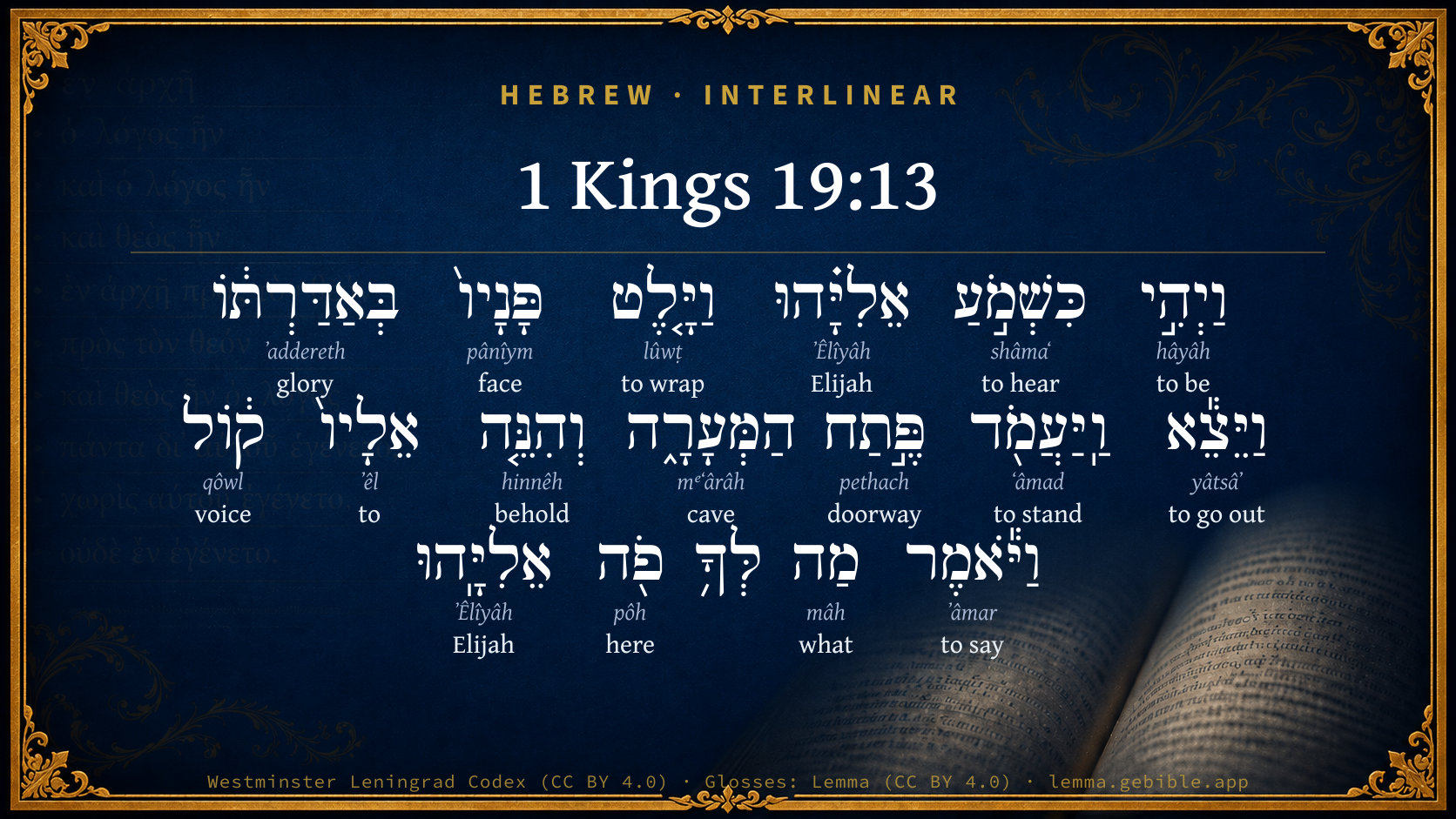
  1. וַיְהִ֣י hâyâh H1961 “and · to be” Conjunction + Verb, Qal, Sequential Imperfect, 3rd Person, Masculine, Singular
  2. כִּשְׁמֹ֣עַ shâmaʻ H8085 “like/as · to hear” Preposition + Verb, Qal, Infinitive Construct
  3. אֵלִיָּ֗הוּ ʼÊlîyâh H452 “Elijah” Noun, Proper
  4. פָּנָיו֙ pânîym H6440 “face(s) · his” Noun, Common, Both, Plural, Construct + Suffix, Personal, 3rd Person, Masculine, Singular
  5. בְּאַדַּרְתּ֔וֹ ʼaddereth H155 “in/at · glory · his” Preposition + Noun, Common, Feminine, Singular, Construct + Suffix, Personal, 3rd Person, Masculine, Singular
  6. וַיֵּצֵ֕א yâtsâʼ H3318 “and · to go out” Conjunction + Verb, Qal, Sequential Imperfect, 3rd Person, Masculine, Singular
  7. וַֽיַּעֲמֹ֖ד ʻâmad H5975 “and · to stand” Conjunction + Verb, Qal, Sequential Imperfect, 3rd Person, Masculine, Singular
  8. פֶּ֣תַח pethach H6607 “doorway of” Noun, Common, Masculine, Singular, Construct
  9. הַמְּעָרָ֑ה mᵉʻârâh H4631 “the · cave” Particle, Definite Article + Noun, Common, Feminine, Singular, Absolute
  10. וְהִנֵּ֤ה hinnêh H2009 “and · behold” Conjunction + Particle, Demonstrative
  11. אֵלָיו֙ ʼêl H413 “to · him” Preposition + Suffix, Personal, 3rd Person, Masculine, Singular
  12. ק֔וֹל qôwl H6963 “voice” Noun, Common, Masculine, Singular, Absolute
  13. וַיֹּ֕אמֶר ʼâmar H559 “and · to say” Conjunction + Verb, Qal, Sequential Imperfect, 3rd Person, Masculine, Singular
  14. מַה mâh H4100 “what” Particle, Interrogative
  15. פֹ֖ה pôh H6311 “here” Adverb
  16. אֵלִיָּֽהוּ ʼÊlîyâh H452 “Elijah” Noun, Proper

About this verse

These counts appear in no published source. They are computed here, from the morphology-tagged text and Lemma’s own curated glosses. What Lemma adds →

18
words
16
distinct lemmas
Historical
section

Notable vocabulary

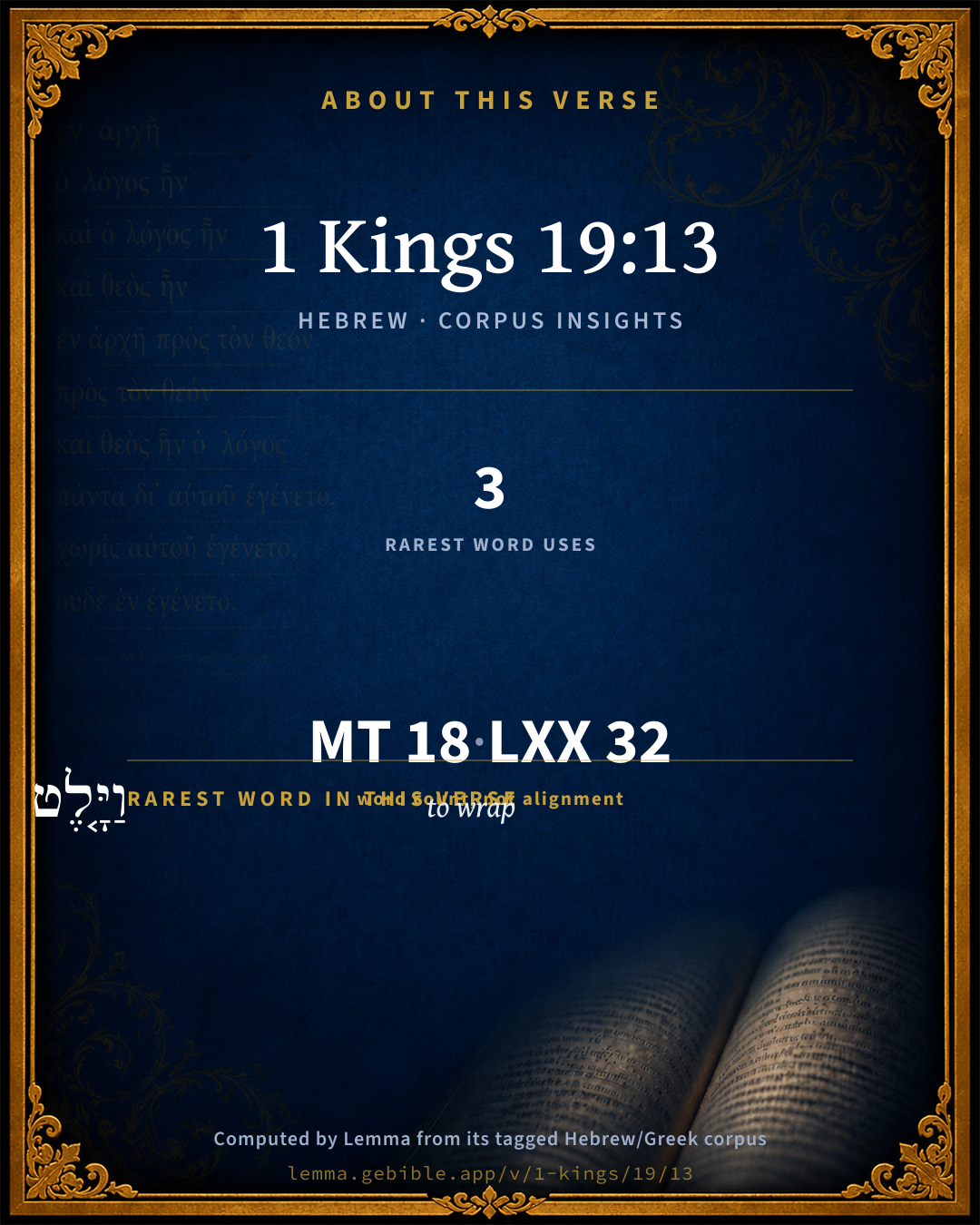
The rarest word here is וַיָּ֤לֶט to wrap H3874 — appearing just 3 times in the whole Hebrew Bible.

Shared distinctive vocabulary

וַיָּ֤לֶט to wrap H3874 occurs in 3 verses of the Hebrew Bible. Also found in:

Grammatical profile

  • 6 verbs
  • 7 nouns
  • 2 prepositions
  • 1 adverb
  • 2 particles

Verb forms

  • וַיְהִ֣י Qal · Sequential Imperfect
  • כִּשְׁמֹ֣עַ Qal · Infinitive Construct
  • וַיָּ֤לֶט Hiphil · Sequential Imperfect
  • וַיֵּצֵ֕א Qal · Sequential Imperfect
  • וַֽיַּעֲמֹ֖ד Qal · Sequential Imperfect
  • וַיֹּ֕אמֶר Qal · Sequential Imperfect

Repetition

A word recurs within this verse — often emphatic in Hebrew:

  • אֵלִיָּ֗הוּ Elijah H452 ×2

Hebrew & Septuagint length

In English translation the verse runs 41 words from the Hebrew and 38 from the Septuagint (LXX English) — closely comparable.

A rough comparison of the two English renderings, which tokenize alike — not a word-level alignment.

Word counts can differ between the Hebrew and the Greek without any difference in meaning — e.g. the Hebrew direct-object marker אֵת has no separate Greek word, and Greek often adds the article ὁ.

In the original languages it is 18 Hebrew tokens and 32 Greek tokens — but the two are counted differently (Hebrew bundles its prefixes and suffixes into one token; the Greek is in lemma form), so that isn’t a like-for-like length.

Cross-references

8

Topical passages linked to 1 Kings 19:13 in the Treasury of Scripture Knowledge — connected by theme and wording, ordered by reader-vote popularity; previews shown in the World English Bible.

  • 1 Kings 19:9 He came there to a cave, and lodged there; and, behold, the word of Yahweh came to him, and he said to him, What are you doing here, Elijah?
  • Genesis 16:8 He said, "Hagar, Sarai's handmaid, where did you come from? Where are you going?" She said, "I am fleeing from the face of my mistress Sarai."
  • Exodus 33:23 then I will take away my hand, and you will see my back; but my face shall not be seen."
  • 1 Kings 18:42 So Ahab went up to eat and to drink. Elijah went up to the top of Carmel; and he bowed himself down on the earth, and put his face between his knees.
  • Isaiah 6:2 Above him stood the seraphim. Each one had six wings. With two he covered his face. With two he covered his feet. With two he flew.
  • Isaiah 6:5 Then I said, "Woe is me! For I am undone, because I am a man of unclean lips, and I dwell in the midst of a people of unclean lips: for my eyes have seen the King, Yahweh of Hosts!"
  • John 21:15–17 So when they had eaten their breakfast, Jesus said to Simon Peter, "Simon, son of Jonah, do you love me more than these?" He said to him, "Yes, Lord; you know that I have affection for you." He said to him, "Feed my lambs."
  • Exodus 3:5–6 He said, "Don't come close. Take off your sandals from off your feet, for the place you are standing on is holy ground."

Cross-references courtesy of OpenBible.info (CC BY 4.0).

Hebrew and Greek witnesses Masoretic Hebrew ↔ Greek Septuagint

The same verse in the two great witnesses to the Old Testament, shown verse-for-verse.

These are two independent witnesses, not word-aligned to each other, and the Septuagint is shown in lemma (dictionary) form.

Hebrew 1 Kings 19:13 Masoretic · Westminster Leningrad Codex

וַיְהִ֣י כִּשְׁמֹ֣עַ אֵלִיָּ֗הוּ וַיָּ֤לֶט פָּנָיו֙ בְּאַדַּרְתּ֔וֹ וַיֵּצֵ֕א וַֽיַּעֲמֹ֖ד פֶּ֣תַח הַמְּעָרָ֑ה וְהִנֵּ֤ה אֵלָיו֙ ק֔וֹל וַיֹּ֕אמֶר מַה לְּךָ֥ פֹ֖ה אֵלִיָּֽהוּ

It was so, when Elijah heard it, that he wrapped his face in his mantle, and went out, and stood in the entrance of the cave. Behold, there came a voice to him, and said, What are you doing here, Elijah?

World English Bible · Public Domain

Greek LXX 1 Kings 19:13 Septuagint · lemma form

καί γίγνομαι ὡς ἀκούω ηλιου καί ἐπικαλύπτω ὁ πρόσωπον αὐτός ἐν ὁ μηλωτή ἑαυτοῦ καί ἐκἔρχομαι καί ἵστημι ὑπό ὁ σπήλαιον καί ἰδού πρός αὐτός φωνή καί εἶπον τίς σύ ἐνταῦθα ηλιου

And it came to pass when Eliu heard, that he wrapped his face in his mantle, and went forth and stood in the cave: and, behold, a voice came to him and said, What do you here, Eliu?

LXX2012 (modern English Septuagint) · Public Domain

On this verse, The Pulpit Commentary discusses the Septuagint’s reading. Read the note in Commentary ↓

Hebrew: Westminster Leningrad Codex (CC BY 4.0). Greek: Septuagint (public domain); English from LXX2012 (modern English Septuagint) (Public Domain). How the Septuagint differs from the Hebrew →

Targum (Aramaic paraphrase)

1

The Targum is the ancient Jewish Aramaic paraphrase of the Hebrew Scriptures — an interpretive translation, not the Hebrew text itself. Onkelos (literal) and Pseudo-Jonathan (expansive) render the Torah, and Jonathan the Prophets. Coverage is partial: where no permissively-licensed English translation exists for a verse, only the Aramaic is shown. This is verse-level text, not a word-by-word alignment to the Hebrew.

  1. Targum Jonathan Prophets (Joshua–Malachi)
    וַהֲוָה כַּד שְׁמַע אֵלִיָהוּ וּכְרִיךְ אַפּוֹהִי בְּשׁוֹשִׁיפֵיהּ וּנְפַק וְקָם בִּתְרַע מְעַרְתָּא וְהָא עִמֵיהּ קָלָא וַאֲמַר מַה לָךְ כָּא אֵלִיָהוּ:

    (no public-domain English translation for this verse)

    Targum Jonathan — Aramaic: “Mikraot Gedolot” (public domain). English: “Sefaria Community Translation” (CC0 1.0 (public-domain dedication)); “London "Chaldee Paraphrase," 1871” (public domain). Text via Sefaria.

Commentary

Notes on 1 Kings 19:13 from classic Christian and Jewish commentators (each source and its license shown beneath its notes). The classic Christian expositions comment on the surrounding passage and are grouped to its opening verse, so a note may address several verses; the Jewish commentaries on the Tanakh (Rashi and others) are per-verse, so they appear only where the commentator wrote on this verse.

Lemma curates 59 commentaries, every one of them public domain or Creative Commons licensed, each selected and text-cleaned for this edition rather than reprinted as found. About our sources →

Trapp's Complete Commentary

John Trapp

1Ki 19:13 And it was [so], when Elijah heard [it], that he wrapped his face in his mantle, and went out, and stood in the entering in of the cave. And, behold, [there came] a voice unto him, and said, What doest thou here, Elijah?

Ver. 13. He wrapped his face in his mantle.] As not able to behold God’s surpassing brightness, whereby the very angels might have their eyes put out, did they not cover their faces with their wings as with a double scarf.

What dost thou here, Elijah?] q.d., Speak out, man; let me have a more direct answer. But this his guiltiness would not let him do. He is at it, therefore, as before.

John Trapp, A Commentary or Exposition upon All the Books of the Old and New Testament (1647–1656) — public domain. Text from a community e-Sword module.

Joseph Benson's Commentary

1Ki 19:13. When Elijah heard it, he wrapped his face in his mantle — Through dread of God’s presence, being sensible that he was neither worthy of nor able to endure the sight of God with open face. And went out and stood, &c. — Which God had commanded him to do; and as he was going toward the mouth of the cave, he was affrighted and stopped in his course by the dreadful wind, and earthquake, and fire; when these were past, he proceeds, and goes on to the month of the cave. Moses was put into the cave when God’s glory passed before him, but Elijah was called out of it: but neither Moses nor Elijah saw any manner of similitude. And, behold, a voice — What dost thou here, Elijah? — What God before spake by an angel, he now speaks to him himself immediately.

Joseph Benson's Commentary on the Old and New Testaments (1811–1818) — public domain. Text from a community e-Sword module.

Tyndale Open Study Notes

Tyndale Open Resources

19:13-14 What are you doing here? The Lord repeats his question (see 19:9), and Elijah gives exactly the same response as earlier. Elijah’s answer gives no indication that he understood how God was working through all that had happened. Paul makes reference to this interchange in Rom 11:3-4.

Tyndale Open Study Notes — © Tyndale Open Resources, licensed CC BY-SA 4.0. Text via the HelloAO Bible API.

Adam Clarke's Commentary

Verse 13. Wrapped his face in his mantle] This he did to signify his respect; so Moses hid his face, for he dared not to look upon God Ex 3:6. Covering the face was a token of respect among the Asiatics, as uncovering the head is among the Europeans.

Adam Clarke's Commentary on the Bible (1810–1826) — public domain. Text from a community e-Sword/MySword module.

The Cambridge Bible for Schools and Colleges

gen. ed. J. J. S. Perowne

13. wrapped his face in his mantle] The revelation was not one for the eye, but for the spirit, of the prophet. Like Moses ‘he was afraid to look upon God’ (Exo_3:6).

in the entering in of the cave] The command given before had been ‘Go forth and stand upon the mount,’ but this only applies to such an advance as would bring him out of the cave and into the open air, not to any climbing to the mountain top.

What doest thou here?] This repeated question seeks to know whether the prophet has understood the manifestations that have been made to him, and whether he is able to apply them to his own circumstances. The answer coming in the same words as before seems to declare that Elijah is still ignorant of what is meant. God therefore gives him direct charges which shall make it clear that, though his own success has not been such as he expected, yet God’s work is still going forward and that new agents are already prepared, in Jehovah’s design, for advancing it as He sees best.

The Cambridge Bible for Schools and Colleges (gen. ed. J. J. S. Perowne; Cambridge University Press, 1878–1918) — public domain. Text from a community e-Sword module.

John Gill's Exposition

And it was so, when Elijah heard it, that he wrapped his face in his mantle,.... Through reverence of the divine Majesty he perceived was there, and through shame and confusion under a sense of his impurity, imperfections, and unworthiness, as the seraphim in Isa 6:2, and as Moses, Exo 3:6, and went out and stood in the entering in of the cave; he attempted to come forth out of the cave upon the divine order, Kg1 19:11, but was stopped by the terrible appearances of the wind, earthquake, and fire, a little within it; but now he came quite out, and stood at the mouth of it, to hear what the Lord would say unto him:

and, behold, there came a voice unto him, and said, what dost thou here, Elijah? the same question is here put as in Kg1 19:9, though there by an angel, here by the Lord himself.

John Gill's Exposition of the Whole Bible (1746–1763) — public domain (CC PDM 1.0). Text via the HelloAO Bible API.

Albert Barnes' Notes on the Bible

Mantle - The upper garment, a sort of short cloak or cape - perhaps made of untanned sheepskin, which was, besides the strip of leather round his loins, the sole apparel of the prophet (compare Mat 3:4). For the action compare the marginal references.

There came a voice unto him ... - The question heard before in vision is now put again to the prophet by the Lord Himself. Elijah gives no humbler and more gentle answer. He is still satisfied with his own statement of his case.

Albert Barnes' Notes on the Bible (1834–1885) — public domain. Text from a community e-Sword/MySword module.

Haydock's Catholic Bible Commentary

Mantle, out of respect, like Moses, Exodus iii. 6. So the cherubim veil their faces with their wings, Isaias vi. 2. (Menochius) --- Among the Orientals, to cover the face has the same import as when we pull of our hats. (Calmet)

George Leo Haydock (1774–1849), Haydock's Catholic Family Bible and Commentary, 1859 edition — public domain. Excludes Psalms (Douay-Rheims chapter numbering differs from Protestant) and Deuterocanonical books (Catholic canon only).

Matthew Poole's English Annotations

He wrapped his face in his mantle, through horror and dread of God’s presence, being sensible that he was neither worthy nor able to endure the sight of God with open face. Compare Gen 16:13, with Exo 3:6.

Stood in the entering in of the cave; which God commanded him to do; and as he was going towards the mouth of the cave, he was affrighted and stopped in his course, by the dreadful wind, and earthquake, and fire; and when these were past, he prosecutes his journey, and goeth on to the mouth of the cave, and there stands still. Or the words may be rendered, after (as vau is elsewhere used) he was gone out, and standing in the mouth of the cave; which may be mentioned as the reason why he covered his face, because now he wanted the shelter of the cave.

What doest thou here, Elijah? what before he spake by an angel, he now speaks to him again immediately.

Matthew Poole's English Annotations on the Holy Bible (1683–1685) — public domain. Text from a community e-Sword/MySword module.

Whedon's Commentary on the Bible

Daniel D. Whedon

13. Wrapped his face in his mantle — Conscious of his infirmities and shortcomings, he was, like Moses, “afraid to look upon God.” Exo_3:6. He began to realize that as yet he knew comparatively little of the Divine nature and will.

There came a voice unto him — It was the voice of Jehovah; perhaps the same as that whose soft whisper followed the lightning flash; but, if so, it now rose to a clearer and more intelligible sound.

What doest thou here — The Lord’s question and the prophet’s answer are repeated (compare 1Ki_19:9) in order to deepen the impression of the scene. The repetition also shows Elijah still presuming to justify his flight. He was guilty of no wilful sin. His error was not one of the heart, but of the understanding; and his flight to Horeb, though not blameless, was largely the result of disappointment and discouragement. He had, indeed, been very zealous for the Lord, and had expected too much from the triumph at Carmel. Jehovah proceeds to show him there are other ways of taking off the wicked than by miraculous interference.

Daniel D. Whedon (gen. ed.), Commentary on the Old and New Testaments (1874–1909) — public domain. Text from a community e-Sword module.

The Pulpit Commentary

And it was so, when Elijah heard it, that he wrapped his face in his mantle Like Moses, Exo_3:6.; cf. 33:20; 34:33; 2Co_3:13; Isa_6:1, Isa_6:2. This mantle (see note on 1Ki_18:46) was probably a sheepskin. The LXX calls it nhlwth (cf. Heb_11:37) In, Zec_13:4 we find that the prophets wore a mantle of hair and went out, and stood Same words as in ver. 11. It was the still small voice, apparently, that first brought him to obey the command there given. He would perhaps be afraid to issue from the shelter of his cave during the tempest and the earthquake, which may have followed directly after the instruction to go forth was given. Possibly there was a lesson for him here also, viz., that amid the din and excitement and torture of drought and famine and fire and blood the commands of God are less likely to be heard in the soul and obeyed, than in the hour of peace and stillness. The drought and famine and sword have their work to do, even as the tempest and the earthquake have theirs; but it is by the voice of mercy and love that the hearts of men are turned back again. "Not in the strong east wind that parted the Red Sea, or the fire that swept the top of Sinai, or the earthquake that shook down the walls of Jericho would God be brought so near to man as in the still small voice of the child of Bethlehem" (Stanley) in the entering in of the cave. He hardly obeyed the letter of the command of ver. 11 even then. Does not this point to a rebellious and unsubdued heart? Is it not a confirmation of the view taken above, that he fled to Horeb, full of bitter disappointment and murmuring against God; and that the purpose of this revelation was not only to teach him as to God"s dealings with men, but also to school and subdue his own rebellious heart? And, behold, there came a voice unto him The expression is different from that of ver. 9. There we read of the "word of the Lord," here of a "voice." But this is not to be identified with the "still small voice" of ver. 12, and said, What doest, thou here, Elijah? As in ver. 9.

Wrapped his face in his mantle." He was afraid to look upon (Exo_3:6; cf. Gen_3:10, "I hid myself "Conscience makes cowards of us all." Besides, no man can see His face and live. (Exo_33:20) The beatific vision is too much for our poor mortality, too much for the angelic powers. (Isa_6:2) It is in mercy that God isveiled from our view. The seeing God as He is belongs to the times of restitution. (Mat_5:8; Heb_12:14; Rev_1:7 Rev_22:4; 1Co_13:12)

The Pulpit Commentary (1880–1919), ed. H.D.M. Spence-Jones & Joseph S. Exell — public domain. Text from a community e-Sword module.

John Wesley's Explanatory Notes

He wrapped, &c. - Through dread of God's presence, being sensibly that he was neither worthy nor able to endure the sight of God with open face. And stood, &c. - Which God commanded him to do; and as he was going towards the mouth of the cave, he was affrighted and stopped in his course, by the dreadful wind, and earthquake, and fire; when these were past, he prosecutes his journey, and goeth on to the mouth of the cave.

John Wesley, Explanatory Notes Upon the Whole Bible (1754–1765) — public domain. Text via the GEBible commentary corpus.

unfoldingWord translationNotes

Door43 World Missions Community

he wrapped his face in his cloak

"he covered his face with his cloak" A cloak is a long robe, a piece of clothing that covers the whole body.

Then a voice came to him

"Then he heard a voice"

What are you doing here ... and they are also trying to take my life

See how you translated this text in 1 Kings 19:9-10.

I, only I, am left

Here the word "I" is repeated for emphasis.

translationWords

face

unfoldingWord translationNotes — © Distant Shores Media and the Door43 World Missions Community, licensed CC BY-SA 4.0. Source: git.door43.org/Door43/en_tn.

Rashi

Rabbi Shlomo Yitzchaki (Rashi)

He wrapped his face. [Targum Yonoson rendered,] “and he wrapped his face,” and so it states, “wrapped up [לוטה] in a cloth.”

Rashi on the Tanakh — English translations: “The Judaica Press complete Tanach with Rashi, translated by A. J. Rosenberg” (CC BY 4.0); “Pentateuch with Rashi's commentary by M. Rosenbaum and A.M. Silbermann, 1929-1934” (public domain); “The Metsudah Tanach series, Lakewood, N.J” (CC BY 4.0); and “The Book of Joshua, Metsudah Publications, 1997” (CC BY 4.0). Text via Sefaria.

Lesson kit

Teaching starters — assembled from the data on this page, not authored interpretation. Every prompt links to the verse data it draws on. Edit before teaching.

1 Kings, in the Historical, opens this verse with 18 words (16 distinct Hebrew lemmas). Its most distinctive word is lûwṭ (“to wrap”). A historical commentator’s framing appears above. Read the whole chapter for the surrounding context.

Discussion questions

  1. What does “to wrap” (lûwṭ) contribute to the verse as a whole?
  2. How does 1 Samuel 21:9, which shares the word «to wrap», read alongside this verse?
  3. What does the repetition of “Elijah” (2× in this one verse) do in this verse?
  4. These translations render this verse differently; the difference is in the English rendering, not the original. What questions does that raise?
  5. «וַיְהִ֣י» is a Qal Sequential Imperfect verb. How does that grammatical form shape the action described?
  6. Compare how Trapp's Complete Commentary and Joseph Benson's Commentary read this verse. Where do they agree or differ?

Things to notice

Reading settings

Reading text

Shown beneath each verse's original-language words.

Old Testament
Old Testament edition

Read the OT as the Masoretic Hebrew (MT) or the Greek Septuagint (LXX).

English shown for the Greek Septuagint (in the Hebrew ↔ Greek comparison).

Comparing translations? Open the Compare panel on any verse page to stack up to four side by side.