
2 Kings 18:12

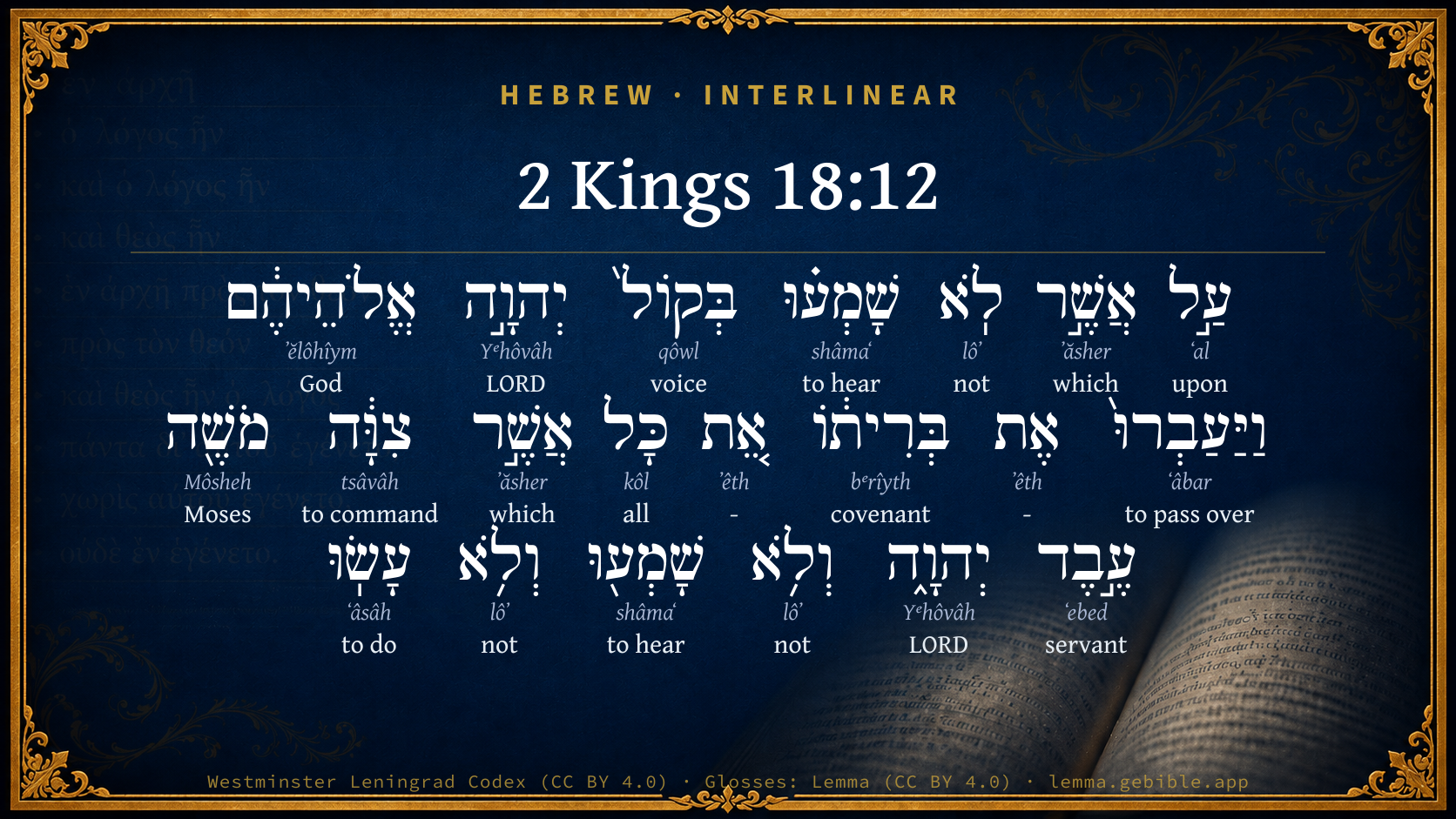
Hebrew (Westminster Leningrad Codex) 2 Kings 18:12 appears in the Hebrew Old Testament. The text above is from the Westminster Leningrad Codex. Each word links to its Strong’s number, a concise gloss, and parsing drawn from the Open Scriptures Hebrew Bible morphology. Click any word for its full Brown-Driver-Briggs (BDB) entry.
Download image
Cite this verse

2 Kings 18:12 (World English Bible). Public Domain. Lemma interlinear Bible study tool, https://lemma.gebible.app/v/2-kings/18/12.

Show BibTeX & RIS
BibTeX
RIS
English Translation
because they didn't obey the voice of Yahweh their God, but transgressed his covenant, even all that Moses the servant of Yahweh commanded, and would not hear it, nor do it.
World English Bible · Public Domain
Download a study sheet

One document with this verse’s original text, its word-by-word gloss line, the meaning frame, cross-references with their text, attributed commentary, and full source and license credits — printable, and it pastes into notes with its structure intact.

This verse Autodidact and up

Study sheet (.html) Plain text (.txt)

A passage Seminary Student

Up to 50 verses in one chapter. A passage sheet keeps up to 6 commentary sources and 12 cross-references per verse, in the order this page ranks them, and says so on the sheet whenever that leaves anything out. Ask for a single verse and you get the Autodidact verse sheet above.

Everything on this page stays free to read, with no account — the sheet is a download of what is already on screen, not access to it.

Want to remove ads? Support Godless Engineer
Compare translations 3

The same verse in 3 English versions, stacked beneath the original-language interlinear above. Click any original word for its lexicon entry.

Each is an independent rendering of the whole verse — the interlinear is not word-aligned to these translations.

Highlighted words mark where these versions differ — a whole-verse word diff, not a word-by-word alignment.

  • World English Bible Public Domain
    because they didn't obey the voice of Yahweh their God, but transgressed his covenant, even all that Moses the servant of Yahweh commanded, and would not hear it, nor do it.
  • King James Version Public Domain
    Because they obeyed not the voice of the LORD their God, but transgressed his covenant, and all that Moses the servant of the LORD commanded, and would not hear them, nor do them.
  • unfoldingWord Literal Text CC BY-SA 4.0
    because they did not listen to the voice of Yahweh their God, but they transgressed his covenant, all that Moses, the servant of Yahweh, had commanded, and they did not listen, and they did not do.

unfoldingWord Literal Text — © unfoldingWord, licensed CC BY-SA 4.0. Word-aligned USFM3 via Door43 (git.door43.org/unfoldingWord/en_ult).

Versions to compare (up to 4)

3 of 4 selected

Show all 18 translations

Every available English version of this verse, each an independent rendering of the whole verse.

  • World English Bible Public Domain
    because they didn't obey the voice of Yahweh their God, but transgressed his covenant, even all that Moses the servant of Yahweh commanded, and would not hear it, nor do it.
  • Berean Standard Bible Public Domain
    This happened because they did not listen to the voice of the LORD their God, but violated His covenant—all that Moses the servant of the LORD had commanded—and would neither listen nor obey.
  • Majority Standard Bible Public Domain
    This happened because they did not listen to the voice of the LORD their God, but violated His covenant—all that Moses the servant of the LORD had commanded—and would neither listen nor obey.
  • King James Version Public Domain
    Because they obeyed not the voice of the LORD their God, but transgressed his covenant, and all that Moses the servant of the LORD commanded, and would not hear them, nor do them.
  • American Standard Version (1901) Public Domain
    because they obeyed not the voice of Jehovah their God, but transgressed his covenant, even all that Moses the servant of Jehovah commanded, and would not hear it, nor do it.
  • Revised Version (1885) Public Domain
    because they obeyed not the voice of the LORD their God, but transgressed his covenant, even all that Moses the servant of the LORD commanded, and would not hear it, nor do it.
  • Geneva Bible (1599) Public Domain
    Because they woulde not obey the voyce of the Lord their God, but transgressed his couenant: that is, all that Moses the seruant of the Lord had commanded, and would neyther obey nor doe them.
  • Douay-Rheims (1899) Public Domain
    Because they hearkened not to the voice of the Lord their God, but transgressed his covenant: all that Moses the servant of the Lord commanded, they would not hear nor do.
  • Young's Literal Translation Public Domain
    because that they have not hearkened to the voice of Jehovah their God, and transgress His covenant -- all that He commanded Moses, servant of Jehovah -- yea, they have not hearkened nor done `it'.
  • Literal Standard Version CC BY-SA 4.0
    because that they have not listened to the voice of their God YHWH, and transgress His covenant—all that He commanded Moses, servant of YHWH—indeed, they have not listened nor done [it].
  • Unlocked Literal Bible CC BY-SA 4.0
    He did this because they did not obey the voice of Yahweh their God, but they violated the terms of his covenant, all that Moses the servant of Yahweh commanded. They refused to listen to it or do it.
  • unfoldingWord Literal Text CC BY-SA 4.0
    because they did not listen to the voice of Yahweh their God, but they transgressed his covenant, all that Moses, the servant of Yahweh, had commanded, and they did not listen, and they did not do.
  • Darby Bible Public Domain
    because they hearkened not to the voice of Jehovah their God, but transgressed his covenant, all that Moses the servant of Jehovah commanded; and they would not hear nor do it.
  • World Messianic Bible Public Domain
    because they didn’t obey the LORD their God’s voice, but transgressed his covenant, even all that Moses the servant of the LORD commanded, and would not hear it or do it.
  • Webster's Bible Public Domain
    Because they obeyed not the voice of the LORD their God, but transgressed his covenant, and all that Moses the servant of the LORD commanded, and would not hear them, nor do them.
  • Free Bible Version CC BY-SA 4.0
    This happened because they refused to listen to the Lord their God and broke his agreement—all that Moses, the Lord's servant, had commanded. They refused to listen and did not obey.
  • Bible in Basic English Public Domain
    Because they did not give ear to the voice of the Lord their God, but went against his agreement, even against everything ordered by Moses, the servant of the Lord, and they did not give ear to it or do it.
  • JPS Tanakh (1917) Public Domain
    because they hearkened not to the voice of the LORD their God, but transgressed His covenant, even all that Moses the servant of the LORD commanded, and would not hear it, nor do it.

Literal Standard Version (2020), Covenant Press — licensed CC BY-SA 4.0. Text via the HelloAO Bible API (eBible.org). Unlocked Literal Bible (unfoldingWord) — licensed CC BY-SA 4.0. Text via the HelloAO Bible API (eBible.org). unfoldingWord Literal Text — © unfoldingWord, licensed CC BY-SA 4.0. Word-aligned USFM3 via Door43 (git.door43.org/unfoldingWord/en_ult). Free Bible Version, Dr. Jonathan Gallagher — licensed CC BY-SA 4.0. Text via the HelloAO Bible API (eBible.org).

Word by word

More ways to search: Search by grammar → Find every occurrence → Compare this word →

Practice this passage: Drill this verse → Learn its vocabulary →

בְּרִית֔וֹ
bᵉrîyth
H1285
“covenant · his”
Noun, Common, Feminine, Singular, Construct + Suffix, Personal, 3rd Person, Masculine, Singular
Part of Speech
Noun
Type
Common
Gender
Feminine
Number
Singular
State
Construct
Full BDB Definition

Origin: from H1262 (in the sense of cutting [like H1254 ])

TWOT: 282a

covenant, alliance, pledge - between men - treaty, alliance, league (man to man) - constitution, ordinance (monarch to subjects) - agreement, pledge (man to man) - alliance (of friendship) - alliance (of marriage) - between God and man - alliance (of friendship) - covenant (divine ordinance with signs or pledges) - (phrases) - covenant making - covenant keeping - covenant violation
  1. עַ֣ל ʻal H5921 “upon” Preposition
  2. אֲשֶׁ֣ר ʼăsher H834 “which” Particle, Relative
  3. לֹֽא lôʼ H3808 “not” Particle, Negative
  4. שָׁמְע֗וּ shâmaʻ H8085 “to hear” Verb, Qal, Perfect, 3rd Person, Common, Plural
  5. בְּקוֹל֙ qôwl H6963 “in/at · voice of” Preposition + Noun, Common, Masculine, Singular, Construct
  6. יְהוָ֣ה Yᵉhôvâh H3068 “LORD” Noun, Proper
  7. אֱלֹהֵיהֶ֔ם ʼĕlôhîym H430 “God(s) · their” Noun, Common, Masculine, Plural, Construct + Suffix, Personal, 3rd Person, Masculine, Plural
  8. וַיַּעַבְרוּ֙ ʻâbar H5674 “and · to pass over” Conjunction + Verb, Qal, Sequential Imperfect, 3rd Person, Masculine, Plural
  9. אֶת ʼêth H853 “-” Particle, Direct Object
  10. אֵ֚ת ʼêth H853 “-” Particle, Direct Object
  11. כָּל kôl H3605 “all of” Noun, Common, Masculine, Singular, Construct
  12. אֲשֶׁ֣ר ʼăsher H834 “which” Particle, Relative
  13. צִוָּ֔ה tsâvâh H6680 “to command” Verb, Piel, Perfect, 3rd Person, Masculine, Singular
  14. מֹשֶׁ֖ה Môsheh H4872 “Moses” Noun, Proper
  15. עֶ֣בֶד ʻebed H5650 “servant of” Noun, Common, Masculine, Singular, Construct
  16. יְהוָ֑ה Yᵉhôvâh H3068 “LORD” Noun, Proper
  17. וְלֹ֥א lôʼ H3808 “and · not” Conjunction + Particle, Negative
  18. שָׁמְע֖וּ shâmaʻ H8085 “to hear” Verb, Qal, Perfect, 3rd Person, Common, Plural
  19. וְלֹ֥א lôʼ H3808 “and · not” Conjunction + Particle, Negative
  20. עָשֽׂוּ ʻâsâh H6213 “to do” Verb, Qal, Perfect, 3rd Person, Common, Plural

About this verse

These counts appear in no published source. They are computed here, from the morphology-tagged text and Lemma’s own curated glosses. What Lemma adds →

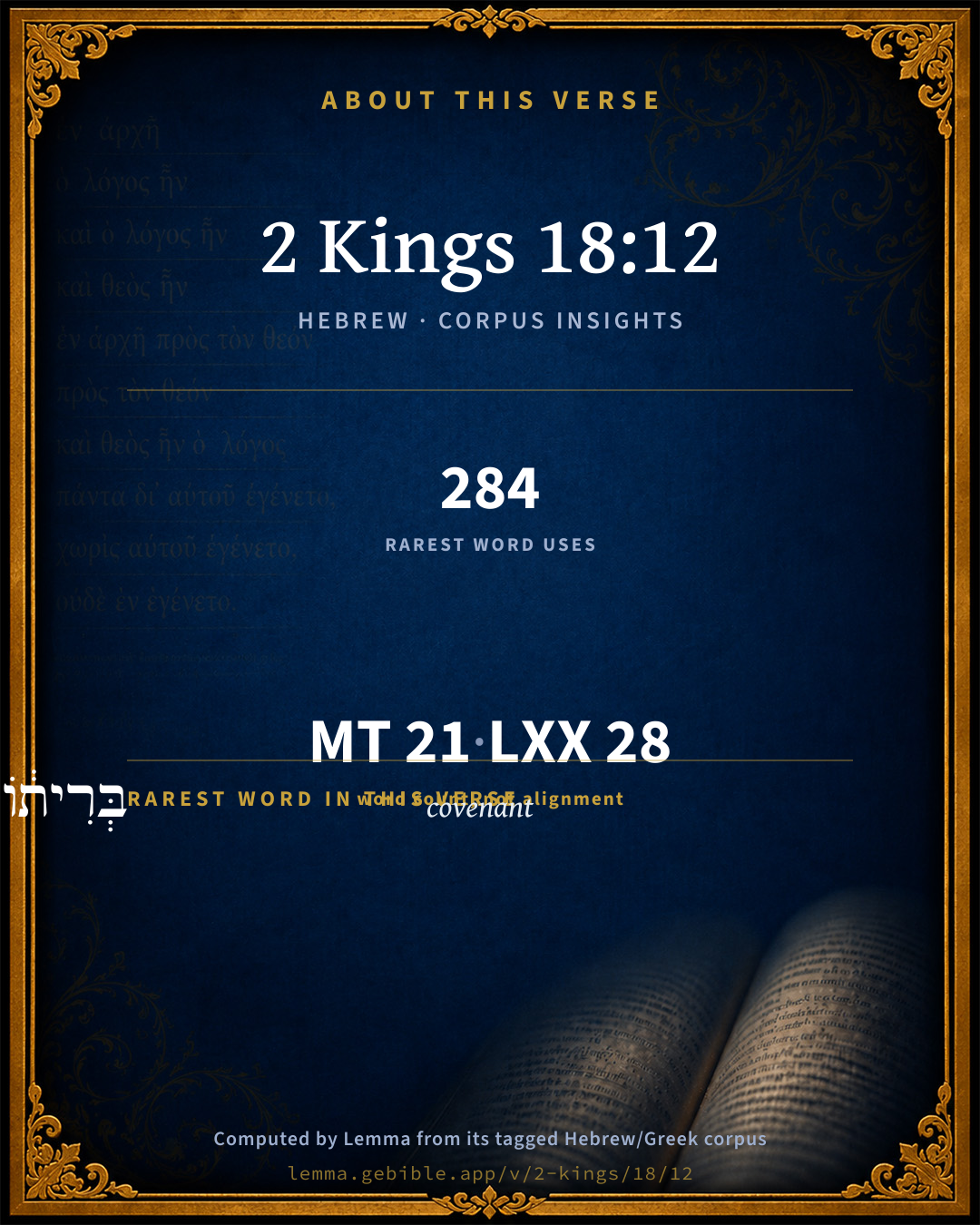
21
words
15
distinct lemmas
Historical
section

Grammatical profile

  • 5 verbs
  • 8 nouns
  • 1 preposition
  • 7 particles

Verb forms

  • שָׁמְע֗וּ Qal · Perfect
  • וַיַּעַבְרוּ֙ Qal · Sequential Imperfect
  • צִוָּ֔ה Piel · Perfect
  • שָׁמְע֖וּ Qal · Perfect
  • עָשֽׂוּ Qal · Perfect

Repetition

Words recur within this verse — often emphatic in Hebrew:

  • שָׁמְע֗וּ to hear H8085 ×2
  • יְהוָ֣ה LORD H3068 ×2
  • לֹֽא not H3808 ×3
  • אֲשֶׁ֣ר which H834 ×2

Hebrew & Septuagint length

In English translation the verse runs 31 words from the Hebrew and 36 from the Septuagint (LXX English) — closely comparable.

A rough comparison of the two English renderings, which tokenize alike — not a word-level alignment.

Word counts can differ between the Hebrew and the Greek without any difference in meaning — e.g. the Hebrew direct-object marker אֵת has no separate Greek word, and Greek often adds the article ὁ.

In the original languages it is 21 Hebrew tokens and 28 Greek tokens — but the two are counted differently (Hebrew bundles its prefixes and suffixes into one token; the Greek is in lemma form), so that isn’t a like-for-like length.

Cross-references

22

Topical passages linked to 2 Kings 18:12 in the Treasury of Scripture Knowledge — connected by theme and wording, ordered by reader-vote popularity; previews shown in the World English Bible.

  • Numbers 12:7 My servant Moses is not so; he is faithful in all my house:
  • Deuteronomy 8:20 As the nations that Yahweh makes to perish before you, so shall you perish; because you wouldn't listen to the voice of Yahweh your God.
  • Deuteronomy 11:28 and the curse, if you shall not listen to the commandments of Yahweh your God, but turn aside out of the way which I command you this day, to go after other gods, which you have not known.
  • Deuteronomy 29:24–28 even all the nations shall say, Why has Yahweh done thus to this land? what means the heat of this great anger?
  • Deuteronomy 31:17 Then my anger shall be kindled against them in that day, and I will forsake them, and I will hide my face from them, and they shall be devoured, and many evils and troubles shall come on them; so that they will say in that day, Haven't these evils come on us because our God is not among us?
  • Deuteronomy 34:5 So Moses the servant of Yahweh died there in the land of Moab, according to the word of Yahweh.
  • Joshua 1:1 Now it happened after the death of Moses the servant of Yahweh, that Yahweh spoke to Joshua the son of Nun, Moses' minister, saying,
  • 1 Kings 9:6 But if you shall turn away from following me, you or your children, and not keep my commandments and my statutes which I have set before you, but shall go and serve other gods, and worship them;
  • 2 Kings 17:7–23 It was so, because the children of Israel had sinned against Yahweh their God, who brought them up out of the land of Egypt from under the hand of Pharaoh king of Egypt, and had feared other gods,
  • Nehemiah 9:17 and refused to obey, neither were mindful of your wonders that you did among them, but hardened their neck, and in their rebellion appointed a captain to return to their bondage. But you are a God ready to pardon, gracious and merciful, slow to anger, and abundant in loving kindness, and didn't forsake them.
  • Nehemiah 9:26–27 Nevertheless they were disobedient, and rebelled against you, and cast your law behind their back, and killed your prophets that testified against them to turn them again to you, and they committed awful blasphemies.
  • Psalms 107:17 Fools are afflicted because of their disobedience, And because of their iniquities.
  • Isaiah 1:19 If you are willing and obedient, You shall eat the good of the land;
  • Jeremiah 3:8 I saw, when, for this very cause that backsliding Israel had committed adultery, I had put her away and given her a bill of divorce, yet treacherous Judah, her sister, didn't fear; but she also went and played the prostitute.
  • Jeremiah 7:23 but this thing I commanded them, saying, Listen to my voice, and I will be your God, and you shall be my people; and walk you in all the way that I command you, that it may be well with you.
  • Daniel 9:6–11 neither have we listened to your servants the prophets, who spoke in your name to our kings, our princes, and our fathers, and to all the people of the land.
  • Micah 3:4 Then they will cry to Yahweh, But he will not answer them. Yes, he will hide his face from them at that time, Because they made their deeds evil."
  • 2 Thessalonians 1:8 giving vengeance to those who don't know God, and to those who don't obey the Gospel of our Lord Jesus,
  • 2 Timothy 2:24 The Lord's servant must not quarrel, but be gentle towards all, able to teach, patient,
  • Hebrews 3:5–6 Moses indeed was faithful in all his house as a servant, for a testimony of those things which were afterward to be spoken,
  • 1 Peter 2:8 and, "A stone of stumbling, and a rock of offense." For they stumble at the word, being disobedient, whereunto also they were appointed.
  • 1 Peter 4:17 For the time has come for judgment to begin at the house of God. If it begins first with us, what will happen to those who don't obey the Gospel of God?

Cross-references courtesy of OpenBible.info (CC BY 4.0).

Hebrew and Greek witnesses Masoretic Hebrew ↔ Greek Septuagint

The same verse in the two great witnesses to the Old Testament, shown verse-for-verse.

These are two independent witnesses, not word-aligned to each other, and the Septuagint is shown in lemma (dictionary) form.

Hebrew 2 Kings 18:12 Masoretic · Westminster Leningrad Codex

עַ֣ל אֲשֶׁ֣ר לֹֽא שָׁמְע֗וּ בְּקוֹל֙ יְהוָ֣ה אֱלֹהֵיהֶ֔ם וַיַּעַבְרוּ֙ אֶת בְּרִית֔וֹ אֵ֚ת כָּל אֲשֶׁ֣ר צִוָּ֔ה מֹשֶׁ֖ה עֶ֣בֶד יְהוָ֑ה וְלֹ֥א שָׁמְע֖וּ וְלֹ֥א עָשֽׂוּ

because they didn't obey the voice of Yahweh their God, but transgressed his covenant, even all that Moses the servant of Yahweh commanded, and would not hear it, nor do it.

World English Bible · Public Domain

Greek LXX 2 Kings 18:12 Septuagint · lemma form

ἀντί ὅς ὅτι οὐ ἀκούω ὁ φωνή κύριος θεός αὐτός καί παραβαίνω ὁ διαθήκη αὐτός πᾶς ὅσος ἐντέλλομαι μωυσῆς ὁ δοῦλος κύριος καί οὐ ἀκούω καί οὐ ποιέω

because they listened not to the voice of the Lord their God, and transgressed his covenant, even in all things that Moses the servant of the Lord commanded, and listened not to them, nor did them.

LXX2012 (modern English Septuagint) · Public Domain

Hebrew: Westminster Leningrad Codex (CC BY 4.0). Greek: Septuagint (public domain); English from LXX2012 (modern English Septuagint) (Public Domain). How the Septuagint differs from the Hebrew →

Targum (Aramaic paraphrase)

1

The Targum is the ancient Jewish Aramaic paraphrase of the Hebrew Scriptures — an interpretive translation, not the Hebrew text itself. Onkelos (literal) and Pseudo-Jonathan (expansive) render the Torah, and Jonathan the Prophets. Coverage is partial: where no permissively-licensed English translation exists for a verse, only the Aramaic is shown. This is verse-level text, not a word-by-word alignment to the Hebrew.

  1. Targum Jonathan Prophets (Joshua–Malachi)
    עַל דְלָא קַבִּילוּ לְמֵימָר דַייָ אֱלָהָהוֹן וַעֲבָדוּ יַת קְיָמֵיהּ יַת כָּל דְפַקֵיד מֹשֶׁה עַבְדָא דַייָ וְלָא קַבִּילוּ לְמֵימְרֵיהּ וְלָא עֲבָדוּ רְעוּתֵיהּ:

    (no public-domain English translation for this verse)

    Targum Jonathan — Aramaic: “Mikraot Gedolot” (public domain). English: “Sefaria Community Translation” (CC0 1.0 (public-domain dedication)); “London "Chaldee Paraphrase," 1871” (public domain). Text via Sefaria.

Commentary

Notes on 2 Kings 18:12 from classic Christian and Jewish commentators (each source and its license shown beneath its notes). The classic Christian expositions comment on the surrounding passage and are grouped to its opening verse, so a note may address several verses; the Jewish commentaries on the Tanakh (Rashi and others) are per-verse, so they appear only where the commentator wrote on this verse.

Lemma curates 59 commentaries, every one of them public domain or Creative Commons licensed, each selected and text-cleaned for this edition rather than reprinted as found. About our sources →

Trapp's Complete Commentary

John Trapp

2Ki 18:12 Because they obeyed not the voice of the LORD their God, but transgressed his covenant, [and] all that Moses the servant of the LORD commanded, and would not hear [them], nor do [them].

Ver. 12. Because they obeyed not.] See 2Ki 17:7-17.

John Trapp, A Commentary or Exposition upon All the Books of the Old and New Testament (1647–1656) — public domain. Text from a community e-Sword module.

Ellicott's Commentary for English Readers

(12) Because they obeyed not . . .—Thenius calls this remark, which properly belongs to the historical abstract from which the compiler drew the narrative of 2Ki_18:1-12, “the theme” which suggested the reflections of 2Ki_17:7-23. They may have been suggested by passages of the Law and Prophets.

And all.—Omit and, with all the versions. “All that Moses . . . commanded” is in apposition with “his covenant.”

And would not . . . do them.—Literally, and hearkened not, and did not.

A Bible Commentary for English Readers, edited by Charles John Ellicott (1878–1897) — public domain. Text from a community e-Sword module.

The Cambridge Bible for Schools and Colleges

gen. ed. J. J. S. Perowne

12. his covenant, and [R.V. even] all that Moses … commanded] Thus R.V. avoids the italics.

the servant of the Lord] This name is often given to Moses in the earlier books. See Deu_34:5, where it is found in the notice of his death. It is specially frequent in the book of Joshua. Cf. Jos_1:1; Jos_1:13; Jos_1:15; Jos_8:31; Jos_8:33; Jos_11:12, &c. In Chronicles also the title is used of him, see 2Ch_1:3; 2Ch_24:6, but in those books he is also called ‘servant of God’ (1Ch_6:49; 2Ch_24:9), and this form is found in Neh_10:29; Dan_9:11; Rev_15:3.

hear them [R. V, it] nor do them [R.V. it] The change is required by reason of the previous alteration in the verse.

At this point terminates the Biblical history of the ten tribes. The people were for the most part carried away, and settled in various places in Assyria, and they never came again to their own land, which continued to be occupied by the settlers introduced by Shalmaneser. Of those who were removed, the most probable fate was that they became mixed up with the people of the various districts in which they were settled, and so their nationality was lost. Some of their descendants we can hardly doubt, joined themselves to their brethren of Judah in the later days when the two tribes also were carried captive by the same power. These would return when the captivity was at an end, and so we find notices in the later history of persons who were members of one or other of the ten tribes. That the number of the tribes was kept in mind we can see from the dedication service after the captivity (Ezr_6:17), where among the sacrifices offered are ‘twelve he-goats according to the number of the tribes of Israel’. In greater or less proportion each tribe must have been thought to be represented at this service. In the Apocryphal books we have mention of the same service in nearly similar words (1Es_7:8). Tobit (Tob_1:1) was of the tribe of Naphtali. In the book of Judith (2Ki_6:15) we read of Ozias the son of Micha of the tribe of Simeon, in St Luke (Luk_2:36) Anna the daughter of Phanuel is of the tribe of Asher, in Acts (Act_26:7) the language of St Paul shews that members of the twelve tribes were believed to be existing among the Jews of Palestine and of the Dispersion; to which twelve tribes St James (Jas_1:1) also addresses his Epistle.

But on the strength of language such as is found in the 2nd book of Esdras (2Es_13:39-50) where the writer speaks of the ten tribes as going forth into a country where mankind had never dwelt, and of their future restoration, various theories have from time to time been started about the discovery of the lost tribes. The words of Josephus (Ant. XI. 5, 2) have helped on such notions. He speaks of the Israelites, i.e. the ten tribes, as existing in his own day in countless myriads beyond the Euphrates. If this statement had been true we should most certainly have found some mention of the people in other writers, of which there is not the slightest trace. Isolated bodies of Jews have no doubt been discovered here and there in the east, but no such community as would answer to the notions, which prevailed early in the Christian era of a large host of Israelites existing in some remote country of the northeast. The latest development of this notion, viz., that the Anglo-Saxon race is identical with the ten tribes, is only the outcome of great ignorance both of history and language. But it does harm because the devout among unlearned persons often grasp at such an idea, and by their absurd clinging thereto bring ridicule upon the rest of their faith, and are also led away from a reasonable and earnest study of the word of God into fanciful interpretations whereby they strive to support their erroneous ideas.

The Cambridge Bible for Schools and Colleges (gen. ed. J. J. S. Perowne; Cambridge University Press, 1878–1918) — public domain. Text from a community e-Sword module.

John Gill's Exposition

And Hezekiah king of Judah sent to the king of Assyria to Lachish,.... A city in the tribe of Judah, about twenty miles from Jerusalem, towards the southwest (q); which the king of Assyria was now besieging, Ch2 32:9 at first Hezekiah made provision to defend himself, and encouraged his people not to be afraid of the king of Assyria, Ch2 32:1, but understanding he had taken his fortified cities, and made such progress with his arms, he was disheartened, and sent an embassy to him to sue for peace; judging it more advisable to buy it than to expose his capital to a siege; in which he betrayed much weakness and distrust of the power and providence of God:

saying, I have offended; not the Lord, but the king of Assyria by rebelling against him, or refusing to pay the yearly tribute to him; he owned he had acted imprudently, and had given him, just occasion to invade his land:

return from me; from his land, from proceeding to Jerusalem, which he seemed to have a design upon, and go back to his own country with his army, and make no further conquests:

that which thou puttest on me I will bear; what mulct or fine he should lay upon him, or tribute he should impose upon him, or whatever he should demand of him, he would submit to:

and the king of Assyria appointed unto Hezekiah king of Judah three hundred talents of silver, and thirty talents of gold; to be paid to him directly; which, according to Brerewood (r), amounted to 247,500 pounds.

(q) Bunting's Travels, &c. p. 99. (r) De Ponder. & Pret. Vet. Num. c. 5.

John Gill's Exposition of the Whole Bible (1746–1763) — public domain (CC PDM 1.0). Text via the HelloAO Bible API.

Matthew Poole's English Annotations

All that Moses the servant of the Lord commanded: they began with one sin, the worship of the calves; but from thence they were led by degrees into the violation of all the other commands; although indeed that one sin made them in some sort guilty of the breach of the whole law, Jam 2:10.

Matthew Poole's English Annotations on the Holy Bible (1683–1685) — public domain. Text from a community e-Sword/MySword module.

The Pulpit Commentary

Because they obeyed not the voice of the Lord their God, but transgressed his covenant, and all that Moses the servant of the Lord commanded, and would not hear them, nor do them. (compare the expanded version of this statement in 2Ki_17:7-23) The sin of Samaria may be summed up under three heads:

(1) disobedience;

(2) breach of the covenant; and

(3) disregard of Moses, and the other "servants of the Lord."

The Pulpit Commentary (1880–1919), ed. H.D.M. Spence-Jones & Joseph S. Exell — public domain. Text from a community e-Sword module.

Lesson kit

Teaching starters — assembled from the data on this page, not authored interpretation. Every prompt links to the verse data it draws on. Edit before teaching.

2 Kings, in the Historical, opens this verse with 21 words (15 distinct Hebrew lemmas). Its most distinctive word is bᵉrîyth (“covenant”). A historical commentator’s framing appears above. Read the whole chapter for the surrounding context.

Discussion questions

  1. How does “covenant” (bᵉrîyth) shape what this verse is saying?
  2. Numbers 12:7 shares this passage’s theme. How do the two illuminate each other?
  3. “to hear” occurs 2× in this one verse. What is the effect of the repetition?
  4. These translations render this verse differently; the difference is in the English rendering, not the original. What questions does that raise?
  5. The verb «שָׁמְע֗וּ» is Qal Perfect. How does its form color the action?
  6. Reading how Trapp's Complete Commentary and Ellicott's Commentary for English Readers read this verse, where do the two commentators agree and where do they part?

Things to notice

Reading settings

Reading text

Shown beneath each verse's original-language words.

Old Testament
Old Testament edition

Read the OT as the Masoretic Hebrew (MT) or the Greek Septuagint (LXX).

English shown for the Greek Septuagint (in the Hebrew ↔ Greek comparison).

Comparing translations? Open the Compare panel on any verse page to stack up to four side by side.