1 Samuel 15:19

Hebrew (Westminster Leningrad Codex) 1 Samuel 15:19 appears in the Hebrew Old Testament. The text above is from the Westminster Leningrad Codex. Each word links to its Strong’s number, a concise gloss, and parsing drawn from the Open Scriptures Hebrew Bible morphology. Click any word for its full Brown-Driver-Briggs (BDB) entry.
Download image
Cite this verse

1 Samuel 15:19 (World English Bible). Public Domain. Lemma interlinear Bible study tool, https://lemma.gebible.app/v/1-samuel/15/19.

Show BibTeX & RIS
BibTeX
RIS
English Translation
Why then didn't you obey the voice of Yahweh, but flew on the spoil, and did that which was evil in the sight of Yahweh?"
World English Bible · Public Domain
Download a study sheet

One document with this verse’s original text, its word-by-word gloss line, the meaning frame, cross-references with their text, attributed commentary, and full source and license credits — printable, and it pastes into notes with its structure intact.

This verse Autodidact and up

Study sheet (.html) Plain text (.txt)

A passage Seminary Student

Up to 50 verses in one chapter. A passage sheet keeps up to 6 commentary sources and 12 cross-references per verse, in the order this page ranks them, and says so on the sheet whenever that leaves anything out. Ask for a single verse and you get the Autodidact verse sheet above.

Everything on this page stays free to read, with no account — the sheet is a download of what is already on screen, not access to it.

Want to remove ads? Support Godless Engineer
Compare translations 3

The same verse in 3 English versions, stacked beneath the original-language interlinear above. Click any original word for its lexicon entry.

Each is an independent rendering of the whole verse — the interlinear is not word-aligned to these translations.

Highlighted words mark where these versions differ — a whole-verse word diff, not a word-by-word alignment.

  • World English Bible Public Domain
    Why then didn't you obey the voice of Yahweh, but flew on the spoil, and did that which was evil in the sight of Yahweh?"
  • King James Version Public Domain
    Wherefore then didst thou not obey the voice of the LORD, but didst fly upon the spoil, and didst evil in the sight of the LORD?
  • unfoldingWord Literal Text CC BY-SA 4.0
    So why did you not listen to the voice of Yahweh? But you swooped down on the plunder, and you did evil in the eyes of Yahweh.”

unfoldingWord Literal Text — © unfoldingWord, licensed CC BY-SA 4.0. Word-aligned USFM3 via Door43 (git.door43.org/unfoldingWord/en_ult).

Versions to compare (up to 4)

3 of 4 selected

Show all 18 translations

Every available English version of this verse, each an independent rendering of the whole verse.

  • World English Bible Public Domain
    Why then didn't you obey the voice of Yahweh, but flew on the spoil, and did that which was evil in the sight of Yahweh?"
  • Berean Standard Bible Public Domain
    So why did you not obey the LORD? Why did you rush upon the plunder and do evil in the sight of the LORD?”
  • Majority Standard Bible Public Domain
    So why did you not obey the LORD? Why did you rush upon the plunder and do evil in the sight of the LORD?”
  • King James Version Public Domain
    Wherefore then didst thou not obey the voice of the LORD, but didst fly upon the spoil, and didst evil in the sight of the LORD?
  • American Standard Version (1901) Public Domain
    Wherefore then didst thou not obey the voice of Jehovah, but didst fly upon the spoil, and didst that which was evil in the sight of Jehovah?
  • Revised Version (1885) Public Domain
    wherefore then didst thou not obey the voice of the LORD, but didst fly upon the spoil, and didst that which was evil in the sight of the LORD?
  • Geneva Bible (1599) Public Domain
    Nowe wherefore hast thou not obeyed the voyce of the Lord, but hast turned to the pray, and hast done wickedly in the sight of the Lord?
  • Douay-Rheims (1899) Public Domain
    Why then didst thou not hearken to the voice of the Lord: but hast turned to the prey, and hast done evil in the eyes of the Lord.
  • Young's Literal Translation Public Domain
    and why hast thou not hearkened to the voice of Jehovah -- and dost fly unto the spoil, and dost do the evil thing in the eyes of Jehovah?'
  • Literal Standard Version CC BY-SA 4.0
    and why have you not listened to the voice of YHWH—and fly to the spoil, and do evil in the eyes of YHWH?”
  • Unlocked Literal Bible CC BY-SA 4.0
    Why did you not obey the voice of Yahweh, but instead you seized the booty and did what was evil in the sight of Yahweh?”
  • unfoldingWord Literal Text CC BY-SA 4.0
    So why did you not listen to the voice of Yahweh? But you swooped down on the plunder, and you did evil in the eyes of Yahweh.”
  • Darby Bible Public Domain
    Why then didst thou not hearken to the voice of Jehovah, but didst fall upon the spoil, and didst evil in the sight of Jehovah?
  • World Messianic Bible Public Domain
    Why then didn’t you obey the LORD’s voice, but took the plunder, and did that which was evil in the LORD’s sight?”
  • Webster's Bible Public Domain
    Why then didst thou not obey the voice of the LORD, but didst fly upon the spoil, and didst evil in the sight of the LORD?
  • Free Bible Version CC BY-SA 4.0
    Why didn't you do what the Lord ordered? Why did you swoop down on the plunder and do what was evil in the Lord's sight?”
  • Bible in Basic English Public Domain
    Why then did you not do the orders of the Lord, but by violently taking their goods did evil in the eyes of the Lord?
  • JPS Tanakh (1917) Public Domain
    Wherefore then didst thou not hearken to the voice of the LORD, but didst fly upon the spoil, and didst that which was evil in the sight of the LORD?'

Literal Standard Version (2020), Covenant Press — licensed CC BY-SA 4.0. Text via the HelloAO Bible API (eBible.org). Unlocked Literal Bible (unfoldingWord) — licensed CC BY-SA 4.0. Text via the HelloAO Bible API (eBible.org). unfoldingWord Literal Text — © unfoldingWord, licensed CC BY-SA 4.0. Word-aligned USFM3 via Door43 (git.door43.org/unfoldingWord/en_ult). Free Bible Version, Dr. Jonathan Gallagher — licensed CC BY-SA 4.0. Text via the HelloAO Bible API (eBible.org).

Word by word

More ways to search: Search by grammar → Find every occurrence → Compare this word →

Practice this passage: Drill this verse → Learn its vocabulary →

וַתַּ֨עַט֙
ʻîyṭ
H5860
“and · to swoop”
Conjunction + Verb, Qal, Sequential Imperfect, 2nd Person, Masculine, Singular
Part of Speech
Conjunction + Verb
Stem
Qal
Form
Sequential Imperfect
Person
2nd Person
Gender
Masculine
Number
Singular
Full BDB Definition

Origin: a primitive root

TWOT: 1610 , 1610b

to scream, shriek - (Qal) to scream - to dart greedily, swoop upon, rush upon - (Qal) to dart greedily
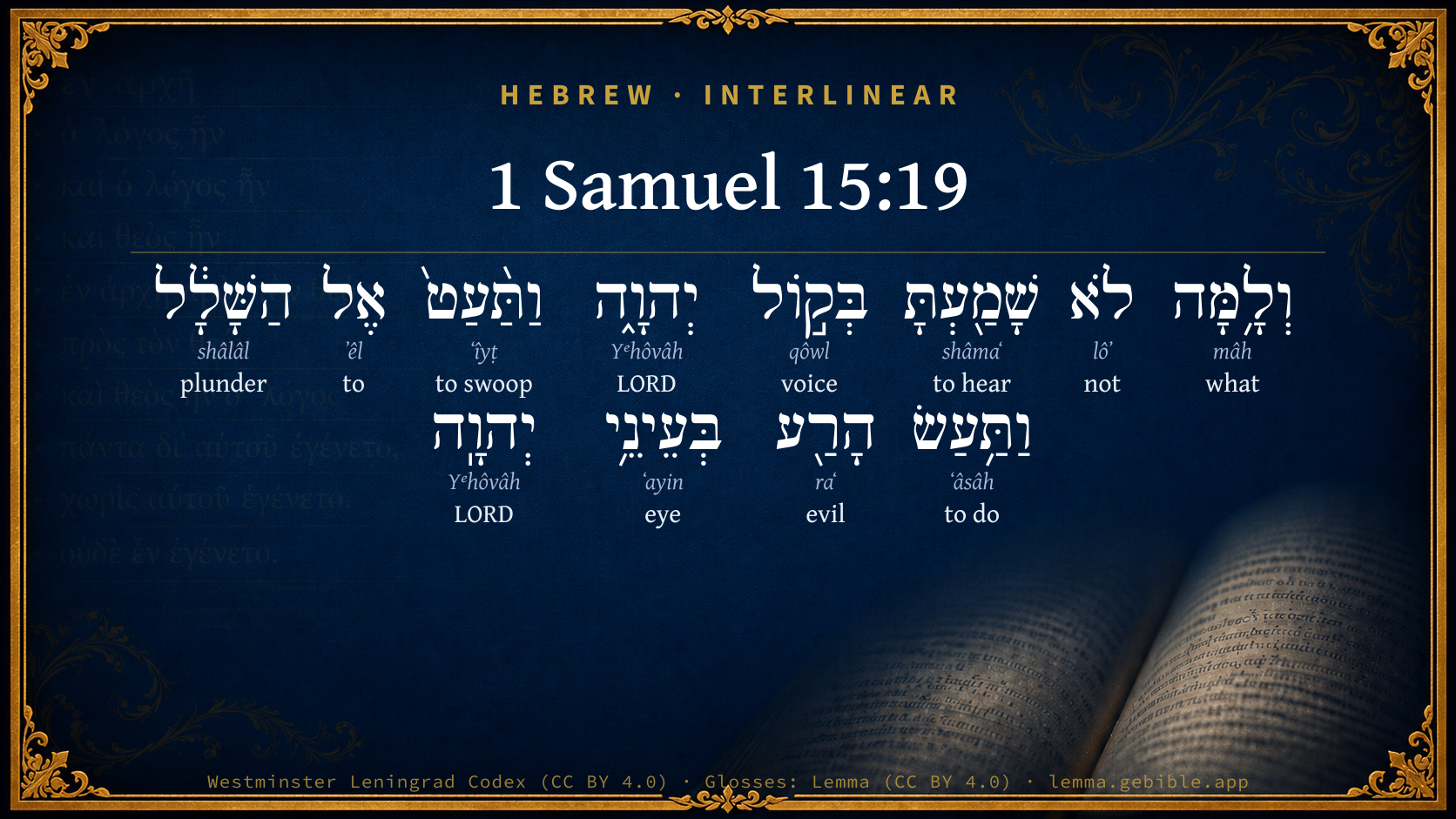
  1. וְלָ֥מָּה mâh H4100 “and · to/for · what” Conjunction + Preposition + Particle, Interrogative
  2. לֹא lôʼ H3808 “not” Particle, Negative
  3. שָׁמַ֖עְתָּ shâmaʻ H8085 “to hear” Verb, Qal, Perfect, 2nd Person, Masculine, Singular
  4. בְּק֣וֹל qôwl H6963 “in/at · voice of” Preposition + Noun, Common, Masculine, Singular, Construct
  5. יְהוָ֑ה Yᵉhôvâh H3068 “LORD” Noun, Proper
  6. אֶל ʼêl H413 “to” Preposition
  7. הַשָּׁלָ֔ל shâlâl H7998 “the · plunder” Particle, Definite Article + Noun, Common, Masculine, Singular, Absolute
  8. וַתַּ֥עַשׂ ʻâsâh H6213 “and · to do” Conjunction + Verb, Qal, Sequential Imperfect, 2nd Person, Masculine, Singular
  9. הָרַ֖ע raʻ H7451 “the · evil” Particle, Definite Article + Adjective, Adjective, Masculine, Singular, Absolute
  10. בְּעֵינֵ֥י ʻayin H5869 “in/at · eyes of” Preposition + Noun, Common, Both, Dual, Construct
  11. יְהוָֽה Yᵉhôvâh H3068 “LORD” Noun, Proper

About this verse

These counts appear in no published source. They are computed here, from the morphology-tagged text and Lemma’s own curated glosses. What Lemma adds →

12
words
11
distinct lemmas
Historical
section

Notable vocabulary

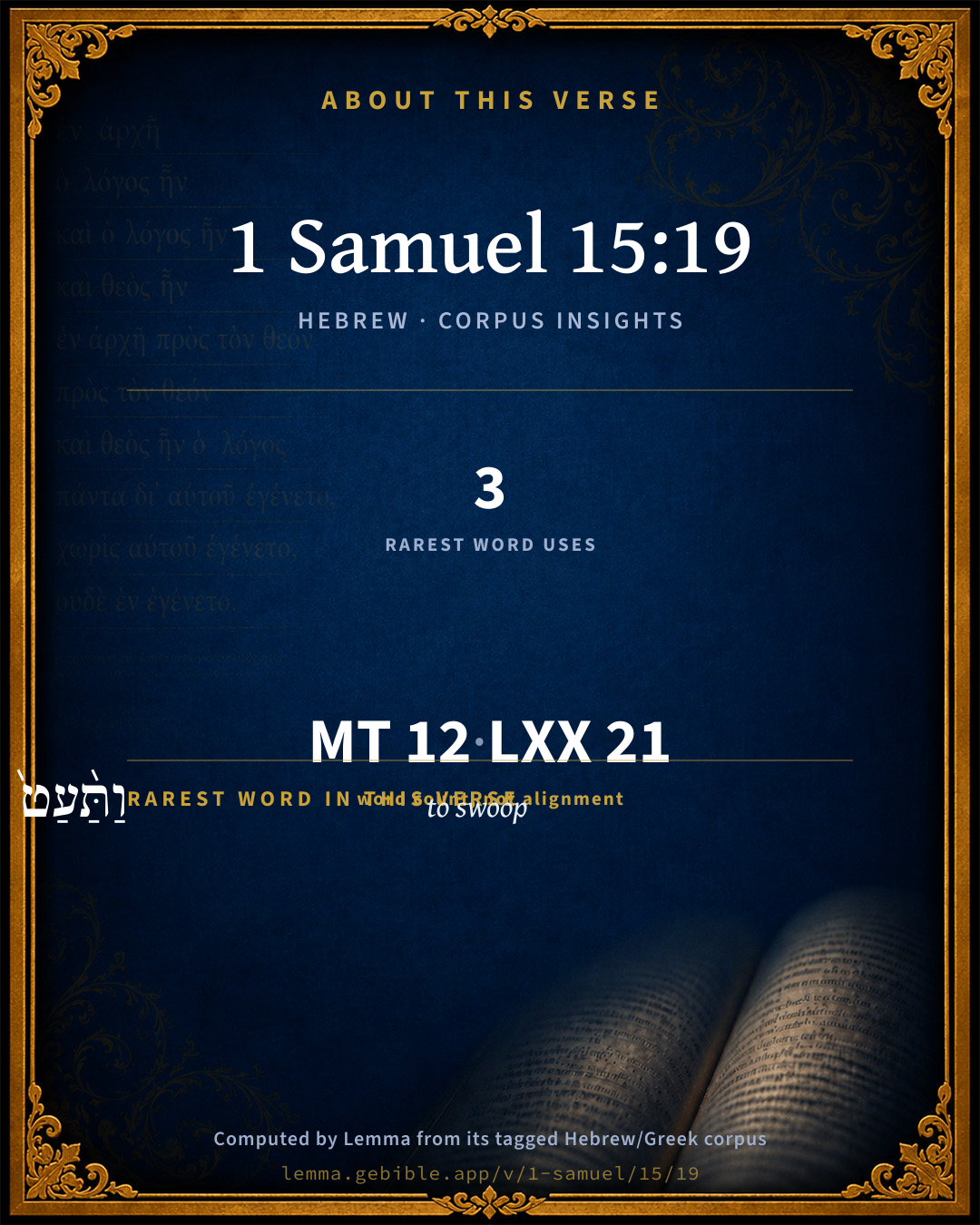
The rarest word here is וַתַּ֨עַט֙ to swoop H5860 — appearing just 3 times in the whole Hebrew Bible.

Shared distinctive vocabulary

וַתַּ֨עַט֙ to swoop H5860 occurs in 3 verses of the Hebrew Bible. Also found in:

Grammatical profile

  • 3 verbs
  • 5 nouns
  • 1 adjective
  • 1 preposition
  • 2 particles

Verb forms

  • שָׁמַ֖עְתָּ Qal · Perfect
  • וַתַּ֨עַט֙ Qal · Sequential Imperfect
  • וַתַּ֥עַשׂ Qal · Sequential Imperfect

Repetition

A word recurs within this verse — often emphatic in Hebrew:

  • יְהוָ֑ה LORD H3068 ×2

Hebrew & Septuagint length

In English translation the verse runs 25 words from the Hebrew and 32 from the Septuagint (LXX English) — closely comparable.

A rough comparison of the two English renderings, which tokenize alike — not a word-level alignment.

Word counts can differ between the Hebrew and the Greek without any difference in meaning — e.g. the Hebrew direct-object marker אֵת has no separate Greek word, and Greek often adds the article ὁ.

In the original languages it is 12 Hebrew tokens and 21 Greek tokens — but the two are counted differently (Hebrew bundles its prefixes and suffixes into one token; the Greek is in lemma form), so that isn’t a like-for-like length.

Cross-references

8

Topical passages linked to 1 Samuel 15:19 in the Treasury of Scripture Knowledge — connected by theme and wording, ordered by reader-vote popularity; previews shown in the World English Bible.

  • 1 Samuel 14:32 and the people flew on the spoil, and took sheep, and oxen, and calves, and killed them on the ground; and the people ate them with the blood.
  • 2 Chronicles 33:2 He did that which was evil in the sight of Yahweh, after the abominations of the nations whom Yahweh cast out before the children of Israel.
  • 2 Chronicles 33:6 He also made his children to pass through the fire in the valley of the son of Hinnom; and he practiced sorcery, and used enchantments, and practiced sorcery, and dealt with those who had familiar spirits, and with wizards: he worked much evil in the sight of Yahweh, to provoke him to anger.
  • 2 Chronicles 36:12 and he did that which was evil in the sight of Yahweh his God; he didn't humble himself before Jeremiah the prophet [speaking] from the mouth of Yahweh.
  • Proverbs 15:27 He who is greedy for gain troubles his own house, But he who hates bribes will live.
  • Jeremiah 7:11 Is this house, which is called by my name, become a den of robbers in your eyes? Behold, I, even I, have seen it, says Yahweh.
  • Habakkuk 2:9–12 Woe to him who gets an evil gain for his house, that he may set his nest on high, that he may be delivered from the hand of evil!
  • 2 Timothy 4:10 for Demas left me, having loved this present world, and went to Thessalonica; Crescens to Galatia, and Titus to Dalmatia.

Cross-references courtesy of OpenBible.info (CC BY 4.0).

Hebrew and Greek witnesses Masoretic Hebrew ↔ Greek Septuagint

The same verse in the two great witnesses to the Old Testament, shown verse-for-verse.

These are two independent witnesses, not word-aligned to each other, and the Septuagint is shown in lemma (dictionary) form.

Hebrew 1 Samuel 15:19 Masoretic · Westminster Leningrad Codex

וְלָ֥מָּה לֹא שָׁמַ֖עְתָּ בְּק֣וֹל יְהוָ֑ה וַתַּ֨עַט֙ אֶל הַשָּׁלָ֔ל וַתַּ֥עַשׂ הָרַ֖ע בְּעֵינֵ֥י יְהוָֽה

Why then didn't you obey the voice of Yahweh, but flew on the spoil, and did that which was evil in the sight of Yahweh?"

World English Bible · Public Domain

Greek LXX 1 Samuel 15:19 Septuagint · lemma form

καί ἵνα τίς οὐ ἀκούω ὁ φωνή κύριος ἀλλά ὁρμάω ὁ τίθημι ἐπί ὁ σκῦλον καί ποιέω ὁ πονηρός ἐνώπιον κύριος

And why did not you listen to the voice of the Lord, but did haste to fasten upon the spoils, and did that which was evil in the sight of the Lord?

LXX2012 (modern English Septuagint) · Public Domain

Hebrew: Westminster Leningrad Codex (CC BY 4.0). Greek: Septuagint (public domain); English from LXX2012 (modern English Septuagint) (Public Domain). How the Septuagint differs from the Hebrew →

Targum (Aramaic paraphrase)

1

The Targum is the ancient Jewish Aramaic paraphrase of the Hebrew Scriptures — an interpretive translation, not the Hebrew text itself. Onkelos (literal) and Pseudo-Jonathan (expansive) render the Torah, and Jonathan the Prophets. Coverage is partial: where no permissively-licensed English translation exists for a verse, only the Aramaic is shown. This is verse-level text, not a word-by-word alignment to the Hebrew.

  1. Targum Jonathan Prophets (Joshua–Malachi)
    וּלְמָא לָא קַבֵּלְתָּא לְמֵימְרָא דַייָ וְאִתְפְּנֵיתָא עַל בִּזְתָא וַעֲבַדְתָּא דְבִישׁ קֳדָם יְיָ:

    (no public-domain English translation for this verse)

    Targum Jonathan — Aramaic: “Mikraot Gedolot” (public domain). English: “Sefaria Community Translation” (CC0 1.0 (public-domain dedication)); “London "Chaldee Paraphrase," 1871” (public domain). Text via Sefaria.

Commentary

Notes on 1 Samuel 15:19 from classic Christian and Jewish commentators (each source and its license shown beneath its notes). The classic Christian expositions comment on the surrounding passage and are grouped to its opening verse, so a note may address several verses; the Jewish commentaries on the Tanakh (Rashi and others) are per-verse, so they appear only where the commentator wrote on this verse.

Lemma curates 59 commentaries, every one of them public domain or Creative Commons licensed, each selected and text-cleaned for this edition rather than reprinted as found. About our sources →

Trapp's Complete Commentary

John Trapp

1Sa 15:19 Wherefore then didst thou not obey the voice of the LORD, but didst fly upon the spoil, and didst evil in the sight of the LORD?

Ver. 19. Wherefore then didst thou … fly upon the spoil?] As a hungry hawk upon his prey. See on 1Sa 15:9.

John Trapp, A Commentary or Exposition upon All the Books of the Old and New Testament (1647–1656) — public domain. Text from a community e-Sword module.

Ellicott's Commentary for English Readers

(19) Didst fly upon the spoil.—The expression used evidently includes the idea of greedy eagerness, as though Samuel detected a spirit of grasping covetousness at the bottom of this disobedient act of Saul’s.

A Bible Commentary for English Readers, edited by Charles John Ellicott (1878–1897) — public domain. Text from a community e-Sword module.

John Gill's Exposition

Wherefore then didst thou not obey the voice of the Lord,.... Who had made him king, and sent him on this errand, and gave him such plain directions, and such strong orders to make an entire consumption of Amalek:

but didst fly upon the spoil; like a bird of prey, such as an eagle or vulture, not to devote it to the Lord, by an entire destruction of it, but to seize it for his own use, as being greedily desirous and covetous of it:

and didst evil in the sight of the Lord? by disobeying his commands, from whose sight nothing can be hid.

John Gill's Exposition of the Whole Bible (1746–1763) — public domain (CC PDM 1.0). Text via the HelloAO Bible API.

Matthew Poole's English Annotations

Who cannot be deceived by thy fair professions of religion, but knows very well that thou didst not seek sacrifices for God, but prey for thyself.

Matthew Poole's English Annotations on the Holy Bible (1683–1685) — public domain. Text from a community e-Sword/MySword module.

Rashi

Rabbi Shlomo Yitzchaki (Rashi)

You rushed. Meaning 'וַתַּעַף' [you flew], an expression related to 'עַיִט' [birds of prey].

Rashi on the Tanakh — English translations: “The Judaica Press complete Tanach with Rashi, translated by A. J. Rosenberg” (CC BY 4.0); “Pentateuch with Rashi's commentary by M. Rosenbaum and A.M. Silbermann, 1929-1934” (public domain); “The Metsudah Tanach series, Lakewood, N.J” (CC BY 4.0); and “The Book of Joshua, Metsudah Publications, 1997” (CC BY 4.0). Text via Sefaria.

Lesson kit

Teaching starters — assembled from the data on this page, not authored interpretation. Every prompt links to the verse data it draws on. Edit before teaching.

1 Samuel, in the Historical, opens this verse with 12 words (11 distinct Hebrew lemmas). Its most distinctive word is ʻîyṭ (“to swoop”). A historical commentator’s framing appears above. Read the whole chapter for the surrounding context.

Discussion questions

  1. How does “to swoop” (ʻîyṭ) shape what this verse is saying?
  2. 1 Samuel 14:32 shares the word «to swoop» with this verse. How do the two illuminate each other?
  3. “LORD” occurs 2× in this one verse. What is the effect of the repetition?
  4. The translations on this page render this verse differently — a whole-verse word diff, not a word-by-word alignment. What might account for the different wordings?
  5. The verb «שָׁמַ֖עְתָּ» is Qal Perfect. How does its form color the action?
  6. Reading how Trapp's Complete Commentary and Ellicott's Commentary for English Readers read this verse, where do the two commentators agree and where do they part?

Things to notice

Reading settings

Reading text

Shown beneath each verse's original-language words.

Old Testament
Old Testament edition

Read the OT as the Masoretic Hebrew (MT) or the Greek Septuagint (LXX).

English shown for the Greek Septuagint (in the Hebrew ↔ Greek comparison).

Comparing translations? Open the Compare panel on any verse page to stack up to four side by side.