2 Kings 11:13

Hebrew (Westminster Leningrad Codex) 2 Kings 11:13 appears in the Hebrew Old Testament. The text above is from the Westminster Leningrad Codex. Each word links to its Strong’s number, a concise gloss, and parsing drawn from the Open Scriptures Hebrew Bible morphology. Click any word for its full Brown-Driver-Briggs (BDB) entry.
Download image
Cite this verse

2 Kings 11:13 (World English Bible). Public Domain. Lemma interlinear Bible study tool, https://lemma.gebible.app/v/2-kings/11/13.

Show BibTeX & RIS
BibTeX
RIS
English Translation
When Athaliah heard the noise of the guard [and of] the people, she came to the people into the house of Yahweh:
World English Bible · Public Domain
Download a study sheet

One document with this verse’s original text, its word-by-word gloss line, the meaning frame, cross-references with their text, attributed commentary, and full source and license credits — printable, and it pastes into notes with its structure intact.

This verse Autodidact and up

Study sheet (.html) Plain text (.txt)

A passage Seminary Student

Up to 50 verses in one chapter. A passage sheet keeps up to 6 commentary sources and 12 cross-references per verse, in the order this page ranks them, and says so on the sheet whenever that leaves anything out. Ask for a single verse and you get the Autodidact verse sheet above.

Everything on this page stays free to read, with no account — the sheet is a download of what is already on screen, not access to it.

Want to remove ads? Support Godless Engineer
Compare translations 3

The same verse in 3 English versions, stacked beneath the original-language interlinear above. Click any original word for its lexicon entry.

Each is an independent rendering of the whole verse — the interlinear is not word-aligned to these translations.

Highlighted words mark where these versions differ — a whole-verse word diff, not a word-by-word alignment.

  • World English Bible Public Domain
    When Athaliah heard the noise of the guard [and of] the people, she came to the people into the house of Yahweh:
  • King James Version Public Domain
    And when Athaliah heard the noise of the guard and of the people, she came to the people into the temple of the LORD.
  • unfoldingWord Literal Text CC BY-SA 4.0
    And Athaliah heard the sound of the runners the people, and she came to the people the house of Yahweh.

unfoldingWord Literal Text — © unfoldingWord, licensed CC BY-SA 4.0. Word-aligned USFM3 via Door43 (git.door43.org/unfoldingWord/en_ult).

Versions to compare (up to 4)

3 of 4 selected

Show all 18 translations

Every available English version of this verse, each an independent rendering of the whole verse.

  • World English Bible Public Domain
    When Athaliah heard the noise of the guard [and of] the people, she came to the people into the house of Yahweh:
  • Berean Standard Bible Public Domain
    When Athaliah heard the noise from the guards and the people, she went out to the people in the house of the LORD.
  • Majority Standard Bible Public Domain
    When Athaliah heard the noise from the guards and the people, she went out to the people in the house of the LORD.
  • King James Version Public Domain
    And when Athaliah heard the noise of the guard and of the people, she came to the people into the temple of the LORD.
  • American Standard Version (1901) Public Domain
    And when Athaliah heard the noise of the guard `and of' the people, she came to the people into the house of Jehovah:
  • Revised Version (1885) Public Domain
    And when Athaliah heard the noise of the guard and of the people, she came to the people into the house of the LORD:
  • Geneva Bible (1599) Public Domain
    And when Athaliah heard the noyse of the running of the people, shee came in to the people in the house of the Lord.
  • Douay-Rheims (1899) Public Domain
    And Athalia heard the noise of the people running: and going in to the people into the temple of the Lord,
  • Young's Literal Translation Public Domain
    And Athaliah heareth the voice of the runners `and' of the people, and she cometh in unto the people, to the house of Jehovah,
  • Literal Standard Version CC BY-SA 4.0
    And Athaliah hears the voice of the runners [and] of the people, and she comes to the people [in] the house of YHWH,
  • Unlocked Literal Bible CC BY-SA 4.0
    When Athaliah heard the noise of the guard and of the people, she came to the people in the house of Yahweh.
  • unfoldingWord Literal Text CC BY-SA 4.0
    And Athaliah heard the sound of the runners the people, and she came to the people the house of Yahweh.
  • Darby Bible Public Domain
    And Athaliah heard the noise of the couriers [and] of the people; and she came to the people into the house of Jehovah.
  • World Messianic Bible Public Domain
    When Athaliah heard the noise of the guard and of the people, she came to the people into the LORD’s house;
  • Webster's Bible Public Domain
    And when Athaliah heard the noise of the guard and of the people, she came to the people into the temple of the LORD.
  • Free Bible Version CC BY-SA 4.0
    When Athaliah heard the noise of the guards and the people, she rushed to the crowds at the Lord's Temple.
  • Bible in Basic English Public Domain
    Now Athaliah, hearing the noise made by the people, came to the people in the house of the Lord;
  • JPS Tanakh (1917) Public Domain
    And when Athaliah heard the noise of the guard and of the people, she came to the people into the house of the LORD.

Literal Standard Version (2020), Covenant Press — licensed CC BY-SA 4.0. Text via the HelloAO Bible API (eBible.org). Unlocked Literal Bible (unfoldingWord) — licensed CC BY-SA 4.0. Text via the HelloAO Bible API (eBible.org). unfoldingWord Literal Text — © unfoldingWord, licensed CC BY-SA 4.0. Word-aligned USFM3 via Door43 (git.door43.org/unfoldingWord/en_ult). Free Bible Version, Dr. Jonathan Gallagher — licensed CC BY-SA 4.0. Text via the HelloAO Bible API (eBible.org).

Word by word

More ways to search: Search by grammar → Find every occurrence → Compare this word →

Practice this passage: Drill this verse → Learn its vocabulary →

עֲתַלְיָ֔ה
ʻĂthalyâh
H6271
“Athaliah”
Noun, Proper
Part of Speech
Noun
Type
Proper
Full BDB Definition

Origin: from the same as H6270 and H3050

TWOT: None

Athaliah = "afflicted of the Lord" - son of Jeroham of the tribe of Benjamin (noun proper masculine) - father of Jeshaiah of the sons of Elam who was one of the heads of a family who returned with Ezra from exile (noun proper masculine) - the daughter of Ahab and Jezebel and the wife of king Jehoram of Judah; killer of all the members of the royal family of Judah with the exception of one baby named Joash who was hidden by the high priest Jehoiada until 6 years had passed and Jehoiada led the revolution to put him on the throne, overthrowing Athaliah and putting her to death (noun proper feminine)
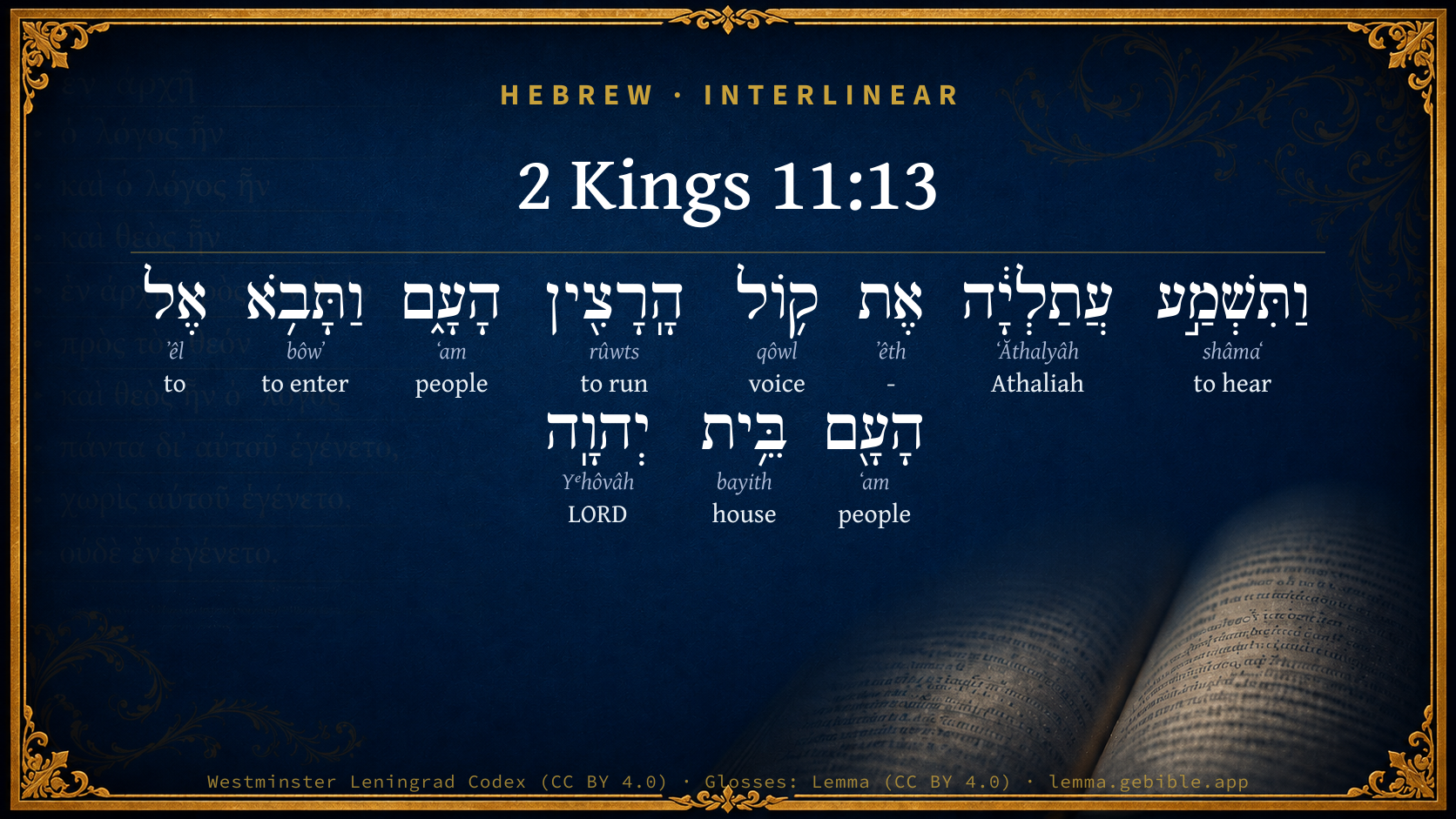
  1. וַתִּשְׁמַ֣ע shâmaʻ H8085 “and · to hear” Conjunction + Verb, Qal, Sequential Imperfect, 3rd Person, Feminine, Singular
  2. אֶת ʼêth H853 “-” Particle, Direct Object
  3. ק֥וֹל qôwl H6963 “voice of” Noun, Common, Masculine, Singular, Construct
  4. הָֽרָצִ֖ין rûwts H7323 “the · running” Particle, Definite Article + Verb, Qal, Participle Active, Masculine, Plural, Absolute
  5. הָעָ֑ם ʻam H5971 “the · people” Particle, Definite Article + Noun, Common, Masculine, Singular, Absolute
  6. וַתָּבֹ֥א bôwʼ H935 “and · to enter” Conjunction + Verb, Qal, Sequential Imperfect, 3rd Person, Feminine, Singular
  7. אֶל ʼêl H413 “to” Preposition
  8. הָעָ֖ם ʻam H5971 “the · people” Particle, Definite Article + Noun, Common, Masculine, Singular, Absolute
  9. בֵּ֥ית bayith H1004 “house of” Noun, Common, Masculine, Singular, Construct
  10. יְהוָֽה Yᵉhôvâh H3068 “LORD” Noun, Proper

About this verse

These counts appear in no published source. They are computed here, from the morphology-tagged text and Lemma’s own curated glosses. What Lemma adds →

11
words
10
distinct lemmas
Historical
section

Notable vocabulary

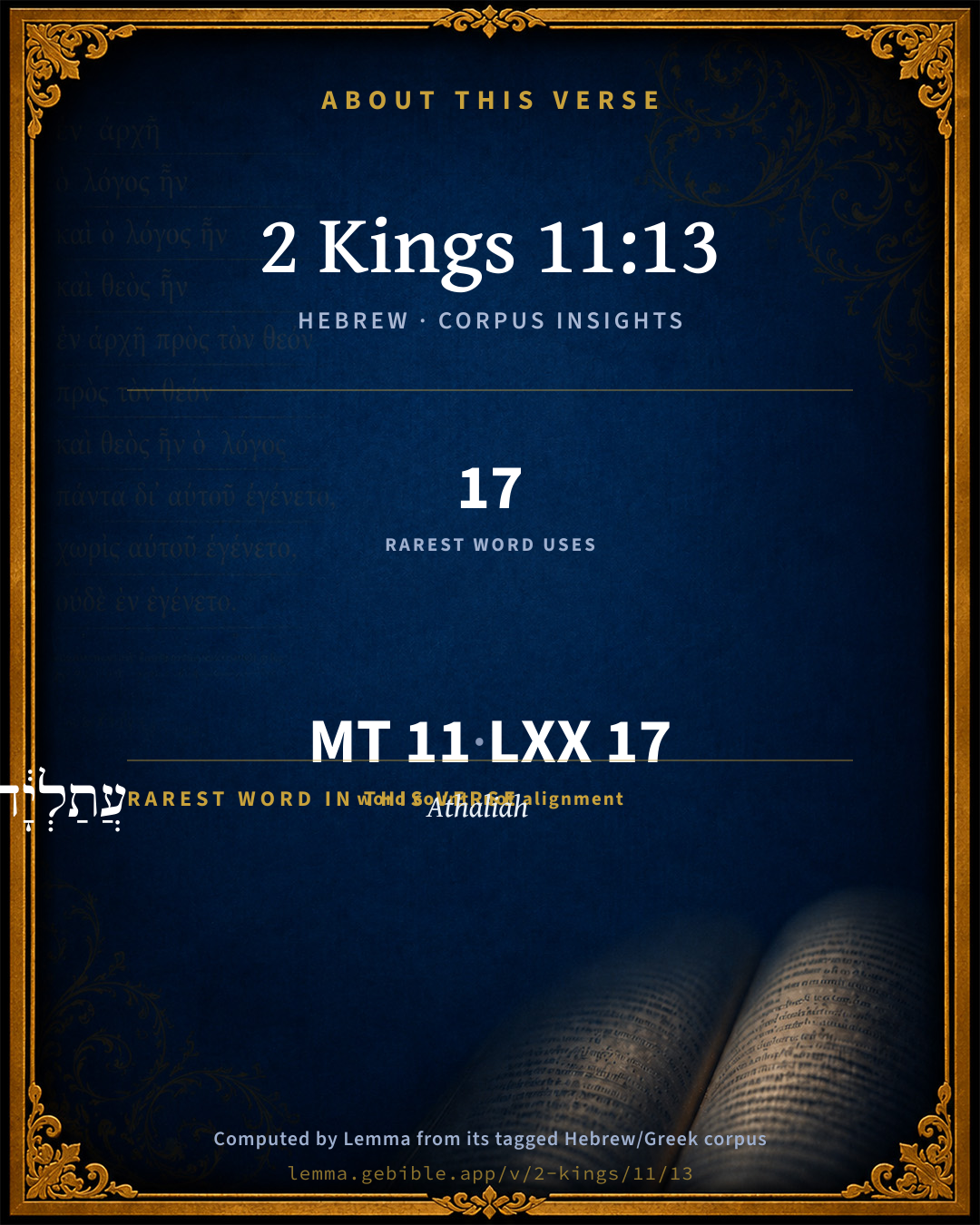
The rarest word here is עֲתַלְיָ֔ה Athaliah H6271 — appearing just 17 times in the whole Hebrew Bible.

Shared distinctive vocabulary

עֲתַלְיָ֔ה Athaliah H6271 occurs in 17 verses of the Hebrew Bible. Also found in:

Grammatical profile

  • 3 verbs
  • 6 nouns
  • 1 preposition
  • 1 particle

Verb forms

  • וַתִּשְׁמַ֣ע Qal · Sequential Imperfect
  • הָֽרָצִ֖ין Qal · Participle Active
  • וַתָּבֹ֥א Qal · Sequential Imperfect

Repetition

A word recurs within this verse — often emphatic in Hebrew:

  • הָעָ֑ם people H5971 ×2

Hebrew & Septuagint length

In English translation the verse runs 22 words from the Hebrew and 22 from the Septuagint (LXX English) — the same length.

A rough comparison of the two English renderings, which tokenize alike — not a word-level alignment.

Word counts can differ between the Hebrew and the Greek without any difference in meaning — e.g. the Hebrew direct-object marker אֵת has no separate Greek word, and Greek often adds the article ὁ.

In the original languages it is 11 Hebrew tokens and 17 Greek tokens — but the two are counted differently (Hebrew bundles its prefixes and suffixes into one token; the Greek is in lemma form), so that isn’t a like-for-like length.

Cross-references

1

Topical passages linked to 2 Kings 11:13 in the Treasury of Scripture Knowledge — connected by theme and wording, ordered by reader-vote popularity; previews shown in the World English Bible.

  • 2 Chronicles 23:12–15 When Athaliah heard the noise of the people running and praising the king, she came to the people into the house of Yahweh:

Cross-references courtesy of OpenBible.info (CC BY 4.0).

Hebrew and Greek witnesses Masoretic Hebrew ↔ Greek Septuagint

The same verse in the two great witnesses to the Old Testament, shown verse-for-verse.

These are two independent witnesses, not word-aligned to each other, and the Septuagint is shown in lemma (dictionary) form.

Hebrew 2 Kings 11:13 Masoretic · Westminster Leningrad Codex

וַתִּשְׁמַ֣ע עֲתַלְיָ֔ה אֶת ק֥וֹל הָֽרָצִ֖ין הָעָ֑ם וַתָּבֹ֥א אֶל הָעָ֖ם בֵּ֥ית יְהוָֽה

When Athaliah heard the noise of the guard [and of] the people, she came to the people into the house of Yahweh:

World English Bible · Public Domain

Greek LXX 2 Kings 11:13 Septuagint · lemma form

καί ἀκούω γοθολια ὁ φωνή ὁ τρέχω ὁ λαός καί εἰςἔρχομαι πρός ὁ λαός εἰς οἶκος κύριος

And Gotholia heard the sound of the people running, and she went in to the people to the house of the Lord.

LXX2012 (modern English Septuagint) · Public Domain

Hebrew: Westminster Leningrad Codex (CC BY 4.0). Greek: Septuagint (public domain); English from LXX2012 (modern English Septuagint) (Public Domain). How the Septuagint differs from the Hebrew →

Targum (Aramaic paraphrase)

1

The Targum is the ancient Jewish Aramaic paraphrase of the Hebrew Scriptures — an interpretive translation, not the Hebrew text itself. Onkelos (literal) and Pseudo-Jonathan (expansive) render the Torah, and Jonathan the Prophets. Coverage is partial: where no permissively-licensed English translation exists for a verse, only the Aramaic is shown. This is verse-level text, not a word-by-word alignment to the Hebrew.

  1. Targum Jonathan Prophets (Joshua–Malachi)
    וּשְׁמַעַת עֲתַלְיָה יַת קַל דְרַקְדָנִין עַמָא וַאֲתָת לְוַת עַמָא לְבֵית מַקְדְשָׁא דַיָי:

    (no public-domain English translation for this verse)

    Targum Jonathan — Aramaic: “Mikraot Gedolot” (public domain). English: “Sefaria Community Translation” (CC0 1.0 (public-domain dedication)); “London "Chaldee Paraphrase," 1871” (public domain). Text via Sefaria.

Commentary

Notes on 2 Kings 11:13 from classic Christian and Jewish commentators (each source and its license shown beneath its notes). The classic Christian expositions comment on the surrounding passage and are grouped to its opening verse, so a note may address several verses; the Jewish commentaries on the Tanakh (Rashi and others) are per-verse, so they appear only where the commentator wrote on this verse.

Lemma curates 59 commentaries, every one of them public domain or Creative Commons licensed, each selected and text-cleaned for this edition rather than reprinted as found. About our sources →

Matthew Henry's Commentary

We may suppose it was designed when they had finished the solemnity of the king's inauguration, to pay a visit to Athaliah, and call her to an account for her murders, usurpation, and tyranny; but, like her mother Jezebel, she saved them the labour, went out to meet them, and hastened her own destruction. 1. Hearing the noise, she came in a fright to see what was the matter, Kg2 11:13. Jehoiada and his friends began in silence, but now that they found their strength, they proclaimed what they were doing. It seems, Athaliah was little regarded, else she would have had intelligence brought her of this daring attempt before with her own ears she heard the noise; had the design been discovered before it was perfected, it might have been quashed, but now it was too late. When she heard the noise it was strange that she was so ill advised as to come herself, and, for aught that appears, to come alone. Surely she was not so neglected as to have none to go for her, or none to go with her, but she was wretchedly infatuated by the transport both of fear and indignation she was in. Whom God will destroy he befools. 2. Seeing what was done she cried out for help. She saw the king's place by the pillar possessed by one to whom the princes and people did homage (Kg2 11:14) and had reason to conclude her power at an end, which she knew was usurped; this made her rend her clothes, like one distracted, and cry, "Treason! treason! Come and help against the traitors." Josephus adds that she cried to have him killed that possessed the king's place. What was now doing was the highest justice, yet it was branded as the highest crime; she herself was the greatest traitor, and yet was first and loudest in crying Treason! treason! Those that are themselves most guilty are commonly most forward to reproach others. 3. Jehoiada gave orders to put her to death as an idolater, a usurper, and an enemy to the public peace. Care was taken, (1.) That she should not be killed in the temple, or any of the courts of it, in reverence to that holy place, which must not be stained with the blood of any human sacrifice, though ever so justly offered. (2.) That whoever appeared for her should die with her: "Him that follows her, to protect or rescue her, any of her attendants that resolve to adhere to her and will not come into the interests of their rightful sovereign, kill with the sword, but not unless they follow her now," Kg2 11:15. According to these orders, she endeavouring to make her escape the back way to the palace, through the stalls, they pursued her, and there killed her, Kg2 11:16. So let thy enemies perish, O Lord! thus give the bloody harlot blood to drink, for she is worthy.

Matthew Henry's Commentary on the Whole Bible (1708–1710) — public domain (CC PDM 1.0). Text via the HelloAO Bible API.

Jamieson, Fausset & Brown

Robert Jamieson, A. R. Fausset & David Brown

ATHALIAH SLAIN. (Kg2 11:13-16)

Athaliah heard the noise of the guard and of the people--The profound secrecy with which the conspiracy had been conducted rendered the unusual acclamations of the vast assembled crowd the more startling and roused the suspicions of the tyrant.

she came . . . into the temple of the Lord--that is, the courts, which she was permitted to enter by Jehoiada's directions (Kg2 11:8) in order that she might be secured.

Jamieson, Fausset & Brown — Commentary Critical and Explanatory on the Whole Bible (1871) — public domain (CC PDM 1.0). Text via the HelloAO Bible API.

Trapp's Complete Commentary

John Trapp

2Ki 11:13 And when Athaliah heard the noise of the guard [and] of the people, she came to the people into the temple of the LORD.

Ver. 13. And when Athaliah heard.] See on 2Ki 11:1.

She came to the people.] Without any mistrust or fear; but not without a special providence, that the warders might have her in their power.

John Trapp, A Commentary or Exposition upon All the Books of the Old and New Testament (1647–1656) — public domain. Text from a community e-Sword module.

Joseph Benson's Commentary

2Ki 11:13. She came to the people — To inquire into the cause of this great noise; being hitherto kept in deep ignorance, because the affair was managed with so much secrecy, and in the temple; and because the people universally hated her, and wished her downfall. Into the temple of the Lord — That is, into the courts, into which, being a queen, she was permitted to enter, though contrary to the general order, 2Ki 11:8. She seems, in her fright, to have come alone, or with but few attendants.

Joseph Benson's Commentary on the Old and New Testaments (1811–1818) — public domain. Text from a community e-Sword module.

Tyndale Open Study Notes

Tyndale Open Resources

11:13-14 The pillar may be one of the two pillars that Solomon erected at the Temple entrance (1 Kgs 7:15-22; 2 Chr 23:13), or the Hebrew term could mean a raised platform set in place for the occasion so that the new king could be seen by all. • Athaliah’s cry of treason is ironic, considering her own treasonous murders to seize the throne (2 Kgs 11:1).

Tyndale Open Study Notes — © Tyndale Open Resources, licensed CC BY-SA 4.0. Text via the HelloAO Bible API.

Ellicott's Commentary for English Readers

(13) Of the guard and of the people.—This is correct. The and has fallen out of the Hebrew text.

The guard.—The Aramaic form of the plural, rare in prose, occurs here. (Comp. 1Ki_11:33.) In 2Ch_23:11 the words are transposed. This gives a different sense—viz., “of the people running together” to which is added, “and acclaiming the king.” The chronicler may have found this in the work he followed, but the text before us seems preferable, as the word “runners” (Couriers) throughout the account means the royal guard.

The people.—See Note on 2Ki_11:14.

She came . . . into the temple.—Evidently, therefore, the palace was hard by the Temple. (See Note on 2Ki_11:16.)

A Bible Commentary for English Readers, edited by Charles John Ellicott (1878–1897) — public domain. Text from a community e-Sword module.

The Cambridge Bible for Schools and Colleges

gen. ed. J. J. S. Perowne

13. And when Athaliah heard the noise] The arrangements had all been made so cautiously that the queen-mother had no knowledge of what was being done. But we may suppose that ere long the report would reach her through her attendants, and so she went, where otherwise she was not wont to go, toward the house of the Lord. Unless she had thought it some matter of grave concern we cannot fancy her going out to put an end by her presence, if possible, to the proceeding. Josephus’ account is that ‘having heard the tumult and applause unexpectedly, Athaliah was greatly troubled, and hastened with her private troops from the palace: that the priests admitted her into the temple area, but prevented the armed men who were with her from entering’. The Bible narratives do not speak of a guard accompanying Athaliah, but it is not likely that she would go forth on such an errand without one, though the influence of a queen-mother was very powerful.

of the guard and of the people] There is no conjunction in the Hebrew, and the guard were the ‘runners’ spoken of above. The narrative in Chronicles transposes the two words, and the rendering there is ‘of the people running’, but probably the conjunction is wanting in both cases through the error of the scribe. So in 2Ch_23:2 the R.V. has put on the margin ‘of the people, of the guard and of those who praised the king’.

she came to the people into the temple [R.V. house] of the Lord] The assembly was a notable one and seems to have been at the time of some feast which had brought a more than usually great concourse to Jerusalem.

The Cambridge Bible for Schools and Colleges (gen. ed. J. J. S. Perowne; Cambridge University Press, 1878–1918) — public domain. Text from a community e-Sword module.

John Gill's Exposition

And when she looked, behold, the king stood by a pillar, as the manner was,.... Of kings, when they came into the temple on any occasion, civil or religious, therefore it is called his pillar, Ch2 23:13, some think this was the brazen scaffold erected by Solomon, Ch2 6:13, though Vitringa (e) and Bishop Patrick suppose it to be the post of the east gate of the inner court, from Eze 46:2, according to Jacob Leo (f), this was the royal throne in the court of the Israelites, near the high or upper gate, on a marble pillar, where the kings of the house of David sat, when they came into the sanctuary to see the Lord in the second temple; this throne was like an high tower, standing upon two pillars, each twenty cubits high, and their circumference twelve; here sat Joash, and Hezekiah, and Josiah; however, Athaliah saw Jehoash with the crown on his head, and in the place where kings used to sit or stand:

and the princes and the trumpeters by the king; the rulers of the courses of the priests, and the Levites, blowing the trumpets:

and all the people of the land rejoiced, and blew with trumpets; it is added, in Ch2 23:13 that the singers played also on musical instruments; that were then and there assembled:

and Athaliah rent her clothes; through grief, and as one almost distracted:

and cried, treason, treason! to try if she could get any to take her part, and seize on the new king, and those that set him up.

(e) Proleghom. de Synagog. Vet. c. 4. p. 32. (f) Apud Wagenseil. Sotah, p. 680.

John Gill's Exposition of the Whole Bible (1746–1763) — public domain (CC PDM 1.0). Text via the HelloAO Bible API.

Haydock's Catholic Bible Commentary

Going in. She must have been attended by a strong guard, to force the passage through the Levites at the door. (Haydock)

George Leo Haydock (1774–1849), Haydock's Catholic Family Bible and Commentary, 1859 edition — public domain. Excludes Psalms (Douay-Rheims chapter numbering differs from Protestant) and Deuterocanonical books (Catholic canon only).

Matthew Poole's English Annotations

The noise of the people, who came thither upon the hearing of the noise and tidings of what was done.

She came to the people, to inquire into the cause of this great noise; being hitherto kept in deep ignorance; partly because it wits managed with so much secrecy, and in the temple; and partly because the people universally hated her, and wished her downfall.

Into the temple of the Lord, i.e. into the courts; whither by Jehoiada’s direction she was permitted to enter, though contrary to his general order, 2Ki 11:8, that so he might draw her into his net.

Matthew Poole's English Annotations on the Holy Bible (1683–1685) — public domain. Text from a community e-Sword/MySword module.

The Pulpit Commentary

And when Athaliah heard the noise of the guard. (comp. 1Ki_1:41-45, where the noise accompanying the coronation of Solomon was heard to an equal distance) and of the people. The "and," which is omitted in the present Hebrew text, may be supplied by a very slight alteration. We have only to read yxirh for yxrh an emendation rendered almost certain by the fact that the plural in YA does not belong to the date of the writer of Kings. She came to the people into the temple of the Lord. It was not her habit to enter the temple on the sabbath, or on any ether day; but, hearing the noise, she hurried across from the palace to learn its cause. It would seem that she was still unsuspicious of danger, and brought no guards with her, nor any large body of attendants.

The Pulpit Commentary (1880–1919), ed. H.D.M. Spence-Jones & Joseph S. Exell — public domain. Text from a community e-Sword module.

Kretzmann's Popular Commentary

Paul E. Kretzmann

Athaliah Slain

v. 13. And when Athaliah heard the noise of the guard and of the people, as they hailed the king with delight, she came to the people into the Temple of the Lord, driven by curiosity, to find out what the outcry was about.

v. 14. And when she looked, behold, the king, who was still a very young boy, stood by a pillar, as the manner was, at the place reserved for the king by ancient usage, apparently a platform, and the princes and the trumpeters by the king, the latter being Levites or priests blowing the Temple trumpets, as on festival occasions, and all the people of the land rejoiced and blew with trumpets. And Athaliah, who took in the situation at a glance, rent her clothes, in great fear and terror, and cried, Treason, treason!

v. 15. But Jehoiada, the priest, commanded the captains of the hundreds, the officers of the host, and said unto them, Have her forth without the ranges, they should lead her out through the ranks, so that she would not be able to communicate with any adherents; and him that followeth her, making a show of taking her part, kill with the sword. For the priest had said, Let her not be slain in the house of the Lord, which would have been desecrated by the blood of the usurper and murderess.

v. 16. And they laid hands on her, they made way for her to escort her out; and she went by the way by the which the horses came into the king’s house, inside the city walls; and there was she slain.

v. 17. And Jehoiada made a covenant between the Lord and the king and the people that they should be the Lord’s people; he solemnly renewed the covenant which had been broken by the idolatry of Athaliah, between the king also and the people, pledging the king to rule according to the Law and the people to give a cheerful obedience to their lawful ruler.

v. 18. And all the people of the land went into the house of Baal, the temple which had been erected to the heathen idol at Jerusalem, and brake it down; his altars and his images brake they in pieces thoroughly, thus removing all the evidences of idol worship in the city of God, and slew Mattan, the priest of Baal, before the altars. And the priest, Jehoiada,appointed officers over the house of the Lord, thus renewing the position of overseers which had been created by David, 1 Chronicles 25.

v. 19. And he took the rulers over hundreds, and the captains, and the guard, and all the people of the land; and they brought down the king from the house of the Lord, and came by the way of the gate of the guard, the chief entrance to the royal palace, to the king’s house. And he sat on the throne of the kings, as acknowledged ruler of the kingdom of Judah.

v. 20. And all the people of the land rejoiced, and the city was in quiet. And they slew Athaliah with the sword beside the king’s house, none of her adherents daring to resent her execution or to venture a hostile demonstration.

v. 21. Seven years old was Jehoash when he began to reign. The last member of the house of Ahab was now removed, and the legitimate authority of the house of David was restored. The Church of God usually emerges from persecutions intended to take her last strength filled with new power and zeal for the pure Word and Sacraments.

Paul E. Kretzmann, Popular Commentary of the Bible (1921–1924) — public domain. Text from a community e-Sword module.

unfoldingWord translationNotes

Door43 World Missions Community

the noise of the guard

This refers to the noise made by all the soldiers.

she came to the people in the house of Yahweh

"she came to where the people had gathered at the temple"

She looked, and, behold, the king was standing

"When she arrived, she was surprised to see King Joash standing"

by the pillar

"by one of the pillars of the temple"

as the custom was

"which was the usual place for the king to stand"

the trumpeters

"the people who played the trumpets"

Athaliah tore her clothes

She tore her clothes to express that she was very upset and angry. (See: Symbolic Action)

Treason! Treason!

"You are traitors! You have betrayed me!"

translationWords

Athaliah

column

joy

trumpet

unfoldingWord translationNotes — © Distant Shores Media and the Door43 World Missions Community, licensed CC BY-SA 4.0. Source: git.door43.org/Door43/en_tn.

Lesson kit

Teaching starters — assembled from the data on this page, not authored interpretation. Every prompt links to the verse data it draws on. Edit before teaching.

2 Kings, in the Historical, opens this verse with 11 words (10 distinct Hebrew lemmas). Its most distinctive word is ʻĂthalyâh (“Athaliah”). A historical commentator’s framing appears above. Read the whole chapter for the surrounding context.

Discussion questions

  1. The word ʻĂthalyâh carries the sense “Athaliah.” How does it shape the verse?
  2. 2 Kings 8:26 shares the word «Athaliah» with this verse. How do the two illuminate each other?
  3. “people” occurs 2× in this one verse. What is the effect of the repetition?
  4. These translations render this verse differently; the difference is in the English rendering, not the original. What questions does that raise?
  5. The verb «וַתִּשְׁמַ֣ע» is Qal Sequential Imperfect. How does its form color the action?
  6. Reading how Matthew Henry's Commentary and Jamieson, Fausset & Brown read this verse, where do the two commentators agree and where do they part?

Things to notice

Reading settings

Reading text

Shown beneath each verse's original-language words.

Old Testament
Old Testament edition

Read the OT as the Masoretic Hebrew (MT) or the Greek Septuagint (LXX).

English shown for the Greek Septuagint (in the Hebrew ↔ Greek comparison).

Comparing translations? Open the Compare panel on any verse page to stack up to four side by side.