Exodus 32:17

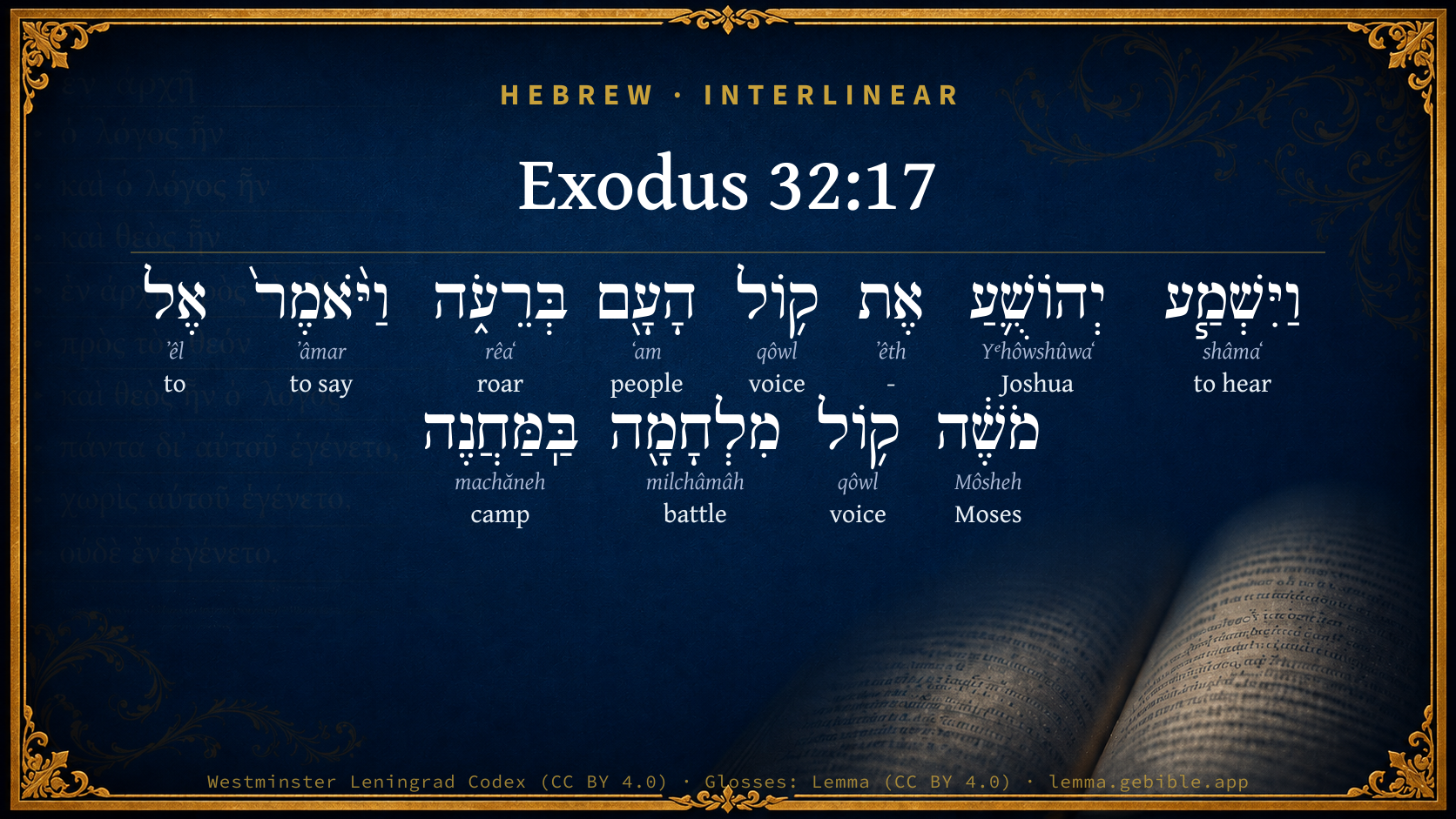
Hebrew (Westminster Leningrad Codex) Exodus 32:17 appears in the Hebrew Old Testament. The text above is from the Westminster Leningrad Codex. Each word links to its Strong’s number, a concise gloss, and parsing drawn from the Open Scriptures Hebrew Bible morphology. Click any word for its full Brown-Driver-Briggs (BDB) entry.
Download image
Cite this verse

Exodus 32:17 (World English Bible). Public Domain. Lemma interlinear Bible study tool, https://lemma.gebible.app/v/exodus/32/17.

Show BibTeX & RIS
BibTeX
RIS
English Translation
When Joshua heard the noise of the people as they shouted, he said to Moses, "There is the noise of war in the camp."
World English Bible · Public Domain
Highlights
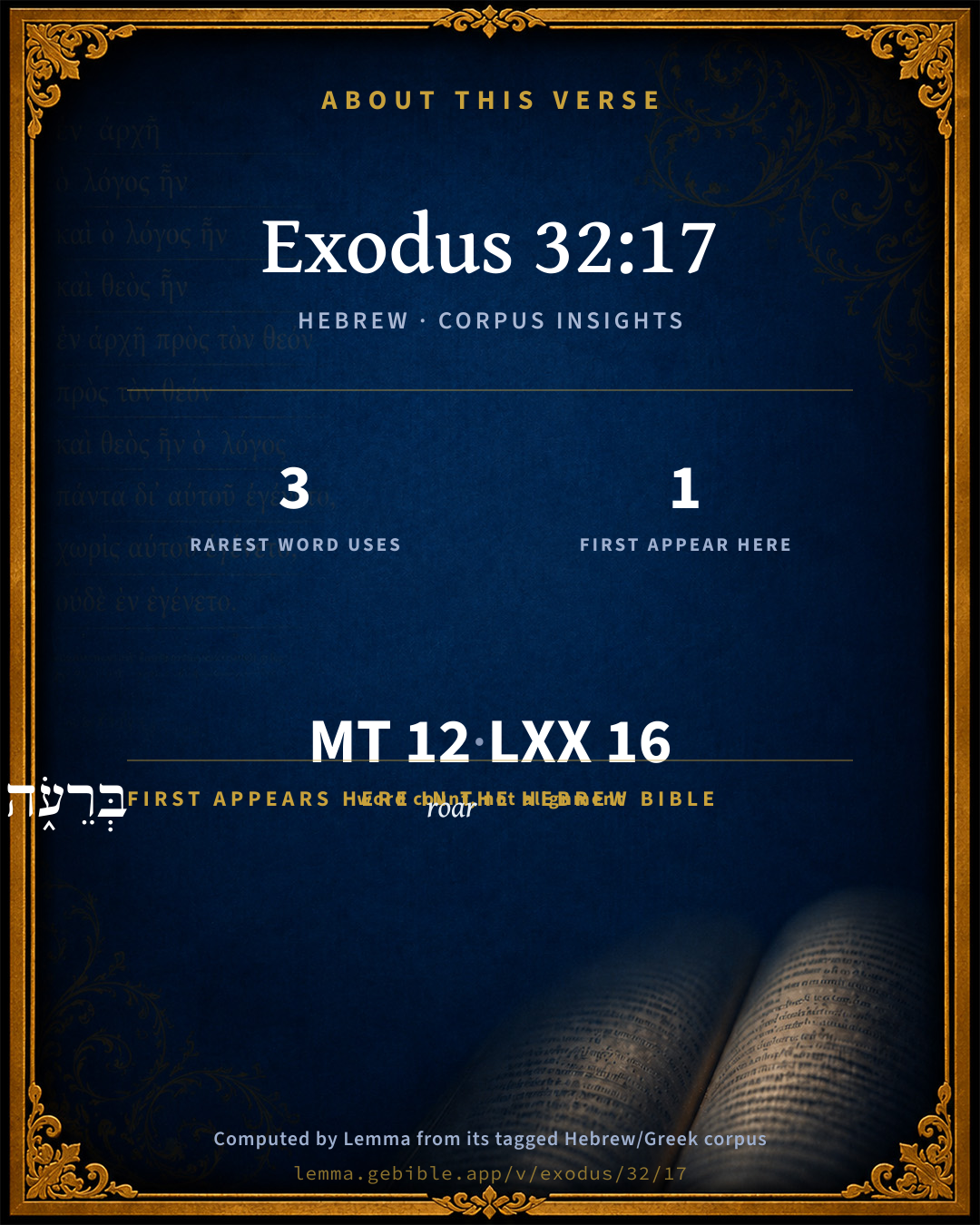
  • 1 first appearance in the Hebrew Bible
Full analysis ↓
Download a study sheet

One document with this verse’s original text, its word-by-word gloss line, the meaning frame, cross-references with their text, attributed commentary, and full source and license credits — printable, and it pastes into notes with its structure intact.

This verse Autodidact and up

Study sheet (.html) Plain text (.txt)

A passage Seminary Student

Up to 50 verses in one chapter. A passage sheet keeps up to 6 commentary sources and 12 cross-references per verse, in the order this page ranks them, and says so on the sheet whenever that leaves anything out. Ask for a single verse and you get the Autodidact verse sheet above.

Everything on this page stays free to read, with no account — the sheet is a download of what is already on screen, not access to it.

Want to remove ads? Support Godless Engineer
Compare translations 3

The same verse in 3 English versions, stacked beneath the original-language interlinear above. Click any original word for its lexicon entry.

Each is an independent rendering of the whole verse — the interlinear is not word-aligned to these translations.

Highlighted words mark where these versions differ — a whole-verse word diff, not a word-by-word alignment.

  • World English Bible Public Domain
    When Joshua heard the noise of the people as they shouted, he said to Moses, "There is the noise of war in the camp."
  • King James Version Public Domain
    And when Joshua heard the noise of the people as they shouted, he said unto Moses, There is a noise of war in the camp.
  • unfoldingWord Literal Text CC BY-SA 4.0
    And Joshua heard the noise of the people in its shouting, and he said to Moses, “ the noise of war in the camp.”

unfoldingWord Literal Text — © unfoldingWord, licensed CC BY-SA 4.0. Word-aligned USFM3 via Door43 (git.door43.org/unfoldingWord/en_ult).

Versions to compare (up to 4)

3 of 4 selected

Show all 18 translations

Every available English version of this verse, each an independent rendering of the whole verse.

  • World English Bible Public Domain
    When Joshua heard the noise of the people as they shouted, he said to Moses, "There is the noise of war in the camp."
  • Berean Standard Bible Public Domain
    When Joshua heard the sound of the people shouting, he said to Moses, “The sound of war is in the camp.”
  • Majority Standard Bible Public Domain
    When Joshua heard the sound of the people shouting, he said to Moses, “The sound of war is in the camp.”
  • King James Version Public Domain
    And when Joshua heard the noise of the people as they shouted, he said unto Moses, There is a noise of war in the camp.
  • American Standard Version (1901) Public Domain
    And when Joshua heard the noise of the people as they shouted, he said unto Moses, There is a noise of war in the camp.
  • Revised Version (1885) Public Domain
    And when Joshua heard the noise of the people as they shouted, he said unto Moses, There is a noise of war in the camp.
  • Geneva Bible (1599) Public Domain
    And when Ioshua heard the noyse of the people, as they shouted, he said vnto Moses, There is a noyse of warre in the hoste.
  • Douay-Rheims (1899) Public Domain
    And Josue hearing the noise of the people shouting, said to Moses: The noise of battle is heard in the camp.
  • Young's Literal Translation Public Domain
    And Joshua heareth the voice of the people in their shouting, and saith unto Moses, `A noise of battle in the camp!'
  • Literal Standard Version CC BY-SA 4.0
    And Joshua hears the voice of the people in their shouting and says to Moses, “A noise of battle in the camp!”
  • Unlocked Literal Bible CC BY-SA 4.0
    When Joshua heard the noise of the people as they shouted, he said to Moses, “There is the noise of combat in the camp.”
  • unfoldingWord Literal Text CC BY-SA 4.0
    And Joshua heard the noise of the people in its shouting, and he said to Moses, “ the noise of war in the camp.”
  • Darby Bible Public Domain
    And Joshua heard the noise of the people as they shouted, and said to Moses, There is a shout of war in the camp.
  • World Messianic Bible Public Domain
    When Joshua heard the noise of the people as they shouted, he said to Moses, “There is the noise of war in the camp.”
  • Webster's Bible Public Domain
    And when Joshua heard the noise of the people as they shouted, he said to Moses, There is a noise of war in the camp.
  • Free Bible Version CC BY-SA 4.0
    When Joshua heard all the shouting from the camp, he said to Moses, “It sounds like fighting in the camp!”
  • Bible in Basic English Public Domain
    Now when the noise and the voices of the people came to the ears of Joshua, he said to Moses, There is a noise of war in the tents.
  • JPS Tanakh (1917) Public Domain
    And when Joshua heard the noise of the people as they shouted, he said unto Moses: 'There is a noise of war in the camp.'

Literal Standard Version (2020), Covenant Press — licensed CC BY-SA 4.0. Text via the HelloAO Bible API (eBible.org). Unlocked Literal Bible (unfoldingWord) — licensed CC BY-SA 4.0. Text via the HelloAO Bible API (eBible.org). unfoldingWord Literal Text — © unfoldingWord, licensed CC BY-SA 4.0. Word-aligned USFM3 via Door43 (git.door43.org/unfoldingWord/en_ult). Free Bible Version, Dr. Jonathan Gallagher — licensed CC BY-SA 4.0. Text via the HelloAO Bible API (eBible.org).

Word by word

More ways to search: Search by grammar → Find every occurrence → Compare this word →

Practice this passage: Drill this verse → Learn its vocabulary →

בְּרֵעֹ֑ה
rêaʻ
H7452
“in/at · roar · his”
Preposition + Noun, Common, Masculine, Singular, Construct + Suffix, Personal, 3rd Person, Masculine, Singular
Part of Speech
Preposition + Noun
Type
Common
Gender
Masculine
Number
Singular
State
Construct
Full BDB Definition

Origin: from H7321

TWOT: 2135a

shouting, roar - meaning dubious
  1. וַיִּשְׁמַ֧ע shâmaʻ H8085 “and · to hear” Conjunction + Verb, Qal, Sequential Imperfect, 3rd Person, Masculine, Singular
  2. יְהוֹשֻׁ֛עַ Yᵉhôwshûwaʻ H3091 “Joshua” Noun, Proper
  3. אֶת ʼêth H853 “-” Particle, Direct Object
  4. ק֥וֹל qôwl H6963 “voice of” Noun, Common, Masculine, Singular, Construct
  5. הָעָ֖ם ʻam H5971 “the · people” Particle, Definite Article + Noun, Common, Masculine, Singular, Absolute
  6. וַיֹּ֨אמֶר֙ ʼâmar H559 “and · to say” Conjunction + Verb, Qal, Sequential Imperfect, 3rd Person, Masculine, Singular
  7. אֶל ʼêl H413 “to” Preposition
  8. מֹשֶׁ֔ה Môsheh H4872 “Moses” Noun, Proper
  9. ק֥וֹל qôwl H6963 “voice of” Noun, Common, Masculine, Singular, Construct
  10. מִלְחָמָ֖ה milchâmâh H4421 “battle” Noun, Common, Feminine, Singular, Absolute
  11. בַּֽמַּחֲנֶה machăneh H4264 “in/at the · camp” Preposition, Determined + Noun, Common, Both, Singular, Absolute

About this verse

These counts appear in no published source. They are computed here, from the morphology-tagged text and Lemma’s own curated glosses. What Lemma adds →

12
words
11
distinct lemmas
Pentateuch
section

Notable vocabulary

The rarest word here is בְּרֵעֹ֑ה roar H7452 — appearing just 3 times in the whole Hebrew Bible.

First appearance in Scripture

This word makes its first canonical appearance in the Hebrew Bible here:

  • בְּרֵעֹ֑ה roar H7452

Shared distinctive vocabulary

בְּרֵעֹ֑ה roar H7452 occurs in 3 verses of the Hebrew Bible. Also found in:

Grammatical profile

  • 2 verbs
  • 8 nouns
  • 1 preposition
  • 1 particle

Verb forms

  • וַיִּשְׁמַ֧ע Qal · Sequential Imperfect
  • וַיֹּ֨אמֶר֙ Qal · Sequential Imperfect

Repetition

A word recurs within this verse — often emphatic in Hebrew:

  • ק֥וֹל voice H6963 ×2

Hebrew & Septuagint length

In English translation the verse runs 24 words from the Hebrew and 22 from the Septuagint (LXX English) — closely comparable.

A rough comparison of the two English renderings, which tokenize alike — not a word-level alignment.

Word counts can differ between the Hebrew and the Greek without any difference in meaning — e.g. the Hebrew direct-object marker אֵת has no separate Greek word, and Greek often adds the article ὁ.

In the original languages it is 12 Hebrew tokens and 16 Greek tokens — but the two are counted differently (Hebrew bundles its prefixes and suffixes into one token; the Greek is in lemma form), so that isn’t a like-for-like length.

Cross-references

17

Topical passages linked to Exodus 32:17 in the Treasury of Scripture Knowledge — connected by theme and wording, ordered by reader-vote popularity; previews shown in the World English Bible.

  • Exodus 24:13 Moses rose up with Joshua, his servant, and Moses went up onto God's Mountain.
  • Exodus 17:9 Moses said to Joshua, "Choose men for us, and go out, fight with Amalek. Tomorrow I will stand on the top of the hill with God's rod in my hand."
  • Exodus 32:18 He said, "It isn't the voice of those who shout for victory, neither is it the voice of those who cry for being overcome; but the noise of those who sing that I hear."
  • Joshua 6:5 It shall be that when they make a long blast with the ram's horn, and when you hear the sound of the trumpet, all the people shall shout with a great shout; and the wall of the city shall fall down flat, and the people shall go up every man straight before him.
  • Joshua 6:10 Joshua commanded the people, saying, You shall not shout, nor let your voice be heard, neither shall any word proceed out of your mouth, until the day I bid you shout; then shall you shout.
  • Joshua 6:16 It happened at the seventh time, when the priests blew the trumpets, Joshua said to the people, Shout; for Yahweh has given you the city.
  • Joshua 6:20 So the people shouted, and [the priests] blew the trumpets; and it happened, when the people heard the sound of the trumpet, that the people shouted with a great shout, and the wall fell down flat, so that the people went up into the city, every man straight before him, and they took the city.
  • Judges 15:14 When he came to Lehi, the Philistines shouted as they met him: and the Spirit of Yahweh came mightily on him, and the ropes that were on his arms became as flax that was burnt with fire, and his bands dropped from off his hands.
  • 1 Samuel 4:5–6 When the ark of the covenant of Yahweh came into the camp, all Israel shouted with a great shout, so that the earth rang again.
  • 1 Samuel 17:20 David rose up early in the morning, and left the sheep with a keeper, and took, and went, as Jesse had commanded him; and he came to the place of the wagons, as the host which was going forth to the fight shouted for the battle.
  • 1 Samuel 17:52 The men of Israel and of Judah arose, and shouted, and pursued the Philistines, until you come to Gai, and to the gates of Ekron. The wounded of the Philistines fell down by the way to Shaaraim, even to Gath, and to Ekron.
  • Ezra 3:11–13 They sang one to another in praising and giving thanks to Yahweh, [saying], For he is good, for his loving kindness endures forever toward Israel. All the people shouted with a great shout, when they praised Yahweh, because the foundation of the house of Yahweh was laid.
  • Job 39:25 As often as the trumpet sounds he snorts, 'Aha!' He smells the battle afar off, The thunder of the captains, and the shouting.
  • Psalms 47:1 Oh clap your hands, all you nations. Shout to God with the voice of triumph!
  • Jeremiah 51:14 Yahweh of Hosts has sworn by himself, [saying], Surely I will fill you with men, as with the canker-worm; and they shall lift up a shout against you.
  • Amos 1:14 But I will kindle a fire in the wall of Rabbah, And it will devour its palaces, With shouting in the day of battle, With a tempest in the day of the whirlwind;
  • Amos 2:2 But I will send a fire on Moab, And it will devour the palaces of Kerioth; And Moab will die with tumult, with shouting, and with the sound of the trumpet;

Cross-references courtesy of OpenBible.info (CC BY 4.0).

Hebrew and Greek witnesses Masoretic Hebrew ↔ Greek Septuagint

The same verse in the two great witnesses to the Old Testament, shown verse-for-verse.

These are two independent witnesses, not word-aligned to each other, and the Septuagint is shown in lemma (dictionary) form.

Hebrew Exodus 32:17 Masoretic · Westminster Leningrad Codex

וַיִּשְׁמַ֧ע יְהוֹשֻׁ֛עַ אֶת ק֥וֹל הָעָ֖ם בְּרֵעֹ֑ה וַיֹּ֨אמֶר֙ אֶל מֹשֶׁ֔ה ק֥וֹל מִלְחָמָ֖ה בַּֽמַּחֲנֶה

When Joshua heard the noise of the people as they shouted, he said to Moses, "There is the noise of war in the camp."

World English Bible · Public Domain

Greek LXX Exodus 32:17 Septuagint · lemma form

καί ἀκούω ἰησοῦς ὁ φωνή ὁ λαός κράζω λέγω πρός μωυσῆς φωνή πόλεμος ἐν ὁ παρεμβολή

And Joshua having heard the voice of the people crying, says to Moses, There is a noise of war in the camp.

LXX2012 (modern English Septuagint) · Public Domain

Hebrew: Westminster Leningrad Codex (CC BY 4.0). Greek: Septuagint (public domain); English from LXX2012 (modern English Septuagint) (Public Domain). How the Septuagint differs from the Hebrew →

Targum (Aramaic paraphrase)

2

The Targum is the ancient Jewish Aramaic paraphrase of the Hebrew Scriptures — an interpretive translation, not the Hebrew text itself. Onkelos (literal) and Pseudo-Jonathan (expansive) render the Torah, and Jonathan the Prophets. Coverage is partial: where no permissively-licensed English translation exists for a verse, only the Aramaic is shown. This is verse-level text, not a word-by-word alignment to the Hebrew.

  1. Targum Onkelos Torah (Genesis–Deuteronomy)
    וּשְׁמַע יְהוֹשֻׁעַ יָת קַל עַמָא כַּד מְיַבְּבִן וַאֲמַר לְמשֶׁה קַל קְרָבָא בְּמַשְׁרִיתָא:

    (no public-domain English translation for this verse)

    Targum Onkelos — Aramaic: “Onkelos Genesis” (public domain); “Onkelos Exodus” (public domain); “Onkelos Leviticus” (public domain); “Onkelos Numbers” (public domain); “Onkelos Deuteronomy” (public domain). English: “Sefaria Community Translation” (CC0 1.0 (public-domain dedication)); “J.W. Etheridge. The Targums of Onkelos and Jonathan Ben Uzziel on the Pentateuch. London: Longmans, Green, 1862” (public domain). Text via Sefaria.

  2. Targum Pseudo-Jonathan Torah (Genesis–Deuteronomy)
    וּשְׁמַע יְהוֹשֻׁעַ יַת קַל עַמָּא כַּד מְיַבְּבִין בְּחֶדְוָא קֳדָם עִיגְלָא וַאֲמַר לְמשֶׁה קַל סִידְרֵי קְרָבָא בְּמַשְׁרִיתָא

    And Jehoshua heard the voice of the people exulting with joy before the calf. And he said to Mosheh, There is the voice of battle in the camp.

    Targum Pseudo-Jonathan — Aramaic: “Targum Jonathan on Genesis” (public domain); “Targum Jonathan on Exodus” (public domain); “Targum Jonathan on Leviticus” (public domain); “Targum Jonathan on Numbers” (public domain); “Targum Jonathan on Deuteronomy” (public domain). English: “The Targum of Jonathan ben Uzziel, trans. J. W. Etheridge, London, 1862” (public domain). Text via Sefaria.

Commentary

Notes on Exodus 32:17 from classic Christian and Jewish commentators (each source and its license shown beneath its notes). The classic Christian expositions comment on the surrounding passage and are grouped to its opening verse, so a note may address several verses; the Jewish commentaries on the Tanakh (Rashi and others) are per-verse, so they appear only where the commentator wrote on this verse.

Lemma curates 59 commentaries, every one of them public domain or Creative Commons licensed, each selected and text-cleaned for this edition rather than reprinted as found. About our sources →

Trapp's Complete Commentary

John Trapp

Exo 32:17 And when Joshua heard the noise of the people as they shouted, he said unto Moses, [There is] a noise of war in the camp.

Ver. 17. And when Joshua.] Who had waited, in some part of the mount, the return of his master.

John Trapp, A Commentary or Exposition upon All the Books of the Old and New Testament (1647–1656) — public domain. Text from a community e-Sword module.

Joseph Benson's Commentary

Exo 32:17. Joshua said, There is a noise of war in the camp — Joshua had waited upon the middle of the hill for Moses, and so neither knew what the people had done, nor heard what God had said to Moses.

Joseph Benson's Commentary on the Old and New Testaments (1811–1818) — public domain. Text from a community e-Sword module.

Adam Clarke's Commentary

Verse 17. Joshua - said - There is a noise of war in the camp.] How natural was this thought to the mind of a military man! Hearing a confused noise he supposed that the Israelitish camp had been attacked by some of the neighbouring tribes.

Adam Clarke's Commentary on the Bible (1810–1826) — public domain. Text from a community e-Sword/MySword module.

Ellicott's Commentary for English Readers

(17) When Joshua heard.—Joshua’s presence with Moses in the mount has not been indicated since Exo_24:13. But it would seem that when Moses was summoned up into the cloud (Exo_24:16) his faithful “minister” remained where he was, waiting for his master. He may have found shelter in some “cleft of the rock;” and the manna may have fallen about him, and sufficed for his sustenance during the forty days and nights of his master’s absence.

The noise of the people as they shouted.—“Shouting” was a feature of idolatrous rites (1Ki_18:28; Act_19:34; Herod. ii. 60, &c.), and was in part a cause, in part a result, of the physical excitement which prevailed during such orgies. Joshua, unsuspicious of the real nature of the shouting, supposed, naturally enough, that the camp was attacked by an enemy, and that the noise was “a noise of war.” But Moses, forewarned of the actual state of affairs (Exo_32:7-8), had probably a shrewd suspicion of the real nature of the sounds. He contented himself, however, with negativing his minister’s conjecture.

A Bible Commentary for English Readers, edited by Charles John Ellicott (1878–1897) — public domain. Text from a community e-Sword module.

The Cambridge Bible for Schools and Colleges

gen. ed. J. J. S. Perowne

17. Joshua] whom Moses had left on the lower part of the mountain (Exo_24:13), and whom he must be supposed to have now rejoined.

The Cambridge Bible for Schools and Colleges (gen. ed. J. J. S. Perowne; Cambridge University Press, 1878–1918) — public domain. Text from a community e-Sword module.

John Gill's Exposition

And he said,.... Not Joshua, as Saadiah Gaon thinks, but Moses, in answer to what Joshua had said:

it is not the voice of them that shout for mastery; that have got the better of it, and have obtained the victory, and shout on that account; or, "not the voice of a cry of strength", or "of a strong cry" (h); that is, of men who have got the victory, and are in high spirits, and shout with a strong voice; and so the Targums of Onkelos and Jonathan,"not the voice of strong men that overcome in battle:"

neither is it the voice of them that cry for being overcome; which is not a voice of shouting, but of howling; or, "not the voice of the cry of weakness", or "of a weak cry" (i); who being unable to stand their ground are conquered, and make a bitter outcry on falling into the enemy's hands, or being wounded shriek terribly, and so the above Targums,"not the voice of the weak who are overcome by the enemy in battle:"

but the noise of them that sing do I hear; as at a merry entertainment, either on a civil or religious account: Moses, who knew what the children of Israel had done, and what they were about, could better judge of the nature of the sound he heard than Joshua could, who knew nothing of what was transacting,

(h) "vox eorum qui respondeant fortiter", Tigurine version; "vox clamoris fortis", Drusius. (i) "vox eorum qui respondeant infirmiter", Tigurine version; "vox clamoris debilis", Drusius.

John Gill's Exposition of the Whole Bible (1746–1763) — public domain (CC PDM 1.0). Text via the HelloAO Bible API.

Haydock's Catholic Bible Commentary

Josue, who was waiting for Moses lower down on the mountain, chap. xxiv. 13.

George Leo Haydock (1774–1849), Haydock's Catholic Family Bible and Commentary, 1859 edition — public domain. Excludes Psalms (Douay-Rheims chapter numbering differs from Protestant) and Deuterocanonical books (Catholic canon only).

Matthew Poole's English Annotations

Joshua had waited all this while upon the middle of the hill for Moses’s return; and so neither knew what the people had done, nor heard what God had said to Moses.

Matthew Poole's English Annotations on the Holy Bible (1683–1685) — public domain. Text from a community e-Sword/MySword module.

Whedon's Commentary on the Bible

Daniel D. Whedon

17. Joshua heard — Palmer mentions a number of paths leading up the mountain from different points, and speaks of the ravine known as Jethro’s Road as emerging into the valley at the foot of the “Hill of the Golden Calf,” and observes: “Often in descending this, while the precipitous sides of the ravine hid the tents from my gaze, have I heard the sound of voices from below, and thought how Joshua had said unto Moses, as he came down from the mount, ‘There is a noise of war in the camp.’” — Desert of the Exodus, p. 101.

Daniel D. Whedon (gen. ed.), Commentary on the Old and New Testaments (1874–1909) — public domain. Text from a community e-Sword module.

The Pulpit Commentary

When Joshua heard. This abrupt introduction of Joshua, who has not been mentioned for seven entire chapters, is curious. Probably he had considered himself bound, as Moses" minister, (Exo_24:13) to await his return, and had remained in the middle portion of the mount, where he may have fed upon manna, until Moses came down from the top. The noise of the people. It is noted by travellers, that in all the latter part of the descent from Sinai, the plain at its base is shut out from sight; and that sounds would be heard from it a long time before the plain itself would open on the view (Stanley, Sinai and Palestine, p. 44). Sounds, however, which come circuitously, are always indistinct; and it is not surprising that Joshua, knowing nothing of the proceedings in the camp, should have fancied he heard a sound of war.

The Pulpit Commentary (1880–1919), ed. H.D.M. Spence-Jones & Joseph S. Exell — public domain. Text from a community e-Sword module.

unfoldingWord translationNotes

Door43 World Missions Community

he said to Moses

It is assumed that Joshua met Moses while Moses was going back to the camp. (See: Assumed Knowledge and Implicit Information)

translationWords

Joshua

people group

Moses

unfoldingWord translationNotes — © Distant Shores Media and the Door43 World Missions Community, licensed CC BY-SA 4.0. Source: git.door43.org/Door43/en_tn.

Rashi

Rabbi Shlomo Yitzchaki (Rashi)

ברעה means WHEN THEY WERE SHOUTING for they were shouting for joy and making merry.

Rashi on the Tanakh — English translations: “The Judaica Press complete Tanach with Rashi, translated by A. J. Rosenberg” (CC BY 4.0); “Pentateuch with Rashi's commentary by M. Rosenbaum and A.M. Silbermann, 1929-1934” (public domain); “The Metsudah Tanach series, Lakewood, N.J” (CC BY 4.0); and “The Book of Joshua, Metsudah Publications, 1997” (CC BY 4.0). Text via Sefaria.

Lesson kit

Teaching starters — assembled from the data on this page, not authored interpretation. Every prompt links to the verse data it draws on. Edit before teaching.

Exodus, in the Pentateuch, opens this verse with 12 words (11 distinct Hebrew lemmas). Its most distinctive word is rêaʻ (“roar”). A historical commentator’s framing appears above. Read the whole chapter for the surrounding context.

Discussion questions

  1. What does “roar” (rêaʻ) contribute to the verse as a whole?
  2. This is the first place “roar” appears in Scripture (first appears here). What does its debut here establish?
  3. How does Job 36:33, which shares the word «roar», read alongside this verse?
  4. What does the repetition of “voice” (2× in this one verse) do in this verse?
  5. These translations render this verse differently; the difference is in the English rendering, not the original. What questions does that raise?
  6. «וַיִּשְׁמַ֧ע» is a Qal Sequential Imperfect verb. How does that grammatical form shape the action described?
  7. Compare how Trapp's Complete Commentary and Joseph Benson's Commentary read this verse. Where do they agree or differ?

Things to notice

Reading settings

Reading text

Shown beneath each verse's original-language words.

Old Testament
Old Testament edition

Read the OT as the Masoretic Hebrew (MT) or the Greek Septuagint (LXX).

English shown for the Greek Septuagint (in the Hebrew ↔ Greek comparison).

Comparing translations? Open the Compare panel on any verse page to stack up to four side by side.