
Exodus 18:24

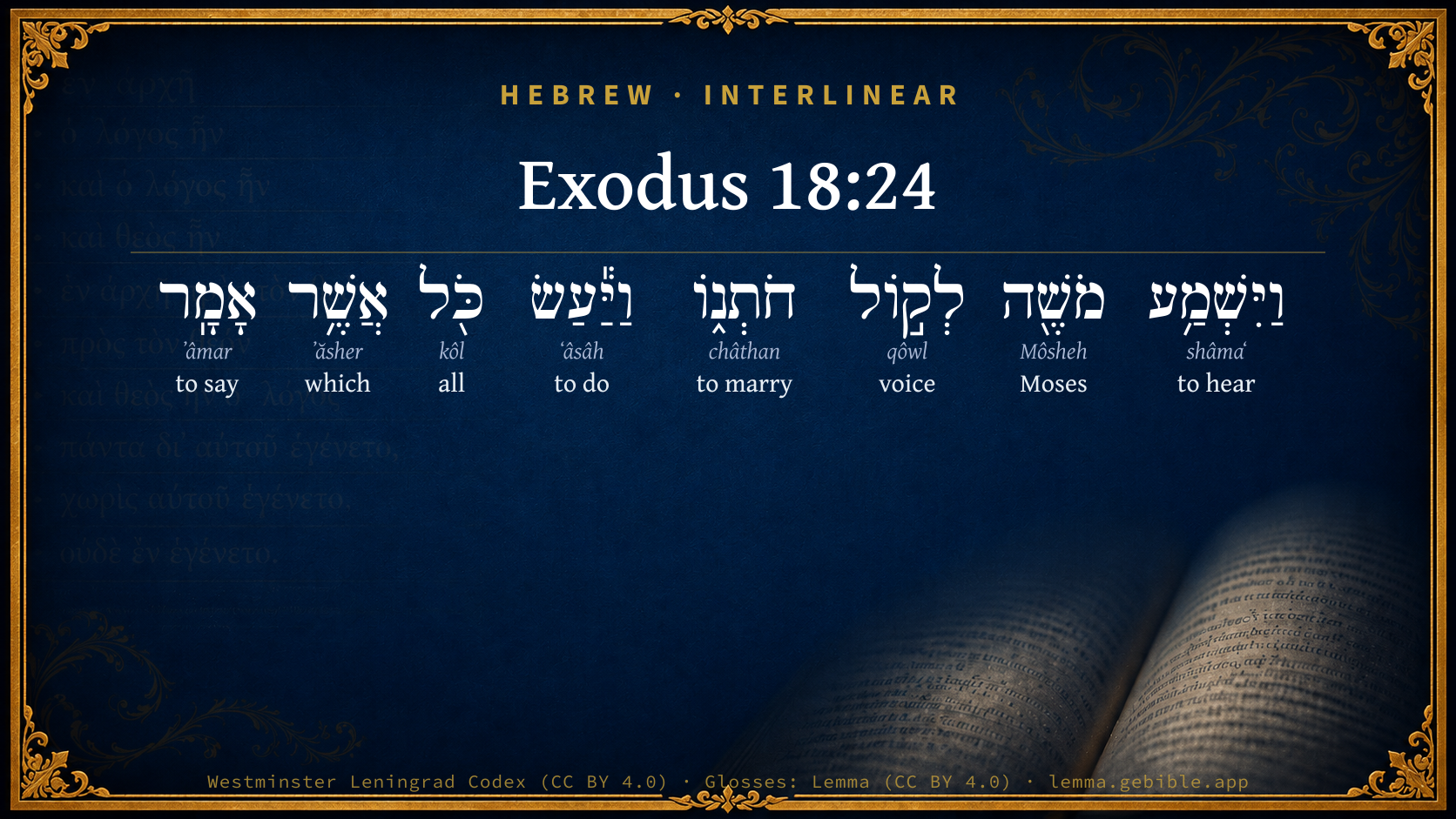
Hebrew (Westminster Leningrad Codex) Exodus 18:24 appears in the Hebrew Old Testament. The text above is from the Westminster Leningrad Codex. Each word links to its Strong’s number, a concise gloss, and parsing drawn from the Open Scriptures Hebrew Bible morphology. Click any word for its full Brown-Driver-Briggs (BDB) entry.
Download image
Cite this verse

Exodus 18:24 (World English Bible). Public Domain. Lemma interlinear Bible study tool, https://lemma.gebible.app/v/exodus/18/24.

Show BibTeX & RIS
BibTeX
RIS
English Translation
So Moses listened to the voice of his father-in-law, and did all that he had said.
World English Bible · Public Domain
Download a study sheet

One document with this verse’s original text, its word-by-word gloss line, the meaning frame, cross-references with their text, attributed commentary, and full source and license credits — printable, and it pastes into notes with its structure intact.

This verse Autodidact and up

Study sheet (.html) Plain text (.txt)

A passage Seminary Student

Up to 50 verses in one chapter. A passage sheet keeps up to 6 commentary sources and 12 cross-references per verse, in the order this page ranks them, and says so on the sheet whenever that leaves anything out. Ask for a single verse and you get the Autodidact verse sheet above.

Everything on this page stays free to read, with no account — the sheet is a download of what is already on screen, not access to it.

Want to remove ads? Support Godless Engineer
Compare translations 3

The same verse in 3 English versions, stacked beneath the original-language interlinear above. Click any original word for its lexicon entry.

Each is an independent rendering of the whole verse — the interlinear is not word-aligned to these translations.

Highlighted words mark where these versions differ — a whole-verse word diff, not a word-by-word alignment.

  • World English Bible Public Domain
    So Moses listened to the voice of his father-in-law, and did all that he had said.
  • King James Version Public Domain
    So Moses hearkened to the voice of his father in law, and did all that he had said.
  • unfoldingWord Literal Text CC BY-SA 4.0
    And Moses listened to the voice of his father-in-law and did everything that he had said.

unfoldingWord Literal Text — © unfoldingWord, licensed CC BY-SA 4.0. Word-aligned USFM3 via Door43 (git.door43.org/unfoldingWord/en_ult).

Versions to compare (up to 4)

3 of 4 selected

Show all 18 translations

Every available English version of this verse, each an independent rendering of the whole verse.

  • World English Bible Public Domain
    So Moses listened to the voice of his father-in-law, and did all that he had said.
  • Berean Standard Bible Public Domain
    Moses listened to his father-in-law and did everything he said.
  • Majority Standard Bible Public Domain
    Moses listened to his father-in-law and did everything he said.
  • King James Version Public Domain
    So Moses hearkened to the voice of his father in law, and did all that he had said.
  • American Standard Version (1901) Public Domain
    So Moses hearkened to the voice of his father-in-law, and did all that he had said.
  • Revised Version (1885) Public Domain
    So Moses hearkened to the voice of his father in law, and did all that he had said.
  • Geneva Bible (1599) Public Domain
    So Moses obeyed the voyce of his father in law, and did all that he had sayd:
  • Douay-Rheims (1899) Public Domain
    And when Moses heard this, he did all things that he had suggested unto him.
  • Young's Literal Translation Public Domain
    And Moses hearkeneth to the voice of his father-in-law, and doth all that he said,
  • Literal Standard Version CC BY-SA 4.0
    And Moses listens to the voice of his father-in-law, and does all that he said,
  • Unlocked Literal Bible CC BY-SA 4.0
    So Moses listened to his father-in-law's words and did everything that he had said.
  • unfoldingWord Literal Text CC BY-SA 4.0
    And Moses listened to the voice of his father-in-law and did everything that he had said.
  • Darby Bible Public Domain
    And Moses hearkened to the voice of his father-in-law, and did all that he had said.
  • World Messianic Bible Public Domain
    So Moses listened to the voice of his father-in-law, and did all that he had said.
  • Webster's Bible Public Domain
    So Moses hearkened to the voice of his father-in-law, and did all that he had said.
  • Free Bible Version CC BY-SA 4.0
    Moses listened to what his father-in-law said and followed all his advice.
  • Bible in Basic English Public Domain
    So Moses took note of the words of his father-in-law, and did as he had said.
  • JPS Tanakh (1917) Public Domain
    So Moses hearkened to the voice of his father-in-law, and did all that he had said.

Literal Standard Version (2020), Covenant Press — licensed CC BY-SA 4.0. Text via the HelloAO Bible API (eBible.org). Unlocked Literal Bible (unfoldingWord) — licensed CC BY-SA 4.0. Text via the HelloAO Bible API (eBible.org). unfoldingWord Literal Text — © unfoldingWord, licensed CC BY-SA 4.0. Word-aligned USFM3 via Door43 (git.door43.org/unfoldingWord/en_ult). Free Bible Version, Dr. Jonathan Gallagher — licensed CC BY-SA 4.0. Text via the HelloAO Bible API (eBible.org).

Word by word

More ways to search: Search by grammar → Find every occurrence → Compare this word →

Practice this passage: Drill this verse → Learn its vocabulary →

חֹתְנ֑וֹ
châthan
H2859
“marrying · him”
Verb, Qal, Participle Active, Masculine, Singular, Construct + Suffix, Personal, 3rd Person, Masculine, Singular
Part of Speech
Verb
Stem
Qal
Form
Participle Active
Gender
Masculine
Number
Singular
State
Construct
Full BDB Definition

Origin: a primitive root

TWOT: 781b

to become a son-in-law, make oneself a daughter's husband - (Qal) wife's father, wife's mother, father-in-law, mother-in-law (participle) - (Hithpael) to make oneself a daughter's husband
  1. וַיִּשְׁמַ֥ע shâmaʻ H8085 “and · to hear” Conjunction + Verb, Qal, Sequential Imperfect, 3rd Person, Masculine, Singular
  2. מֹשֶׁ֖ה Môsheh H4872 “Moses” Noun, Proper
  3. לְק֣וֹל qôwl H6963 “to/for · voice of” Preposition + Noun, Common, Masculine, Singular, Construct
  4. וַיַּ֕עַשׂ ʻâsâh H6213 “and · to do” Conjunction + Verb, Qal, Sequential Imperfect, 3rd Person, Masculine, Singular
  5. כֹּ֖ל kôl H3605 “all” Noun, Common, Masculine, Singular, Absolute
  6. אֲשֶׁ֥ר ʼăsher H834 “which” Particle, Relative
  7. אָמָֽר ʼâmar H559 “to say” Verb, Qal, Perfect, 3rd Person, Masculine, Singular

About this verse

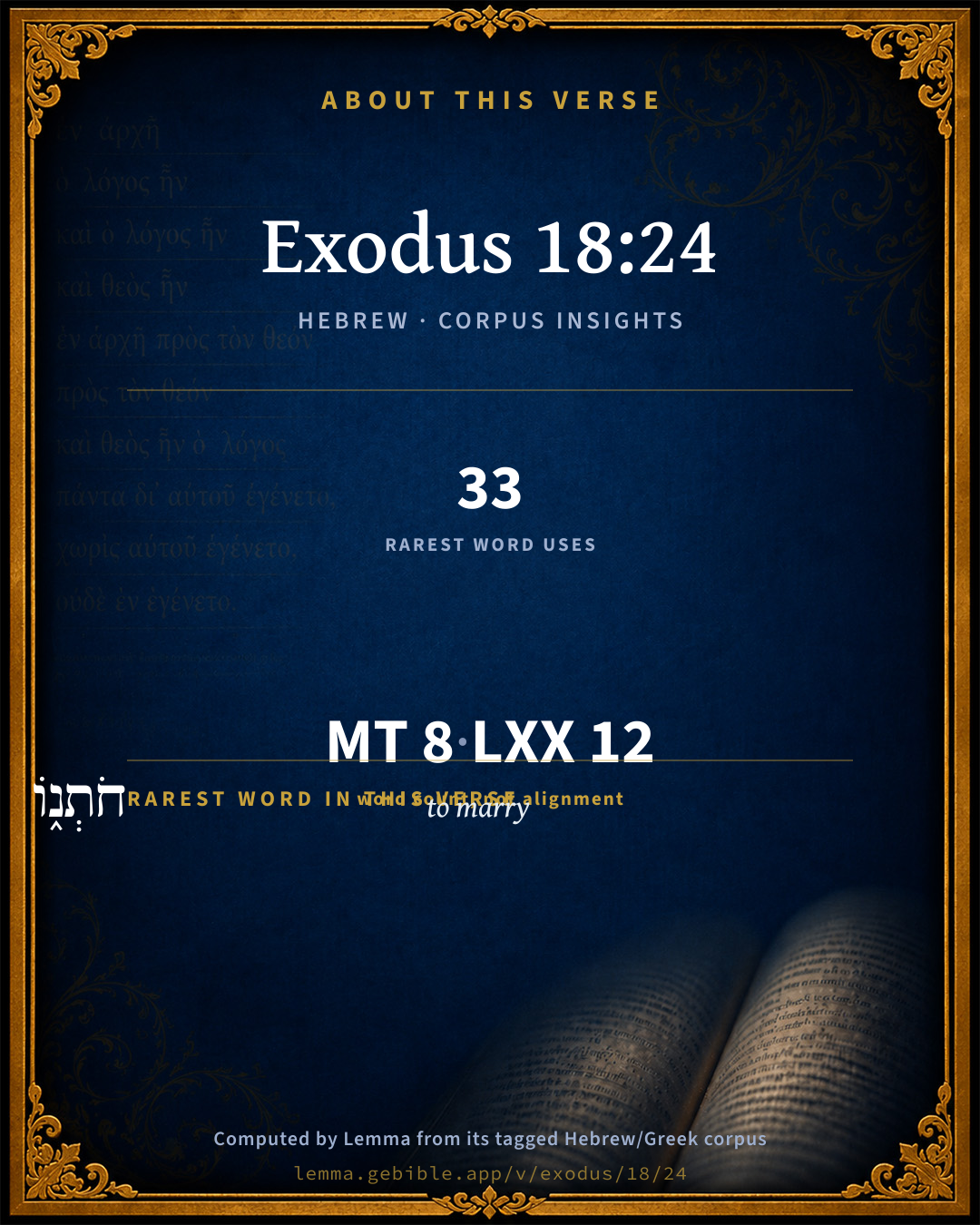
These counts appear in no published source. They are computed here, from the morphology-tagged text and Lemma’s own curated glosses. What Lemma adds →

8
words
8
distinct lemmas
Pentateuch
section

Shared distinctive vocabulary

חֹתְנ֑וֹ to marry H2859 occurs in 32 verses of the Hebrew Bible. Also found in:

Grammatical profile

  • 4 verbs
  • 3 nouns
  • 1 particle

Verb forms

  • וַיִּשְׁמַ֥ע Qal · Sequential Imperfect
  • חֹתְנ֑וֹ Qal · Participle Active
  • וַיַּ֕עַשׂ Qal · Sequential Imperfect
  • אָמָֽר Qal · Perfect

Hebrew & Septuagint length

In English translation the verse runs 16 words from the Hebrew and 16 from the Septuagint (LXX English) — the same length.

A rough comparison of the two English renderings, which tokenize alike — not a word-level alignment.

Word counts can differ between the Hebrew and the Greek without any difference in meaning — e.g. the Hebrew direct-object marker אֵת has no separate Greek word, and Greek often adds the article ὁ.

In the original languages it is 8 Hebrew tokens and 12 Greek tokens — but the two are counted differently (Hebrew bundles its prefixes and suffixes into one token; the Greek is in lemma form), so that isn’t a like-for-like length.

Cross-references

6

Topical passages linked to Exodus 18:24 in the Treasury of Scripture Knowledge — connected by theme and wording, ordered by reader-vote popularity; previews shown in the World English Bible.

  • Exodus 18:2–5 Jethro, Moses' father-in-law, received Zipporah, Moses' wife, after he had sent her away,
  • Exodus 18:19 Listen now to my voice. I will give you counsel, and God be with you. You represent the people before God, and bring the causes to God.
  • Ezra 10:2 Shecaniah the son of Jehiel, one of the sons of Elam, answered Ezra, We have trespassed against our God, and have married foreign women of the peoples of the land: yet now there is hope for Israel concerning this thing.
  • Ezra 10:5 Then arose Ezra, and made the chiefs of the priests, the Levites, and all Israel, to swear that they would do according to this word. So they swore.
  • Proverbs 1:5 That the wise man may hear, and increase in learning; That the man of understanding may attain to sound counsel:
  • 1 Corinthians 12:21 The eye can't tell the hand, "I have no need for you," or again the head to the feet, "I have no need for you."

Cross-references courtesy of OpenBible.info (CC BY 4.0).

Hebrew and Greek witnesses Masoretic Hebrew ↔ Greek Septuagint

The same verse in the two great witnesses to the Old Testament, shown verse-for-verse.

These are two independent witnesses, not word-aligned to each other, and the Septuagint is shown in lemma (dictionary) form.

Hebrew Exodus 18:24 Masoretic · Westminster Leningrad Codex

וַיִּשְׁמַ֥ע מֹשֶׁ֖ה לְק֣וֹל חֹתְנ֑וֹ וַיַּ֕עַשׂ כֹּ֖ל אֲשֶׁ֥ר אָמָֽר

So Moses listened to the voice of his father-in-law, and did all that he had said.

World English Bible · Public Domain

Greek LXX Exodus 18:24 Septuagint · lemma form

ἀκούω δέ μωυσῆς ὁ φωνή ὁ γαμβρός καί ποιέω ὅσος αὐτός εἶπον

And Moses listened to the voice of his father-in-law, and did whatever he said to him.

LXX2012 (modern English Septuagint) · Public Domain

Hebrew: Westminster Leningrad Codex (CC BY 4.0). Greek: Septuagint (public domain); English from LXX2012 (modern English Septuagint) (Public Domain). How the Septuagint differs from the Hebrew →

Targum (Aramaic paraphrase)

2

The Targum is the ancient Jewish Aramaic paraphrase of the Hebrew Scriptures — an interpretive translation, not the Hebrew text itself. Onkelos (literal) and Pseudo-Jonathan (expansive) render the Torah, and Jonathan the Prophets. Coverage is partial: where no permissively-licensed English translation exists for a verse, only the Aramaic is shown. This is verse-level text, not a word-by-word alignment to the Hebrew.

  1. Targum Onkelos Torah (Genesis–Deuteronomy)
    וְקַבִּיל משֶׁה לְמֵימְרָא דַחֲמוּהִי וַעֲבַד כֹּל דִי אֲמָר:

    (no public-domain English translation for this verse)

    Targum Onkelos — Aramaic: “Onkelos Genesis” (public domain); “Onkelos Exodus” (public domain); “Onkelos Leviticus” (public domain); “Onkelos Numbers” (public domain); “Onkelos Deuteronomy” (public domain). English: “Sefaria Community Translation” (CC0 1.0 (public-domain dedication)); “J.W. Etheridge. The Targums of Onkelos and Jonathan Ben Uzziel on the Pentateuch. London: Longmans, Green, 1862” (public domain). Text via Sefaria.

  2. Targum Pseudo-Jonathan Torah (Genesis–Deuteronomy)
    וְקַבֵּל משֶׁה לְמֵימָר חָמוֹי וְעָבַד כָּל דְּאָמַר

    And Mosheh hearkened to his father-in-law, and did all that he had said.

    Targum Pseudo-Jonathan — Aramaic: “Targum Jonathan on Genesis” (public domain); “Targum Jonathan on Exodus” (public domain); “Targum Jonathan on Leviticus” (public domain); “Targum Jonathan on Numbers” (public domain); “Targum Jonathan on Deuteronomy” (public domain). English: “The Targum of Jonathan ben Uzziel, trans. J. W. Etheridge, London, 1862” (public domain). Text via Sefaria.

Commentary

Notes on Exodus 18:24 from classic Christian and Jewish commentators (each source and its license shown beneath its notes). The classic Christian expositions comment on the surrounding passage and are grouped to its opening verse, so a note may address several verses; the Jewish commentaries on the Tanakh (Rashi and others) are per-verse, so they appear only where the commentator wrote on this verse.

Lemma curates 59 commentaries, every one of them public domain or Creative Commons licensed, each selected and text-cleaned for this edition rather than reprinted as found. About our sources →

Trapp's Complete Commentary

John Trapp

Exo 18:24 So Moses hearkened to the voice of his father in law, and did all that he had said.

Ver. 24. So Moses hearkened.] Of a meek man it is said that a child shall lead him: {Isa 11:6} how much more so grave a counsellor as Jethro! Augustus, ταις παρρησιαις των φιλων υπερεχαιρε, was overjoyed with the plain dealings of his friends and counsellors; as of Mecaenas. {a}

{a} Dio, in Augusto.

John Trapp, A Commentary or Exposition upon All the Books of the Old and New Testament (1647–1656) — public domain. Text from a community e-Sword module.

Joseph Benson's Commentary

Exo 18:24. So Moses hearkened unto the voice of his father-in-law — When he came to consider the thing, he saw the reasonableness of it, and resolved to put it in practice, which he did soon after, when he had received directions from God. Those are not so wise as they would be thought to be, who think themselves too wise to be counselled; for “a wise man will hear and will increase learning,” and not slight good counsel, though given by an inferior.

Joseph Benson's Commentary on the Old and New Testaments (1811–1818) — public domain. Text from a community e-Sword module.

Geneva Bible (1599)

Geneva Bible translators

Godly counsel ought ever to be obeyed, though it come of our inferiors, for to such God oftentimes giveth wisdom to humble them that are exalted, and to declare that one member hath need of another.

Geneva Bible (1599) marginal notes — public domain. Text via Bolls.life.

Ellicott's Commentary for English Readers

(24, 25) Moses hearkened.—The appointment of judges, according to Jethro’s advice, was not made until after the giving of the Law and the setting up of the Tabernacle. (See Deu_1:9-15.) In one particular Moses departed from the counsel given to him. Instead of directly choosing the “able men” himself, he left the selection to the people (Deu_1:13). And contented himself with investing the men chosen with their authority. Comp. the course taken by the apostolic college with respect to the first deacons (Act_6:3-6).

A Bible Commentary for English Readers, edited by Charles John Ellicott (1878–1897) — public domain. Text from a community e-Sword module.

The Cambridge Bible for Schools and Colleges

gen. ed. J. J. S. Perowne

24–26. Moses listened to Jethro’s counsel, and appointed the assistant judges accordingly.

The Cambridge Bible for Schools and Colleges (gen. ed. J. J. S. Perowne; Cambridge University Press, 1878–1918) — public domain. Text from a community e-Sword module.

John Gill's Exposition

And Moses chose able men out of all Israel,.... He looked among them, and selected the best of them, such as most answered to the qualifications it was requisite they should have; and though only one of them is here mentioned, which is the first Jethro gave, yet no doubt they were all attended to, though not expressed:

and made them heads over the people; rulers, governors, judges, and officers; this is a general word, comprehending their several particular offices they sustained; which seem to be chiefly distinguished by the different numbers of people, or families, under them, otherwise their work and office were much the same:

rulers of thousands, rulers of hundreds, rulers of fifties, and rulers of tens; just as Jethro advised, Exo 18:21. According to the Targum of Jonathan, the rulers of thousands were six hundred, rulers of hundreds 6000, rulers of fifties 12,000, and the rulers of tens 60,000; and so Jarchi; and the like account is given in both the Talmuds (x), where the whole is summed up, amounting to 78,600; which account Aben Ezra disapproves of, and thinks not credible: it is built upon the number of Israel at this time, when they came out of Egypt, being 600,000 men; and so if there was a ruler to every thousand men, there must be six hundred of them, and so on; but these thousands may intend not individual persons, but families, that these were appointed over, as the families of Israel and Judah are called their thousands, Mic 5:2 and this will serve greatly to reduce the number of these judges and officers.

(x) T. Hieros. Sanhedrin, fol. 19. 3. T. Bab. Sanhedrin, fol. 18. 1.

John Gill's Exposition of the Whole Bible (1746–1763) — public domain (CC PDM 1.0). Text via the HelloAO Bible API.

Albert Barnes' Notes on the Bible

Hearkened - Nothing can be more characteristic of Moses, who combines on all occasions distrust of himself and singular openness to impressions, with the wisdom and sound judgment which chooses the best course when pointed out.

Albert Barnes' Notes on the Bible (1834–1885) — public domain. Text from a community e-Sword/MySword module.

Matthew Poole's English Annotations

This is one evidence of that meekness for which Moses is justly magnified, that he disdained not to receive advice from one so much his inferior in wisdom, and learning, and knowledge of the things of God. And God would have this wise counsel to come from Jethro, not from Moses himself, to show how variously he distributes his gifts, and to teach all men not to think too highly of themselves, nor to despise the counsels even of their inferiors.

Moses did all that he had said, not immediately, but after he had received God’s approbation, Num 11:16, and the people’s consent, Deu 1:14.

Matthew Poole's English Annotations on the Holy Bible (1683–1685) — public domain. Text from a community e-Sword/MySword module.

Whedon's Commentary on the Bible

Daniel D. Whedon

24. Moses hearkened — He was meek, deferential, and prompt to profit by the counsel of the venerable priest.

Daniel D. Whedon (gen. ed.), Commentary on the Old and New Testaments (1874–1909) — public domain. Text from a community e-Sword module.

The Pulpit Commentary

So Moses hearkened. Moses took the advice tendered him, not immediately, but after the law had been given at Sinai, and the journeying was about to be resumed. See Deu_1:9-15.

The Pulpit Commentary (1880–1919), ed. H.D.M. Spence-Jones & Joseph S. Exell — public domain. Text from a community e-Sword module.

John Wesley's Explanatory Notes

So Moses hearkened unto the voice of his father-in-law. When he came to consider the thing, he saw the reasonableness of it, and resolved to put it in practice, which he did soon after, when he had received directions from God. Those are not so wise as they would be thought to be, who think themselves too wise to be counselled; for a wise man will hear, and will increase learning, and not slight good counsel, though given by an inferior.

John Wesley, Explanatory Notes Upon the Whole Bible (1754–1765) — public domain. Text via the GEBible commentary corpus.

Keil & Delitzsch

C. F. Keil & F. Delitzsch

Moses followed this sage advice, and, as he himself explains in Deu 1:12-18, directed the people to nominate wise, intelligent, and well-known men from the heads of the tribes, whom he appointed as judges, instructing them to administer justice with impartiality and without respect of persons.

Keil & Delitzsch — Biblical Commentary on the Old Testament (1861–1891) — public domain (CC PDM 1.0). Text via the HelloAO Bible API. (Old Testament only.)

unfoldingWord translationNotes

Door43 World Missions Community

heads over the people

Moses writes of the leaders of people as if they were the head of a body. AT: "leaders of the people" (See: Metaphor)

capable men

What they were capable of doing can be stated clearly. AT: "men who were able to lead" or "men who were able to judge" (See: Assumed Knowledge and Implicit Information)

leaders in charge of thousands, hundreds, fifties, and tens

Possible meanings are 1) these numbers represent the exact amount of people in each group. AT: "leaders in charge of groups of 1,000 people, groups of 100 people, groups of 50 people, and groups of 10 people" or 2) these numbers are not exact, but represent groups of people of various sizes. AT: "leaders in charge of very small groups, small groups, large groups, and very large groups" See how you translated this in Exodus 18:21. (See: Numbers)

judged the people in normal circumstances

"judged the people most of the time" or "judged the people's easy cases"

The difficult cases they brought to Moses

The author writes of telling Moses about the difficult cases as bringing him the difficult cases. AT: "the difficult cases they told Moses about" or "when there were difficult cases, they told Moses about them so that he would judge them" (See: Metaphor)

the small cases

"the easy cases"

translationWords

Moses

head

judge

unfoldingWord translationNotes — © Distant Shores Media and the Door43 World Missions Community, licensed CC BY-SA 4.0. Source: git.door43.org/Door43/en_tn.

Lesson kit

Teaching starters — assembled from the data on this page, not authored interpretation. Every prompt links to the verse data it draws on. Edit before teaching.

Exodus, in the Pentateuch, opens this verse with 8 words (8 distinct Hebrew lemmas). Its most distinctive word is châthan (“to marry”). A historical commentator’s framing appears above. Read the whole chapter for the surrounding context.

Discussion questions

  1. How does “to marry” (châthan) shape what this verse is saying?
  2. How does Genesis 34:9, which shares the word «to marry», read alongside this verse?
  3. These translations render this verse differently. What is at stake in choosing one wording over another?
  4. «וַיִּשְׁמַ֥ע» is a Qal Sequential Imperfect verb. How does that grammatical form shape the action described?
  5. Compare how Trapp's Complete Commentary and Joseph Benson's Commentary read this verse. Where do they agree or differ?

Things to notice

Reading settings

Reading text

Shown beneath each verse's original-language words.

Old Testament
Old Testament edition

Read the OT as the Masoretic Hebrew (MT) or the Greek Septuagint (LXX).

English shown for the Greek Septuagint (in the Hebrew ↔ Greek comparison).

Comparing translations? Open the Compare panel on any verse page to stack up to four side by side.