
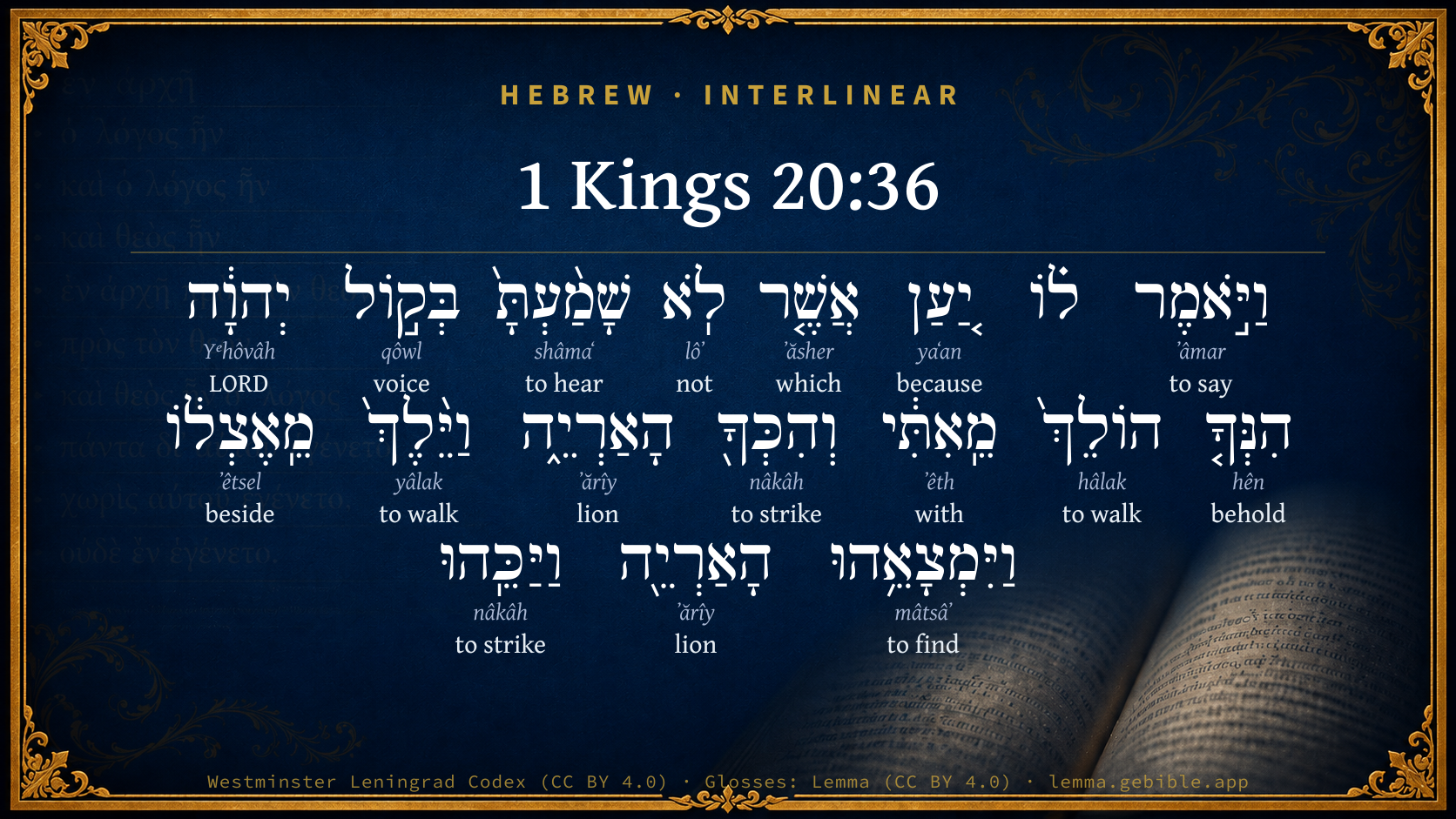
1 Kings 20:36

Hebrew (Westminster Leningrad Codex) 1 Kings 20:36 appears in the Hebrew Old Testament. The text above is from the Westminster Leningrad Codex. Each word links to its Strong’s number, a concise gloss, and parsing drawn from the Open Scriptures Hebrew Bible morphology. Click any word for its full Brown-Driver-Briggs (BDB) entry.
Download image
Cite this verse

1 Kings 20:36 (World English Bible). Public Domain. Lemma interlinear Bible study tool, https://lemma.gebible.app/v/1-kings/20/36.

Show BibTeX & RIS
BibTeX
RIS
English Translation
Then said he to him, Because you have not obeyed the voice of Yahweh, behold, as soon as you are departed from me, a lion shall kill you. As soon as he was departed from him, a lion found him, and killed him.
World English Bible · Public Domain
Download a study sheet

One document with this verse’s original text, its word-by-word gloss line, the meaning frame, cross-references with their text, attributed commentary, and full source and license credits — printable, and it pastes into notes with its structure intact.

This verse Autodidact and up

Study sheet (.html) Plain text (.txt)

A passage Seminary Student

Up to 50 verses in one chapter. A passage sheet keeps up to 6 commentary sources and 12 cross-references per verse, in the order this page ranks them, and says so on the sheet whenever that leaves anything out. Ask for a single verse and you get the Autodidact verse sheet above.

Everything on this page stays free to read, with no account — the sheet is a download of what is already on screen, not access to it.

Want to remove ads? Support Godless Engineer
Compare translations 3

The same verse in 3 English versions, stacked beneath the original-language interlinear above. Click any original word for its lexicon entry.

Each is an independent rendering of the whole verse — the interlinear is not word-aligned to these translations.

Highlighted words mark where these versions differ — a whole-verse word diff, not a word-by-word alignment.

  • World English Bible Public Domain
    Then said he to him, Because you have not obeyed the voice of Yahweh, behold, as soon as you are departed from me, a lion shall kill you. As soon as he was departed from him, a lion found him, and killed him.
  • King James Version Public Domain
    Then said he unto him, Because thou hast not obeyed the voice of the LORD, behold, as soon as thou art departed from me, a lion shall slay thee. And as soon as he was departed from him, a lion found him, and slew him.
  • unfoldingWord Literal Text CC BY-SA 4.0
    And he said to him, “Because you did not listen to the voice of Yahweh, behold you, going from with me, and a lion will strike you.” And he went from beside him, and a lion found him and struck him.

unfoldingWord Literal Text — © unfoldingWord, licensed CC BY-SA 4.0. Word-aligned USFM3 via Door43 (git.door43.org/unfoldingWord/en_ult).

Versions to compare (up to 4)

3 of 4 selected

Show all 18 translations

Every available English version of this verse, each an independent rendering of the whole verse.

  • World English Bible Public Domain
    Then said he to him, Because you have not obeyed the voice of Yahweh, behold, as soon as you are departed from me, a lion shall kill you. As soon as he was departed from him, a lion found him, and killed him.
  • Berean Standard Bible Public Domain
    Then the prophet said to him, “Because you have not obeyed the voice of the LORD, as soon as you depart from me a lion will kill you.” And when he left, a lion found him and killed him.
  • Majority Standard Bible Public Domain
    Then the prophet said to him, “Because you have not obeyed the voice of the LORD, as soon as you depart from me a lion will kill you.” And when he left, a lion found him and killed him.
  • King James Version Public Domain
    Then said he unto him, Because thou hast not obeyed the voice of the LORD, behold, as soon as thou art departed from me, a lion shall slay thee. And as soon as he was departed from him, a lion found him, and slew him.
  • American Standard Version (1901) Public Domain
    Then said he unto him, Because thou hast not obeyed the voice of Jehovah, behold, as soon as thou art departed from me, a lion shall slay thee. And as soon as he was departed from him, a lion found him, and slew him.
  • Revised Version (1885) Public Domain
    Then said he unto him, Because thou hast not obeyed the voice of the LORD, behold, as soon as thou art departed from me, a lion shall slay thee. And as soon as he was departed from him, a lion found him, and slew him.
  • Geneva Bible (1599) Public Domain
    Then sayd he vnto him, Because thou hast not obeyed the voyce of the Lord, beholde, as soone as thou art departed from me, a lyon shall slay thee. So when he was departed from him, a lyon found him and slew him.
  • Douay-Rheims (1899) Public Domain
    Then he said to him: Because thou wouldst not hearken to the word of the Lord, behold then shalt depart from me, and a lion shall slay thee. And when he was gone a little from him, a lion found him, and slew him.
  • Young's Literal Translation Public Domain
    and he saith to him, `Because that thou hast not hearkened to the voice of Jehovah, lo, thou art going from me, and the lion hath smitten thee;' and he goeth from him, and the lion findeth him, and smiteth him.
  • Literal Standard Version CC BY-SA 4.0
    and he says to him, “Because that you have not listened to the voice of YHWH, behold, you are going from me, and the lion has struck you”; and he goes from him, and the lion finds him, and strikes him.
  • Unlocked Literal Bible CC BY-SA 4.0
    Then the prophet said to his fellow prophet, “Because you have not obeyed the voice of Yahweh, as soon as you leave me, a lion will kill you.” As soon as that man had left him, a lion came upon him and killed him.
  • unfoldingWord Literal Text CC BY-SA 4.0
    And he said to him, “Because you did not listen to the voice of Yahweh, behold you, going from with me, and a lion will strike you.” And he went from beside him, and a lion found him and struck him.
  • Darby Bible Public Domain
    Then said he to him, Because thou hast not hearkened to the voice of Jehovah, behold, when thou departest from me, the lion will slay thee. And when he had departed from him, the lion found him and slew him.
  • World Messianic Bible Public Domain
    Then he said to him, “Because you have not obeyed the LORD’s voice, behold, as soon as you have departed from me, a lion will kill you.” As soon as he had departed from him, a lion found him and killed him.
  • Webster's Bible Public Domain
    Then said he to him, Because thou hast not obeyed the voice of the LORD, behold, as soon as thou hast departed from me, a lion will slay thee. And as soon as he had departed from him, a lion found him, and slew him.
  • Free Bible Version CC BY-SA 4.0
    So the prophet told him, “Since you have not done what the Lord said, once you leave me a lion is going to kill you.” When the man left, a lion came and killed him.
  • Bible in Basic English Public Domain
    Then he said to him, Because you have not given ear to the voice of the Lord, straight away when you have gone from me a lion will put you to death. And when he had gone, straight away a lion came rushing at him and put him to death.
  • JPS Tanakh (1917) Public Domain
    Then said he unto him: 'Because thou hast not hearkened to the voice of the LORD, behold, as soon as thou art departed from me, a lion shall slay thee.' And as soon as he was departed from him, a lion found him; and slew him.

Literal Standard Version (2020), Covenant Press — licensed CC BY-SA 4.0. Text via the HelloAO Bible API (eBible.org). Unlocked Literal Bible (unfoldingWord) — licensed CC BY-SA 4.0. Text via the HelloAO Bible API (eBible.org). unfoldingWord Literal Text — © unfoldingWord, licensed CC BY-SA 4.0. Word-aligned USFM3 via Door43 (git.door43.org/unfoldingWord/en_ult). Free Bible Version, Dr. Jonathan Gallagher — licensed CC BY-SA 4.0. Text via the HelloAO Bible API (eBible.org).

Word by word

More ways to search: Search by grammar → Find every occurrence → Compare this word →

Practice this passage: Drill this verse → Learn its vocabulary →

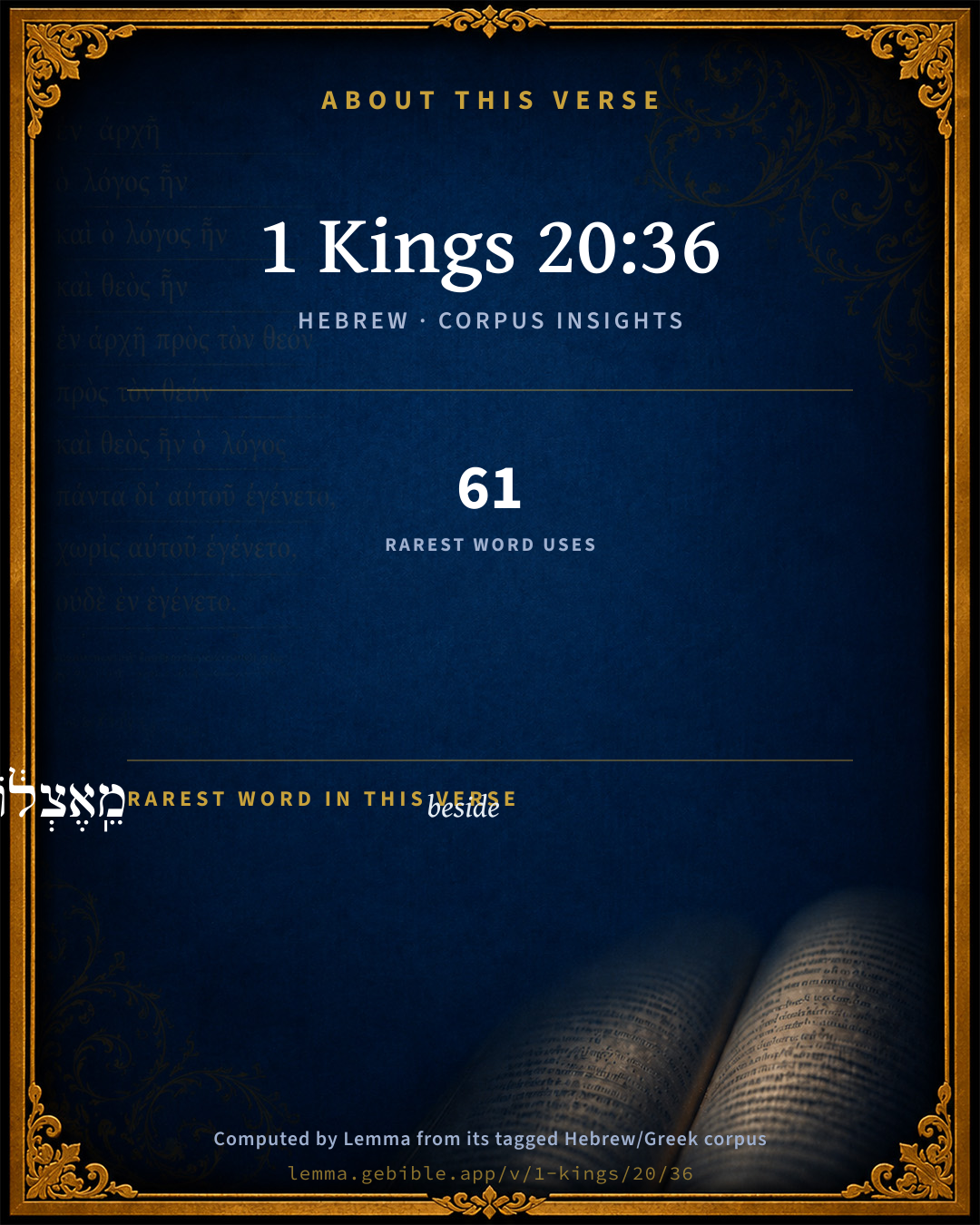
מֵֽאֶצְל֔וֹ
ʼêtsel
H681
“from · beside · him”
Preposition + Preposition + Suffix, Personal, 3rd Person, Masculine, Singular
Part of Speech
Preposition + Preposition
Full BDB Definition

Origin: from H680 (in the sense of joining)

TWOT: 153a

beside, by, near, nearness, joining, proximity - (BDB) (substantive) - conjunction, proximity - beside, in proximity, contiguous to, from beside
  1. וַיֹּ֣אמֶר ʼâmar H559 “and · to say” Conjunction + Verb, Qal, Sequential Imperfect, 3rd Person, Masculine, Singular
  2. יַ֚עַן yaʻan H3282 “because” Conjunction
  3. אֲשֶׁ֤ר ʼăsher H834 “which” Particle, Relative
  4. לֹֽא lôʼ H3808 “not” Particle, Negative
  5. שָׁמַ֨עְתָּ֙ shâmaʻ H8085 “to hear” Verb, Qal, Perfect, 2nd Person, Masculine, Singular
  6. בְּק֣וֹל qôwl H6963 “in/at · voice of” Preposition + Noun, Common, Masculine, Singular, Construct
  7. יְהוָ֔ה Yᵉhôvâh H3068 “LORD” Noun, Proper
  8. הִנְּךָ֤ hên H2005 “behold · you” Particle, Demonstrative + Suffix, Personal, 2nd Person, Masculine, Singular
  9. הוֹלֵךְ֙ hâlak H1980 “walking” Verb, Qal, Participle Active, Masculine, Singular, Absolute
  10. מֵֽאִתִּ֔י ʼêth H854 “from · with · me” Preposition + Preposition + Suffix, Personal, 1st Person, Common, Singular
  11. וְהִכְּךָ֖ nâkâh H5221 “and · to strike · you” Conjunction + Verb, Hiphil, Perfect, 3rd Person, Masculine, Singular + Suffix, Personal, 2nd Person, Masculine, Singular
  12. הָאַרְיֵ֑ה ʼărîy H738 “the · lion” Particle, Definite Article + Noun, Common, Masculine, Singular, Absolute
  13. וַיֵּ֨לֶךְ֙ yâlak H3212 “and · to walk” Conjunction + Verb, Qal, Sequential Imperfect, 3rd Person, Masculine, Singular
  14. וַיִּמְצָאֵ֥הוּ mâtsâʼ H4672 “and · to find · him” Conjunction + Verb, Qal, Sequential Imperfect, 3rd Person, Masculine, Singular + Suffix, Personal, 3rd Person, Masculine, Singular
  15. הָאַרְיֵ֖ה ʼărîy H738 “the · lion” Particle, Definite Article + Noun, Common, Masculine, Singular, Absolute
  16. וַיַּכֵּֽהוּ nâkâh H5221 “and · to strike · him” Conjunction + Verb, Hiphil, Sequential Imperfect, 3rd Person, Masculine, Singular + Suffix, Personal, 3rd Person, Masculine, Singular

About this verse

These counts appear in no published source. They are computed here, from the morphology-tagged text and Lemma’s own curated glosses. What Lemma adds →

18
words
15
distinct lemmas
Historical
section

Grammatical profile

  • 7 verbs
  • 4 nouns
  • 3 prepositions
  • 1 conjunction
  • 3 particles

Verb forms

  • וַיֹּ֣אמֶר Qal · Sequential Imperfect
  • שָׁמַ֨עְתָּ֙ Qal · Perfect
  • הוֹלֵךְ֙ Qal · Participle Active
  • וְהִכְּךָ֖ Hiphil · Perfect
  • וַיֵּ֨לֶךְ֙ Qal · Sequential Imperfect
  • וַיִּמְצָאֵ֥הוּ Qal · Sequential Imperfect
  • וַיַּכֵּֽהוּ Hiphil · Sequential Imperfect

Repetition

Words recur within this verse — often emphatic in Hebrew:

  • וְהִכְּךָ֖ to strike H5221 ×2
  • הָאַרְיֵ֑ה lion H738 ×2

Cross-references

3

Topical passages linked to 1 Kings 20:36 in the Treasury of Scripture Knowledge — connected by theme and wording, ordered by reader-vote popularity; previews shown in the World English Bible.

  • 1 Samuel 15:22–23 Samuel said, Has Yahweh as great delight in burnt offerings and sacrifices, as in obeying the voice of Yahweh? Behold, to obey is better than sacrifice, and to listen than the fat of rams.
  • 1 Kings 13:21–24 and he cried to the man of God who came from Judah, saying, Thus says Yahweh, Because you have been disobedient to the mouth of Yahweh, and have not kept the commandment which Yahweh your God commanded you,
  • 1 Kings 13:26 When the prophet who brought him back from the way heard of it, he said, It is the man of God, who was disobedient to the mouth of Yahweh: therefore Yahweh has delivered him to the lion, which has torn him, and slain him, according to the word of Yahweh, which he spoke to him.

Cross-references courtesy of OpenBible.info (CC BY 4.0).

Hebrew and Greek witnesses Masoretic Hebrew ↔ Greek Septuagint

The same verse in the two great witnesses to the Old Testament, shown verse-for-verse.

These are two independent witnesses, not word-aligned to each other, and the Septuagint is shown in lemma (dictionary) form.

Hebrew 1 Kings 20:36 Masoretic · Westminster Leningrad Codex

וַיֹּ֣אמֶר ל֗וֹ יַ֚עַן אֲשֶׁ֤ר לֹֽא שָׁמַ֨עְתָּ֙ בְּק֣וֹל יְהוָ֔ה הִנְּךָ֤ הוֹלֵךְ֙ מֵֽאִתִּ֔י וְהִכְּךָ֖ הָאַרְיֵ֑ה וַיֵּ֨לֶךְ֙ מֵֽאֶצְל֔וֹ וַיִּמְצָאֵ֥הוּ הָאַרְיֵ֖ה וַיַּכֵּֽהוּ

Then said he to him, Because you have not obeyed the voice of Yahweh, behold, as soon as you are departed from me, a lion shall kill you. As soon as he was departed from him, a lion found him, and killed him.

World English Bible · Public Domain

Hebrew: Westminster Leningrad Codex (CC BY 4.0). Greek: Septuagint (public domain); English from a public-domain English Septuagint. How the Septuagint differs from the Hebrew →

Targum (Aramaic paraphrase)

1

The Targum is the ancient Jewish Aramaic paraphrase of the Hebrew Scriptures — an interpretive translation, not the Hebrew text itself. Onkelos (literal) and Pseudo-Jonathan (expansive) render the Torah, and Jonathan the Prophets. Coverage is partial: where no permissively-licensed English translation exists for a verse, only the Aramaic is shown. This is verse-level text, not a word-by-word alignment to the Hebrew.

  1. Targum Jonathan Prophets (Joshua–Malachi)
    וַאֲמַר לֵיהּ חֲלַף דְלָא קַבֵּלְתָּא לְמֵימְרָא דַייָ הָא אַתְּ אָזֵיל מִלְוָתִי וְיִקְטְלִנָךְ אַרְיָא וַאֲזַל מִלְוָתֵיהּ וְאַשְׁכְּחֵיהּ אַרְיָא וְקַטְלֵיהּ:

    (no public-domain English translation for this verse)

    Targum Jonathan — Aramaic: “Mikraot Gedolot” (public domain). English: “Sefaria Community Translation” (CC0 1.0 (public-domain dedication)); “London "Chaldee Paraphrase," 1871” (public domain). Text via Sefaria.

Commentary

Notes on 1 Kings 20:36 from classic Christian and Jewish commentators (each source and its license shown beneath its notes). The classic Christian expositions comment on the surrounding passage and are grouped to its opening verse, so a note may address several verses; the Jewish commentaries on the Tanakh (Rashi and others) are per-verse, so they appear only where the commentator wrote on this verse.

Lemma curates 59 commentaries, every one of them public domain or Creative Commons licensed, each selected and text-cleaned for this edition rather than reprinted as found. About our sources →

Trapp's Complete Commentary

John Trapp

1Ki 20:36 Then said he unto him, Because thou hast not obeyed the voice of the LORD, behold, as soon as thou art departed from me, a lion shall slay thee. And as soon as he was departed from him, a lion found him, and slew him.

Ver. 36. A lion found him, and slew him.] So dangerous a thing it is for a man to prefer his own reason before God’s command. There is not a more noble proof of our faith, than to captivate all the powers of our understanding and will to our Creator: and without all questioning to go blind folded whither he will lead us.

John Trapp, A Commentary or Exposition upon All the Books of the Old and New Testament (1647–1656) — public domain. Text from a community e-Sword module.

Joseph Benson's Commentary

1Ki 20:36. Because thou hast not obeyed the voice of the Lord, a lion shall slay thee — If the punishment seem too severe for so small a fault, let it be considered, 1st, That disobedience to God’s express command, especially when delivered by a person known by the party disobeying to be a prophet, was a great sin, and no less than capital, Deu 18:19. 2d, This fault was much worse in a prophet, who very well knew the authority of God’s commands, and this way of publishing them. 3d, This man might be guilty of many other heinous sins unknown to us, but known to God; for which God might justly cut him off: which God chose to do upon this occasion, that by the severity of this punishment of a prophet’s disobedience, proceeding from pity to his brother, he might teach Ahab the greatness of his sin, in sparing him through foolish pity, whom, by the laws of religion, and justice, and prudence, he should have cut off.

Joseph Benson's Commentary on the Old and New Testaments (1811–1818) — public domain. Text from a community e-Sword module.

Tyndale Open Study Notes

Tyndale Open Resources

20:36 a lion will kill you: A lion was previously the means of divine judgment (13:20-24) and would be so again during the repopulation of Israel following the fall of Samaria (2 Kgs 17:25-26).

Tyndale Open Study Notes — © Tyndale Open Resources, licensed CC BY-SA 4.0. Text via the HelloAO Bible API.

Geneva Bible (1599)

Geneva Bible translators

Because thou hast transgressed the commandment of the Lord.

Geneva Bible (1599) marginal notes — public domain. Text via Bolls.life.

Adam Clarke's Commentary

Verse 36. A lion found him, and slew him.] This seems a hard measure, but there was ample reason for it. This person was also one of the sons of the prophets, and he knew that God frequently delivered his counsels in this way, and should have immediately obeyed; for the smiting could have had no evil in it when God commanded it, and it could be no outrage or injury to his fellow when he himself required him to do it.

Adam Clarke's Commentary on the Bible (1810–1826) — public domain. Text from a community e-Sword/MySword module.

Ellicott's Commentary for English Readers

(36) A lion shall slay thee.—It is obvious to compare the example of 1Ki_13:24.

A Bible Commentary for English Readers, edited by Charles John Ellicott (1878–1897) — public domain. Text from a community e-Sword module.

The Cambridge Bible for Schools and Colleges

gen. ed. J. J. S. Perowne

36. a lion] On the frequency of wild beasts in the Holy Land at this time, see above on 1Ki_13:24. The incident here recorded is not without its importance as a comment on disobedience to God’s command, for which a punishment was just to be pronounced against Ahab.

The Cambridge Bible for Schools and Colleges (gen. ed. J. J. S. Perowne; Cambridge University Press, 1878–1918) — public domain. Text from a community e-Sword module.

John Gill's Exposition

Then said he unto him, because thou hast not obeyed the voice of the Lord,.... In not smiting him; which, if he was a prophet, he must know how great an evil it was to disregard or disobey what was said by a prophet in his name; he must be inexcusable:

behold, as soon as thou art departed from me, a lion shall slay thee.

And as soon as he was departed from him, a lion found him, and slew him; which may seem severe, yet being an act of disobedience to the command of God, by a prophet of his, was punishable with death.

John Gill's Exposition of the Whole Bible (1746–1763) — public domain (CC PDM 1.0). Text via the HelloAO Bible API.

Matthew Poole's English Annotations

If the punishment seem too severe for so small a fault, let it be considered.

1. That disobedience to God’s express command, especially when it is delivered by a prophet, is a great sin, and no less than capital, Deu 18:19.

2. This fault was much worse in a prophet, who very well knew the authority of God’s commands, and this way or manner of publishing them.

3. We cannot judge of the case, because this man might be guilty of many other heinous sins unknown to us, but known to God; for which God might justly cut him off; which God chose to do upon this occasion, that by the severity of this punishment of a prophet’s disobedience, proceeding from pity to his brother, he might teach Ahab the greatness of his sin, in sparing him through foolish pity, whom by the laws of religion, and justice, and prudence, and common safety, he should have cut off, and what punishment he might expect for it.

Matthew Poole's English Annotations on the Holy Bible (1683–1685) — public domain. Text from a community e-Sword/MySword module.

Whedon's Commentary on the Bible

Daniel D. Whedon

36. A lion shall slay thee — As in the case of the disobedient prophet of Judah. 1Ki_13:24. Both of these examples show how fearful a thing it is for a prophet to disobey the word of the Lord; and Ahab also is to find, like Saul, (compare 1Sa_15:26,) that it is equally fearful for a king to disobey.

Daniel D. Whedon (gen. ed.), Commentary on the Old and New Testaments (1874–1909) — public domain. Text from a community e-Sword module.

The Pulpit Commentary

Then said he unto him, Because thou hast not obeyed the voice of the Lord, behold, as soon as thou art departed from me, a lion Heb. the lion, perhaps the lion appointed already to this office, or one that had lately been seen in the neighbourhood shall slay thee. And as soon as he was departed from him, a Heb. the lion found him same word, 1Ki_13:24, where see note and slew him For the same sin as that of "the man of God, (1Ki_13:21, 1Ki_13:26) viz., disobedience (Deu_32:24; Jer_5:6) and disobedience, too, under circumstances remarkably similar to those. In fact, the two histories run on almost parallel lines. In each case it is a prophet who disobeys, and disobeys the "word of the Lord;" in each case the disobedience appears almost excusable; in each case the prophet appears to be hardly dealt with, and suffers instant punishment, whilst the king escapes; in each case the punishment is foretold by a prophet; in each case it is effected by the instrumentality of a lion. And in each case the lesson is the same that God"s commands must be kept, whatever the cost, or that stern retribution will inevitably follow.

The Pulpit Commentary (1880–1919), ed. H.D.M. Spence-Jones & Joseph S. Exell — public domain. Text from a community e-Sword module.

John Wesley's Explanatory Notes

Slew him - We cannot judge of the case; this man might be guilty of many other heinous sins unknown to us but known to God; for which, God might justly cut him off: which God chose to do upon this occasion, that by the severity of this punishment of a prophet's disobedience, proceeding from pity to his brother, he might teach Ahab the greatness of his sin, in sparing him through foolish pity, whom by the laws of religion, and justice, and prudence, he should have cut of.

John Wesley, Explanatory Notes Upon the Whole Bible (1754–1765) — public domain. Text via the GEBible commentary corpus.

Lesson kit

Teaching starters — assembled from the data on this page, not authored interpretation. Every prompt links to the verse data it draws on. Edit before teaching.

1 Kings, in the Historical, opens this verse with 18 words (15 distinct Hebrew lemmas). Its most distinctive word is ʼêtsel (“beside”). A historical commentator’s framing appears above. Read the whole chapter for the surrounding context.

Discussion questions

  1. The word ʼêtsel carries the sense “beside.” How does it shape the verse?
  2. 1 Samuel 15:22–23 shares this passage’s theme. How do the two illuminate each other?
  3. “to strike” occurs 2× in this one verse. What is the effect of the repetition?
  4. These translations render this verse differently. What is at stake in choosing one wording over another?
  5. The verb «וַיֹּ֣אמֶר» is Qal Sequential Imperfect. How does its form color the action?
  6. Reading how Trapp's Complete Commentary and Joseph Benson's Commentary read this verse, where do the two commentators agree and where do they part?

Things to notice

Reading settings

Reading text

Shown beneath each verse's original-language words.

Old Testament
Old Testament edition

Read the OT as the Masoretic Hebrew (MT) or the Greek Septuagint (LXX).

English shown for the Greek Septuagint (in the Hebrew ↔ Greek comparison).

Comparing translations? Open the Compare panel on any verse page to stack up to four side by side.