
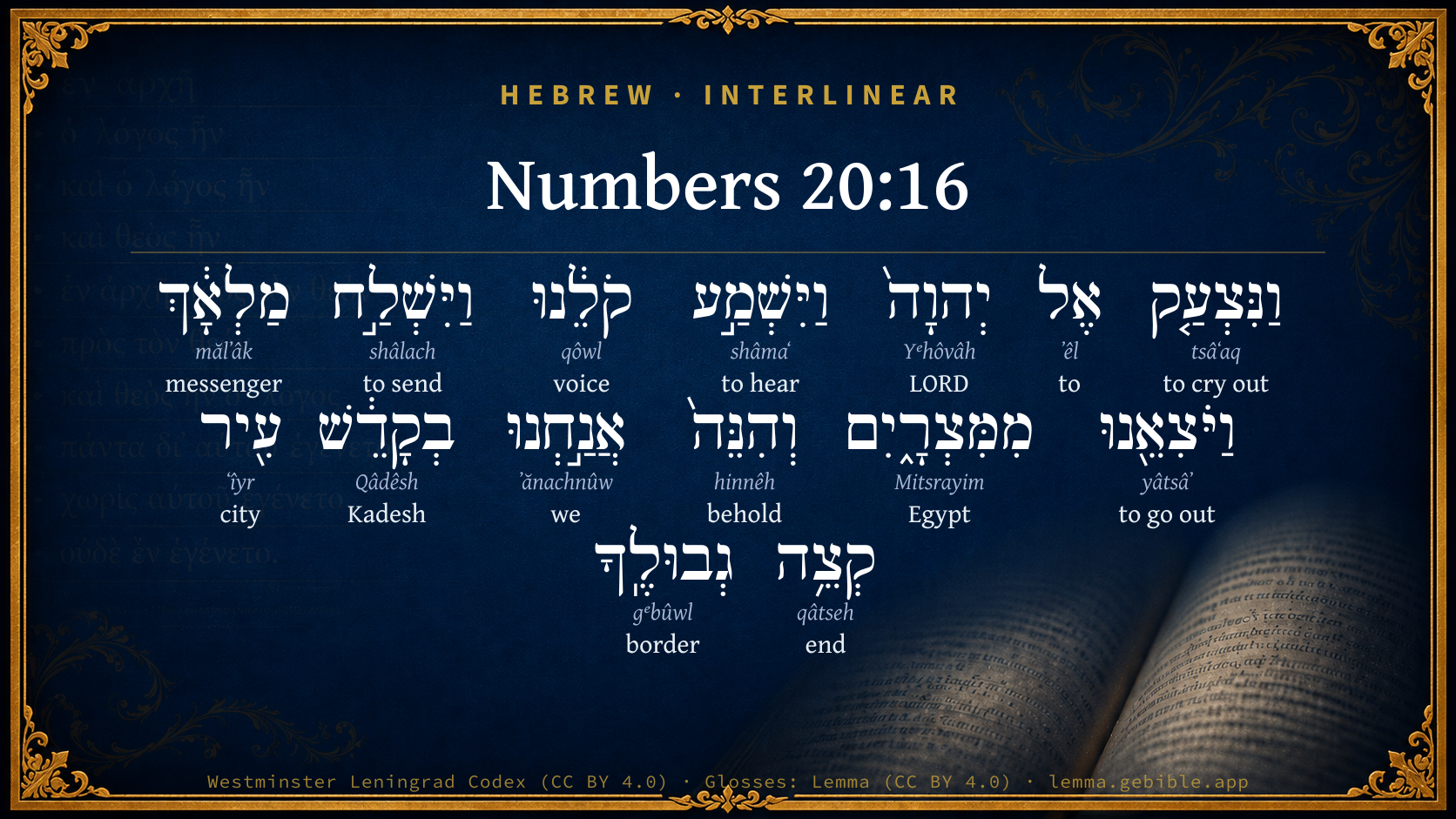
Numbers 20:16

Hebrew (Westminster Leningrad Codex) Numbers 20:16 appears in the Hebrew Old Testament. The text above is from the Westminster Leningrad Codex. Each word links to its Strong’s number, a concise gloss, and parsing drawn from the Open Scriptures Hebrew Bible morphology. Click any word for its full Brown-Driver-Briggs (BDB) entry.
Download image
Cite this verse

Numbers 20:16 (World English Bible). Public Domain. Lemma interlinear Bible study tool, https://lemma.gebible.app/v/numbers/20/16.

Show BibTeX & RIS
BibTeX
RIS
English Translation
and when we cried to Yahweh, he heard our voice, and sent an angel, and brought us forth out of Egypt: and, behold, we are in Kadesh, a city in the uttermost of your border.
World English Bible · Public Domain
Download a study sheet

One document with this verse’s original text, its word-by-word gloss line, the meaning frame, cross-references with their text, attributed commentary, and full source and license credits — printable, and it pastes into notes with its structure intact.

This verse Autodidact and up

Study sheet (.html) Plain text (.txt)

A passage Seminary Student

Up to 50 verses in one chapter. A passage sheet keeps up to 6 commentary sources and 12 cross-references per verse, in the order this page ranks them, and says so on the sheet whenever that leaves anything out. Ask for a single verse and you get the Autodidact verse sheet above.

Everything on this page stays free to read, with no account — the sheet is a download of what is already on screen, not access to it.

Want to remove ads? Support Godless Engineer
Compare translations 3

The same verse in 3 English versions, stacked beneath the original-language interlinear above. Click any original word for its lexicon entry.

Each is an independent rendering of the whole verse — the interlinear is not word-aligned to these translations.

Highlighted words mark where these versions differ — a whole-verse word diff, not a word-by-word alignment.

  • World English Bible Public Domain
    and when we cried to Yahweh, he heard our voice, and sent an angel, and brought us forth out of Egypt: and, behold, we are in Kadesh, a city in the uttermost of your border.
  • King James Version Public Domain
    And when we cried unto the LORD, he heard our voice, and sent an angel, and hath brought us forth out of Egypt: and, behold, we are in Kadesh, a city in the uttermost of thy border:
  • unfoldingWord Literal Text CC BY-SA 4.0
    And we cried out to Yahweh, and he heard our voice, and he sent a messenger, and he brought us out from Egypt. And behold, we in Kadesh, a city of the edge of your border.

unfoldingWord Literal Text — © unfoldingWord, licensed CC BY-SA 4.0. Word-aligned USFM3 via Door43 (git.door43.org/unfoldingWord/en_ult).

Versions to compare (up to 4)

3 of 4 selected

Show all 18 translations

Every available English version of this verse, each an independent rendering of the whole verse.

  • World English Bible Public Domain
    and when we cried to Yahweh, he heard our voice, and sent an angel, and brought us forth out of Egypt: and, behold, we are in Kadesh, a city in the uttermost of your border.
  • Berean Standard Bible Public Domain
    and when we cried out to the LORD, He heard our voice, sent an angel, and brought us out of Egypt. Now look, we are in Kadesh, a city on the edge of your territory.
  • Majority Standard Bible Public Domain
    and when we cried out to the LORD, He heard our voice, sent an angel, and brought us out of Egypt. Now look, we are in Kadesh, a city on the edge of your territory.
  • King James Version Public Domain
    And when we cried unto the LORD, he heard our voice, and sent an angel, and hath brought us forth out of Egypt: and, behold, we are in Kadesh, a city in the uttermost of thy border:
  • American Standard Version (1901) Public Domain
    and when we cried unto Jehovah, he heard our voice, and sent an angel, and brought us forth out of Egypt: and, behold, we are in Kadesh, a city in the uttermost of thy border.
  • Revised Version (1885) Public Domain
    and when we cried unto the LORD, he heard our voice, and sent an angel, and brought us forth out of Egypt: and, behold, we are in Kadesh, a city in the uttermost of thy border:
  • Geneva Bible (1599) Public Domain
    But when we cried vnto the Lord, he heard our voyce, and sent an Angel, and hath brought vs out of Egypt, and beholde, wee are in the citie Kadesh, in thine vtmost border.
  • Douay-Rheims (1899) Public Domain
    And how we cried to the Lord, and he heard us, and sent an angel, who hath brought us out of Egypt. Lo, we are now in the city of Cades, which is in the uttermost of thy borders,
  • Young's Literal Translation Public Domain
    and we cry unto Jehovah, and He heareth our voice, and sendeth a messenger, and is bringing us out of Egypt; and lo, we `are' in Kadesh, a city `in' the extremity of thy border.
  • Literal Standard Version CC BY-SA 4.0
    then we cry to YHWH, and He hears our voice, and sends a Messenger, and is bringing us out of Egypt; and behold, we [are] in Kadesh, a city [in] the extremity of your border.
  • Unlocked Literal Bible CC BY-SA 4.0
    When we called out to Yahweh, he heard our voice and sent an angel and brought us out of Egypt. Look, we are in Kadesh, a city on the border of your land.
  • unfoldingWord Literal Text CC BY-SA 4.0
    And we cried out to Yahweh, and he heard our voice, and he sent a messenger, and he brought us out from Egypt. And behold, we in Kadesh, a city of the edge of your border.
  • Darby Bible Public Domain
    and when we cried to Jehovah, he heard our voice, and sent an angel, and brought us forth out of Egypt; and behold, we are at Kadesh, a city at the extremity of thy border.
  • World Messianic Bible Public Domain
    When we cried to the LORD, he heard our voice, sent an angel, and brought us out of Egypt. Behold, we are in Kadesh, a city in the edge of your border.
  • Webster's Bible Public Domain
    And when we cried to the LORD, he heard our voice, and sent an angel, and hath brought us forth from Egypt: and behold, we are in Kadesh, a city in the uttermost of thy border:
  • Free Bible Version CC BY-SA 4.0
    so we called out to the Lord for help, and he heard our cries. He sent an angel and led us out of Egypt. Listen, now we are in Kadesh, a town on the border of your territory.
  • Bible in Basic English Public Domain
    And the Lord gave ear to the voice of our cry, and sent an angel and took us out of Egypt: and now we are in Kadesh, a town on the edge of your land;
  • JPS Tanakh (1917) Public Domain
    and when we cried unto the LORD, He heard our voice, and sent an angel, and brought us forth out of Egypt; and, behold, we are in Kadesh, a city in the uttermost of thy border.

Literal Standard Version (2020), Covenant Press — licensed CC BY-SA 4.0. Text via the HelloAO Bible API (eBible.org). Unlocked Literal Bible (unfoldingWord) — licensed CC BY-SA 4.0. Text via the HelloAO Bible API (eBible.org). unfoldingWord Literal Text — © unfoldingWord, licensed CC BY-SA 4.0. Word-aligned USFM3 via Door43 (git.door43.org/unfoldingWord/en_ult). Free Bible Version, Dr. Jonathan Gallagher — licensed CC BY-SA 4.0. Text via the HelloAO Bible API (eBible.org).

Word by word

More ways to search: Search by grammar → Find every occurrence → Compare this word →

Practice this passage: Drill this verse → Learn its vocabulary →

בְקָדֵ֔שׁ
Qâdêsh
H6946
“in/at · Kadesh”
Preposition + Noun, Proper
Part of Speech
Preposition + Noun
Type
Proper
Full BDB Definition

Origin: the same as H6945

TWOT: 1990e

Kadesh = "holy" - a city in the extreme south of Judah - same as 'Kedesh' and 'Kadesh-barnea'
  1. וַנִּצְעַ֤ק tsâʻaq H6817 “and · to cry out” Conjunction + Verb, Qal, Sequential Imperfect, 1st Person, Common, Plural
  2. אֶל ʼêl H413 “to” Preposition
  3. יְהוָה֙ Yᵉhôvâh H3068 “LORD” Noun, Proper
  4. וַיִּשְׁמַ֣ע shâmaʻ H8085 “and · to hear” Conjunction + Verb, Qal, Sequential Imperfect, 3rd Person, Masculine, Singular
  5. קֹלֵ֔נוּ qôwl H6963 “voice · our” Noun, Common, Masculine, Singular, Construct + Suffix, Personal, 1st Person, Common, Plural
  6. וַיִּשְׁלַ֣ח shâlach H7971 “and · to send” Conjunction + Verb, Qal, Sequential Imperfect, 3rd Person, Masculine, Singular
  7. מַלְאָ֔ךְ mălʼâk H4397 “messenger” Noun, Common, Masculine, Singular, Absolute
  8. וַיֹּצִאֵ֖נוּ yâtsâʼ H3318 “and · to go out · us” Conjunction + Verb, Hiphil, Sequential Imperfect, 3rd Person, Masculine, Singular + Suffix, Personal, 1st Person, Common, Plural
  9. מִמִּצְרָ֑יִם Mitsrayim H4714 “from · Egypt” Preposition + Noun, Proper
  10. וְהִנֵּה֙ hinnêh H2009 “and · behold” Conjunction + Particle, Demonstrative
  11. אֲנַ֣חְנוּ ʼănachnûw H587 “we” Pronoun, Personal, 1st Person, Common, Plural
  12. עִ֖יר ʻîyr H5892 “city of” Noun, Common, Feminine, Singular, Construct
  13. קְצֵ֥ה qâtseh H7097 “end of” Noun, Common, Both, Singular, Construct
  14. גְבוּלֶֽךָ gᵉbûwl H1366 “border · your” Noun, Common, Masculine, Singular, Construct + Suffix, Personal, 2nd Person, Masculine, Singular

About this verse

These counts appear in no published source. They are computed here, from the morphology-tagged text and Lemma’s own curated glosses. What Lemma adds →

15
words
15
distinct lemmas
Pentateuch
section

Notable vocabulary

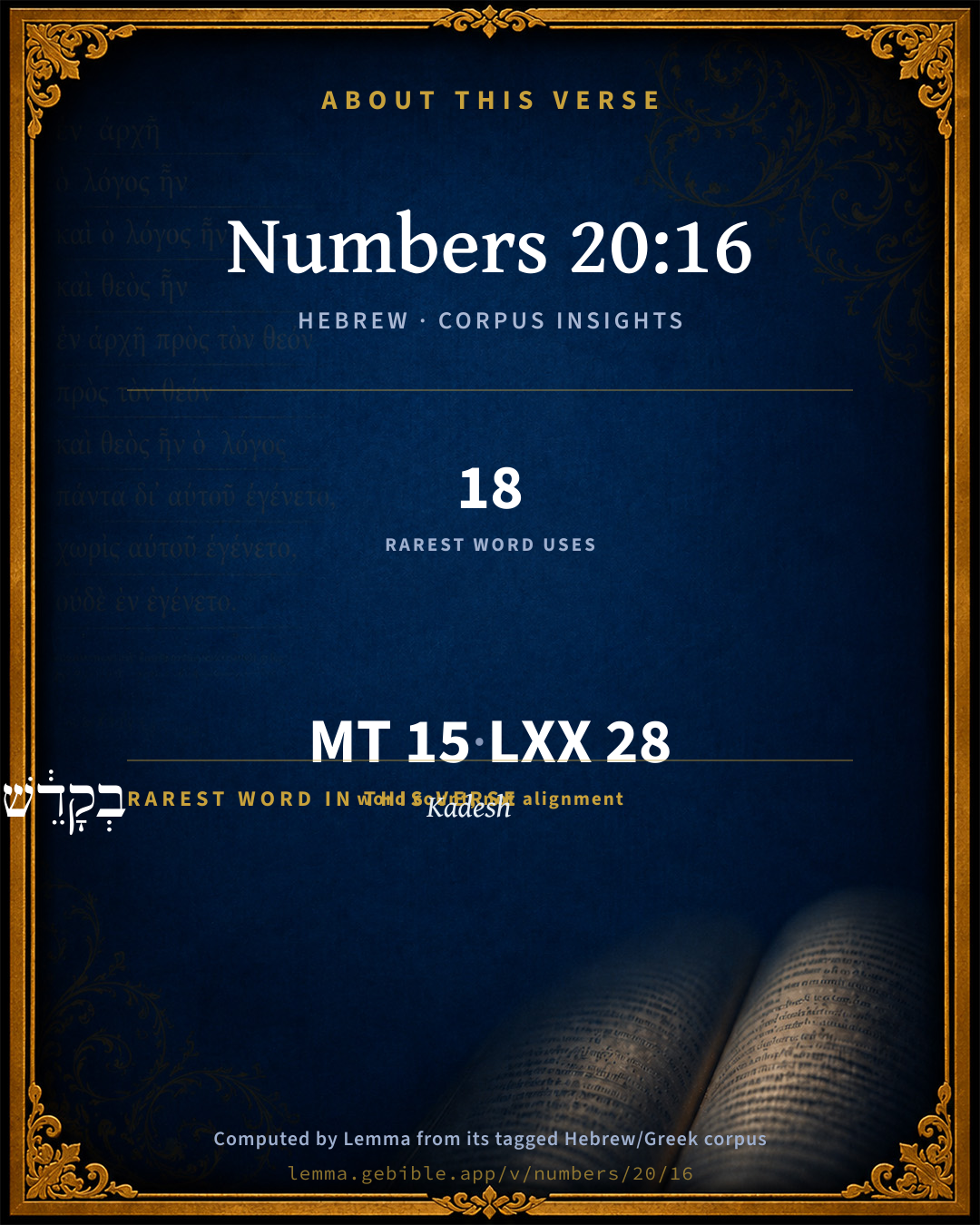
The rarest word here is בְקָדֵ֔שׁ Kadesh H6946 — appearing just 18 times in the whole Hebrew Bible.

Shared distinctive vocabulary

בְקָדֵ֔שׁ Kadesh H6946 occurs in 18 verses of the Hebrew Bible. Also found in:

Grammatical profile

  • 4 verbs
  • 8 nouns
  • 1 pronoun
  • 1 preposition
  • 1 particle

Verb forms

  • וַנִּצְעַ֤ק Qal · Sequential Imperfect
  • וַיִּשְׁמַ֣ע Qal · Sequential Imperfect
  • וַיִּשְׁלַ֣ח Qal · Sequential Imperfect
  • וַיֹּצִאֵ֖נוּ Hiphil · Sequential Imperfect

Hebrew & Septuagint length

In English translation the verse runs 35 words from the Hebrew and 37 from the Septuagint (LXX English) — closely comparable.

A rough comparison of the two English renderings, which tokenize alike — not a word-level alignment.

Word counts can differ between the Hebrew and the Greek without any difference in meaning — e.g. the Hebrew direct-object marker אֵת has no separate Greek word, and Greek often adds the article ὁ.

In the original languages it is 15 Hebrew tokens and 28 Greek tokens — but the two are counted differently (Hebrew bundles its prefixes and suffixes into one token; the Greek is in lemma form), so that isn’t a like-for-like length.

Cross-references

7

Topical passages linked to Numbers 20:16 in the Treasury of Scripture Knowledge — connected by theme and wording, ordered by reader-vote popularity; previews shown in the World English Bible.

  • Exodus 14:19 The angel of God, who went before the camp of Israel, moved and went behind them; and the pillar of cloud moved from before them, and stood behind them.
  • Exodus 23:20 "Behold, I send an angel before you, to keep you by the way, and to bring you into the place which I have prepared.
  • Exodus 33:2 I will send an angel before you; and I will drive out the Canaanite, the Amorite, and the Hittite, and the Perizzite, the Hivite, and the Jebusite:
  • Exodus 3:2–9 The angel of Yahweh appeared to him in a flame of fire out of the midst of a bush. He looked, and behold, the bush burned with fire, and the bush was not consumed.
  • Exodus 2:23–24 It happened in the course of those many days, that the king of Egypt died, and the children of Israel sighed because of the bondage, and they cried, and their cry came up to God because of the bondage.
  • Exodus 6:5 Moreover I have heard the groaning of the children of Israel, whom the Egyptians keep in bondage, and I have remembered my covenant.
  • Exodus 14:10 When Pharaoh drew near, the children of Israel lifted up their eyes, and behold, the Egyptians were marching after them; and they were very afraid. The children of Israel cried out to Yahweh.

Cross-references courtesy of OpenBible.info (CC BY 4.0).

Hebrew and Greek witnesses Masoretic Hebrew ↔ Greek Septuagint

The same verse in the two great witnesses to the Old Testament, shown verse-for-verse.

These are two independent witnesses, not word-aligned to each other, and the Septuagint is shown in lemma (dictionary) form.

Hebrew Numbers 20:16 Masoretic · Westminster Leningrad Codex

וַנִּצְעַ֤ק אֶל יְהוָה֙ וַיִּשְׁמַ֣ע קֹלֵ֔נוּ וַיִּשְׁלַ֣ח מַלְאָ֔ךְ וַיֹּצִאֵ֖נוּ מִמִּצְרָ֑יִם וְהִנֵּה֙ אֲנַ֣חְנוּ בְקָדֵ֔שׁ עִ֖יר קְצֵ֥ה גְבוּלֶֽךָ

and when we cried to Yahweh, he heard our voice, and sent an angel, and brought us forth out of Egypt: and, behold, we are in Kadesh, a city in the uttermost of your border.

World English Bible · Public Domain

Greek LXX Numbers 20:16 Septuagint · lemma form

καί ἀναβοάω πρός κύριος καί εἰςἀκούω κύριος ὁ φωνή ἐγώ καί ἀποστέλλω ἄγγελος ἐκἄγω ἐγώ ἐκ αἴγυπτος καί νῦν εἰμί ἐν καδης πόλις ἐκ μέρος ὁ ὅριον σύ

And we cried to the Lord, and the Lord heard our voice, and sent an angel and brought us out of Egypt; and now we are in the city of Cades, at the extremity of your coasts.

LXX2012 (modern English Septuagint) · Public Domain

Hebrew: Westminster Leningrad Codex (CC BY 4.0). Greek: Septuagint (public domain); English from LXX2012 (modern English Septuagint) (Public Domain). How the Septuagint differs from the Hebrew →

Targum (Aramaic paraphrase)

2

The Targum is the ancient Jewish Aramaic paraphrase of the Hebrew Scriptures — an interpretive translation, not the Hebrew text itself. Onkelos (literal) and Pseudo-Jonathan (expansive) render the Torah, and Jonathan the Prophets. Coverage is partial: where no permissively-licensed English translation exists for a verse, only the Aramaic is shown. This is verse-level text, not a word-by-word alignment to the Hebrew.

  1. Targum Onkelos Torah (Genesis–Deuteronomy)
    וְצַלֵינָא קֳדָם יְיָ וְקַבִּיל צְלוֹתָנָא וּשְׁלַח מַלְאָכָא וְאַפְקָנָא מִמִצְרָיִם וְהָא אֲנַחְנָא בִּרְקַם קַרְתָּא דְבִסְטַר תְּחוּמָךְ

    (no public-domain English translation for this verse)

    Targum Onkelos — Aramaic: “Onkelos Genesis” (public domain); “Onkelos Exodus” (public domain); “Onkelos Leviticus” (public domain); “Onkelos Numbers” (public domain); “Onkelos Deuteronomy” (public domain). English: “Sefaria Community Translation” (CC0 1.0 (public-domain dedication)); “J.W. Etheridge. The Targums of Onkelos and Jonathan Ben Uzziel on the Pentateuch. London: Longmans, Green, 1862” (public domain). Text via Sefaria.

  2. Targum Pseudo-Jonathan Torah (Genesis–Deuteronomy)
    וְצַלִינָא קֳדָם יְיָ וְקַבֵּיל צְלוֹתָנָא וְשָׁדַר חַד מִמַלְאֲכֵי שֵׁירוּתָא וְהַנְפָקָנָא מִמִצְרַיִם וְהָא אֲנַחְנָא בִּרְקַם קַרְתָּא דְמִתְבַּנְיָא בִּסְטַר תְּחוּמָךְ

    And we prayed before the Lord, who heard our prayers, and sent one of the ministering angels to lead us out of Mizraim: and, behold, we are in Rekem, a city built on the side of thy border.

    Targum Pseudo-Jonathan — Aramaic: “Targum Jonathan on Genesis” (public domain); “Targum Jonathan on Exodus” (public domain); “Targum Jonathan on Leviticus” (public domain); “Targum Jonathan on Numbers” (public domain); “Targum Jonathan on Deuteronomy” (public domain). English: “The Targum of Jonathan ben Uzziel, trans. J. W. Etheridge, London, 1862” (public domain). Text via Sefaria.

Commentary

Notes on Numbers 20:16 from classic Christian and Jewish commentators (each source and its license shown beneath its notes). The classic Christian expositions comment on the surrounding passage and are grouped to its opening verse, so a note may address several verses; the Jewish commentaries on the Tanakh (Rashi and others) are per-verse, so they appear only where the commentator wrote on this verse.

Lemma curates 59 commentaries, every one of them public domain or Creative Commons licensed, each selected and text-cleaned for this edition rather than reprinted as found. About our sources →

Trapp's Complete Commentary

John Trapp

Num 20:16 And when we cried unto the LORD, he heard our voice, and sent an angel, and hath brought us forth out of Egypt: and, behold, we [are] in Kadesh, a city in the uttermost of thy border:

Ver. 16. Sent an angel.] This was Christ; or, as some would have it, Moses; like as Phineas is thought to be that angel at Bochim. {Jdg 2:1}

John Trapp, A Commentary or Exposition upon All the Books of the Old and New Testament (1647–1656) — public domain. Text from a community e-Sword module.

Joseph Benson's Commentary

Num 20:16. An angel — The angel of the covenant, who first appeared to Moses in the bush, and afterward in the cloudy pillar, who conducted Moses and the people out of Egypt, and through the wilderness. For though Moses may be called an angel or messenger, yet it is not probable that he is meant; partly because Moses was the person that sent this message, and partly because another angel above Moses conducted them; and the mention hereof to the Edomites, was likely to give more authority to the present message. In Kadesh — Or near it, as the particle in is often used.

Joseph Benson's Commentary on the Old and New Testaments (1811–1818) — public domain. Text from a community e-Sword module.

Ellicott's Commentary for English Readers

(16) And sent an angel.—See Exo_3:2; Exo_14:19.

And hath brought us forth.—Better, And brought us forth.

A Bible Commentary for English Readers, edited by Charles John Ellicott (1878–1897) — public domain. Text from a community e-Sword module.

John Gill's Exposition

Let us pass, I pray thee, through thy country,.... That being the nearest and shortest way to the land of Canaan, from the place where they now were:

we will not pass through the fields, or through the vineyards; to harm them, and injure any man in his private property, by gathering the fruit of them, if the season of the year for it, or by trampling them down:

neither will we drink of the water of the wells; which private persons had dug, for the watering of their fields and vineyards, and for other uses, at least without paying for it; or only of the waters of the rivers, common to all passengers; from hence it appears, that the country of Edom was not then such a barren country as in later times, and as travellers (c) now report it is; See Gill on Mal 1:3.

we will go by the king's highway; not the way in which the king used to walk, or which he should order them to walk in, as Aben Ezra; but the public roads, common to all his subjects, and travellers to walk in by his allowance; and such roads are now called by us the king's highway:

we will not turn to the right hand, or to the left; to do any injury to any person's property, but go straight forward:

until we have passed thy borders; from one to another, and got quite through the country.

(c) See Shaw's Travels, 4. 438. Ed. 2.

John Gill's Exposition of the Whole Bible (1746–1763) — public domain (CC PDM 1.0). Text via the HelloAO Bible API.

Albert Barnes' Notes on the Bible

An angel - See Gen 12:7, note; Exo 3:2, note. The term is to be understood as importing generally the supernatural guidance under which Israel was.

Albert Barnes' Notes on the Bible (1834–1885) — public domain. Text from a community e-Sword/MySword module.

Haydock's Catholic Bible Commentary

Angel, who had performed so many wonders in favour of the Hebrews. He is generally supposed to have been St. Michael in the cloud.

George Leo Haydock (1774–1849), Haydock's Catholic Family Bible and Commentary, 1859 edition — public domain. Excludes Psalms (Douay-Rheims chapter numbering differs from Protestant) and Deuterocanonical books (Catholic canon only).

Matthew Poole's English Annotations

An angel, to wit, the Angel of the covenant, Christ Jesus, who first appeared to Moses in the bush, Exo 3:2, and afterward in the cloudy pillar, who conducted Moses and the people out of Egypt, and through the wilderness, as appears from Exo 14:19; 23:20; 33:14; 1Co 9:4. For though Moses may be called an angel or messenger, a title given to Phineas, Jdg 2:1; and to the prophets, 2Ch 36:16; and to Haggai, Hag 1:13; yet it is not probable that he is meant, partly, because Moses was the person that sent this message; partly, because there was no reason why he should express himself by such a dark and doubtful title to them: and partly, because another Angel besides and above Moses did conduct them, and the mention hereof to the Edomites was likely to give more authority and efficacy to their present message.

In Kadesh, i.e. near the city Kadesh, the particle in being oft so used, as we have showed.

Matthew Poole's English Annotations on the Holy Bible (1683–1685) — public domain. Text from a community e-Sword/MySword module.

Whedon's Commentary on the Bible

Daniel D. Whedon

16. We cried… he heard — Their piety, as evinced by their prayers and the signal answer to their cry for help, is a further commendation. Thus Moses showed that they were not a gang of freebooters, but a moral and religious nation worthy of being trusted with the courtesy of a right of passage through the territory of another people.

Sent an angel — The term angel — one sent — points to the second Person in the Godhead in his office of Revealer and Mediator. Acts are attributed in a special way to Christ which the Old Testament writers, with as much particularity, have predicted of the Messenger of Jehovah. Luk_1:15-17; 1Co_10:4; Heb_12:25-26; comp. Mal_3:1; Exo_17:6; Hag_2:6; see full discussion Biblioth. Sacra, vol. 16:805.

In the uttermost of thy border — In accordance with this description Dr. Robinson located Kadesh near Mount Seir, at the fountain el-Weibeh, in the northern part of the great valley Arabah. But the advocates of Ain Gadis are obliged to stretch Edom a long distance westward. Num_33:36-37; Jos_10:41, notes.

Daniel D. Whedon (gen. ed.), Commentary on the Old and New Testaments (1874–1909) — public domain. Text from a community e-Sword module.

The Pulpit Commentary

And sent an angel. It is probable, that Moses purposely used an expression which might be understood in various senses, because he could not explain to the king of Edom the true relation of the Lord to his people. At the same time it was in the deepest sense true, (cf. Exo_14:19 Exo_32:34) because it was the uncreated angel of the covenant, which was from God, and yet was God, (cf. Gen_32:30 Jos_5:15 Jos_6:2 Act_7:35) who was the real captain of the Lord"s host. In Kadesh, a city in the uttermost of thy border. See note on Kadesh. It is clear that Kadesh itself was outside the territory of the king of Edom, although it lay close to the frontier.

The Pulpit Commentary (1880–1919), ed. H.D.M. Spence-Jones & Joseph S. Exell — public domain. Text from a community e-Sword module.

John Wesley's Explanatory Notes

An Angel - The Angel of the Covenant, who first appeared to Moses in the bush, and afterward in the cloudy pillar, who conducted Moses and the people out of Egypt, and through the wilderness. For though Moses may be called an angel or messenger yet it is not probable that he is meant, partly because Moses was the person that sent this message; and partly because another angel above Moses conducted them, and the mention hereof to the Edomites, was likely to give more authority to their present message. In Kadesh - Near, the particle in being so often used.

John Wesley, Explanatory Notes Upon the Whole Bible (1754–1765) — public domain. Text via the GEBible commentary corpus.

Scofield Reference Notes

C. I. Scofield

angel

(See Scofield "Heb 1:4").

The Scofield Reference Bible (1917 edition), notes by C. I. Scofield — public domain. Text from a community e-Sword module.

Rashi

Rabbi Shlomo Yitzchaki (Rashi)

וישמע קלנו HE HEARD OUR VOICE — through the blessing with which our father, Jacob, had blessed us — “the voice is Jacob’s voice” (Genesis 27:22), because whenever we cry we are answered (Midrash Tanchuma, Beshalach 9 on בשלח).

מלאך A MESSENGER (or an angel) — This was Moses; from this we may learn that the prophets are termed “angel”; so, too, it says, (II Chronicles 36:16) “And they grieved the angels (מלאכי) of God” (Leviticus Rabbah 1:1).

Rashi on the Tanakh — English translations: “The Judaica Press complete Tanach with Rashi, translated by A. J. Rosenberg” (CC BY 4.0); “Pentateuch with Rashi's commentary by M. Rosenbaum and A.M. Silbermann, 1929-1934” (public domain); “The Metsudah Tanach series, Lakewood, N.J” (CC BY 4.0); and “The Book of Joshua, Metsudah Publications, 1997” (CC BY 4.0). Text via Sefaria.

Lesson kit

Teaching starters — assembled from the data on this page, not authored interpretation. Every prompt links to the verse data it draws on. Edit before teaching.

Numbers, in the Pentateuch, opens this verse with 15 words (15 distinct Hebrew lemmas). Its most distinctive word is Qâdêsh (“Kadesh”). A historical commentator’s framing appears above. Read the whole chapter for the surrounding context.

Discussion questions

  1. The word Qâdêsh carries the sense “Kadesh.” How does it shape the verse?
  2. How does Genesis 14:7, which shares the word «Kadesh», read alongside this verse?
  3. The translations on this page render this verse differently — a whole-verse word diff, not a word-by-word alignment. What might account for the different wordings?
  4. «וַנִּצְעַ֤ק» is a Qal Sequential Imperfect verb. How does that grammatical form shape the action described?
  5. Compare how Trapp's Complete Commentary and Joseph Benson's Commentary read this verse. Where do they agree or differ?

Things to notice

Reading settings

Reading text

Shown beneath each verse's original-language words.

Old Testament
Old Testament edition

Read the OT as the Masoretic Hebrew (MT) or the Greek Septuagint (LXX).

English shown for the Greek Septuagint (in the Hebrew ↔ Greek comparison).

Comparing translations? Open the Compare panel on any verse page to stack up to four side by side.